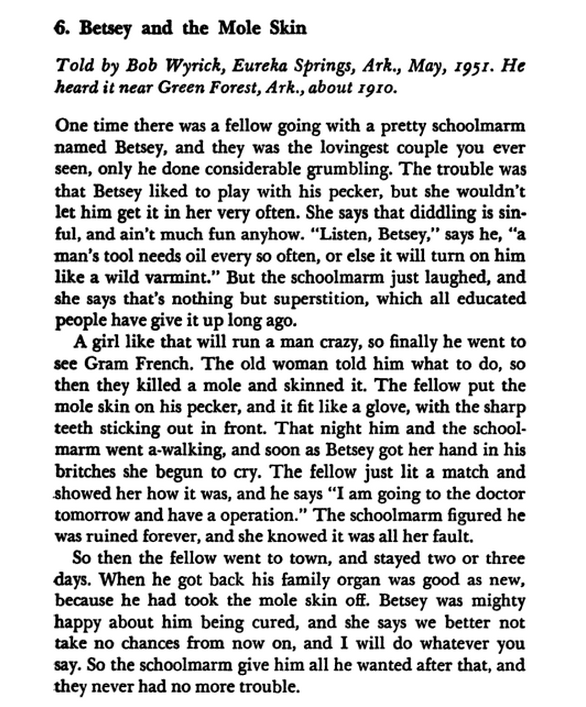
Betsey and The Mole Skin (A Dirty Ozark Folktale)

bms

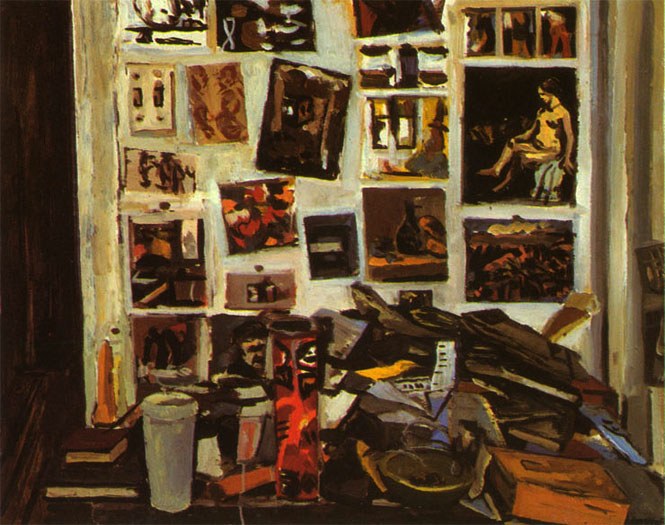
Wall of Fame — Dmitry Samarov

walloffame

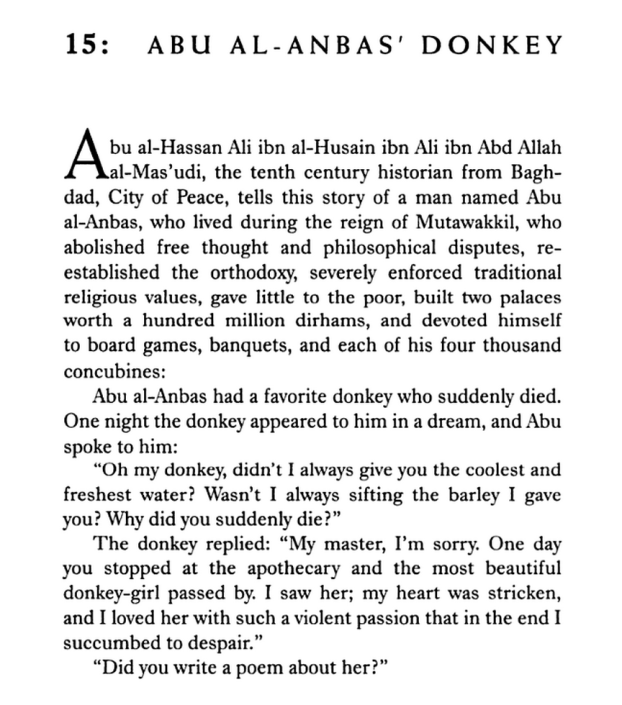
“Abu Al-Anbas’ Donkey” – Eliot Weinberger

Screen Shot 2013-09-07 at 11.51.10 AM Screen Shot 2013-09-07 at 11.51.48 AM

“The World’s Greatest” — Bonnie ‘Prince’ Billy

“—you see you were always lost” (Thomas Bernhard)

“You just arrive in a place,” said the painter,“ and then you leave it again, and yet everything, every single object you take in, is the sum of its prehistory. The older you become, the less you think about the connections you’ve already established. Table, cow, sky, stream, stone, tree, they’ve all been studied. Now they just get handled. Objects, the harmonic range of invention, completely unappreciated, no more truck with variation, deepening, gradation. You just try to work out the big connections. Suddenly you look into the macro-structure of the world, and you discover it: a vast ornament of space, nothing else. Humble backgrounds, vast replications—you see you were always lost. As you get older, thinking becomes a tormenting reference mechanism. No merit to it. I say ‘tree,’ and I see huge forests. I say ‘river,’ and I see every river. I say ‘house,’ and I see cities with their seas of roofs. I say ‘snow,’ and I see oceans of it. A thought sets off the whole thing. Where it takes art is to think small as well as big, to be present on every scale …”

From Thomas Bernhard’s novel Frost.

Lesender Knabe — Frans Hals

“Game” – Octavio Paz

I’ll plunder seasons.
I’ll play with months and years.
Winter days with the red faces of summer.

And down the gray road,
in the silent parade
of hard, unmoving days,
I’ll organize the blues and gymnastics.

A rippling morning
of painted lips,
cool, as though just bathed,
with an autumn dawn.

And I’ll catch the clouds–
red, blue, purple–
and throw them against the inexpressive paper
of the black and blue sky,
so that they’ll write a letter
in the universal language
to their good friend the wind.

To help the shopkeepers,
I’ll make luminous billboards,
with spotlights of stars.

Maybe I’ll assassinate a dawn
so that, bleeding,
it will stain a white cloud purple.

In the shop of the seasons,
I’ll sell ripe autumn apples
wrapped in the paper of winter mists.

I’ll kidnap Spring,
to have her in my house,
like a ballerina.

The wind will change its schedule.
Unpredictable crossings of the clouds.

And down the highway of the Future, I’ll rush toward Winter,
for the surprise of meeting it later,
mixed with Summer.

On the green felt of space,
I’ll bet on days
that will roll like dice.

I’ll play with months and years.


Octavio Paz’s first unpublished poem, 1931. Translated by Eliot Weinberger.

Watch Rembrandt’s J’Accuse, Peter Greenaway’s Film-Essay on Visual Illiteracy


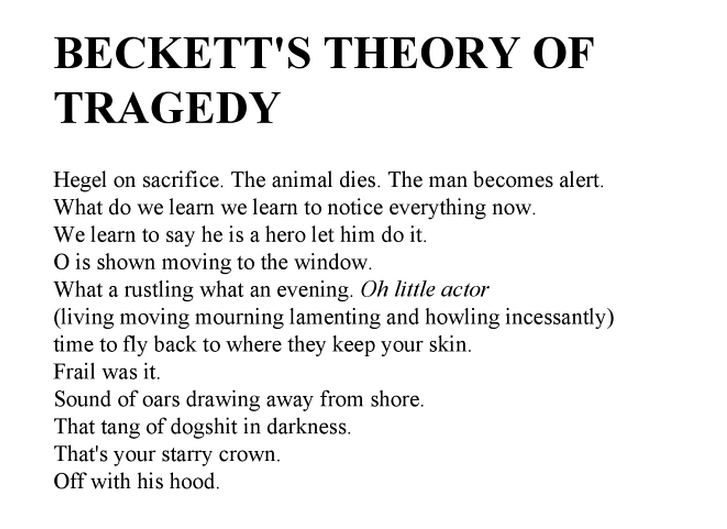
“Beckett’s Theory of Tragedy” — Anne Carson

Capture

Scheveningen Women and Other People Under Umbrellas — Vincent van Gogh

List with No Name #38

  1. John Barth’s beret
  2. Zora Neale Hurston’s fedora
  3. Mark Twain’s bowtie
  4. David Foster Wallace’s bandanna
  5. Tom Wolfe’s white suit
  6. Carson McCuller’s cigarettes
  7. Wiillaim Faulkner’s pipe
  8. Jonathan Franzen’s spectacles
  9. Flannery O’Connor’s crutches
  10. Walt Whitman’s hat (cocked, natch)
  11. Oscar Wilde’s fur coat
  12. Thomas Pynchon’s paper bag

Waterproof Mascara — Marlene Dumas

World of Pains and Troubles (John Keats)

—The common cognomen of this world among the misguided and superstitious is ‘a vale of tears’ from which we are to be redeemed by a certain arbitrary interposition of God and taken to Heaven–What a little circumscribed straightened notion! call the world if you Please ‘The vale of Soul-making’ Then you will find out the use of the world (I am speaking now in the highest terms for human nature admitting it to be immortal which I will here take for granted for the purpose of showing a thought which has struck me concerning it) I say “Soul making” Soul as distinguished from an Intelligence– There may be intelligences or sparks of the divinity in millions–but they are not Souls till they acquire identities, till each one is personally itself. Intelligences are atoms of perception–they know and they see and they are pure, in short they are God–how then are Souls to be made? How then are these sparks which are God to have identity given them–so as ever to possess a bliss peculiar to each ones individual existence? How, but by the medium of a world like this? This point I sincerely wish to consider because I think it a grander system of salvation than the chrystain religion–or rather it is a system of Spirit-creation–This is effected by three grand materials acting the one upon the other for a series of years–These Materials are the Intelligence–the human heart (as distinguished from intelligence or Mind) and the World or Elemental space suited for the proper action of Mind and Heart on each other for the purpose of forming the Soul or Intelligence destined to possess the sense of Identity. I can scarcely express what I but dimly perceive–and yet I think I perceive it–that you may judge the more clearly I will put it in the most homely form possible–I will call the world a School instituted for the purpose of teaching little children to read–I will call the Child able to read, the Soul made from that school and its hornbook. Do you not see how necessary a World of Pains and troubles is to school an Intelligence and make it a soul? A Place where the heart must feel and suffer in a thousand diverse ways! Not merely is the Heart a Hornbook, it is the Minds Bible, it is the Minds experience, it is the teat from which the Mind or intelligence sucks its identity–As various as the Lives of Men are–so various become their Souls, and thus does God make individual beings, Souls, Identical Souls of the sparks of his own essence–“

—From a letter John Keats wrote to his brother George, dated April 21, 1810. (More excerpts from Keats’s letters with commentary).

Woman Reading — Utagawa Kuniyoshi

Kuniyoshi_Utagawa_Woman_reading

Susan Sontag’s List of Novels with Cinematic Structure

Novels with cinematic structure:

Hemingway, In Our Time

Faulkner,

[Horace] McCoy, They Shoot Horses, Don’t They?

Robbe-Grillet, Les Gommes [The Erasers]

[Georges] Bernanos, M. Ouine

I[vy] Compton-Burnett,

V Woolf, Between the Acts

Philip Toynbee, Tea with Mrs. Goodman

des Forêts, Les Mendiants

his first novel—multiple pov [points of view]

[Barnes,] Nightwood

Reverzy, Le Passage

Burroughs,

[John] Dos Passos

Firbank, CapriceVainglory; and [Inclinations] (trilogy)

Jap[anese] writer [Yasunari Kawabata] (N.B. visual sense, suppleness of changing scenes)—Snow Country, etc.

Dickens (cf. Eisenstein)—

There are people who thought with camera eye (a unified p-o-v that displaces itself) before the camera

N[athaniel] West,

Blechman

“new novelists”: Claude Simon, Le Palace

Claude Ollier, La Mis-en-Scène

(all based on organization of a decor (N[orth] Africa)

–From an entry dated 6/26/66 Paris in Susan Sontag’s notebook, published as part of As Consciousness Is Harnessed to Flesh. (I’ve maintained the bracketed editorial intrusions of the published text, even with they did not seem necessary).

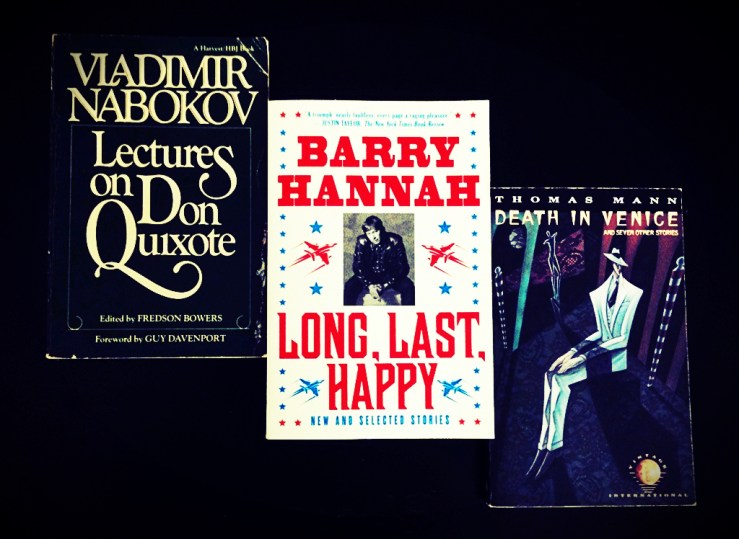
Hannah/Nabokov/Mann (Books Acquired, 8.30.2013)

20130905-153520

Psychopathic Ward — Robert Riggs