1. Noah continues director Darren Aronofsky’s streak of making films that I will never watch more than once.
2. (The film is new on DVD &c.; I dutifully missed in the theater).
3. (Although I did see Aronofsky’s first feature Pi in the theater—at my university’s student union. I liked the claustrophobic paranoia of Pi, but the film was also silly, histrionic even, and I did not understand the film’s handling of metaphysics—mostly because the film does not understand its own metaphysical vision).
4. (Noah, for its part, does seem to understand its own metaphysical vision; or, rather, it understands a version of its own metaphysical vision).
5. Aronofsky’s Noah takes place in a post-apocalyptic landscape: Cities are failing, the world is barren, dry, the ground seems to be comprised of basalt and ash. The people in his Prediluvian world use a mishmash of technologies, some of which seem fairly advanced (strip-mining, metallurgy, advanced textiles, etc.)—but these technologies also seem stymied, stuck, abortive last grasps at progress. Noah looks at times like a Mad Max film, or even Hillcoat’s adaptation of The Road.
6. Aronofsky’s Noah is a post-apocalyptic pre-apocalypse film.
7. Aronofsky’s Noah attempts an answer to both Adam and Eve’s expulsion from Eden and Cain’s murder of Abel.
8. Aronofsky’s Noah foregrounds the radical infanticide at the heart of the flood myth.
9. From A. Samuel Kimball’s The Infanticidal Logic of Evolution and Culture:
. . . when he promises never again to subject the world to such destruction, God memorializes the irreversibility of his massively -cidal violence and binds the future that will transpire to the futurity that will now never come to pass. Indeed, God destroys an infinite number of futures with the respective deaths of the Flood’s victims, for whom the waters of the Flood will never stop flooding, never cease obliterating the future. When he ratifies his promise in the covenant with Noah and his descendants, God inscribes the future reproductivity of the Noahic lineage in the limitless infanticidism of the Flood.
10. Aronofsky’s Noah gains most, if not all, of its moral tension in depicting Noah’s attempt to negate the future reproductivity of the Noahic lineage.
11. Should humanity be allowed to exist after The Flood? is Noah’s (and Noah’s) central question. Aronofsky’s answer to this question is, I think, ultimately ambiguous. While Noah’s own infanticidal violence (an extension of his attempt to prevent his sons from begetting offspring) is suspended (by love!), Aronofsky represents this suspension with ambivalence. Noah, drunk in a cave, invites us to look on his naked failure.
12. Aronofsky’s Noah is most successful as a kind of failed boilerplate color-by-numbers summer-popcorn-big-budget-action flick. It’s just too weird to fully adhere to its formula, but it hangs together by the formula nonetheless, jostling, uneasy.
13. Aronofsky’s Noah features giant fallen angels encased in rock. These golems are probably the signal special effect of the film, and a sore reminder of the pervasive influence of the special effects battle sequences in Peter Jackson’s Lord of the Rings.
14. This was easily my favorite sequence of Noah:
15. (And yet that sequence still suffers from a kind of queasy supernatural cheesiness that infects Aronofsky’s work).
16. After watching the film, I sought reviews, which led me quickly to John Nolte’s paranoid (and unintentionally hilarious) take on the film at the right-wing website Breitbart. Nolte clearly enjoyed the film and he repeatedly praises its techniques, production values, and acting, but condemns it as “blasphemous” in depicting God as “some kind of tree-hugger.” “Aronofsky is the anti-Michelangelo,” Nolte declares, “a master craftsman using his talents to a dishonest and wicked end.” That wicked end is “using the story of Noah to twist Christianity into something it is not…[Noah is] a genius piece of propagandizing that is sure to lead many away from God under the mistaken belief that through left-wing environmentalism they are coming closer to Him.”
Nolte’s strident praise/condemnation is hilarious and hyperbolic.
Does he actually believe that this movie is aesthetically affecting enough to motivate any kind of change in belief?
17. (Reviews like Nolte’s are important to me because they help to remind me of the subjectivity of aesthetic experience. He saw a completely different film (with his completely different eyes) than I did).
18. My favorite Aronofsky film, and the only one that I would consider watching again, is The Fountain. I think that The Fountain might be a kind of precursor film to Noah, a trial-run even, although I have no evidence for this claim.
19. I started this riff with the claim that I have no desire to rewatch Aronofsky’s films, and that Noah continues this pattern. Aronofksy is an auteur, and like most auteurs, I’m sure rewatching his films would enrich an understanding of the themes and problems he’s trying to address. However, I find his films repulsive, by which I mean the opposite of compelling. I have never wanted to exit a fictional world as much as I wanted to escape Requiem for a Dream. I found The Wrestler depressing and empty. I’m afraid if I watch Black Swan again it will turn out that Aronofsky was actually not attempting to make a comedy about psychosis, but was rather actually serious about his melodrama’s tragic scope.
20. Noah isn’t repulsive, but it isn’t great either. Flawed doesn’t even begin to describe the film—yes, it survives its own competing impulses of spectacle-bombast and introspective-character-study, but never synthesizes them. It’s unclear who the film is for. The film resolves in a moment of supposed-uplift, positing “love” –of offspring– as a solution, but it also binds that solution/blessing in the cursing of offspring.
Both of these moments feel wholly inauthentic. In the end, what remains is the bitter aftertaste of Noah’s contempt—and his anxiety at failing to create a utopia devoid of humans.
We are little critters who live in the black earth beneath the desert. The people on Mother Earth can’t imagine such a large expanse of fertile humus lying dozens of meters beneath the boundless desert. Our race has lived here for generations. We have neither eyes nor any olfactory sense. In this large nursery, such apparatus is useless. Our lives are simple, for we merely use our long beaks to dig the earth, eat the nutritious soil, and then excrete it. We live in happiness and harmony because we have abundant resources in our home town. Thus, we can all eat our fill without a dispute arising. At any rate, I’ve never heard of one.
In our spare time, we congregate to recall anecdotes of our forebears. We begin by remembering the oldest of our ancestors and then run through the others. The remembrances are pleasurable, filled with outlandish salty and sweet flavours, as well as some crispy amber – the immemorial turpentine. In our recollections, there is a blank passage that is difficult to describe. Broadly speaking, as one of our elders (the one with the longest beak) was digging the earth, he suddenly crossed the dividing line and vanished in the desert above. He never returned to us. Whenever we remembered this, we fell silent. I sensed that everyone was afraid.
At no moment in human history does growing old seem to have been a pleasure cruise; but, in the years preceding the disappearance of the species, it had manifestly become atrocious to the point where the level of voluntary deaths, prudishly renamed departures by the public-health bodies, was nearing 100 percent, and the average age of departure, estimated at sixty across the entire globe, was falling toward fifty in the most developed countries.
This figure was the result of a long evolution, scarcely begun at the time of Daniel1, when the average age at death was much higher, and suicide by old people was still infrequent. The now-ugly, deteriorated bodies of the elderly were, however, already the object of unanimous disgust, and it was undoubtedly the heat wave of summer 2003, which was particularly deadly in France, that provoked the first consciousness of the phenomenon. “The Death March of the Elderly” was the headline in Libération on the day after the first figures became known—more than ten thousand people, in the space of two weeks, had died in the country; some had died alone in their apartments, others in the hospital or in retirement homes, but all had essentially died because of a lack of care. In the weeks that followed, that same newspaper published a series of atrocious reports, illustrated with photos that were reminiscent of concentration camps, relating the agony of old people crammed into communal rooms, naked on their beds, in diapers, moaning all day without anyone coming to rehydrate them or even to give them a glass of water; describing the rounds made by nurses unable to contact the families who were on vacation, regularly gathering up the corpses to make space for new arrivals. “Scenes unworthy of a modern country,” wrote the journalist, without realizing that they were in fact the proof that France was becoming a modern country, that only an authentically modern country was capable of treating old people purely as rubbish, and that such contempt for one’s ancestors would have been inconceivable in Africa, or in a traditional Asian country.
From Michel Houellebecq’s novel The Possibility of an Island.
Sex. The difficulty of writing about sex, for women, is that sex is best when not thought about, not analysed. Women deliberately choose not to think about technical sex. They get irritable when men talk technically, it’s out of self-preservation: they want to preserve the spontaneous emotion that is essential for their satisfaction.
Sex is essentially emotional for women. How many times has that been written? And yet there’s always a point even with the most perceptive and intelligent man, when a woman looks at him across a gulf: he hasn’t understood; she suddenly feels alone; hastens to forget the moment, because if she doesn’t she would have to think. Julia, myself and Bob sitting in her kitchen gossiping. Bob telling a story about the breakup of a marriage. He says: ‘The trouble was sex. Poor bastard, he’s got a prick the size of a needle.’ Julia: ‘I always thought she didn’t love him.’ Bob, thinking she hadn’t heard”
“heard: ‘No, it’s always worried him stiff, he’s just got a small one.’ Julia: ‘But she never did love him, anyone could see that just by looking at them together.’ Bob, a bit impatient now: ‘It’s not their fault, poor idiots, nature was against the whole thing from the start.’ Julia: ‘Of course it’s her fault. She should never have married him if she didn’t love him.’ Bob, irritated because of her stupidity, begins a long technical explanation, while she looks at me, sighs, smiles, and shrugs. A few minutes later, as he persists, she cuts him off short with a bad-tempered joke, won’t let him go on.
I started reading Lessing’s book after finishing Alasdair Gray’s novel Lanark. Gray’s novel was published in 1981 nineteen years after The Golden Notebook, but he was writing it for at least three decades before its publication, and the structural features of the two books are similar: both novels self-deconstruct, self-criticize, and rely on fragmentation and juxtaposition to evoke their themes. The themes are fairly different, I suppose, although not really. It’s all sex and death, yes?
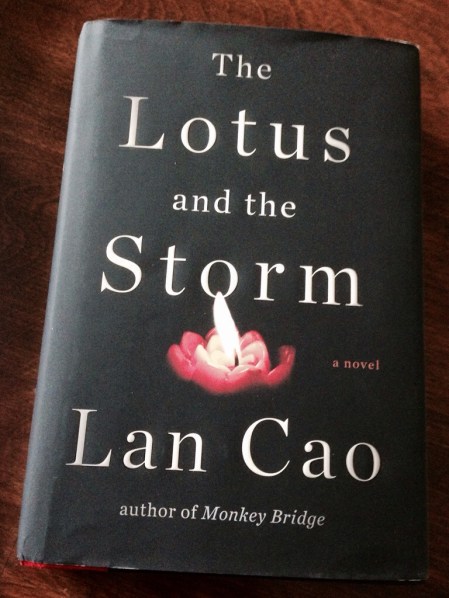
Lan Cao’s novel The Lotus and the Storm is out in hardback later this month. Here’s the Kirkus review:
Written with acute psychological insight and poetic flair, this deeply moving novel illuminates the ravages of war as experienced by a South Vietnamese family.
In a rewarding follow-up to her well-received debut, Monkey Bridge (1997), the author returns to the conflict that shaped her own destiny before she was airlifted from her native Saigon to live in Virginia. Here, she shows what happens to a family of four—a South Vietnamese airborne commander, his beautiful wife and their two young daughters—as the war challenges loyalties with betrayals. The story is narrated by two characters: Mai, the younger daughter, who recalls her girlhood as the war intensified from her current home in Virginia; and Minh, her father, who’s living with Mai and with his memories of what transpired in Vietnam 40 years earlier. “Saigon still wraps itself around me and squeezes me with sudden force,” he explains, though the traumatic effects on Mai prove stronger and even stranger. What’s plain from the setup, with its alternating voices, is that only half of this family will be telling the story, a story in which what happened to the other two proves crucial. The novel’s most complex figure is Quý, Mai’s mother and Minh’s wife, from whom the reader never hears but whose depth of character reveals itself through the perspectives of others. She made a sacrifice by marrying a man considered below her, and she continued to make sacrifices, some of which seemed like betrayals, to protect the lives of those she loved, including her Viet Cong brother as well as her husband. Mai can’t really comprehend through a child’s eyes what’s happening with her family and how threatened their future is, though she intuitively senses that something is wrong. Even Minh doesn’t realize until decades later what really happened, and the revelations will surprise the reader as well.
A novel that humanizes the war in a way that body counts and political analyses never will.
I now see that sorrow, being the supreme emotion of which man is capable, is at once the type and test of all great art. What the artist is always looking for is the mode of existence in which soul and body are one and indivisible: in which the outward is expressive of the inward: in which form reveals. Of such modes of existence there are not a few: youth and the arts preoccupied with youth may serve as a model for us at one moment: at another we may like to think that, in its subtlety and sensitiveness of impression, its suggestion of a spirit dwelling in external things and making its raiment of earth and air, of mist and city alike, and in its morbid sympathy of its moods, and tones, and colours, modern landscape art is realising for us pictorially what was realised in such plastic perfection by the Greeks. Music, in which all subject is absorbed in expression and cannot be separated from it, is a complex example, and a flower or a child a simple example, of what I mean; but sorrow is the ultimate type both in life and art.
Behind joy and laughter there may be a temperament, coarse, hard and callous. But behind sorrow there is always sorrow. Pain, unlike pleasure, wears no mask. Truth in art is not any correspondence between the essential idea and the accidental existence; it is not the resemblance of shape to shadow, or of the form mirrored in the crystal to the form itself; it is no echo coming from a hollow hill, any more than it is a silver well of water in the valley that shows the moon to the moon and Narcissus to Narcissus. Truth in art is the unity of a thing with itself: the outward rendered expressive of the inward: the soul made incarnate: the body instinct with spirit. For this reason there is no truth comparable to sorrow. There are times when sorrow seems to me to be the only truth. Other things may be illusions of the eye or the appetite, made to blind the one and cloy the other, but out of sorrow have the worlds been built, and at the birth of a child or a star there is pain.
More than this, there is about sorrow an intense, an extraordinary reality. I have said of myself that I was one who stood in symbolic relations to the art and culture of my age. There is not a single wretched man in this wretched place along with me who does not stand in symbolic relation to the very secret of life. For the secret of life is suffering. It is what is hidden behind everything. When we begin to live, what is sweet is so sweet to us, and what is bitter so bitter, that we inevitably direct all our desires towards pleasures, and seek not merely for a ‘month or twain to feed on honeycomb,’ but for all our years to taste no other food, ignorant all the while that we may really be starving the soul.
French for author, this term denotes a film director who makes the same film again and again and again.
BIBLIOGRAPHY
A detailed list of the books from which the author plundered all his or her good ideas.
CIRCUMLOCUTION
The rhetorical device of circumlocution can be seen by the reader or made evident to the reader when a writer chooses to compose phrases, clauses, or sentences that are inordinately complex, exaggerated, long-winded, or otherwise unnecessarily verbose in order to demonstrate, convey, show, or express an idea, image, or meaning that might have been demonstrated, conveyed, shown, or expressed via the use of shorter, simpler, more direct phrases, clauses, or sentences that demonstrate brevity.
Inexperienced writers, especially composition students, are advised to use circumlocution to pad their writing and meet the assigned word count.
DESCRIPTIVIST
A grammarian who holds strong opinions and judgments about prescriptivists.
EXPOSITION
Telling without showing. Exposition can be extremely useful to the reader, who will slight the author who successfully employs it.
FREE INDIRECT STYLE
James Wood Approved!™
GOLDEN AGE
A comforting, nebulous fantasy.
HAGIOGRAPHY
A biography composed entirely of distortions, half-truths, and outright lies.
INNUENDO
The funny dirty bits that make you feel clever.
JARGON
Trade-specific diction employed (preferably clumsily) to confuse the average reader and offend the expert reader.
KINDLE
Early 21st-century reading device, often mistaken as a harbinger of literary doom.
LITERALLY
An adverb that most often means figuratively.
MYTH
The most enduring—and therefore most true—kind of story.
NEGATIVE CAPABILITY
A writer’s ability to just chill and not know. (Also useful for lazy frauds).
OBJECTIVE POINT OF VIEW
A comforting, nebulous fantasy.
PRESCRIPTIVIST
A grammarian who holds strong opinions and judgments about descriptivists.
QUEST
The story-teller’s scheme. Make it up as you go along. Steal as necessary.
REALISM
A comforting, nebulous fantasy.
SEBALDIAN
An adjective used to describe a literary work that is not quite as good as anything by W.G. Sebald.
TRAGEDY
A work often mistaken as more serious or more important or more literary than a comedy.
UNIVERSAL SYMBOL
A comforting, nebulous fantasy.
VULGARITY
A specific type of lucidity that authors sometimes use.
WELTSCHMERZ
The emotional byproduct of attempting to maintain comforting, nebulous fantasies.
XANAX
A stop-gap for bouts of Weltschmerz.
YOKNAPATAWPHA COUNTY
Faulkner’s Middle-earth.
ZYZZYVA
Zyzzyva is a real word, and this fact should give us all some small measure of hope..
David Foster Wallace’s “Order and Flux in Northampton” was published in the Fall 1991 issue of Conjunctions: Part I, Part II, Part III, Part IV.
First few paragraphs:
BARRY DINGLE, CROSS-EYED PURVEYOR of bean sprouts, harbors for Myrnaloy Trask, operator of Xerox and regent of downtown Northampton’s most influential bulletin board at Collective Copy, an immoderate love.
Myrnaloy Trask, trained Reproduction Technician, unmarried woman, vegetarian, flower-child tinged faintly with wither, overseer and editor of Announcement and Response at the ten-foot-by-ten-foot communicative hub of a dizzying wheel of leftist low-sodium aesthetes, a woman politically correct, active in relevant causes, slatternly but not unerotic, all-weather wearer of frayed denim skirts and wool knee-socks, sexually troubled, ambiguous sexual past, owner of one spectacularly incontinent Setter/Retriever bitch, Nixon, so named by friend Don Megala because of the dog’s infrangible habit of shitting where it eats: Myrnaloy has eyes only for Don Megala: Don Megala, middle-aged liberal, would-be drifter, maker of antique dulcimers by vocation, by calling a professional student, a haunter of graduate hallways, adrift, holding fractions of Ph.D.’s in everything from Celtic phonetics to the sociobiology of fluids from the University of Massachusetts at Amherst, presently at work on his seventh and potentially finest unfinished dissertation, an exhaustive study of Stephen Dedalus’s sublimated oedipal necrophilia vis à vis Mrs. D. in Ulysses, an essay tentatively titled “The Ineluctable Modality of the Ineluctably Modal.”
Add to the above Trask-data the fact that, though Barry Dingle’s spotlessly managed franchise, The Whole Thing Health Food Emporium, is located directly next to Collective Copy on Northampton’s arterial Great Awakening Avenue, Myrnaloy has her nutritional needs addressed at The Whole Thing’s out-of-the-way, sawdust-floored competition, Good Things to Eat, Ltd., the proprietor of which, one Adam Baum, is a crony of Megala, and add also that The Whole Thing is in possession of its own Xerox copier, and the following situation comes into narrative focus: Myrnaloy Trask has only the sketchiest intuition that Barry Dingle even exists, next door.
For Barry Dingle, though, the love of Myrnaloy Trask has become the dominant emotional noisemaker in his quiet life, the flux-ridden state of his heart, a thing as intimately close to Dingle as Myrnaloy is forever optically distant or unreal.





 Biblioklept