Still Life with Watermelons and Apples in a Landscape — Luis Meléndez

Jackson Pollock’s Passport

Read “To the Measures Fall,” a Short Story by Richard Powers

“To the Measures Fall” by Richard Powers

First read-through: you are biking through the Cotswolds when you come across the thing. Spring of ’63. Twenty-one years old, in your junior year abroad at the University of York, after a spring term green with Chaucer, Milton, Byron, and Swinburne. (Remember Swinburne?) Year One of a life newly devoted to words. Your recent change, of course, has crushed your father. He long hoped that you would follow through on that Kennedy-inspired dream of community service. You, who might have become a first-rate social worker. You, who might have done good things for the species, or at least for the old neighborhood. But life will be books for you, from here on. Nothing has ever felt more preordained.

Term’s out, and it’s time to see every square mile of this island. Bicycle clips, a Blue Guide, a transistor radio, and skin-hugging rain. Villages slip past on valley roads as twisty as the clauses in Henry James. The book turns up in a junk shop in an old Saxon market town whose name you will remember as almost certainly having an “m” in it. Among the rusted baby buggies and ancient radios you find old cooking magazines, books on fly-tying and photography, late-fifties spy novels with cardboard covers worn as soft as felt.

The thing pops out at you: “To the Measures Fall,” by someone named Elton Wentworth. There’s nothing else like it in the shop. It’s a fat tome with rough-cut pages in a deluxe, tooled binding. The dust jacket has disappeared, but the front matter suggests that you know all about Mr. Wentworth already. Born in 1888, the author of twelve previous books and the winner of awards too numerous to mention.

The first line reads, “A freak snow hit late that year, two weeks after the sand martins returned to the gravel pits near the South Downs.” The next few paragraphs sketch out a hard-pressed town, Wotton-on-Wold, much like the one you are in, with the “m” in it. On page 3, the author reveals the date: 1913. On the last page, a village search party finds the body of a young amputee captain who served at the Somme lying at the bottom of said gravel pits. Only seven years have passed, but the lilting opening cadences have darkened into fragments from another world.

The book seems to be a sweeping portrait of rural England before and after the First World War. You check the title page: copyright 1948. Aside from two bold exclamation points at the end of Chapter 1, the pages are unblemished, perhaps unread.

Pencilled into the upper right hand of the inside front is a price: 10/6 d. Exorbitant. You draw seven pounds a week for student expenses. A three-course Chinese dinner on Station Road costs four shillings, and lunch in the canteen is half that. A 12-inch LP runs only a pound, and even a two-minute call to the States is cheaper than Mr. Wentworth’s book. Half a guinea for a used novel you’ve never heard of? Robbery. But something about that opening is too strange for you to resist. Besides, you’ve just devoted your life to literature. You graze the start of Chapter 2, in which Trevor, a spindly farmer’s son with Addison’s disease, baffles his parents by insisting on going to university. You need to know how this beginning can reach so macabre an end.

The shop’s owner is a beaked old man with a gray hairline like a cowl slipping off his head. It’s humiliating to bargain with him, but you’re desperate.

How much do you offer the junk-store owner for his used book?

You are, by the way, female. Lots of folks think you shouldn’t be out biking alone, even in the Cotswolds. See pages 214 to 223 of Mr. Wentworth’s epic.

How much would you have offered for the book had you been male?

Continue reading “Read “To the Measures Fall,” a Short Story by Richard Powers”

The Reading — George Henry

Two Girls Lying Entwined — Egon Schiele

“A Poem to Read in August” — Gilbert Sorrentino

IMG_3021

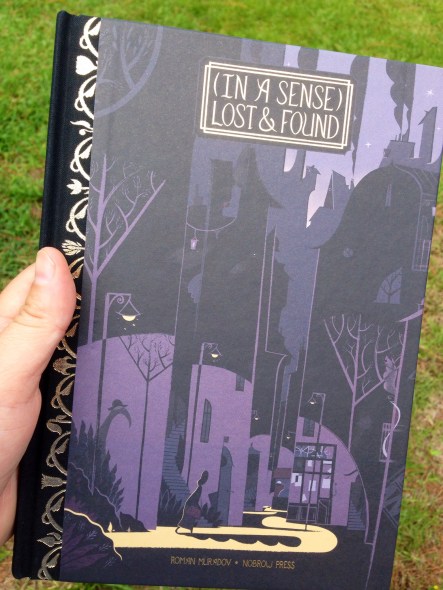
(In a Sense) Lost & Found (Book Acquired, 7.26.2014)

IMG_2935

I’ve read Roman Muradov’s debut graphic novella (In a Sense) Lost & Found a few times now and it’s great—hits the trifecta of strange, beautiful, and smart. It’s new from Nobrow Press. Here’s their blurb:

(In a Sense) Lost and Found, the first graphic novel by rising star Roman Muradov, explores the theme of innocence by treating it as a tangible object; something that can be used, lost, and mistreated. Muradov’s crisp, delicate style conjures a world of strange bookstores, absurd conspiracies, and charming wordplay. A surreal tale in the mold of the best American alternative comics, In a Sense retains its distinctly Eastern perspective.

Muradov lets the art tell this surreal story of a girl looking for something that the narrative refuses to reveal to us. There is no exposition, and readers looking for dialogue that explains everything to them will likely be perplexed. The book is gorgeous, rich, dark—I would include some panels here but the pages are so thick and dark that my iPhone simply can’t handle them. (The picture I took of the cover, above, does no justice to the book’s aesthetics). I’ll get some hi-res images for the full review I plan to post next week though. Great stuff.

Desktop — Jeremy Miranda

desktopwebiste

The thinning of language (Doris Lessing)

I am in a mood that gets more and more familiar: words lose their meaning suddenly. I find myself listening to a sentence, a phrase, a group of words, as if they are in a foreign language—the gap between what they are supposed to mean, and what in fact they say seems unbridgeable. I have been thinking of the novels about the breakdown of language, like Finnegans Wake. And the preoccupation with semantics. The fact that Stalin bothers to write a pamphlet on this subject at all is just a sign of a general uneasiness about language. But what right have I to criticize anything when sentences from the most beautiful novel can seem idiotic to me? 

… I made tea, and then I remembered a story that was sent to me last week. By a comrade living somewhere near Leeds. When I first read it, I thought it was an exercise in irony. Then a very skilful parody of a certain attitude. Then I realized it was serious—it was at the moment I searched my memory and rooted out certain fantasies of my own. But what seemed to me important was that it could be read as parody, irony or seriously. It seems to me this fact is another expression of the fragmentation of everything, the painful disintegration of something that is linked with what I feel to be true about language, the thinning of language against the density of our experience.

From Doris Lessing’s novel The Golden Notebook.

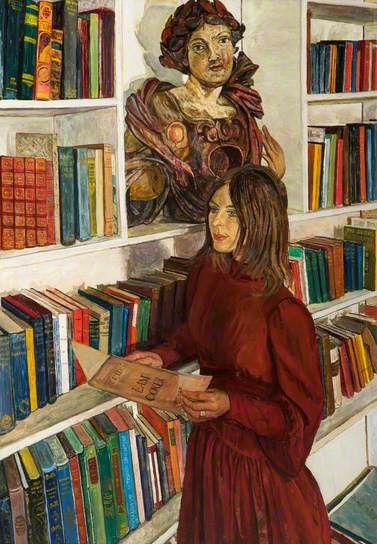
The Library — Carel Victor Morlais

Bridgeman; (c) Bridgeman; Supplied by The Public Catalogue Foundation

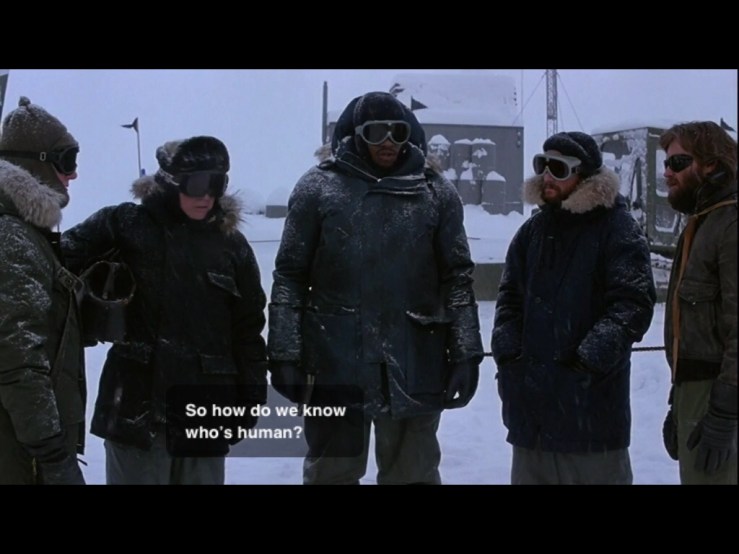
So how do we know who’s human?

20140731-120217-43337604.jpg

Technically (Glen Baxter)

20140627-095605-35765119.jpg

Personnage Ancien — Jacques Hérold

“The Crystal Crypt” — Philip K. Dick

“The Crystal Crypt” by Philip K. Dick

“ATTENTION, Inner-Flight ship! Attention! You are ordered to land at the Control Station on Deimos for inspection. Attention! You are to land at once!”

The metallic rasp of the speaker echoed through the corridors of the great ship. The passengers glanced at each other uneasily, murmuring and peering out the port windows at the small speck below, the dot of rock that was the Martian checkpoint, Deimos.

“What’s up?” an anxious passenger asked one of the pilots, hurrying through the ship to check the escape lock.

“We have to land. Keep seated.” The pilot went on.

“Land? But why?” They all looked at each other. Hovering above the bulging Inner-Flight ship were three slender Martian pursuit craft, poised and alert for any emergency. As the Inner-Flight ship prepared to land the pursuit ships dropped lower, carefully maintaining themselves a short distance away.

“There’s something going on,” a woman passenger said nervously. “Lord, I thought we were finally through with those Martians. Now what?”

“I don’t blame them for giving us one last going over,” a heavy-set business man said to his companion. “After all, we’re the last ship leaving Mars for Terra. We’re damn lucky they let us go at all.”

“You think there really will be war?” A young man said to the girl sitting in the seat next to him. “Those Martians won’t dare fight, not with our weapons and ability to produce. We could take care of Mars in a month. It’s all talk.”

The girl glanced at him. “Don’t be so sure. Mars is desperate. They’ll fight tooth and nail. I’ve been on Mars three years.” She shuddered. “Thank goodness I’m getting away. If—”

“Prepare to land!” the pilot’s voice came. The ship began to settle slowly, dropping down toward the tiny emergency field on the seldom visited moon. Down, down the ship dropped. There was a grinding sound, a sickening jolt. Then silence.

“We’ve landed,” the heavy-set business man said. “They better not do anything to us! Terra will rip them apart if they violate one Space Article.”

“Please keep your seats,” the pilot’s voice came. “No one is to leave the ship, according to the Martian authorities. We are to remain here.”

A restless stir filled the ship. Some of the passengers began to read uneasily, others stared out at the deserted field, nervous and on edge, watching the three Martian pursuit ships land and disgorge groups of armed men.

The Martian soldiers were crossing the field quickly, moving toward them, running double time.

This Inner-Flight spaceship was the last passenger vessel to leave Mars for Terra. All other ships had long since left, returning to safety before the outbreak of hostilities. The passengers were the very last to go, the final group of Terrans to leave the grim red planet, business men, expatriates, tourists, any and all Terrans who had not already gone home.

“What do you suppose they want?” the young man said to the girl. “It’s hard to figure Martians out, isn’t it? First they give the ship clearance, let us take off, and now they radio us to set down again. By the way, my name’s Thacher, Bob Thacher. Since we’re going to be here awhile—”

Read the rest of “The Crystal Crypt” at Project Gutenberg.

Franz Marc and Maria in the Studio — August Macke

Lavender Disaster — Andy Warhol

Warhol_-Lavender-Disaster

To hang in the Inhumanity Museum.

The Inhumanity Museum


Scissors, Richard Diebenkorn

Near the end of the first cycle-section of Doris Lessing’s novel The Golden Notebook, protagonist Anna Wulf abandons the pretense of personal narrative in favor of pastiche, collage, clipping. Our heroine cuts and pastes material directly from the newspapers she’s been reading into her blue notebook:

[At this point the diary stopped, as a personal document. It continued in the form of newspaper cuttings, carefully pasted in and dated.]

March, 50

The modeller calls this the ‘H-Bomb Style’, explaining that the ‘H’ is for peroxide of hydrogen, used for colouring. The hair is dressed to rise in waves as from a bomb-burst, at the nape of the neck. Daily Telegraph.

July 13th, 50

There were cheers in Congress today when Mr Lloyd Bentsen, Democrat, urged that President Truman should tell the North Koreans to withdraw within a week or their towns would be atom-bombed. Express.

July 29th, 50

Britain’s decision to spend £100 million more on Defence means, as Mr Attlee has made clear, that hoped-for improvements in living standards and social services must be postponed. New Statesman.

Aug. 3, 50

America is to go right ahead with the H Bomb, expected to be hundreds of times more powerful than the atom bombs. Express.

The passages continue for pages in the same vein until:

30th March 2nd H-BOMB EXPLODED. Express.

This section of The Golden Notebook fits neatly into what I’ve come to think of as the Inhumanity Museum. The writer clips from the newspaper and passes those fragments to the author, who tosses them to the speaker, the narrator, a character, perhaps—and asks: What to do with these? Can you believe this? Are there even words for this? 

Which is the appeal to the writer, I think, of clippings that belong to the Inhumanity Museum: That the journalist telegraphs (plainly, simply, succinctly) what the novelist may deem ineffable.

I’ve appropriated the term the Inhumanity Museum from William H. Gass’s novel Middle C:

The gothic house he and his mother shared had several attic rooms, and Joseph Skizzen had decided to devote one of them to the books and clippings that composed his other hobby: the Inhumanity Museum. He had painstakingly lettered a large white card with that name and fastened it to the door. It did not embarrass him to do this, since only he was ever audience to the announcement. Sometimes he changed the placard to an announcement that called it the Apocalypse Museum instead. The stairs to the third floor were too many and too steep for his mother now. Daily, he would escape his sentence in order to enter yesterday’s clippings into the scrapbooks that constituted the continuing record:

Friday June 18, 1999

Sri Lanka. Municipal workers dug up more bones from a site believed to contain the bodies of hundreds of Tamils murdered by the military. Poklek, Jugoslavia. 62 Kosovars are packed into a room into which a grenade is tossed. Pristina, Jugoslavia. It is now estimated that 10,000 people were killed in the Serbian ethnic-cleansing pogram..

There is more

Tomato and Knife, Richard Diebenkorn

I’m still not sure exactly how the Inhumanity Museum fits into Middle C’s tale of fraud and music. Maybe it’s just Gass’s excuse to unload some of the material he’s been clipping for years. (Maybe I need to reread Middle C).

Here is Gass, in a 2009 interview, discussing William Gaddis (the emphasis is mine): 

We were very close, even though we spent most of our time apart. I really had the warmest… We had great times. We both had the same views: Mankind, augh hsdgahahga!!!!. And he would read the paper and make clippings out of it. He was always saying, “Did you read…!?” We would both exalt in our gloom.

“Mankind [unintelligible]!” Ha! Continue reading “The Inhumanity Museum”