Every happiness that a man enjoys rests upon illusion (Schopenhauer)

Every happiness that a man enjoys, and almost every friendship that he cherishes, rest upon illusion; for, as a rule, with increase of knowledge they are bound to vanish. Nevertheless, here as elsewhere, a man should courageously pursue truth, and never weary of striving to settle accounts with himself and the world. No matter what happens to the right or to the left of him,—be it a chimaera or fancy that makes him happy, let him take heart and go on, with no fear of the desert which widens to his view. Of one thing only must he be quite certain: that under no circumstances will he discover any lack of worth in himself when the veil is raised; the sight of it would be the Gorgon that would kill him. Therefore, if he wants to remain undeceived, let him in his inmost being feel his own worth. For to feel the lack of it is not merely the greatest, but also the only true affliction; all other sufferings of the mind may not only be healed, but may be immediately relieved, by the secure consciousness of worth. The man who is assured of it can sit down quietly under sufferings that would otherwise bring him to despair; and though he has no pleasures, no joys and no friends, he can rest in and on himself; so powerful is the comfort to be derived from a vivid consciousness of this advantage; a comfort to be preferred to every other earthly blessing. Contrarily, nothing in the world can relieve a man who knows his own worthlessness; all that he can do is to conceal it by deceiving people or deafening them with his noise; but neither expedient will serve him very long.

From Arthur Schopenhauer’s The Art of Controversy. Translated by T. Bailey Saunders.

Blossom (Detail) — Rustam Qbic

qbic-2

Plasticity unfolding. pre-version. — AUJIK

The Day of the Dead — Diego Rivera

Stephen Collins’s Allegorical Fable The Gigantic Beard That Was Evil Reviewed

IMG_3543

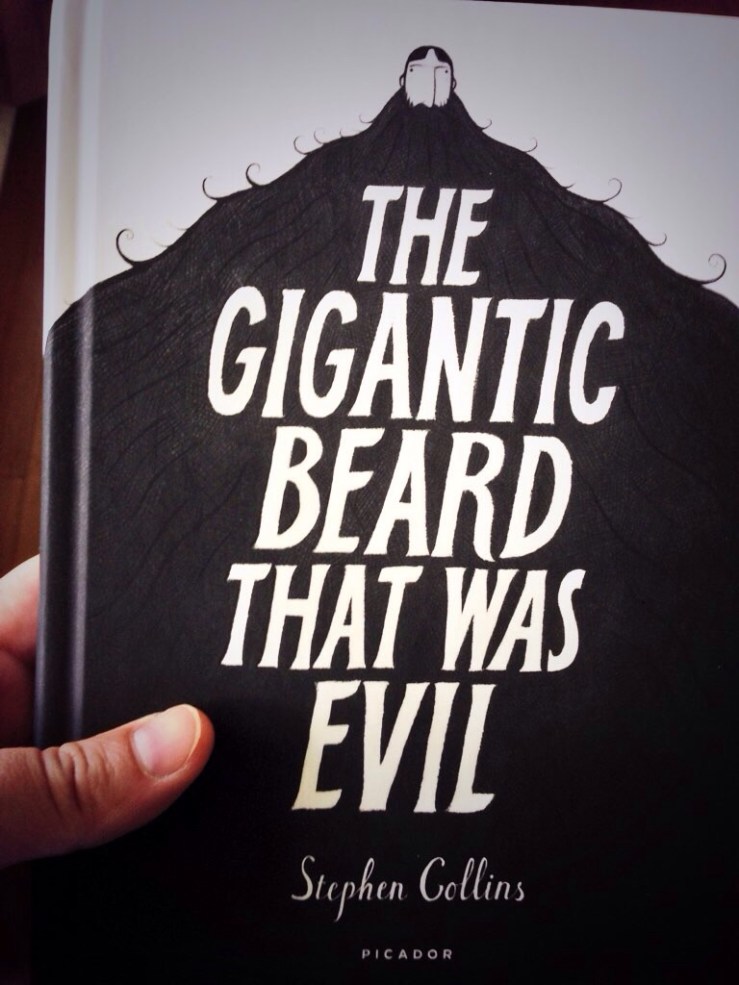
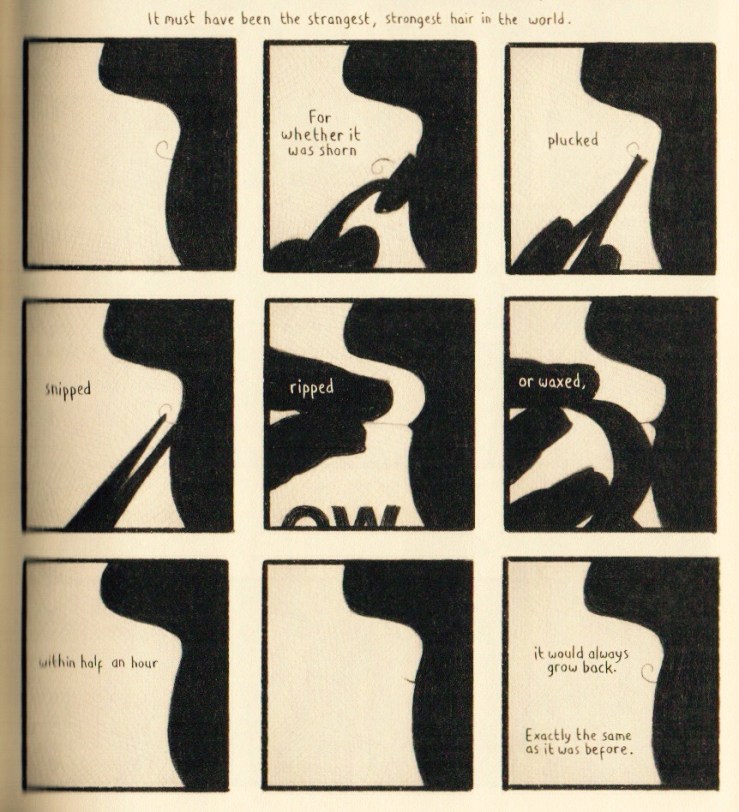
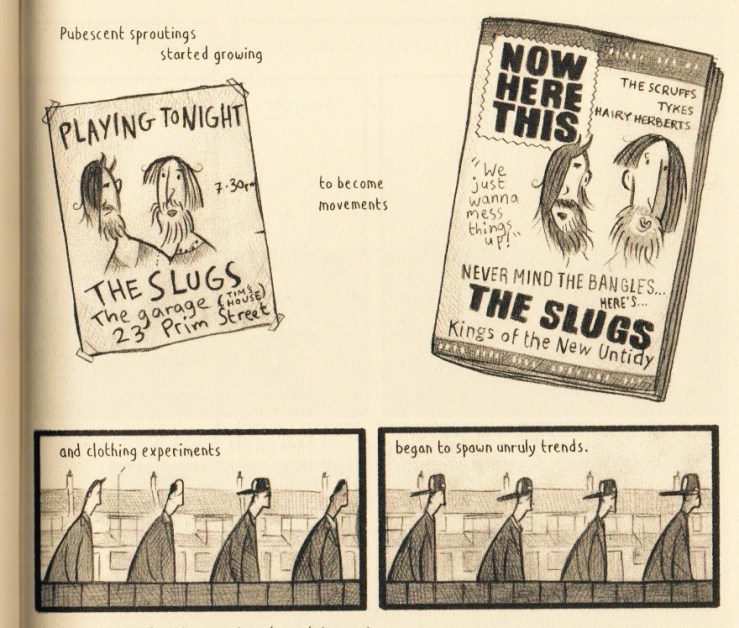
Stephen Collins’s début graphic novel The Gigantic Beard That Was Evil tells the story of Dave, an especially average (forgive the oxymoron) guy in the neat-and-tidy island of Here, a place where conformity rules and difference is unthinkable. Dave fits like a cog into his tidy world until a beard erupts from his face, severing him from society.

IMG_3865.JPG

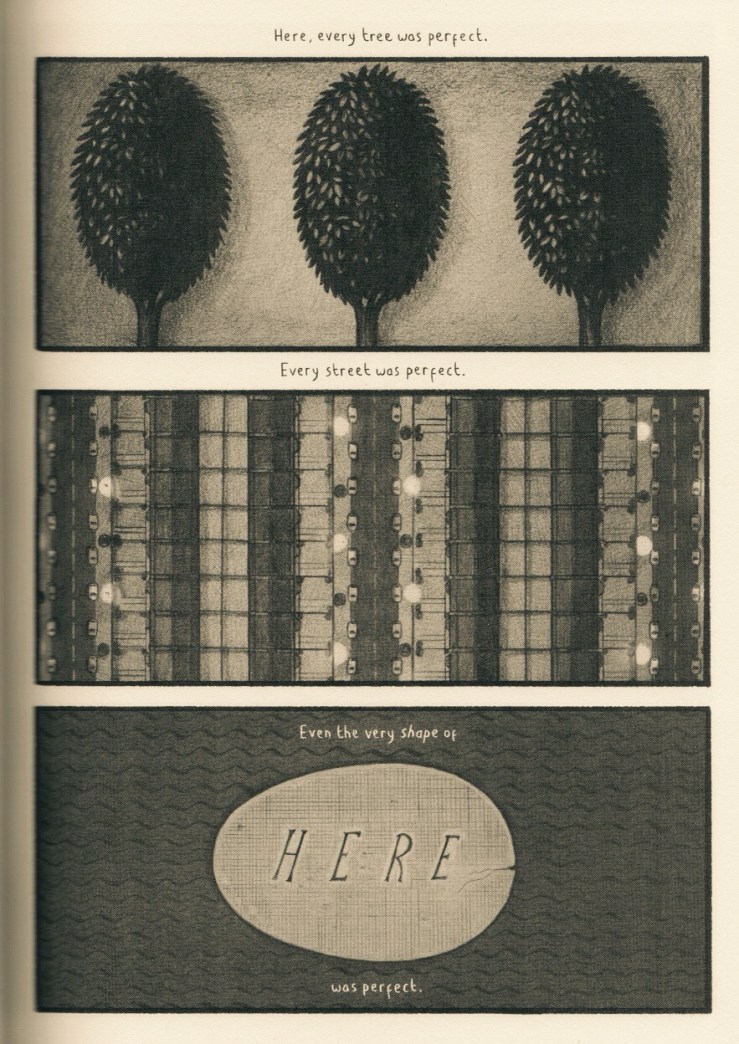
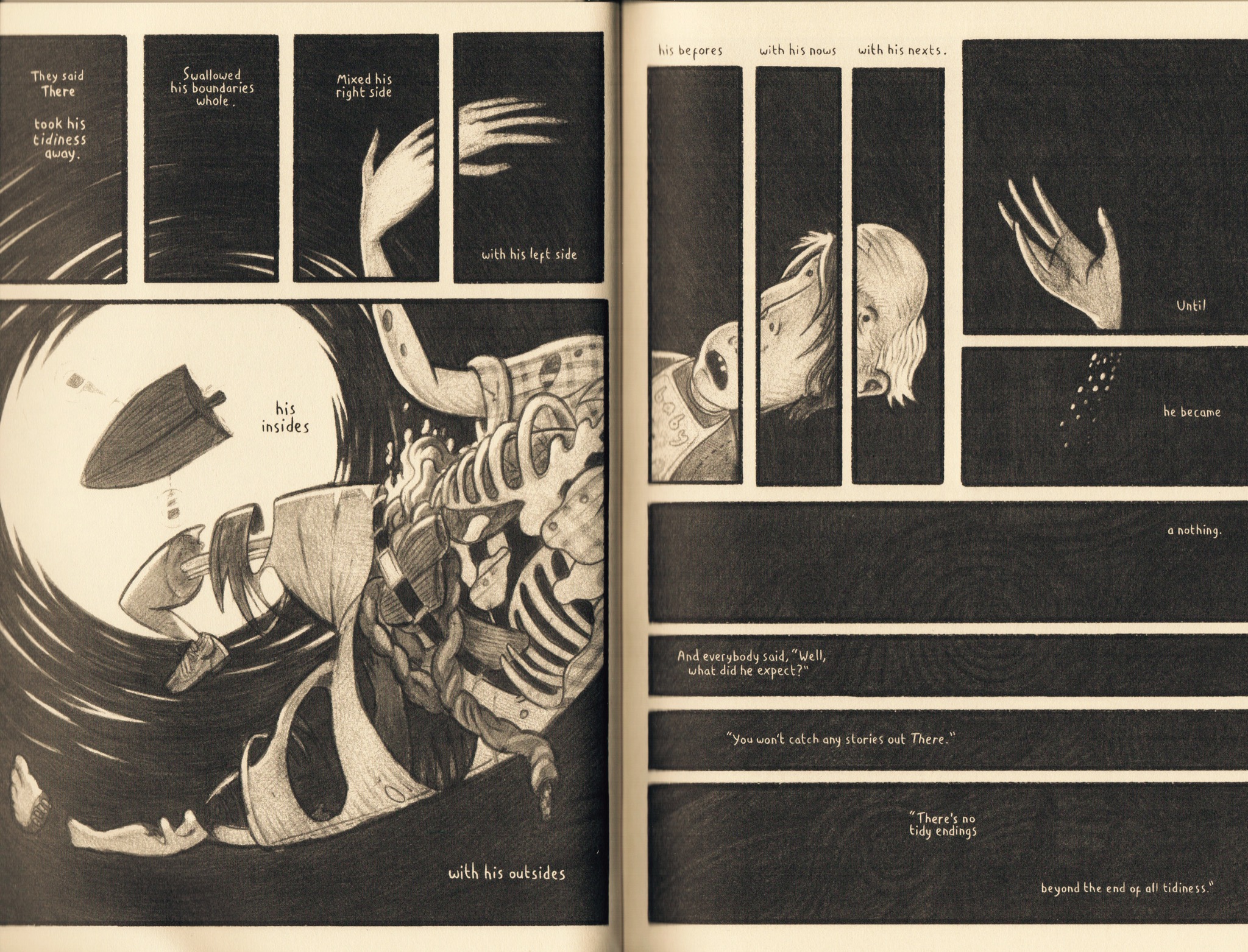
Despite its neat and tidy contours, an omnipresent dread of otherness gestates in the egg-shaped isle of Here. That dread manifests in the fabled land of There. Dave’s psyche is haunted by There; its very existence threatens both body and mind. Collins renders this anxiety in a remarkable series of panels that concretize Dave’s nightmare of otherness:

IMG_3873

Dave’s nightmare highlights his subconscious realization that there cannot be a Here without a There. The realization leaves him abject, torn, and destabilized, even before his beard appears. When the first hairs do arrive, Dave’s interior existential crisis spills outward, his messy difference oozing out to disrupt and upset the tidy normalcy of Here.

IMG_3867.JPG

Poor Dave.

IMG_3871.JPG

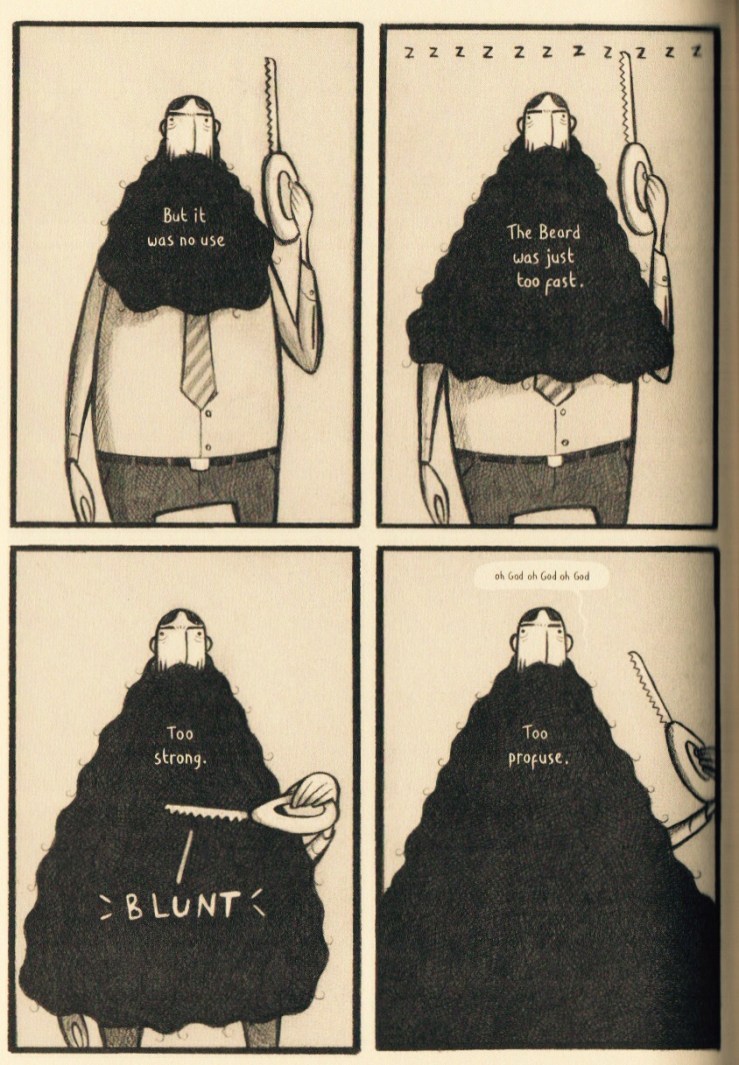
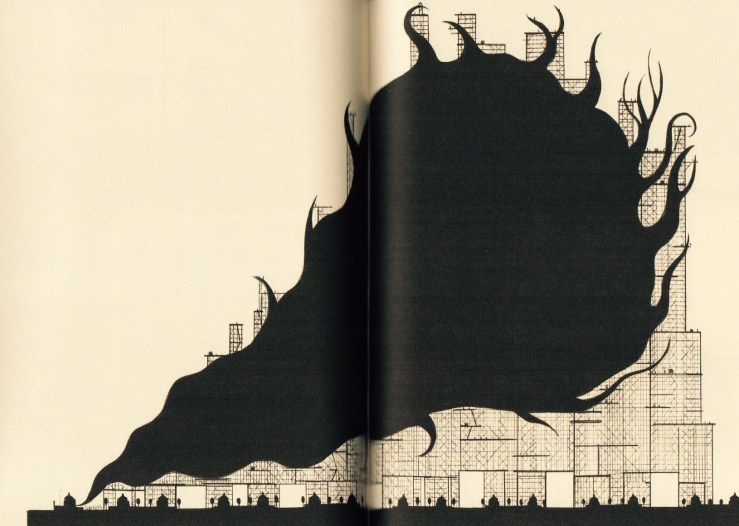
The beard quickly becomes a national emergency requiring enormous resources. Police, military, the media, and eventually the entire society become entangled in the crisis. United against a common foe, the citizens of Here are nevertheless distracted, letting their grooming habits slip. Things become less tidy. In their battle against the beard, they overlook the greater war on weird.

IMG_3868.JPG

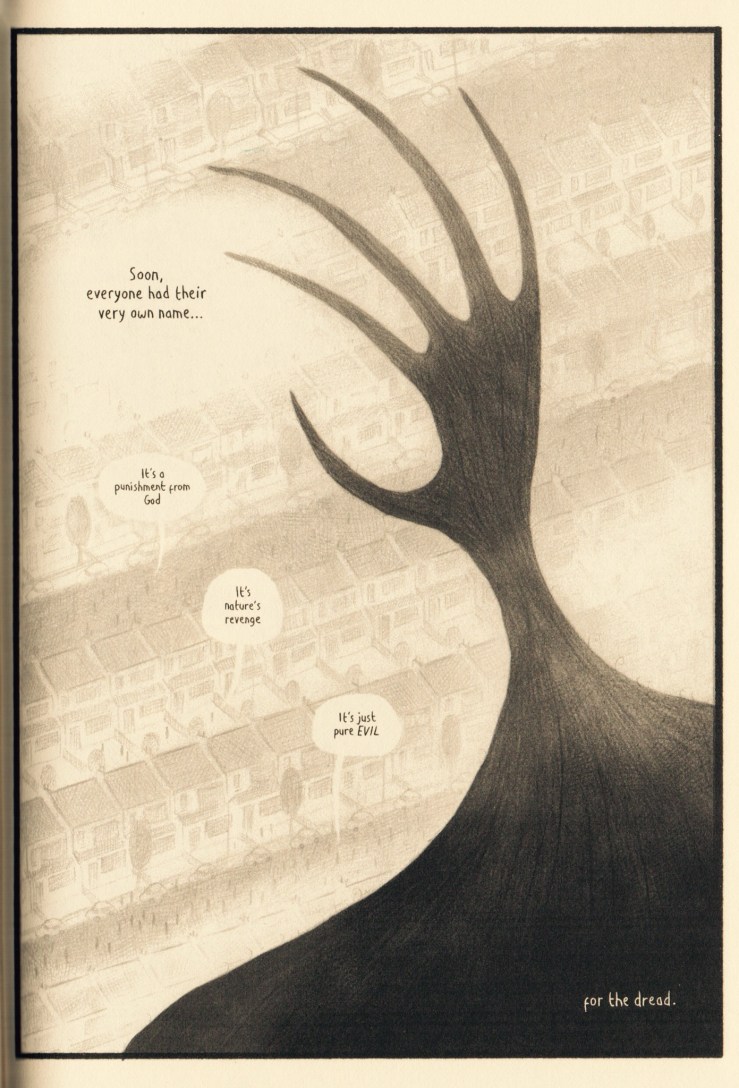
The Gigantic Beard That Was Evil is an allegorical fable. Collins attacks conformity and fear of otherness, but also depicts just how complex and horrifying otherness can be. While the island of Here is clearly a stand-in for England, Collins’s satire of xenophobia and the dangers of groupthink will resonate pretty much everywhere. All kinds of 21st-century anxieties writhe under the text: fear of immigration, the collapse of cultural homogeneity, ecological devastation—the end of a particular way of life. The angry mob castigating poor Dave call him a terrorist, but they are the authors of their own terror.

IMG_3874

In an unexpected and rewarding fourth act, Collins examines the aftermath of what comes to be known as “The Beard Event.” The Untidiness that happened while the citizens of Here were distracted dealing with Dave becomes the new normal. Fits of nonconformity inevitably become trends, then commodities.

IMG_3869.JPG

The Beard Event eventually becomes “A story many times retold and resold,” complete with its own museum (enter through the gift shop). Collins offers a clear depiction of difference—how it’s first feared, then resisted and attacked, and eventually absorbed and recycled.

I’ve tried to offer enough of Collin’s words and art to convey a sense of his simple but refined style. His lines are often gentle and always precise, his subtle shading all the color this tale needs. The Gigantic Beard That Was Evil succeeds visually on the strength of Collins’s pacing and panel design. Collins seamlessly integrates his prose into the panels, moving the story along in a lilt of rhymes and non-rhymes evocative of Edward Gorey or Roald Dahl. Collins nimbly avoids the potential pitfalls of preachiness or meaningless absurdity here, leading to a confident and convincing début. I look forward to more. Great stuff.

The Gigantic Beard That Was Evil is now available in the United States in hardback and ebook from Picador.

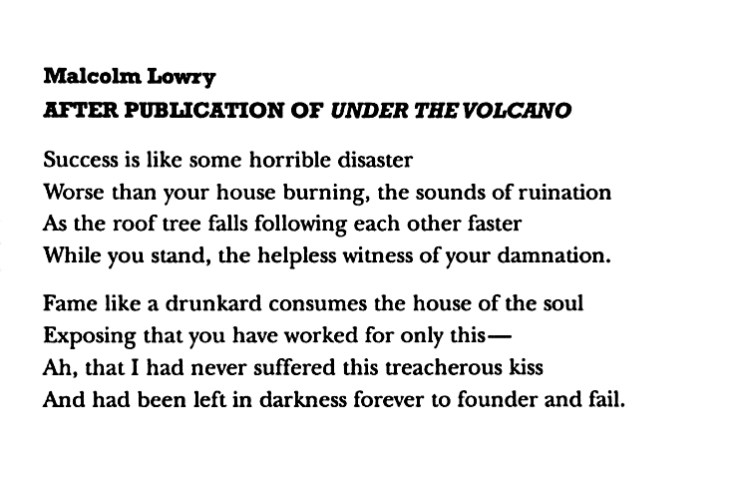
“After Publication of Under the Volcano” — Malcolm Lowry

ml

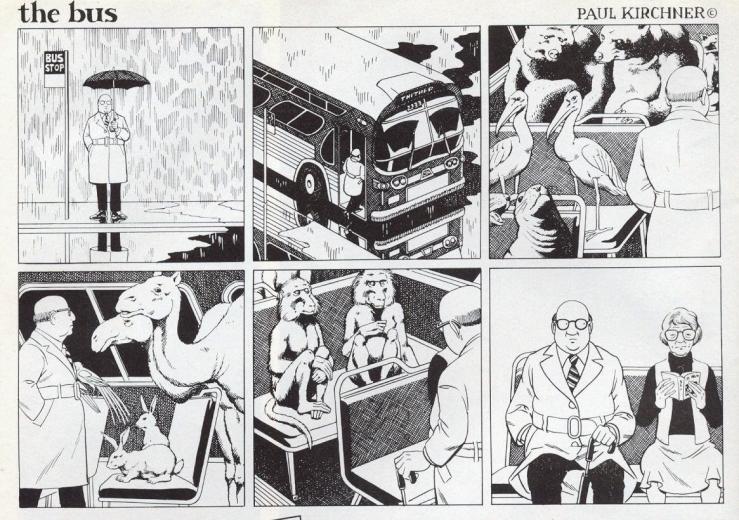
The Bus — Paul Kirchner

c

Portrait of Zacharie Astruc — Edouard Manet

November — Carl Larsson

Boy Blowing Bubbles — Edouard Manet

Accept the mystery

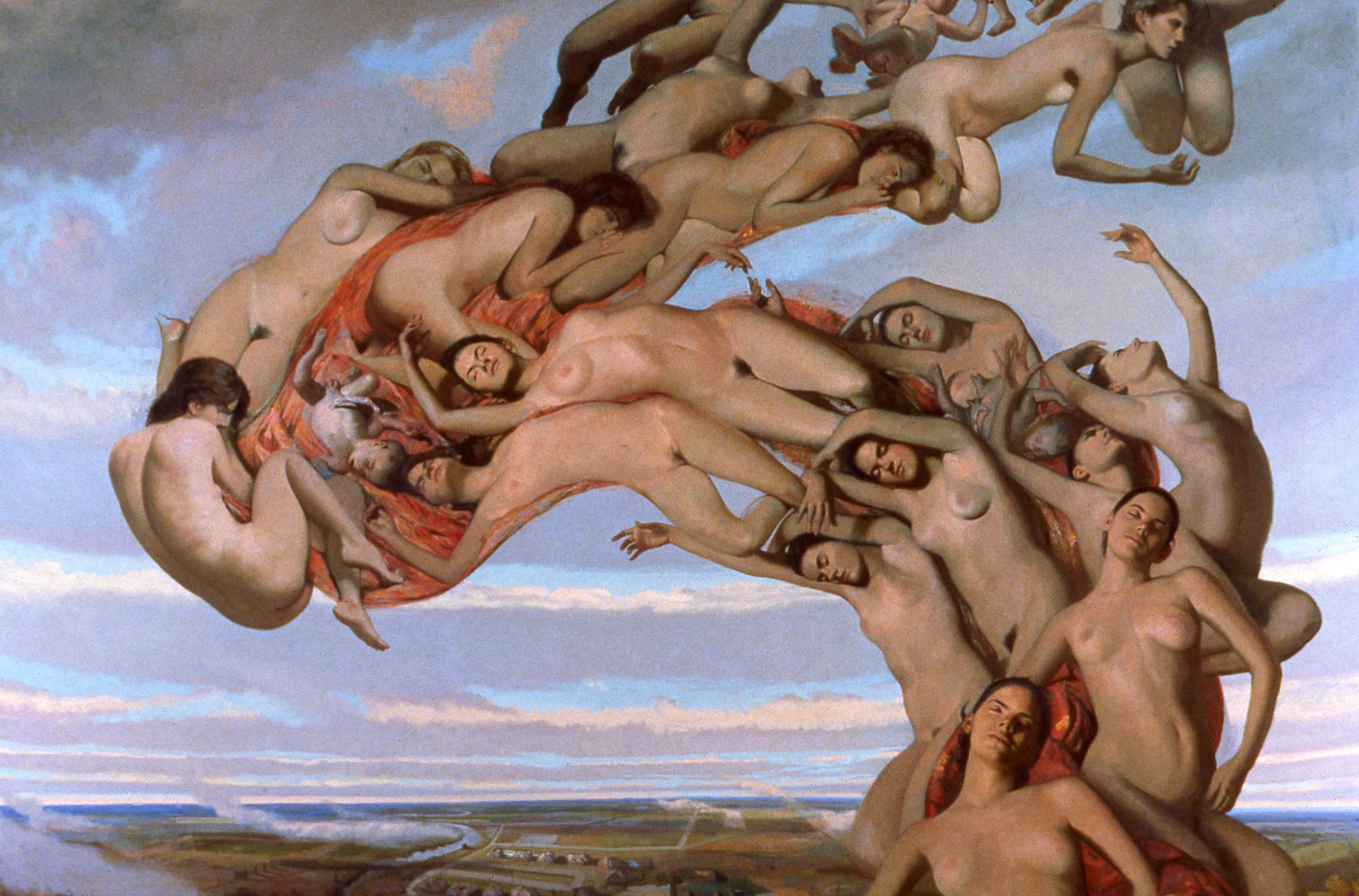
Resurgere e Renasci — Bo Bartlett

1986-resurgere-e-renasci-lg (1)

(More).

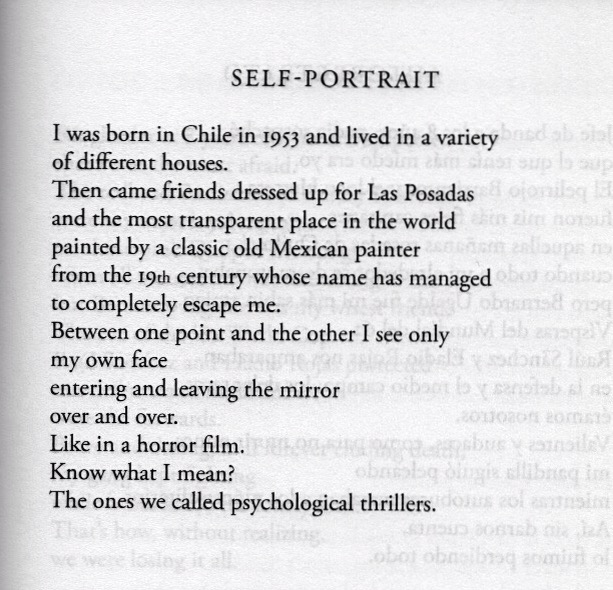
“Self-Portrait” — Roberto Bolaño

IMG_3857-0.JPG

Cynthia — William Strang

Werner Herzog’s Nosferatu

A Grotesque Vignette from Haruki Murakami’s Latest Novel

They spent an hour at an express-train station with the stationmaster, going over the details of the rebuilding project. It was lunchtime, so they ordered in bentos and ate together in the stationmaster’s office. Afterward they chatted over tea. The stationmaster, a friendly, heavyset middle-aged man, told them some fascinating stories about things he’d experienced in his career. Tsukuru loved going to sites and hearing these kinds of stories. The topic turned to lost property, more specifically to the huge amount of lost-and-found items left behind on trains and in stations, and the unusual, strange items among them—the ashes of cremated people, wigs, prosthetic legs, the manuscript of a novel (the stationmaster read a little bit of it and found it dull), a neatly wrapped, bloodstained shirt in a box, a live pit viper, forty color photos of women’s vaginas, a large wooden gong, the kind Buddhist priests strike as they chant sutras …

“Sometimes you’re not sure what to do with them,” the stationmaster said. “A friend of mine who runs another station turned in a Boston bag once that had a dead fetus inside. Thankfully, I’ve never had that kind of experience myself. But once, when I was a stationmaster at another station, someone brought in two fingers preserved in formaldehyde.”

“That’s pretty grotesque,” Tsukuru said.

“Yes, it sure was. Two small fingers floating in liquid, kept in what looked like a small mayonnaise jar, all inside a pretty cloth bag. Looked like a child’s fingers severed at the base. Naturally we contacted the police, since we thought it might be connected to a crime. The police came over immediately and took the jar away.”

The stationmaster drank a sip of tea.

“A week later the same police officer who’d taken the fingers stopped by. He questioned the station employee who’d found the jar in the restroom again. I was present for the questioning. According to the officer, the fingers in the jar weren’t those of a child. The forensics lab determined that they belonged to an adult. The reason they were so small was that they were sixth, vestigial fingers. The officer said that sometimes people have extra fingers. Most of the time the parents want to get rid of the deformity, so they have the fingers amputated when the child’s still a baby, but there are some people who, as adults, still have all six fingers. The ones that were found were an example—the fingers of an adult who had had them surgically removed, then preserved in formaldehyde. The lab estimated the fingers to be those of a man, age mid-twenties to mid-thirties, though they couldn’t tell how long it had been since the fingers had been amputated. I can’t imagine how they’d come to be forgotten, or perhaps thrown away, in the station restroom. But it doesn’t seem that they were connected to any crime. In the end the police kept them, and no one ever came forward to claim them. For all I know, they may still be in a police warehouse somewhere.”

“That’s a weird story,” Tsukuru said. “Why would he keep those sixth fingers until he became an adult and then suddenly decide to amputate them?”

“It’s a mystery. It got me interested in the phenomenon, though, and I started looking into it. The technical term is hyperdactyly, and there have been lots of famous people who’ve had it. It’s unclear whether it’s true or not, but there was some evidence that Hideyoshi Toyotomi, the famous leader of the Sengoku period, had two thumbs. There are plenty of other examples. There was a famous pianist who had the condition, a novelist, an artist, a baseball player. In fiction, Hannibal Lecter of The Silence of the Lambs had six fingers. It’s not all that unusual, and genetically it’s a dominant trait. There are variations among different races, but in general, one out of every five hundred people is born with six fingers. As I said, though, the vast majority of their parents have the extra fingers amputated before their children’s first birthdays, when kids begin to develop fine-motor skills. So we hardly ever run across someone with the condition. It was the same for me. Until that jar was found in the station, I’d never even heard of such a thing.”

From Haruki Murakami’s latest novel Colorless Tsukuru Tazaki and His Years of Pilgrimage.