The Music Master — Edmund Dulac

The first page of Chris Ware’s new novel The Last Saturday is up at The Guardian

CWChris Ware, one of the greatest living American novelists, will be publishing his new novel The Last Saturday, “tracing the lives of six individuals from Sandy Port, Michigan,”
in installments in The Guardian this fall.
 New episodes every Saturday.


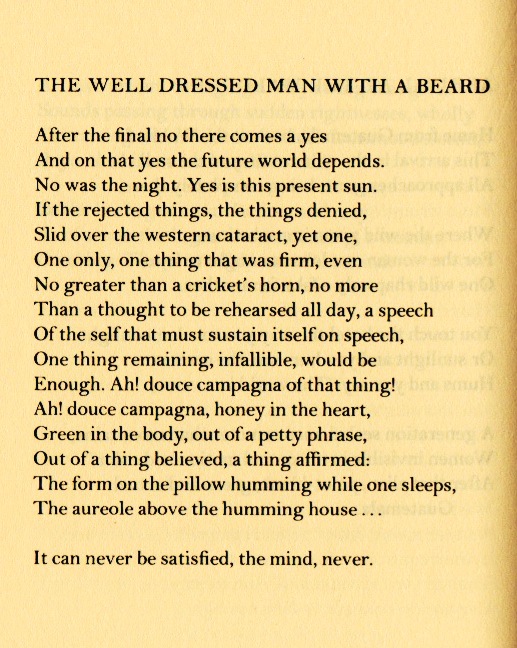
“The Well Dressed Man with a Beard” — Wallace Stevens

IMG_3323

It is very unhappy, but too late to be helped, the discovery we have made that we exist (Ralph Waldo Emerson)

It is very unhappy, but too late to be helped, the discovery we have made that we exist. That discovery is called the Fall of Man. Ever afterwards we suspect our instruments. We have learned that we do not see directly, but mediately, and that we have no means of correcting these colored and distorting lenses which we are, or of computing the amount of their errors. Perhaps these subject-lenses have a creative power; perhaps there are no objects. Once we lived in what we saw; now, the rapaciousness of this new power, which threatens to absorb all things, engages us. Nature, art, persons, letters, religions, objects, successively tumble in, and God is but one of its ideas. Nature and literature are subjective phenomena; every evil and every good thing is a shadow which we cast. The street is full of humiliations to the proud. As the fop contrived to dress his bailiffs in his livery and make them wait on his guests at table, so the chagrins which the bad heart gives off as bubbles, at once take form as ladies and gentlemen in the street, shopmen or bar-keepers in hotels, and threaten or insult whatever is threatenable and insultable in us. ‘Tis the same with our idolatries. People forget that it is the eye which makes the horizon, and the rounding mind’s eye which makes this or that man a type or representative of humanity, with the name of hero or saint. Jesus, the “providential man,” is a good man on whom many people are agreed that these optical laws shall take effect. By love on one part and by forbearance to press objection on the other part, it is for a time settled, that we will look at him in the centre of the horizon, and ascribe to him the properties that will attach to any man so seen. But the longest love or aversion has a speedy term. The great and crescive self, rooted in absolute nature, supplants all relative existence and ruins the kingdom of mortal friendship and love. Marriage (in what is called the spiritual world) is impossible, because of the inequality between every subject and every object. The subject is the receiver of Godhead, and at every comparison must feel his being enhanced by that cryptic might. Though not in energy, yet by presence, this magazine of substance cannot be otherwise than felt; nor can any force of intellect attribute to the object the proper deity which sleeps or wakes forever in every subject. Never can love make consciousness and ascription equal in force. There will be the same gulf between every me and thee as between the original and the picture. The universe is the bride of the soul. All private sympathy is partial. Two human beings are like globes, which can touch only in a point, and whilst they remain in contact, all other points of each of the spheres are inert; their turn must also come, and the longer a particular union lasts the more energy of appetency the parts not in union acquire.

From Ralph Waldo Emerson’s essay “Experience.”

Grandmother Reading the Bible — Albert Anker

Don DeLillo on William Gaddis

I REMEMBER THE BOOKSTORE, long gone now, on Forty-Second Street. I stood in the narrow aisle reading the first paragraph of The Recognitions. It was a revelation, a piece of writing with the beauty and texture of a Shakespearean monologue-or, maybe more apt, a work of Renaissance art impossibly transformed from image to words. And they were the words of a contemporary American. This, to me, was the wonder of it.
Years later, when I was a writer myself, I read JR, and it seemed to me, at first, that Gaddis was working against his own gifts for narration and physical description, leaving the great world behind to enter the pigeon-coop clutter of minds intent on deal-making and soul-swindling. This was not self-denial, I began to understand, but a writer of uncommon courage and insight discovering a method that would allow him to realize his sense of what the great world had become.
JR in fact is a realistic novel–so unforgivingly real that we may fail to recognize it as such. It is the real world of its own terms, without the perceptual scrim that we tend to erect (novelists and others) in order to live and work safely within it.
Two tremendous novels. And the author maneuvering his car out of a dark and cramped driveway, the last time I saw him, with four or five friends and acquaintances calling out instructions as the car backed onto the country road, headlights shining on our waved good nights.

Don DeLillo on William Gaddis. From the Fall 2003 issue of Conjunctions.

The Masked Woman — Max Pechstein

The Bus — Paul Kirchner

Werner Herzog’s Utopian Film Academy

Tell me about your ideal film school.

This is something we can talk about later when we discuss Film Lesson, the programmes I made for Austrian television, but let me say here that there are some very basic skills that any filmmaker must have. First of all, learn languages. One also needs to be able to type and to drive a car. It is like the knights of old who had to be able to ride, wield a sword and play the lute. At my Utopian film academy I would have students do athletic things with real physical contact, like boxing, something that would teach them to be unafraid. I would have a loft with a lot of space where in one corner there would be a boxing ring. Students would train every evening from 8 to 10 with a boxing instructor: sparring, somersaults (backwards and forwards), juggling, magic card tricks. Whether or not you would be a filmmaker by the end I do not know, but at least you would come out as an athlete. My film school would allow young people who want to make films to experience a certain climate of excitement of the mind. This is what ultimately creates films and nothing else. It is not technicians that film schools should be producing, but people with a real agitation of mind. People with spirit, with a burning flame within them.

From Herzog on Herzog.

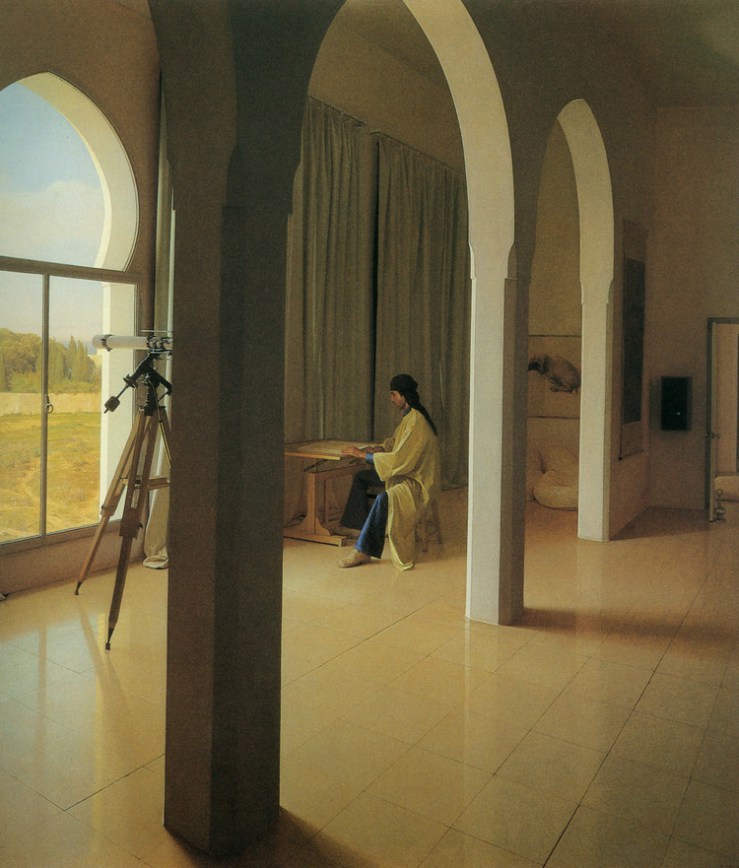
The Magician — Claudio Bravo

magician

I was filling in the holes | Charles Burns discusses Tintin’s influence

cb

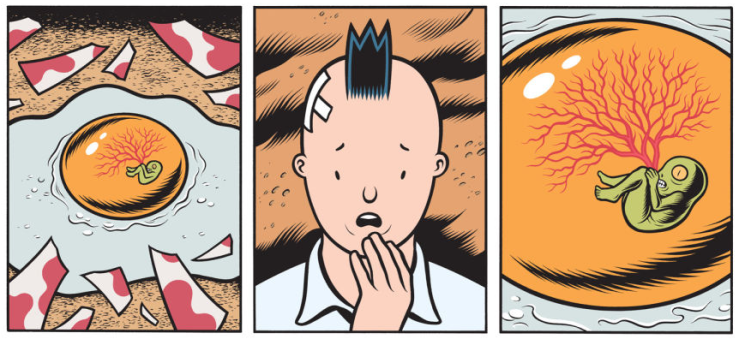
Charles Burns talked to The New Yorker about the influence Herge’s Tintin had on his X’ed Out trilogy:

The format of the three hardcovers is based on Tintin in its Franco-Belgian comics album format… Luckily, I had those books growing up. When I was five years old—I couldn’t even read yet—my Dad, who went to bookstores and libraries all the time, brought back one of those early Tintin books for me. It felt like the first book that was just my own…

Eventually, when they started being imported to the U.S., I found the British translations, but it took a long time. So as a kid looking at the books, I was filling in the holes, the missing pieces—kind of making up my own stories, I guess—looking at the back cover and seeing images that didn’t appear in the stories I knew. Now, the book I made—all three books—feels complete to me. I had a pretty firm idea of what the story was going to be when I started, but many things changed while I was working. In the end, all the pieces fit together the way I wanted, or as close as I could get. I feel like I’ve said everything I need to say.

I should have a review of Sugar Skull up next week (surprise: it’s good!—but I loved X’ed Out and The Hive, so).

Three of a Perfect Pair — 90 Minutes of King Crimson in Japan, 1984

1 Three Of A Perfect Pair 0:00:27
1a backstage 0:04:36
2 No Warning 0:07:00
3 Larks’ Tongues In Aspic Part III 0:10:56
4 Thela Hun Ginjeet 0:16:05
5 Frame By Frame 0:22:07
6 Matte Kudasai 0:26:07
7 Industry 0:29:37
8 Dig Me 0:36:32
9 Indiscipline 0:40:15
10 Sartori In Tangier 0:50:37
11 Man With An Open Heart 0:54:51
12 Waiting Man 0:58:37
13 Sleepless 1:05:17
14 Larks’ Tongues In Aspic Part II 1:11:34
15 Elephant Talk 1:17:38
16 Heartbeat 1:22:45

Wouldn’t It Be Deadly? (Book Acquired, Like Last Week or the Week Before)

IMG_3228

Wouldn’t It Be Deadly by D.E. Ireland. PW’s write up:

Set in London in 1913, this tongue-in-cheek series kickoff from the pseudonymous Ireland picks up where the musical My Fair Lady left off. Eliza Doolittle has left her irascible mentor, Henry Higgins, to work for a rival elocution teacher, Emil Nepommuck. Nepommuck features her transformation from street flower-seller to someone who passed for a duchess prominently in his advertising, and manages to steal some of Higgins’s students. When someone fatally stabs Nepommuck in the back outside his apartment, Higgins, who confronted the man earlier, becomes Scotland Yard’s prime suspect. Higgins turns out to be hiding a secret, which is out of character with his stage and film personae. Some readers may find character names like Harrison and Shaw a bit heavy-handed, though others may smile when Higgins describes Eliza as a “fair lady” or wonders why anyone would care about the “rain in Spain.” A

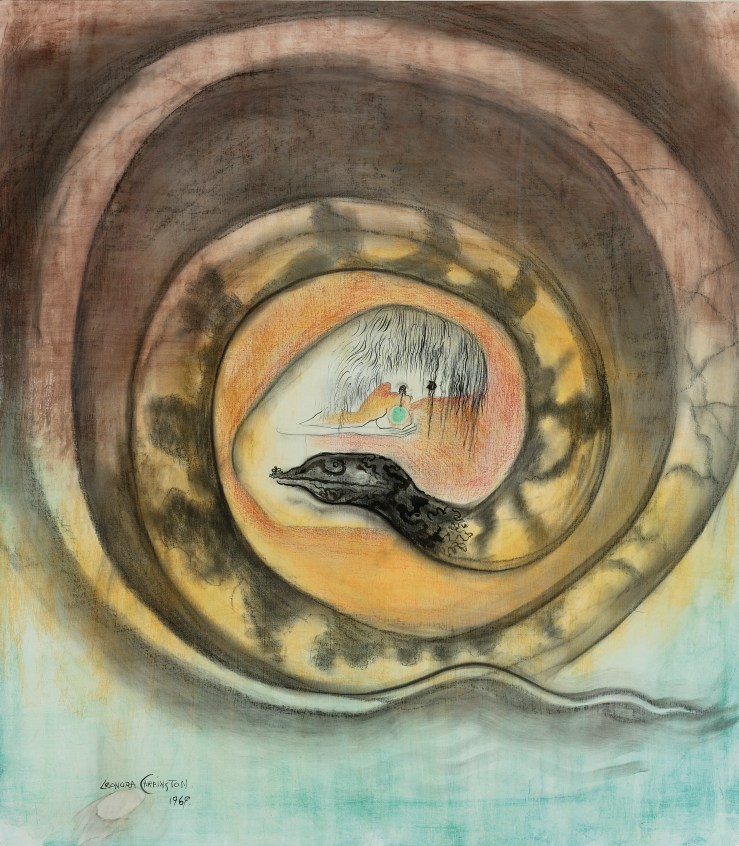
Snake — Leonora Carrington

Snake 1969 gouache, ink, pastel and wax crayon on board 29.875 x 26.5 in