The Hammock — Thomas Theodor Heine

Where the artist is still trusted, he will not be looked to for assurance (Flannery O’Connor)

Unless we are willing to accept our artists as they are, the answer to the question, “Who speaks for America today?” will have to be: the advertising agencies. They are entirely capable of showing us our unparalleled prosperity and our almost classless society, and no one has ever accused them of not being affirmative. Where the artist is still trusted, he will not be looked to for assurance. Those who believe that art proceeds from a healthy, and not from a diseased, faculty of the mind will take what he shows them as a revelation, not of what we ought to be but of what we are at a given time and under given circumstances; that is, as a limited revelation but revelation nevertheless.

From Flannery O’Connor’s essay “The Fiction Writer and His Country,” collected in Mystery and Manners.


Portrait of Friederike Maria Beer — Egon Schiele

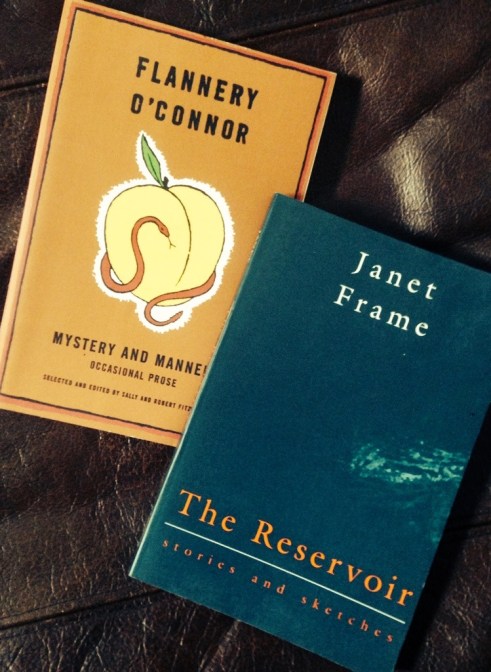
Flannery O’Connor/Janet Frame (Books Acquired, 6.27.2014)

20140628-161808-58688350.jpg

“Death and the Maiden” — The Verlaines

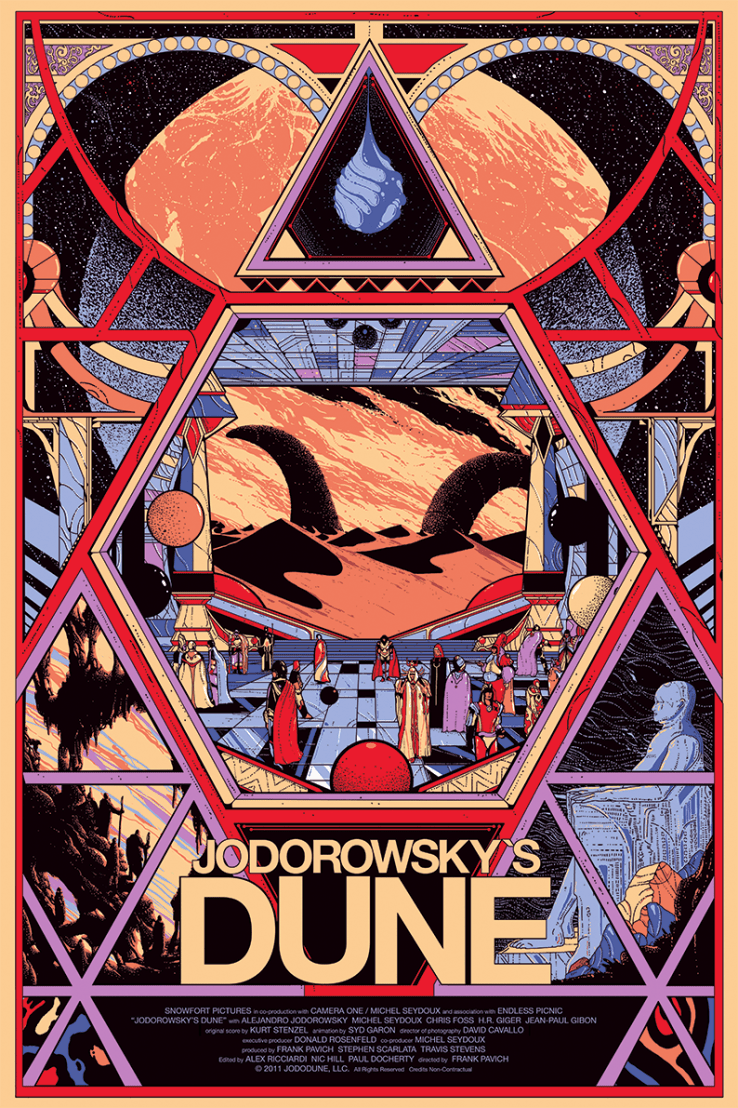
A Riff Jodorowsky’s Dune (And Some Lovely Film Posters)

dune

Fans of Alejandro Jodorowsky and will likely already be familiar with the story that unfolds in Jodorowsky’s Dune, a new documentary by Frank Pavich. The short version: After the success of his midnight cult films El Topo and The Holy Mountain, Jodorowsky moves to a castle in France to turn Frank Herbert’s sci-fi novel Dune into a film. Jodorowky put together a group of “spiritual warriors” to aid him in this quest, including the core team of Dan O’Bannon (who went on to create Alien), H.R. Giger, and the French artist Jean Giraud, aka Moebius, whose character designs and storyboards are the concrete manifestations of Jodorowsky’s vision. Jodorowsky also sought out Orson Welles, Salvador Dali, Pink Floyd, and Mick Jagger, among others. The project resulted in a tome the size of several phonebooks, including paintings, designs, technical solutions, and a storyboard by Moebius—but no film. Studios shied away from Jodorowsky, daunted in no small part by the film’s proposed fourteen hour running time. Dino De Laurentiis eventually bought the film rights and handed the project to David Lynch, resulting in 1984’s admirable failure Dune.
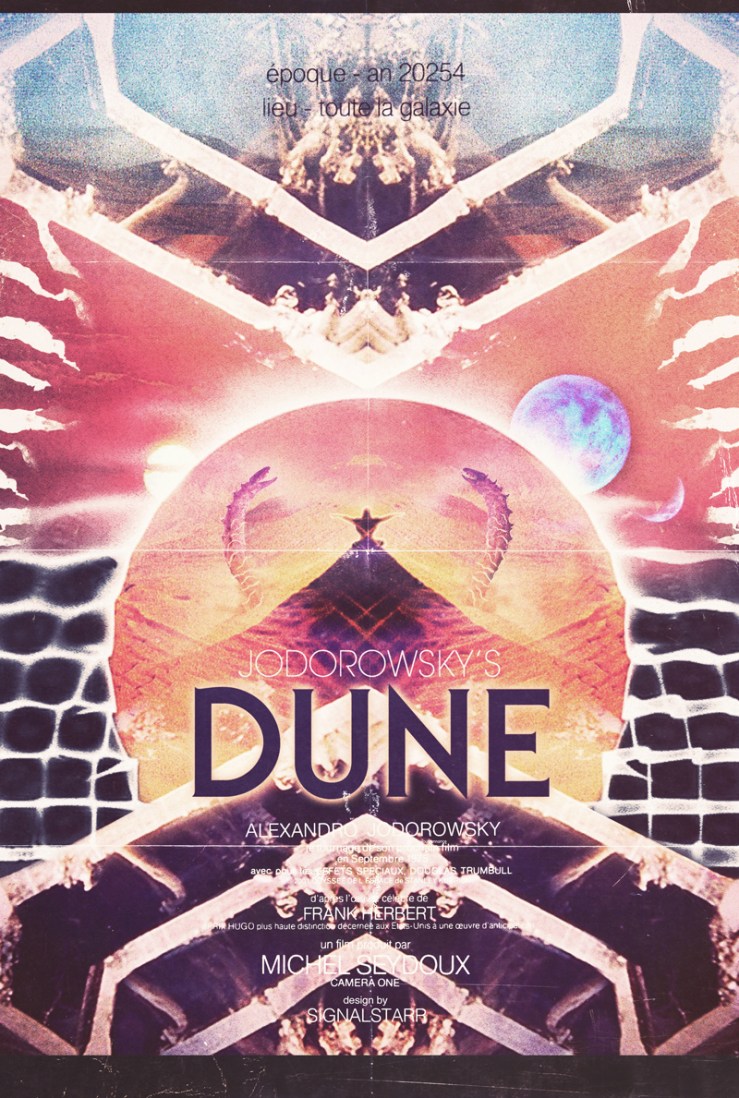
DUNE F 6_WEB_911

Jodorowsky’s Dune enriches and enhances the mythic status of Jodo (as he’s affectionately called by half the interviewees) and his non-film. Most of this enhancing comes from Jodo himself, whose shaman-presence radiates through the screen, charming the camera and the viewer. Here is someone spinning his own legend, telling stories he’s told a million times before, it seems, but weaving them into a more definitive tapestry—one that covers over half-truths, poses, and outright fraudulence. Like any great con-man, Jodo believes in his own bullshit and makes his audience want to believe it as well. His little stories—promising to buy off Orson Welles with a personal chef and plenty of wine, snapping at Pink Floyd while they wolf down hamburgers, a fateful across-the-room meeting with Mick Jagger, dueling with Dali—these anecdotes are the real life-force of the film.
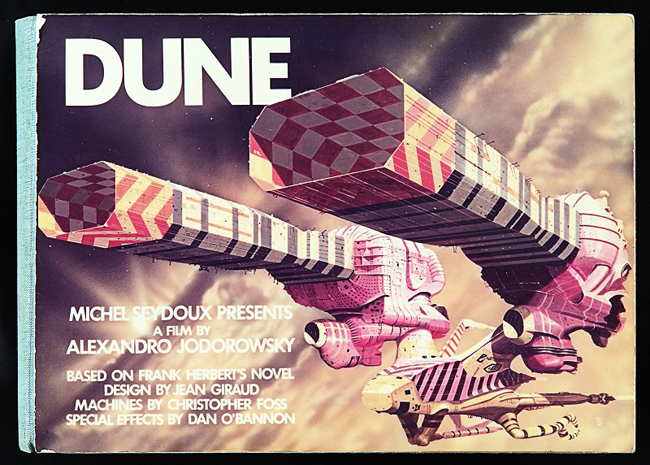
dunej

The other talking heads (and occasional disembodied voices) in the documentary offer a more nuanced, reality-based perspective, although it’s always clear that Jodo’s core team of “spiritual warriors” were willing to do whatever he asked of them (including Jodo’s son, who was to play the starring role of Paul Atreides—he had to endure several years of intense martial arts training). Jodorowsky’s influence on H.R. Giger and O’Bannon is especially clear, and the film makes a strong case that many of the concepts that landed in Jodo’s Dune-film-tome eventually showed up all over subsequent sci-fi and fantasy films.  
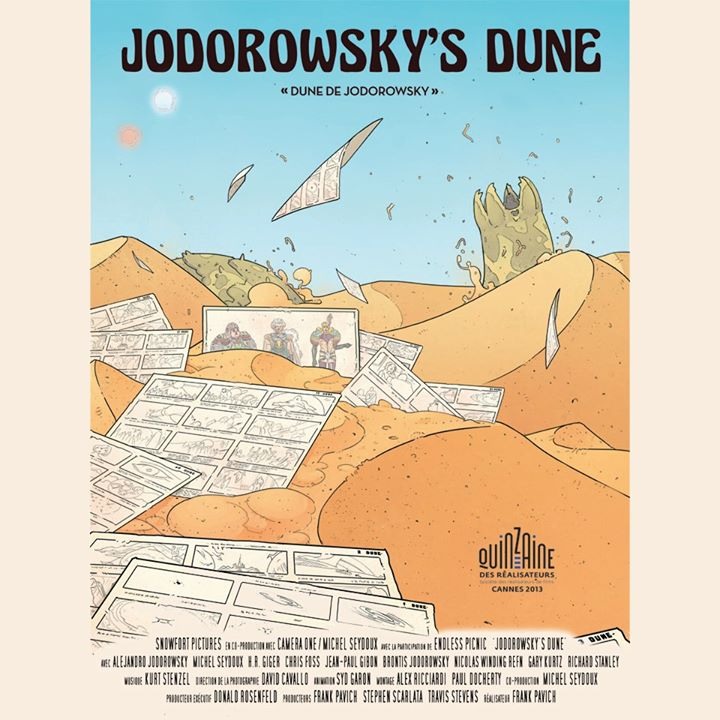
dune

Moebius is sorely missing here. He’s repeatedly (and correctly) credited as a genius, but his overall influence on the project is understated, and unless I blinked and missed it, there is no footage of him in the film—not even a voiceover (conflicting film rights?).

Perhaps what’s most significantly missing from the film is Frank Herbert. Early on, Jodorowsky admits that he hadn’t read Dune, just had the plot summarized by a friend. As the film progresses, it becomes evident that Jodorowsky probably never bothered to read the book. “I was raping Frank Herbert…but with love,” he declares at one point. Of course, it’s Jodorowsky’s Dune—not Herbert’s Dune.

The film also avoids spending much time on Lynch’s Dune, which is probably for the better. Still, there’s a wonderful moment near the end when Jodorowsky shares his thoughts on Lynch’s take (spoiler: He agreed with pretty much every other critic).
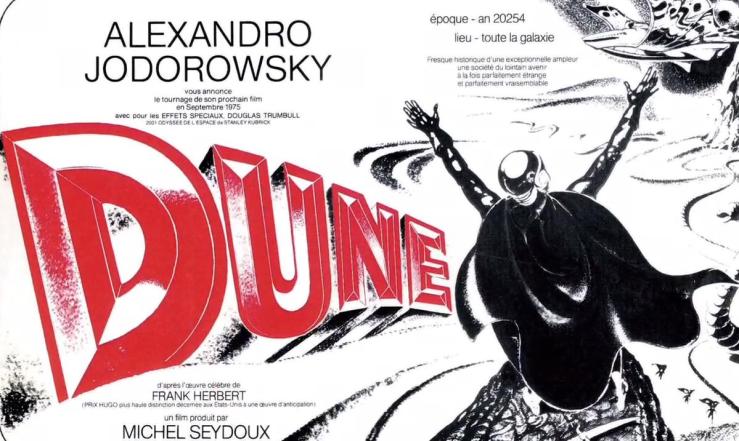
dune-headline_0

Jodorowsky is clearly still angry that the film was never made. Like a magician practiced in misdirection, he spends much of the film hiding his wounded ego. His performance conveys the appearance—but not the spirit—of candor. In a rare moment that feels honest though, he grasps the tome he made with his spiritual warriors and expresses how much he would like somebodyanybody—to make the film.

Do we actually want Jodorowsky’s Dune? Isn’t it somehow better for the myth to exist, the chimera, the idealization, the-could-have-been? The filmmakers of Jodorowsky’s Dune offer us a version or a template or a guide. They do a wonderful job of synthesizing disparate materials into a unified audiovisual experience. Animation and original music bring the storyboards and concept art into vivid life, and Jodo’s voice commands and directs the viewer’s imagination. And this is the real joy of Jodorowsky’s Dune: A chance for the viewer to imagine, along with its shaman-author, the film that never happened.

Language (Ambrose Bierce)

20140628-110428-39868603.jpg

Batman ’66 Meets the Dark Knight Returns — Marco D’Alfonso

batma

Peace — William H. Johnson

The Battle of Algiers

Galatea — Gustave Moreau

“Play” — William Carlos Williams

20140627-095522-35722674.jpg

Sea Piece (Cloudy) — Gerhard Richter

The dictionary is as disturbing as the world (William H. Gass)

The worship of the word must be pagan and polytheistic. It cannot endure one god. The Scots use blue brilliantly, for instance, and have their own term, blae, for gray blue, lead blue, and livid. The hedge-chanter is better known to them as the blue hafit, and if we pursue their names for the lumpsucker or sea owl, a fish of uncouth appearance, we come upon bluepaidle, or the even more common cockpaidle. The dictionary is as disturbing as the world, full of teasing parallels and misleading coincidence. The same fish is called a paddlecock on account of the tubercular skin which envelopes its dorsal ridge and which resembles the comb of that barnyard lord.

From William H. Gass’s On Being Blue.

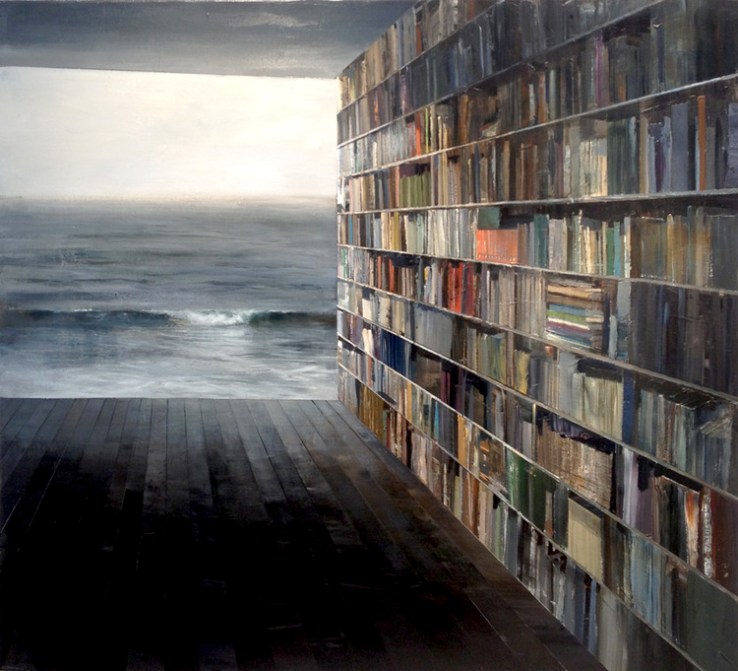
Library with Grey Sea — Jeremy Miranda

library with grey sea

The poisonous radiations which had killed most of his contemporaries had, by a fluke, given him eternal youth (Alasdair Gray)

Apparent life was a succession of dull habits in which he did what was asked automatically, only resenting demands to show interest. His energy had withdrawn into imaginary worlds and he had none to waste on reality.

A small fertile land lay hidden in a crater made by an atomic explosion. Thaw was Prime Minister of it. He lived in an old mansion among lawns and clumps of forest on the shore of a loch ornamented with islands. The mansion was spacious, dim and peaceful. The halls were hung with his paintings, the library full of his novels and poems, there were studios and laboratories where the best minds of the day worked whenever they cared to visit him. Outside the sun was warm, bees hummed among flowers and fountains, the season was midway between summer and autumn when the trees showed their matured green and only the maples were crimson. Political work took little of his time, for the people of that country had such confidence in him that he had only to suggest a reform for it to be practised. Indeed, his main problem was to keep the land democratic, for he would have been crowned king long before if his socialist principles had not forbidden it. He looked young for a Prime Minister, being a boy in early adolescence; at the same time he had ruled that land for centuries. He was a survivor of the third world war. The poisonous radiations which had killed most of his contemporaries had, by a fluke, given him eternal youth. In two or three centuries of wandering about the shattered earth he had become leader of a small group of people who had come to trust his gentleness and wisdom. He had brought them to the crater, protected by its walls from the envy of unhappier lands, to build a republic where nobody was sick, poor or forced to live by work they hated. Unluckily his country was surrounded by barbaric lands ruled by queens and tyrants who kept plotting to conquer it and were only kept out by his courage and ingenuity. As a result he was often involved in battles, rescues, escapes, fights with monsters in the middle of arenas, and triumphal processions of shocking vulgarity which he only took part in to avoid hurting the feelings of the queens and princesses whose lives and countries he had saved. When these adventures were over he invited the main characters home to stay with him, and since he annexed the plot of every book and film which impressed him the house by the loch was always crowded with the celebrities of many different races, nations and historical phases. In the simplicity of his spacious rooms they were amazed by the quiet friendliness of a way of life more civilized than their own, and they learned the true duties of a ruler by seeing him spend an afternoon drawing the plans of a new reservoir or university. The women guests usually fell in love with him, though some of the more barbaric came to hate him for his friendly indifference, an indifference which clothed a deep shyness. He could only feel near to women when rescuing them, and often envied the villains who could humiliate or torture them. His position made it impossible to imagine doing such things himself. Yet when walking home from school or public library, these adventures filled his head and chest with such intoxicating emotions that he had to run hard to be relieved of them and often found he had come through several streets without remembering anything of the people, houses or traffic.

His other imaginary world was enjoyed in the genitals. It was a secret gold mine in Arizona which a gang of bandits worked by slave labour. Thaw was bandit chief and spent his time inventing and practising tortures for the slaves. The mine got outside stimulus, not from the shelves of the library but, cryptically, from American comics. He never bought these, and had courage to look at their enticing covers only when the shop contained something else he could pretend to examine, but he sometimes borrowed one at school and in the privacy of the back bedroom copied out pictures of men being whipped and branded. He kept these pictures between pages of Carlyle’s French Revolution, a book no one else was likely to open.

From Alasdair Gray’s novel Lanark.