19 May. He feels more deserted with a second person than when alone. If he is together with someone, this second person reaches out for him and he is helplessly delivered into his hand. If he is alone, all mankind reaches out for him – but the innumerable outstretched arms become entangled with one another and no one reaches to him.
Franz Kafka’s diary entry of 19 May 1922. From The Diaries of Franz Kafka.” Schocken Books. Translation by Martin Greenberg.
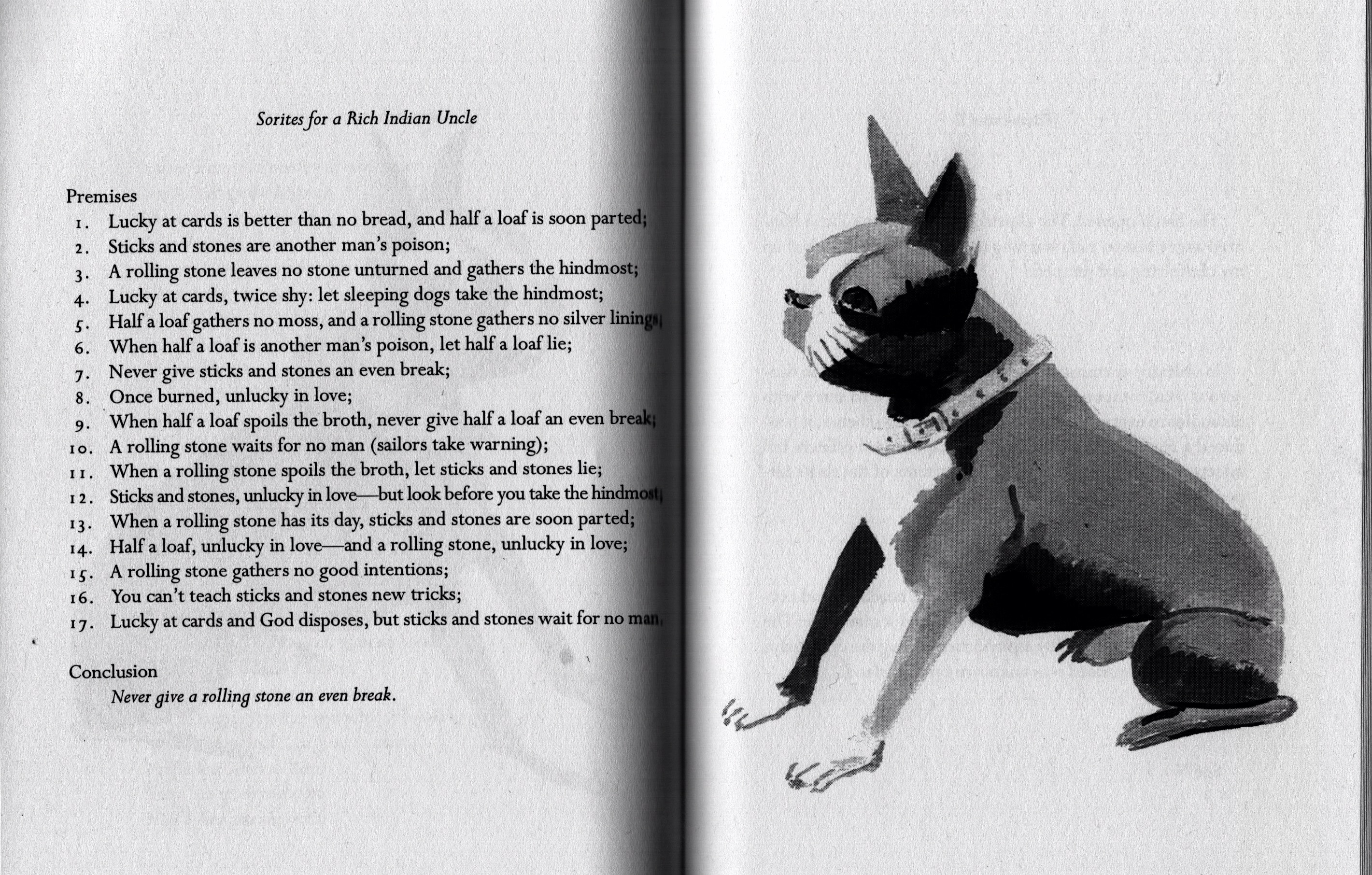
Click on the damn image to make it much bigger so you can read Mathews’ list (or sorites/stories/sorties). From Selected Declarations of Independence. The illustration is by Alex Katz.
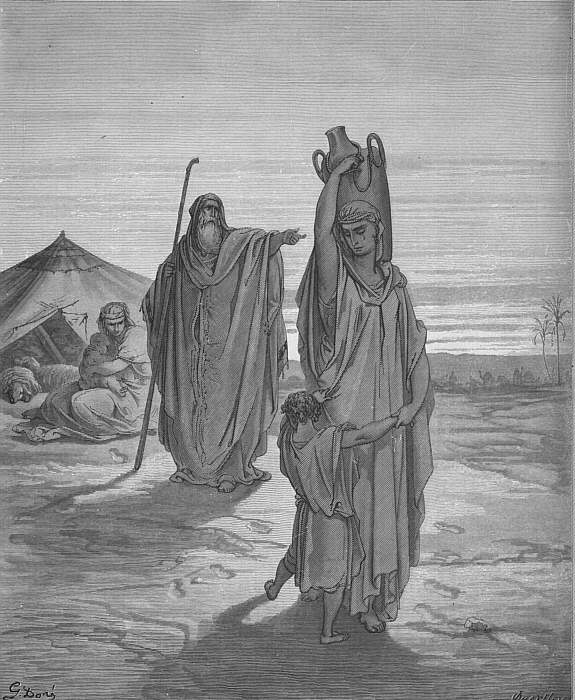
An African fairy tale retold by Alena Benesova and translated into English by Ruth Shepherd. The marvelous illustration is by Karel Franta. From Animal Fairy Stories.
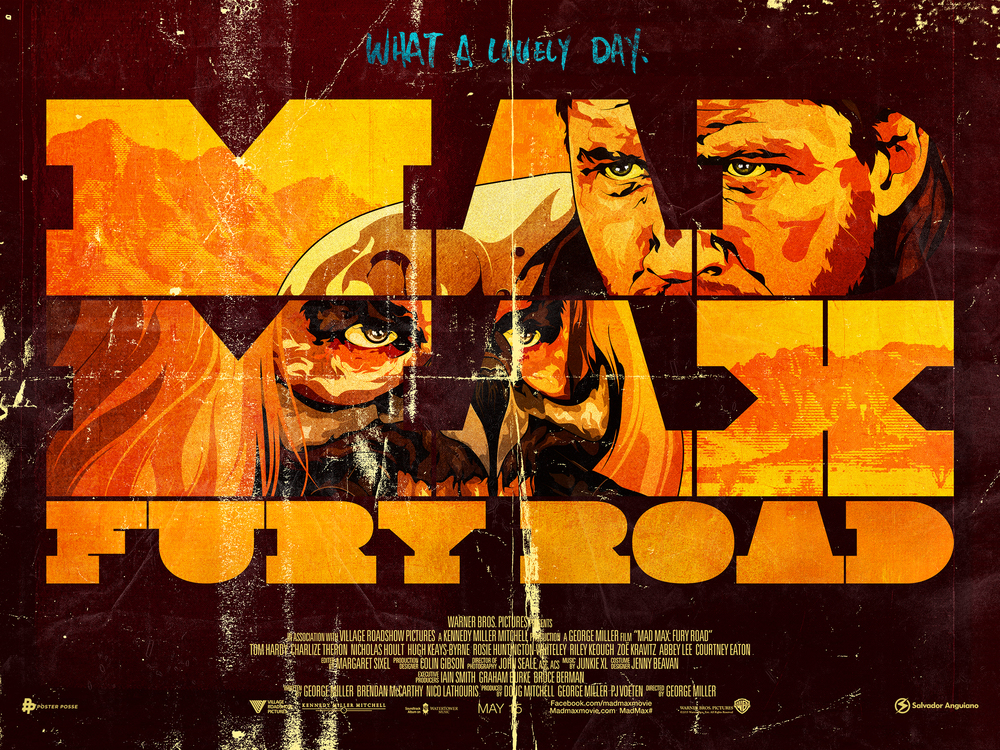
Fury Road film poster by John AslaronaGeorge Miller’s Mad Max: Fury Road performs exactly what its intended audience demands. Essentially a cartoonish two-hour car chase brimming with violent badassery, Fury Road precludes any real criticism. Poking at the weak dialogue, cardboard characterizations, and muddled motivations would miss the point. Fury Road looks amazing. It’s thrilling. It’s violent. It does what it was made to do. It’s a spectacular entertainment. (Spectacular in the Guy Debord sense).
Those who would contend there’s more to Fury Road, that would protest I’m missing some depth here, might refer me to the film’s feminist motifs. Yes, this is a film that critiques and rebels against patriarchal authority (going so far as to spell out its message in big block letters even). Maybe there’s a Freudian or Lacanian analysis in there too: Charlize Theron’s Imperator Furiosa (she’s the real star of the film—Tom Hardy’s Max is a bland substitute for old crazy eyes Mel), shorn of both hair and an arm (castration symbols, no?) driving an enormous phallus (one dangling a big testicle full of fuel, power, no less) across the desert wastes, plunging it violently ahead to save some concubines (their eminence derives from their non-mutant genes and marvelous cheekbones—like Zack Snyder’s 300, Fury Road always privileges ideal body types over aberrations).
Where was I? It doesn’t really matter.
Ah, yes: I claimed that the movie obviates criticism.
Fury Road is a product, a commodity that successfully camouflages its very commodification. It’s fan service for our post global id.
The film has been nearly universally praised, as a quick tour through the aggregator site Rotten Tomatoes shows. I’ll lazily pull from RT’s pull quotes lazily: “This movie will melt your face off,” promises Christy Lemire. (Uh, okay). For David Edelstein, seeing the film a second time “became about digging the spectacle – not to mention the hilarious sexual politics.” (Were they really “hilarious”?) “An A-plus B-movie that at times feels almost like a tone poem to early-’80s excess,” writes Christopher Orr, who may or may not know what a tone poem is. Mark Kermode, a crank whom I generally admire, calls it “an orgy of loud and louder, leaving us alternately exhilarated, exasperated and exhausted.”
I stuff these quips in here to show how Fury Road precludes any real criticism. Like I said up front, it does what it intends to do, and what it intends to do is show us something wholly familiar in a way that makes us think that we are not seeing something wholly familiar. But for me, anyway, Fury Road does feel familiar, like any number of movies I’ve already seen. Maybe blame it on Miller’s earlier Mad Max films. Maybe they colonized our cultural imagination so much that any strangeness in Fury Road is difficult to glean, hence the filmmaker’s central trick: Speed the damn thing up. Less character development, less bothersome talking.
The first edges of that boredom actually creep in early, when we see how little is actually at stake in the film. Miller’s gambit is to keep Max constrained for the first quarter of the film—bound, chained, even muzzled. Tied to the prow of a rumbling car like some mythic figure, Max is relentlessly imperiled by spears and bullets and an apocalyptic sandstorm. But like some mythic figure, we know he’ll never die. Like the Roadrunner cartoons it so closely resembles, Fury Road imagines a slapstick world of zany cause-and-effect non-logic, producing kinetic anxieties in its audience that are ultimately relieved (over and over again) with a belief so strong that it cannot be suspended: Max will not die. Max can never die. There must be a sequel.
That promise of a sequel finds its affirmation in the film’s most clichéd final moments. (I’m going to discuss the end of the film now. Spoilers coming up—fair warning, eh?)
I am a woman who appeared in public on Late Night with David Letterman on March 22, 1989.
In the words of my husband, Rudy, I am a woman whose face and attitudes are known to something over half of the measurable population of the United States, whose name is on lips and covers and screens. Whose heart’s heart is invisible to the world and unapproachably hidden. Which is what Rudy thought could save me from all this appearance implied.
The week of March 19, 1989, was the week David Letterman’s variety-and-talk show featured a series of taped skits on the private activities and pastimes of executives at NBC. My husband and I sacrificed sleep and stayed up late, watching. My husband, whose name in the entertainment industry is better known than his face, had claimed at first to be neutrally excited about the call I’d gotten from Late Night, though by the time he’d been driven home, he was beginning to worry that this particular public appearance could present problems. He knew and feared Letterman; he claimed to know that Letterman loved to savage female guests. It was on a Sunday that Rudy told me we would need to formulate strategies for my appearance on Late Night. March 22nd was to be a Wednesday.
I was pretty happy when Jim O’Rourke’s new LP Simple Songs showed up in today’s mail. (I tried to take a photo of the record cover, which has this glossy-embossed-Jim-visual-echo-of-the-cover-to-Halfway-to-a-Threeway-thing going on, but it was too glossy, the cover, so here’s the Drag City packing tape that sealed the package):
I’ve already lauded Simple Songs here, based on listening to it dozens of times on NPR last week. Even though the streaming quality wasn’t so bad (and I played it over a proper stereo system), it simply isn’t as good as the full rich sound on the vinyl. (As I write this, I realize that I have a tendency, like many people, I’m thinking, to listen to too much new music digitally, over streaming services or as shitty compressed mp3s, or—even worse!—on YouTube. I think O’Rourke’s songwriting, musicianship, and production can withstand these new technologies, but I’ve also been a huge fan of his for, jeez, 20 years now, so I’m compelled to listen to his work much more closely than, say, New Band with mp3).
Anyway.
Simple Songs is beautiful: Rich, full, personal, and somehow expansive at only eight songs in 33 minutes. O’Rourke seems to have structured the album like a 1970s singer-songwriter record—the sequencing is perfect, with each side culminating in moments that synthesize O’Rourke’s cynicism with real pathos. Worth the long wait.
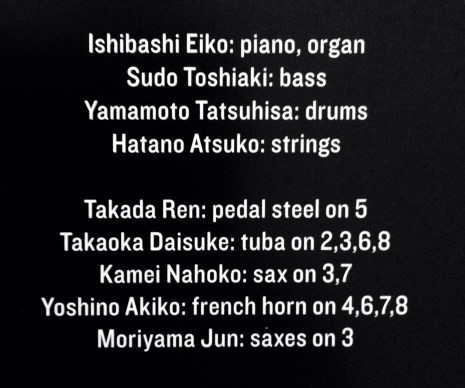
The LP contains a lyric sheet, as well as the album’s personnel:
I’m thinking that some of these guys are playing with O’Rourke in this concert from last year (I’m pretty confident that Yamamoto Tatsuhisa is on drums):









 Biblioklept