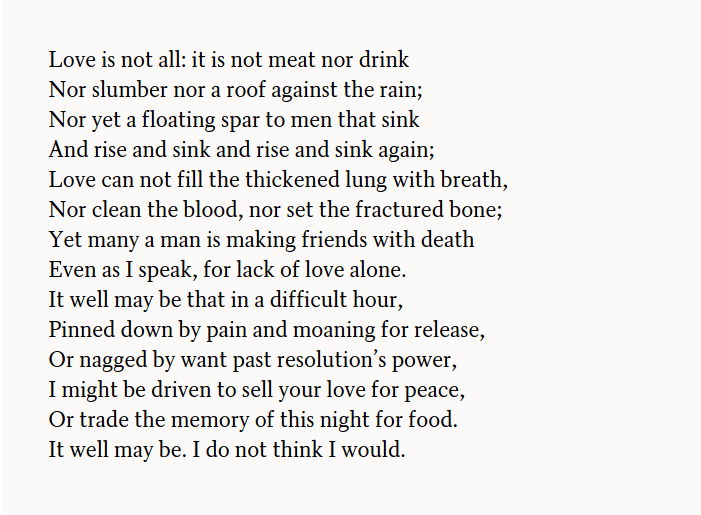
“Love is not all” — Edna St. Vincent Millay

Screenshot 2015-05-04 at 7.33.58 PM

An Interview with Christopher K. Coffman and Daniel Lukes, Editors of William T. Vollmann: A Critical Companion (Part 2)

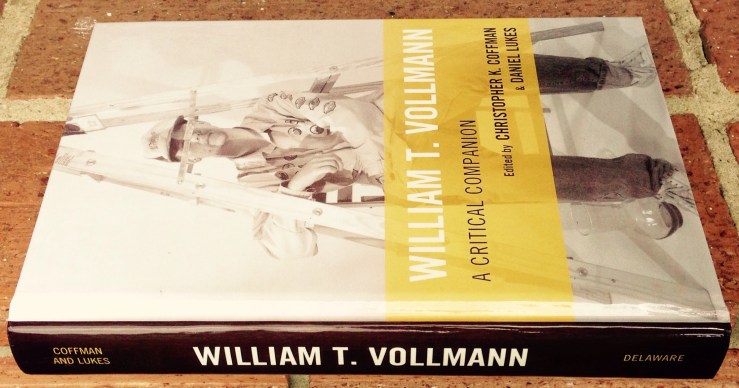
William T. Vollmann: A Critical Companion, newish from University of Delaware Press, collects academic essays and memoir-vignettes by a range of critics and authors to make the case that Vollmann is, as the blurb claims, the “most ambitious, productive, and important living author in the US.” I interviewed the book’s editors, Christopher K. Coffman and Daniel Lukes, over a series of emails in a two-part interview. You can read the first part here. A few days after the first part of the interview posted, Lukes and Coffman hosted a book launch party in NYC for WTV: ACC; the pics in this interview are from that event (check out the Facebook page for more, including Jonathan Franzen reading from his piece on Vollmann).
IMG_6524


Biblioklept: Let’s talk about the formal elements of William T. Vollmann: A Critical Companion. The collection seems to balance essays of a more academic flavor with memoir-vignettes, personal accounts, and riffs.

Christopher K. Coffman: We decided early on to intersperse among the academic essays pieces by non-scholars, or by scholars writing in a non-scholarly mode. The goal here was at least two-fold. We wanted to offer something a bit more accessible to WTV readers who were not in academia (although I think the average WTV fan can follow scholarly arguments as well as many of us in academia can). Also, we realized that some people with a privileged view on WTV’s work–such as those of WTV’s book designers who contributed (Bolte and Speaker Austin)–could add something of interest and great value to audiences in and out of academia, and we wanted to make space for that. I would have to look back through the e-mail log to be sure, but I think Daniel first came up with the idea of soliciting shorter pieces from non-scholars, and that I then conceived the structural component. I am a huge fan of Hemingway’s In Our Time, and the contrapuntal play between the stories and the very short inter-chapters in that book served for me as a paradigm of what Daniel and I have tried to do in this regard. Of course, as soon as we brought up the example of Hemingway, we recalled that WTV does something similar in Thirteen Stories and Thirteen Epitaphs, so he beat us to the punch even there. At any rate, my hope is that our readers find in the short chapterlets material that serves as a response to or as an extension of ideas presented in the more properly scholarly readings that surround those shorter pieces.

The second question of arrangement was the placement of essays and interchapters, and we here grouped according to subject matter as well as we could, without merely replicating what McCaffery and Hemmingson had done for Expelled from Eden. We also, obviously, made space for both Larry and Michael as the authors of the Preface and Afterword. Our intention there, insofar as I can speak for both of us, is to make it clear that we are trying to situate our contribution to scholarship on WTV in relation to the work that Larry and Michael have already done. Finally, I wrote the Introduction not only because one of us had to, but also because Daniel was spoken for in the sense that he already had material that formed the basis for the really great chapter that he contributed. Also, I found the chance to frame the book’s material via an introduction that dealt with WTV’s place in the landscape of post-1945 American fiction appealing. That said, while the introduction bears my byline, my ongoing conversation with Daniel during the past few years shaped my thinking about WTV as much as any original ideas of my own, so he deserves a lot of credit for the introduction as well.

Daniel Lukes: I’ve been going back over the timeline to see if Samuel Cohen and Lee Konstantinou’s edited volume The Legacy of David Foster Wallace, which also features some shorter pieces, was an influence on that, but it looks like we took our approach independently. Though I will say their book did serve as a model in some ways of what ours could be. Dealing with the “non-scholarly” pieces has been for me one of the most exciting parts of putting this book together (the distinction between “scholarlies” and “non-scholarlies” itself being one of the various amusing frameworks that Chris and I have been carrying around throughout the process). From the beginning I thought it would be very helpful to have some of Vollmann’s literary peers chime in: you just don’t hear too much from them about him. So we reached out to writers we thought might be Vollmann readers: some just weren’t (I’d love to know if Cormac McCarthy reads Vollmann: the letter I mailed to a presumed representative of his returned unopened). Some were Vollmann fans/friends, but couldn’t make it for another reason; when Jonathan Franzen came through and expressed his enthusiasm for the project and willingness to contribute a piece, I felt some relief. And James Franco was a pleasure to work with. That said I think the primary value of the non-scholarlies is in the insights they offer into Vollmann’s world and writing practices, from those who have worked closely with him, in particular Carla Bolte, Mary Austin Speaker, and Mariya Gusev’s excellent and vivid pieces. Continue reading “An Interview with Christopher K. Coffman and Daniel Lukes, Editors of William T. Vollmann: A Critical Companion (Part 2)”

Read “Gandalf Goes West,” a short story by Chris Power

“Gandalf Goes West”

by

Chris Power


HAL STANDS IN FRONT OF THE SCREEN. On the screen the words GANDALF GOES EAST.


GO EAST, types Hal.


The cursor flashes.


BILBO GOES EAST, the screen says.


The cursor flashes.


Another line of text appears: GANDALF GOES WEST, it says.


Hal clenches his hands once, twice. He cannot progress in the game without Gandalf. GO WEST, he types.


The cursor flashes.


BILBO GOES WEST, the screen says.


Ben comes into the room and walks over to Hal. He reads the words on the screen from top to bottom:


GANDALF GOES EAST


GO EAST


BILBO GOES EAST


GANDALF GOES WEST


GO WEST


BILBO GOES WEST


GANDALF GOES EAST


Hal turns to Ben. How are you? Hal says.


Ben stares at the screen.


Stay, says Ben.

Read the rest of Chris Power’s short story “Gandalf Goes West” at The White Review.

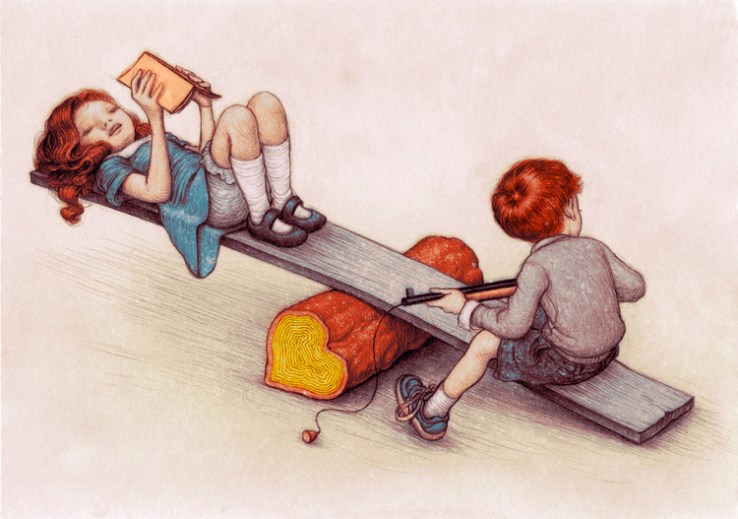
See-Saw — James Jean

seesaw-web

No Zen-type One, always rather Two (Infinite Jest)

How many sub-rosa twins are there, out there, really? What if heredity, instead of linear, is branching? What if it’s not arousal that’s so finitely circumscribed? What if in fact there were ever only like two really distinct individual people walking around back there in history’s mist? That all difference descends from this difference? The whole and the partial. The damaged and the intact. The deformed and the paralyzingly beautiful. The insane and the attendant. The hidden and the blindingly open. The performer and the audience. No Zen-type One, always rather Two, one upside-down in a convex lens.

A passage from David Foster Wallace’s novel Infinite Jest. Thoughts are Joelle Van Dyne’s for those keeping score. The riff reminds me of all the binaries in Gravity’s Rainbow, but maybe only because I just read Gravity’s Rainbow.

Antaeus Setting Down Dante and Virgil in the Last Circle of Hell — William Blake

514484

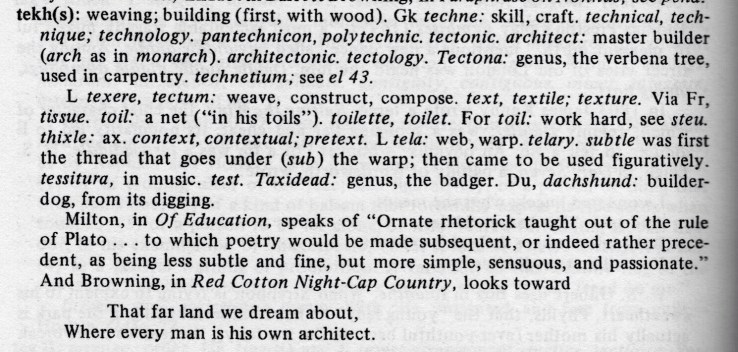
tekh(s): weaving; building (first, with wood).

IMG_6502

From Joseph T. Shipley’s The Origin of English Words: A Discursive Dictionary of Indo-European Roots.

The Sirens — Gustave Moreau

Madame Psychosis’ Downer-Lit Hour Reading List (Infinite Jest)

Like for months in the spring semester of Y.D.P.A.H. she referred to her own program as ‘Madame’s Downer-Lit Hour’ and read depressing book after depressing book — Good Morning, Midnight and Maggie: A Girl of the Streets and Giovanni’s Roomand Under the Volcanoplus a truly ghastly Bret Ellis period during Lent — in a monotone, really slowly, night after night.

From David Foster Wallace’s Infinite Jest (hyperlinks are my attempt at oblique (non)annotation and obviously not part of the original text).

Gemini — Mikalojus Ciurlionis

Faust was an actual person (From Ishmael Reed’s novel Mumbo Jumbo)

…Faust was an actual person. Somewhere between 1510 and 1540 this “wandering conjurer and medical quack” made his travels about the southwest German Empire, telling people his knowledge of “secret things.” I always puzzled over why such a legend was so basic to the Western mind; but I’ve thought about it and now I think I know the answer. Can’t you imagine this man traveling about with his bad herbs, love philters, physicks and potions, charms, overcharging the peasants but dazzling them with his badly constructed Greek and sometimes labeling his “wonder cures” with gibberish titles like “Polyunsaturated 99½% pure.” Hocus-pocus. He makes a living and can always get a free night’s lodging at an inn with his ability to prescribe cures and tell fortunes, that is, predict the future. You see he travels about the Empire and is able to serve as a kind of national radio for people in the locales. Well 1 day while he is leeching people, cutting hair or raising the dead who only have diseases which give the manifestations of death, something really works. He knows that he’s a bokor adept at card tricks, but something really works. He tries it again and it works. He continues to repeat this performance and each time it works. The peasants begin to look upon him as a supernatural being and he encourages the tales about him, that he heals the sick and performs marvels. He becomes wealthy with his ability to do The Work. Royalty visits him. He is a counselor to the king. He lives in a castle. Peasants whisper, a Black man, a very bearded devil himself visits him. That strange coach they saw, the 1 with the eyes as decorations drawn to his castle by wild-looking black horses. They say that he has made a pact with the devil because he invites the Africans who work in various cities throughout the Empire to his castle. There were 1000s in Europe at the time: blackamoors who worked as butlers, coachmen, footmen, pint-sized page boys; and conjurors whom only the depraved consulted. The villagers hear “Arabian” music, drums coming from the place but as soon as the series of meetings begin it all comes to a halt. Rumors circulate that Faust is dead. The village whispers that the Black men have collected. That is the nagging notion of Western man. China had rocketry, Africa iron furnaces, but he didn’t know when to stop with his newly found Work. That’s the basic wound. He will create fancy systems 13 letters long to convince himself he doesn’t have this wound. What is the wound? Someone will even call it guilt. But guilt implies a conscience. Is Faust capable of charity? No it isn’t guilt but the knowledge in his heart that he is a bokor. A charlatan who has sent 1000000s to the churchyard with his charlatan panaceas. Western man doesn’t know the difference between a houngan and a bokor. He once knew this difference but the knowledge was lost when the Atonists crushed the opposition. When they converted a Roman emperor and began rampaging and book-burning. His sorcery, white magic, his bokorism will improve. Soon he will be able to annihilate 1000000s by pushing a button. I do not believe that a Yellow or Black hand will push this button but a robot-like descendant of Faust the quack will. The dreaded bokor, a humbug who doesn’t know when to stop. 

From Ishmael Reed’s novel Mumbo Jumbo.

Madame Roulin Rocking the Cradle (A Lullaby) — Vincent Van Gogh

Read J.G. Ballard’s story “The Terminal Beach”

“The Terminal Beach”

by

J.G. Ballard


The Terminal Beach


At night, as he lay asleep on the floor of the ruined bunker, Traven heard the waves breaking along the shore of the lagoon, like the sounds of giant aircraft warming up at the ends of their runways. This memory of the great night raids against the Japanese mainland had filled his first months on the island with images of burning bombers falling through the air around him. Later, with the attacks of ben-ben, the nightmare passed and the waves began to remind him of the deep Atlantic rollers on the beach at Dakar, where he had been born, and of watching from the window in the evenings for his parents to drive home along the corniche road from the airport. Overcome by this long-forgotten memory, he woke uncertainly from the bed of old magazines on which he slept and went out to the dunes that screened the lagoon.


Through the cold night air he could see the abandoned Superfortresses lying among the palms beyond the perimeter of the emergency landing field three hundred yards away. Traven walked through the dark sand, already forgetting where the shore lay, although the atoll was little more than half a mile in width. Above him, along the crests of the dunes, the tall palms leaned into the dim air like the symbols of a cryptic alphabet. The landscape of the island was covered by strange ciphers.


Giving up the attempt to find the beach, Traven stumbled into a set of tracks left years earlier by a large caterpillar vehicle. The heat released by the weapons tests had fused the sand, and the double line of fossil imprints, uncovered by the evening air, wound its serpentine way among the hollows like the footfalls of an ancient saurian.


Too weak to walk any further, Traven sat down between the tracks. Hoping that they might lead him to the beach, he began to excavate the wedge-shaped grooves from a drift into which they disappeared. He returned to the bunker shortly before dawn, and slept through the hot silences of the following noon.


The Blocks


As usual on these enervating afternoons, when not even a breath of on-shore breeze disturbed the dust, Traven sat in the shadow of one of the blocks, lost somewhere within the centre of the maze. His back resting against the rough concrete surface, he gazed with a phlegmatic eye down the surrounding aisles and at the line of doors facing him. Each afternoon he left his cell in the abandoned camera bunker among the dunes and walked down into the blocks. For the first half an hour he restricted himself to the perimeter aisle, now and then trying one of the doors with the rusty key in his pocket – found among the litter of smashed bottles and cans in the isthmus of sand separating the testing ground from the air-strip – and then inevitably, with a sort of drugged stride, he set off into the centre of the blocks, breaking into a run and darting in and out of the corridors, as if trying to flush some invisible opponent from his hiding place. Soon he would be completely lost. Whatever his efforts to return to the perimeter, he always found himself once more in the centre.


Eventually he would abandon the task, and sit down in the dust, watching the shadows emerge from their crevices at the foot of the blocks. For some reason he invariably arranged to be trapped when the sun was at zenith – on Eniwetok, the thermonuclear noon.


One question in particular intrigued him: ‘What sort of people would inhabit this minimal concrete city?’

Continue reading “Read J.G. Ballard’s story “The Terminal Beach””

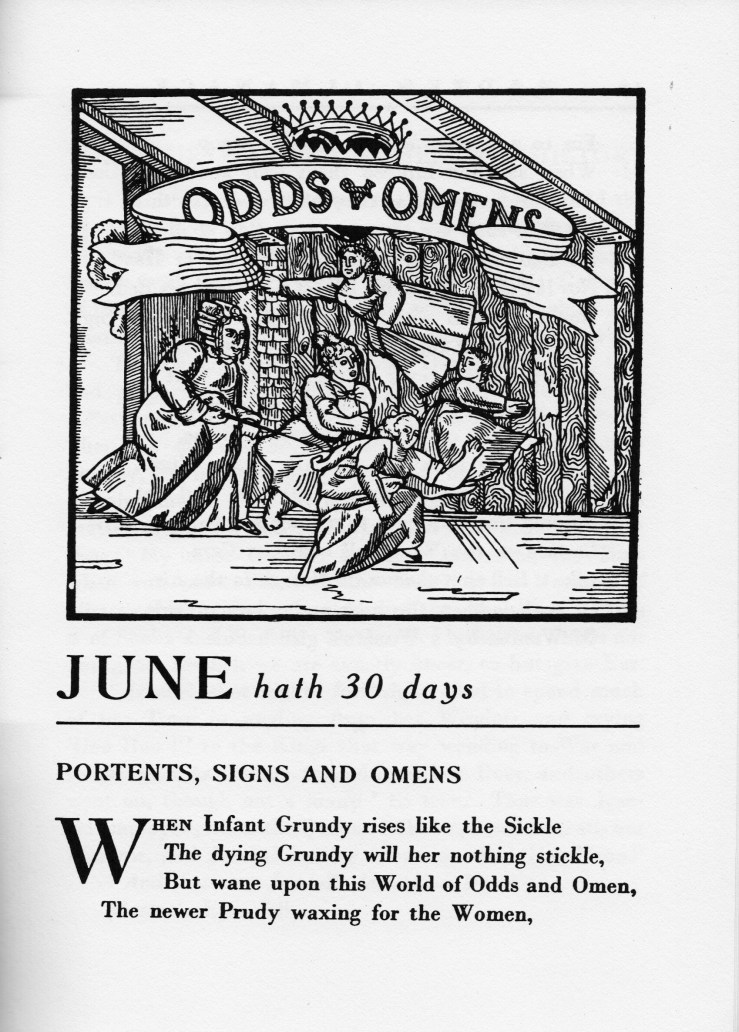
“June” — Djuna Barnes

image image

Possible photographic evidence of Thomas Pynchon’s hand (and a pig piñata)

6a00d8341c630a53ef014e88434d23970d

From an article in LAist:

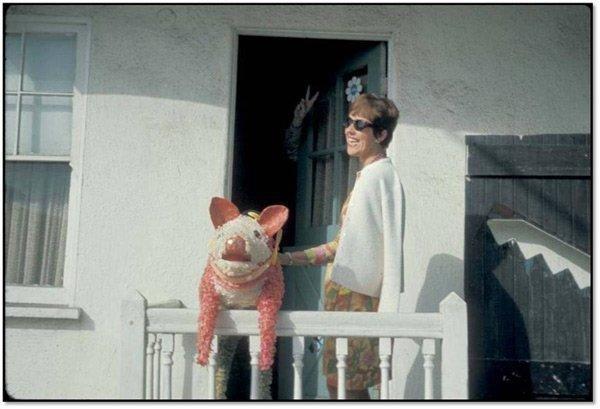
A photograph on the back cover of a memoir by Phyllis Gebauer, a close friend of Pynchon’s, shows the author’s hand extending out of the door of his apartment giving a peace sign with a pig piñata named Claude and Gebauer in the foreground. In 2011, Gebauer donated her rare collection of signed Pynchon novels to UCLA.

I seem to recall mention of this pig piñata in A Journey into the Mind of P (but I could be wrong).

Big thanks to Doug Eklund for pointing the photo out to me.