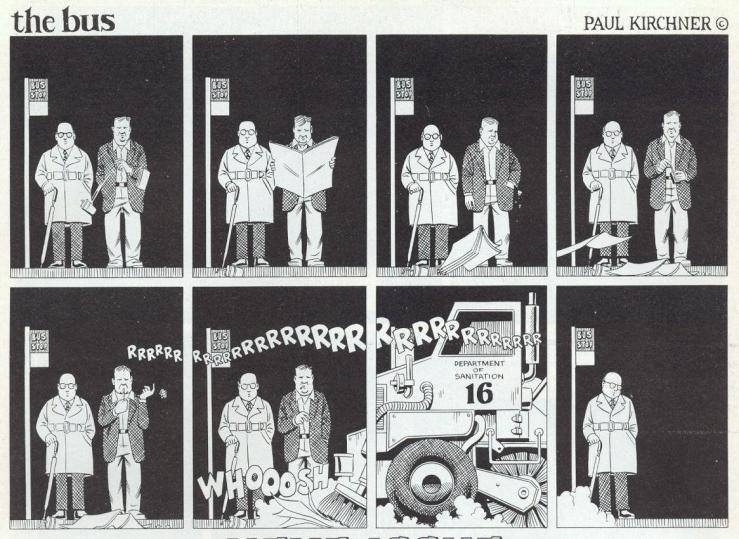
The Bus — Paul Kirchner

U6iKNJX - Imgur

Read “Tony and the Beetles,” an early short story by Philip K. Dick

illus

“Tony and the Beetles”

by

Philip K. Dick

Reddish-yellow sunlight filtered through the thick quartz windows into the sleep-compartment. Tony Rossi yawned, stirred a little, then opened his black eyes and sat up quickly. With one motion he tossed the covers back and slid to the warm metal floor. He clicked off his alarm clock and hurried to the closet.

It looked like a nice day. The landscape outside was motionless, undisturbed by winds or dust-shift. The boy’s heart pounded excitedly. He pulled his trousers on, zipped up the reinforced mesh, struggled into his heavy canvas shirt, and then sat down on the edge of the cot to tug on his boots. He closed the seams around their tops and then did the same with his gloves. Next he adjusted the pressure on his pump unit and strapped it between his shoulder blades. He grabbed his helmet from the dresser, and he was ready for the day.

In the dining-compartment his mother and father had finished breakfast. Their voices drifted to him as he clattered down the ramp. A disturbed murmur; he paused to listen. What were they talking about? Had he done something wrong, again?

And then he caught it. Behind their voices was another voice. Static and crackling pops. The all-system audio signal from Rigel IV. They had it turned up full blast; the dull thunder of the monitor’s voice boomed loudly. The war. Always the war. He sighed, and stepped out into the dining-compartment.

“Morning,” his father muttered.

“Good morning, dear,” his mother said absently. She sat with her head turned to one side, wrinkles of concentration webbing her forehead. Her thin lips were drawn together in a tight line of concern. His father had pushed his dirty dishes back and was smoking, elbows on the table, dark hairy arms bare and muscular. He was scowling, intent on the jumbled roar from the speaker above the sink.

“How’s it going?” Tony asked. He slid into his chair and reached automatically for the ersatz grapefruit. “Any news from Orion?”

Neither of them answered. They didn’t hear him. He began to eat his grapefruit. Outside, beyond the little metal and plastic housing unit, sounds of activity grew. Shouts and muffled crashes, as rural merchants and their trucks rumbled along the highway toward Karnet. The reddish daylight swelled; Betelgeuse was rising quietly and majestically. Continue reading “Read “Tony and the Beetles,” an early short story by Philip K. Dick”

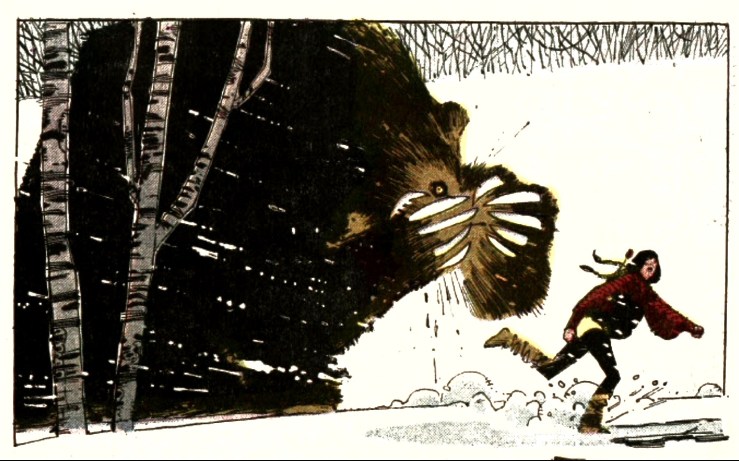
Demon Bear — Bill Sienkiewicz

18-bear2

“Valley Candle” — Wallace Stevens

Screenshot 2015-04-11 at 4.08.02 PM

Sugar Sphinx — Salvador Dali

Just when I was on the point of choking with a huge German word (Nathaniel Hawthorne’s journal entry, 11 April 1843)

April 11th.–I meditated accordingly, but without any very wonderful result. Then at eight o’clock bothered myself till after nine with this eternal tale of Tieck. The forenoon was spent in scribbling; but at eleven o’clock my thoughts ceased to flow,–indeed, their current has been wofully interrupted all along,–so I threw down my pen, and set out on the daily journey to the village. Horrible walking! I wasted the customary hour at the Athenæum, and returned home, if home it may now be called. Till dinner-time I labored on Tieck’s tale, and resumed that agreeable employment after the banquet.

Just when I was on the point of choking with a huge German word, Molly announced Mr. Thoreau. He wished to take a row in the boat, for the last time, perhaps, before he leaves Concord. So we emptied the water out of her, and set forth on our voyage. She leaks, but not more than she did in the autumn. We rowed to the foot of the hill which borders the North Branch, and there landed, and climbed the moist and snowy hill-side for the sake of the prospect. Looking down the river, it might well have been mistaken for an arm of the sea, so broad is now its swollen tide; and I could have fancied that, beyond one other headland, the mighty ocean would outspread itself before the eye. On our return we boarded a large cake of ice, which was floating down the river, and were borne by it directly to our own landing-place, with the boat towing behind.

Parting with Mr. Thoreau, I spent half an hour in chopping wood, when Molly informed me that Mr. Emerson wished to see me. He had brought a letter of Ellery Channing, written in a style of very pleasant humor. This being read and discussed, togetherwith a few other matters, he took his leave, since which I have been attending to my journalizing duty; and thus this record is brought down to the present moment.

From Nathaniel Hawthorne’s American Note-Books.

Augustine Saving a Falling Child — Simone Martini

simone_martini_072

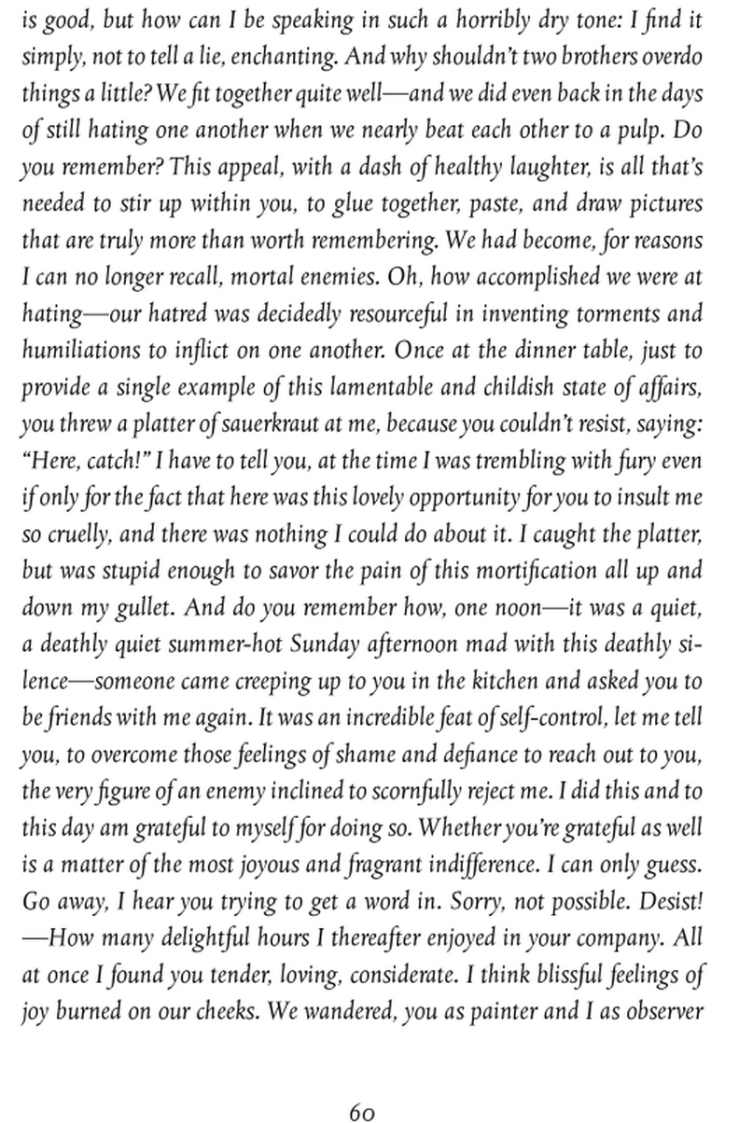
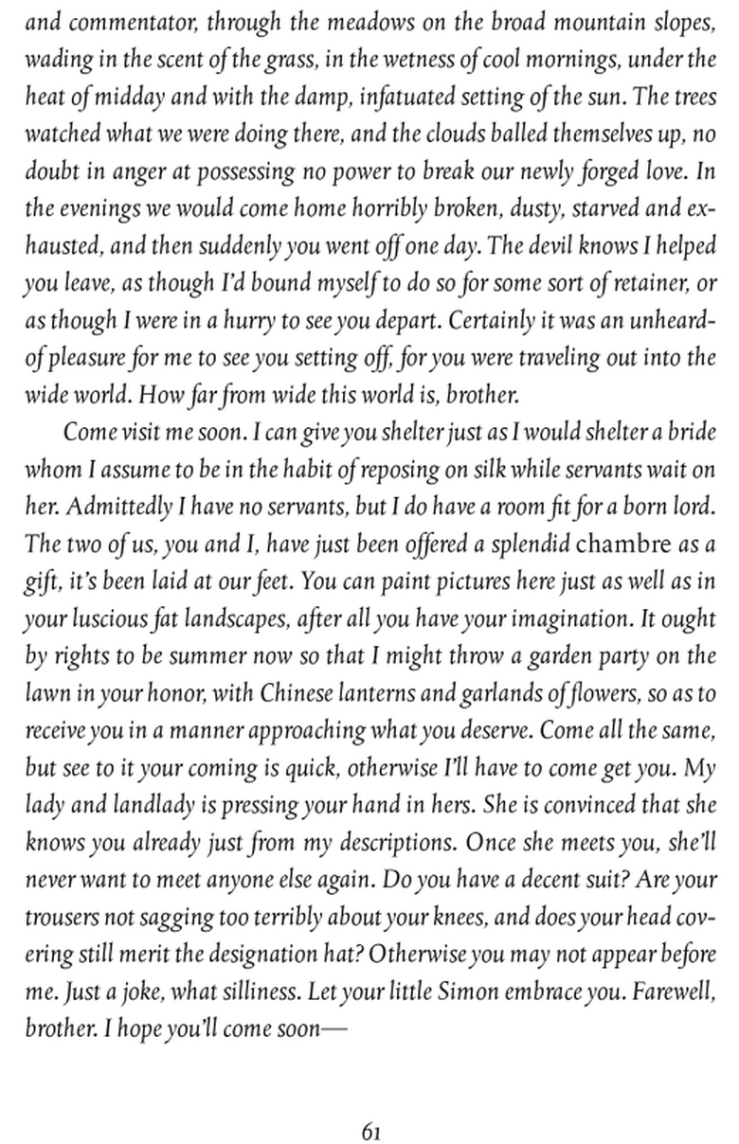
Happy National Sibling Day from Robert Walser

RW1

RW2

RW3

From Robert Walser’s The Tanners, translated by Susan Bernofsky.

House of the Past — Clarence John Laughlin

OLYMPUS DIGITAL CAMERA

Sphinx (Woman in Three Stages) — Edvard Munch

Lydia Davis on Thomas Pynchon

A rather appealing specimen of early Pynchon is the last story in his collection Slow Learner. The story, “The Secret Integration”—first published in the Saturday Evening Post more than forty years ago (three years after V. appeared)—involves a gang of young practical jokers and a rich childhood setting of an old town with a new development, a sprawling estate with a derelict mansion, and a downtown, complete with seedy hotel. In one deftly described scene, the boys coast on their bikes down a long hill in the early evening toward the hotel, “leaving behind two pages of arithmetic homework and a chapter of science” and, on the TV, “a lousy movie, some romantic comedy.” Because all the televisions in town receive only one channel, the boys, as they fly by, are able to follow the movie’s progress from house to house, through doors and windows “still open for the dark’s first coolness.”

In his introduction to Slow Learner, Pynchon, who somewhat preempts our reactions to the story, remarks that he likes it more than he dislikes it. In fact it is so likable that one envies the boys their comfortable society and the fields, streams, and town of their games. Their collaboration and apportioning of assignments is charming (to develop an arsenal for sabotaging the railroad; to enlist malcontent first-graders to destroy the boys’ latrine; to infiltrate PTA meetings); the elaborateness of their schemes, and the number that succeed, is impressive; and the animation of the central character, Grover the boy genius—with his enormous vocabulary, fund of information, and flights of hilarity—is particularly savory. The pranks the boys plan are potentially devastating to the community, yet, as Pynchon says in a lovely bit of writing, the boys would never actually take “any clear or irreversible step,” because “everybody on the school board, and the railroad, and the PTA and paper mill had to be somebody’s mother or father, whether really or as a member of a category; and there was a point at which the reflex to their covering warmth, protection, effectiveness against bad dreams, bruised heads and simple loneliness took over and made worthwhile anger with them impossible.”

There is a lyrical humanity in this story, an almost unapologetic gentleness, inviting and inclusive, that contrasts with the weightier, complex pessimism and bravura of Pynchon’s later works, in which perhaps it is more difficult for the characters to go home and be comforted at the end of the day.

From the Summer 2005 issue of Bookforum.

Don Cherry and Organic Music Theatre, live on Italian TV in 1976

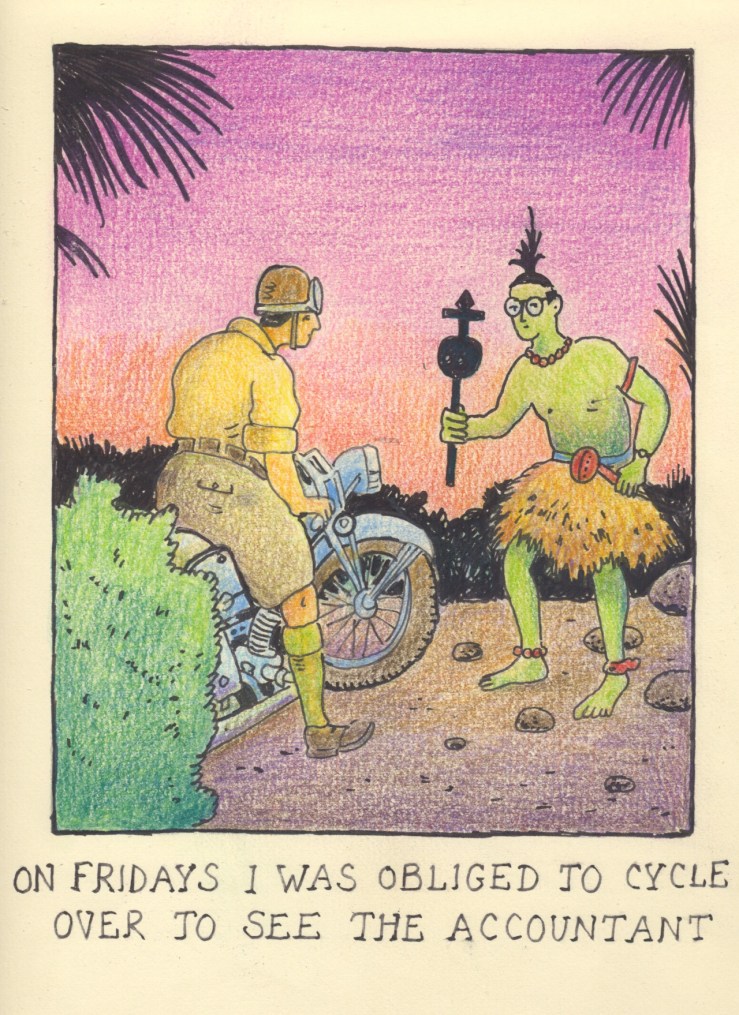
Fridays (Glen Baxter)

tumblr_nk11uiRdnq1r5zbdgo1_1280

Orpheus – Giovanni Bellini

“The She-Owl” — Robert Walser

“The She-Owl”

by

Robert Walser

A she-owl in a ruined wall said to herself: What a horrifying existence. Anyone else would be dismayed, but me, I am patient. I lower my eyes, huddle. Everything in me and on me hangs down like gray veils, but above me, too, the stars glitter; this knowledge fortifies me. Bushy plumage covers me: by day I sleep, at night I’m awake. I need no mirror to discover how I look: feeling tells me. I can easily think of my peculiar face.

People say I’m ugly. If they only knew what smiles I feel in my soul, they’d not run from me in fright anymore. Yet they don’t see into the interior, they stop at the body, the clothes. Once I was young and pretty, I might say, but that makes it sound as if I pine for the past, and that is not my way. The she-owl, who once practiced growing big, endures the course and change of time tranquilly, she finds herself and every present moment.

They say to me: “Philosophy.” Yet the death that comes beforetimes cancels the later one. Death is nothing new to this she-owl, she knows it already. It looks as if I’m a lady of learning, wear glasses, and somebody is so interested in me that he pays me a visit now and then. He finds me Harmonious. He tells me I’m somebody who doesn’t disappoint him. Of course, I have never bewitched him either. He studies me profoundly, strokes my wings, brings me candy sometimes, with which to delight, so he believes, the most serious of females, and he’s making no mistake. I am reading a poet whose finesse makes him fit to be digested by owls. There’s something sweet in his ways, something veiled, undefinable, which is to say, he suits me well. Once I was charming, I laughed and twittered jokes into the blue of the day, I turned many young men’s heads. Now things look different, the shoes I wear have holes in them, I’m old, I sit and say nothing.

Translated by Christopher Middleton.

“Dizzy Dizzy” (Live in ’77) — Can