“The Gardener and the Guinea” — G.K. Chesterton

“The Gardener and the Guinea”

by

G.K. Chesterton

Strictly speaking, there is no such thing as an English Peasant. Indeed, the type can only exist in community, so much does it depend on cooperation and common laws. One must not think primarily of a French Peasant; any more than of a German Measle. The plural of the word is its proper form; you cannot have a Peasant till you have a peasantry. The essence of the Peasant ideal is equality; and you cannot be equal all by yourself.

Nevertheless, because human nature always craves and half creates the things necessary to its happiness, there are approximations and suggestions of the possibility of such a race even here. The nearest approach I know to the temper of a Peasant in England is that of the country gardener; not, of course, the great scientific gardener attached to the great houses; he is a rich man’s servant like any other. I mean the small jobbing gardener who works for two or three moderate-sized gardens; who works on his own; who sometimes even owns his house; and who frequently owns his tools. This kind of man has really some of the characteristics of the true Peasant—especially the characteristics that people don’t like. He has none of that irresponsible mirth which is the consolation of most poor men in England. The gardener is even disliked sometimes by the owners of the shrubs and flowers; because (like Micaiah) he prophesies not good concerning them, but evil. The English gardener is grim, critical, self-respecting; sometimes even economical. Nor is this (as the reader’s lightning wit will flash back at me) merely because the English gardener is always a Scotch gardener. The type does exist in pure South England blood and speech; I have spoken to the type. I was speaking to the type only the other evening, when a rather odd little incident occurred.

It was one of those wonderful evenings in which the sky was warm and radiant while the earth was still comparatively cold and wet. But it is of the essence of Spring to be unexpected; as in that heroic and hackneyed line about coming “before the swallow dares.” Spring never is Spring unless it comes too soon. And on a day like that one might pray, without any profanity, that Spring might come on earth as it was in heaven. The gardener was gardening. I was not gardening. It is needless to explain the causes of this difference; it would be to tell the tremendous history of two souls. It is needless because there is a more immediate explanation of the case: the gardener and I, if not equal in agreement, were at least equal in difference. It is quite certain that he would not have allowed me to touch the garden if I had gone down on my knees to him. And it is by no means certain that I should have consented to touch the garden if he had gone down on his knees to me. His activity and my idleness, therefore, went on steadily side by side through the long sunset hours.

And all the time I was thinking what a shame it was that he was not sticking his spade into his own garden, instead of mine: he knew about the earth and the underworld of seeds, the resurrection of Spring and the flowers that appear in order like a procession marshalled by a herald. He possessed the garden intellectually and spiritually, while I only possessed it politically. I know more about flowers than coal-owners know about coal; for at least I pay them honour when they are brought above the surface of the earth. I know more about gardens than railway shareholders seem to know about railways: for at least I know that it needs a man to make a garden; a man whose name is Adam. But as I walked on that grass my ignorance overwhelmed me—and yet that phrase is false, because it suggests something like a storm from the sky above. It is truer to say that my ignorance exploded underneath me, like a mine dug long before; and indeed it was dug before the beginning of the ages. Green bombs of bulbs and seeds were bursting underneath me everywhere; and, so far as my knowledge went, they had been laid by a conspirator. I trod quite uneasily on this uprush of the earth; the Spring is always only a fruitful earthquake. With the land all alive under me I began to wonder more and more why this man, who had made the garden, did not own the garden. If I stuck a spade into the ground, I should be astonished at what I found there…and just as I thought this I saw that the gardener was astonished too.

Just as I was wondering why the man who used the spade did not profit by the spade, he brought me something he had found actually in my soil. It was a thin worn gold piece of the Georges, of the sort which are called, I believe, Spade Guineas. Anyhow, a piece of gold.

If you do not see the parable as I saw it just then, I doubt if I can explain it just now. He could make a hundred other round yellow fruits: and this flat yellow one is the only sort that I can make. How it came there I have not a notion—unless Edmund Burke dropped it in his hurry to get back to Butler’s Court. But there it was: this is a cold recital of facts. There may be a whole pirate’s treasure lying under the earth there, for all I know or care; for there is no interest in a treasure without a Treasure Island to sail to. If there is a treasure it will never be found, for I am not interested in wealth beyond the dreams of avarice since I know that avarice has no dreams, but only insomnia. And, for the other party, my gardener would never consent to dig up the garden.

Nevertheless, I was overwhelmed with intellectual emotions when I saw that answer to my question; the question of why the garden did not belong to the gardener. No better epigram could be put in reply than simply putting the Spade Guinea beside the Spade. This was the only underground seed that I could understand. Only by having a little more of that dull, battered yellow substance could I manage to be idle while he was active. I am not altogether idle myself; but the fact remains that the power is in the thin slip of metal we call the Spade Guinea, not in the strong square and curve of metal which we call the Spade. And then I suddenly remembered that as I had found gold on my ground by accident, so richer men in the north and west counties had found coal in their ground, also by accident.

I told the gardener that as he had found the thing he ought to keep it, but that if he cared to sell it to me it could be valued properly, and then sold. He said at first, with characteristic independence, that he would like to keep it. He said it would make a brooch for his wife. But a little later he brought it back to me without explanation. I could not get a ray of light on the reason of his refusal; but he looked lowering and unhappy. Had he some mystical instinct that it is just such accidental and irrational wealth that is the doom of all peasantries? Perhaps he dimly felt that the boy’s pirate tales are true; and that buried treasure is a thing for robbers and not for producers. Perhaps he thought there was a curse on such capital: on the coal of the coal-owners, on the gold of the gold-seekers. Perhaps there is.
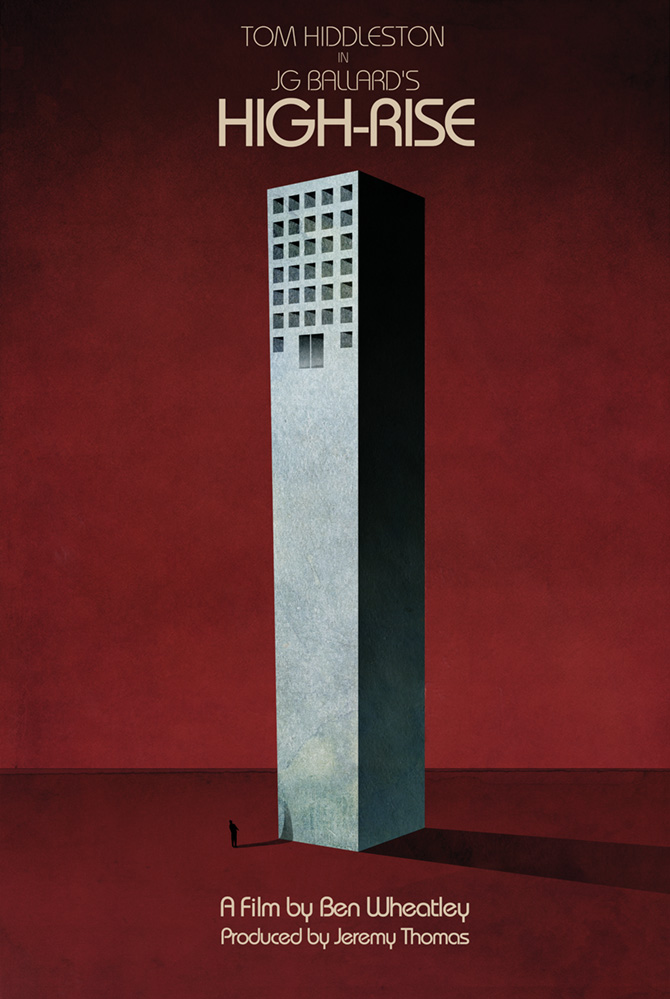
J.G. Ballard’s High Rise (Film Poster by Jay Shaw)

HIGH-RISE_A_670

Spring — Witold Pruszkowski

Then, as promised, the mononoke came for his bride (Hayao Miyazaki)


Jon McNaught’s Birchfield Close Is a Tranquil Visual Poem

A few weekends ago, I spent several days primitive camping on a tiny, rocky island off Cape Canaveral. The weather was miserable and the fishing was poor, but the company and bourbon offered cheer. Still, by the time I got home I was terribly sore, thoroughly damp, and inhabited by one of those hangovers that sets up shop inside one’s soul as a kind of second-consciousness, coloring the world a dreadful surreal blue. I wanted to see my family, but they were out playing tennis. There was a small stack of packages waiting for me though—review copies for this blog—with Jon McNaught’s Birchfield Close neatly nestled atop. After showering, I lay on my soft soft bed in the afternoon, read through the brief poem-novel-comic, and drifted into a gentle warm hazy nap. It was the most marvelous medicine. Sublime.

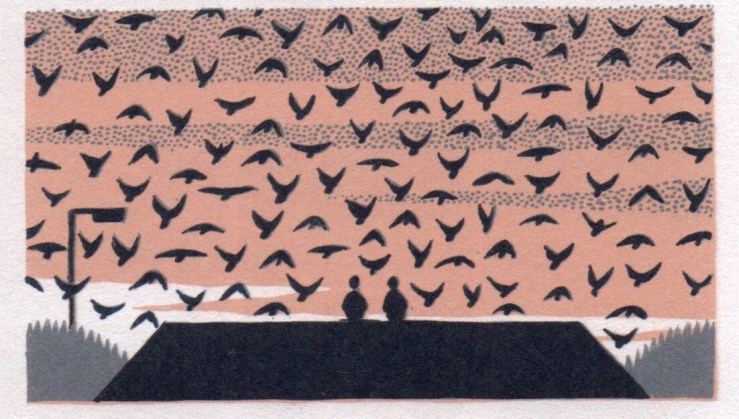
I read Birchfield Close again later that night and then every night for a week. McNaught’s work—see his longer novel Dockwood—is its own aesthetic experience: Minimal, gentle, tranquil, but also evocative and complex. Birchfield Close is (maybe) the (non-)story of two lads who climb upon a roof and spend the day observing (or not observing) their neighborhood.

IMG_5562

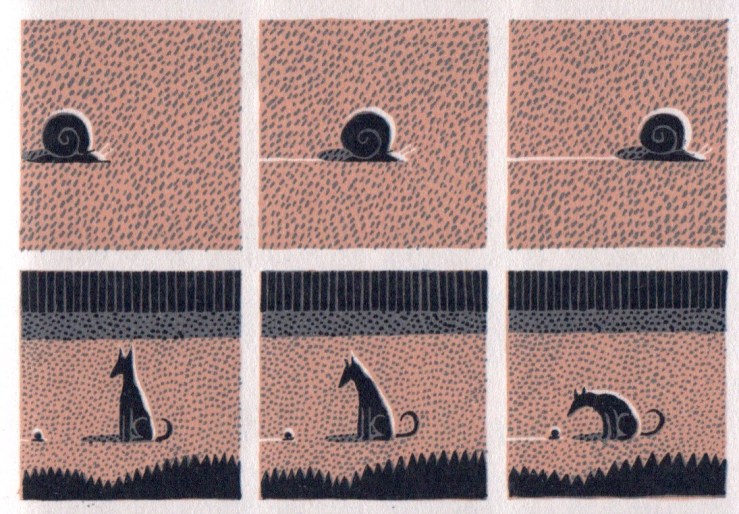
They see birds and people, dogs and snails, balloons and bikes (etc.), all rendered in gentle gradations of orange-pink and grey-blue and black-black.

IMG_5563

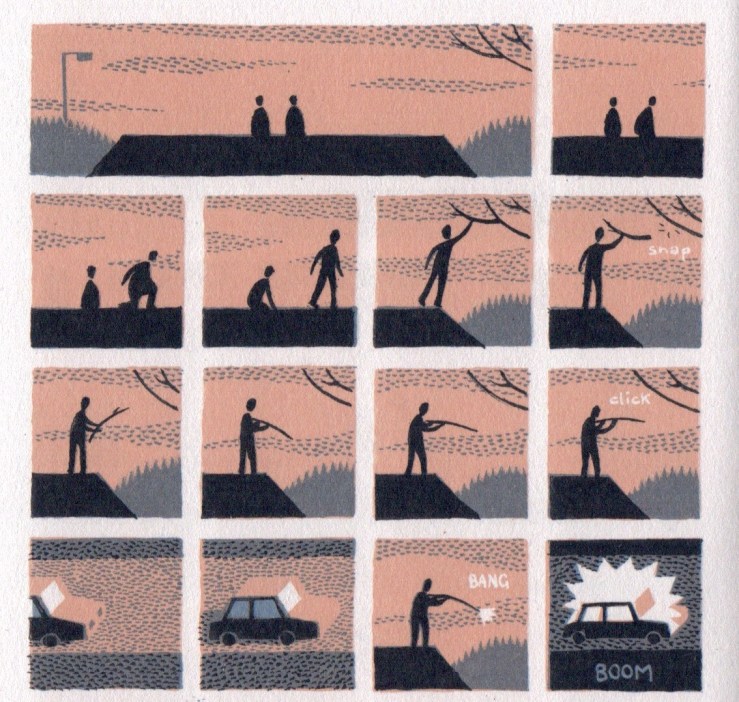
In one of my favorite little episodes, one boy reaches for a branch. His imagination transmutes the branch into a rifle, and a play-shooting spree ensues.

Birchfield Close is comprised entirely of such moments, yet none of its episodes feel discrete. Rather, each panel pushes (pushesThat’s not the right verb!) into the next, a miniature gesture that creates—that somehow is—the entire work. The effect is soothing.

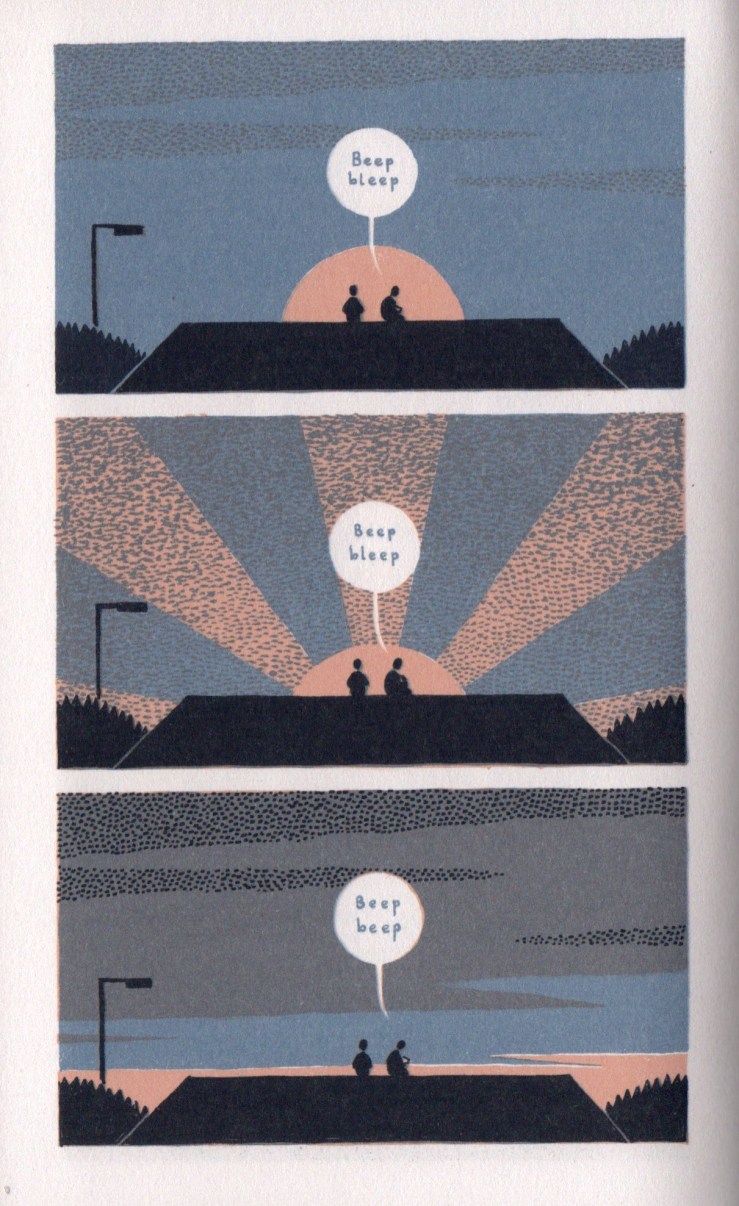
I’ve read Birchfield Close a dozen times now (read? Is that the right verb?), and I’m still (happily) unsure what commentary McNaught might be making on media. The story is full of images of “entertainments” that may or may not be at odds with the neighborhood’s ambiance: a handheld video game, a banal soap opera, a pop song on the radio. In another favorite episode, we move from rooftop to an airplane flying through the sky to the actual inside of the airplane, where a passenger watches Nemo’s reunion with his overprotective father. On the next page, we are treated to the imaginative forms that the clouds might take—formations that the airplane passenger, wrapped up in viewing Finding Nemo on a tiny headrest screen, perhaps misses. But if there’s a judgment here, McNaught seems to leave it to the viewer to suss out. As we pan back down to the boys on the roof, we see that one remains watching the clouds, shaping them in his imagination (or perhaps he’s sharing an imaginative vision with the airplane passenger), while the other boy has returned to his own tiny screen to play a fighting game. He misses the sunset.

Or does he miss the sunset? Maybe it’s simply part of his own aesthetic experience with the game, a peripheral, environmental occurrence, one he enjoys as transitory and ambient, an event promised to repeat again and again. I like this second reading more, as it fits neatly with my own reading experience of Birchfield Close—the book is an ambient aesthetic experience, calming but quizzical, deeply enjoyable—physical: light, color, the touch of the fine thick paper. I’ve tried to capture some of that reading experience here but have undoubtedly failed. Better you read see think feel for yourself.

Birchfield Close and other books by Jon McNaught are available from the good people at Nobrow Press.

The Minotaur — Remedios Varo

Look at Borges (Pynchon’s Gravity’s Rainbow)

In the days of the gauchos, my country was a blank piece of paper. The pampas stretched as far as men could imagine, inexhaustible, fenceless. Wherever the gaucho could ride, that place belonged to him. But Buenos Aires sought hegemony over the provinces. All the neuroses about property gathered strength, and began to infect the countryside. Fences went up, and the gaucho became less free. It is our national tragedy. We are obsessed with building labyrinths, where before there was open plain and sky. To draw ever more complex patterns on the blank sheet. We cannot abide that openness: it is terror to us. Look at Borges. Look at the suburbs of Buenos Aires. The tyrant Rosas has been dead a century, but his cult flourishes. Beneath the city streets, the warrens of rooms and corridors, the fences and the networks of steel track, the Argentine heart, in its perversity and guilt, longs for a return to that first unscribbled serenity… that anarchic oneness of pampas and sky…

From Thomas Pynchon’s novel Gravity’s Rainbow.

Osprey — John James Audubon

Katkelma — Helene Schjerfbeck

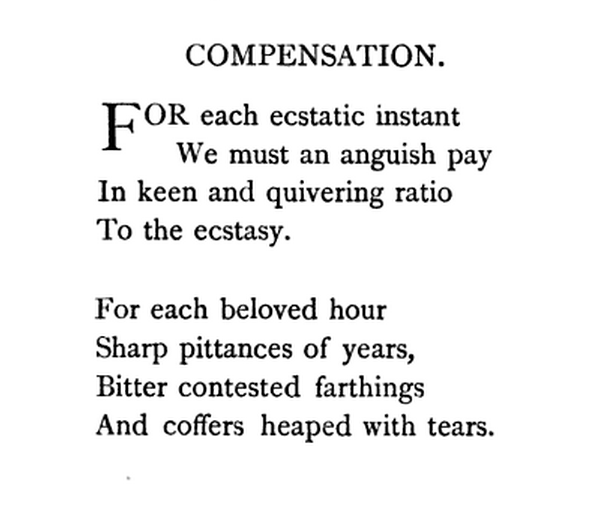
“For each ecstatic instant” — Emily Dickinson

anguish

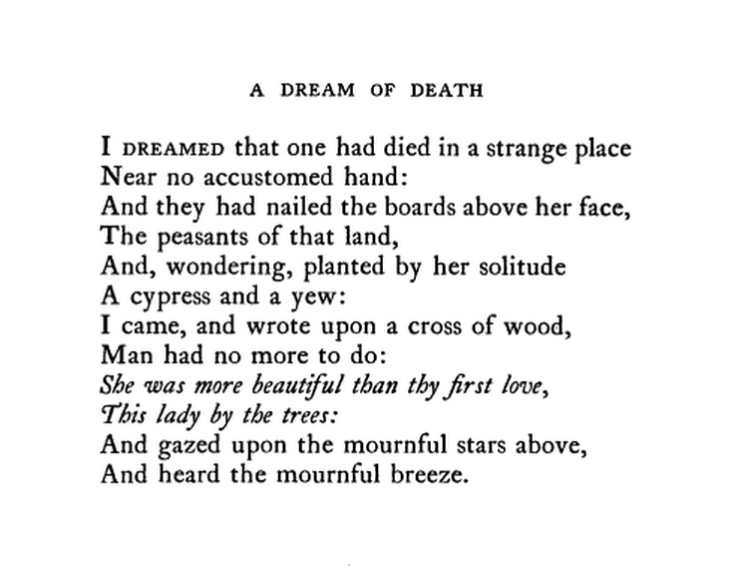
“A Dream of Death” — W.B. Yeats

Capture

Green Bathtub — Elmer Bischoff

Mirror Scene, Blood of a Poet (Jean Cocteau)

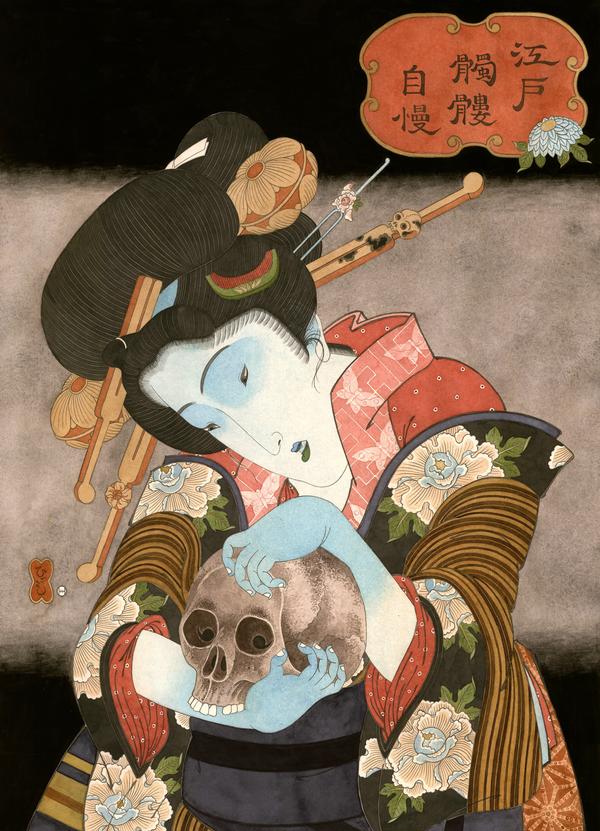
Woman with Skull — Hiroshi Hirakawa

tumblr_lski17J1Wh1qbcporo1_1280

A List of Irish Heroes from James Joyce’s Ulysses

One of my favorite passages in Ulysses (it’s from the “Cyclops” chapter, episode 12)—

He wore a long unsleeved garment of recently flayed oxhide reaching to the knees in a loose kilt and this was bound about his middle by a girdle of plaited straw and rushes. Beneath this he wore trews of deerskin, roughly stitched with gut. His nether extremities were encased in high Balbriggan buskins dyed in lichen purple, the feet being shod with brogues of salted cowhide laced with the windpipe of the same beast. From his girdle hung a row of seastones which dangled at every movement of his portentous frame and on these were graven with rude yet striking art the tribal images of many Irish heroes and heroines of antiquity, Cuchulin, Conn of hundred battles, Niall of nine hostages, Brian of Kincora, the Ardri Malachi, Art MacMurragh, Shane O’Neill, Father John Murphy, Owen Roe, Patrick Sarsfield, Red Hugh O’Donnell, Red Jim MacDermott, Soggarth Eoghan O’Growney, Michael Dwyer, Francy Higgins, Henry Joy M’Cracken, Goliath, Horace Wheatley, Thomas Conneff, Peg Woffington, the Village Blacksmith, Captain Moonlight, Captain Boycott, Dante Alighieri, Christopher Columbus, S. Fursa, S. Brendan, Marshal Mac-Mahon, Charlemagne, Theobald Wolfe Tone, the Mother of the Maccabees, the Last of the Mohicans, the Rose of Castille, the Man for Galway, The Man that Broke the Bank at Monte Carlo, The Man in the Gap, The Woman Who Didn’t, Benjamin Franklin, Napoleon Bonaparte, John L. Sullivan, Cleopatra, Savourneen Deelish, Julius Caesar, Paracelsus, sir Thomas Lipton, William Tell, Michelangelo, Hayes, Muhammad, the Bride of Lammermoor, Peter the Hermit, Peter the Packer, Dark Rosaleen, Patrick W. Shakespeare, Brian Confucius, Murtagh Gutenberg, Patricio Velasquez, Captain Nemo, Tristan and Isolde, the first Prince of Wales, Thomas Cook and Son, the Bold Soldier Boy, Arrah na Pogue, Dick Turpin, Ludwig Beethoven, the Colleen Bawn, Waddler Healy, Angus the Culdee, Dolly Mount, Sidney Parade, Ben Howth, Valentine Greatrakes, Adam and Eve, Arthur Wellesley, Boss Croker, Herodotus, Jack the Giantkiller, Gautama Buddha, Lady Godiva, The Lily of Killarney, Balor of the Evil Eye, the Queen of Sheba, Acky Nagle, Joe Nagle, Alessandro Volta, Jeremiah O’Donovan Rossa, Don Philip O’Sullivan Beare. A couched spear of acuminated granite rested by him while at his feet reposed a savage animal of the canine tribe whose stertorous gasps announced that he was sunk in uneasy slumber, a supposition confirmed by hoarse growls and spasmodic movements which his master repressed from time to time by tranquillising blows of a mighty cudgel rudely fashioned out of paleolithic stone.


Weaver — Vincent van Gogh