Like 8 minutes of Prince rehearsing “When Doves Cry” in 1984

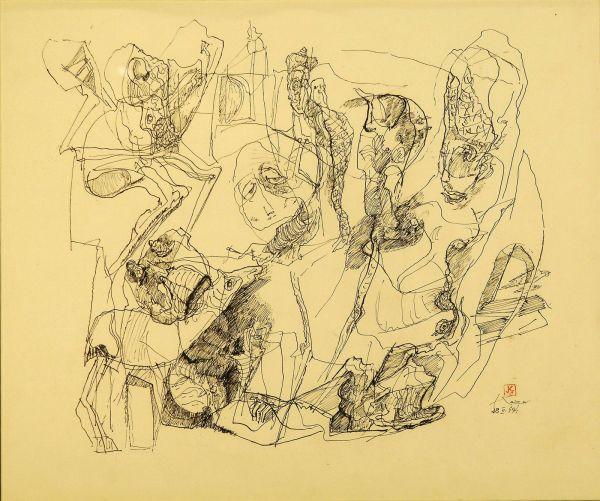
Untitled — Vasile Kazar

unknown-title-4

Three Books

img_2325-1

How Bluegrass Music Destroyed My Life by John Fahey. Third edition paperback from Drag City (DC 124). No designer credited.

I first read Fahey’s collection in 2000 or 2001, when it first came out—a good friend lent it to me and I returned it. Later, he loaned it to another friend who did not return it. I bought the book last summer while visiting the first friend (he took me to the Spoonbill & Sugartown bookshop in Brooklyn). Fahey’s book is sorta memoir, sorta fiction (at times), all weird and good. There’s a wonderful chapter about Fahey’s work on Michaelangelo Antonioni’s film Zabriskie Point that culminates in Fahey and Antonioni getting into a fistfight.

img_2320

Will Oldham on Bonnie “Prince” Billy by Will Oldham and Alan Licht. First edition trade paperback from W.W. Norton. Cover design by Faber using a painting (of Oldham) by Becky Blair.

The friend who lent me the Fahey book insisted for months that I pick up Will Oldham on Bonnie “Prince” Billy; when I kept neglecting to find it, he eventually just sent it to me. The book is basically the edited transcripts of discussions between Oldham and Licht. While there’s a heavy focus on Oldham’s music (and his acting career), the book is ultimately about creation and the artistic process. It is one of the better books about music that I’ve ever read. (A “Cosmological Timeline” at the end of the book begins in 1778 with Captain James Cook’s discovery of the “the Hawaiian tradition of surfing” and ends in 2011 with Jennifer Herrema changing RTX into Black Bananas).

img_2322

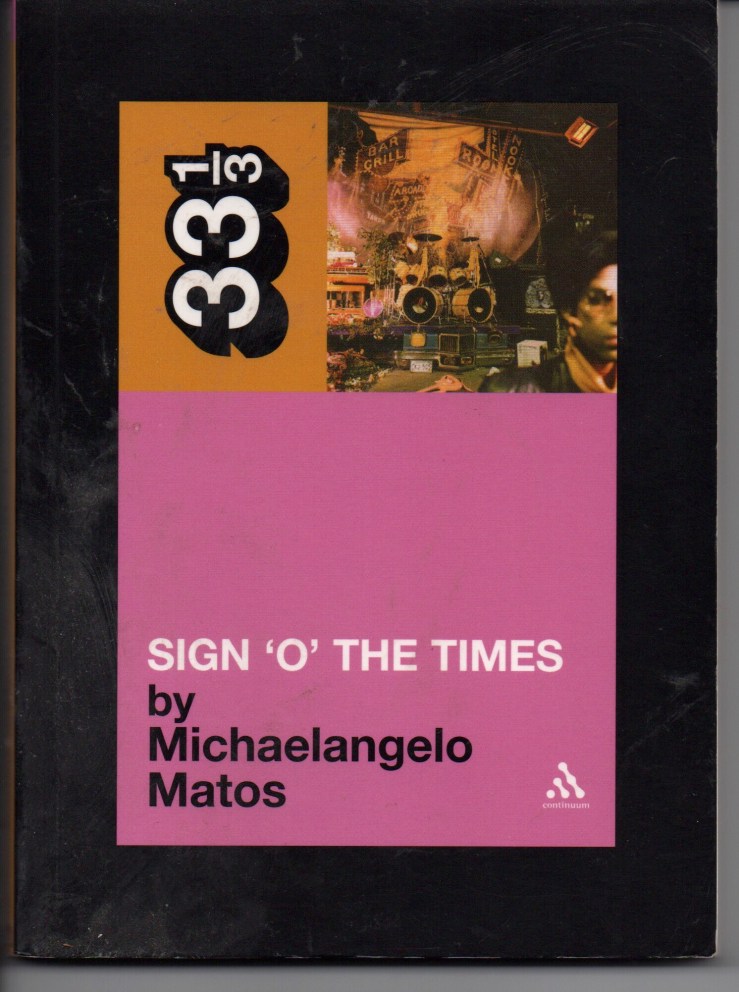
Sign ‘O’ the Times by Michaelangelo Matos. A 33 1/3 book from Continuum, 2004. No designer credited.

I bought this at a Friends of the Library sale maybe 10 years ago. Matos’s take on Prince’s 1987 double album weaves music history and music criticism into personal memoir. The book ends with Prince seeing Matos seeing Prince at an Ohio Players’ show in 1997.

Washing the Hair — Ito Shinsui

washing-the-hair

From this darkness packs of mad dogs will emerge, vipers, scorpions, enormous sea serpents (From Ferrante’s The Story of a New Name)

I made the dark descent. Now the moon was visible amid scattered pale-edged clouds; the evening was very fragrant, and you could hear the hypnotic rhythm of the waves. On the beach I took off my shoes, the sand was cold, a gray-blue light extended as far as the sea and then spread over its tremulous expanse. I thought: yes, Lila is right, the beauty of things is a trick, the sky is the throne of fear; I’m alive, now, here, ten steps from the water, and it is not at all beautiful, it’s terrifying; along with this beach, the sea, the swarm of animal forms, I am part of the universal terror; at this moment I’m the infinitesimal particle through which the fear of every thing becomes conscious of itself; I; I who listen to the sound of the sea, who feel the dampness and the cold sand; I who imagine all Ischia, the entwined bodies of Nino and Lila, Stefano sleeping by himself in the new house that is increasingly not so new, the furies who indulge the happiness of today to feed the violence of tomorrow. Ah, it’s true, my fear is too great and so I hope that everything will end soon, that the figures of the nightmares will consume my soul. I hope that from this darkness packs of mad dogs will emerge, vipers, scorpions, enormous sea serpents. I hope that while I’m sitting here, on the edge of the sea, assassins will arrive out of the night and torture my body. Yes, yes, let me be punished for my insufficiency, let the worst happen, something so devastating that it will prevent me from facing tonight, tomorrow, the hours and days to come, reminding me with always more crushing evidence of my unsuitable constitution. Thoughts like that I had, the frenzied thoughts of girlish discouragement. I gave myself up to them, for I don’t know how long.

From Elena Ferrante’s 2012 novel The Story of a New Name. English translation by Ann Goldstein.

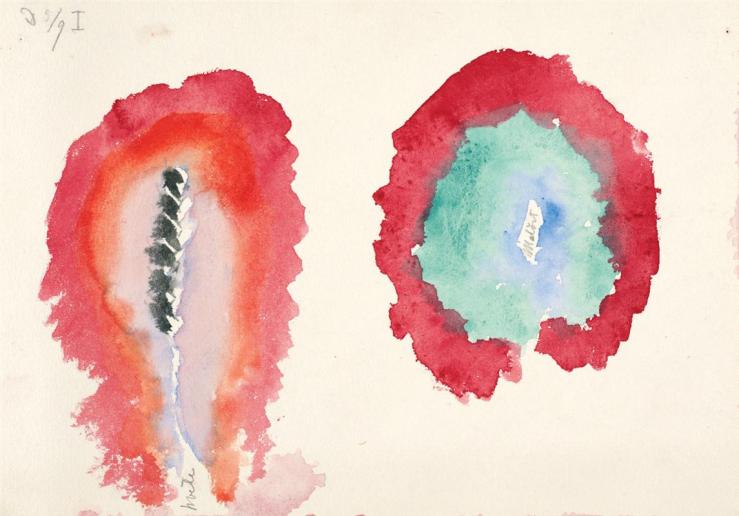
Wheat and Wormwood — Hilma af Klint

wheat-and-wormwood-1922halfhd

“God to Hungry Child” — Langston Hughes

god to hungry child

Crews/DeLillo/Gardner/Murdoch (Books acquired, 5.12.2016)

img_2315

The Sunbather — Ken Danby

sunbather-1972

List of writers mentioned in Gordon Lish’s Paris Review interview

A list of writers mentioned in Gordon Lish’s Winter 2015 (No. 215) Paris Review interview

Jean Baudrillard

Harold Bloom

Harold Brodkey

William F. Buckley

William S. Burroughs

Raymond Carver

Neal Cassady

Cormac McCarthy

Don DeLillo

Jacques Derrida

Denis Donoghue

Tess Gallagher

Leonard Gardner

Jack Gilbert

Allen Ginsberg

Barry Hannah

Giles Harvey

 Victor Herman

Noy Holland

John Clellon Holmes

Jack Kerouac

Ken Kesey

Stephen King

Romulus Linney

Sam Lipsyte

Atticus Lish

Gary Lutz

Norman Mailer

Ben Marcus

Patty Marx

Cynthia Ozick

Grace Paley

James Purdy

J.D. Salinger

Christine Schutt

Jason Schwartz

Allan Temko

Joy Williams

Tom Wolfe

Sadko the Green Monster — Leon Bakst

sadko-the-green-monster-1917halfhd

Beckett critique (From Elena Ferrante’s novel The Story of a New Name)

“Have you ever been to the theater?”

“A few times.”

“Did you like it?”

“It was all right.”

“I’ve never been, but I’ve seen it on television.”

“It’s not the same thing.”

“I know, but better than nothing.”

And at that point she took out of her bag the book I had given her, the volume of Beckett’s plays, and showed it to him.

“Have you read this?”

Nino took the book, examined it, admitted uneasily, “No.”

“So there is something you haven’t read.”

“Yes.”

“You should read it.”

Lila began to talk to us about the book. To my surprise she was very deliberate, she talked the way she used to, choosing the words so as to make us see people and things, and also the emotion she gave them, portraying them anew keeping them there, present, alive. She said that we didn’t have to wait for nuclear war, in the book it was as if it had already happened. She told us at length about a woman named Winnie who at a certain point announced, another happy day, and she herself declaimed the phrase, becoming so upset that, in uttering it, her voice trembled slightly: another happy day, words that were insupportable, because nothing, nothing, she explained, in Winnie’s life, nothing in her gestures, nothing in her head, was happy, not that day or the preceding days. But, she added, the biggest impression had been made on her by a Dan Rooney. Dan Rooney, she said, is blind but he’s not bitter about it, because he believes that life is better without sight, and in fact he wonders whether, if one became deaf and mute, life would not be still more life, life without anything but life.

“Why did you like it?” Nino asked.

“I don’t know yet if I liked it.”

“But it made you curious.”

“It made me think. What does it mean that life is more life without sight, without hearing, even without words?”

“Maybe it’s just a gimmick.”

“No, what gimmick. There’s a thing here that suggests a thousand others, it’s not a gimmick.”

From Elena Ferrante’s 2012 novel The Story of a New Name. English translation by Ann Goldstein.

Ferrante’s so-called Neapolitan Novels do at least two things successfully that so many contemporary novels of “literary” fiction attempt and fail to do:

One, Ferrante harnesses and demonstrates the intellectual force of her two protagonists/antagonists. Many contemporary novelists insist on the brilliance of a particular character, but fail to capture and convey any sense of brilliance.

Two, Ferrante uses metatextual literary references adroitly and meaningfully, where other contemporary writers often clunkily throw in references to greater works of literature as a means to offer ballast to an otherwise-lite offering.

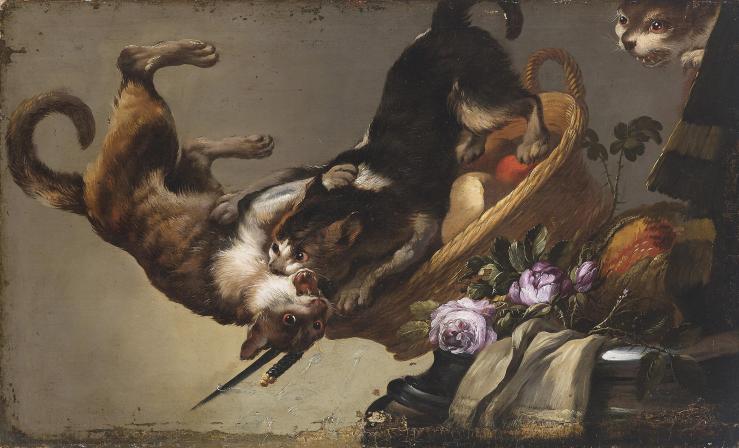
Still Life with Fighting Cats — Workshop of Frans Snyders

frans_snyders_workshop_kc3a4mpfende_katzen

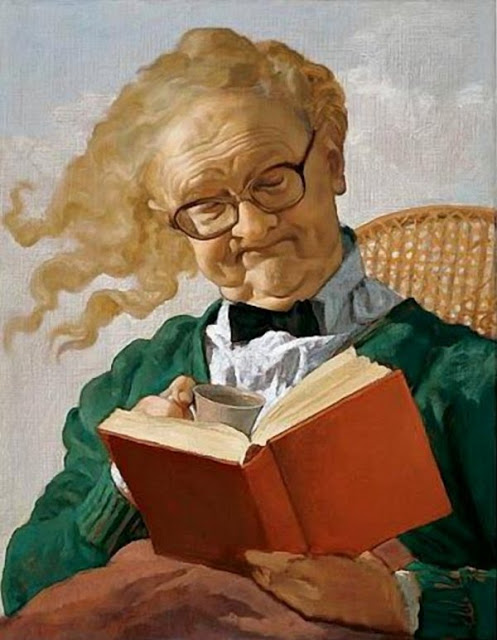
2070 — John Currin

john2bcurrin2b-2bold2bwoman2breading

Nathaniel Hawthorne’s journal entry for May 11, 1838

May 11, 1838.–At Boston last week. Items:–A young man, with a small mustache, dyed brown, reddish from its original light color. He walks with an affected gait, his arms crooked outwards, treading much on his toes. His conversation is about the theatre, where he has a season ticket,–about an amateur who lately appeared there, and about actresses, with other theatrical scandal.–In the smoking-room, two checker and backgammon boards; the landlord a great player, seemingly a stupid man, but with considerable shrewdness and knowledge of the world.– F—-, the comedian, a stout, heavy-looking Englishman, of grave deportment, with no signs of wit or humor, yet aiming at both in conversation, in order to support his character. Very steady and regular in his life, and parsimonious in his disposition,–worth $50,000, made by his profession.–A clergyman, elderly, with a white neck-cloth, very unbecoming, an unworldly manner, unacquaintance with the customs of the house, and learning them in a childlike way. A ruffle to his shirt, crimped.–A gentleman, young, handsome, and sea-flushed, belonging to Oswego, New York, but just arrived in port from the Mediterranean: he inquires of me about the troubles in Canada, which were first beginning to make a noise when he left the country,–whether they are all over. I tell him all is finished, except the hanging of the prisoners. Then we talk over the matter, and I tell him the fates of the principal men,–some banished to New South Wales, one hanged, others in prison, others, conspicuous at first, now almost forgotten.–Apartments of private families in the hotel,–what sort of domesticity there may be in them; eating in public, with no board of their own. The gas that lights the rest of the house lights them also, in the chandelier from the ceiling.–A shabby-looking man, quiet, with spectacles, at first wearing an old, coarse brown frock, then appearing in a suit of elderly black, saying nothing unless spoken to, but talking intelligently when addressed. He is an editor, and I suppose printer, of a country paper. Among the guests, he holds intercourse with gentlemen of much more respectable appearance than himself, from the same part of the country.–Bill of fare; wines printed on the back, but nobody calls for a bottle. Chairs turned down for expected guests. Three-pronged steel forks. Cold supper from nine to eleven P.M. Great, round, mahogany table, in the sitting-room, covered with papers. In the morning, before and soon after breakfast, gentlemen reading the morning papers, while others wait for their chance, or try to pick out something from the papers of yesterday or longer ago. In the forenoon, the Southern papers are brought in, and thrown damp and folded on the table. The eagerness with which those who happen to be in the room start up and make prize of them. Play-bills, printed on yellow paper, laid upon the table. Towards evening comes the “Transcript.”

Nathaniel Hawthorne’s journal entry for May 11, 1848. From Passages from the American Note-Books.

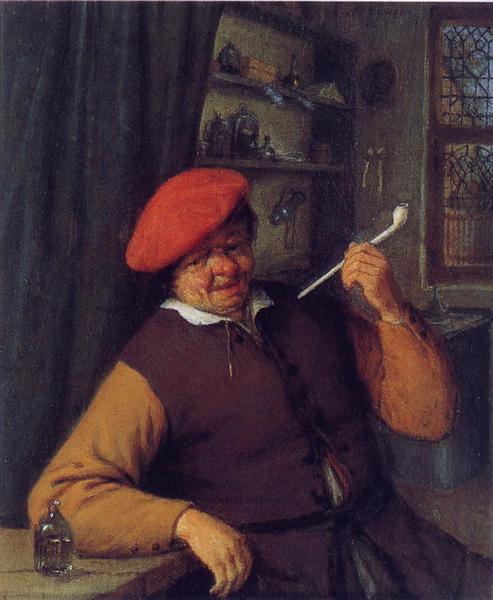
A Peasant in a Red Beret Smoking a Pipe — Adriaen van Ostade

a-peasant-in-a-red-beret-smoking-a-pipe.jpg!Large

Friendship — Egon Schiele

schiele_-_freundschaft_-_1913