A review of Gisèle Prassinos’s collection of surreal anti-fables, The Arthritic Grasshopper

img_7667

I can’t remember which particular Surrealist I was googling when I learned about Gisèle Prassinos. I do know that it was just a few weeks ago, and I’ve had an interest in Surrealist art and literature since I was a kid, so I was a bit stunned that I’d never heard of her before now—strange, given the origin of her first publication. In 1934, when she was 14, Prassinos was “discovered” by André Breton, and the Surrealists delighted in what they called her “automatic writing.” (Prassinos would later reject that label, and go as far as to declare that she had never been a surrealist). Her first book, La Sauterelle arthritique (The Arthritic Grasshopper) was published just a year later.

1-work
Prassinos reading her work to the Surrealists; photograph by Man Ray


I somehow found a .pdf of one of her stories, “A Nice Family,” a bizarre little tale that runs on its own surreal mythology. The story struck me as simultaneously grandiose and miniature, dense but also skeletal. It was impossible. Surreal. I wanted more.

Luckily, just this spring Wakefield Press released The Arthritic Grasshopper: Collected Stories, 1934-1944, a new English translation of a 1976 compendium of Prassinos’s tales, Trouver sans checher. The translation is by Henry Vale and Bonnie Ruberg, whose introduction to the volume is a better review and overview than I can muster here. Ruberg offers a miniature biography, and shares details from her letters and visits with Prassinos. She situates Prassinos within the Surrealists’ gender biases: “For a young writer such as Prassinos, being involved with the surrealists would have meant gaining access to resources like publishers, but it also would have meant being fetishized and marginalized.” Ruberg characterizes Prassinos’s tales eloquently and accurately—no simple feat given the material’s utter strangeness:

Taken collectively, their effect is a piercing cackle, a complete disorientation, rather than an ethical lesson. The politics of these stories are absurdist. They upend the world by making children dangerous, by reanimating the dead, by letting the carefully tended domestic deform, foam, and melt. No social structure holds power in the world of these stories—not on the basis of gender, or nationality, or class. The force that reigns is chaos.

Let’s look at that reigning chaos.

In “The Sensitivity of Others,” one of the earliest tales in the volume, we get the sparest narrative action seemingly possible: A speaker walks forward. And yet dream-nightmare touches impinge on all sides and on all senses. The opening line shows a world that is never stable, and if monsters and other dangers lurk just on the margins of our narrator’s shifting path, so do wonders and the promise of strange knowledge. Here’s the tale in full:

img_7666

I still have no idea what to make of the punchline there at the end, but those final images—a father, a faulty library, a power failure—hang heavy against the narrator’s trembling walk.

Many of Prassinos’s anti-fables conclude with such apparent non sequiturs, and yet the final lines can also cast a weird light back over the previous sentences. In “Photogenic Quality,” a dream-tale about the act of writing itself, the final line at first appears as sheer absurdity. A man receives a pencil from a child, whittles it into powder, blots the powder on paper, and throws the paper in the river (more things happen, too). The tale concludes with the man declaring, “Brass is made from copper and tin.” It’s possible to enjoy the absurdity here on its own; however, I think we can also read the last line as a kind of Abracadabra!, magic words that describe an almost alchemical synthesis—a synthesis much like the absurd modes of transformative writing that “Photogenic Quality” outlines.

img_7664

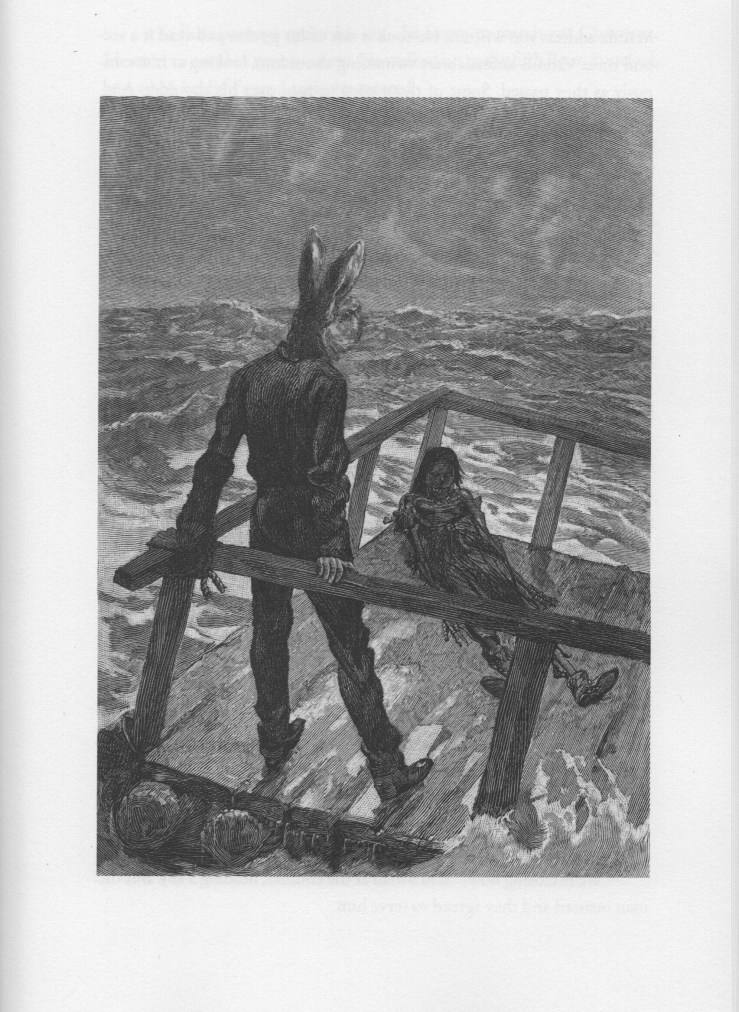
You’ll see above one of Allan Kausch’s illustrations for The Arthritic Grasshopper. Kausch’s collages pointedly recall Max Ernst’s surreal 1934 graphic novel Une semaine de bonté (A Week of Kindness). Kausch’s work walks a weird line between horror and whimsy; images from old children’s books and magazines become chimerical figures, sometimes cute, sometimes horrific, and sometimes both. They’re lovely.
img_7663

Surreal figures shift throughout the book—monks and kings, daughters and mothers, deep sea divers and knights and salesmen and talking horses—all slightly out of place, or, rather, all making new places. Even when Prassinos establishes a traditional space we might think we recognize—often a fairy trope—she warps its contours, shaping it into something else. “A Marriage Proposal,” with its unsuspecting title, opens with “Once upon a time” — but we are soon dwelling in impossibility: “the garter snake appeared in the doorway, arm in arm with the snail, who was slobbering with happiness.” Other stories, like “Tragic Fanaticism,” immediately condense fairy tales into pure images, leaving the reader to suss out connections. Here is that story’s opening line: “A black hole, a little old woman, animals.” At five pages, “Tragic Fanaticism” is one of the collection’s longer stories. It ends with a four line poem, sung by five red cats to the old woman: “Go home and burn / Darling / You’re the only one we’ll love / Trash Bin.”

I still have a number of stories to read in The Arthritic Grasshopper. I’ve enjoyed its tales most when taken as intermezzos between sterner (or compulsory) reading. There’s something refreshing in Prassinos’s illogic. In longer stretches, I find that I tire, get lazy—Prassinos’s imagery shifts quickly—there’s something even picaresque to the stories—and keeping up with its veering rhythms for tale after tale can be taxing. Better not to gobble it all up at once. In this sense, The Arthritic Grasshopper reminds me strongly of another recently-published volume of surreal, imagistic stories that I’ve been slowly consuming this year: The Complete Stories of Leonora CarringtonIn their finest moments, both of these writers can offer new ways of looking at art, at narrative, at the world itself.

I described Prassinos’s tales as “anti-fables” above—a description that I think is accurate enough, as literary descriptions go—but that doesn’t mean there isn’t something that we can learn from them (although, to be very clear, I do not think literature has to offer us anything to learn). What Prassinos’s anti-fables do best is open up strange impossible spaces—there’s a kind of radical, amorphous openness here, one that might be neatly expressed in the original title to this newly-translated volume—Trouver sans checherTo Find without Seeking.

In her preface (titled “To Find without Seeking”) Prassinos begins with the question, “To find what?” Here is a question that many of us have been taught we must direct to all the literature we read—to interrogate it so that it yields moral instruction. Prassinos answers: “The spot where innocence rejoices, trembling as it first meets fear. The spot where innocence unleashes its ferocity and its monsters.” She goes on to describe a “true and complete world” where the “earth and water have no borders and each us can live there if we choose, in just the same way, without changing our names.” Her preface concludes by repeating “To find what?”, and then answering the question in the most perfectly (im)possible way: “In the end, the mind that doesn’t know what it knows: the free astonishing voice that speaks, faceless, in the night.” Prassinos’s anti-fables offer ways of reading a mind that doesn’t know what it knows, of singing along with the free faceless astonishing voice. Highly recommended.

Bat — Germaine Richier

Bat 1948-51, published 1955 by Germaine Richier 1902-1959

Bat, 1951 by Germaine Richier (1902-1959)

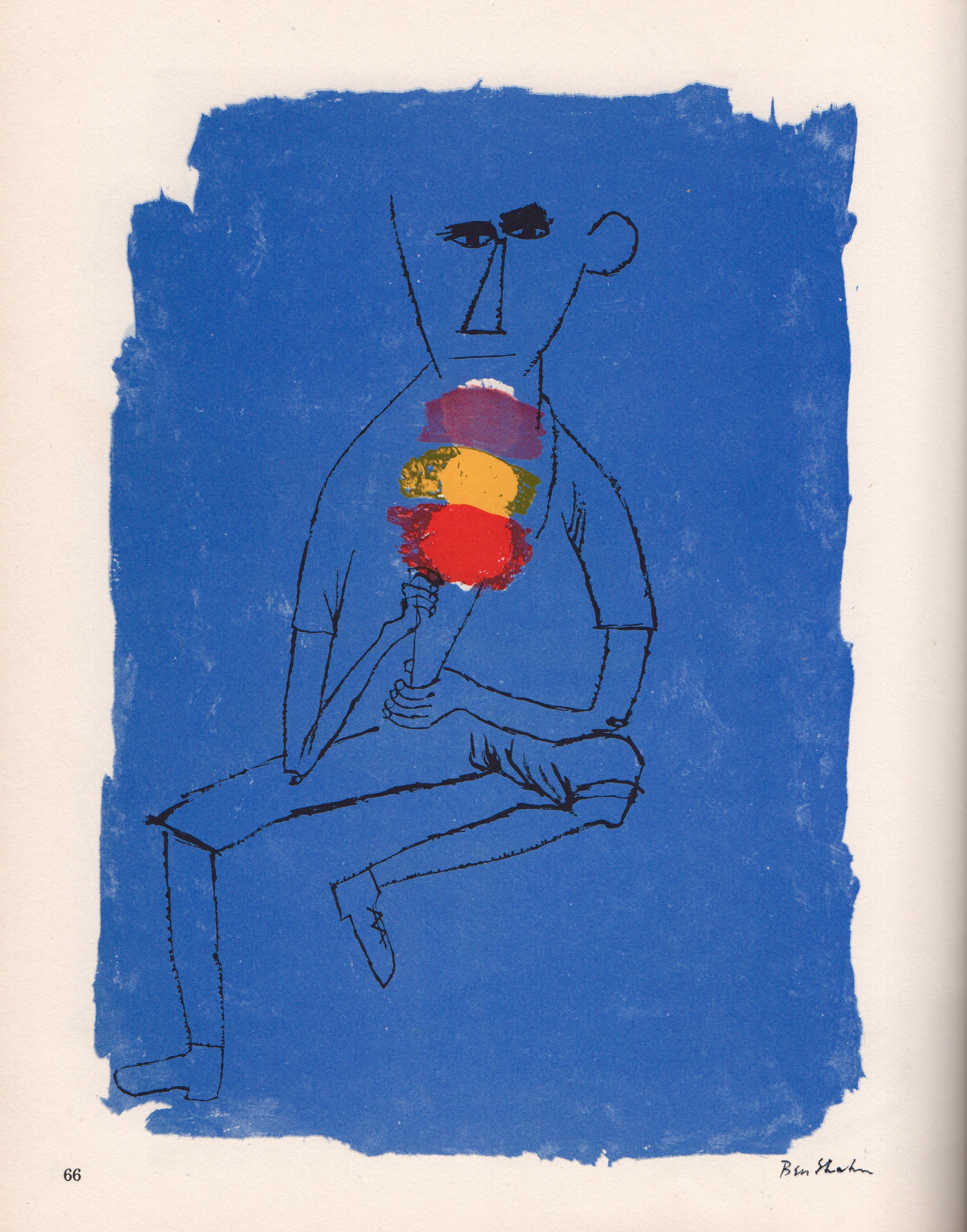
Triple Dip — Ben Shahn

Triple Dip, 1952 by Ben Shahn (1898–1969). From Ben Shahn: His Graphic Art, George Braziller, Inc., NY 1957.

A riff on rereading Carson McCullers’ novel The Heart Is a Lonely Hunter

  1. I’m not really sure what made me pick up Carson McCullers’ 1940 début novel The Heart Is a Lonely Hunter to read again.
  2. Actually, writing that sentence makes me remember: I was purging books, and the edition I have is extremely unattractive; I was considering trading it in. But I started reading it, realizing that I hadn’t reread it ever, that I hadn’t read it since I was probably a senior in high school or maybe a college freshman.
  3. So it was maybe two decades ago that I first read it. I would’ve been maybe 18, about five years younger than McCullers was when the novel was published (and not much older than its protagonist Mick Kelly). The Heart Is a Lonely Hunter never stuck with me like The Ballad of the Sad Café or her short stories did, but I remember at the time thinking it far superior to Faulkner—more lucid in its description of the Deep South’s abjection. (I struggled with Faulkner when I was young, but now see his tangled sentences and thick murky paragraphs are a wholly appropriate rhetorical reckoning with the nightmare of Southern history).
  4. And of course I preferred Flannery O’Connor to both at the time—her writing was simultaneously lucid and acid, cruel and funny. Maybe I still like her best of the three.
  5. O’Connor, in a 1963 letter: “I dislike intensely the work of Carson McCullers.”
  6. O’Connor again:

    When we look at a good deal of serious modern fiction, and particularly Southern fiction, we find this quality about it that is generally described, in a pejorative sense, as grotesque. Of course, I have found that anything that comes out of the South is going to be called grotesque by the Northern reader, unless it is grotesque, in which case it is going to be called realistic.

  7. The Heart Is a Lonely Hunter is at its best when it is at its most grotesque, which is to say, most realistic.
  8. Here’s a sample of that grotesque dirty realism from very late in the book, as Jake Blount (an alcoholic and would-be revolutionary) departs the small, unnamed Georgia town that the novel is set in—and the narrative:

    The door closed behind him. When he looked back at the end of the black, Brannon was watching from the sidewalk. He walked until he reached the railroad tracks. On either side there were rows of dilapidated two-room houses. In the cramped back yards were rotted privies and lines of torn, smoky rags hung out to dry. For two miles there was not one sight of comfort or space or cleanliness. Even the earth itself seemed filthy and abandoned. Now and then there were signs that a vegetable row had been attempted, but only a few withered collards had survived. And a few fruitless, smutty fig trees. Little younguns swarmed in this filth, the smaller of them stark naked. The sight of this poverty was so cruel and hopeless that Jake snarled and clenched his fists.

  9. The passage showcases some of McCullers’ best and worst prose tendencies. Her evocation of the South’s rural poverty condenses wonderfully in the image of “a few fruitless, smutty fig trees” — smutty!—but there’s also an underlying resort to cliché, into placeholders — “stark naked”; “clenched his fists.”
  10. (Maybe you think I’m picking on McCullers here, yes? Not my intention. I’ll confess I read a career-spanning compendium of Barry Hannah’s short stories, Long, Last, Happy right before I read The Heart Is a Lonely Hunter, and McCullers simply can’t match sentences with Our Barry. It’s an unfair comparison, sure. But).
  11. But McCullers was only 23 when The Heart Is a Lonely Hunter was published. Stock phrases must be forgiven, yes? Yes.
  12. And there are plenty of great moments on the page, like this one, in which (McCullers’ stand-in) Mick Kelly tries her young hand at writing:

    The rooms smelled of new wood, and when she walked the soles of her tennis shoes made a flopping sound that echoed through all the house. The air was hot and quiet. She stood still in the middle of the front room for a while, and then she suddenly thought of something. She fished in her pocket and brought out two stubs of chalk—one green and the other red. Mick drew the big block letters very slowly. At the top she wrote EDISON, and under that she drew the names of DICK TRACY and MUSSOLINI. Then in each corner with the largest letters of all, made with green and outlined in red, she wrote her initials—M.K. When that was done she crossed over to the opposite wall and wrote a very bad word—PUSSY, and beneath that she put her initials, too. She stood in the middle of the empty room and stared at what she had done. The chalk was still in her hands and she did not feel really satisfied.

    Who is ever really satisfied with their own writing though?

  13. We’re several hundred words into this riff and I’ve failed to summarize the plot of The Heart Is a Lonely Hunter. There really isn’t a plot per se, actually—sure, there are a development of ideas, themes, motifs, characters—yep—and sure, lots of things happen (the novel is episodic)—but there isn’t really a plot.
  14. The point above is absurd. Of course there is a plot, one which you could easily diagram in fact. Such a diagram would describe the sad strands of four misfits gravitating toward the deaf-mute, John Singer, the silent center of this sad novel. These sad strands tangle, yet ultimately fail to cohere into any kind of harmony with each other. Even worse, these strands fail to make a true connection with Singer. The misfits all essentially use him as a sounding board, a mute confessional booth. They think they love him, but they love his silence, they love his listening. They don’t learn about his own strange love and his own strange sadness.
  15. Or, if you really want to oversimplify plot: The Heart Is a Lonely Hunter is about growing up. In a novel with a number of tragic trajectories, it’s somehow the ending of the Mick Kelly thread that I found most affecting. She still dreams of making great grand music, of writing songs the world would love—but McCullers leaves her standing on her feet working overtime in Woolworth’s to get her family out of the hole. This is the curse of adulthood, of grasping onto dreams even as the world flattens them out into a big boring nothing. The final lines McCullers gives her, via the novel’s free indirect style, strike me as ambiguous:

    …what the hell good had it all been—the way she felt about music and the plans she had made in the inside room? It had to be some good if anything made sense. And it was too and it was too and it was
    too and it was too. It was some good.
    All right!
    O.K!
    Some good.

  16. Is Mick’s self-talk here a defense against disillusionment—one haunted by the truth of life’s awful boring ugliness—or a genuine earnest rallying against the ugliness—or perhaps a mix of both? “Some good” can be read both ironically and earnestly.
  17. Its navigation of irony and earnestness is where I find the novel most off balance. There’s a clumsy cynicism to The Heart Is a Lonely Hunter—a justified cynicism, to be sure, given its themes of racism, classicism, modern alienation—but McCullers’ approach to sussing out her big themes is often heavy-handed. Too often characters’ speeches and dialogues—particularly those of the working-class socialist Blount and Dr. Copeland, a black Marxist—feel forced. Entire dialectics that seem lifted from college lecture notes are shoved into characters’ mouths. Still: if I sometimes found such moments insufferable, McCullers nevertheless reminded me that she was pointedly addressing suffering.
  18. The earnestness there is mature, but the cynicism isn’t. I’m not quite sure what I mean by this—the cynicism isn’t deep? The cynicism is a pose, a viewpoint not fully, but nevertheless freshly, lived in. The cynicism is the cynicism that some of us like to try on when we’re 18, 19, 20, 21.
  19. And re: the point above—that’s good, right? I mean it’s good that McCullers channeled this pure and very real anger into her novel. Maybe I failed the novel, this time, in rereading it twenty years later and thinking repeatedly, But that’s the way the world is: Often awful and almost always unfair. Blount and Copeland are interesting but essentially paralyzed characters; they howl against injustice but McCullers can only make them act in modes of ineffective despair.
  20. Despair. This is a sad novel—a realistically sad novel, a grotesquely sad novel—sympathetic but never sentimental. (We Southerners love sugar and sentiment; bless her heart, McCullers cuts any hint of the latter out. And if Mick Kelly enjoys an ice cream sundae for her last dinner in the novel, note that she chases it with a bitter beer that gets her just drunk enough to keep going).
  21. But some of us like to laugh at and with despair, and The Heart Is a Lonely Hunter serves up a big bitter brew without a heady or hearty laugh to help you swallow it down. The novel’s humorlessness was perhaps by design—these characters dwell in absurd abjection. But absurdity often calls for a laugh, and laughter is not always sugar sweetness, but rather can be a reveling in bitterness—perhaps what I mean here, is that laughter is a sincere and deep reckoning with mature cynicism.
  22. I quoted O’Connor above, in point six; in the same lecture, she warned against writers (particularly Southern writers) giving into the need of the “tired reader…to be lifted up.” O’Connor often forced her characters into moments of radical redemption, moments that complicate her “tired reader’s” desire to have his “senses tormented or his spirits raised.” This modern reader, according to O’Connor, “wants to be transported, instantly, either to mock damnation or a mock innocence.” For O’Connor, the modern reader’s “sense of evil is diluted or lacking altogether, and so he has forgotten the price of restoration.” Restoration in O’Connor’s fiction is always purchased at a heavy cost—many readers can only see the cost, and not the redemption in her calculus.
  23. And restoration in The Heart Is a Lonely Hunter? Perhaps the novel’s greatest strength is its lack of sentimentality, its unwillingness to restore its characters to a mythical Eden. Indeed, McCullers’ setting never even posits a grace from which her characters might fall. Instead, the novel’s final moments leave us “suspended between radiance and darkness. Between bitter irony and faith.” Any restoration is impermanent, as the final line suggests: “And when at last he was inside again he composed himself soberly to await the morning sun.” If the morning sun promises a new tomorrow, a futurity, that futurity is nevertheless conditioned by the need to repeatedly “compose” oneself into a new being, always under the duress of “bitter irony and faith.” McCullers’ plot might side with bitter irony, but her belief in her characters’ beliefs—belief in the powers of art, politics, and above all love—point ultimately to an earnest faith in humanity to compose itself anew.

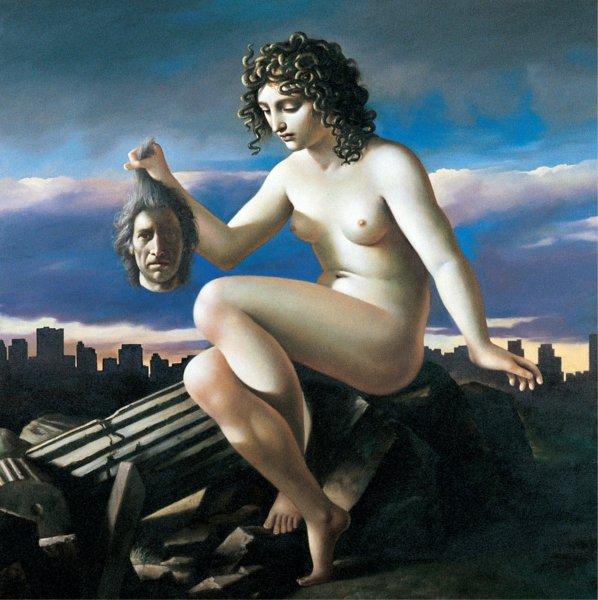
Allegory of Criticism — Carlo Maria Mariani

allegoria-della-critica-2005.jpg!Large

Allegoria della critica (Allegory of Criticism), 2005 by Carlo Maria Mariani (b. 1931)

Flannery O’Connor on Carson McCullers

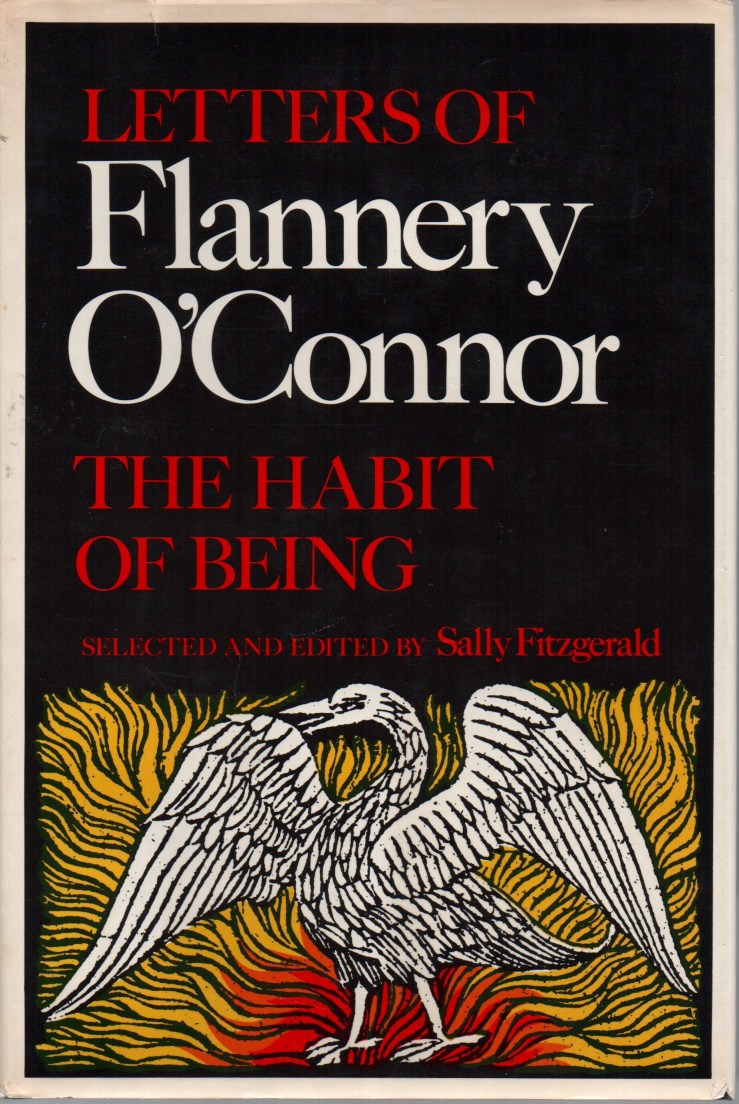
All of the times that Flannery O’Connor mentions Carson McCullers in her letters collected in The Habit of Being: Letters of Flannery O’Connor:

IMG_0525

I read in the paper that Carson McCullers is going to have a play shortly to be called The Square Root of Wonderful—a title that makes me cringe. (8 Oct. 1957)

…Paul Levine [is] preparing a book on 6 writers—McCullers, Capote, Buechner, Bellow, Salinger, and me… (25 June 1960)

I haven’t read [Frederick] Buechner myself, but if I was writing it I would throw out Capote in favor of Malamud and Carson McCullers in favor of [J.F.] Powers. (9 July 1960)

Last week Houghton Mifflin sent me a book called Clock Without Hands by Carson McCullers. This long-awaited-by-the-faithful book will come out in September. I believe it is the worst book I have ever read. It is incredible…It must signal the complete disintegration of this woman’s talent. I have forgotten how the other three were, but they were at least respectable from the writing standpoint. (26 July 1961)

If you ever go to the Albee-McCullers [play] let me know what you think about it? … Did you ever consider Wise Blood as a possibility for dramatizing? If the times were different I would suggest that, but I think it would just be taken for the super-grotesque sub-Carson McCullers sort of thing that I couldn’t stand the sight or sound of. (5 Nov. 1963)

I was interested in the reviews of the Carson McCullers adaptation. I dislike intensely the work of Carson McCullers but it is interesting to see what is made of it in the theatre, and by Edward Albee at that. (28 Nov. 1963)


Between Right and Wrong — Samuel Bak

bk1122_images

Between Right and Wrong, 2007 by Samuel Bak (b. 1933)

The Luncheon on the Grass Is Finished — Susannah Martin


le-dejeuner-sur-l-herbe-est-fini

Le Déjeuner sur l’herbe est fini (The Luncheon on the Grass Is Finished), 2015 by Susannah Martin (b. 1964)


“The Curse” — Bonnie Prince Billy and The Roots of Music

Untitled — Marcel Dzama

Untitled 2003 by Marcel Dzama born 1974Screenshot 2017-08-04 at 11.12.28 AM

Untitled, 2003 by Marcel Dzama (b. 1974)

The Book of Emma Reyes (Book acquired, 3 Aug. 2017)

img_7636

This one looks pretty cool. The Book of Emma Reyes, an epistolary “memoir,” is new in hardback from Penguin, in English translation by Daniel Alarcón.  Here’s Penguin’s blurb/bio:

Anxiety of influence (Barry Hannah’s “ideal inner voices”)

The fact is I wanted to write long before I had anything to say. I don’t find this condition at all unusual in young writers, good or bad. A sort of attuned restlessness. Often it is simply an overriding need to talk. A sort of transcribed logorrhea, worse than decent gossip. I’ve taught these people, forever blasting away in wretched detail, solidly in love with their own noise. I must say, I was never infatuated with my own voice. It was the ideal inner voices that took me, and they came from everywhere, especially Hemingway, Joyce, Henry Miller, and later, Flannery O’Connor. Like many Mississippians, I shied away from Faulkner, who was at once remote and right there in your own backyard, the powerful resident alien. Having read a little of him, I sensed I would be overcome by him, and had a dread, in fact, that he might be the last word. That I would wind up a pining third-rate echo, like many another Southerner. Then T.S. Eliot, especially “Prufrock.” But the earliest great howler who made me want to make the team was the badly forgotten Dylan Thomas, whose voice seemed available everywhere in English departments in the ’50s and ’60s. It seemed to me a fine thing to get drunk and just start being Welsh and crowing surrealism, as I perceived it. Put that against the sullen bitchery of Holden Caulfield, which charmed almost everybody my age, and you would be cooking. Miles Davis might one day shake your hand. He was God, and that would be very nice.

From Barry Hannah’s essay “Why I Write”; read the whole thing at The Oxford American.

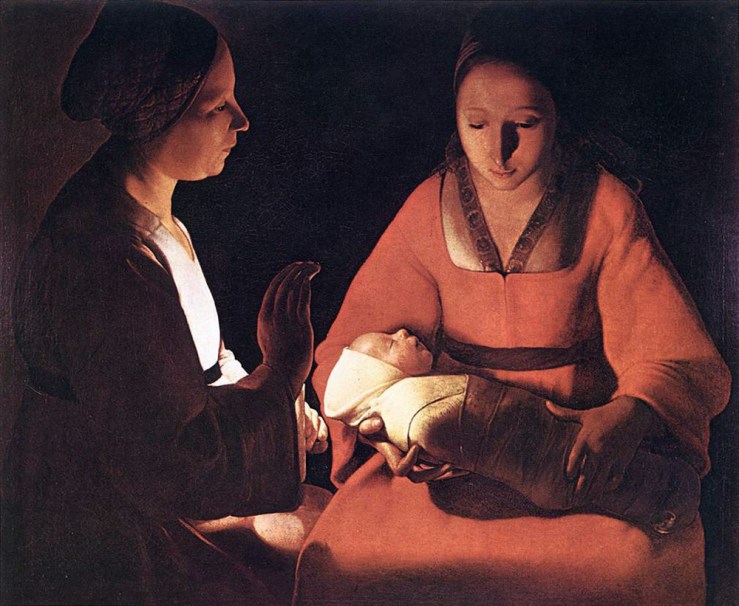
The Newborn — Georges de la Tour

the-newborn

The Newborn, c. 1640-1649 by Georges de la Tour (1593-1652)

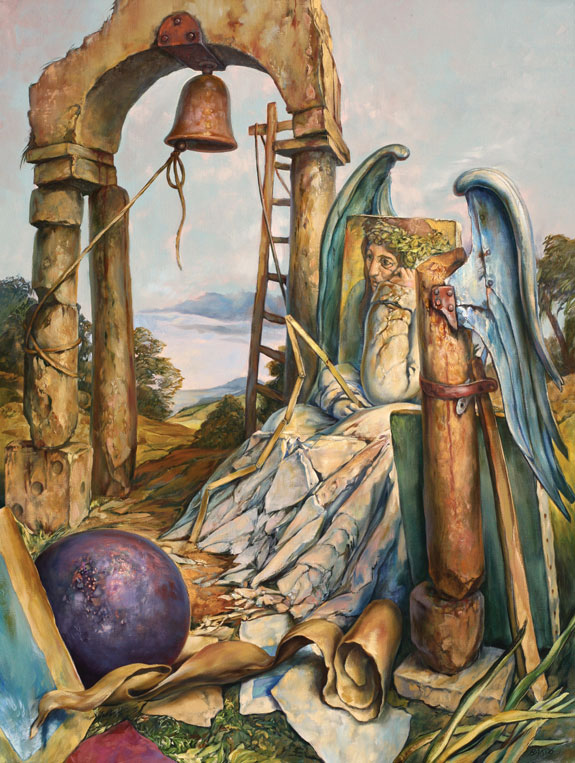
Guardian of Suspended Warnings — Samuel Bak

bk1129_images

Guardian of Suspended Warnings, 2006 by Samuel Bak (b. 1933)


“Baby” — Suburban Lawns

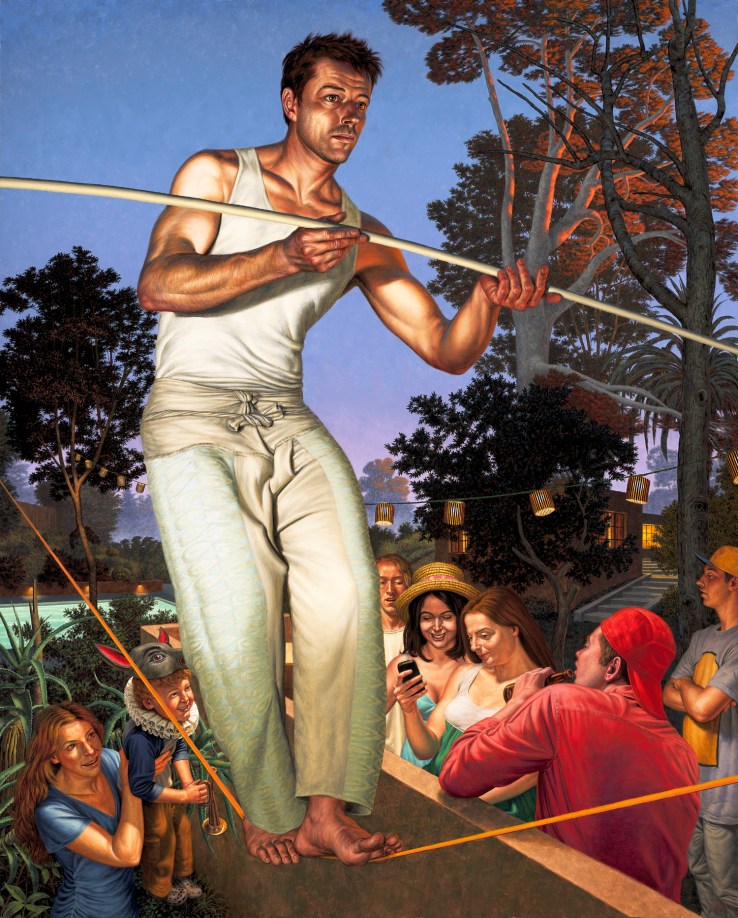
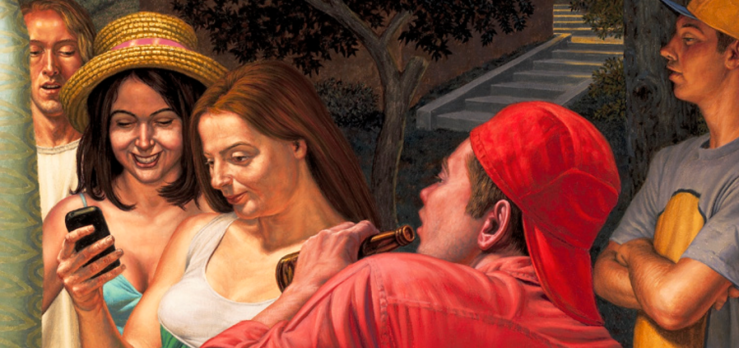
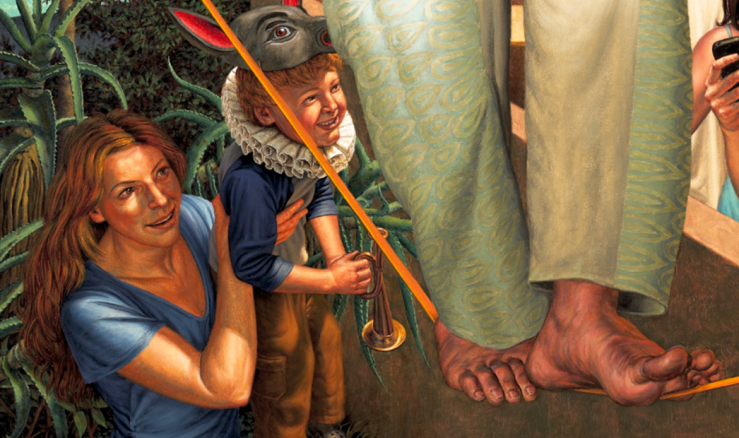
The Rope Walker — F. Scott Hess

109-theropewalker

Screenshot 2017-08-02 at 2.56.29 PM

Screenshot 2017-08-02 at 2.56.10 PM

Screenshot 2017-08-02 at 2.56.50 PM

The Rope Walker, 2010 by F. Scott Hess (b. 1955)

“The Boss,” a new short story by Robert Coover

“The Boss” is  a new (very short) short story by Robert Coover. Read the whole thing at The New Yorker

Read my review of Coover’s latest novel, Huck Out West, here.

Here are the first two paragraphs of “The Boss”:

The gunman lights a cigarette, watches despondently as dusk falls upon the empty alley. He is alone in a lonely place, summoned here to receive instructions from a master criminal known only as the Boss, but the Boss isn’t here. No one is. It’s spooky. He feels like a marked man. The Boss is known for his ruthlessness. When he orders a killing, someone dies. The gunman would like there to be witnesses for what happens next, but the alley’s deserted.

He glances at his watch, a gift from the Boss. Face a gold coin, no numbers. A joke, probably: time is money. Or, maybe, money is time; it depends on what you’re short of. The Boss is a great joker. The watch hands are hair-thin, like the edge of a razor blade, hard to see, especially in this fading light. There and not there, like time itself. Which is perhaps not being clocked—perhaps that’s what the numberless face is saying. How can you measure the shit you’re buried in? He doesn’t know what keeps the watch running. Battery inside, maybe. When the battery dies? Don’t think about it.