Hide Out — Toyin Ojih Odutola

tumblr_pf5xwsuprq1w6tjkb_1280

Hide Out, 2018 by Toyin Ojih Odutola (b. 1985)

Stay Friends — Falk Gernergross

gernegroc39f-stayfriends2c-20142c-90x60cm

Stay Friends, 2018 by Falk Gernergross (b. 1973)

Mervyn Peake/Susan Sontag (Books acquired, 10 Jan. 2020)

img_4717

Last week, browsing yon olde booke shoppe, I came across a battered but beautiful copy of Mervyn Peake’s novel Gormenghast. I can’t remember how or where I heard of Peake’s trilogy of not-quite-fantasy novels, but when I spied the spine I pulled it, loved the cover, and asked Twitter if the novels were any good. The answer seemed to be a resounding, Yes.


I picked up a Penguin Modern Classics edition of the first part of the trilogy, Titus Groan, along with the beautiful Ballantine edition of Gormenghast today. I also couldn’t resist a first edition of Sontag’s Under the Sign of Saturn.

I started Titus Groan today, and after pushing through its thick opening paragraphs, started to really dig it. The opening sentences are a bit of a hurdle. Here’s the first paragraph, thick and even foreboding in its diction and syntax:

Gormenghast, that is, the main massing of the original stone, taken by itself would have displayed a certain ponderous architectural quality were it possible to have ignored the circumfusion of those mean dwellings that swarmed like an epidemic around its outer walls. They sprawled over the sloping earth, each one half way over its neighbour until, held back by the castle ramparts, the innermost of these hovels laid hold on the great walls, clamping themselves thereto like limpets to a rock. These dwellings, by ancient law, were granted this chill intimacy with the stronghold that loomed above them. Over their irregular roofs would fall throughout the seasons, the shadows of time-eaten buttresses, of broken and lofty turrets, and, most enormous of all, the shadow of the Tower of Flints. This tower, patched unevenly with black ivy, arose like a mutilated finger from among the fists of knuckled masonry and pointed blasphemously at heaven. At night the owls made of it an echoing throat; by day it stood voiceless and cast its long shadow.

It was “the owls made of it an echoing throat” that made me want to keep going. Peake, like Faulkner or Cormac McCarthy, is a wordslinger. A few pages in he made me look up the word “recrudescent.” I was proud of myself a few pages later when Peake busted out “catalpytic,” which I guess I sort of knew (“a catalyptic mass of wine-drenched blubber” was the phrase). Describing some castle drudges getting drunks, he notes that they “attacked the bungs as though unweaned” which cracked me up. By the time little Titus is born, the book seems to make more sense to me: funny, thick, imaginative, but also abject, a bit gross, grotesque even, drunk on its own thick language.


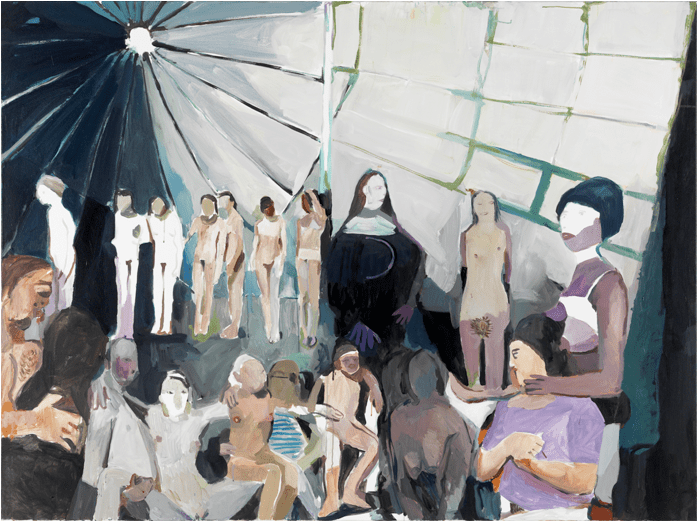
The Arrival of Late Lucys — Helen Verhoeven 

image052

The Arrival of Late Lucys, 2011 by Helen Verhoeven (b. 1974)

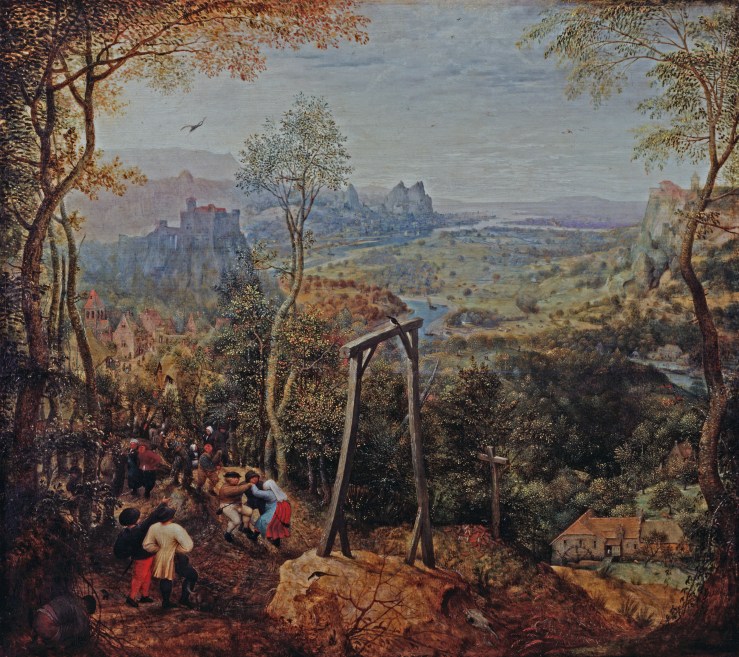
The Magpie on the Gallows — Pieter Bruegel the Elder

The Magpie on the Gallows, by Pieter Brueghel the Elder

Screenshot 2020-01-09 at 4.25.57 PMScreenshot 2020-01-09 at 4.25.32 PM

The Magpie on the Gallows, 1568 by Pieter Bruegel the Elder (c. 1525-1569)

The Journal of David Foster Wallace Studies, Vol. 1, Issue 2 (Book acquired, 9 Dec. 2019)

img_4711

I finally had a bit of time to properly dip into the second issue of The Journal of David Foster Wallace Studies this afternoon. (I brought it to work with me and read from it between classes.)

This issue essentially came out of a 2015 conference at the University of Bristol called David Foster Wallace and the Short Things. Issue 2 contains six essays on Wallace’s “short things” — short stories, sure, but also the vignettes and bits and pieces and fragments that make up The Pale King (and Infinite Jest).

After skimming around a bit, I read the last one, Jeffrey Severs’ “‘Listen’: Wallace’s Short Story Endings and the Art of Falling Silent.” Severs explores Wallace’s endings as a kind of series of revisions to the conclusion of Wallace’s first novel, The Broom of the System (Wallace later called the ending “shitty and dissatisfying”). Severs discusses Girl with Curious Hair extensively, but also touches on The Pale King and Infinite Jest. (And Wittgenstein, silence, and meditative listening.)

There are also two reviews of recent books on Wallace in this issue, just as in the previous issue, one for Marshall Boswell’s The Wallace Effect: David Foster Wallace and the Contemporary Literary Imagination, and one for Ralph Clare’s The Cambridge Companion to David Foster Wallace.

A few of the other essays piqued my interest; Tim Groenland has a thing on fragments, The Pale King, and ancient Rome, and Pia Masiero has a thing on Brief Interviews with Hideous Men, which is maybe my favorite Wallace book.


Float — David Bailin

float

Float, 2015 by David Bailin

The Land of Extreme Happiness in The West — Mu Pan

west_web-1-768x650-1

The Land of Extreme Happiness in The West, 2019 by Mu Pan (b. 1976)

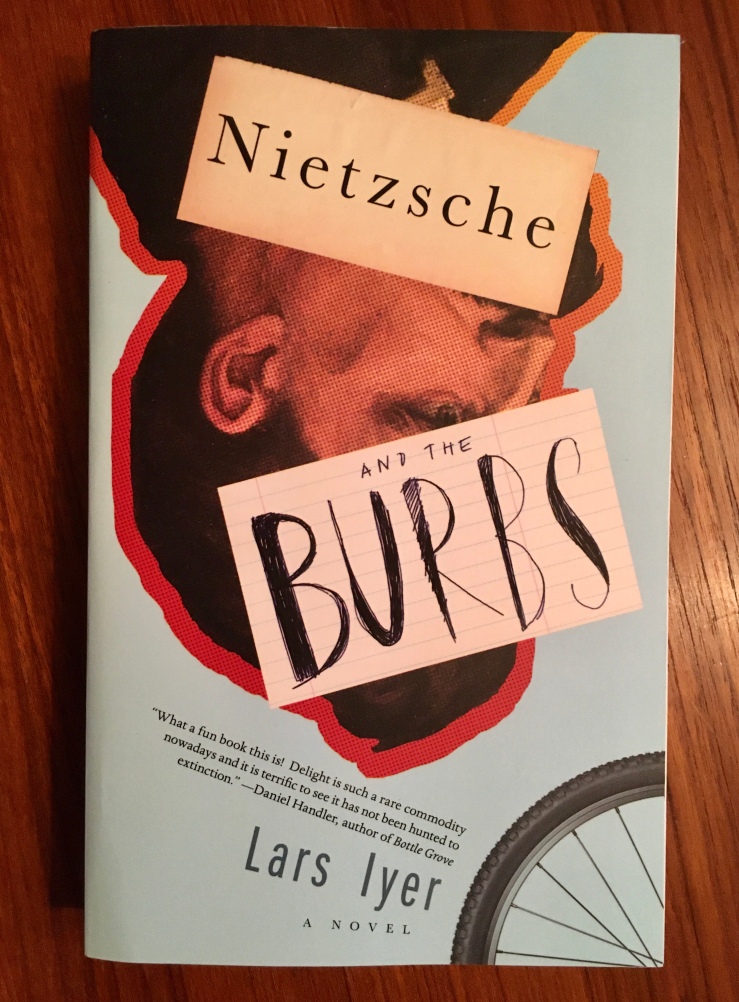
Lars Iyer’s Nietzsche and the Burbs (Book acquired, sometime in Dec. 2019)

img_4709

Lars Iyer’s latest is Nietzsche and the Burbs, out now from Melville House. Their blurb:

In a work of blistering dark hilarity, a young Nietzsche experiences life in a metal band & the tribulations of finals season in a modern secondary school

When a new student transfers in from a posh private school, he falls in with a group of like-minded suburban stoners, artists, and outcasts—too smart and creative for their own good. His classmates nickname their new friend Nietzsche (for his braininess and bleak outlook on life), and decide he must be the front man of their metal band, now christened Nietzsche and the Burbs.

With the abyss of graduation—not to mention their first gig—looming ahead, the group ramps up their experimentations with sex, drugs, and…nihilist philosophy. Are they as doomed as their intellectual heroes? And why does the end of youth feel like such a universal tragedy?

And as they ponder life’s biggies, this sly, elegant, and often laugh-out-loud funny story of would-be rebels becomes something special: an absorbing and stirring reminder of a particular, exciting yet bittersweet moment in life…and a reminder that all adolescents are philosophers, and all philosophers are adolescents at heart.


Ratner’s Star | On Uncut Gems

uncut_gems_0174939

Frenetic, chaotic, and unceasingly energetic, the Safdie brothers’ 2019 film Uncut Gems plays out like a two-hour panic attack. Uncut Gems opens in the turbulent aftermath of a mining accident. An Ethiopian mine worker is borne up by his frenzied fellows, his leg a raw mangled bloody mess. The Ethiopian workers’ voices mix into the Chinese mine operators’ attempts to calm the situation. This initial cacophony signals the babble and buzz that will continue through the rest of the film, and the camera’s lingering on the destroyed leg signals the violent cost that underwrites the material splendor at the heart of Uncut Gems.

Two Ethiopian miners take a gamble and use the chaos as an opportunity to sneak away, back into the mine to make off with a rare black opal, the titular uncut gem. One of the miners peers into the gem, and the camera follows his gaze. We are taken into a kaleidoscope of shifting colors as Daniel Lopatin’s beautiful synth score kicks in. The camera swirls through the gem and, in an opening sequence that rivals Gaspar Noé’s Enter the Void, eventually enters the colon of our hero, Howard Ratner.

A title card informs us it is two years later. It is 2012 in New York City and Howard Ratner is getting a colonoscopy. There is probably some metaphor here—the aesthetic journey from the gem’s dazzle of color to the interior glistening-chewing-gum-pink flesh of Howard’s colon—but I’ll avoid remarking further upon it.

Here is the film’s premise: Howard owns and runs a jewelry store in the Diamond District. His associate Demany brings rappers and athletes to him to buy unique, high-end pieces. He is flush with cash all the time, but is also severely indebted to a loan shark named Arno (among other folks). However, his debts don’t stop him from continuing to place bets. He is also in the middle of an affair with one of his employees, Julia, whom he keeps in his Manhattan apartment, barely-concealed from his wife and children in Long Island.

uncut-garnett-sandler-1576518581

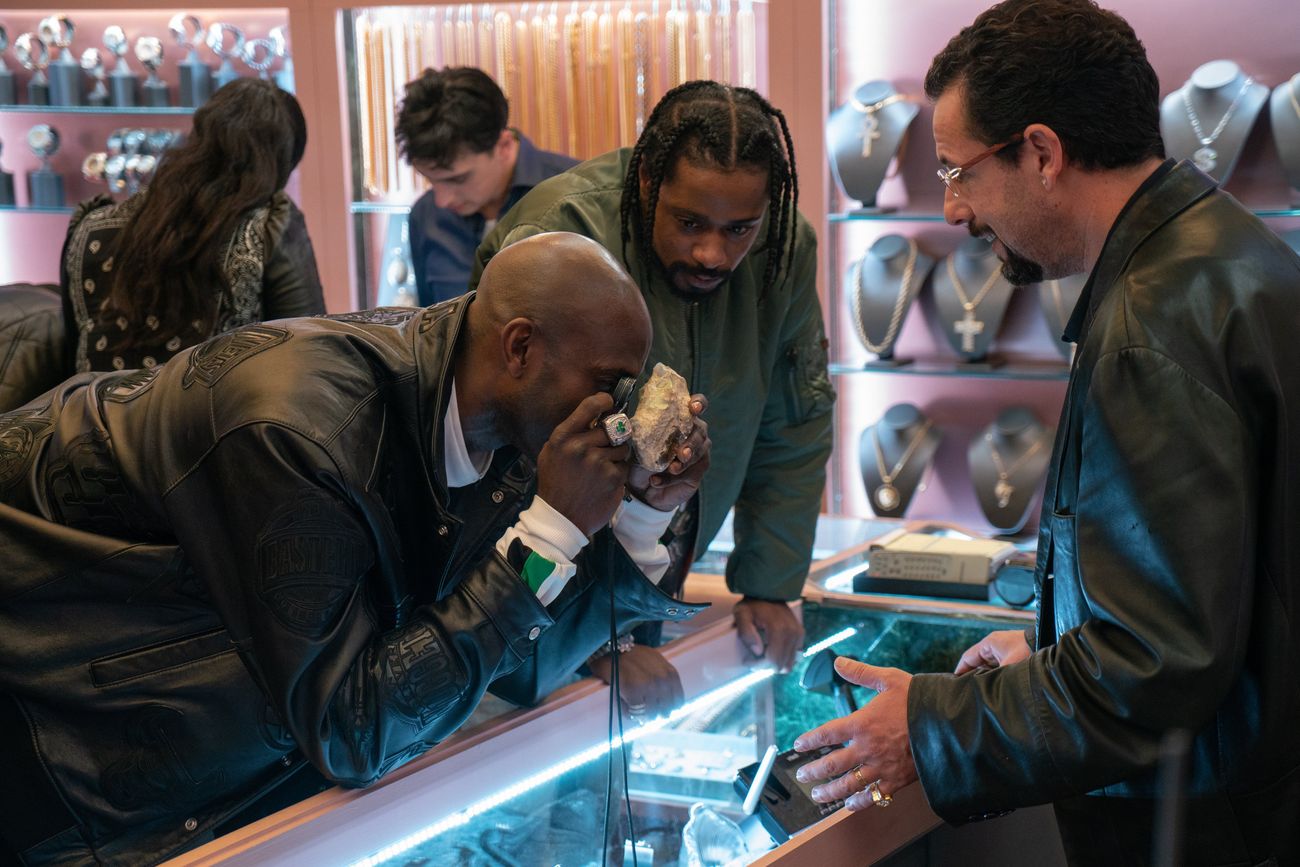
Three things happen on the day we meet Howard: Arno’s henchmen come to prove good on their threats of violence towards him if he does not pay back his loans; Demany brings Boston Celtics power forward Kevin Garnett to Howard’s shop; and Howard receives the titular uncut black opal, which he plans to sell at auction for at least a million dollars. Seeking to impress Kevin Garnett (“KG!”), the jeweler shows off his opal, Ratner’s star. In one of the film’s most extraordinary visual sequences, KG gazes into the opal and undergoes a seismic epiphany. He demands to buy the gem, but Howard refuses—he needs the money from the auction to get clean of debt. However, Howard allows KG to borrow the gem for the night, taking Garnett’s 2008 NBA Championship ring as collateral for its return. KG is convinced that the gem will lead to his success in that night’s Eastern Conference Semifinals game against the Philadelphia ’76ers (it does).

From this early point in the film Howard goes on to make a series of increasingly-nerve-wracking decisions against the backdrop of his loan shark’s enforcers’ increasingly-violent promises of retribution. I will not spoil any more of the plot—my “premise” paragraph seems too long as it is—I’ll simply say that there were moments that I (and other audience members) audibly gasped (in shock, in exasperation, in frustrated disbelief) at Howard’s choices.

Uncut Gems never really lets up. There are a few moments of respite as well as moments of comedy, but they mostly serve to suspend the anxiety the film creates, not release it. Uncut Gems is a horror film posing as a crime thriller, an anxiety film equal to Aronofsky’s mother! or Polanski’s Repulsion. The Safdies conjure a hectic, bustling world in Uncut Gems, a world of babble and noise and beauty and ugliness. Characters crowd the frames, their voices colliding in a way reminiscent of the films of Altman, Cassavetes, or early Scorsese.

Under and through the noise of voices in Uncut Gems floats Daniel Lopatin’s wonderful score. Waves of synths swing between between evocations of romance and horror; menacing swells and whimsical melodies, simultaneously busy and calming, cascade over the film. Lopatin, better known as the electronic artist Oneohtrix Point Never, is a highlight of this film.

Another highlight of Uncut Gems is Darius Khondji’s cinematography . The not-overly-saturated shots are reminiscent of his work on Wong Kar-Wai’s under-rated 2007 film My Blueberry Nights (as well as his work the same year on Haneke’s equally-anxiety-producing black comedy/horror Funny Games). Khondji conjures a candy-colored Manhattan, lush and opulent. The painterly frames are seductive but also dangerous, recalling the neon-noir of films by Gaspar Noé and Nicolas Winding Refn.

And of course the acting. I have spent close to 800 words not pointing out that this is an Adam Sandler film. Sandler inhabits his role as Howard Ratner with a vibrating energy that is hard to capture in words. It’s hard to imagine any one else playing the part. Sandler’s Howard is a degenerate gambler, addicted to the thrills of his own confidence games, a trickster blowing up his life in real time. He’s in love with his own chaos, and it’s hard not to root for him, even as he destroys everything around him.

Kevin Garnett is fantastic as himself. His eyes are especially expressive, and his screen presence is utterly natural. His final scene with Sandler’s Howard is a highlight of the film, as he seems to deliver any sane person’s remarks to the gambling addict. Lakieth Stanfield is also excellent in the film as Demany, Howard’s procurer. He both balances and matches Howard’s energetic chaos, even if he can’t ground his erstwhile partner. Eric Bogosian brings ballast to the role of Arno, Howard’s loan shark, as does Judd Hirsch, playing his father-in-law. Idina Menzel plays Howard’s (soon-to-be-ex-) wife with an unflinching meanness that the character deserves. Newcomer Julia Fox is a standout as Julia, Howard’s mistress. She enables Howard, but in some ways she’s also the hero of the film.

Uncut Gems is a very good film and I was very relieved when it was over. The Safdie brothers have created something that sustains a feeling that many of us take SSRIs to avoid. “Wow, I really hated that,” the young woman next to me remarked to her date as the closing credits began. I can understand that reaction. Uncut Gems will not be entertaining for most folks, but I thought it was great. Its initial evocations of worldly violence as the cost of worldly pleasures are answered in its final moments. Catch it in the theater if you can.

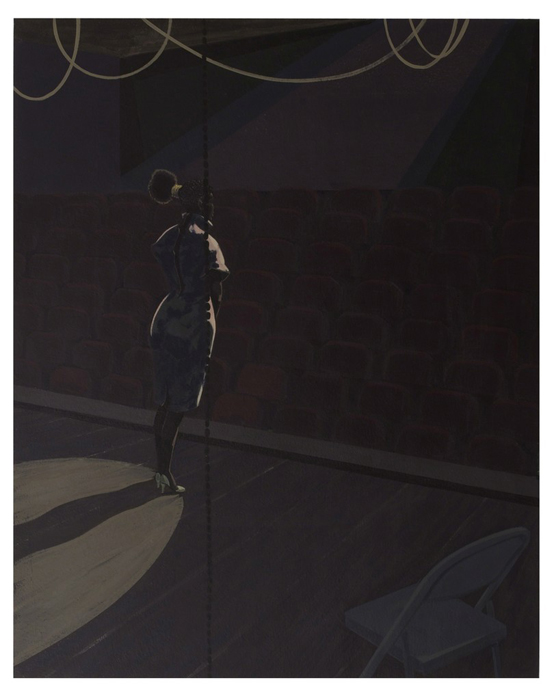
Untitled (Stage) — Kerry James Marshall

untitled-stage

Untitled (Stage), 2018 by Kerry James Marshall (b. 1955)

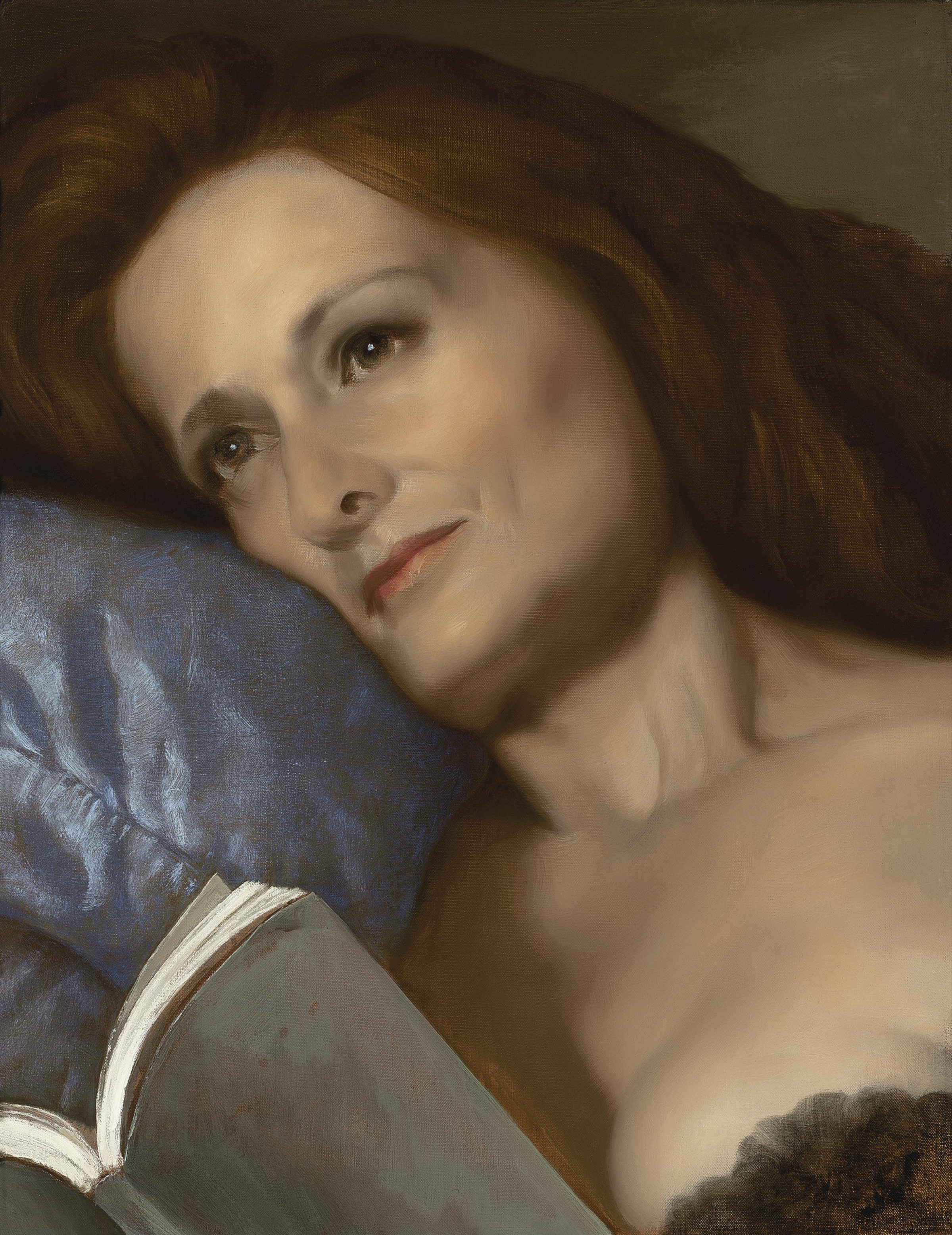
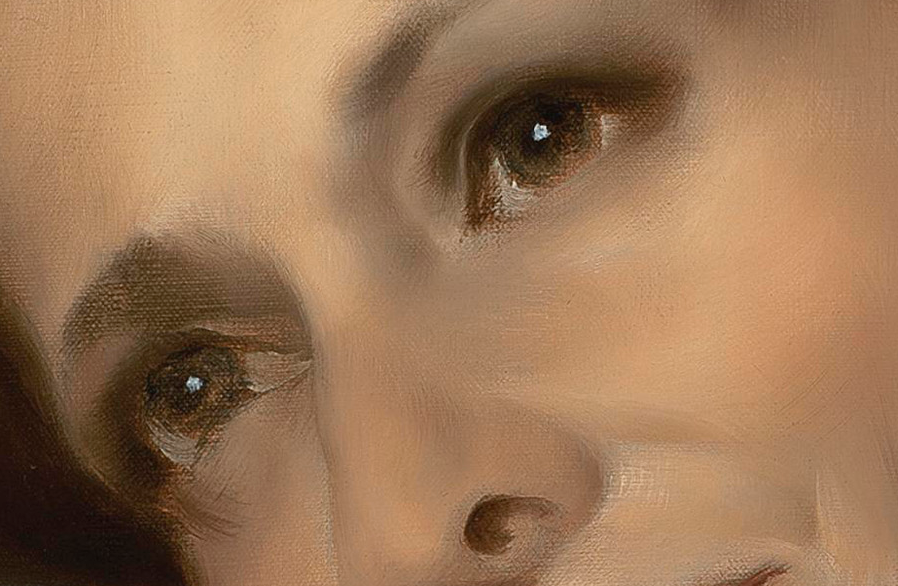
The Pillow — John Currin

2011_cks_07990_0012_000john_currin_the_pillow

Screenshot 2020-01-04 at 11.03.26 AM.png

The Pillow, 2006 by John Currin (b. 1962)

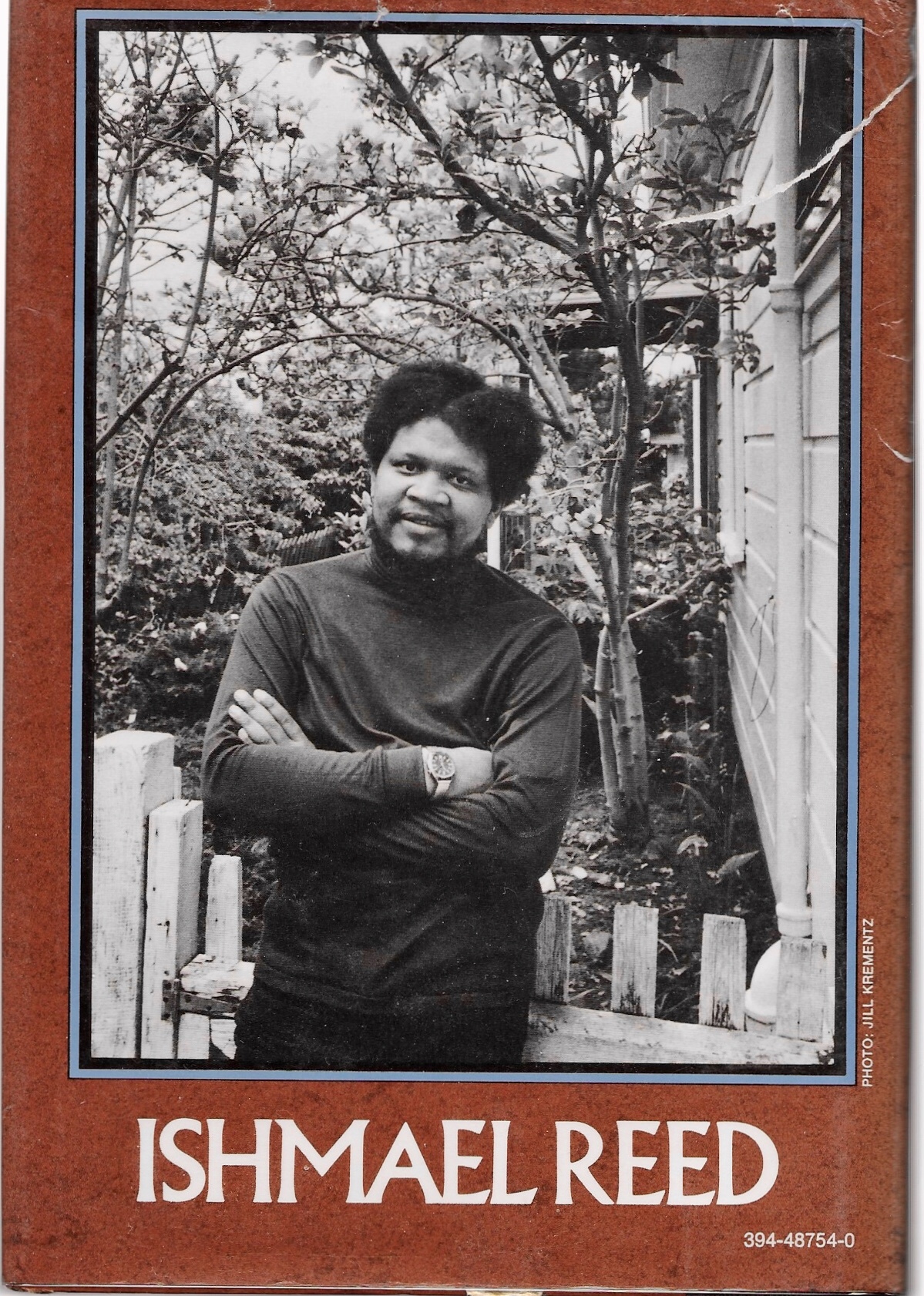
Blog about Ishmael Reed’s 1976 neo-slave narrative Flight to Canada

2020-01-03_152112

I read Ishmael Reed’s 1976 novel Flight to Canada over the last few days of 2019. I enjoyed the book tremendously, even as it made me dizzy at times with its frenetic, zany  achronological satire of the American Civil War.

What is it about?

Flight to Canada features a number of intersecting plots. One of these plots follows the ostensible protagonist of the novel, former slave Raven Quickskill, who escapes the Swille plantation in Virginia. Along with two other former slaves of the Swille plantation, Quickskill makes his way far north to “Emancipation City” where he composes a poem called “Flight to Canada,” which expresses his desire to escape America completely. The aristocratic (and Sadean) Arthur Swille simply cannot let “his property run off with himself,” and sends trackers to find Quickskill and the other escapees, Emancipation Proclamation be damned. On the run from trackers, Quickskill jumps from misadventure to misadventure, eventually reconnecting his old flame, an Indian dancer named Quaw Quaw (as well as her husband, the pirate Yankee Jack). Back at Swille’s plantation Swine’rd, several plots twist around, including a visit by Old Abe Lincoln, a sadistic episode between Lady Swille and her attendant Mammy Barracuda, and the day-to-day rituals of Uncle Robin, a seemingly-compliant “Uncle Tom” figure who turns out to be Reed’s real hero in the end.

(And oh, Quickskill makes it to Canada in the end. Now, whether or not he wants to stay there after he gets there…)

There’s a whole lot more in the book, too. It’s difficult to summarize—like the majority of the other seven novels I’ve read by Reed, Flight to Canada isn’t so much a work of plot and character development as it is a jazzy extemporization of disparate themes and motifs. Reed’s novel is about slavery and freedom, war and aesthetics, perspective and time, and how history gets told and taught to future.

As a means to satirize not just the Civil War but also how we read and write and portray the Civil War, Reed collapses time in Flight to Canada. As novelist Jerome Charyn points out in his contemporary review of the novel in The New York Times,

Reed has little use for statistical realities. He is a necromancer, a believer in the voodoos of art. Time becomes a modest, crazy fluid in Reed’s head, allowing him to mingle events of the last 150 years, in order to work his magic. We have Abe Lincoln and the Late Show, slave catchers and “white ‐ frosted Betty Crocker glossy cake,” Jefferson Davis and Howard K. Smith. Every gentleman’s carriage is equipped with “factory climate‐control air conditioning, vinyl top, AM/FM stereo radio, full leather interior, power‐lock doors, six‐way power seat, power windows, whitewall wheels, door‐edge guards, bumper impact strips, rear defroster and softglass.”

Reed’s achronological gambit allows him to bring figures from any time period into the narrative, no questions asked. Edgar Allan Poe is there, even though he died over a decade before the war began. No matter. Our narrator claims early on that Poe was “the principal biographer of that strange war…Poe got it all down. Poe says more in a few stories than all of the volumes by historians.” Lord Byron shows up too, as do Charles I of England and the Marquis de Sade. There are contemporary figures of the Civil War era there too, of course—Harriet Beecher Stowe (whom Reed takes to task repeatedly), Frederick Douglass, and the writer William Wells Brown, whom Quickskill meets in a surprisingly moving scene (Quickskill says that Brown is his hero and that his novel Clotel was the inspiration for “Flight to Canada”). The fictional characters of Flight to Canada discuss or interact with these historical figures in such a way to continually critique not just the words and deeds of the historical figures, but the very way we frame and narrativize those words and deeds.

2020-01-03_152112_1The technological anachronisms of Flight to Canada also serve to critique our framing of history. Our American Cousins plays live on broadcast TV, assassination and all:

Booth, America’s first Romantic Assassin. They replay the actual act, the derringer pointing through the curtains, the President leaning to one side, the FIrst Lady standing, shocked, the Assassin leaping from the balcony, gracefully, beautifully, in slow motion. They promise to play it again on the Late News. When the cameras swing back to the Balcony, Miss Laura Keene of Our American Cousins is at Lincoln’s side “live.” Her gown is spattered with brain tissue. A reporter has a microphone in Mary Todd’s face.

“Tell us, Mrs. Lincoln, how do you feel having just watched your husband’s brains blow out before your eyes?”

(In a very Reedian move, the live assassination plays out during a sex scene between Quickskill and Quaw Quaw. The TV is always on in America, even during sex.)

Reed’s rhetorical distortions in depicting the Lincoln assassination are both grotesque and comic. Not only can we imagine a reporter doing the same in 1976, when Flight to Canada was published, we can imagine the same crass, exploitative handling today. Technology might have changed but people really haven’t

In his review, Jerome Charyn, begins by pointing out that 1976 is the American Bicentennial, something that simply did not entire my mind while reading Flight to Canada. Reed’s novel’s publication is appropriate and timely, and breaks “through the web of historical romance” (in the words of Charyn) that hangs over the “chicanery, paranoia and violence underlying most of our ‘democratic vistas.'”

Concluding his review, Charyn writes,

Flight to Canada could have been a very thin book, an unsubtle catalogue of American disorders. But Reed has the wit, the style, and the intelligence to do much more than that. The book explodes. Reed’s special grace is anger. His own sense of bewilderment deepens the comedy, forces us to consider the sad anatomy of his ideas. Flight to Canada is a hellish book with its own politics and a muscular, luminous prose. It should survive.

Books don’t survive of course; rather, they are always in the process of surviving. Books are either read, or not read. Flight to Canada should be read because it is witty and angry and unique and smart, and its critique of American history (and how we narrativize and aestheticize American history) is as vital and necessary today as it was nearly a half century ago.

img_4558


Klop, Klop, Klack Klack Klack — Kati Heck

KH

Klop, Klop, Klack Klack Klack, 2018 by Kati Heck (b. 1979)

Blog about the first books I bought in 2020 (Books acquired, 2 Jan. 2020)

img_4686

Since the last time I’ve done one of these stupid “books acquired” posts, I’ve had at least six review copies show up at Biblioklept World Headquarters, Joy Williams’ 1988 Florida Keys novel Breaking and Entering, and a signed first-edition hardback copy of Ishmael Reed’s 1976 neo-hoodoo novel Flight to Canada—which I finished yesterday morning—and I’ve yet to do one of these stupid “books acquired posts” on any of them.

I had intended to do write about Flight to Canada today—a very Reedesque romp, overstuffed with characters and capers and motifs and themes, a zany satire of not just the Civil War, but also the American 1970s. Anyway, I’d intended to write about it today (or maybe riff on Greta Gerwig’s Little Women, which I saw last night and adored), but I ended up having to do a bunch of post-Xmas chores. The last few weeks have been busy.

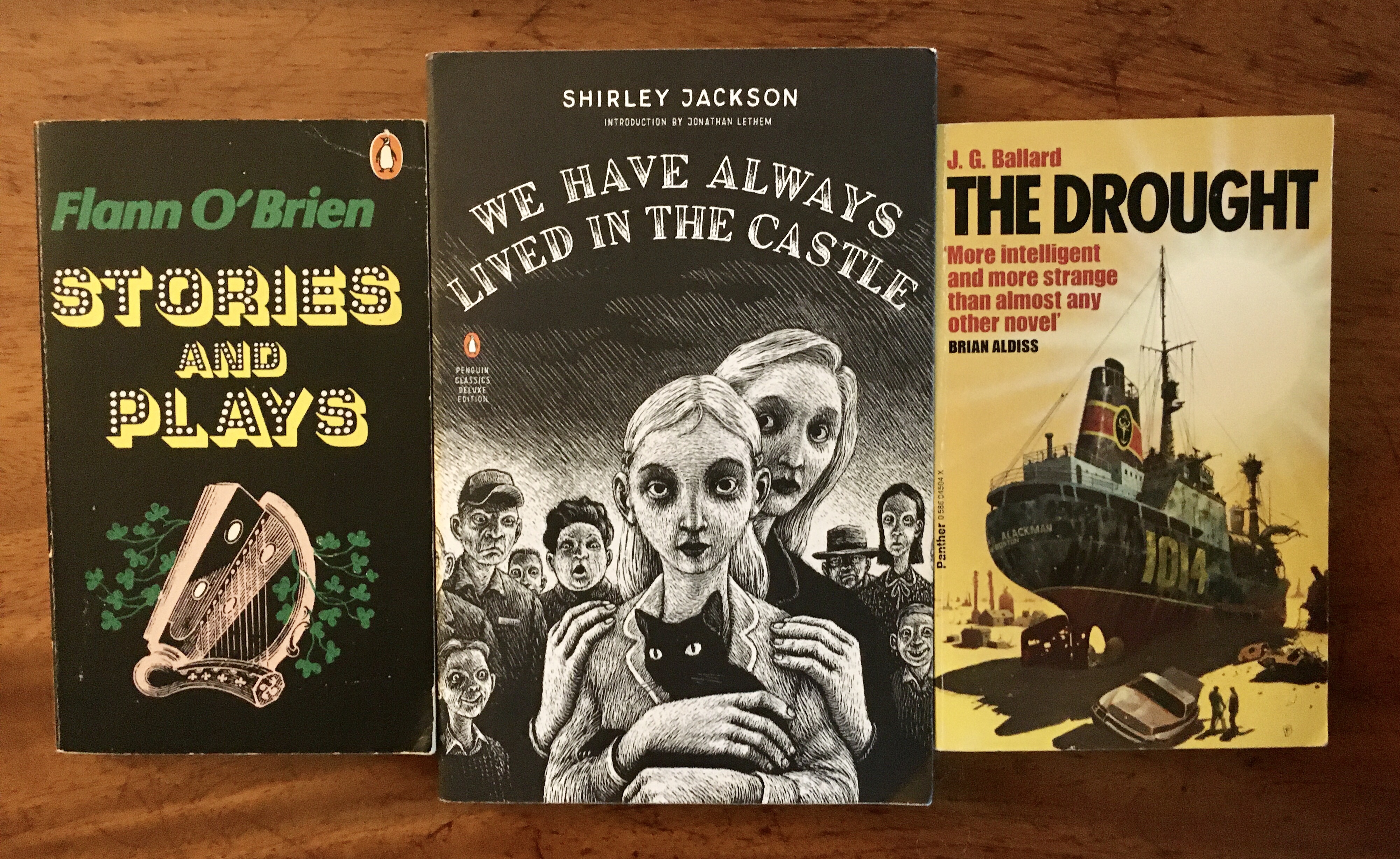
In between post-Xmas chores, I dropped my daughter off at my in-law’s, which necessitates driving past my favorite used bookstore. I couldn’t resist stopping by, even though I need another book like I need another hole in my head. I mean, I had intended to start Charles Portis’s latest (and hopefully not last!) novel Gringos today. Instead, I started Shirley Jackson’s We Have Always Lived in the Castle.

Jackson’s novel The Haunting of Hill House was an unexpected highlight for me in 2019—I’ll admit I’d never really thought to read anything of hers after filing her under Eighth grade lit after reading “The Lottery” (I made a similar stupid mistake with William Golding (filed under Tenth grade lit), corrected by good people who told me to read The Inheritors). I didn’t really know anything about We Have Always Lived in the Castle until today, but I love the title and really dig this Penguin edition’s cover (by comix artist Thomas Ott). Like Hill House, Castle also has a fantastic opening paragraph:

My name is Mary Katherine Blackwood. I am eighteen years old, and I live with my sister Constance. I have often thought that with any luck at all I could have been born a werewolf, because the two middle fingers on both my hands are the same length, but I have had to be content with what I had. I dislike washing myself, and dogs, and noise. I like my sister Constance, and Richard Plantagenet, and Amanita phalloides, the death-cup mushroom. Everyone else in my family is dead.

The first sentence is a bit banal, a little bit of exposition, right? And then by the time you get to the “I could have been a werewolf,” well, what the hell? And then there’s a because, lovely, before a nice lists of dislikes (first!) and then likes (including a deadly mushroom, which Jackson’s narrator Mary (purposefully?) misnames as the “death-cup” instead of the death cap. The last line is a hell of a zinger.

I skipped Jonathan Lethem’s introduction of course, but I did have to go figure out if he also wrote the introduction to the edition of Hill House I read last year. (He didn’t Jonny Lethe wrote the intro to the copy of Anna Kavan’s Ice that I read last year. I’ll read J-Lethz intro after I finish.)

I also picked up a 1973 Penguin edition of a collection of Flann O’Brien’s stories and plays. (Neil Stuart’s cover was worth the two bucks.) The bulk of the collection is devoted to an unfinished novel called Slattery’s Sogo Saga and a play called Faustus Kelly, attributed to O’Brien’s pseudonym Myles na gCopaleen (rendered in this edition as Myles Na Gopaleen—Flann O’Brien was actually a pseudonym too, for Brian O’Nolan).

Like the O’Brien collection, picking up a clearly-unread pristine massmarket paperback edition of J.G. Ballard’s 1965 novel The Drought was more an I have to type situation than anything else, although I’m sure I’ll read it this year (I’m always looking to scarf down a Philip K. Dick or Ballard I haven’t read, and I haven’t read The Drought). Initially, I was perplexed—I thought I knew all Ballard titles, even the ones I haven’t read—but it turns out that The Drought was initially published in 1964 as The Burning World (which I was aware of). In any case, The Drought is probably horrifyingly prescient novel as we enter the New Twenties. Happy New Year!

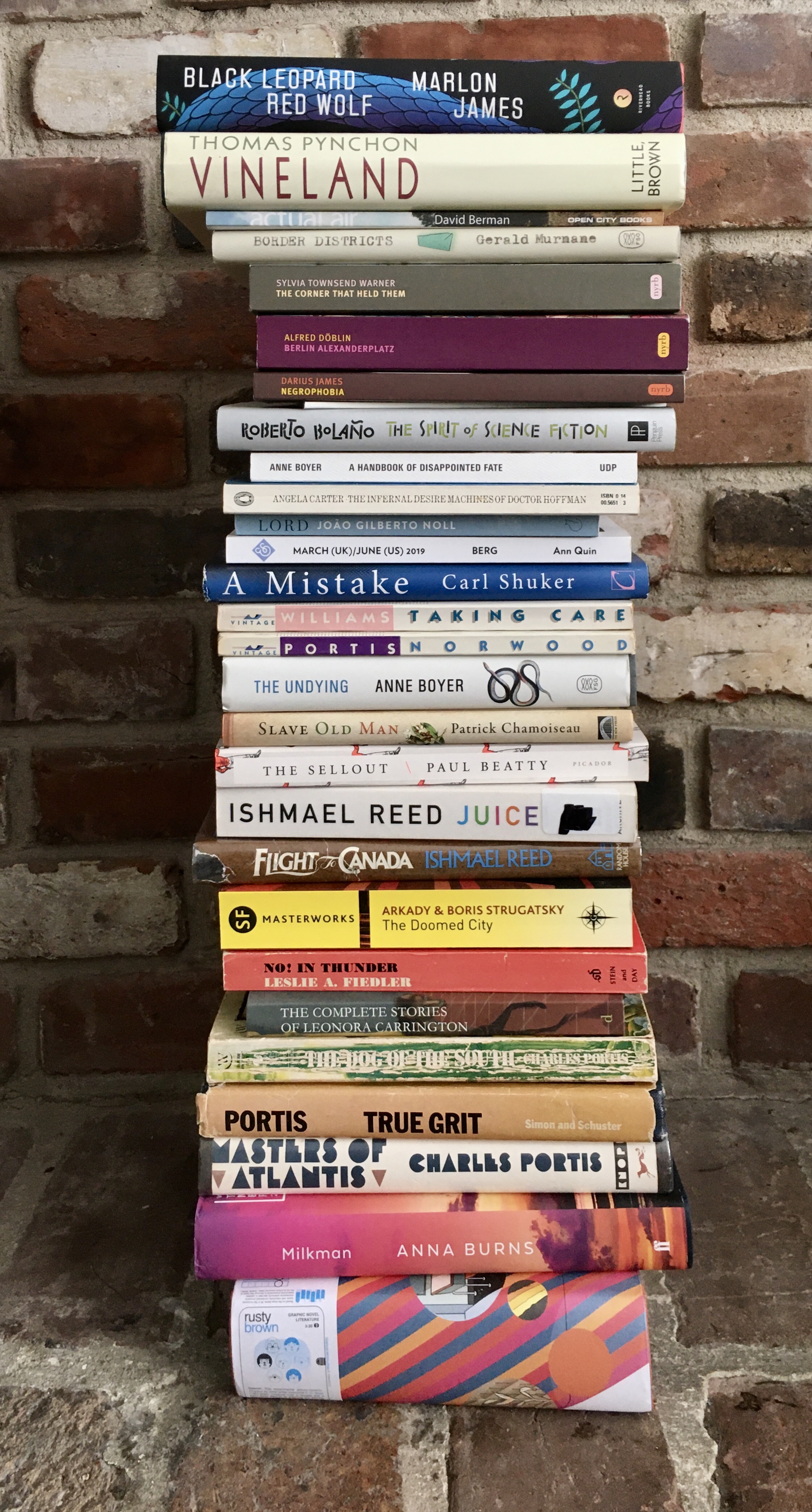
Annotations on a probably incomplete list of books I read or reread in full in 2019

img_4664

The Infernal Desire Machines of Dr. Hoffman, Angela Carter

Deeply horny and deeply deprave. Hoffman sprints along with an out-of-the-frying-pan-into-the-fire energy. It’s a picaresque adventure with narrator Desiderio taking on titular mad scientist Hoffman and his war against reality. Wild shit happens and each chapter feels like it could stand on its own as a short story. I loved it. Someone could make a fantastic video game out of The Infernal Desire Machines of Doctor Hoffman.

 Letters, Dreams & Other Writings, Remedios Varo (translation by Margaret Carson)

Interviewing Margaret Carson was an early highlight of 2019 for me. We talked about Varo’s letters and other writings (dreams!), and she brought up Roberto Bolaño and Thomas Pynchon, which is like, golden for me.

We, Yevgeny Zamyatin (translation by Clarence Brown)

I absolutely loved Clarence Brown’s 1993 translation of Zamyatin’s We. From my review:

Set millennia in the future, Yevgeny Zamyatin’s 1921 dystopian novel We tells the story of a man whose sense of self shatters when he realizes he can no longer conform to the ideology of his totalitarian government. Zamyatin’s novel is a zany, prescient, poetic tale about resisting the forces of tyranny, conformity, and brute, unimaginative groupthink.Set millennia in the future, Yevgeny Zamyatin’s 1921 dystopian novel We tells the story of a man whose sense of self shatters when he realizes he can no longer conform to the ideology of his totalitarian government. Zamyatin’s novel is a zany, prescient, poetic tale about resisting the forces of tyranny, conformity, and brute, unimaginative groupthink.

Origin of the Brunists, Robert Coover

Probably the best opening chapters I’ve ever read in a novel that fails deliver after the first 100 or so pages. Coover turns it up to 11—the second chapter of Origin, describing a mine’s implosion, is some of the best stuff I’ve ever read, but the next 400 pages of the disaster’s fallout is a rhetorical trudge.

The Spirit of Science Fiction, Roberto  Bolaño (translation by Natasha Wimmer)

For completists only. A dress rehearsal for The Savage Detectives. I wrote about it here.

Evening in Paradise, Lucia Berlin

Fucking loved it, didn’t I.

Taking Care, Joy Williams

Williams’ early collection contains at least three perfect short stories.

No!, Leslie Fiedler

Fiedler’s Love and Death in the American Novel is extremely important to how I think about American literature. No! is not nearly as good.

A Handbook of Disappointed Fate, Anne Boyer

How serendipitous that Boyer’s collection of essays begins with a wonderful essay called “No.” Good stuff.

Kingdom, Jon McNaught

I reviewed it at The Comics Journal, writing,

Not much happens in Jon McNaught’s latest graphic novel Kingdom. A mother takes her son and daughter to Kingdom Fields Holiday Park, a vacation lodge on the British coast. There, they watch television, go to a run-down museum, play on the beach, walk the hills, and visit an old aunt. Then they go home. There is no climactic event, no terrible trial to endure. There is no crisis, no trauma. And yet it’s clear that the holiday in Kingdom Fields will remain forever with the children, embedded into their consciousness as a series of strange aesthetic impressions. Not much happens in Kingdom, but what does happen feels vital and real.

,before going on to riff on John Berryman’s fourteenth Dream Song  a bit.

Parable of the Sower, Octavia Butler

I mean like I guess I didn’t really think it was that good?

Black Leopard, Red Wolf, Marlon James

Well I fucking loved it didn’t I?

Marlon James’s novel Black Leopard, Red Wolf is a postmodern fantasy that takes place in medieval sub-Saharan Africa. Set against the backdrop of two warring states, the North Kingdom and the South Kingdom, Black Leopard, Red Wolf is the story—or stories, really—of Tracker, a man “with a nose” who can track down pretty much anyone (as long as he’s got the scent).

The central quest of Black Leopard, Red Wolf is for Tracker to find and recover a missing child of great importance. An explanation of exactly how and why the child is so important is deferred repeatedly; indeed, James’s novel is as much a detective story as it is a fantasy. In his detective-quest, Tracker partners with a number of strange allies: a talkative giant (who tells us repeatedly that he is not a giant), an anti-witch who places charms on Tracker, a duplicitous Moon Witch, a skin-shedding warrior-spy, a sandy-colored soldier from an alien land, a surly archer, a very smart buffalo, and more, more, more.

Berg, Ann Quin

Maybe the best novel I read this year.

The Book of the New Sun, Gene Wolfe

Did these on audiobook and loved them. The first in this tetraology, The Shadow of the Torturer was probably my favorite, but the best scene in the whole deal is in the third book, The Sword of the Lictor, when the protagonist Severian fights this were-bear thing called the Alzabo—a slow, protracted battle scene based more on strategy and tactics than on brute force.

Vineland, Thomas Pynchon

I love Thomas Pynchon but Vineland is not his best book, or his second- or third- or fourth-best book (etc.). Has a perfect paragraph nevertheless.

Don Quixote, Kathy Acker

I dig that wild gross stuff what can I say.

Slave Old Man, Patrick Chamoiseau (translation by Linda Coverdale)

Superb.

The Love Bunglers, Jaime Hernandez

–and–

Is This How You See Me?, Jaime Hernandez

I reread The Love Bunglers to review Is This How You See Me? at The Comics Journal. From my review:

Can you ever really go home again?

This is the central question of Jaime Hernandez’s Is This How You See Me? Collecting serialized comics from the past five years into a cohesive graphic novel, Is This How You See Me? is a moving tale of friendship, aging, and how the past shapes how we see the present.

Border Districts, Gerald Murnane

Great stuff.

Letters of William Gaddis, ed. Steven Moore

“Lonely cows on the highway appeared as splendid Baracuda, and the dismally soaked Spanish moss luxuriant submarine vetch,” Gaddis writes his mother, in 1947, describing leaving rainy New Orleans. All the best letters are to his sweet mama, even the many many ones asking for money. God rest Mama Gaddis’s soul.

Optic Nerve, Maria Gainza (translation by Thomas Bunstead)

Maybe it was the time of year, maybe it was because I had to rush before returning the book to the library. I thought Optic Nerve was nice post-Sebald thing, but it never zapped me.

The Unmapped Country, Ann Quin

Good stuff, good experiments, not Berg.

Ice, Anna Kavan

This book is imperfectly perfect. I wish I’d read it years ago but I’m glad I read it this year. More here. (I fucking loved Ice.)

Geometry in the Dust, Pierre Senges (translation by Jacob Siefring)

More Senges please.

Milkman, Anna Burns

Is good

Milkman is a maybe-horror, but also a maybe-comedy (it even ends in a maybe-laugh), and like many strong works that showcase the intense relationship between horror and comedy (Kafka, BrazilThe King of Comedy, “Young Goodman Brown,” Twin Peaks, Goya, Bolaño, Get OutCandideCurb Your EnthusiasmFunny Games, etc.)—like many strong works that showcase the intense relationship between horror and comedy, Milkman exists in a weird maybe-space, a queasy wonderful freaky upsetting maybe-space that, in its finest moments, makes us look at something we thought we might have understood in a wholly new way.  Highly recommended.

A Little Lumpen Novelita, Roberto Bolaño (translation by Natasha Wimmer)

A Little Long Short Story by dipped out of the bottom of the Bolaño barrel.

Tears of the Trufflepig, Fernando A. Flores

This review piqued my interest in Flores’s alternate timeline border novel. The novel’s premise was good, but the prose seemed uninspired.

Norwood, Charles Portis

The Dog of the South, Charles Portis

Masters of Atlantis, Charles Portis

True Grit, Charles Portis

I read Norwood this summer and then promptly picked up everything I could by Portis. Can’t believe I haven’t read him until now. I wrote about his novels in a post here. I’m saving Gringos for later.

The Corner That Held Them, Sylvia Warner Townsend

I never would’ve thought an epic story about a backwater nunnery could be so good. More Townsend in 2020.

Rusty Brown, Chris Ware

One of the best novels I read this year. From my review at The Comics Journal

Rusty Brown, Ware’s latest novel (or, more precisely, novel-in-progress) strengthens the argument that Ware is a Serious American Novelist, one who deserves a large crossover audience. Like Jimmy Corrigan and Building StoriesRusty Brown has a central primary setting, a small private school in Nebraska. And like those novels, Rusty Brown comprises material (lightly reworked) from Ware’s Acme Novelty Library series (issues 16, 17, 19, and 20, specifically). The cast here is much larger and the themes are arguably more ambitious though.

Rusty Brown is a sprawling story about memory and perception, about minor triumphs and chronic failures, about how our inner monologues might not match up to the reality around us. In Ware’s world, life can be blurry, spotty, fragmented. His characters are so bound up in their own consciousnesses that they cannot see the bigger picture that frames them.

In the Time of the Blue Ball, Manuela Draeger (translation by Brian Evenson and Valerie Evenson)

I read In the Time of the Blue Ball in two quick sittings. Draeger is one of French author Antoine Valodine’s pseudonyms, but I had forgotten that when I picked it up. It was a Dorothy Project title, and it looked neat, so I got it. Draeger is also one of Volodine’s recurring characters, a concentration camp librarian who invents tales for the camp’s children. The three stories in Blue Ball are whimsical with a dark edge, an edge perhaps provided if one know more of Volodine’s project (encapsulated neatly in Writers). The Draeger stories focus on a detective named Bobby Potemkine and his dog Djinn, and they are lovely.

Rat Time, Keiler Roberts

I loved Rat Time! In my review, I wrote,

Rat Time, like any good autobiography, is crammed with life, brimming with vivid moments that feel authentic and real. Often funny and sometimes painful, Roberts’ book is sweet without sentimentality, sour without caustic meanness, and generous to both its subjects and its readers. Highly recommended.

Negrophobia, Darius James

I had never heard of Negrophobia. I found it in a used bookstore next to something else. The title intrigued me (not to mention the NYRB imprint), and blurbs from Kathy Acker, Paul Beatty, and Kara Walker sold me on it. Negrophobia, first published in 1992, is ugly, hilarious, abject, and gritty, a deep comic dive into American racism and the ways that massculture and urban living propagate and feed off of racism. NYRB’s blurb rightfully compares the novel to the work of William S. Burroughs and Ishmael Reed, but, in its hallucinatory film script form (an apocalyptic angles), it also recalls Aldous Huxley’s overlooked novel Ape in Essence.

Actual Air, David Berman

I wish David Berman were still alive.

The Doomed City, Arkady and Boris Strugatsky  (translation by Andrew Bromfield)

A baggy, abject, Kafkaesque riff on a utopian project’s dystopian turn, The Doomed City was not my favorite Strugatsky jam, but it was pretty good.

The Haunting of Hill House, Shirley Jackson

I made a huge mistake by not reading Shirley Jackson earlier. I think I just associated her with that story we all have to read in like eighth grade, and never went back. Anyway. Hill House has a perfect opening (I riffed on the opening here):

No live organism can continue for long to exist sanely under conditions of absolute reality; even larks and katydids are supposed, by some, to dream. Hill House, not sane, stood by itself against the hills, holding darkness within; it had stood so for eighty years and might stand for eighty more. Within, walls continued upright, bricks met neatly, floors were firm, and doors were sensibly shut; silence lay steadily against the wood and stone of Hill House, and whatever walked there, walked alone.

Berlin Alexanderplatz, Alfred Döblin (translation by Michael Hofmann)

“Unbe-fucking-lievable”

A Mistake, Carl Shuker

I enjoyed Carl Shuker’s slim novel A Mistake. Set in Wellington, New Zealand, A Mistake is the story of Elizabeth Taylor, the only female surgeon at her hospital. Shuker’s novel reads in some ways as a critique of neoliberalism’s attempt to quantify every aspect of medical care. The novel is set against “the minister’s mistake,” a plan to publicize each surgeon’s results. And at the beginning of the novel, well, there’s a mistake, one which Elizabeth is involved with. Although the blurb describes A Mistake as a “procedural thriller,” I found it closer to a character study of an outsider who finds herself increasingly alienated by her peers and friends alike. Shuker conveys his hero edging into paranoia and depression in sharp, precise prose which occasionally recalls Don DeLillo.

The Undying, Anne Boyer

An aphoristic memoir-essay, The Undying is a discursive dive into Boyer’s diagnosis of, treatment of, and recovery from breast cancer. It’s an angry, smart book, with little bursts of mean humor, and it rips apart the ways that neoliberal late capitalism have made health care inhuman and inhumane.

Sports Is Hell, Ben Passmore

Sports Is Hell is a send-up of American massculture that simultaneously stings and enlivens its reader. The novel takes place during the aftermath of a Super Bowl featuring a Kaepernickesque (Kaepernesque?) star player. The Big Game devolves into a Big Riot, with its heroes fighting their way through the madness—think Walter Hill’s film The Warriors by way of George Herriman’s Krazy Kat.

The Sellout, Paul Beatty

Why did I wait so long to read The Sellout?

Falstaff: An Apotheosis, Pierre Senges (translation by Jacob Siefring)

This chapbook is wonderful riff on Henry IV Part I, V.iv—the part where Falstaff flops on the battlefield, faking his death in an act of cowardly heroism.

Juice!, Ishmael Reed

I wrote about Juice! here.

Flight to Canada, Ishmael Reed

I bought myself a signed first-edition hardback copy of Flight to Canada on the internet. It was like 12 bucks. I’m actually not quite finished with it, to be honest–but I’m drafting this post from the past (it’s 14:08 on 31 Dec. 2019 as I type)–but I’ve only got like fifty more pages, so I think I can get it done.

Happy 2020 to all of you!