Donald Barthelme’s Sixty Stories in reverse, Part IV

I am rereading Donald Barthelme’s Sixty Stories, starting with the sixtieth story and working my way to the first and writing about it.

Previous entries:

Stories 60-55

Stories 54-49

Stories 48-43

This post covers stories 42-37.

47. “The Crisis” (Great Days, 1979)

“The Crisis” is a bit of a toss off, a bricolage of the last decade (’69-’79) that never coheres into a duet, monologue, theme, or even punchline. Its plot, such as it is, details (details is not the correct verb) the circumstances of an absurd failed revolution. Ostensibly a dialogue (or is it a chorus?), “The Crisis” doesn’t add up to much, and is perhaps best summarized in one of its closing images:

Distant fingers from the rebel forces are raised in fond salute.

Is Barthelme shooting his readers the bird?

The story feels like a slapdash riff on Walker Percy’s weird and wonderful satirical novel Love in the Ruins. (Barthelme was a huge Percy fan.)

46. “Our Work and Why We Do It” (Amateurs, 1976)

“Our Work and Why We Do It” is self-consciously postmodern, a mash-up of Beckett’s absurdism, Benjamin’s seminal “The Work of Art in the Age of Mechanical Reproduction,” burgeoning Marxist aesthetic philosophy, and the modes and means of modernism. The opening line seems to satirize capital’s relationship between art, artist, and the means of production: “As admirable volume after admirable volume tumbled from the sweating presses . . . ” The ellipses are not mine; rather, Barthelme sets the stage here for a print economy of capitalist transactions. The Wells Fargo man arrives, gun in hand, to pick up the “bundle of Alice Cooper T-shirts we had just printed up.” He hurries the “precious product” — that’s all it is, product, content — to the “glittering fans”.

We then learn there’s a bit of conflict between the owners and the workers.

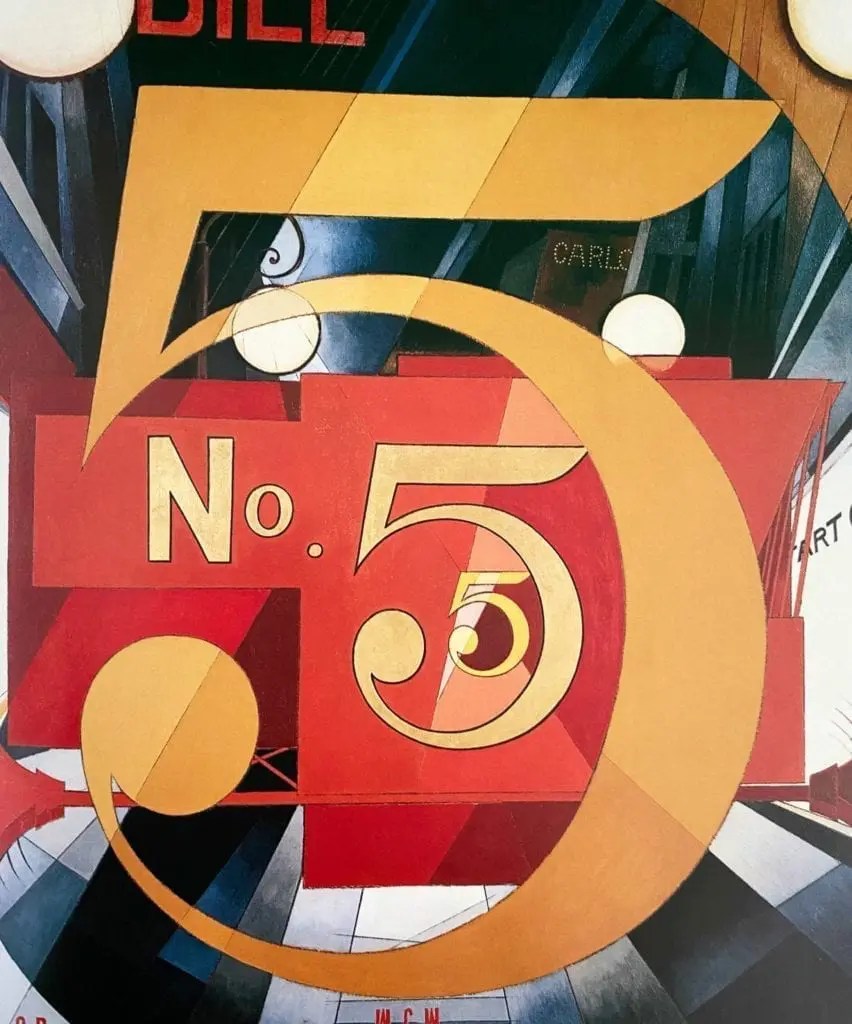
A few lines later, the narrator quips, “And I saw the figure 5 writ in gold.” Barthelme copies-cuts-pastes the modernists into his collage here—we get the visual of Charles Demuth’s painting, itself copying-cutting-pasting Willliam Carlos Williams’ “The Great Figure.”
Publication is a rough business: “If only we could confine ourselves to matchbook covers!” laments the narrator–

But matchbook covers are not our destiny. Our destiny is to accomplish 1. 5 million impressions per day. In the next quarter, that figure will be upped by twelve percent, unless

The hanging “unless” is Barthelme’s rhetorical trick and not my oversight—the punchline is “leather,” by the way.  “Leather is the way to accomplish more impressions. But the real hanging punchline is that word “impressions,” with its many connotations.

45. “The Great Hug” (Amateurs, 1976)

Such a great weird little story—is it about a toxic relationship between the Balloon Man and the Pin Lady? is it a metaphor for relationships in the modern era? is it an autobiographical riff, Barthelme’s love woes scribbled into a weird parody? —an oblique comment on e.e. cummings “in Just” — look, I don’t fucken know, maybe read it here. It’ll only take a few minutes, and then you can think about it for a week or so.

44. “The School” (Amateurs, 1976)

“The School” is wonderful stuff, and will take you like, what, 9, 10 minutes to read, if not less.

It’s a monologue I guess, delivered by a sorry educator whose schooling has killed off all manner of creatures. In the first three paragraphs we learn about the school’s failure to keep alive trees, snakes, and herb gardens, but then there’s a more drastic turn:

Of course we expected the tropical fish to die, that was no surprise. Those numbers, you look at them crooked and they’re belly-up on the surface. But the lesson plan called for a tropical fish input at that point, there was nothing we could do, it happens every year, you just have to hurry past it.

We weren’t even supposed to have a puppy.

We weren’t even supposed to have a puppy—goddammit Donald Barthelme. This line made me laugh out loud. And then it made me sad.

Reviewing my summary of the first three paragraphs, I’m tempted to make something religious out of it all—trees, snakes, gardens, and the like—but I don’t think that’s the gist. Or maybe it is the gist (Barthelme grew up Catholic). Is this a goof on the Eden thing? Humanity’s failure to be good stewards of the planet, etc. etc. etc.? I don’t know. Look, it’s a funny little story, read it.

43. “The Sergeant” (Amateurs, 1976)

“The Sergeant” reads like an oddity in Barthelme’s catalog—although not really, I guess, when that catalog is all oddity.

On one hand, “The Sergeant” is narrated in a seemingly-straightforward Hemingwayesque first-person I. This narrator is clearly based on a version of Barthelme. Barthelme served in the Korean War, but the real backdrop of “The Sergeant” is the Vietnam War–which was also the backdrop of much of Barthelme’s writing career (he arguably best addresses that folly in his 1968 story “The Indian Uprising,” which I’m still a ways from).

On the other hand, “The Sergeant” comes from the school of Kafka—it’s the bad dream we’ve all had, the nightmare repetitions of past duties we didn’t even sign up for. “The Sergeant” reads like a short blueprint for much of the Kafkaesque fiction that would follow it, including the labyrinths of Kazuo Ishiguro.

But Barthelme punctuates his nightmare-tale with a mythological touch: “Penelope!” cries the narrator, extending Barthelme’s anxiety riff into an ageless epic.

42. “I Bought a Little City” (Amateurs, 1976)

I Bought a Little City” is likely regarded as one of Barthelme’s greatest hits, possibly because it’s a more straightforward affair than his collages, pastiches, and oblique parodies. There’s a mean streak to this story about a rich man who buys Galveston, Texas. The story is about a lot things—control, desire, community, and creativity, maybe best summed up in two of its early lines: “What a nice little city, it suits me fine. It suited me fine so I started to change it.” People love to blow up their lives, but the asshole narrator citybuyer starts to blow up other people’s lives. He shoots six thousand dogs, for example. He humiliates a cop by making said cop buy him some fried chicken. He tries to steal another man’s wife, but it doesn’t work out. Maybe “I Bought a Little City” is about creative failures; maybe it’s a satire of capitalism. Or maybe it’s just another Barthelme goof.

Summary thoughts: Uh…the stories in Amateurs are generally better than those in Great Days. The weakest one here is “The Crisis,” from Great Days; the other stories feel more of a piece with each other. I enjoyed “The Sergeant” the most, but mostly because it has a different flavor from the other stories. “The School” is probably the best of the batch.

Going forward (in reverse): We continue backwards through the seventies, where we eventually hit (what I think might be a top-ten Barthelme hit) “Eugénie Grandet.”
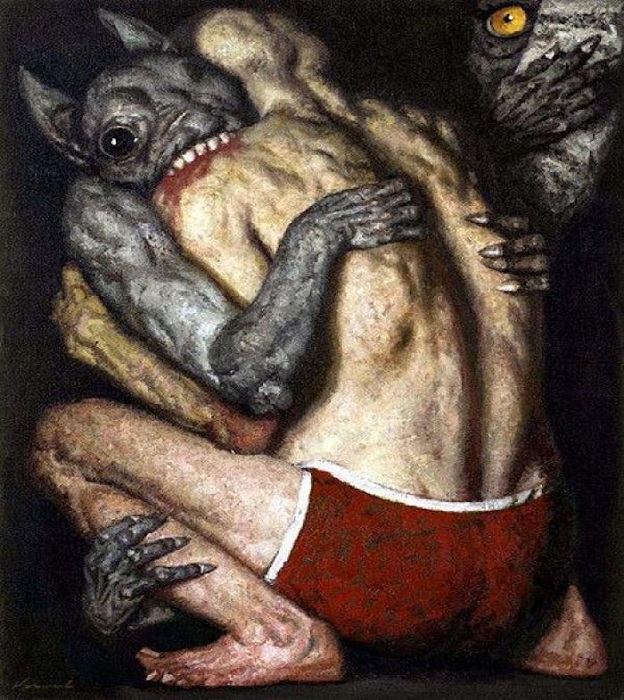
Fight — Gely Korzhev

Fight, 1987 by Gely Korzhev (1925-2012)

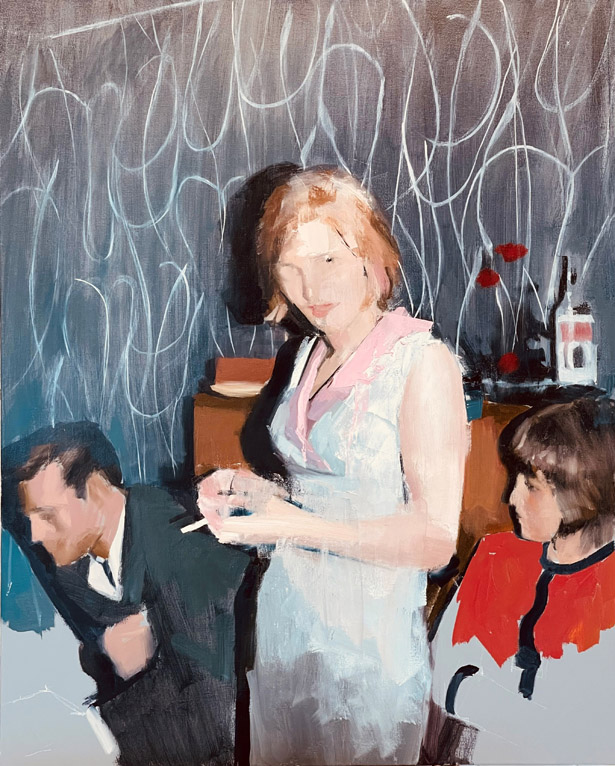
Wallpaper — Mark Tennant

Wallpaper by Mark Tennant (b. 1950)

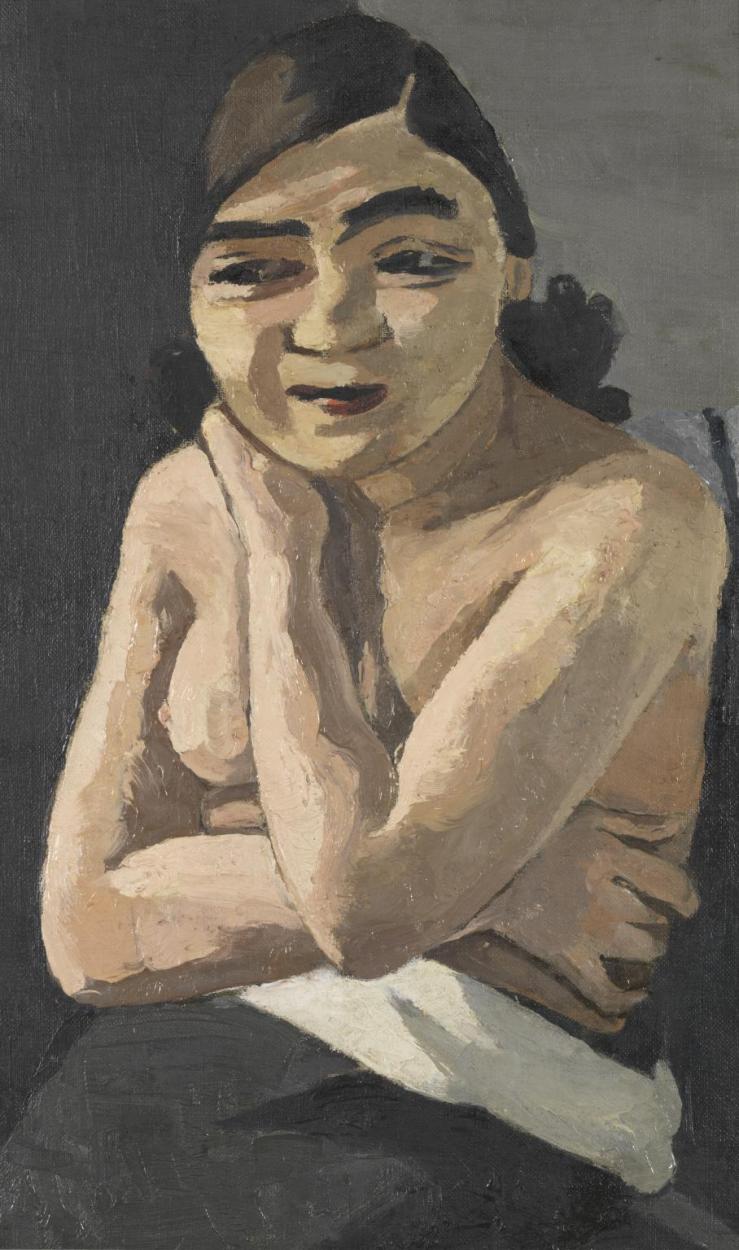
Model, Vienna — Marie-Louise Von Motesiczky

Model, Vienna, 1930 by Marie-Louise Von Motesiczky (1906-1996)

“Cassette County” — David Berman

“Cassette County”

by

David Berman


This is meant to be in praise of the interval called hangover,
a sadness not co-terminous with hopelessness,
and the North American doubling cascade
that (keep going) “this diamond lake is a photo lab”
and if predicates really do propel the plot
then you might see Jerusalem in a soap bubble
or the appliance failures on Olive Street
across these great instances,
because “the complex Italians versus the basic Italians”
because what does a mirror look like (when it’s not working)
but birds singing a full tone higher in the sunshine.

I’m going to call them Honest Eyes until I know if they are,
in the interval called slam-clicker, Realm of Pacific,
because the second language wouldn’t let me learn it
because I have heard of you for a long time occasionally
because diet cards may be the recovery evergreen
and there is a new benzodiazepene called Distance,

anti-showmanship, anti-showmanship, anti-showmanship.

I suppose a broken window is not symbolic
unless symbolic means broken, which I think it sorta does,
and when the phone jangles
what’s more radical, the snow or the tires,
and what does the Bible say about metal fatigue
and why do mothers carry big scratched-up sunglasses
in their purses.

Hello to the era of going to the store to buy more ice
because we are running out.
Hello to feelings that arrive unintroduced.
Hello to the nonfunctional sprig of parsley
and the game of finding meaning in coincidence.

Because there is a second mind in the margins of the used book
because Judas Priest (source: Firestone Library)
sang a song called Stained Class,
because this world is 66% Then and 33% Now,

and if you wake up thinking “feeling is a skill now”
or “even this glass of water seems complicated now”
and a phrase from a men’s magazine (like single-district cognac)
rings and rings in your neck,
then let the consequent misunderstandings
(let the changer love the changed)
wobble on heartbreakingly nu legs
into this street-legal nonfiction,
into this good world,
this warm place
that I love with all my heart,

anti-showmanship, anti-showmanship, anti-showmanship.

Studio Conversation I — John Wonnacott

Studio Conversation I, 1994 by John Wonnacott (b. 1940)

Man Lying in Grass — Tim Eitel

Man Lying in Grass, 2018 by Tim Eitel (b. 1971)

“The Shirt” — Robert Pinsky

“The Shirt”

by

Robert Pinsky


The back, the yoke, the yardage. Lapped seams,
The nearly invisible stitches along the collar
Turned in a sweatshop by Koreans or Malaysians

Gossiping over tea and noodles on their break
Or talking money or politics while one fitted
This armpiece with its overseam to the band

Of cuff I button at my wrist. The presser, the cutter,
The wringer, the mangle. The needle, the union,
The treadle, the bobbin. The code. The infamous blaze

At the Triangle Factory in nineteen-eleven.
One hundred and forty-six died in the flames
On the ninth floor, no hydrants, no fire escapes—

The witness in a building across the street
Who watched how a young man helped a girl to step
Up to the windowsill, then held her out

Away from the masonry wall and let her drop.
And then another. As if he were helping them up
To enter a streetcar, and not eternity.

A third before he dropped her put her arms
Around his neck and kissed him. Then he held
Her into space, and dropped her. Almost at once

He stepped to the sill himself, his jacket flared
And fluttered up from his shirt as he came down,
Air filling up the legs of his gray trousers—

Like Hart Crane’s Bedlamite, “shrill shirt ballooning.”
Wonderful how the pattern matches perfectly
Across the placket and over the twin bar-tacked

Corners of both pockets, like a strict rhyme
Or a major chord. Prints, plaids, checks,
Houndstooth, Tattersall, Madras. The clan tartans

Invented by mill-owners inspired by the hoax of Ossian,
To control their savage Scottish workers, tamed
By a fabricated heraldry: MacGregor,

Bailey, MacMartin. The kilt, devised for workers
To wear among the dusty clattering looms.
Weavers, carders, spinners. The loader,

The docker, the navvy. The planter, the picker, the sorter
Sweating at her machine in a litter of cotton
As slaves in calico headrags sweated in fields:

George Herbert, your descendant is a Black
Lady in South Carolina, her name is Irma
And she inspected my shirt. Its color and fit

And feel and its clean smell have satisfied
Both her and me. We have culled its cost and quality
Down to the buttons of simulated bone,

The buttonholes, the sizing, the facing, the characters
Printed in black on neckband and tail. The shape,
The label, the labor, the color, the shade. The shirt.

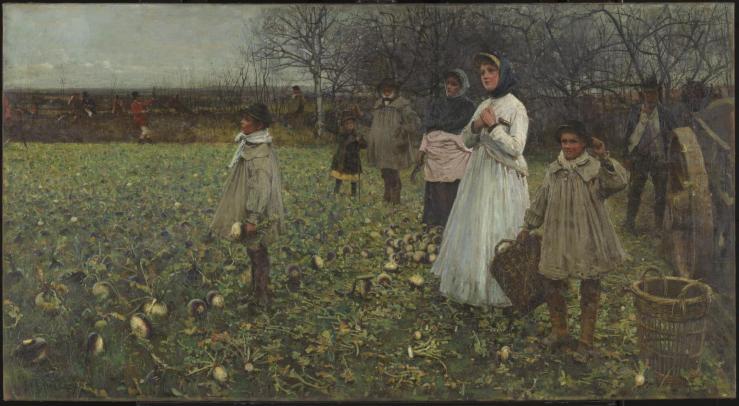
Toil and Pleasure — John Robertson Reid

Toil and Pleasure, 1879 by John Robertson Reid (1851-1926)

A gathering impossible/General merriment (From Pynchon’s Against the Day)

A DAY OR TWO LATER, Lew went up to Carefree Court. The hour was advanced, the light failing, the air heated by the Santa Ana wind. Palm trees rattled briskly, and the rats in their nests up there hung on for dear life. Lew approached through a twilit courtyard lined with tileroofed bungalows, stucco archways, and the green of shrubbery deepening as the light went. He could hear sounds of glassware and conversation.

From the swimming pool came sounds of liquid recreation—feminine squeals, deep singlereed utterances from high and low divingboards. The festivities here this evening were not limited to any one bungalow. Lew chose the nearest, went through the formality of ringing the doorbell, but after waiting a while just walked in, and nobody noticed.

It was a gathering impossible at first to read, even for an old L.A. hand like Lew—society ladies in flapper-rejected outfits from Hamburger’s basement, real flappers in extras’ costumes—Hebrew headdresses, belly-dancing outfits, bare feet and sandals—in from shooting some biblical extravaganza, sugar daddies tattered and unshaven as street beggars, freeloaders in bespoke suits and sunglasses though the sun had set, Negroes and Filipinos, Mexicans and hillbillies, faces Lew recognized from mug shots, faces that might also have recognized him from tickets long cold he didn’t want to be reminded of, and here they were eating enchiladas and hot dogs, drinking orange juice and tequila, smoking cork-tip cigarettes, screaming in each others’ faces, displaying scars and tattoos, recalling aloud felonies imagined or planned but seldom committed, cursing Republicans, cursing police federal state and local, cursing the larger corporate trusts, and Lew slowly began to get a handle, for weren’t these just the folks that once long ago he’d spent his life chasing, them and their cousins city and country? through brush and up creek-beds and down frozen slaughterhouse alleyways caked with the fat and blood of generations of cattle, worn out his shoes pair after pair until finally seeing the great point, and recognizing in the same instant the ongoing crime that had been his own life—and for achieving this self-clarity, at that time and place a mortal sin, got himself just as unambiguously dynamited.

He gradually understood that what everybody here had in common was having survived some cataclysm none of them spoke about directly—a bombing, a massacre perhaps at the behest of the U.S. government. . . .

“No it wasn’t Haymarket.”

“It wasn’t Ludlow. It wasn’t the Palmer raids.”

“It was and it wasn’t.” General merriment.

—Thomas Pynchon’s novel Against the Day.


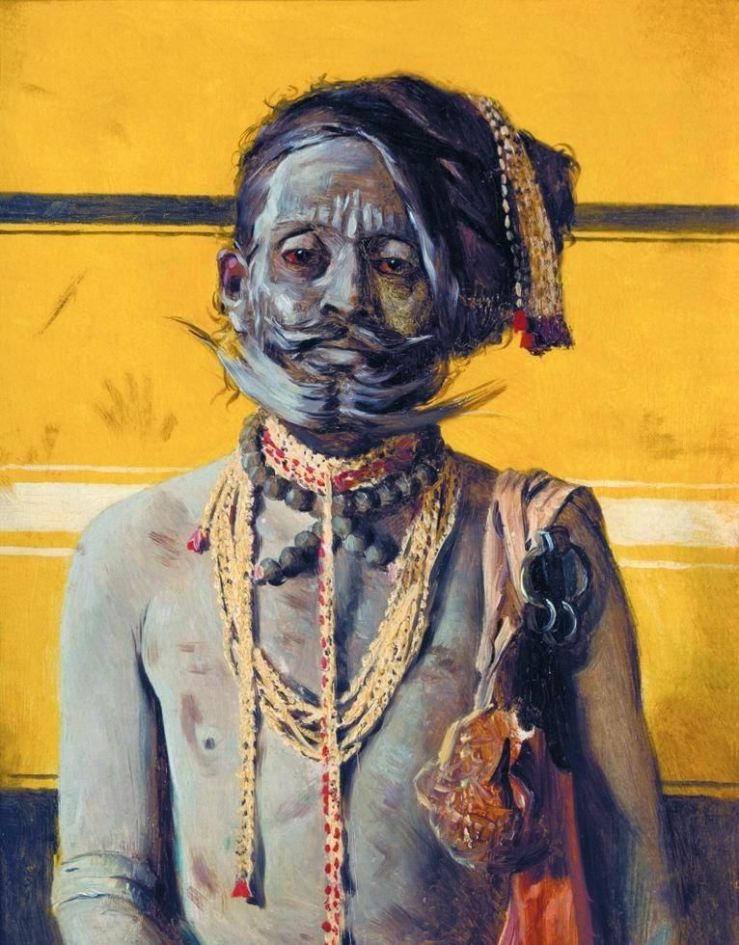
Fakir — Vasily Vereshchagin

Fakir, c. 1875 by Vasily Vereshchagin (1842-1904)

Donald Barthelme’s Sixty Stories in reverse, Part III

I am rereading Donald Barthelme’s Sixty Stories, starting with the sixtieth story and working my way to the first. I wrote about stories 60-55 here and stories 54-49 here,

This post covers stories 48-43.

48. “The Death of Edward Lear” (Great Days, 1979)

Like many of the stories culled from Great Days, the humor in “The Death of Edward Lear” is tinged with melancholy. Perhaps it’s because of its subject matter, or perhaps it’s knowing that Great Days was the last collection of originals Barthelme would write, but “The Death of Edward Lear” feels like the work of a much older man. In fact, it was first published in The New Yorker in 1971, when Barthelme was forty, barely middle aged. (For whatever reasons, Barthelme didn’t include the piece in his collections Sadness (1972) or Amateurs (1976.))

The story begins in the most straightforward manner:

The death of Edward Lear took place on a Sunday morning in May 1888. Invitations were sent out well in advance. The invitations read:

Mr. Edward LEAR
Nonsense Writer and Landscape Painter
Requests the Honor of Your Presence
On the Occasion of his DEMISE.
San Remo 2:20 a.m.
The 29th of May Please reply

One can imagine the feelings of the recipients. Our dear friend! is preparing to depart! and such-like. Mr. Lear! who has given us so much pleasure! and such-like. On the other hand, his years were considered. Mr. Lear! who must be, now let me see… And there was a good deal of, I remember the first time I (dipped into) (was seized by)…But on the whole, Mr. Lear’s acquaintances approached the occasion with a mixture of solemnity and practicalness…

Lear treats his many guests to a strange spectacle of rants, rhymes, and mandolin-playing. He also delivers a “short homily on the subject of Friendship.” Then he dies.

His audience is initially confused, before realizing that Lear had crafted his death into a piece of absurdist art:

People who attended the death of Edward Lear agreed that, all in all, it had been a somewhat tedious performance. Why had he seen fit to read the same old verses, sing again the familiar songs, show the well-known pictures, run through his repertoire once more? Why invitations? Then something was understood: that Mr. Lear had been doing what he had always done and therefore, not doing anything extraordinary. Mr. Lear had transformed the extraordinary into its opposite. He had, in point of fact, created a gentle, genial misunderstanding.

And Lear’s performance engenders future performances:

The death of Edward Lear can still be seen, in the smaller cities, in versions enriched by learned interpretation, textual emendation, and changing fashion. One modification is curious; no one knows how it came about. The supporting company plays in the traditional way, but Lear himself appears shouting, shaking, vibrant with rage.

That final angry image is sad, haunting even. It recalls that other Lear, mad on the heath, as well as Dylan Thomas’s most famous villanelle.

In his biography Hiding Man, Tracy Daugherty speculates that the idea for “Lear” might be attributed in part to the “farewell parties” Susan Sontag hosted in the mid-seventies when she thought she might die from cancer. There’s a human reality coursing under the story’s apparent absurdity that makes it a memorable, enjoyable tale about making art out of life and death.

Edward Lear’s actual death sounds much sadder. According to the Edward Lear Society, “Lear’s funeral was said to be a sad, lonely affair by the wife of Dr. Hassall, Lear’s physician, not one of Lear’s many lifelong friends being able to attend.”

47. “Morning” (Great Days, 1979)

In Hiding Man, Daugherty claims that “Morning” is about “the limits of the educational system,” but I don’t see it. It’s an absurdist dialogue, almost impenetrable in its obliquity—which would be fine if the sentences were better. There had to have been better stories in Great Days than “Morning” — the superior “Concerning the Bodyguard” is from that collection, and eventually ended up in Forty Stories—but I’m sure Barthelme had his reasons for including it. Those reasons, like the story, are inscrutable to me.

46. “The King of Jazz” (Great Days, 1979)

A great little ditty told (almost) entirely in dialogue, “The King of Jazz” takes place over the first few minutes of Hokie Mokie’s reign as the new, um, king of jazz. Hokie’s tenure comes under threat almost immediately when Hideo Yamaguchi, a stranger from Tokyo, appears seemingly from nowhere to challenger the new king. A musical duel ensues, helpfully described by one of the musicians in attendance:

“What’s that sound coming in from the side there?”

“Which side?”

“The left.”

“You mean that sound that sounds like the cutting edge of life? That sounds like polar bears crossing Arctic ice pans? That sounds like a herd of musk ox in full flight? That sounds like male walruses diving to the bottom of the sea? That sounds like fumaroles smoking on the slopes of Mt. Katmai? That sounds like the wild turkey walking through the deep, soft forest? That sounds like beavers chewing trees in an Appalachian marsh? That sounds like an oyster fungus growing on an aspen trunk? That sounds like a mule deer wandering a montane of the Sierra Nevada? That sounds like prairie dogs kissing? That sounds like witchgrass tumbling or a river meandering? That sounds like manatees munching seaweed at Cape Sable? That sounds like coatimundis moving in packs across the face of Arkansas? That sounds like – ”

“Good God, it’s Hokie! Even with a cup mute on, he’s blowing Hideo right off the stand!”

Barthelme here and elsewhere excels at pushing and pulling language in ways with which we are unfamiliar. There’s a synesthetic quality to his best writing, writing which so frequently attempts to engage with and evoke other arts—visual, arts, poetry.

“The King of Jazz” also continues the thread of Oedipal anxiety that courses throughout Barthelme’s work. That anxiety here is not necessarily father-son oriented, but rather the anxiety of the outsider who becomes established, the experimenter who succeeds—and then finds his work challenged by new comers.

45. “The Zombies” (Great Days, 1979)

“The Zombies” is another fun story—and one of the rare late stories not told entirely in dialogue. I’m not really sure if “The Zombies” is a specific parody or just a goof, but it makes me laugh:

In a high wind the leaves fall from the trees. The zombies are standing about talking. “Beautiful day!” “Certainly is!” The zombies have come to buy wives from the people of this village, the only village around that will sell wives to zombies. “Beautiful day!” “Certainly is!” The zombies have brought many cattle. The bride price to a zombie is exactly twice that asked of an ordinary man. The cattle are also zombies and the zombies are in terror lest the people of the village understand this.

There are good zombies and bad zombies. Gris Grue is the hero of the good zombies. There’s a Bishop involved. Watch out: “The kiss of a dying animal, a dying horse or dog, transforms an ordinary man into a zombie.”

And watch out too for bad zombies: “If a bad zombie gets you, he will scarify your hide with chisels and rakes. If a bad zombie gets you, he will make you walk past a beautiful breast without even noticing.”

44. “The New Music” (Great Days, 1979)

“The New Music”: Another dialogue, another synesthetic excursion into Oedipal territories—this time focused on the mother:

–She had a lot on her mind. The chants. And Daddy of course.

–Let’s not do Daddy today.

Two brothers discuss “the new music,” which both is and is not music. As in much of Barthelme’s work, elements of art and culture might be patched and pasted in new designs, new collages.

–The new music burns things together, like a welder. The new music says, life becomes more and more exciting as there is less and less time.

–Momma wouldn’t have ‘lowed it. But Momma’s gone.

With their disallowing mother out of the way, the boys can now move forward into the new music.

43. “Cortés and Montezuma” (Great Days, 1979)

“Cortés and Montezuma” is the strongest tale in this batch. The story tells a version of the “friendship” between the Spanish conquistador and the Aztec emperor. Unlike the quippy, often absurd dialogue pieces, “Cortés and Montezuma” is told in a simple, direct (even flat) third-person voice. Here’s how the story opens:

Because Cortés lands on a day specified in the ancient writings, because he is dressed in black, because his armor is silver in color, a certain ugliness of the strangers taken as a group-for these reasons, Montezuma considers Cortés to be Quetzacoatl, the great god who left Mexico many years before, on a raft of snakes, vowing to return.

Montezuma gives Cortés a carved jade drinking cup.

Cortés places around Montezuma’s neck a necklace of glass beads strung on a cord scented with musk.

Montezuma offers Cortés an earthenware platter containing small pieces of meat lightly breaded and browned which Cortés declines because he knows the small pieces of meat are human fingers.

The story repeats the image of Cortés and Montezuma walking and holding hands, exchanging gifts, and not really trusting each other. There is plenty of intrigue and paranoia. Cortés is sleeping with his translator, but she’s also taken a high-ranking Aztec for a lover. The nobles are starting to turn on Montezuma. Various folks employ detectives to trail other folks. Assassination plots loom.

Much of the strength of “Cortés and Montezuma” derives from Barthelme’s decision to tactically employ the occasional anachronism. Consider the “powdered wigs” and “limousines” here:

Montezuma writes, in a letter to his mother: “The new forwardness of the nobility has come as a welcome relief. Whereas formerly members of the nobility took pains to hide among the general population, to pretend that they were ordinary people, they are now flaunting themselves and their position in the most disgusting ways. Once again they wear scarlet sashes from shoulder to hip, even on the boulevards; once again they prance about in their great powdered wigs; once again they employ lackeys to stand in pairs on little shelves at the rear of their limousines. The din raised by their incessant visiting of one another is with us from noon until early in the morning.”

These anachronisms highlight language’s inability to accurately translate reality. Barthelme gives us images that we identify with wealth and power — “powdered wigs” and “limousines” — but they do not fit within the historical context of Montezuma’s Aztec Empire, and they do not square historically with each other. The anachronisms do offer the contemporary reader an idea of the power of the Aztec aristocracy, and at the same time, their inclusion highlights how incomplete our picture of historical reality is—absurdly incomplete.

Indeed, Barthelme was working from a translation when he crafted “Cortés and Montezuma.” His fourth (and final) wife, the writer Marion Knox, had brought home a copy of Bernal Diaz del Castillo book about Spain’s invasion of the Aztec Empire. Barthelme translated that translation into a new translation, adding a postmodern wink to his story in the process: “Bernal Diaz del Castillo, who will one day write The True History of the Conquest of New Spain, stands in a square whittling upon a piece of mesquite.”

Behind the metatextual cleverness and intentionally-flat tone though, there is a strong, sympathetic core to “Cortés and Montezuma,” a deep sorrow summed up in the final line:

The pair walking down by the docks, hand in hand, the ghost of Montezuma rebukes the ghost of Cortés. “Why did you not throw up your hand, and catch the stone?”

Summary thoughts: It was a bit of an unexpected relief to get out of the dialogue stories. I appreciate what Barthelme did with them, but they are too often constrained but their form, despite highlights like “The Emerald,” “The Leap,” and “The King of Jazz,” which is the strongest dialogue in this batch. I found “Morning” an ugly irritation, some sub-Gertrude-Stein stuff, and “The New Music,” while better, is not especially strong. “Cortés and Montezuma” was the highlight of the six for me.

Going forward (in reverse): One last Great Days stories, and we get into the (stronger) collection Amateurs. 

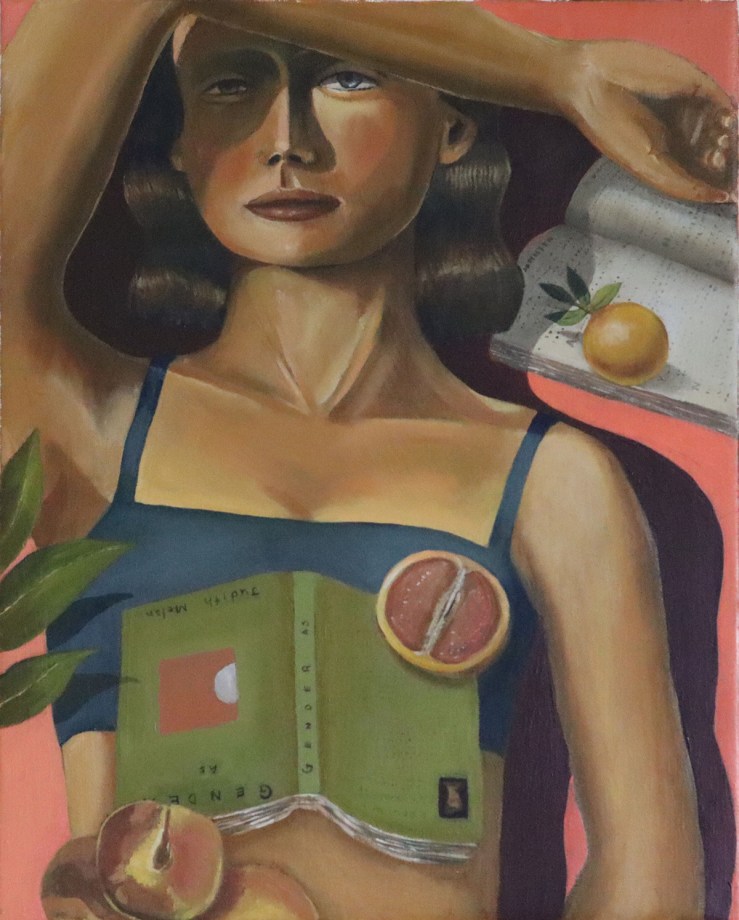
Give My Body Back — Skyler Chen

Give My Body Back, 2021 by Skyler Chen (b. 1982)

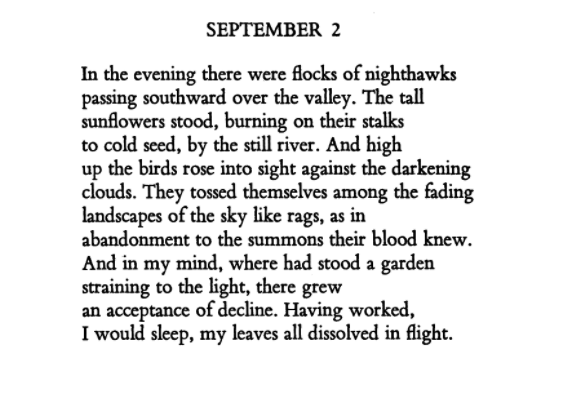
“September 2” — Wendell Berry

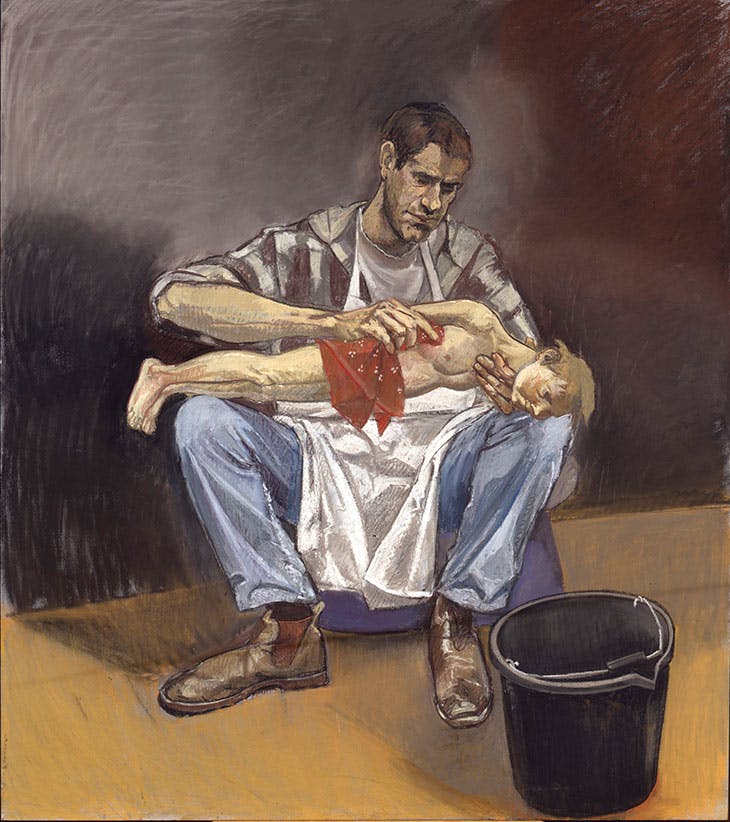
Geppetto Washing Pinocchio — Paula Rego

Geppetto Washing Pinocchio, 1996 by Paul Rego (b. 1935)