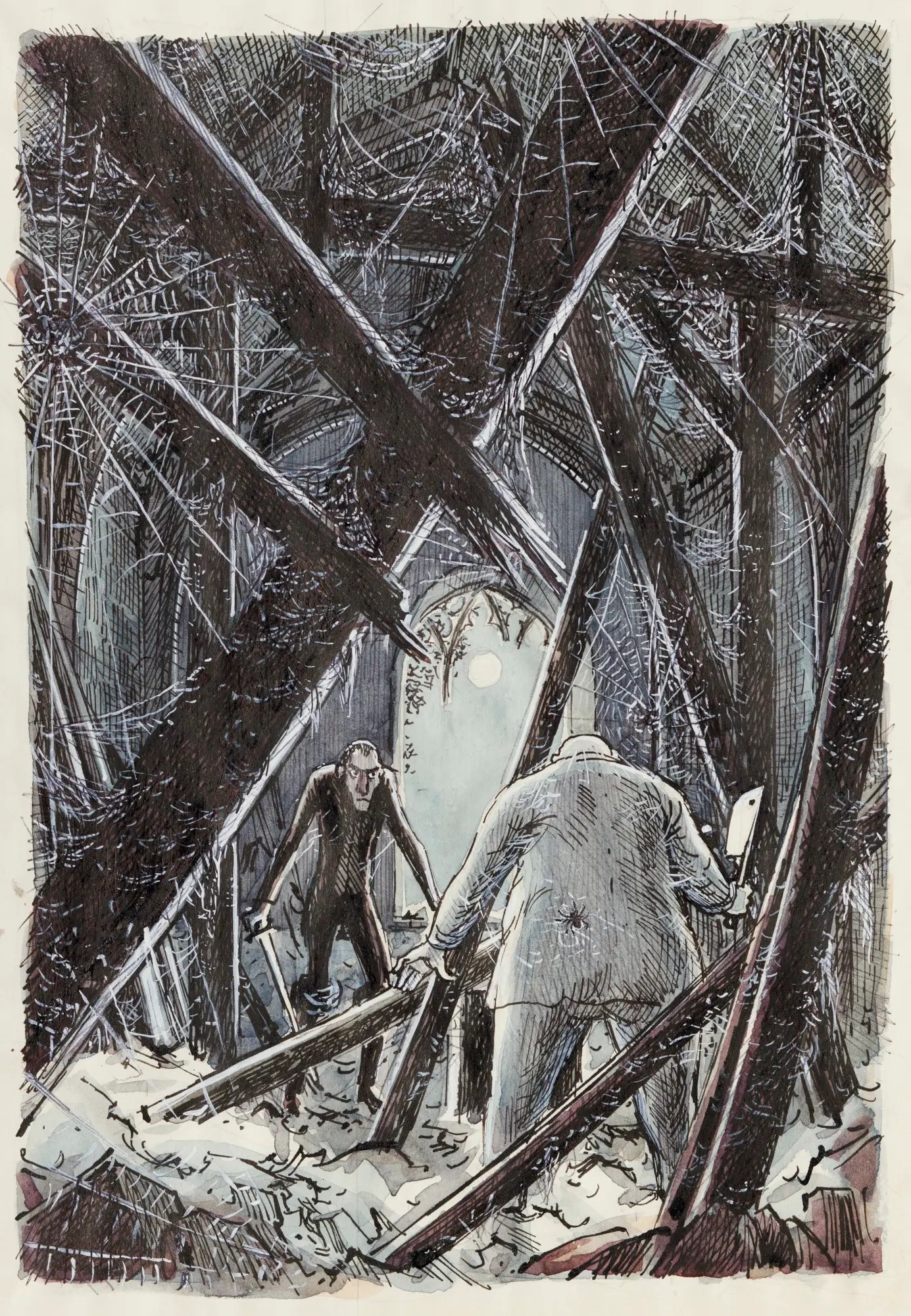
On the Way to the Doctor, 1974 by Charles W. Stewart (1915 – 2001).
Part of a series of unpublished illustrations that were to illustrate Mervyn Peake’s 1950 novel, Gormenghast. (More here.)

On the Way to the Doctor, 1974 by Charles W. Stewart (1915 – 2001).
Part of a series of unpublished illustrations that were to illustrate Mervyn Peake’s 1950 novel, Gormenghast. (More here.)
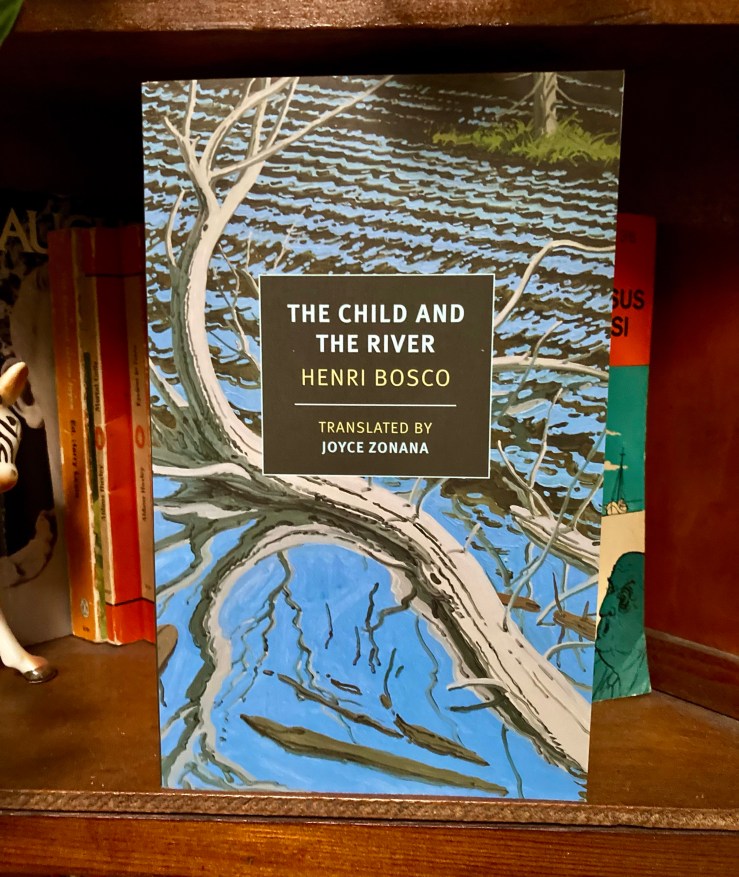
Last week or maybe the week before last, I received in the mail a review copy of Henri Bosco’s slim 1945 novel The Child and The River. This new translation by Joyce Zonana is available now from publisher NYRB. I picked up The Child and the River this week twice: once before bed, and then again immediately upon waking the next morning, where I finished it before rising.
Set some years before either of the Big Wars, The River and the Child takes place in the countryside somewhere in the south of France (likely Bosco’s native Provence). Narrator Pascalet, now an older man, looks back on a transformational episode in his youth. He relates how as a young boy, he was free to roam the countryside wherever he pleased, excepting the river, where, according to his parents, “there are black holes where you can drown; there are snakes in the reeds and Gypsies on the banks.”
When his parents go on a trip, leaving him in the care of sweet Tante Martine, young Pascalet makes his way to the forbidden river posthaste, blaming any mischief on newly-arrived Spring:
…one fine April morning, temptation caught me unawares. It knew how to speak to me. It was a springtime temptation, one of the sweetest there is, I think, for anyone who is open to clear skies, tender leaves, and newly-blossomed flowers.
That is why I succumbed.
Pascalet’s adventure quickly goes awry, or improves in intensity, depending on how you like to think of it. He falls asleep in an old rowboat, drifts downriver, and ends up on an island inhabited by Gypsies. Hungry, he spies them from behind the brush. Near their cauldron they keep a dog and a bear—and a bound prisoner: “He was a handsome child, sturdy, taller than me and stronger, most likely a Gypsy.” The men in the group beat the young prisoner with a whip, but he endures it. Late in the night, under cover of darkness, Pascalet frees this boy, Gatzo; they then steal a boat and escape to live out a boyhood fantasy of utter freedom—for a few days, at least.
The Child and the River brims with lovely nostalgic pleasures. The boys playact their boyish fantasies, forging crude bows and arrows of reed and pretending that they might have to fend off monsters or “headhunters, cannibals.” Pascalet describes the wonderful sensation of escalating these fantasies:
Then I would feel a mock terror. I enjoyed it. Because when you scare yourself through make-believe, you know well enough that you are not in any danger, but still you are afraid. It is one of the most delicious pleasures.
And yet the boys are not merely playacting—they are surviving: fishing, foraging, strategically moving and mooring their boat to avoid detection. They make fire; they cook. In a lovely little scene, they dig a spring to enjoy fresh water:
We made a hole near a bulge in the clay. Water was seeping through. We continued to dig and fashioned a little basin. Through a breach in the clay, the water moistened a bed of sand. We flattened one side of our hole and stuck in a hollow reed. At first the reed stayed dry. We were aching with impatience, even more than for the fire. At long last, a droplet formed and grew round; for a long time, it hung, uncertain. Suddenly it fell. Another drop came, and slowly, at the tip of the green reed, the spring was born.
This passage exemplifies the simple precision of Bosco’s prose via Zonana’s clean, clear translation. The joy of The Child and the River comes from Pascalet’s gentle, limpid observations of his time on the river, which are generally free of intrusive, muddy “adult” meditations. Instead, we experience what the boys experience:
Everywhere, plants and waters, shorelines and trees, came alive at nightfall with a confused, mysterious life. A duck would flap its wings in the reeds; an owl would screech on a black poplar; a brutal badger would rummage in a bush; a weasel, gliding from branch to branch, would cause two or three leaves to tremble lightly; a roving fox would yelp in the distance.
“It is a sad animal,” Gatzo told me. “It is thinking
The adventures of Pascalet and Gatzo culminate in a strange, dreamlike encounter with “the Puppeteer of Souls.” I won’t remark on the episode at any length, only add that it provides a nearly-mystical, memorable climax to the book. I’ll also add that the novel’s last two sentences are some of the sweetest I’ve read in a while.
I loved reading The Child and the River; I loved the feeling of reading it. It took me back to books I’d loved as a child: Arthur Ransome’s Swallows and Amazons, abridged and bowdlerized versions of Moby-Dick and Huckleberry Finn, and countless Robinsades. In a letter to a friend, Bosco suggested that The Child and the River was “a novel very good, I think, for children, adolescents, and poets.” Is there a better audience?
The Child and the River is one of two Bosco books in publication now from NYRB; they released Zonana’s translation of his 1948 novel Malicroix in early March of 2020. I have it on my shelf, still unread, but not for long. I hope NYRB and Zonana will do a few more Bosco titles. Recommended.
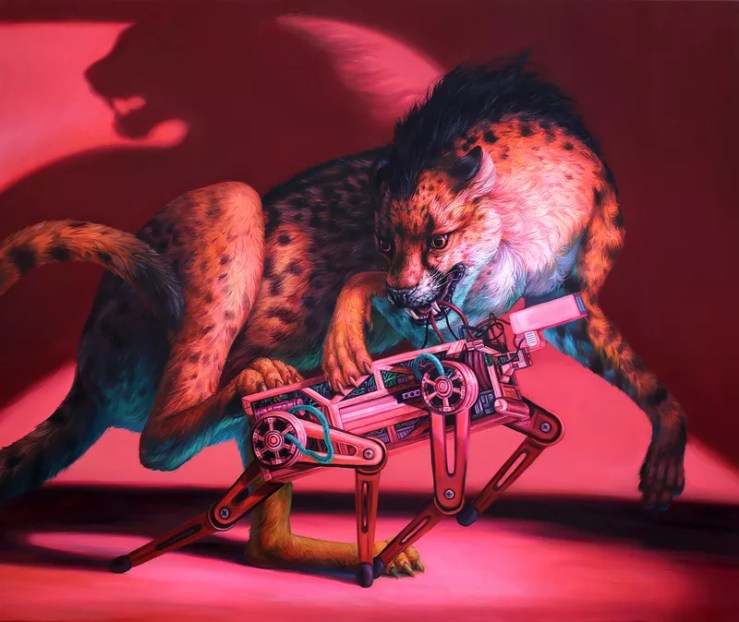
King Cheetah, 2022 by Angela Gram (b. 1985)
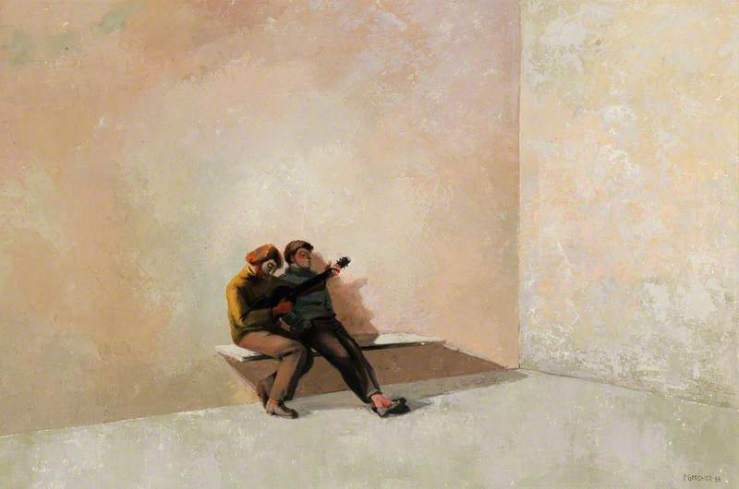
Playground No.6, 1968 by Peter Colville Horridge Gardner (b. 1921)

My wife and I spent a lovely few days in Sunny Manhattan last week in celebration of a recent anniversary. We stayed in the venerable Hotel Chelsea, where we were lucky enough to get a brief visit to room 629, the former residence of the artist Vali Myers. The current resident, photographer Tony Notarberardino was hosting a party later, and the theatrical currents outside of his door, accompanied by ethereal music, attracted us to peer in as we were looking around the hotel. Tony graciously invited us for a brief peek before his party, and the rooms are simply otherworldy, covered in murals by Myers along with beautiful paintings, furniture, and other sundries. Among other books, he recommended Sherill Tippins’ history of the hotel, Inside the Dream Palace. The short tour was a highlight of our visit.
I wasn’t able to find Tippins’ book at any of the four bookstores I visited in NYC, but I found it at my trusty enormous used bookstore when I got home. I’m enjoying it very much so far—it’s really almost like a history of 20th c. modernism focused around one locale. I’m not quite halfway through, around the early 1960s, in a chapter focusing on Harry Smith (he of the Anthology of American Folk Music, and many other things), who was a one-time resident of the Chelsea.
Admittedly, I didn’t scour the history books at The Strand’s main store too closely, spending most of my time browsing fiction. I ended up with László Krasznahorkai’s Spadework for a Palace (trans. by John Batki) and a hardback copy of Joy Williams’ Harrow. Harrow was one of my favorite books of last year. I listened to the audiobook twice and have had an eye out for a physical copy since then. Something I wrote on it in a 2022 round up:
Williams takes the “post-apocalyptic” quite literally–Harrow is about post-revelation, an uncovering, a delayed judgment from an idiot savant. It’s one of those books you immediately start again and see that what appeared to be baggy riffing was knotting so tight you couldn’t recognize it the first time through — the appropriate style for a novel that dramatizes Nietzsche’s eternal return as a mediation of preapocalyptic consciousness in a post-apocalyptic world.

Trey Ellis’s 1988 debut novel Platitudes begins with a typical metatextual conceit: the novel-within-a-novel gambit. Our story starts with Earle, a nerdy, idealistic high school sophomore who lusts after True Love (and some sex if he can get it). After about a dozen pages though, the “author” shows his hand. Depressed divorced Dewayne Wellington is Earle’s creator, and he’s stuck in his novel-in-progress Platitudes. “I’m sorry. I don’t know what more to write,” Wellington declares, before soliciting help from his readers.
Wellington soon receives manuscript pages from bestselling author Isshee Ayam, who transplants his story from 1980s Manhattan to 1930s rural Georgia. When Wellington introduces worldly and gorgeous Dorothy as Earle’s romantic foil, Ayam’s rhetorical interventions take on a new intensity as the two authors duel to guide the spirit of the novel-in-progress.
The plot threads and styles intertwine, with Wellington’s experimental mode clashing with Ayam’s “Afro-baroque” style (as Ellis described it in a 1989 Los Angeles Times profile). A parodic pastiche of competing Black American artistic voices, Platitudes ultimately synthesizes polyglossic tones into a strangely endearing romantic comedy. Sharp but breezy, ironic and earnest, and utterly metatextual yet soaked in pathos, Ellis’s first novel seems to be an overlooked late-postmodernist gem.
Although Platitudes remains in print (via Northeastern University Press’s New England Library of Black Literature series), I have never seen it mentioned along with its contemporaries—books like David Foster Wallace’s 1989 collection Girl with Curious Hair or Bret Easton Ellis’s 1987 novel The Rules of Attraction. Instead, Ellis’s novel seems to be connected more often along with the works of Ishmael Reed, particularly his 1986 novel Reckless Eyeballing.
Reed’s novel concerns an experimental playwright who finds his career under attack from feminists. As Itabari Njeri pointed out in the LA Times profile mentioned above, many readers “assumed that Ayam is a thinly veiled Alice Walker and that Wellington is the novelist, poet and playwright, Ishmael Reed.” Ellis told Njeri that he hadn’t read Reckless Eyeballing until after he finished Platitudes. He also stated in the profile that he hadn’t read Walker’s The Color Purple. Before I read the Njeri profile I was almost certain that Ellis was parodying (lovingly though at times sharply) Reed and Walker.
Ayam’s “Afro-baroque” style is a particularly purple prose, telegraphed in the oh-so-unsubtle titles of her bestsellers: Chillun o’ de Lawd, Hog Jowl Junction, and My Big Ol’ Feets Gon’ Stomp Dat Evil Down. Here’s the first sentence of Ayam’s version of Platitudes:
Earle awakened to a day as new and as fresh as Mama’s hand-starched and sun-dried petticoat, a huge, plain garment as large and as fresh-smelling as the revival tents that bloomed every summer along Route 49 in Lowndes County, Georgia.
What an awesomely bad awesome sentence! The simple sentence is there: “Earle awakened,” but the adornment tacks on and on, a traffic jam of adjectives glommed onto a simile growing out of another simile, like a lichen that grows on a moss that grows on a rock.
Here’s Ayam’s next sentence:
Yes, from out of those wide Baptist thighs, thighs that shook with the centuries of injustice and degradation, thighs that twitched with the hope of generations yet unplanted, thighs that quivered with the friction of jubilant, bed-thumping, and funky-smelling lovemaking, emerged Earle.
“I’m speechless, Ms. Ayam,” responds Wellington by post after receiving her pages, and offers up as a return gift a list of Earle’s favorite things (to be sung to the tune Coltrane’s take on the Rodgers and Hammerstein song):
All kinds of tanks, Janey Rosebloom, Cream of Wheat, neighbors, Corinthians, toast-r-waffles, his own bean-fart vapors,
A tightly-tucked-in-bed,
Chef Boy-Ar-Dee
Schefflera, balsa wood, and Pay TeeVee.
Eff. Ay. Oh. Schwarz, lingerie straps, cowboy boots and hats.
Sunggle sacks, Chap Stick tubes, BeeBee guns, and films!
Sci-fi, cars, dance—Slurpees.
This list, printed in the console font that demarcates the many other lists, charts, menus, etc. that populate Platitudes then gives way to a brick list paragraph in whatever font Vintage Contemporaries are printed in. This second list might also comprise some of Wellington’s (and perhaps even Ellis’s?) favorite things, and includes “Jamaican accents, cleavage, efficiency, artificial cheese-food product” and
the way a pretty woman’s high heel dangles insecurely from the big toe of the crossed leg always near falling or—from a slight kick—flying spike-over-toe—an exotic Oriental weapon; but never doing either, just dangling, the toe of the shoe covering just enough to promise…
The back-and-forth of the two authors plays out as a personification of the tensions between two modes of Black literature that Ellis seeks to parody, synthesize, and ultimately transcend in Platitudes. While appreciative of the traditions and anti-traditions that came before him, he sought something new in his novel. A year later after the publication of Platitudes, Ellis published his essay “The New Black Aesthetic” in the journal Callaloo. Here, Ellis argued for a new kind of Black arts, evoking the concept of a ludic “cultural mulatto,” an artist free to borrow from both tradition and popular culture alike: “We no longer need to deny or suppress any part of our complicated and sometimes contradictory cultural baggage to please either white people or black,” Ellis declared in his essay.
Platitudes is not an essay—far from it—but it does enact the radical hybridization that Ellis put forth in his New Black Aesthetic manifesto. In his LA Times profile, Ellis declared Platitudes an “anti-novel,” adding that “It’s satirical and primarily about language performance, which has its own delights, as opposed to traditional narrative.”
And yet there is a traditional narrative here. Call it boy meets girl or coming of age or classical-in-the-Aristotelian-sense comedy or whatever you want, but Platitudes offers its reader a satisfying conclusion without selling out the ambiguities and ironies that course through its 180 or so pages.
In his back-cover blurb for Platitudes, Ishmael Reed wrote: “I was zapped by Trey Ellis’s humongous talent. His book, Platitudes, is delightfully rad.” Zapped and delightfully rad are perfect descriptors, and I feel like I’ve neglected to share enough of Ellis’s prose, which at times approximates linguistic channel surfing (at one point, quite literally). The book is both fun and funny, and while the book has not been neglected in academia (Christian Schmidt devotes a chapter to it in his study Postblack Aesthetics, for example), it deserves a wider readership from those who enjoy satirical postmodern novels. Highly recommended.
BOCKRIS: Do you ever get worried that being a writer provides a pretty thin income?
BURROUGHS: It’s gotten very thin. I’ve sat down many times and tried to write a bestseller but something always goes wrong. It isn’t that I can’t bring myself to do it or that I feel I’m commercializing myself or anything like that, but it just doesn’t work. If your purpose is to make a lot of money on a book or film, there are certain rules to observe. You’re aiming for the general public, and there are all sorts of things the general public doesn’t want to see or hear. A good rule is never ask the general public to experience anything they cannot easily experience. You don’t want to scare them to death, knock them out of their seats, and above all, you don’t want to puzzle them.
From With William Burroughs: A Report from the Bunker by Victor Bockris. The selection is from Bockris’s recording of a 1978 dinner with Maurice Girodias, Gerard Malanga, and Glenn O’Brien.
“Mothers”
by
William Gaddis
When Ralph Waldo Emerson informed—or rather, perhaps, warned us—that we are what our mothers made us, we might dismiss it as received opinion and let it go at that, like the broken clock which is right twice a day, like the self-evident answer contained in Freud’s oft-quoted query “What do women want?” when, as nature’s handmaid, she must want what nature wants which is, quite simply, More. But which woman? Whose mother, Emerson’s? A woman so in thrall to religion that we confront another dead end; or Freud’s? or even one’s own, even mine, offering an opportune bit of wisdom to those of us engaged in the creative arts, where paranoia is almost an occupational hazard: “Bill, just try to remember,” she said, “there is much more stupidity than there is malice in the world,” an observation lavish with possibilities recalling Anatole France finding the fool more dangerous than the rogue because “the rogue does at least take a rest sometimes, the fool never.”
This is hardly to see stupidity and malice as mutually exclusive: look at your morning paper, where their combined forces explode exponentially (women and children first) from Bosnia to Belfast, unlike the international “intelligence community” so self-contained in its malice-free exercises that it generally ensnares only its own dubious cast of players. Of further importance is the distinction between stupidity and ignorance, since ignorance is educable, while stupidity’s self-serving mission is the cultivation and exploitation of ignorance, as politicians are keenly aware.
How, then, might Emerson’s mother have seen herself stumbling upon Thomas Carlyle’s vision of her son as a “hoary-headed and toothless baboon”? Or Freud’s, in the gross unlikelihood of her reading the Catholic World’s review of her son’s book Moses and Monotheism as “poorly written, full of repetitions . . . and spoiled by the author’s atheistic bias and his flimsy psychoanalytic fancies”? Goethe’s Wilhelm Meister dismissed as “sheer nonsense” by the Edinburgh Review and, a good century later, the hero of Saul Bellow’s Dangling Man ridiculed as a “pharisaical stinker” in Time magazine, John Barth’s The End of the Road recommended by Kirkus Reviews “for those schooled in the waste matter of the body and the mind,” and William Faulkner’s Absalom, Absalom! shrugged off as the “final blowup of what was once a remarkable, if minor, talent” by The New Yorker magazine where, just forty years later, “a group of avant-garde critics has put forward the idea that books should be made unreadable. This movement has manifest advantages. Being unreadable, the text repels reviewers, critics, anthologists, academic literati, and other parasitical forms of life,” indicting the author of the novel J R wherein “to produce an unreadable text, to sustain this foxy purpose over 726 pages, demands rare powers. Mr. Gaddis has them.” “You’re a fool, a fool!” the distraught mother of Dostoevski’s ill-fated hero Nikolay Stavrogin cries out at the “parasitical forms of life” surrounding her. “You’re all ungrateful fools. Give me my umbrella!”
(“Mothers” is collected in The Rush to Second Place).
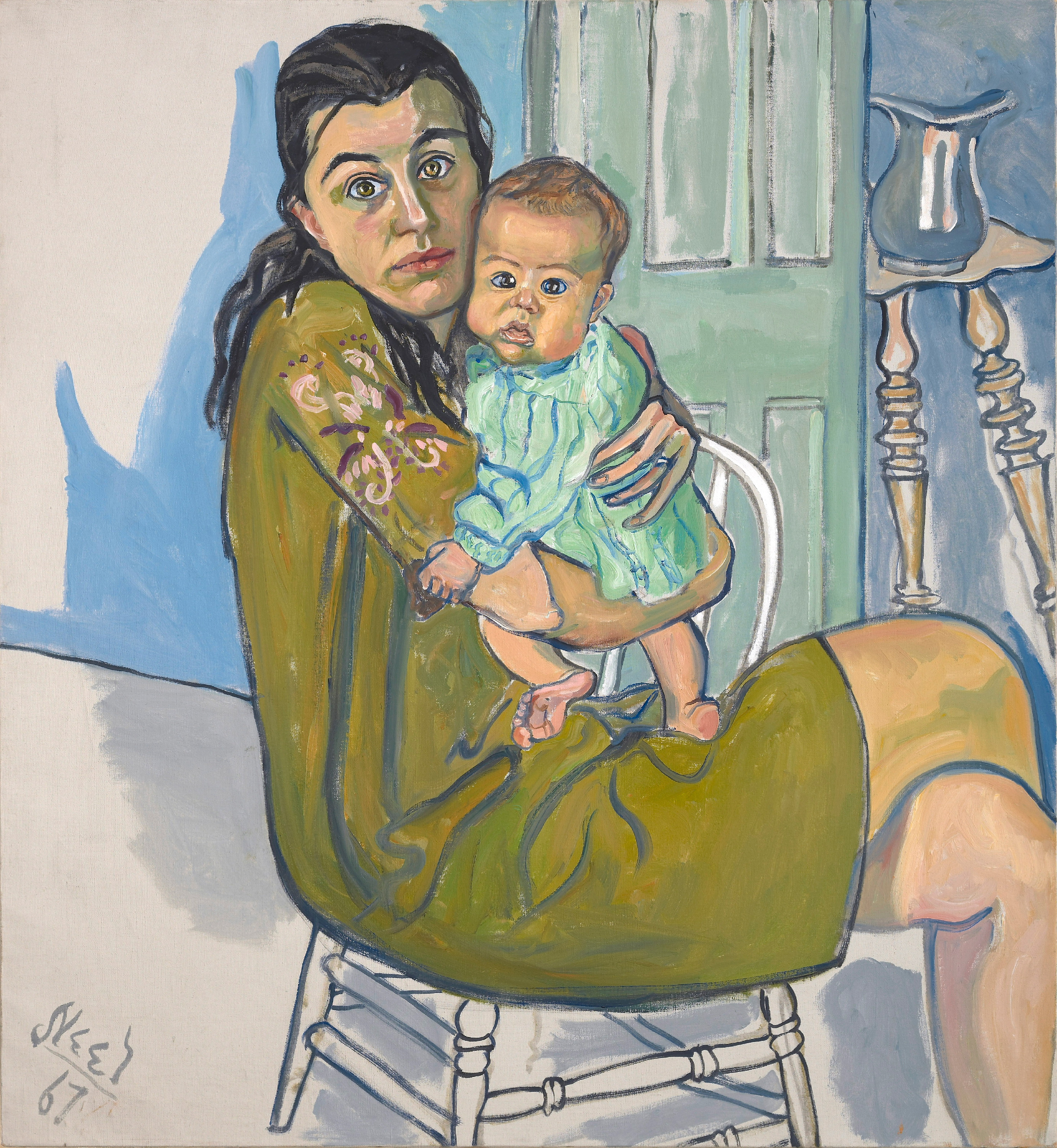
Mother and Child (Nancy and Olivia), 1967 by Alice Neel (1900-1984)
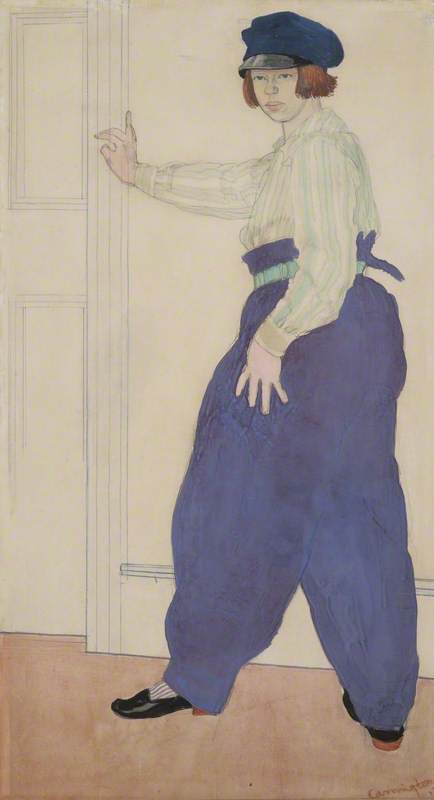
Self Portrait by Dora Carrington (1893-1932)

Medusa Grown Old, 1945 by Marion Adnams (1898-1995)
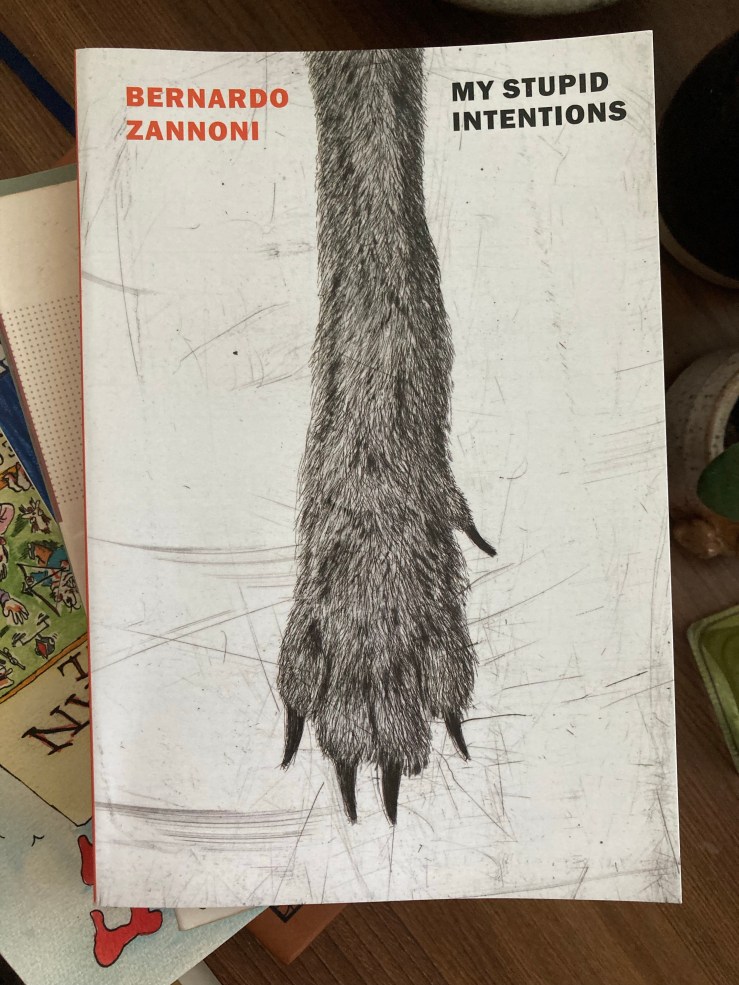
A few pages into Bernardo Zannoni’s brash, brilliant novel My Stupid Intentions, our narrator Archy and his eldest brother Leroy have the following conversation about their youngest brother Otis:
“Are you cold?” he said.
“I’m hungry.”
“Me too. We could eat Otis. He’s small, and weak.”
Otis is small and weak, but his brothers ultimately elect to remain hungry and not consume him. A few pages later, Archy falls from a tree, leaving one leg permanently lame. He then engages in sexual intercourse with his sister Louise. And poor Otis? “I’m going to die because I’m not growing,” he declares at the family dinner. This prediction quickly proves true. Archy is then sold into the service of a writer named Solomon for the low price of one and a half chickens.
Perhaps, having put forth details in lieu of a bigger picture, I should backtrack:
My Stupid Intentions (I miei stupidi intenti) is Bernardo Zannoni’s first published novel. It won the 2022 Campiello Prize, and is now available in English thanks to translator Alex Andriesse and publisher NYRB. I enjoyed all 211 pages of it.
Archy, the narrator of My Stupid Intentions is a beech marten, a kind of mustelid similar to a weasel or ferret. My Stupid Intentions is Archy’s life story—and it is crammed with life, with nerve, joy, terror, anger, and discovery.
I mentioned some names above, mostly of Archy’s family members, but we can dispense with them now. The most important character in Archy’s life is Solomon, an old fox who has learned to read and write. Solomon’s ability to cipher makes him a market nexus for the animals of the forest, who come to him to trade in goods like chickens, eggs, and vegetables. A fiercely loyal dog named Joel protects Solomon and their enterprise (Joel claims that Solomon rescued him from a wasp’s nest when he was an infant). Crippled Archy soon finds his place in Solomon and Joel’s routine, even venturing out with Joel to collect delinquent accounts.
In time, Solomon teaches Archy to read and write. They begin with the business, keeping track of customers’ debts, but soon advance to the bible. Here, Archy learns about God and comes to despise him: “Why had he inflicted this pain upon me? Why wasn’t I a man? Hadn’t I sought him, hadn’t I been on his side?”
In knowing God, Zannoni seems to suggest, Archy and Solomon become imbued with a consciousness otherwise unavailable to animals. The curse of this consciousness is the revelation of mortality. While other animals comprehend that death exists, they do not, at least from Archy’s perspective, fully understand what death entails. Understanding his own mortality is Archy’s curse, and his agon with God weaves through the novel’s bright and dark adventures. In one of the novel’s most poignant moments, Archy, unable to provide succor to his friend Joel, offers him an illusion, a proper telos for his dog’s soul:
He went off searching for a place that didn’t exist, beyond the wrong mountains, where no three rivers parted ways. He would wander all his life, clinging to a spurious hope, the only thing that made him keep going, like a phantom. I am terrified to think he may still be out there, searching. I am terrified to think he may have realized he has been damned to a pointless existence, a life of grasping at smoke. I am terrified to think I have been crueler than God.
My Stupid Intentions is full of cruelties and heroics. There are bandits and thieves and duels. There is a strange underground club for maimed and toothless animals to huddle together. (“Even in their loneliness, their exhaustion, their absence of appetite, they did not think they were going to die, and absurdly I envied them.”) There are doctors and apprentices and violent brigands—again, Zannoni’s novel bristles with life, teems with a propulsive energy.
This energy pulses at both the sentence and paragraph level in Andriesse’s nimble translation. The book’s jacket summary describes My Stupid Intentions as a “picaresque fable,” and it indeed rockets along with picaresque energy, its sharp turns often made even sharper by an ironic quip from Archy.
As for the “fable” bit…well, any story with anthropomorphic animals might be called a “fable,” especially if there is a moral dimension highlighted. Archy’s complaint against God is direct yet ultimately ambiguous. I didn’t catch a didactic whiff from Zannoni. My Stupid Intentions is more complex than Aesop’s fables; it has more in common with the visceral reality of Richard Adam’s novel Watership Down or the zany violence of Roald Dahl’s The Fantastic Mr. Fox (especially in Anderson’s film adaptation). My Stupid Intentions also reminded me strongly of Neko Case’s nature songs, some of the essays in Joy Williams’ collection Ill Nature, Disney’s loose, picaresque 1970’s take on the legend of Robin Hood, Russell Hoban’s inimitable novel Riddley Walker, Brian Jacques’ Redwall books, and Italo Calvino’s novel The Baron in the Trees.
My Stupid Intentions is also a book about writing, a kind of self-creating document, Archy’s autobiography in action, a sort of funny animal Künstlerroman. If there were any urges on Zannoni’s part to give into postmodern cleverness here, to play with the metatextual nature of his tale, not a trace of such frippery is evident. The novel is, for all its twisting and turning and snapping, wonderfully and refreshingly straightforward. There is nothing stupid about this book. I loved it. Highly recommended.

Pipe, 2004 by Hideko Inoue (b.1975)
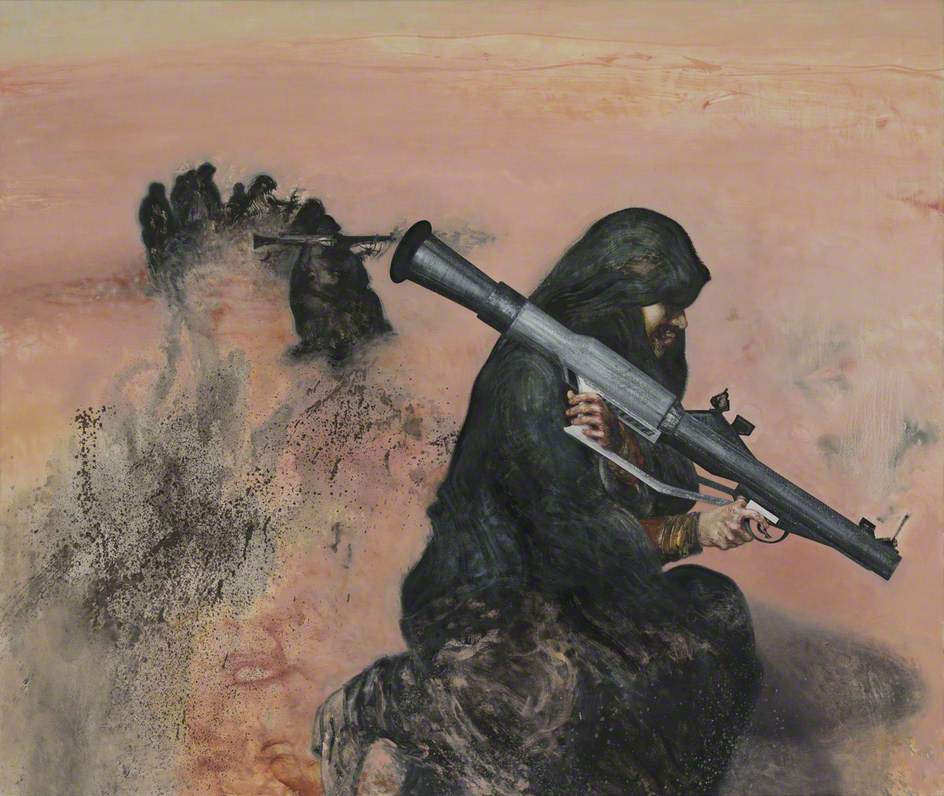
Gulf Women Prepare for War, 1986 by Maggi Hambling b.1945;
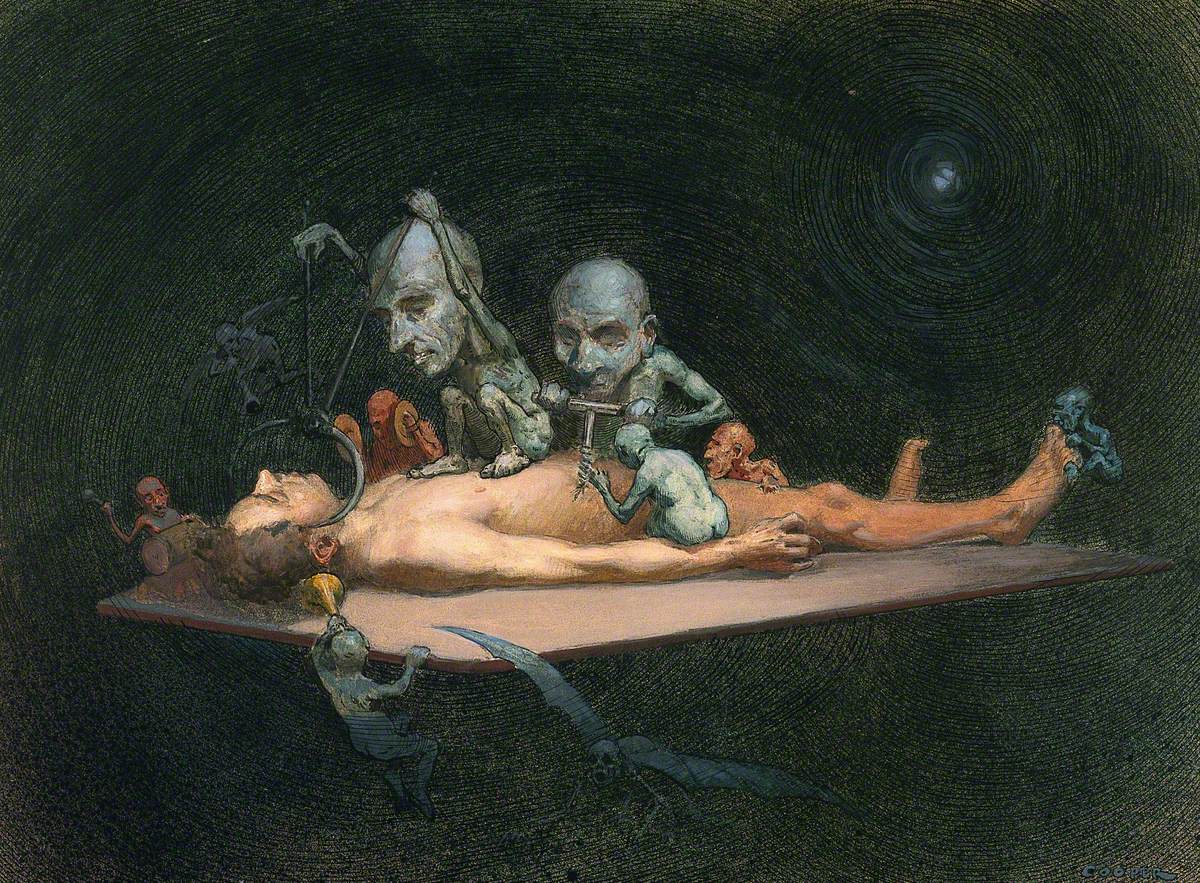
An Unconscious Naked Man Lying on a Table Being Attacked by Little Demons Armed with Surgical Instruments; Representing the Effects of Chloroform on the Human Body c. 1912, by Richard Tennant Cooper (1885–1957)


 Biblioklept