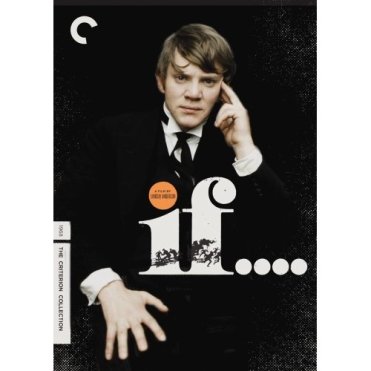
if…. — Lindsay Anderson

41ahznwegjl_ss500_.jpg

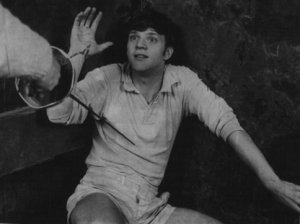
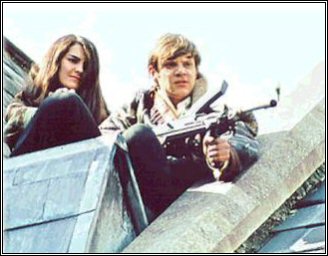
Criterion has finally given Lindsay Anderson‘s 1968 classic if…. a proper DVD release. if…. is one of my all time favorite films. Mick Travis (played with savage aplomb by a very young Malcolm McDowell) leads “The Crusaders,” a band of rebels who defy “The Whips,” the cruel upperclassmen who mete out harsh punishments at their stringent English boarding school. “What I want to know is when do we live?” asks restless Mick. However, the life of individual freedom that he wants to live is so suppressed by the cruel and dominating hierarchy of his school (a microcosm of British society) that he must take liberty by force. In one scene, the Crusaders playfully fence with each other, declaring “Death to all tyrants!” The playfulness quickly slips into violence, as the repressed urges of these would-be revolutionaries flare up. When Mick is cut, he shows his wounded hand and declares with pride “Blood! Real blood!”

if1.jpg

Anderson loads if…. with myriad revolutionary images that foreshadow the film’s shocking ending, at the same time tempering if…. with a surrealist sense of humor that satirizes the inherent dangers in institutionalized education and groupthink in general. if…. is bitingly funny, oddly sexy, and unlike any other film I’ve ever seen. The new edition looks great (much better than my VHS dub) and sounds great, and the commentary track provided by Malcolm McDowell and film critic David Robinson is insightful and surely a must for fans of the film. But who am I kidding, if you’re a fan of this film you’ve already seen the release and listened to the commentary–right?

if.jpg

U.S.!–Chris Bachelder

us.jpg

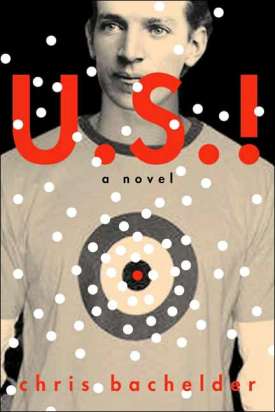
Chris Bachelder‘s superb novel U.S.! portrays an alternate (and somewhat hyperbolic) United States where the Left (big-L) keeps bringing Upton Sinclair (that guy who wrote The Jungle (maybe you read it in high school (I didn’t))) back to life. These would-be revolutionaries try to keep Sinclair (and hope) alive in spite of the fact that right-wing reactionary populist heroes keep assassinating him. In fact, in U.S.!, Upton Sinclair assassination is its own cottage industry.

Bachelder uses a dazzling range of approaches in the first 200 pages of the novel, employing everything from folk song lyrics to Amazon reviews to talk show transcripts in order to flesh out his alternate universe. The first part of U.S.! essentially sets up the last third of the novel, a relatively straight-forward third-person omniscient account of a Fourth of July book-burning in a Southern state. I won’t reveal any more of the plot, because I’m lazy and you should read this book for yourself.

Bachelder’s writing crackles with wit and surprising warmth, especially in the character of Sinclair, who comes across as a (literally) dusty out-of-touch relic, an idealist as equally unable to effect any change in the modern world as he was able to in his own era. Sinclair and the would-be revolutionaries who resuscitate him serve as Bachelder’s critique on America’s stale, impotent left (or is it Left?). Bachelder also savagely criticizes Sinclair’s rhetoric; one of the funniest sections of the first part of the book involves an analysis of exclamation points (and their overuse) in Sinclair’s novels. Toward the end of the novel, Bachelder employs a meta-critical strategy of adding more and more exclamation points to his own writing; the exaggerated gestures comically highlight the cartoonishly grotesque world of U.S.!, at the same time counterbalancing the understated but profound sadness of the novel.

My only gripe with U.S.! would be Bachelder’s rare lapse into what I like to call “workshop fiction”–fiction that seems the contrived and overwritten product of MFA work-shopping (did I mention that Bachelder got his MFA at my alma mater, the University of Florida at Gainesville? (other great writers associated with this glorious institution include Padgett Powell and Harry Crews)). As I noted though, these instances are rare and mostly notable because the majority of the novel is so fresh, original, and readable. This book is funny, poignant, and you should read it.

Old Joy

old-joy-poster.jpg

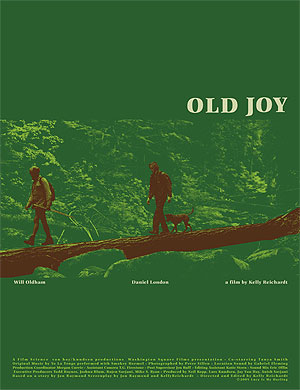
There’s a scene in Adaptation (dir. Spike Jonze, 2002), where “real life” screenwriter Charlie Kaufman (played by Nick Cage) delivers a railing lament that he can’t create the film he wants to–a film like “real life,” a film where people don’t face huge crises, where people don’t change, where nothing much happens. Adaptation unravels into a farce on Hollywood as Charlie’s twin brother Donald takes over the movie, clumsily forcing sex, drugs, and violence into a story frame that wasn’t meant to bear such themes. Perhaps last year’s Old Joy is the movie Charlie Kaufman would have wanted to make, if he could have.

I picked up Old Joy for two simple reasons: 1) the AV Club seemed to love it and 2) Will Oldham is one of the two leads (digression: a few years ago my wife and I saw Oldham perform on the tour supporting the Superwolf record. Oldham was drunk and somewhat lascivious, prompting my wife to announce that he would “never be allowed in our house.” That cracks me up to this day for some reason).

I didn’t expect to like Old Joy nearly as much as I did. The story is very simple: two aging hipsters go on a weekend camping trip in the Oregon Cascades in search of an isolated hot spring. They get a little lost the first night, camp near the road, and get back on track the next day, finding the springs without incident. Then they go home. No crises, no conflict, no life-changing events, right? Well, not necessarily. This movie is subtle. Crisis and conflict are never stated or overt, but there is definitely tension between these two old friends.

Aspects of Mark (Daniel London) and Kurt (Will Oldham) remind me of both myself and just about all of my friends. Mark’s wife is very pregnant; faced with imminent fatherhood, he is more conventionally “responsible” than Kurt, who apparently doesn’t have a permanent job or residence. Kurt gets the pair lost the first day of the trip, and while Mark pores over a map looking for some directions, Kurt carelessly rolls and smokes a joint. The tension between the two is largely implicit, and the only time the movie’s crisis–are these two still friends?–rears its head is over a campfire scene, when, after many several beers, Kurt breaks down and admits that there’s “something” between the two of them, and that their relationship has somehow changed. Mark swears that everything is fine and the issue is more or less dropped, at least in dialog. However, that conversation lingers wistfully over the rest of the film and perhaps remains unresolved.

oldjoypic.jpg

But dialog is not what this film is about. The real star of this film is director Kelly Reichardt’s lush footage of the verdant forests and streams of the Cascade Mountains. Paired with the more mundane shots of the countryside-as-seen-from-a-moving-car, these “nature shots” standout in their dreamy beauty. Reichardt’s pacing is lovely; he allows the camera to rest on still moments of tranquility, producing a soothing tone and mood that contrasts uneasily with the unspoken tensions between Mark and Kurt. Reichardt allows the forest’s own soundtrack of running water and singing birds to do much of the talking in this film, using Yo La Tengo’s beautiful soundtrack sparingly but to great effect. And at just 76 minutes, the film is a perfect length–the shots are profound at times, but never ponderous.

The overall experience of Old Joy is a mix of ineffable loss and stunning but calming beauty, perhaps best expressed in a line from Kurt. “Sorrow is just worn out joy,” he tells Mark, relating a dream he recently had. And it’s that kind of paradox that informs the film–that merging of beauty and loss and beginnings and endings. In the end, we don’t get answers, and if the characters change, those changes are understated and incremental. In Charlie Kaufman’s terms, this is a film about “real life,” and no doubt many viewers will see aspects of themselves haunting the screen.

Leviathan–Jens Harder

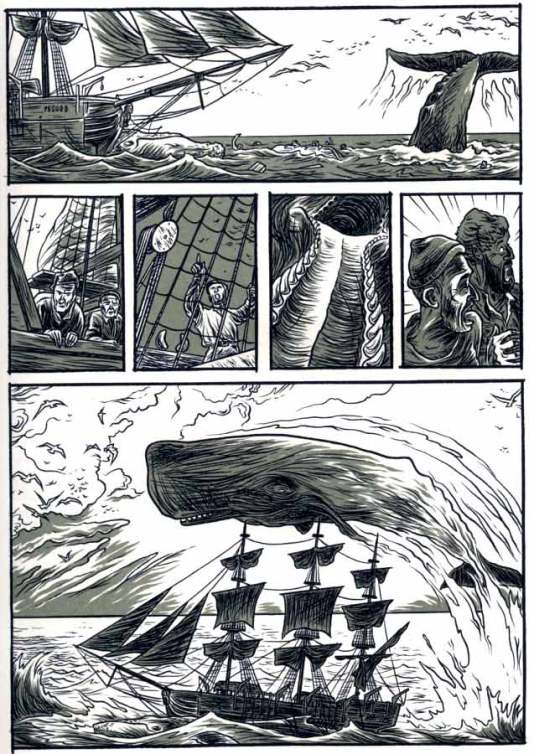
Jens Harder’s Leviathan is a graphic novel in the truest sense. Harder uses scratchy but fluid images to tell the story of a mystical whale who battles a giant squid, saves Noah’s ark, attacks the Pequod, wreaks havoc on a cruise ship, and eventually battles an armada of anachronisms. The only text Harder employs in Leviathan are excerpts and quotes from a variety of sources including the Bible and a host of philosophers; the bulk of quotes come from Melville’s Moby-Dick. Just as that novel begins with an “Etymology” followed by a section called “Extracts,” Harder begins with a section called “Leviathanology,” a collection of quotes about leviathans from the likes of Hobbes, Milton, and the book of Job. These quotes inform the story of Leviathan, connecting the whale to a sublime and unknowable mystery that Harder will explore. Harder’s surreal images often invert notions of “proper” space and time, giving the whale an awesome significance, but also positing the beast as something that denies signification. By eschewing the traditional forms of graphic storytelling, which rely on speech bubbles and clear-cut panel transitions, Harder is able to capture something that is essentially too large to capture. This book works. Highly recommended.

leviathan.jpg

End of the Century–The Heartbreaking Story of the Ramones

If you love the Ramones, you really shouldn’t watch the 2003 documentary film End of the Century–it will only break your heart.

logo_ramones1.jpg

I love the Ramones; I’ve loved the Ramones since I was a kid. I was lucky enough to see them in concert about twelve years ago (even then we were hip to the fact that the Ramones without Dee Dee–the C.J. version of Ramones–was not really the real Ramones). My favorite memory of the show was Joey saying that the venue of the show was built on top of a pet cemetery. Then they played “Pet Cemetery.” Genius.

So well and anyway. End of the Century. This is an excellent music documentary, a standout in a genre which is generally hit or miss. Unlike weaker films that rely on narrators or musicians influenced by the subject*, End of the Century is composed entirely of interviews (both archival and original to the film) with the Ramones themselves (Dee Dee, Tommy, Joey, Johnny, Marky, Richie (Richie wears a conservative suit in his interview, and mostly complains about not getting a taste of “that T-shirt money”) and C.J. (C.J. comes across as naive, energetic, and wholly endearing, making me feel kind of bad about my previous opinions of him). In addition to the Ramones’ first-hand accounts, there are plenty of interviews with managers and friends and family and roadies and so on–eyewitnesses who candidly relate the good, the bad, and the ugly in excruciating detail (there is plenty of ugly). Raw live footage dating back to the early 70s brings to life the sheer volume and bizarre intensity of a Ramones show.

So why so heartbreaking? Well, here’s the deal. We know that the John and Paul didn’t like each other. We know that Mick and Keith bicker. We know that bands have “creative differences” and egos get bruised and so and so on. But with the Ramones, well, I guess I always thought of them, as well, cartoons of themselves. But End of the Century makes it very clear that these guys were very, very serious about themselves and what they did. They were in no way cultivating an image: the Ramones really were what you thought they were. And they hated each other. Like, years-of-not-talking-to-each-other hatred, right up until their retirement. They were bitter–they really wanted to be successful. Now, I always thought of the Ramones as legendary, as huge, as the original punk band. But they wanted to be huge, huge like the Beach Boys or the Beatles. Hits on the radio huge (a quick aside: the accounts of working with Phil Spector on the 1980 album End of the Century, in the hopes of gaining a top 10 hit, are hilarious. Apparently Phil held the band plus entourage at gunpoint, threatening to shoot them if they returned to the hotel. The reason for Phil’s hostage-taking: he wanted them to hang out and watch movies. But I’m sure Spector’s like, totally not guilty of murdering that chick in his house). So a lot of the movie is the Ramones lamenting that they “never made it” (again, to me this was ludicrous). But really it’s the hatred, the meanness of their interviews, their complete dismissal of each other that I found most disconcerting (particularly heartbreaking is hearing Johnny’s non-affected nonchalance over Joey’s relatively recent (to the time of the movie’s shooting) death from lymphoma). Maybe I’m just a foolish fan who wanted my cartoons.

The film ends by noting that Dee Dee died of a heroin overdose two months after the film finished shooting. Johnny Ramone died in 2004. The principal members of the band all died within a few short years of each other, like married folks often do.

To end on a lighter note, check out this footage from the film, featuring Dee Dee’s rap project, Dee Dee King’s “Funky Man” (listen for this embarrassing nugget: “I’m a Negro too!”)

* There are one or two very brief interviews (like one or two sentences) with famous fans, including, of course, Thurston Moore, who is contractually obligated to appear in any film about any musician. Check out his prolific (and incomplete–unless my memory fails me he’s also in the 1995 Brian Wilson documentary I Just Wasn’t Made for These Times) filmography here.

God Bless You, Mr. Vonnegut

Like many of you I’m sure, I cut my literary teeth on Kurt Vonnegut, who died early this morning. My dad gave me three of Vonnegut’s books–Breakfast of Champions, Slaughterhouse Five, and The Sirens of Titan–when I was about eleven or twelve. It’s a cliché, but these books really did change my life forever. In the next couple of years, I devoured everything Vonnegut wrote. My favorite book of his was and is Cat’s Cradle, which I think surpasses both Mother Night and Slaughterhouse Five as his most important work. As I grew older, I began to reject Vonnegut, to see him as not as serious or profound as the authors I was reading. His later books like Hocus Pocus and the truly-lamentable Timequake didn’t help either. Nevertheless, I read them as soon as they came out in paperback. I had to. I had to read everything he wrote. Celebrate Vonnegut’s life by reading one of his books, and remember what got you into reading in the first place.

0kv1orgonpink.jpg

Lost: Lost in the Funhouse

It’s been a while since I’ve written about a stolen book (ostensibly, this blog is all about book theft. But we’re easily distracted here). John Barth’s Lost in the Funhouse is one of my favorite short story collections ever and it’s been MIA from my library for a couple of years now. The collection starts with “Frame Tale,” a one-page (front and back) meta-commentary that informs the whole text. “Frame Tale” is essentially a marginal strip which says “Once upon a time…” on one side and “there was a tale that began…” on the other. The accompanying directions (a number of the stories come with directions; some are to be read aloud, some are to be tape recorded and played back, some are to be read aloud along to looped recording) direct the reader to cut out a strip of paper and connect the opposing ends, creating a Möbius strip, a commentary on the infinite and cyclical nature of story-telling (Barth expanded on this theme in the three linked novellas of Chimera).

funhouse-pbk.gif funhouse-hbk.jpg

My favorite story in the collection is “Petition,” a letter from a distraught Siamese twin, but the most lauded tale in LITF is the title story. “Lost in the Funhouse” recounts the adventures of young Ambrose as he navigates a bizarre amusement park funhouse during a family vacation to the beach one summer. The story is shot through with sexual anxiety and familial tension; Ambrose’s confused (and sometimes confusing) narrative loops discursively, unwinding and then condensing as he trips over his own thoughts. David Foster Wallace riffs off of “Lost in the Funhouse” in his long short story “Westward the Course of Empire Goes” (from Girl With Curious Hair). Ambrose, a semi-autobiographical stand-in as Barth’s pubescent alter-ego, appears as a a much older writing teacher in DFW’s novella. Clever, hunh? And to think, some people hate post-modernism! I feel bad for these folks.

I think that this collection paired with DFW’s Girl With Curious Hair (or, even better Brief Interviews With Hideous Men) makes a great introduction to post-modern writing. The major tropes, themes, and devices are explored in these books in short, digestible chunks full of humor and (surprise!) emotion. Highly recommended.

The Biblioklept Interview: Eddie de Oliveira

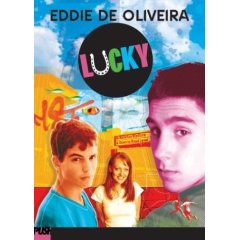
Last month a local news station reported that Eddie de Oliveira’s book Lucky was being placed under review by the Duval Public School Board. Apparently an upset mother was disturbed by some of the content of the book; instead of calling the school directly, she allegedly went directly to the local news. I reacted by posting this blog, to which Eddie responded. We exchanged a few emails and I tried to contact some of the people involved in this story; I believe Folio tried to follow up this story also, but the leads go nowhere. I still haven’t been able to find out if the book really is “under review,” but I asked my department head (I teach English) if such a review list or “banned list” existed, and she said she’d never heard of such a thing. She then became alarmed and told me to “be careful” with what my classes read. This is kind of an unwritten rule of public education: don’t rock the boat. Play it safe. Books can be dangerous.

There’s nothing dangerous about Lucky, though, and I mean that in the nicest way–it is a book intended for teens, after all. Some down here in the beautiful South may still be alarmed or shocked by the subject matter of a sexually confused teen navigating identity in modern London. However, the real themes here are hardly subversive: Young Adult (YA) fiction has a legacy of exploring what it means to be an individual among a collective, and how young people are to negotiate a “proper” space in society. In the case of Lucky‘s protagonist Sam, that “proper” space is constantly under attack from all directions, as he is repeatedly prompted to identify–is he straight? gay? bisexual? In a way, the novel creates a meta-critique of those who would question its valid, “proper” space in a school library–unfortunately, those would-be censors will probably not read the book, preferring to simply highlight “offending” words.

Lucky tells an important story about the search for identity that all teens have to traverse, and I would have no problem suggesting it to any of my students. Eddie was kind enough to answer a few questions, which you will find below.

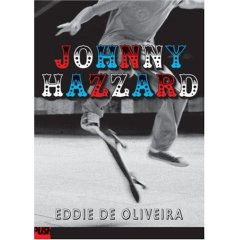
You can find both of Eddie’s books, Lucky and Johnny Hazzard, at Amazon or your local library.
luck.jpg hazz.jpg

Biblioklept: Have you ever stolen a book, and if so, could you
talk a little bit about that experience?

Eddie de Oliveira: I removed the Wide Awake Club book of Ghosts, Monsters
and Legends
from my school library when I was around
ten years-old. The Wide Awake Club was a Saturday
morning kids’ show, and this book was the bomb.

BK: Have you ever borrowed a book and never returned it
(on purpose)?

EO: I have not. I never checked out the Wide Awake Club
book.

BK: What are you reading right now?

EO: I’m reading Four Trials by Senator John Edwards. Amid
all the media hullabaloo about Hillary and Barack,
I’ve been impressed by the one candidate for the
presidency who bothers to combine policies with
explanations on how he’ll implement them. I’m also
impressed by Edwards’ manner, rhetoric and sincerity.
Four Trials was published in 2003, and, as the title
suggests, it recounts four of Edwards’ most defining
moments in the courtroom when he was a trial lawyer,
defending the powerless against medical negligence and
corporate giants.

Next up, I’ll re-read The Perks of Being a Wallflower,
which I first read way back when.

BK: What were your favorite books as a child?

EO: I loved Roald Dahl – especially Charlie and the
Chocolate Factory
and George’s Marvelous Medicine. I
re-read Charlie not so long ago and it really is
special. I remember reading To Kill a Mockingbird and
Lord of the Flies at school and thinking they were
extraordinary – helped, perhaps, by having a brilliant
English teacher back then, Mrs. Martin.

Way before I was 13, I read The Secret Diary of Adrian
Mole aged 13 ¾
and The Growing Pains of Adrian Mole
several times. And, of course, the Wide Awake Club
book of Ghosts, Monsters and Legends
.

BK: You are currently an expatriate, living in Sweden.
Could you say a few words on this?

EO: London was pissing me off and in Sweden, most ‘things’
work very well. It may be colder, but the tap water
tastes like water should and the Stockholm air doesn’t
turn my white earphones black after two days.
Everybody speaks English very well (some better than
my compatriots) which makes learning Swedish rather
hard. Public transport is cheap and, for the most
part, reliable. The overwhelming sense here is that
the government actually gives a shit about its
citizens.

I’ve done some freelance journalism and continued
working on new books and film projects since living
here.

BK: Your book Lucky could be seen to fall under the
rubric of Young Adult fiction. What do you think of YA
as a genre, and was it your initial intention to reach
young people with your book?

EO: Yes, Lucky and Johnny Hazzard are both YA. I think
it’s an important genre and, thankfully, a growing
one. More and more books are being written primarily
with teens in mind, and those of us who write them
have a significant and serious responsibility. That
responsibility is to stay relevant and realistic,
avoiding some kind of The OC type representation of
what it is to be an adolescent. I read Melvyn Burgess’
Doing It, a YA/adult crossover title. He’s a good
writer, no doubt about it, but it really reads like a
middle-aged man writing about teens.

Johnny Hazzard is a love story written for teenage
boys. It’s a hard sell, because teen boy aren’t
renowned for their reading. Probably the finest
compliment I’ve ever received was on a 17-year-old
Texan boy’s myspace page. He listed dozens of bands in
the favourite Music section, a bunch of films in the
Movies section, and, in Books, it just said “I don’t
really read except this one book called Johnny
Hazzard
.”

If I ever stop knowing how a teenager thinks, I’lI
quit YA and begin writing cookbooks.

BK: As you know, a cranky mom in Duval County, here in
sunny Florida, has raised some objections to you book
Lucky having a place in her kid’s school library. Is
there any merit to her objections? If you could speak
with her, what would you say?

EO: There is no merit to her preposterous objections.
Censorship of any form is reprehensible. I don’t
accept that Lucky isn’t suitable for a child. It’s a
book about identity and figuring out where you fit in.
It is not a bomb-making manual.

If I could speak with her, I’d sit her down with a
fine Arctic Daquiri, served on a coaster with the text
of the First Amendment written over it. I’d ask her
what she’s afraid of, and offer her a signed copy of
Johnny Hazzard.

BK: How does one make an Arctic Dacquiri?

EO: Arctic Daquiri
———–
Lots of ice cubes
Winter fruits (berries)
Sugar water
Vodka

Put it in the blender. Absolutely wonderful.

BK: Are you an Edwin or an Edward (or possibly an
Edmund, or just an Eddie)?

EO: I’m neither, I’m an Eduardo. You also left out Edgar.

(ed. note: Biblioklept will now acknowledge an anglocentric bias that we didn’t even know we had!)

BK: According to your Myspace page, you and I are the
same age. How is it that you’ve managed to write and
publish two books, while I’ve accomplished so very,
very little in comparison? But no, seriously, how long
have you been writing? What kind of writing did you do
when you were younger?

EO: I’m motivated by guilt: Each and every day I feel I
haven’t achieved enough, and that motivates me to get
some work done. I have South American parents,
football was on the diet from a young age, and so I
look at my career like that of a footballer’s;
considering they hit their peak at 27 and tend to be
on the slide by 31, it’s not a constructive analogy.

I’ve been writing since I was small – I started out
with school magazines and little plays I’d put on with
my friends, then moved on to big plays I’d put on at
the Edinburgh Festival and in London, and then on to
the fiction novels, short films and journalism.

BK: You seem to be a big Beastie Boys fan. What draws
you to their music? What album is “the” Beastie Boys
album, in your opinion?

EO: The Beastie Boys are the most innovative and important
American band alive. They’re always a step ahead,
doing new things, mixing up genres and sounds. “The”
album for me has to be Paul’s Boutique, which did all
of those things I’ve just mentioned, but on a massive
scale. That record pioneered the art of sampling,
which is now a given in almost every modern musical
style.

Noam Chomsky, Intellectual Elitism, Po-Mo Gibberish, More Attacks on Deconstruction, and Bad Writing Revisited

While doing some background research for an upcoming Graduate Symposium I’ll be participating in later this month (more on that in the future), I somehow stumbled upon this post from Noam Chomsky in which the famous linguist/activist attacks post-modernism and its heroes. In this email/posting Chomsky criticizes what he views as “a huge explosion of self- and mutual-admiration among those who propound what they call “theory” and “philosophy,”” as little beyond “pseudo-scientific posturing.” Immediately, my thoughts jumped to the discussion of the Sokal Hoax I posted a few weeks back. Chomsky continues his affront to post-structuralism, arguing, much like Sokal, that the major figures of this movement–Derrida, Lacan, Foucault, Kristeva, etc.–obfuscate their arguments with an incoherent vocabulary rife with misused and misapplied scientific terminology. Chomsky on Derrida:

“So take Derrida, one of the grand old men. I thought I ought to at least be able to understand his Grammatology, so tried to read it. I could make out some of it, for example, the critical analysis of classical texts that I knew very well and had written about years before. I found the scholarship appalling, based on pathetic misreading; and the argument, such as it was, failed to come close to the kinds of standards I’ve been familiar with since virtually childhood. Well, maybe I missed something: could be, but suspicions remain […]”

Ouch!

But Chomsky’s not done yet:

“Some of the people in these cults (which is what they look like to me) I’ve met: Foucault (we even have a several-hour discussion, which is in print, and spent quite a few hours in very pleasant conversation, on real issues, and using language that was perfectly comprehensible — he speaking French, me English); Lacan (who I met several times and considered an amusing and perfectly self-conscious charlatan, though his earlier work, pre-cult, was sensible and I’ve discussed it in print); Kristeva (who I met only briefly during the period when she was a fervent Maoist); and others. Many of them I haven’t met, because I am very remote from from these circles, by choice, preferring quite different and far broader ones […] I’ve dipped into what they write out of curiosity, but not very far, for reasons already mentioned: what I find is extremely pretentious, but on examination, a lot of it is simply illiterate, based on extraordinary misreading of texts that I know well (sometimes, that I have written), argument that is appalling in its casual lack of elementary self-criticism, lots of statements that are trivial (though dressed up in complicated verbiage) or false; and a good deal of plain gibberish.”

Illiterate gibberish? Charlatan? Cults ? (This is a really common charge leveled at psychoanalysis in particular, and when one considers that both the work of Freud and Lacan was carried on by their respective daughters, there may be some validity to the claim. Still…)

Double-ouch!

Two things:

First, as a linguist, Chomsky is searching for an underlying, “universal grammar” or deep structure, a core pattern that underpins/organizes/generates all human languages. In this sense, Chomsky is searching for an ideal, a foundation. This method is in direct opposition to deconstruction, which as I understand it, seeks to decenter and disrupt all metaphysical anchors. I will never forget the class in transformational syntax I took at the University of Florida with Mohammed Mohammed (or MoMo, as we affectionately were permitted to call him). The class was a split grad/undergrad section, and MoMo scared away all of the undergrads in the first session, with the exception of myself and another student. After that point, he was always very kind to us (the undergrads) and cruel to the grads. MoMo was a Palestinian; he identified as a Jordanian refugee. He was a devout Chomskyian (cultishly so, perhaps). Derrida spoke at UF while I was in this class. I didn’t really understand what Derrida’s lecture was about, but it was very long and his English accent wasn’t so great. The next day in class, MoMo savaged Derrida for the entirety of the period on points both specific and general, most of it over our heads. It was a true rant, one of the best I’ve ever witnessed, culminating in (and I quote): “He’s full of shit!”

So Derrida certainly provoked MoMo, a strict Chomskyian–and why not? If you spend your academic career and your adult life searching for something that another person says you could never find, wouldn’t you be upset? (I believe that more than anything MoMo was upset over Derrida’s reception at UF, which was rock-starish to say the least). For MoMo, Derrida was a phony, a pied-piper misleading the children from the real issues.

Which brings me to point two–Chomsky is primarily a political figure, and really a pragmatist at heart. The core of his argument is not so much that po-mo writing is high-falutin’ nonsense, but rather that it ultimately serves no practical purpose. Here is where I would strongly disagree. The people that Chomsky attacks and their followers are re-evaluating the canon and the very notion of received wisdom. Chomsky attacks them for “misreading the classics”–but just what are the classics, and whose value systems created the notion that the classics were indeed “classic”? If Derrida & co. appear to “misread,” it is because they seek to recover the marginalized knowledge that has been buried under a sediment of givens as “truth.” Yes, the post-modern movement might have elitist tendencies, and yes, the subjects and themes of their work might not have much to do on the surface with the plight of a refugee (cf. MoMo in Jordan in 1948)…but the goal is actually in line with Chomsky’s goal–to make people question the powers that structure their lives.

I do agree, as I’ve said before, that post-modern writing often comes off as so-much sophistry and hogwash (I admit to plenty of this myself), that in some sense it relies too heavily on a coded vocabulary that seems unaccessible to the untrained eye, and that all too often an air of self-congratulation, an atmosphere of winks and nods replaces an environment of real thinking and debate. But my real take is this: any philosophy that could shake MoMo into discomposure is good. MoMo is a brilliant man and his class was fascinating, but to have seen him that day–his feathers so ruffled, his foundations tested–so infuriated over ideas–that was a beautiful thing. Right then, I knew there must be something to Derrida, something I wanted to figure out. And that’s what the best of these writers do–they infuriate us by provoking the truths that we are so sure that we hold in ourselves. They destabilize our safe spaces. They don’t allow for easy answers; they rebuke tradition. And if this approach falls into the norm in academia, becomes lazy and sedimentary, undoubtedly someone will come along and call “bullshit” on it, thus reigniting debate, questions, language. Nietzsche speaks of language as a series of hardened metaphors, language as petrified lava, sedimentary givens. This is the goal of deconstruction: to get that lava flowing again.


The Sokal Hoax, Friedrich Nietzsche, Attacks on Deconstruction, and More Bad Writing

NYU physics professor Alan Sokal wrote a paper entitled “Transgressing the Boundaries: Towards a Transformative Hermeneutics of Quantum Gravity” which was published in 1996 in Duke University’s Social Text, a cultural studies journal. The same day the article was published–with no peer review, incidentally–Sokal announced in Lingua Franca that the whole thing was a hoax, a collection of nonsense, buzzwords, and jargon, making liberal use of recontextualized quotes. Sokal’s intention was to provoke the postmodern tendencies of humanities professors, whom he viewed as having a poor understanding of the science they critiqued.

Now, anyone who has spent any time in any university’s cultural studies department or English department (they tend to be the same thing nowadays) knows that postmodernism is all the rage: the dominant thinkers tend to be of the deconstructionist/post-structuralist school of thought–Derrida, Kristeva, Deleuze, Foucault, Butler, and so on. The major goal of deconstructive analysis is to disrupt the traditional, metaphysical groundings that have been accepted as “natural” to philosophy–to free up marginalized and subjugated areas of thought and break through the layers of sedimentary “givens.” In this sense, deconstruction takes a major queue from the philosophy of Friedrich Nietzsche. In many ways Nietzsche provided not only some of the major questions that initiate a deconstructive philosophy, but also a model for how those ideas would be presented in writing.

Nietzsche’s writing is poetic and often ironically self-reflexive. In his essay “On Truth and Lie in an Extra-Moral Sense,” he makes the claim that all language is an anthropomorphic jumble of metaphors, that concepts are only constructed upon other concepts, all understood through an anthropocentric viewpoint that is impossible to abandon. Nietzsche’s writing contains this awareness; he frames his argument in a series of illustrative metaphors and similes, arguing that language does not permit people to reach the true essence of “the thing in itself”; rather, concepts are the “fractured echo[es]” of the ego seeking recognition—deceptions and illusions. In Nietzsche’s view, science can only build on these empty metaphors and therefore all scientific, empirical knowledge is a house of cards waiting to collapse. Nietzsche prefers an irrational, intuitive, liquid approach to life—a “playing with seriousness”: by abandoning stoic, static reasoning, one will gain “illumination, cheer, and redemption.” This joyful disruption is one starting point for the deconstructionists who Sokal attacked in his hoax.

Sokal obviously disagrees with Nietzsche: as a physicist, Sokal clearly values empirical, rational thought. But his real disagreement is with his perception of an abusive misuse of scientific and mathematic terminology by humanities professors. Sokal views the majority of post-modern theorists as perpetrators of hogwash, arrogant elitists who obfuscate their hollow ideas in jargon.

Okay. Now. So. Is Sokal right? Is there a tendency in humanities departments toward obscurantism with elitist undertones? Absolutely. However, I see this as the academic byproduct of the writers under attack, the detritus of myriad misunderstandings and misreadings. Nobody’s perfect, obviously. I disagree that certain of the writers Sokal attacks–Julia Kristeva in particular (a hero of mine, whose writing I find to be both wonderfully lucid and poetically profound)–are purposefully difficult. Most of the deconstructionists mentioned above take their lead from Nietzsche, and thus employ a strange, elliptical, roundabout and often poetic strategy to their writing. The deconstructionist methodology itself is an affront to easy readings–simply put, it’s meant to make you think. Furthermore, philosophy, for most of us, is not beach reading.

Interestingly, and perhaps ironically, Sokal’s gesture is an essentially postmodern move, a deconstructive move–a challenge to the new establishment of academic humanities and cultural studies. Even his use of recontextualized quotes is an affirmation of Derrida’s concept of iterability. The greatest value of the hoax is that it reinforces the tenets of deconstruction: to upset the places we feel are comfortable and safe, prompting constant re-examination of our aims and goals. Sokal’s hoax initiates a dynamic rethinking of the way we write and the way we read. Who are we writing for? How are we presenting our ideas? Do we understand what we are saying? More than anything, Sokal’s hoax calls attention to the constant need for peer review, for academia to question itself, its products, its institutions.

Infinite Infanticide (Aldous Huxley’s Ape and Essence)

A few weeks ago, I saw (and loved) Children of Men, and it reminded me of one of my favorite books of all time, Ape and Essence by Alduous Huxley.

Ape and Essence

If you’ve only read one book by Huxley, chances are it was Brave New World, an incredibly prescient novel that really “got it right” so to speak–especially when compared to George Orwell’s vision of a dystopian future, 1984. In 1984, Orwell assumes that a totalitarian regime will hide and distort information from a suppressed public, that a Big Brother will watch our every move. Huxley’s BNW posits a future where the public could care less about information at all, a public that willingly cedes an antiquated ideal of “privacy.” In 1984, books are banned; in BNW no one wants to read (and who would want to read when a trip to the feelies provides a total synesthetic experience?)
But where was I…

So. Yes. Hmmm. Ape and Essence. This is a fantastic book, thoroughly entertaining–blackly sardonic, acidic and biting, yet funny and moving, full of pathos and dread and the possibility of loss, extinction, the end of beauty. I have forced this book on just about everyone I know, to the point that it is now Duck-taped together. Ape and Essence is a frame tale of sorts: it begins (significantly, on the day of Gandhi’s assassination) with two Hollywood types discovering the screenplay for an unmade movie called Ape and Essence. Intrigued by the strange story, the two head out to the desert to meet the writer, only to find that he’s recently died. The surreal and imagistic screenplay is then presented uncut as the remainder of the book. Ape and Essence presents an illiterate, post-apocalyptic world where grave-robbing is the primary profession. The hero of the story is one Dr. Poole, a scientist from New Zealand (New Zealand was isolated enough to resist nuclear holocaust) who arrives with a team of scientists to the West Coast of America. Poole is quickly separated from the other scientists and forced into slave labor, excavating graves. He finds a world where people worship the satanic god Belial, who they believe, in his anger, is responsible for the high numbers of genetically deformed children. These children are ritualistically slaughtered in purification rites that frame the social discourse of this New America. Additionally, procreation is proscribed to a two week ritual-orgy; other than this fortnight of lust and blood, sex and love are completely forbidden. The rest of the book details Poole’s infatuation with a woman named Loola, and their plan to escape to a rumored colony of “hots,” outsiders who don’t accept Belial and orgies and book burning and so on.


bosch-trittico-carro-fieno-3-inferno-2-bassa_jpg.jpg

Like Children of Men, Ape and Essence presents infanticide as the ultimate negation of progress. In both stories, people are both root and agent of their own destruction. But playing against this self-destructive death drive is the drive for life, for beauty, for sex. Neither story is willing–or able, perhaps–to make a definitive statement on which drive will prevail. Both stories resist “happy endings,” or can only be said to have “happy” endings in the simplest of senses. Ultimately, the endings are inconclusive, unsure, tentative at best. Will the human race die out? Are simple gestures of human fellowship, of poetry, of love, are these enough to conquer the infinite infanticide recapitulated within the narrative framework? We leave the theater feeling some hope, we close the book praying (to who?) that the characters will make it to a (never) Promised Land, but somewhere in the margins of our consciousness lurks the possibility of extinction–the predicate of loss that drives any story worth telling.

Nursing Gorilla


Mythologies–Roland Barthes

“Myth is a language”–Roland Barthes

Everyone should own a copy of Roland BarthesMythologies. Published over 50 years ago, the book seems more relevant than ever. Barthes wields his sense of ironic humor like a scalpel, dissecting the ideological abuse of the post-war spectacle society. In this collection of short essays, Barthes examines the ways in which societies create, use and mediate myths–particularly the way that the “elite,” monied crust of society create new myths–whole systems of myths, really–to control cultural perceptions of “reality.” Barthes uses the language and tools of linguistics in his meditations to examine the malleable space between the signifier and the signified.  Barthes analyzes a range of disparate topics: amateur wrestling, plastic, advertisements for milk and wine, the face of Greta Garbo, children’s toys, and modern film’s conception of the ancient Roman haircut are all considered in relation to how these “everyday” things support the dominant cultural/economic ideology. The methods put forth in  Mythologies are certainly a precursor to what we now call popular culture studies; Barthes is certainly one of the first writers I can think of to dissect mass-mediated, popular culture. And even though it was published half a century ago, Barthes’ keenly ironic style and short-essay format comes across as thoroughly contemporary.

In the final essay of the collection, “Myth Today,” Barthes warns us that the myths we uphold to protect our culture can ultimately destroy the culture. What are the contemporary myth-systems of the United States? What ideology do these myths uphold? Do these myths hold the potential to harm the culture of our great country?

Lydia Cabrera–Afro-Cuban Tales

afro-cuban-tales.jpg

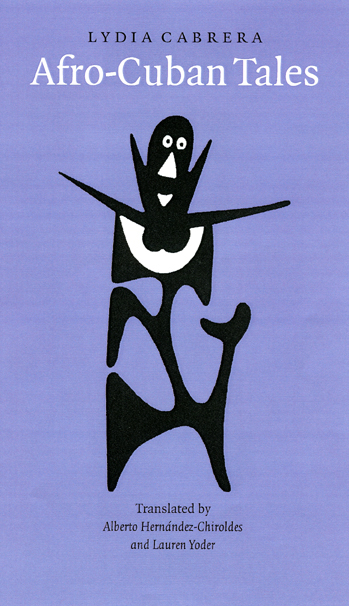
In a sublime synthesis of traditional folklore and imagistic surrealism, Lydia Cabrera’s Afro-Cuban Tales questions the normative spaces occupied by bodies. Deriving from animist tradition, her characters exist in an impossible multiplicity of spaces, being at once animals and plants, humans and gods. Cabrera’s characters endure trials of biological identity and social co-existence, and through these problems they internalize authority, evince taboos, and create a social code. Cabrera’s trickster characters provoke, challenge, or otherwise disrupt the symbolic order of this code. In “Bregantino Bregantín,” a story that recalls Freud’s primal horde theory, as well as the work of more contemporary theorists such as Julia Kristeva and Judith Butler,  narcissist Bull kills all the males of his kingdom and takes all the women for himself.  The sadistic titular turtle of “Papa Turtle and Papa Tiger” uses the power of his dead friend’s antlers to shame, torment, and torture the other animals of his community. And in the magical realism of “Los Compadres,” Capinche seeks to put the horns on his best friend Evaristo by sleeping with his wife–a transgression that ends in necrophilia. This union of sex and death, creation and destruction is the norm in Cabrera’s green and fecund world; the trickster’s displacements of order invariably result in reanimation, transformation, and regeneration—the drawing, stepping-over, and re-drawing of boundaries. A couple of days, Bob hipped me to this really cool Run Wrake short film called Rabbit. While not directly related to Afro-Cuban Tales, this film nonetheless captures the book’s key themes and motifs of death and resurrection, transformation and language, and the trickster’s power to disrupt social and familial codes. Highly recommended.

Girl With Curious Hair–David Foster Wallace

dfw.gif

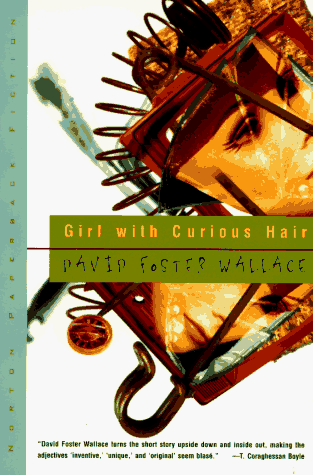
Scott Martin was kind enough to loan me this book. Did he know that it would forever change the way I read? It was the first semester of my freshman year in college, and I was slowly reaching beyond stuff like Henry Miller, Wm Burroughs and Franz Kafka. David Foster Wallace’s short story collection Girl With Curious Hair introduced me to a whole new world of writing. Reading DFW is like having a very witty friend tell you a moving and funny story over a  few beers. He’s hilarious, thought-provoking, and not nearly as hard to read as people seem to think (by the way, simply googling “David Foster Wallace” will yield several vitriolic essays by people who think that DFW is somehow duping his readers. He’s not. These people don’t know a good story when they read one.)

Girl features “real people” like Alex Trebek, David Letterman, and Lyndon Johnson as characters, but constantly destabilizes any realism these figures might lend to the story. The novella included in this collection, Westward the Course of Empire Takes Its Way, alludes directly to John Barth’s Lost in the Funhouse (another book I’ve loaned out and never gotten back). Westward takes a critical but humorous look at how culture is commodified: the plot centers around a reunion for everyone who has ever acted in a McDonald’s commercial. At the reunion, plans are revealed for a series of real-life “Funhouses,” based on the work of “Dr. Ambrose” (Barth’s stand-in in Westward).

Girl with Curious Hair is probably the best starting point for anyone interested in DFW but daunted by 1000 pages of Infinite Jest (IJ is yet another one I loaned out and never got back). Girl‘s stories have a little more ‘pop’ to them than DFW’s latest collection, Oblivion, and Girl tends to be easier to find used than DFW’s other collections, Brief Interviews with Hideous Men (actually a better collection, in my opinion) and A Supposedly Fun Thing I’ll Never Do Again (a collection of hilarious essays and nonfiction).

To sum up: if you still haven’t read DFW go consume this book; when you’re done you’ll be left wondering: “What other good stuff have I been missing out on?”

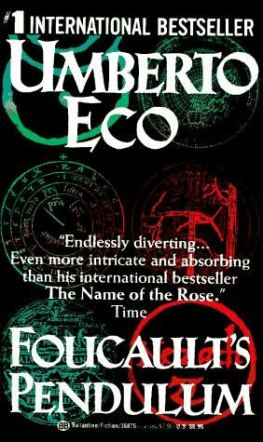
Foucault’s Pendulum — Umberto Eco

fp.jpg

Go here to see a Foucault Pendulum at work.

Snagged as part of the same cache from the Shinjuku-nishiguchi school that yielded Kinski Uncut. Not really a theft–I traded a VHS tape of a six-hour Cosby Show marathon into the book trade for these books.

Foucault’s Pendulum is a detective story fertile with semiotic pranks–a ludic maze of meaning, history, and logic. Dan Brown’s The Da Vinci Code basically rips off Eco, keeping some of the gnostic speculation, and dumbing down both the plot and the writing. Steal from the greats, I guess…

Something I love about this book is that it was a huge bestseller and I always find meet people who’ve read it (or find out that people I know have read it). Have you, gentle reader, read this book?

I loaned the book to RP a few years back; perhaps he’ll consider loaning it to you.

Danny Rolling: From Hell–Part II

 While I took an afternoon nap, serial killer Danny Rolling was killed by the State of Florida. Sixteen years ago in Gainesville, FL, Rolling went on a killing spree, murdering and mutilating five college students.

I graduated from the University of Florida in 2001. A decade after the murders, you would meet someone–a grad student, a law student, a native–who had a story about that weekend. They made it sound scary as hell.

Anyone who’s lived in Gainesville or even spent some time there will be familiar with the 34th Street mural wall. One panel of the wall is dedicated to the victims of the slaying: Sonja Larson, Christina Powell, Christa Hoyt, Tracy Paules, and Manuel Taboada. The panel seems to be repainted annually; sometimes due to vandalism.

Go here for a detailed chronological account of the murders

These murders were horrific, terrible crimes; random and indeterminate, but premeditated nonetheless. Rolling mutilated the corpses, beheading one of them; he also took body parts from the victims. There is no doubt in my mind that this man was a monster, a killer out of the woods like Grendel. And he got exactly what he wanted: fame and infamy and attention. He channeled hell and brought it to earth; I’m sure that hell still exists for some of his victim’s families to this day. Pragmatically, it is right and proper that Rolling be executed.

I still find myself opposed to the death penalty. I don’t pity Rolling and I don’t aim to add to his fame–but he has bought his fame by personifying abject horror, and this is Halloween horror-time. And as just and right as it seems that Rolling die, I still believe that it is wrong for our state government to kill him. I am not arguing that the death penalty is not a deterrent, or that the appeals process death row inmates go through is just as costly as life imprisonment; my argument is simple: murdering people is wrong. It is wrong and therefore against the law, so we (the “we” of community and society who consent to just government) do not kill. If we kill each other we cannot thrive. Rolling’s crime illustrates the human and social disruption of murder. These killings, these gruesome hyperboles of annihilation, show exactly why it is so important that government discontinue use of the death penalty.

Many, many times I have thought: “That person should be killed. That person should be shot.” I have had these murderous thoughts about awful psychopaths and child molesters and about people I am in strong disagreement with and people who have cut me off in traffic. I have had them in brief passing and I have concentrated on them with intensity, giving them much of my time. However, I know that these feelings are rooted in revenge fantasy and rotten wish-fulfillment. I think that when we buy into the death penalty as a punishment, we validate murder. We endorse a moral paradox: killing is wrong, so we will kill you. This type of social paradox becomes a vicious circle. The revenge cycle is metonymized so perfectly in everything from gang warfare to the Israeli–Palestinian conflict. Confronted with the sheer evidence of such futility and emptiness in violence, I think it only sensical and right that we choose to end capital punishment. Otherwise we only help to maintain the hell that Rolling has channelled, a hell we choose to keep.

The Shins — Wincing The Night Away

AUDIOKLEPT (SPECIAL EDITION)

Not a book, but nonetheless obtained by extra-legal means. Piracy baby!

SubPop is set to drop The Shins’ third album Wincing The Night Away in January of 2007, but the thing leaked like a sieve this weekend. Similarly, Of Montreal’s album Hissing Fauna, Are You The Destroyer?, set for a January release, leaked over the last two weeks. I don’t understand why these labels delay releases so long after the record’s been mastered. It’s almost impossible these days to keep a record from leaking–although Thom Yorke managed to keep his solo record The Eraser from leaking right up until it was released.

On paper, The Shins are the type of band I would love to hate. They write tight pop songs with keen melodies and spare harmonies with frequent nods to classic 60s acts like The Kinks, The Beatles, The Zombies and The Beach Boys (unlike every other indie band made up of four white guys). They are name-dropped in the epitome of bad indie films, Zach Braff’s Garden State (Natalie Portman’s character declares them “life-changing”). They appeared in an episode of The Gilmore Girls as a band playing to a club full of improbably ecstatic springbreakers in Ft. Lauderdale.

Despite all of this, I like them quite a bit. Their songs are catchy in a good way. They certainly aren’t re-inventing the wheel, but if you’re going to listen to an indie rock band, you might as well listen to The Shins. All that said, I like their new album a lot, much better than their last Chutes Too Narrow actually, which I thought was too airy. Wincing evinces some growth in songwriting and arrangements, and on the whole the production is much fuller than the past two albums. Wincing features a more prominent use of atmospheric sounds. Synthesizers are utilized to greater advantage advantage with respect to both melodies and atmosphere, and the band even brings in what I believe to be a small string section one one song. They even play with vocal loops on this record.

I don’t know if this band will ever top their first record Oh, Inverted World, a record that somehow was simultaneously breezy and profound, and produced at least four songs that can never go wrong on a mixtape. I’ve listened to it a few times, but there doesn’t seem to be a “New Slang” or “Know Your Onion” on this album. Wincing however seems to work better as a whole album than The Shins’ previous efforts, and the stronger production and fuller arrangements will probably earn the group a broader fanbase.