Take Your Choice — John Frederick Peto

Take Your Choice, 1885 by John Frederick Peto (1854-1907)

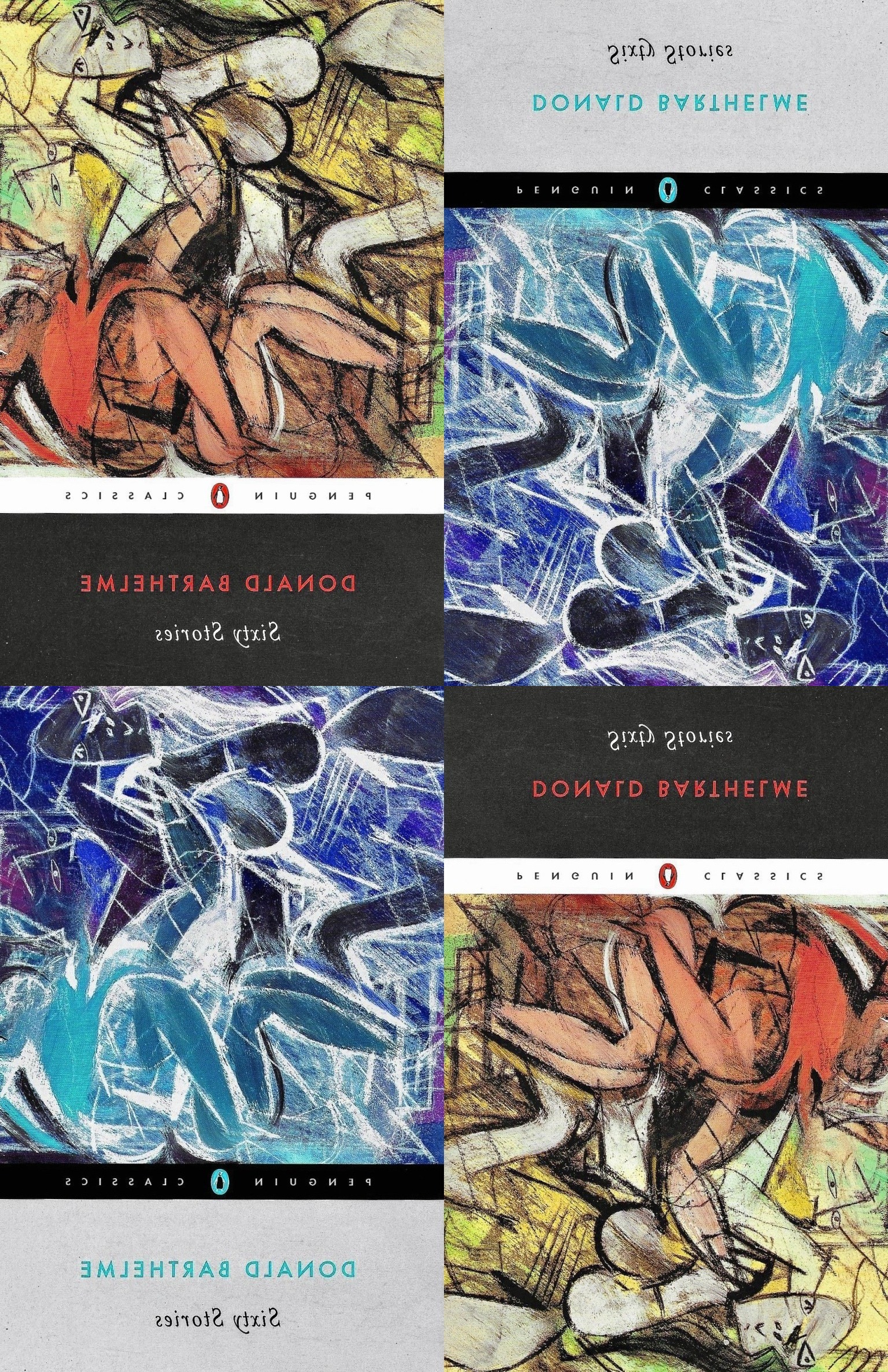
Donald Barthelme — Elaine de Kooning

Donald Barthelme, 1965 by Elaine de Kooning (1918-1989)

I believe that my every sentence trembles with morality | Donald Barthelme

INTERVIEWER

What about the moral responsibility of the artist? I take it that you are a responsible artist (as opposed, say, to X, Y, and Z), but all is irony, comic distortion, foreign voices, fragmentation. Where in all this evasion of the straightforward does responsibility display itself?

BARTHELME

It’s not the straightforward that’s being evaded but the too true. I might fix your eye firmly and announce, “Thou shalt not mess around with thy neighbor’s wife.” You might then nod and say to yourself, Quite so. We might then lunch at the local chili parlor and say scurrilous things about X, Y, and Z. But it will not have escaped your notice that my statement has hardly enlarged your cosmos, that I’ve been, in the largest sense, responsible to neither art, life, nor adultery.
I believe that my every sentence trembles with morality in that each attempts to engage the problematic rather than to present a proposition to which all reasonable men must agree. The engagement might be very small, a word modifying another word, the substitution of “mess around” for “covet,” which undresses adultery a bit. I think the paraphrasable content in art is rather slight—“tiny,” as de Kooning puts it. The way things are done is crucial, as the inflection of a voice is crucial. The change of emphasis from the what to the how seems to me to be the major impulse in art since Flaubert, and it’s not merely formalism, it’s not at all superficial, it’s an attempt to reach truth, and a very rigorous one. You don’t get, following this path, a moral universe set out in ten propositions, but we already have that. And the attempt is sufficiently skeptical about itself. In this century there’s been much stress placed not upon what we know but on knowing that our methods are themselves questionable—our Song of Songs is the Uncertainty Principle.

Also, it’s entirely possible to fail to understand or actively misunderstand what an artist is doing. I remember going through a very large Barnett Newman show years ago with Tom Hess and Harold Rosenberg, we used to go to shows after long lunches, those wicked lunches, which are no more, and I walked through the show like a certifiable idiot, couldn’t understand their enthusiasm. I admired the boldness, the color and so on but inwardly I was muttering, Wallpaper, wallpaper, very fine wallpaper but wallpaper. I was wrong, didn’t get the core of Newman’s enterprise, what Tom called Newman’s effort toward the sublime. Later I began to understand. One doesn’t take in Proust or Canada on the basis of a single visit.

To return to your question: If I looked you straight in the eye and said, “The beauty of women makes of adultery a serious and painful duty,” then we’d have the beginning of a useful statement.

From Donald Barthelme’s 1981 interview in The Paris Review. The interlocutor is J.D. O’Hara. Read the full interview here.

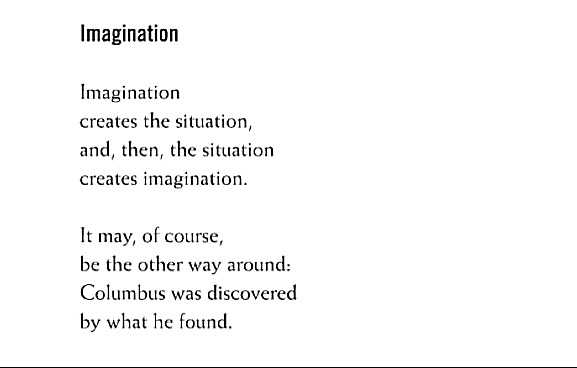
“Imagination Dead Imagine” — Samuel Beckett

“Imagination Dead Imagine”

by

Samuel Beckett

No trace anywhere of life, you say, pah, no difficulty there, imagination not dead yet, yes, dead, good, imagination dead imagine. Islands, waters, azure, verdure, one glimpse and vanished, endlessly, omit. Till all white in the whiteness the rotunda. No way in, go in, measure. Diameter three feet, three feet from ground to summit of the vault. Two diameters at right angles AB CD divide the white ground into two semicircles ACB BDA. Lying on the ground two white bodies, each in its semicircle. White too the vault and the round wall eighteen inches high from which it springs. Go back out, a plain rotunda, all white in the whiteness, go back in, rap, solid throughout, a ring as in the imagination the ring of bone. The light that makes all so white no visible source, all shines with the same white shine, ground, wall, vault, bodies, no shadow. Strong heat, surfaces hot but not burning to the touch, bodies sweating. Go back out, move back, the little fabric vanishes, ascend, it vanishes, all white in the whiteness, descend, go back in. Emptiness, silence, heat, whiteness, wait, the light goes down, all grows dark together, ground, wall, vault, bodies, say twenty seconds, all the greys, the light goes out, all vanishes. At the same time the temperature goes down, to reach its minimum, say freezing-point, at the same instant that the black is reached, which may seem strange. Wait, more or less long, light and heat come back, all grows white and hot together, ground, wall, vault, bodies, say twenty seconds, all the greys, till the initial level is reached whence the fall began. More or less long, for there may intervene, experience shows, between end of fall and beginning of rise, pauses of varying length, from the fraction of the second to what would have seemed, in other times, other places, an eternity. Same remark for the other pause, between end of rise and beginning of fall. The extremes, as long as they last, are perfectly stable, which in the case of the temperature may seem strange, in the beginning. It is possible too, experience shows, for rise and fall to stop short at any point and mark a pause, more or less long, before resuming, or reversing, the rise now fall, the fall rise ,these in their turn to be completed, or to stop short and mark a pause, more or less long, before resuming, or again reversing, and so on, till finally one or the other extreme is reached. Such variations of rise and fall, combining in countless rhythms, commonly attend the passage from white and heat to black and cold, and vice versa. The extremes alone are stable as is stressed by the vibration to be observed when a pause occurs at some intermediate stage, no matter what its level and duration. Then all vibrates, ground, wall, vault, bodies, ashen or leaden or between the two, as may be. But on the whole, experience shows, such uncertain passage is not common. And most often, when the light begins to fail, and along with it the heat, the movement continues unbroken until, in the space of some twenty seconds, pitch black is reached and at the same instant say freezing-point. Same remark for the reverse movement, towards heat and whiteness. Next most frequent is the fall or rise with pauses of varying length in these feverish greys, without at any moment reversal of the movement. But whatever its uncertainties the return sooner or later to a temporary calm seems assured, for the moment, in the black dark or the great whiteness, with attendant temperature, world still proof against enduring tumult. Rediscovered miraculously after what absence in perfect voids it is no longer quite the same, from this point of view, but there is no other. Externally all is as before and the sighting of the little fabric quite as much a matter of chance, its whiteness merging in the surrounding whiteness. But go in now briefer lulls and never twice the same storm. Light and heat remain linked as though supplied by the same source of which still no trace. Still on the ground, bent in three, the head against the wall at B, the arse against the wall at A, the knees against the wall between B and C, the feet against the wall between C and A, that is to say inscribed in the semicircle ACB, merging in the white ground were it not for the long hair of strangely imperfect whiteness, the white body of a woman finally. Similarly inscribed in the other semicircle, against the wall his head at A, his arse at B, his knees between A and D, his feet between D and B, the partner. On their right sides therefore both and back to back head to arse. Hold a mirror to their lips, it mists. With their left hands they hold their left legs a little below the knee, with their right hands their left arms a little above the elbow. In this agitated light, its great white calm now so rare and brief, inspection is not easy. Sweat and mirror notwithstanding they might well pass for inanimate but for the left eyes which at incalculable intervals suddenly open wide and gaze in unblinking exposure long beyond what is humanly possible. Piercing pale blue the effect is striking, in the beginning. Never the two gazes together except once, when the beginning of one overlapped the end of the other, for about ten seconds. Neither fat nor thin, big nor small, the bodies seem whole and in fairly good condition, to judge by the surfaces exposed to view. The faces too, assuming the two sides of a piece, seem to want nothing essential. Between their absolute stillness and the convulsive light the contrast is striking, in the beginning, for one who still remembers having been struck by the contrary. It is clear however, from a thousand little signs too long to imagine, that they are not sleeping. Only murmur ah, no more, in this silence, and at the same instant for the eye of prey the infinitesimal shudder instantaneously suppressed. Leave them there, sweating and icy, there is better elsewhere. No, life ends and no, there is nothing elsewhere, and no question now of ever finding again that white speck lost in whiteness, to see if they still lie still in the stress of that storm, or of a worse storm, or in the black dark for good, or the great whiteness unchanging, and if not what they are doing.

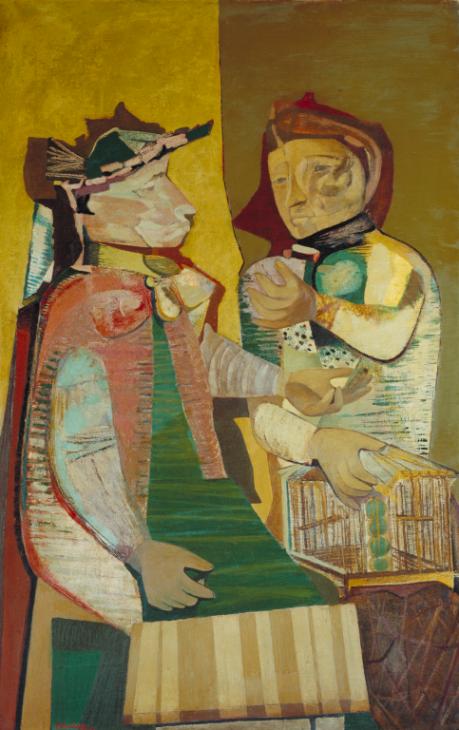
The Ear-Ring — Ambrose McEvoy

The Ear-Ring, 1911 by Ambrose McEvoy (1878-1927)

You don’t consciously see yourself as John Barth, the postmodernist?

Q: You don’t consciously see yourself as John Barth, the postmodernist?

JOHN BARTH: Oh no, no, and the term now has become so stretched out of shape. I did a good deal of reading on the subject for a postmodernist conference in Stuttgart back in 1991, and I think I had a fairly solid grasp of the term then. At the time, there seemed to be a general agreement that, whatever postmodernism was, it was made in America and studied in Europe. At my end, I would say the definitions advanced by such European intellectuals as Jean Baudrillard and Jean- Francois Lyotard have only a kind of a grand overlap with what I think I mean when I am talking about it.g about it. They apply the term to disciplines and fields other than art-their thoughts about postmodern science, for instance, are very interesting-but when the subject is postmodern American fiction, things get murkier. So often we’re told, “You know, it’s Coover, Pynchon, Barth, and Barthelme,” but that’s just pointing at writers. Perhaps that’s all you can do. It led me to say once, “If postmodern is what I am, then postmodernism is whatever I do.” You get a bit wary about these terms. When The Floating Opera came out, Leslie Fiedler called it “provincial American existentialism.” With End of the Road, I was most often described as a black humorist, and with The Sot-Weed Factor, Giles Goat-Boy, and Lost in the Funhouse, I became a fabulist. Bill Gass resists the term “postmodernist,” and I understand his resistance. But we need common words to talk about anything. “Impressionism” is a very useful term which helps describe the achievements of a number of important artists. But when you begin to look at individual impressionist painters, the term becomes less meaningful. You find yourself contemplating a group of artists who probably have as many differences as similarities. I recall a wonderful old philosophy professor of mine who used to talk about the difference between the synthetic temperament and the analytical temperament. With the synthetic, the similarities between things are more impressive than the differences; with the analytical, the differences are more impressive than the similarities. We need them both; you can’t do without either. In that context, once you’ve come up with some criteria that describe what has been going on in a certain type of fiction composed during the sixties, seventies, eighties, and nineties, I think the differences among Donald Barthelme, Angela Carter, and Italo Calvino are probably more interesting than the similarities.

From an interview with Barth conducted by Charlie Reilly in the journal Contemporary Literature, Vol. 41, No. 4 (Winter, 2000).

Papa Hamlet (Book acquired, 20 Aug. 2021)

Papa Hamlet is kind of a weird one. This is the first time Arno Holz and Johannes Schlaf’s collaborative 1889 German novel has appeared in English, thanks to translator James J. Conway and publisher Rixdorf Editions. Here’s their blurb:

Adultery, vulgarity, disordered lives on the brink of collapse: the feverish existence of failed actor Niels Thienwiebel shocked German readers when Papa Hamlet was first published in 1889. In declaiming the soliloquies of his most famous role, ‘the great Thienwiebel’ finds delusional refuge from the squalid room he shares with despondent wife Amalie and infant son Fortinbras. But it was the radical style as much as the moral outrage of this novella that so confounded contemporaries. Reflecting their own bohemian Berlin milieu, Arno Holz and Johannes Schlaf showed the dream of the self-authored life turning to nightmare through apathy and self-absorption. Originally credited to a fabricated Norwegian writer, Papa Hamlet signalled the explosive arrival of Naturalism while also pointing ahead to Modernism; its appropriations, irony and play of identity even foretold Postmodernism. Appearing for the first time in English, it is teamed here with an early incarnation of the same narrative by Schlaf alongside further collaborations with Holz. Together their fearless candour and anarchic ingenuity reveal another side to German Naturalism that is well overdue for rediscovery.

Just four years in duration, the collaboration between Arno Holz (1863-1929) and Johannes Schlaf (1862-1941) created a revolution in form and content which exerted a huge influence on German literature. As well as Papa Hamlet their partnership produced the play The Selicke Family, a number of shorter prose works and an autobiographical comic. After living and working in bohemian isolation just outside Berlin, the pair split acrimoniously in 1892 and continued sniping at each other for decades as they moved on from their Naturalist origins. Arno Holz was something of a tragic figure, consumed with bitterness; works like his verse collection Phantasus were years head of their time yet security eluded him. The more amenable Johannes Schlaf enjoyed greater success but his posthumous reputation suffers from his later embrace of the Nazis. Neither writer has previously appeared in English.

Read an excerpt here.

Witches, crimes, mutants, shape-shifting horses, feuilletonic digressions etc. | Blog about some recent reading

I read an excellent trio of novels to close out the summer: Carol Emshwiller’s Mister Boots, Fernanda Melchor’s Hurricane Season (translated by Sophie Hughes), and Tatyana Tolstaya’s The Slynx (translated by Jane Gambrell). In between, I read most of Anecdotes by Heinrich von Kleist (translated by Matthew Spencer), described by publisher Sublunary Editions as “short fiction and feuilletonic digressions.” (I had to look up the word “feuilletonic.”)

Mister Boots seems as good an introduction to Carol Emshwilller’s writing as I’ll get. I just sort of picked it up, started reading, and kept going. (The print was larger than the edition of her more-famous novel Carmen Dog that I got around the same time. My eyes have declined more quickly in my early forties than I would have imagined.) Mister Boots is a short, fast-paced novel. It moves along like a ever-morphing picaresque. Set somewhere near the American West proximal to the Great Depression, Emshwiller’s novel is told from the first-person perspective of Bobby. Bobby is a ten-year-old girl, but the world, apart from her sister and mother, don’t know this—-her mother raises her as a boy, dresses her as a boy, addresses her as a boy. This conceit, which even young Bobby understands cannot last forever, is a defense against her malevolent father, a stage magician and conman who wants a son to perform in his act. When Bobby’s mother dies, the father returns to take her and her sister on a wild, surreal tour of performances (and other tricks). They bring with them Mister Boots, a man who sometimes turns into a horse. I loved Mister Boots and probably read it way too quickly. It’s surreal stuff, told from the perspective of a child that really captures what young consciousness is like–slippery, trying to match causes and effect, lacking the wisdom that is experience, but also teeming with the holy powers of innocence.

I then read Tatyana Tolstoya’s post-apocalyptic satire The Slynx. The book is funny and abject, and the world Tolstoya conjures is totally gross, but also a place I was sad to leave (the general vibe reminds me of Aleksei German’s film adaptation of Hard to Be a God). The Slynx is about 300 pages but I would’ve read another 700 happily. The central hero is a lunking would-be intellectual named Benedikt; the setting is a few centuries after the Blast has reduced humanity back to the Dark Ages; most of the descendants of the pre-Blast populace endure Consequences—mutations big and small (our boy Benedikt has a cute little tail). There are also elders whose consequence is a tenuous immortality—they survive the blast and continue living (as long as they want to), an ugly curse. We first meet Benedikt as a kind of copyist, a Bartleby maybe, but one who wants more from life. He marries into a near-aristocratic family, where he has access to a huge samizdat library. More problems ensue. Ultimately, The Slynx is a postmodern fable, a book about reading itself. It’s grimy and gross and I loved it and will read it again.

I devoured Fernanda Melchor’s novel Hurricane Season and then started in again. The novel’s blurb compares it to “Roberto Bolaño’s 2666 of Faulkner’s novels,” which is high and true praise. As I stated, I immediately began rereading Hurricane Season after I started it. Like a lot of Faulkner’s work, Melchor’s narrative construction obscures, hides, and even elides important events. Crimes get lost in details. The story is set in and around a podunk Mexican town. It begins with a troop of slingshot-armed youngsters finding the body of “the Witch,” a hated and celebrated icon of the town. From there, the novel moves its camera to hover over a few key characters, letting us into their consciousness to get bits and pieces that may or may not add up to a larger picture. The village is a haunted, haunting place, a cursed world vibrating with bad mojo, drugs, rape, murder…as its publishers promised, Melchor’s world recalls Roberto Bolaño’s 2666, especially the infamous chapter “The Part about the Crimes.” (There is a fantastic moment in the fourth chapter when the third-person free indirect style slips into the language of police reports and detective inquiries.) Hurricane Season’s abjection, despair, and squalor also recalls Krasznahorkai’s Satantango, Faulkner’s A Light in August, and Bernhard’s Gargoyles. And, like Bernhard and Krasznahorkai (and his follower W.G. Sebald), Melchor crafts her novel as a brick of paragraphless text, a sometimes-flowing, sometimes-smothering miasma of words, words, words. Crimes, witches, grudges, and curses, curses, curses: Magical curses, literal curses, cursed text messages, and good old fashioned curse words. Hurricane Season is a devastating, cruel novel, but Melchor concludes it with a strange moment of grace–not for its characters, but for its readers, whom she ferries “out of this hole.” I went right back into the hole.

And—Kleist’s Anecdotes—well, I’ve kept it in my car up until this afternoon, when I finally brought it back into the house. I’ve been reading it while I wait in the carpool lane at my daughter’s school, her new school, the same high school I graduated from in fact. I read three or four as I wait for her and the other carpoolers to emerge. I’ve read a few of the anecdotes collected here before (I think I first became interested in Kleist after reading Donald Barthelme mention him as an influence). Here’s publisher Sublunary’s blurb:

Long available and celebrated in German—Kafka himself championed the 1911 Rowohlt edition of AnekdotenAnecdotes gathers the first extensive English-language collection of Heinrich von Kleist’s short fiction and feuilletonic digressions that appeared in Berliner Abendblätter, the newspaper for which he served as editor from 1810 to 1811. Writing under increasingly unfriendly social and political conditions, this is arguably Kleist at his funniest and most irreverent, not shying away from dirty jokes while nevertheless displaying the same knack for the stylish prose that Rilke called “beautiful and so blind and skillful”.

And here’s a sample (in translation by Matthew Spencer):

Study for Ennui — Walter Sickert

Study for Ennui, 1914  by Walter Richard Sickert (1860-1942)

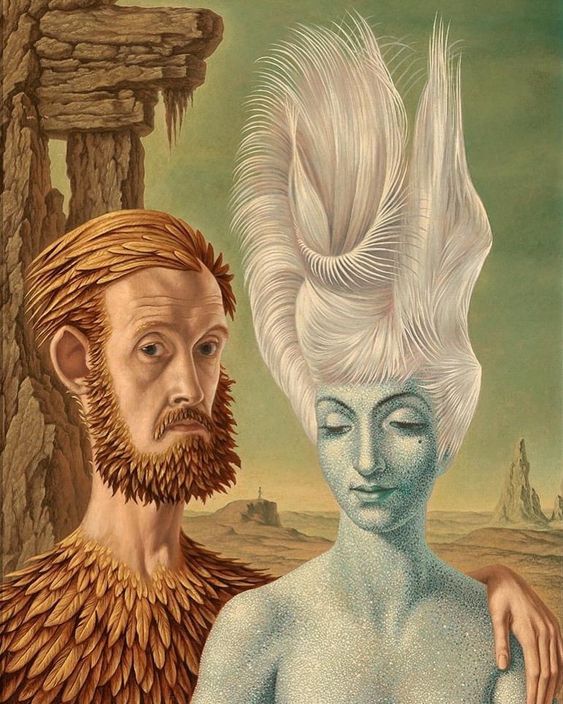
Myth of a Thousand Eyes — Leonora Carrington

Myth of a Thousand Eyes, c. 1950 by Leonora Carrington (1917-2011)

“My Species” — Jane Hirshfield

“My Species”
by
Jane Hirshfield

even
a small purple artichoke
boiled
in its own bittered
and darkening
waters
grows tender,
grows tender and sweet
patience, I think,
my species
keep testing the spiny leaves
the spiny heart

Deadline Island — Samplerman

Deadline Island, 2019 by Samplerman (Yvan Guillo)

Rabbits — Mu Pan

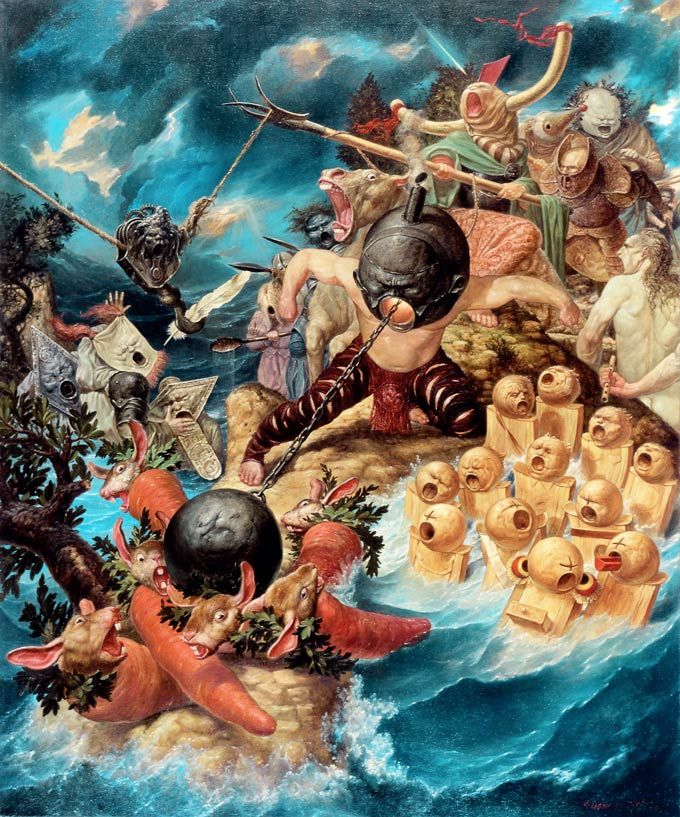
Rabbits, 2020 by Mu Pan (b. 1976)

Barges — David Bomberg

Barges 1919, by David Bomberg (1890-1957)

“The Tale of the Two Hunchbacks” | An excerpt from Fernanda Melchor’s novel Hurricane Season

And Norma nodded and apologized and washed her blood-soaked knickers in secret so that her mother wouldn’t throw her out, so that she wouldn’t discover that her worst fear had come true, until finally one day Norma realized she’d been wrong all that time: the Sunday seven wasn’t the blood that stained her underwear but what happened to your body when that blood stopped flowing. Because one day, on her way home from school, Norma found a little paperback book with a ripped cover and Fairy Tales for Children of All Ages written across it, and on opening it at random the first thing she saw was a black-and-white illustration of a little hunchback crying terrified while a coven of witches with bat wings stabbed the hunch on his back, and the illustration was so strange that, ignoring the time and the ominous rain clouds, ignoring the dishes waiting to be washed and her siblings who needed feeding before their mother got home from the factory, Norma sat down at the bus stop to read the whole story, because at home there was never time to read anything, and even if there were she wouldn’t be to, with her siblings’ racket, the blare of the TV and her mother’s constant yelling, not to mention Pepe’s fooling around or the piles of homework that awaited her each night after washing the pots, which she herself had used at noon before leaving for school; and so she pulled the hood of her coat over her head and folded her legs under her skirt and she read the whole story from start to finish, the tale of the two hunchbacks, that’s what the fairy tale was called, and it was about a hunchback who lost his way one evening in the woods close to his home, dark and sinister woods where witches were said to meet to do their evil deeds, and that was why the little fellow was so frightened to find himself lost there, unable to find his way home, wandering blindly as night fell, until suddenly he spied a fire in the distance, and thinking it might be a campfire he ran towards it, convinced that he’d been saved. So imagine his surprise when he arrived at the clearing with the gigantic fire only to realize it was a Witches’ Sabbath: a coven of horrifying witches with bat wings and claws instead of hands, all dancing around the blazing fire in the most macabre fashion while they sang: Monday and Tuesday and Wednesday, three; Monday and Tuesday and Wednesday, three; Monday and Tuesday and Wednesday, three, and they were cackling their terrible witchy cackles and howling up at the full moon, and the hunchback, who, still unseen, had taken cover behind an enormous rock not far from the fire, listened to that cyclic chant and, unable to explain how, unable to explain the overwhelming urge that came over him, took a deep breath as the witches sang their next Monday and Tuesday and Wednesday, three, jumped onto the rock and shouted at the top of his lungs: Thursday and Friday and Saturday, six! His cry resounded with surprising force in that clearing, and on hearing him the witches froze where they were, petrified around the fire that was casting horrible shadows on their beastly faces. And seconds later they were all running around, hovering between the trees, shrieking and hollering that they had to find the human who’d said that, and the poor hunchback, once again crouched behind the rock, trembled at the thought of the fate awaiting him, but when at last the witches found him they didn’t hurt him as he’d imagined, nor did they turn him into a frog or a worm, or much less eat him. Instead, they took the man and cast spells to conjure enormous magical knives, which they used to cut off his hunch, all without spilling a drop of blood or hurting him at all, because the witches were pleased that the little fellow had improved their song, which, truth be told, they were beginning to find a little boring, and when the hunchback saw that he no longer had a hump, that his back was completely flat and that he didn’t have to walk hunched over, he was happy, enormously happy and contented, and as well as curing his hump the witches also gave him a pot of gold and thanked him for having improved their song, and before resuming their Witches’ Sabbath they showed him the way out of that enchanted part of the woods, and the little man ran all the way home and straight to his neighbor, who was also a hunchback, to show him his back and the riches he’d received from the witches, and his neighbor, who was a mean, jealous man, believed that he deserved those gifts more, because he was more important and more intelligent and those witches must be real fools to go around giving away gold just like that, and by the following Friday the jealous hunchback had convinced himself that he should copy his neighbor, and as night fell he entered the woods in search of that coven of cretinous hags and he walked for hours in the darkness until he, too, lost his way, and just as he was about to collapse against a tree and cry out in fear and desperation he glimpsed, in the distance, in the thickest, gloomiest part of the woods, a fire surrounded by witches dancing and singing: Monday and Tuesday and Wednesday, three; Thursday and Friday and Saturday, six; Monday and Tuesday and Wednesday, three; Thursday and Friday and Saturday, six, and with that the jealous neighbor scurried towards them and hid behind the same enormous rock, and at the next round of Monday and Tuesday and Wednesday, three; Thursday and Friday and Saturday, six, the vile little man – who, despite believing himself more intelligent than his neighbor, was not the smartest of fellows – opened his mouth, took the deepest breath he could, cupped his hands around his lips and shouted: SUNDAY SEVEN! with all his might. And when the witches heard him they froze on the spot, petrified in the middle of their dance, and that dimwit of a hunchback emerged from his hiding place and opened his arms to reveal himself, thinking they’d all flock to him to fix his hunchback and hand him a pot of gold even bigger than the one they’d given his neighbor, but instead he saw that the witches were furious, clawing at their chests and yanking out great clumps of flesh with their own nails, scratching their cheeks and pulling the flowing hair that crowned their horrific heads, roaring like wild beasts and screaming: Who’s the fool who said Sunday? Who’s the wretch who ruined our song? And then they caught sight of the mean little man and zoomed towards him, and with hexes and jinxes they conjured the hump they’d removed from the first man and put it on him, and as a punishment for his imprudence and greedthey placed it on his front, and instead of a pot of gold they pulled out a pot of warts that hopped out of the container and immediately stuck to the body of that despicable man, who was left with no choice but to return to the town like that, with two humps instead of one and warts all over his face and body, and all for having come out with his Sunday seven, the book explained – and in the final illustration of the story the jealous neighbor appeared with those two humps, one deforming his back and the other making him look pregnant, and that was the moment Norma finally understood how silly she’d been to think that the fateful Sunday seven was the blood that stained her knickers each month, because clearly what it referred to was what happened when that blood stopped flowing; what happened to her mother after a spell of going out at night in her flesh-colored tights and her high heels, when from one day to the next her belly would start to swell, reaching grotesque proportions before finally expelling a new child, a new sibling for Norma, a new mistake that generated a new set of problems for her mother, but, above all, for Norma: sleepless nights, crushing tiredness, reeking nappies, mountains of sicky clothes, and crying, unbroken, ceaseless crying. Yet…


From Fernanda Melchor’s novel Hurricane Season. English translation by Sophie Hughes. From New Directions (US)  and Fitzcarraldo Editions (UK) .

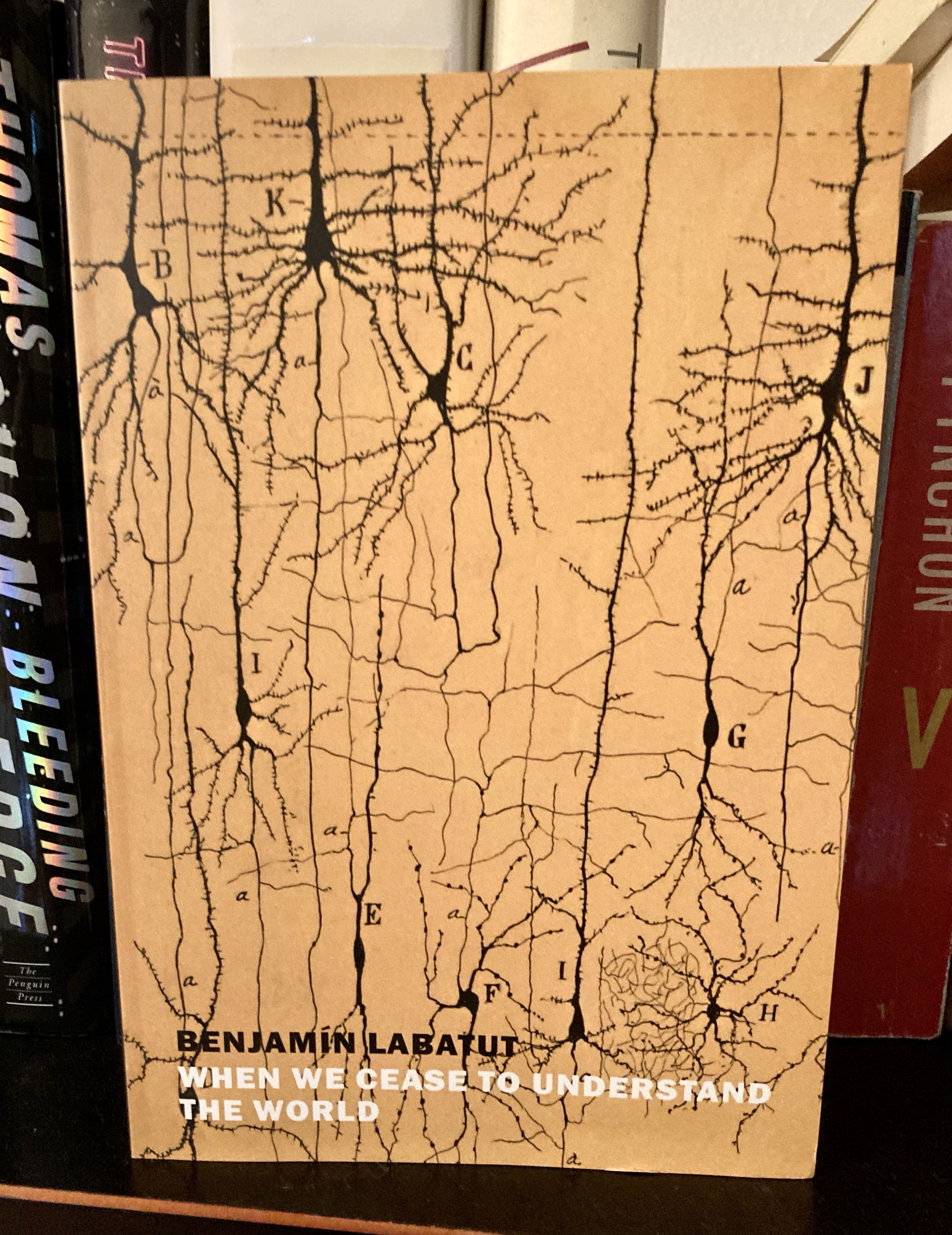
Jean-Patrick Manchette’s The N’Gustro Affair (Book acquired 11 Aug. 2021)

Jean-Patrick Manchette’s The N’Gustro Affair is forthcoming from NYRB in a translation by Donald Nicholson-Smith. NYRB’s blurb:

Mean, arrogant, naive, sadistic on occasion, the young Henri Butron records his life story on tape just before death catches up with him: a death passed off as a suicide by his killers, French secret service agents who need to hush up their role—and Butron’s—in the kidnapping, torture, and murder of a prominent opposition leader from a third-world African nation in the throes of a postcolonial civil war.

The N’Gustro Affair is a thinly veiled retelling of the 1965 abduction and killing of Mehdi Ben Barka, a radical opponent of King Hassan II of Morocco. But this is merely the backdrop to Jean-Patrick Manchette’s first-person portrait (with shades of Jim Thompson’s The Killer Inside Me) of a man who lacks the insight to see himself for what he is: a wannabe nihilist too weak to be even a full-bore fascist.

Seven sketches of people reading by George Jones


Untitled, undated sketches of readers by George Jones (1786–1869)