Hotel Maid — Alex Colville

waddingtons-aedc3ce8af14534419f3ce2af45a977f

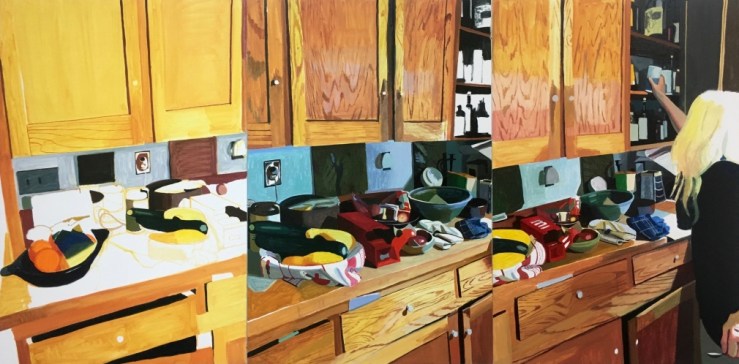
Hotel Maid, 1978 by Alex Colville (1920-2013)

Blog about Ishmael Reed’s The Last Days of Louisiana Red (Book acquired 27 Feb. 2019)

img_2323

A few weeks ago I went to my favorite used bookstore to pick up a copy of Ishmael Reed’s follow up to Mumbo Jumbo, 1974’s The Last Days of Louisiana Red. The store had a few copies of it, but they were all Dalkey Archive editions with ugly covers and bad binding, so I broke down and ordered a first edition Random House hardback online. (I was tempted to pick up the Avon Bard paperback version to match the covers of the other Reed books I own, which are so beautiful I’ll share them here again):

img_2351

Anyway, I did the design of the hardback the came in, which the jacket flap credits as Reed’s own suggestion. Oh, and it’s an old library book:

img_2349

I read the first half of The Last Days of Louisiana Red this weekend. Reed’s writing is bitter, prescient, zany, and mythological, telegraphed in a range of comic and tragic voices. The chapters are short, and the sentences sting. The plot—well, in Louisiana Red, Reed brings back Papa LaBas the Neo-HooDoo hero of Mumbo Jumbo, and sends him to the West Coast, to Berkeley, Carlifornia to investigate the murder of Ed Yellings. Yellings, a Neo-HooDoo man himself, has discovered the cure for cancer through his mysterious enterprise, the Solid Gumbo Works. Yellings’ gumbo is also a cure for “Louisiana Red,” a poisonous mental disease that afflicts black people in the Americas. Papa LeBas is alternately helped and hindered by Yellings’ adult children: Wolf, Street, Sister, and the provocative and gifted Minnie, who leads a group of militants called the Moochers.

I’m really digging Louisiana Red, which, like the other early Reed novels I’ve read, synthesizes the history, folklore, mythology, and intellectual traditions of the African diaspora into a slapstick satire of USA at the end of the twentieth century. Reed cooks his gumbo with a wide variety of ingredients: voodoo lore and California history bubble in the same pots as riffs on astrology and Cab Calloway’s hit “Minnie the Moocher.” Reed satirizes the Berkeley youth movement, radical feminism, and intellectual hucksterism, all through an allegorical lens—he dares us, often explicitly (by way of a character named Chorus) to read Louisiana Red as an allegorical retelling of Sophocles’ Antigone. While Papa LaBas appears to be the moral center of Reed’s novel, delivering righteous condemnation after righteous condemnation of the Moochers and other persons afflicted with Louisiana Red, Reed nevertheless gives expression to a multitude of opposing viewpoints in the novel. It is a speaking novel, a novel that is both of its time but transcends it, as most of the problems and perils it diagnoses are, unfortunately, still with us. More to come.


Devotion — Egon Schiele

egon_schiele_006

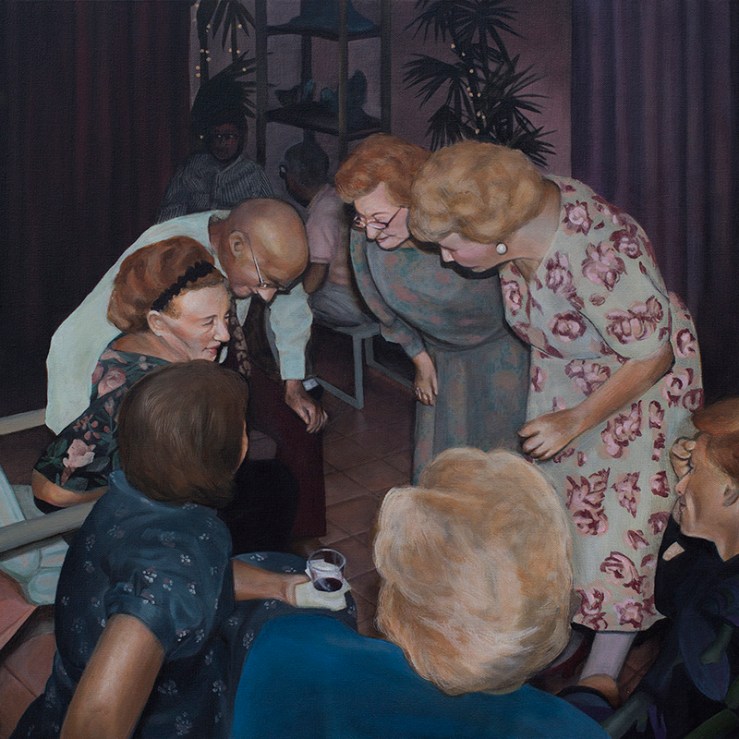
Devotion, 1913 — Egon Schiele (1890-1918)

Battle of Grunwald (Detail) — Jan Matejko

Screenshot 2019-03-02 at 9.02.49 AM

Battle of Grunwald (Detail), 1878 by Jan Matejko (1838-1893)

Read “The Eye of the Sybil,” a short story by Philip K. Dick

“The Eye of the Sybil”

by

Philip K. Dick


How is it that our ancient Roman Republic guards itself against those who would destroy it? We Romans, although only mortals like other mortals, draw on the help of beings enormously superior to ourselves. These wise and kind entities, who originate from worlds unknown to us, are ready to assist the Republic when it is in peril. When it is not in peril, they sink back out of sight — to return when we need them.

Take the case of the assassination of Julius Caesar: a case which apparently was closed when those who conspired to murder him were themselves murdered. But how did we Romans determine who had done this foul deed? And, more important, how did we bring these conspirators to justice? We had outside help; we had the assistance of the Cumean Sibyl who knows a thousand years ahead what will happen, and who gives us, in written form, her advice. All Romans are aware of the existence of the Sibylline Books. We open them whenever the need arises.

I myself, Philos Diktos of Tyana, have seen the Sibylline Books. Many leading Roman citizens, members of the Senate especially, have consulted them. But I have seen the Sibyl herself, and I of my own experience know something about her which few men know. Now that I am old — regretfully, but of the necessity which binds all mortal men — I am willing to confess that once, quite by accident I suppose, I in the course of my priestly duties saw how the Sibyl is capable of seeing down the corridors of time; I know what permits her to do this, as she developed out of the prior Greek Sibyl at Delphi, in that so highly venerated land, Greece.

Few men know this, and perhaps the Sibyl, reaching out through time to strike at me for speaking aloud, will silence me forever. It is quite possible, therefore, that before I can finish this scroll I will be found dead, my head split like one of those overripe melons from the Levant which we Romans prize so. In any case, being old, I will boldly say.

I had been quarreling with my wife that morning — I was not old then, and the dreadful murder of Julius Caesar had just taken place. At that time no one was sure who had done it. Treason against the State! Murder most ugly — a thousand knife wounds in the body of the man who had come to stabilize our quaking society. . . with the approval of the Sibyl, in her temple; we had seen the texts she had written to that effect. We knew that she had expected Caesar to bring his army across the river and into Rome, and to accept the crown of Caesar.

“You witless fool,” my wife was saying to me that morning. “If the Sibyl were so wise as you think, she would have anticipated this assassination.”

“Maybe she did,” I answered.

“I think she’s a fake,” my wife Xantippe said to me, grimacing in that way she has, which is so repulsive. She is — I should say was — of a higher social class than I, and always made me conscious of it. “You priests make up those texts; you write them yourselves — you say what you think in such a vague way that any interpretation can be made of it. You’re bilking the citizens, especially the well-to-do.” By that she meant her own family.

I said hotly, leaping up from the breakfast table, “She is inspired; she is a prophetess — she knows the future. Evidently there was no way the assassination of our great leader, whom the people loved so, could be averted.”

“The Sibyl is a hoax,” my wife said, and started buttering yet another roll, in her usual greedy fashion.

“I have seen the great books –”

How does she know the future?” my wife demanded. At that I had to admit I didn’t know; I was crestfallen — I, a priest at Cumae, an employee of the Roman State. I felt humiliated.

“It’s a money game,” my wife was saying as I strode out the door. Even though it was only dawn — fair Aurora, the goddess of dawn, was showing that white light over the world, the light we regard as sacred, from which many of our inspired visions come — I made my way, on foot, to the lovely temple where I work.

No one else had arrived yet, except the armed guards loitering outside; they glanced at me in surprise to see me so early, then nodded as they recognized me. No one but a recognized priest of the temple at Cumae is allowed in; even Caesar himself must depend on us. Continue reading “Read “The Eye of the Sybil,” a short story by Philip K. Dick”

March — Alex Colville

march-1979.jpg!Large.jpg

March, 1979 by Alex Colville (1920-2013)

Battle of Grunwald (Detail) — Jan Matejko

Screenshot 2019-02-28 at 9.05.56 PM

Battle of Grunwald (Detail), 1878 — Jan Matejko (1838-1893)

The Reader — Roland Peeters

tumblr_pncac7ahq91vl54cho1_540

The Reader, by Roland Peeters (b. 1958)

Reviews, riffs, anti-reviews, etc., January and February 2019 (and an unrelated fox)

I kicked of the New Year by riffing on some reading plans for 2019. (I’ve already read four of the seven books on that list—uncharacteristically on track for me).

At The Comics Journal, I reviewed NYRB’s reissue of Saul Steinberg’s The Labyrinth. I included The Labyrinth on my list of favorite comix of 2018, which ran as part of a feature at The Comics Journal. This is what I wrote about The Labyrinth on the list:

The Labyrinth by Saul Steinberg. (NYRB) First published in 1960 and back in print again from the NRYB this year, Saul Steinberg’s The Labyrinth condenses the modern and the mythic. “Steinberg was a lyricist of the metal nib—a twirler of nonverbal non sequiturs,” notes novelist Nicholson Baker in his introduction to the new volume. Steinberg’s lyrical non sequiturs evince in squiggles and dots, tangles and loops which turn into well-dressed men and staid women, cityscapes and night scenes, cocktail parties and art shows. Steinberg turns Abraham Lincoln into Don Quixote, with Santa as his Sancho Panza. He takes us out of urbane New York and into midcentury America, land of motor courts and baseball parks, a knotty chaotic chorus of life. Steinberg could seemingly do anything with ink, as the range of styles in The Labyrinth shows, but what he ultimately did was utterly-Steinbergian. The Labyrinth echoes Whitman’s Leaves of Grass, which sought a century earlier, to find a new language to describe a new country. Steinberg looked at America through new eyes, and, like Whitman before him, found a new language of expression—the language of labyrinthine lines on paper.

I wrote about a metatextual moment at the end of William Gaddis’s novel The Recognitions.

I reviewed (again at The Comics Journal) Paul Kirchner’s collection Hieronymus & Bosch.

I riffed a little on Angela Carter’s surreal horny abject picaresque novel, The Infernal Desire Machines of Doctor Hoffman, along with Remedio Varo’s letters and more.

I wrote a review of Yevgeny Zamyatin’s prescient novel We, essentially arguing that it’s the ur-text of dystopian fiction.

I also reviewed Lucia Berlin’s collection Evening in Paradise.

My review of  Roberto Bolaño’s latest posthumous novel The Spirit of Science Fiction was as much a cataloging of that novel’s place (and other unreleased early novels) in the Bolañoverse as it was anything else—although I did write about the book, of course:

Indeed, for many Bolaño fans, reading these early novels feels like its own project—winnowing for seeds, pulling at the threads that will cohere into something grander in the Bolaño’s future (which, from a readerly perspective, is the past). So when FS&G published Wimmer’s translation of Woes of the True Policeman in 2012, it was hard for many readers to see the novel as anything but ancillary materials for 2666—it was hard to read the novel as a discrete work, on its own. Instead, the question Woes asked Bolaño fans was, Where does this fit in the Bolañoverse?

The same question is in play for the latest posthumous Bolaño release, The Spirit of Science Fiction (Penguin, Wimmer). A simple read, and one that is not incorrect, is that The Spirit of Science Fiction feels like a trial run at The Savage Detectives. In particular, Spirit blueprints the first and third sections of The Savage Detectives, sections that revolve around the immature adventures of two would-be poets in Mexico City in the 1970s. Instead of Arturo Belano and Ulisses Lima though, we get Jan Schrella (“alias Roberto Bolaño”) and Remo. These two heroes divide Bolaño’s literary ambitions into poetry and prose, posterity and potboiler pulp fiction. In The Savage Detectives, Arturo Belano and Ulisses Lima will synthesize these ambitions more grandly in their literary quest.

I also riffed a little bit on Jon McNaught’s Kingdom and the act of reading physical books.

The last longer piece I managed in February was a take on the final scenes of True Detective Season 3.

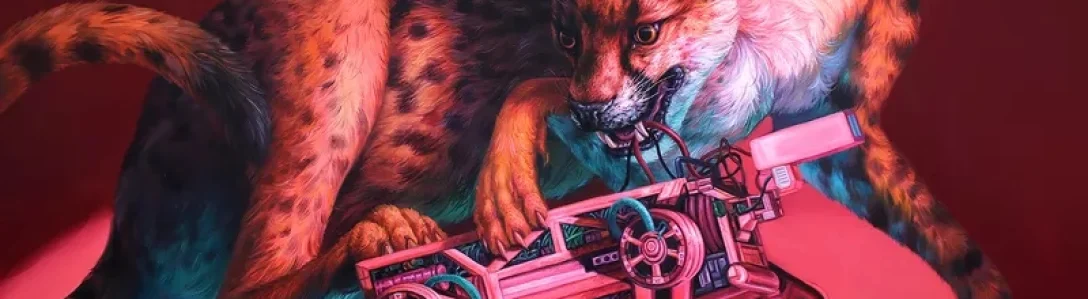
Unrelated fox by Ohara Koson, c. 1930:

fox_in_the_reeds

It Hurts — Jean-Michel Basquiat

422820

It Hurts, 1986 by Jean-Michel Basquiat (1960-1988)

“All art constantly aspires towards the condition of music”

Katzenkopf — Georg Baselitz

445befd4db7447bf

Katzenkopf  (Cat’s Head), 1967 by Georg Baselitz (b. 1938)

the book (is an extension of the eye) — Jen Mazza

jenmazza_thebookjenmazza_extensionofeye

the book (is an extension of the eye), 2012 by Jen Mazza (b. 1972)

“American Heartbreak” — Langston Hughes

american heartbreak

Invisible Man Retreat — Gordon Parks

f0961e26999b100623b1393ee42cf5c1

Invisible Man Retreat, 1952 by Gordon Parks (1912-2006)

The Shores of Faery — J.R.R. Tolkien

the-shores-of-fairy

The Shores of Faery, 1915 by J.R.R. Tolkien (1892–1973).

From The Morgan Library & Museum’s exhibition “Tolkien: Maker of Middle-earth.”

An early round-cornered John Barth and Unica Zürn’s The Trumpets of Jericho (Books acquired 26 Feb. 2019)

img_2319

I cleaned up a large bookcase this weekend, and filled a purge box with close to two dozen books. I took that box to the used bookstore I frequent to trade in for store credit, and browsed a bit, hoping to find a used copy of Joy Williams’ The Visiting Privilege (I finished her debut collection Taking Care this weekend).

No luck with the Williams. I ambled down by the Zs though, where I found a new copy of  Unica Zürn’s novella The Trumpet in English translation by Christina Svendsen. I knew a bit about Zürn (mostly her art and text poems, as well as her relationships with Hans Bellmer and Henri Michaux), but I hadn’t heard of Trumpets.

The Trumpets of Jericho is published by Wakefield Press, which has a great track record as far as I’m concerned. I loved their edition of Gisèle Prassinos’ The Arthritic Grasshopper and they’re recent book Letters, Dreams & Other Writings by Remedios Varo is one of my favorite things this year. Anyway, here’s the Wakefield blurb for The Trumpets of Jericho:

This fierce fable of childbirth by German Surrealist Unica Zürn was written after she had already given birth to two children and undergone the self-induced abortion of another in Berlin in the 1950s. Beginning in the relatively straightforward, if disturbing, narrative of a young woman in a tower (with a bat in her hair and ravens for company) engaged in a psychic war with the parasitic son in her belly, The Trumpets of Jericho dissolves into a beautiful nightmare of hypnotic obsession and mythical language, stitched together with anagrams and private ruminations. Arguably Zürn’s most extreme experiment in prose, and never before translated into English, this novella dramatizes the frontiers of the body—its defensive walls as well as its cavities and thresholds—animating a harrowing and painfully, twistedly honest depiction of motherhood as a breakdown in the distinction between self and other, transposed into the language of darkest fairy tales.

The Trumpets of Jericho includes a few of Zürn’s illustrations, including this one—

img_2321

I also browsed John Barth books a bit. I’ve been reading Robert Coover’s early novel Origin of the Brunists, which reminds me a bit of John Barth’s first two novels, The Floating Opera and End of the Road. It’s not the content as much as the style of these early works that I find similar, and I wanted to dip into the prose of The Floating Opera, which I do not own.

(I have a movie tie-in version of End of the Road. I have never seen the movie, but one of my favorite reading memories is reading the entire novel in a friend’s mother’s childhood bedroom in an entire night. We had gone down to Miami for a few days and were staying with his grandfather. His mother had been an English major, and her bedroom seemed wholly unchanged from like, 1973 (the whole house seemed stuck wonderfully in 1973), and I picked up End of the Road at like midnight and read until four or six or whatever. Great times).

Anyway, this round-cornered Avon copy (1964) of End of the Road jumped out at me. I was smitten! I feel like I’ve seen round-cornered massmarket paperbacks before, but I don’t really remember any specifically. So I googled, and came up with this unsigned article from The New York Times from 17 March 1964:

Avon Books, a division of the Hearst Corporation, has attacked the problem of the dogeared paperback by cutting off the ears. The result is a book with rounded corners at the edges and square corners at the binding.

The company has also improved design, type and paper of its paperbacks. The first titles in the new format are “The Time Has Come” by John Rock, Brendan Behan’s “Borstal Boy,” Herbert Tarr’s “The Conversion of Chaplain Carr,” Nathaniel West’s “Miss Lonelyhearts,” Aldous Huxley’s “After Many a Summer Dies the Swan” and “Those Barren Leaves,” and Van Wyck Brooks’s “The Writer in America.”

I dogear the hell out of my books, by the way.

img_2320