Sunday Comics 

I might occasionally talk shit about my old man (what boy doesn’t?) but he always picked me up an issue of MAD.

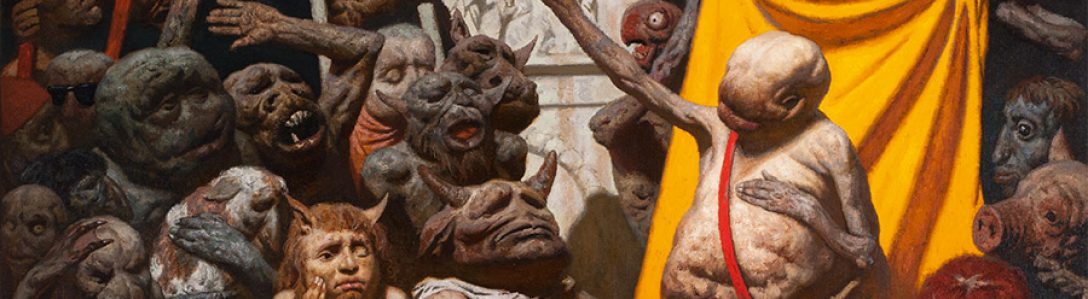
I’m not sure when these wonderfully weird Basil Wolverton drawings were originally done/published, but they come from the Fall 1990 “Super Special” of weirdness. Note that the “Vote for Nixon” button on the cover illustration is likely an update to the “Vote for Landon” button below (Alf Landon lost in a landslide to FDR in 1936). The other internal/meta-textual differences are obvious too.

I love Basil Wolverton.

Una, Lady Troubridge — Romaine Brooks

1966-49-6_1a

Illustration for Oscar Wilde’s “The Canterville Ghost” — James Hill

Canterville

James Hill’s illustration for The Canterville Ghost by Oscar Wilde. From The Short Stories of Oscar Wilde, Heritage Press, 1968.


The Canterville Ghost

by

Oscar Wilde

When Mr. Hiram B. Otis, the American Minister, bought Canterville Chase, every one told him he was doing a very foolish thing, as there was no doubt at all that the place was haunted. Indeed, Lord Canterville himself, who was a man of the most punctilious honour, had felt it his duty to mention the fact to Mr. Otis when they came to discuss terms.

“We have not cared to live in the place ourselves,” said Lord Canterville, “since my grandaunt, the Dowager Duchess of Bolton, was frightened into a fit, from which she never really recovered, by two skeleton hands being placed on her shoulders as she was dressing for dinner, and I feel bound to tell you, Mr. Otis, that the ghost has been seen by several living members of my family, as well as by the rector of the parish, the Rev. Augustus Dampier, who is a Fellow of King’s College, Cambridge. After the unfortunate accident to the Duchess, none of our younger servants would stay with us, and Lady Canterville often got very little sleep at night, in consequence of the mysterious noises that came from the corridor and the library.”

“My Lord,” answered the Minister, “I will take the furniture and the ghost at a valuation. I have come from a modern country, where we have everything that money can buy; and with all our spry young fellows painting the Old World red, and carrying off your best actors and prima-donnas, I reckon that if there were such a thing as a ghost in Europe, we’d have it at home in a very short time in one of our public museums, or on the road as a show.”

“I fear that the ghost exists,” said Lord Canterville, smiling, “though it may have resisted the overtures of your enterprising impresarios. It has been well known for three centuries, since 1584 in fact, and always makes its appearance before the death of any member of our family.”

“Well, so does the family doctor for that matter, Lord Canterville. But there is no such thing, sir, as a ghost, and I guess the laws of Nature are not going to be suspended for the British aristocracy.”

“You are certainly very natural in America,” answered Lord Canterville, who did not quite understand Mr. Otis’s last observation, “and if you don’t mind a ghost in the house, it is all right. Only you must remember I warned you.”

Read the rest of The Canterville Ghost at Project Gutenberg.

Landscape with the Destruction of Sodom and Gomorrah — Joachim Patinir

landscape-with-the-destruction-of-sodom-and-gomorrah

Arno Schmidt’s The Egghead Republic (Book acquired, 10.20.2016…and a bunch of pics of German-language books)

img_3911

I filled 45 minutes that I had to wait for something at my favorite used bookstore. I spent most of the time perusing the section of German books—I’d never looked at them before. I was kinda sorta browsing for a copy of Arno Schmidt’s Zettels Traum. I picked up the English translation of Zettels Traum (Bottom’s Dream) not quite two weeks ago, and I was curious to see what the original looks like. It may or may not (I’m guessing probably not) have been there—I got a bit lost. (There are almost three million books in this store; at least 1000 or so in the German section, and not particularly well-organized).

did pick up Schmidt’s sci-fi novel The Egghead Republic, which is much much shorter (and much much more accessible) than Bottom’s Dream. Here’s the blurb:

img_3912

I couldn’t help but snap some pic of some of the German-language, German-published books I perused:


Girl — Unichi Hiratsuka

girl-1930large

“All art constantly aspires towards the condition of music”

A potted kop (George Herriman’s Krazy Kat)

img_2969

Read “The Dancing Partner,” Jerome K. Jerome’s horror story about an automaton

“The Dancing Partner”

by

Jerome K. Jerome

from Novel Notes (1893)


“This story,” commenced MacShaugnassy, “comes from Furtwangen, a small town in the Black Forest. There lived there a very wonderful old fellow named Nicholaus Geibel. His business was the making of mechanical toys, at which work he had acquired an almost European reputation. He made rabbits that would emerge from the heart of a cabbage, flop their ears, smooth their whiskers, and disappear again; cats that would wash their faces, and mew so naturally that dogs would mistake them for real cats and fly at them; dolls with phonographs concealed within them, that would raise their hats and say, ‘Good morning; how do you do?’ and some that would even sing a song.

“But, he was something more than a mere mechanic; he was an artist. His work was with him a hobby, almost a passion. His shop was filled with all manner of strange things that never would, or could, be sold — things he had made for the pure love of making them. He had contrived a mechanical donkey that would trot for two hours by means of stored electricity, and trot, too, much faster than the live article, and with less need for exertion on the part of the driver, a bird that would shoot up into the air, fly round and round in a circle, and drop to earth at the exact spot from where it started; a skeleton that, supported by an upright iron bar, would dance a hornpipe, a life-size lady doll that could play the fiddle, and a gentleman with a hollow inside who could smoke a pipe and drink more lager beer than any three average German students put together, which is saying much.

“Indeed, it was the belief of the town that old Geibel could make a man capable of doing everything that a respectable man need want to do. One day he made a man who did too much, and it came about in this way:

“Young Doctor Follen had a baby, and the baby had a birthday. Its first birthday put Doctor Follen’s household into somewhat of a flurry, but on the occasion of its second birthday, Mrs. Doctor Follen gave a ball in honour of the event. Old Geibel and his daughter Olga were among the guests.

“During the afternoon of the next day some three or four of Olga’s bosom friends, who had also been present at the ball, dropped in to have a chat about it. They naturally fell to discussing the men, and to criticizing their dancing. Old Geibel was in the room, but he appeared to be absorbed in his newspaper, and the girls took no notice of him.

“‘There seem to be fewer men who can dance at every ball you go to,’ said one of the girls.

“‘Yes, and don’t the ones who can give themselves airs,’ said another; ‘they make quite a favor of asking you.’

“‘And how stupidly they talk,’ added a third. ‘They always say exactly the same things: “How charming you are looking to-night.” “Do you often go to Vienna? Oh, you should, it’s delightful.” “What a charming dress you have on.” “What a warm day it has been.” “Do you like Wagner?” I do wish they’d think of something new.’

“‘Oh, I never mind how they talk,’ said a forth. ‘If a man dances well he may be a fool for all I care.’

“‘He generally is,’ slipped in a thin girl, rather spitefully.

“‘I go to a ball to dance,’ continued the previous speaker, not noticing the interruption. ‘All I ask is that he shall hold me firmly, take me round steadily, and not get tired before I do.’

“‘A clockwork figure would be the thing for you,’ said the girl who had interrupted.

“‘Bravo!’ cried one of the others, clapping her hands, ‘what a capital idea!’

“‘What’s a capital idea?’ they asked.

“‘Why, a clockwork dancer, or, better still, one that would go by electricity and never run down.’ Continue reading “Read “The Dancing Partner,” Jerome K. Jerome’s horror story about an automaton”

Andy Warhol — Alice Neel

80_52_neela

Keen and quivering ratio (Emily Dickinson)

quivering

On the Stream of Life — Hugo Simberg

hugo_s12

Bath Tub Converted into a Pin-Hole Camera — Steven Pippin

Bath Tub Converted into a Pin-Hole Camera 1984 by Steven Pippin born 1960

Joking Couple with a Mirror — Hans von Aachen

gg_1155x

In a dream to wander to some place where may be heard the complaints of all the miserable on earth (Nathaniel Hawthorne’s journal entry for October 17th, 1835)

October 17th.–Some of the oaks are now a deep brown red; others are changed to a light green, which, at a little distance, especially in the sunshine, looks like the green of early spring. In some trees, different masses of the foliage show each of these hues. Some of the walnut-trees have a yet more delicate green. Others are of a bright sunny yellow.

Mr.—- was married to Miss —- last Wednesday. Yesterday Mr. Brazer, preaching on the comet, observed that not one, probably, of all who heard him, would witness its reappearance. Mrs.—- shed tears. Poor soul! she would be contented to dwell in earthly love to all eternity!

Some treasure or other thing to be buried, and a tree planted directly over the spot, so as to embrace it with its roots.

A tree, tall and venerable, to be said by tradition to have been the staff of some famous man, who happened to thrust it into the ground, where it took root.

A fellow without money, having a hundred and seventy miles to go, fastened a chain and padlock to his legs, and lay down to sleep in a field. He was apprehended, and carried gratis to a jail in the town whither he desired to go.

An old volume in a large library,–every one to be afraid to unclasp and open it, because it was said to be a book of magic.

A ghost seen by moonlight; when the moon was out, it would shine and melt through the airy substance of the ghost, as through a cloud.

Prideaux, Bishop of Worcester, during the sway of the Parliament, was forced to support himself and his family by selling his household goods. A friend asked him, “How doth your lordship?” “Never better in my life,” said the Bishop, “only I have too great a stomach; for I have eaten that little plate which the sequestrators left me. I have eaten a great library of excellent books. I have eaten a great deal of linen, much of my brass, some of my pewter, and now I am come to eat iron; and what will come next I know not.”

A scold and a blockhead,–brimstone and wood,–a good match.

To make one’s own reflection in a mirror the subject of a story.

In a dream to wander to some place where may be heard the complaints of all the miserable on earth.

Some common quality or circumstance that should bring together people the most unlike in all other respects, and make a brotherhood and sisterhood of them,–the rich and the proud finding themselves in the same category with the mean and the despised.

A person to consider himself as the prime mover of certain remarkable events, but to discover that his actions have not contributed in the least thereto. Another person to be the cause, without suspecting it.

Nathaniel Hawthorne’s journal entry for October 17th, 1835. From Passages from the American Note-Books.

Posted in Art

Thunder Approaching — Michael Ayrton

h0046-l00501109

Sunday Comics

With Halloween approaching, here are three creepy full page panels from Charles Burns’s Black Hole (Pantheon, 2005).