The Twelfth Department (Book Acquired, Sometime Last Week)

20130621-194131.jpg


The Twelfth Apartment is a forthcoming thriller from William Ryan. Macmillan’s blurb:

The new Captain Korolev mystery set in 1930s Stalinist Russia, from the lauded author of The Holy Thief and The Bloody Meadow

Moscow, 1937. Captain Korolev, a police investigator, is enjoying a long-overdue visit from his young son Yuri when an eminent scientist is shot dead within sight of the Kremlin and Korolev is ordered to find the killer.

It soon emerges that the victim, a man who it appears would stop at nothing to fulfil his ambitions, was engaged in research of great interest to those at the very top ranks of Soviet power. When another scientist is brutally murdered, and evidence of the professors’ dark experiments is hastily removed, Korolev begins to realise that, along with having a difficult case to solve, he’s caught in a dangerous battle between two warring factions of the NKVD. And then his son Yuri goes missing . . .

A desperate race against time, set against a city gripped by Stalin’s Great Terror and teeming with spies, street children and Thieves, The Twelfth Department confirms William Ryan as one of the most compelling historical crime novelists at work today.


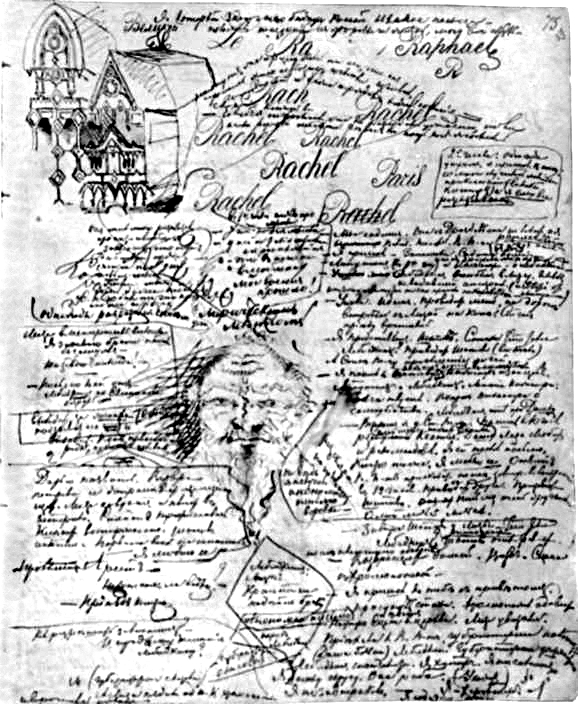
Percy Bysshe Shelley’s Manuscript for “Ozymiandias”

shelley manuscript

“Ozymandias” by Percy Shelley—

I met a traveller from an antique land,
Who said — “two vast and trunkless legs of stone
Stand in the desert … near them, on the sand,
Half sunk a shattered visage lies, whose frown,
And wrinkled lips, and sneer of cold command,
Tell that its sculptor well those passions read
Which yet survive, stamped on these lifeless things,
The hand that mocked them, and the heart that fed;
And on the pedestal these words appear:
My name is Ozymandias, King of Kings,
Look on my Works ye Mighty, and despair!
Nothing beside remains. Round the decay
Of that colossal Wreck, boundless and bare
The lone and level sands stretch far away.” —

(Via).


Truman Capote (1954) — Andy Warhol

Maria — Helene Schjerfbeck

A Midsummer Night’s Dream (1935)

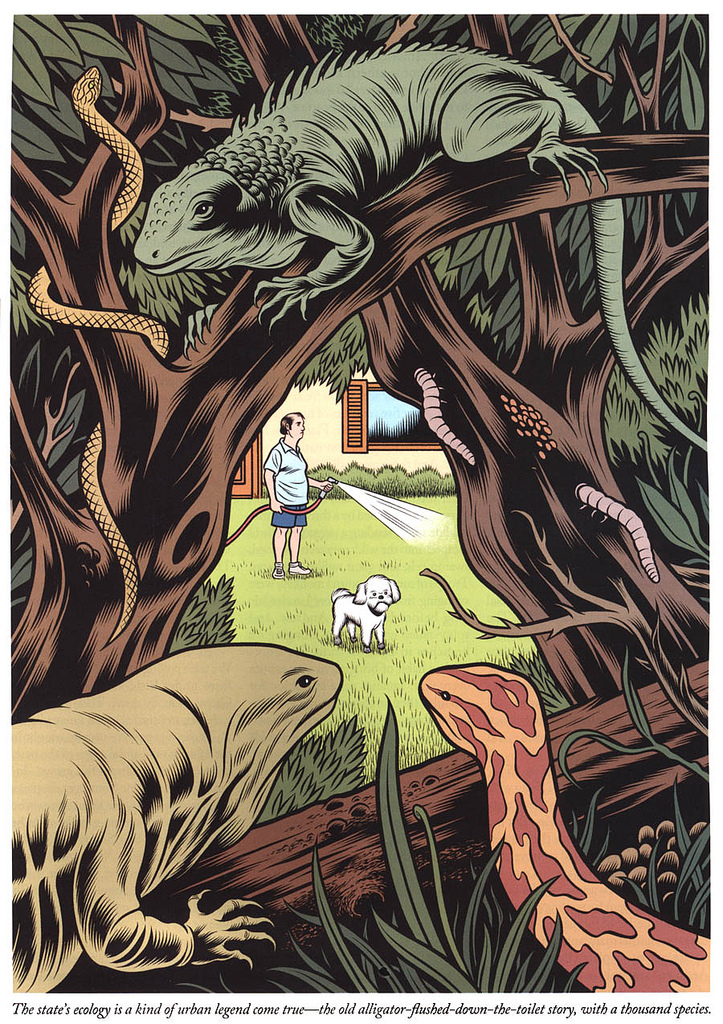
“Insect Life of Florida” — Lynda Hull

“Insect Life of Florida” by Lynda Hull

In those days I thought their endless thrum
   was the great wheel that turned the days, the nights.
      In the throats of hibiscus and oleander


I’d see them clustered yellow, blue, their shells
   enameled hard as the sky before the rain.
      All that summer, my second, from city


to city my young father drove the black coupe
   through humid mornings I’d wake to like fever
      parceled between luggage and sample goods.


Afternoons, showers drummed the roof,
   my parents silent for hours. Even then I knew
      something of love was cruel, was distant.


Mother leaned over the seat to me, the orchid
   Father’d pinned in her hair shriveled
      to a purple fist. A necklace of shells


coiled her throat, moving a little as she
   murmured of alligators that float the rivers
      able to swallow a child whole, of mosquitoes


whose bite would make you sleep a thousand years.
   And always the trance of blacktop shimmering
      through swamps with names like incantations—


Okeefenokee, where Father held my hand
   and pointed to an egret’s flight unfolding
      white above swamp reeds that sang with insects


until I was lost, until I was part
   of the singing, their thousand wings gauze
      on my body, tattooing my skin.


Father rocked me later by the water,
   the motel balcony, singing calypso
      with the Jamaican radio. The lyrics


a net over the sea, its lesson
   of desire and repetition. Lizards flashed
      over his shoes, over the rail


where the citronella burned merging our
   shadows—Father’s face floating over mine
      in the black changing sound


of night, the enormous Florida night,
   metallic with cicadas, musical
      and dangerous as the human heart.

Harry Grant Dart Painting

harry grant dart

(Via/about).

Seated Figure of Summer — Giuseppe Arcimboldo

“The Snow Child” — Angela Carter

“The Snow Child” by Angela Carter

Midwinter — invincible, immaculate. The Count and his wife go riding, he on a grey mare and she on a black one, she wrapped in the glittering pelts of black foxes; and she wore high, black, shining boots with scarlet heels, and spurs. Fresh snow fell on snow already fallen; when it ceased, the whole world was white. “I wish I had a girl as white as snow,” says the Count. They ride on. They come to a hole in the snow; this hole is filled with blood. He says: “I wish I had a girl as red as blood.” So they ride on again; here is a raven, perched on a bare bough. “I wish I had a girl as black as that bird’s feathers.”

As soon as he completed her description, there she stood, beside the road, white skin, red mouth, black hair and stark naked; she was the child of his desire and the Countess hated her. The Count lifted her up and sat her in front of him on his saddle but the Countess had only one thought:how shall I be rid of her?

The Countess dropped her glove in the snow and told the girl to get down to look for it; she meant to gallop off and leave her there but the Count said: “I’ll buy you new gloves.” At that, the furs sprang off the Countess’s shoulders and twined round the naked girl. Then the Countess threw her diamond brooch through the ice of a frozen pond: “Dive in and fetch it for me,” she said; she thought the girl would drown. But the Count said: “Is she a fish to swim in such cold weather?” Then her boots leapt off the Countess’s feet and on to the girl’s legs. Now the Countess was bare as a bone and the girl furred and booted; the Count felt sorry for his wife. They came to a bush of roses, all in flower. “Pick me one,” said the Countess to the girl. “I can’t deny you that,” said the Count.

So the girl picks a rose; pricks her finger on the thorn; bleeds; screams; falls.

Weeping, the Count got off his horse, unfastened his breeches and thrust his virile member into the dead girl. The Countess reined in her stamping mare and watched him narrowly; he was soon finished.

Then the girl began to melt. Soon there was nothing left of her but a feather a bird might have dropped; a blood stain, like the trace of a fox’s kill on the snow; and the rose she had pulled off the bush. Now the Countess had all her clothes on again. With her long hand, she stroked her furs. The Count picked up the rose, bowed and handed it to his wife; when she touched it, she dropped it. “It bites!” she said.

Girl on Divan — Berthe Morisot

Andy Warhol & Nico as Batman & Robin

ab1

(More/about).

Stork — Albrecht Dürer

List with No Name #31

  1. “Made in America”
  2. “Pine Barrens”
  3. “College”
  4. “The Test Dream”
  5. “Whoever Did This”
  6. “Long Term Parking”
  7. “Kennedy and Heidi”
  8. “Mayham”
  9. “Rat Pack”
  10. “Whitecaps”


Admiral Fudge Comes Back to Earth Again (Harry Grant Dart)

explorigator-2

(Via; On The Explorigator’s connection to Thomas Pynchon’s Against the Day).

Portrait of Tony Soprano as Napoleon Bonaparte Accompanied by His Steed Pie-O-My

tony

“Snow White and the Seven Dwarfs” — Anne Sexton

“Snow White and the Seven Dwarfs” by Anne Sexton

No matter what life you lead
the virgin is a lovely number:
cheeks as fragile as cigarette paper,
arms and legs made of Limoges,
lips like Vin Du Rhône,
rolling her china-blue doll eyes
open and shut.
Open to say,
Good Day Mama,
and shut for the thrust
of the unicorn.
She is unsoiled.
She is as white as a bonefish.

Once there was a lovely virgin
called Snow White.
Say she was thirteen.
Her stepmother,
a beauty in her own right,
though eaten, of course, by age,
would hear of no beauty surpassing her own.
Beauty is a simple passion,
but, oh my friends, in the end
you will dance the fire dance in iron shoes.
The stepmother had a mirror to which she referred-
something like the weather forecast-
a mirror that proclaimed
the one beauty of the land.
She would ask,
Looking glass upon the wall,
who is fairest of us all?
And the mirror would reply,
You are the fairest of us all.
Pride pumped in her like poison. Continue reading ““Snow White and the Seven Dwarfs” — Anne Sexton”

The Dream — Eva Gonzales