Jorge Luis Borges Portrait — Roman Muradov

borgesscan

(There’s lots more great stuff at Roman Muradov’s site and blog).

Game of Thrones, 1995 Style

(More–Breaking Bad and The Walking Dead—at AV Club)

“All utopias are depressing” (Georges Perec)

20130312-194740

The Making of Kubrick’s 2001: A Space Odyssey (Documentary)

“Thoughts on Various Subjects” — Jonathan Swift

“Thoughts on Various Subjects” by Jonathan Swift (From The Battle of the Books)

We have just enough religion to make us hate, but not enough to make us love one another.

Reflect on things past as wars, negotiations, factions, etc.  We enter so little into those interests, that we wonder how men could possibly be so busy and concerned for things so transitory; look on the present times, we find the same humour, yet wonder not at all.

A wise man endeavours, by considering all circumstances, to make conjectures and form conclusions; but the smallest accident intervening (and in the course of affairs it is impossible to foresee all) does often produce such turns and changes, that at last he is just as much in doubt of events as the most ignorant and inexperienced person.

Positiveness is a good quality for preachers and orators, because he that would obtrude his thoughts and reasons upon a multitude, will convince others the more, as he appears convinced himself.

How is it possible to expect that mankind will take advice, when they will not so much as take warning?

I forget whether Advice be among the lost things which Aristo says are to be found in the moon; that and Time ought to have been there.

No preacher is listened to but Time, which gives us the same train and turn of thought that older people have tried in vain to put into our heads before.

When we desire or solicit anything, our minds run wholly on the good side or circumstances of it; when it is obtained, our minds run wholly on the bad ones.

In a glass-house the workmen often fling in a small quantity of fresh coals, which seems to disturb the fire, but very much enlivens it.  This seems to allude to a gentle stirring of the passions, that the mind may not languish.

Religion seems to have grown an infant with age, and requires miracles to nurse it, as it had in its infancy.

All fits of pleasure are balanced by an equal degree of pain or languor; it is like spending this year part of the next year’s revenue.

The latter part of a wise man’s life is taken up in curing the follies, prejudices, and false opinions he had contracted in the former. Continue reading ““Thoughts on Various Subjects” — Jonathan Swift” →

Still Life with Book and Purse — Gerrit Dou

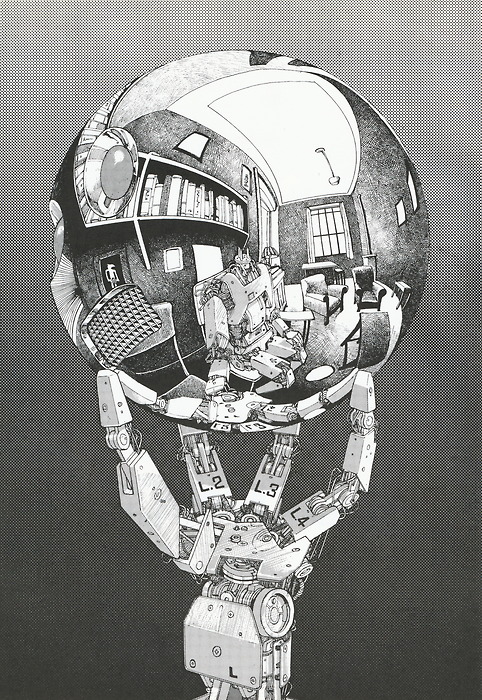
Katsuhiro Otomo, After Escher

Katsuhiro Otomo

The Drinker — Jusepe de Ribera

“I like a look of agony” — Emily Dickinson

Capture

George Saunders Riffs on Vonnegut, Teaching Writing, and How Capitalism Plunders the Sensuality of the Body

Studies of Grotesques — Michelangelo

“The Bet” — Anton Chekhov

“The Bet” by Anton Chekhov

I

It was a dark autumn night. The old banker was pacing from corner to corner of his study, recalling to his mind the party he gave in the autumn fifteen years before. There were many clever people at the party and much interesting conversation. They talked among other things of capital punishment. The guests, among them not a few scholars and journalists, for the most part disapproved of capital punishment. They found it obsolete as a means of punishment, unfitted to a Christian State and immoral. Some of them thought that capital punishment should be replaced universally by life-imprisonment.

“I don’t agree with you,” said the host. “I myself have experienced neither capital punishment nor life-imprisonment, but if one may judge a priori, then in my opinion capital punishment is more moral and more humane than imprisonment. Execution kills instantly, life-imprisonment kills by degrees. Who is the more humane executioner, one who kills you in a few seconds or one who draws the life out of you incessantly, for years?”

“They’re both equally immoral,” remarked one of the guests, “because their purpose is the same, to take away life. The State is not God. It has no right to take away that which it cannot give back, if it should so desire.”

Among the company was a lawyer, a young man of about twenty-five. On being asked his opinion, he said:

“Capital punishment and life-imprisonment are equally immoral; but if I were offered the choice between them, I would certainly choose the second. It’s better to live somehow than not to live at all.”

There ensued a lively discussion. The banker who was then younger and more nervous suddenly lost his temper, banged his fist on the table, and turning to the young lawyer, cried out:

“It’s a lie. I bet you two millions you wouldn’t stick in a cell even for five years.”

“If you mean it seriously,” replied the lawyer, “then I bet I’ll stay not five but fifteen.”

“Fifteen! Done!” cried the banker. “Gentlemen, I stake two millions.”

“Agreed. You stake two millions, I my freedom,” said the lawyer.

So this wild, ridiculous bet came to pass. The banker, who at that time had too many millions to count, spoiled and capricious, was beside himself with rapture. During supper he said to the lawyer jokingly:

“Come to your senses, young roan, before it’s too late. Two millions are nothing to me, but you stand to lose three or four of the best years of your life. I say three or four, because you’ll never stick it out any longer. Don’t forget either, you unhappy man, that voluntary is much heavier than enforced imprisonment. The idea that you have the right to free yourself at any moment will poison the whole of your life in the cell. I pity you.”

And now the banker, pacing from corner to corner, recalled all this and asked himself:

“Why did I make this bet? What’s the good? The lawyer loses fifteen years of his life and I throw away two millions. Will it convince people that capital punishment is worse or better than imprisonment for life? No, no! all stuff and rubbish. On my part, it was the caprice of a well-fed man; on the lawyer’s pure greed of gold.” Continue reading ““The Bet” — Anton Chekhov” →
Dorigen of Britain Waiting for the Return of Her Husband — Edward Burne-Jones

Is It About a Bicycle? (A Documentary About Flann O’Brien aka Brian O’Nolan aka Myles na gCopalee aka Brother Barnabas aka George Knowall)

Fatalism — Jan Toorop

“Tao Lin” — Michael Kimball

Tao Lin was born in Flagstaff, AZ. He had a very busy childhood that involved practicing the piano a lot. When he was 5, Tao remembers writing little books and selling them to his mother for 50¢. When Tao was small, his neighbor had a rabbit farm and sold them for money. Being near that changed Tao, and, because of it, he talks less shit about people publicly and makes fewer grand pronouncements.

Growing up, Tao played kickball and baseball and basketball in the neighborhood, but not at school. When he was 10, he was playing poker with his neighbor and bet his entire coin collection. The neighbor won and Tao picked up his coin collection and ran back to his house and locked the door. The neighbor knocked a lot and said things like this: “Just give me half. I won’t be angry.”

Tao kept practicing the piano until he no longer owned a piano that worked. Then, at New York University, he studied journalism, but he would have studied creative writing if there had been a program. His sophomore year, he broke up with his girlfriend and then decided to focus really hard on writing. After that, Tao wrote and published a few books. As Tao has noted in interviews, his writing expresses crippling loneliness, severe depression, and the arbitrary nature of the universe. Also, Tao enjoys repeatedly looking at Statcounter, Sales Rank Express, Facebook, Gmail, Twitter, and Tumblr. When a number changes, he feels like something has happened. His job is to promote himself to ensure money will come to him 2-3 years from now, and then even after that.

Everything is just something Tao does. It can be either good or bad depending on the way he thinks about it. Once, Tao thought about peeing in an empty FYXX energy drink bottle and selling it on eBay. Another time, after he ran out of money, Tao sold 10% shares of his second novel to six different people for $2,000 per share. He will never get another real job for the rest of his life. Tomorrow, Tao would like to eat only raw vegan foods.

Update : Tao published some more books. He also married Megan Boyle and they later separated.

“Tao Lin” is part of Michael Kimball’s new book Michael Kimball Writes Your Life Story (On a Postcard), which is new from Mud Luscious Press. Interview and review forthcoming. This piece is republished with the kind permission of the author.


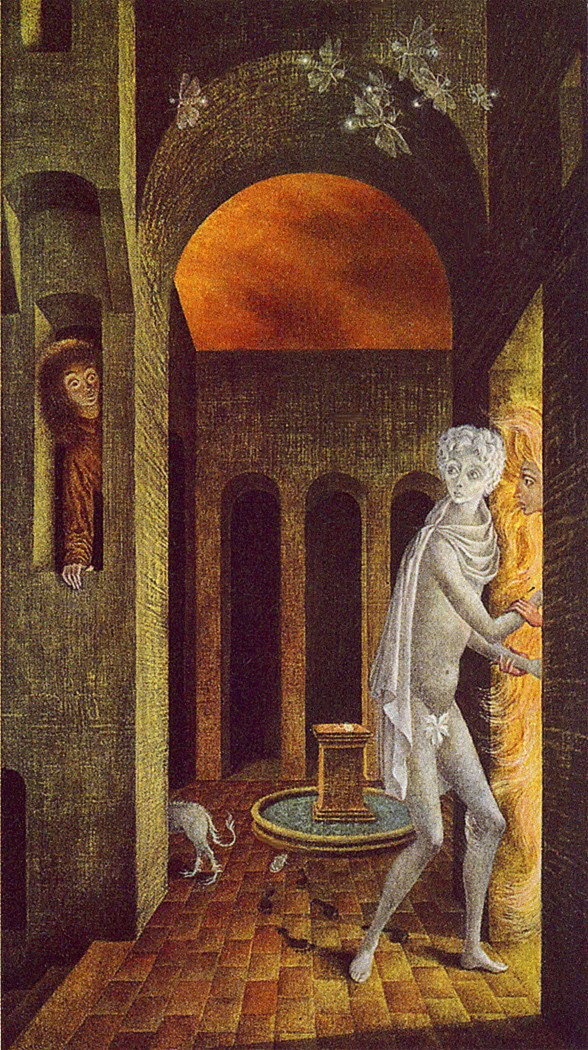
Abut — Remedios Varo

abut