Sometimes I Spit with Pleasure on the Portrait of My Mother (Sacred Heart) — Salvador Dali

HST and Terry Gilliam Riff About Words and Images

Books Acquired, 10.20.2011

20111020-190929.jpg

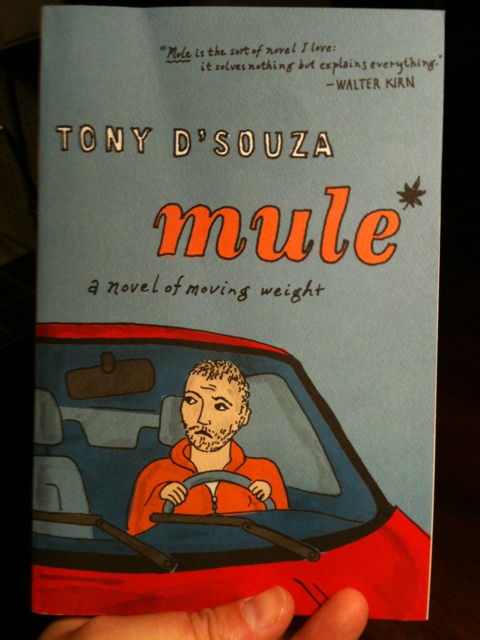
A good lookin’ pair this eve. First up, Tony D’Souza’s novel Mule, which looks rather promising (the cover and premise alone earn it an advanced spot in the stack). From K. Reed Petty’s review at Electric Literature—

Mule is Scarface for readers of The New Yorker: It plots all the emotional points on a man’s rise and downfall, while explaining everything you need to know to avoid getting caught while driving $50,000 worth of marijuana from California to Tennessee.

D’Souza’s book is the most satisfying in answering the details that cable skims over. Our hero, James, is an out-of-work freelance journalist with a new family and no safety net. When he gets an opportunity to make some quick cash, he researches the business of driving drugs like a long-form journalist: How do you convince a bank teller to hand over your $7,000 savings account in hundreds? What are your rights if a cop pulls you over in Texas versus Nevada? And, as James asks of a buyer he meets on his first run: “How much does an ounce weigh?”

20111020-190939.jpg

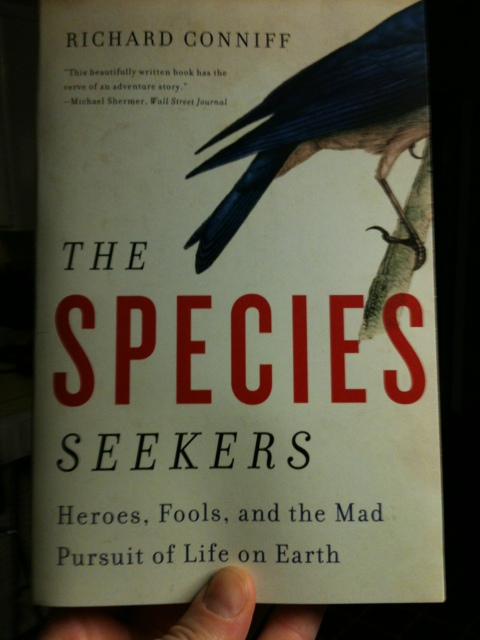
The Species Seekers by Richard Conniff also seems really cool. The book explores the strange intersections of science and adventure. Press release—

Conniff takes us back in time—before the words “scientist” or “biologist” even existed—to when a popular fever for the natural world swept through humanity. Beginning in the mid-eighteenth century, amateur naturalists made it their mission to go to the most perilous corners of the planet and bring back astonishing new species. Linnaeus, Darwin, and Wallace dominate most histories of the great age of discovery.  But they owed their success to this network of enthusiasts, who worked mainly for the pleasure of adding “to the power and grace and beauty of the Infinite.”  Among them:  A grave-robbing anatomist who became the model for Dr. Jekyll and Mr. Hyde, a Catholic missionary who held off bandits at gunpoint, and a British ornithologist who lost his left arm by jamming it down the throat of a charging leopard—but happily lived on to play a good game of tennis.

Discovering new species wasn’t a rarefied pastime; it was a pandemic, a social disease that struck every corner of society, claiming such notables as Thomas Jefferson, who laid out mastodon bones on the floor of the White House, and Mark Twain, who set out to become an Amazonian explorer, but went bust in New Orleans and had to make do with the river at hand.

Amid its tales of adventure and intrigue, The Species Seekers offers unmatched insight into one of the great revolutions in the history of human thought. At the start, God was in heaven, Man was the center of the universe, and everyone accepted that the Earth had been born yesterday for our benefit. But we weren’t sure where vegetable ended and animal began. We didn’t know what species were, or that they could be joined by common origin. We had no way to identify the causes of the pestilential diseases that made death a constant companion.

All that suddenly changed, as the species seekers introduced us to the pantheon of life on Earth—and our place within it.

The Royal Menagerie at the Tower of London — Walton Ford

Werner Herzog Explains Why His Films Are Funnier Than Eddie Murphy’s

AV Club Interviews Daniel Clowes


The AV Club interviews comix creator Daniel Clowes. (Read our review of Clowes’s hilarious and acerbic book Wilson)From the interview—

The A.V. Club: People often ask musicians if they listen to their old albums or filmmakers if they watch their old movies, but do you reread your old comics?

Dan Clowes: I try not to. [Laughs.] It usually doesn’t lead to anything good. The only way I can ever experience them really is if I completely forgot what they were about. Once I send it off to the printer, I try to never look at the work again, if I can help it. Usually when I put together a book like this DeathRay hardcover or that Ghost World special edition, then I have to reread it and see if there is anything I want to change or any re-coloring I want to do. That’s when I’m faced with the actual work. When I’m working, I’m too close to it. I’m sort of inside, and I can’t see it at all. So when I have that experience of rereading it years later, it’s jarring.

“If You Write Every Day, Then You Are a Writer” — Alan Moore’s Advice to Unpublished Authors

King Lear on Occupy Wall Street

Through tatter’d clothes small vices do appear;
Robes and furr’d gowns hide all. Plate sin with gold,
And the strong lance of justice hurtless breaks;
Arm it in rags, a pigmy’s straw does pierce it.

King Lear, 4.6

“Identity Is Always Accompanied by Violence” — Marshall McLuhan on Globalism and Tribalism

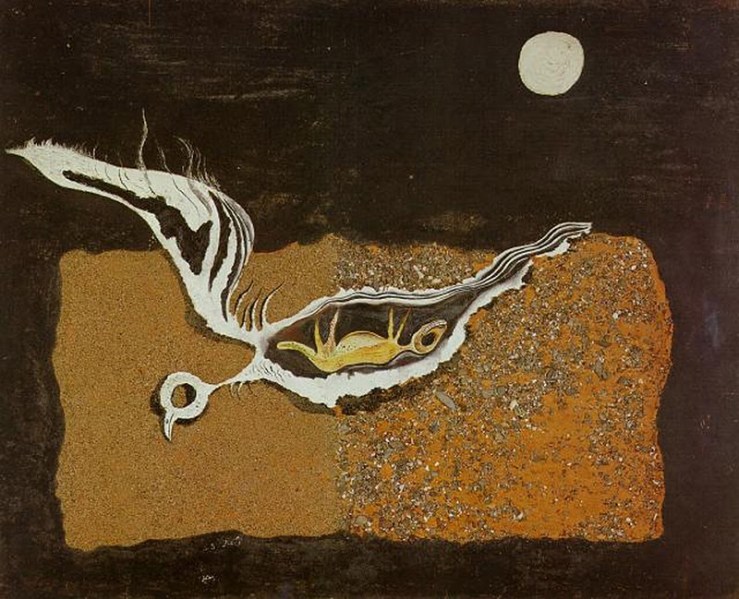
Bird — Salvador Dali

Lemony Snickett on Occupy Wall Street

Lemony Snickett (aka Daniel Handler, aka one of the dudes in Magnetic Fields) offers Thirteen Observations made by Lemony Snicket while watching Occupy Wall Street from a Discreet Distance.”  (See also: Occupy Writers). A taste, but read the whole thing—

1. If you work hard, and become successful, it does not necessarily mean you are successful because you worked hard, just as if you are tall with long hair it doesn’t mean you would be a midget if you were bald.

. . .

5. There may not be a reason to share your cake. It is, after all, yours. You probably baked it yourself, in an oven of your own construction with ingredients you harvested yourself. It may be possible to keep your entire cake while explaining to any nearby hungry people just how reasonable you are.

. . .

7. Someone feeling wronged is like someone feeling thirsty. Don’t tell them they aren’t. Sit with them and have a drink.

. . .

11. Historically, a story about people inside impressive buildings ignoring or even taunting people standing outside shouting at them turns out to be a story with an unhappy ending.


(Some Very Handsome) Books Acquired, 10.18.2011 (Melville House Debuts The Neversink Library)

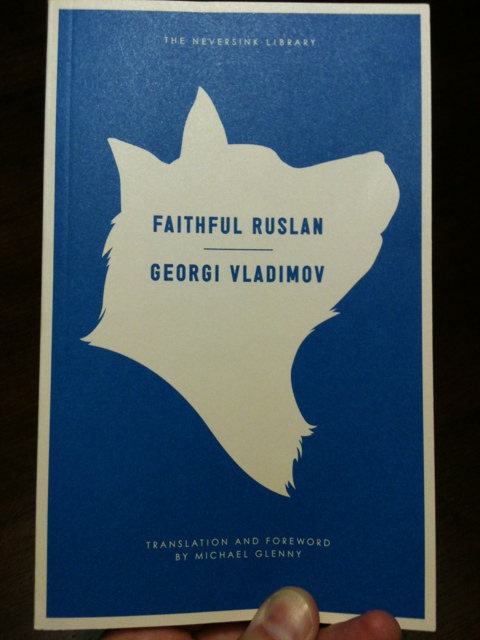
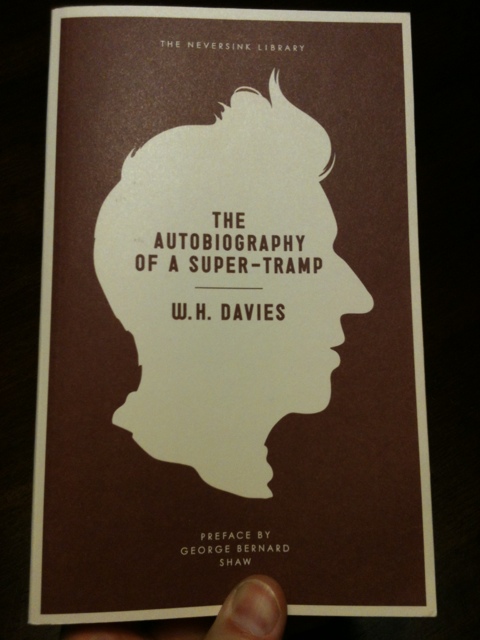
The good people at Melville House, debut The Neversink Library this week, a line of international titles that have been overlooked, neglected, and under-appreciated, many languishing out of print for years. I was pleased as punch to get three from the fall line up (another Neversink title coming out this Fall is a new edition of Karel Capek’s War with the Newts, covered by Biblioklept affiliate Noquar just a few weeks ago). Pics of the titles below—you can see how handsome and unified the design is here.
20111018-170431.jpg

Georgi Vladimov’s Faithful Ruslan

Set in a remote Siberian depot immediately following the demolition of one of the gulag’s notorious camps and the emancipation of its prisoners, Faithful Ruslan is an embittered cri de oeur from a writer whose circumstances obliged him to resist the violence of arbitrary power. “Every writer who writes anything in this country is made to feel he has committed a crime,” Georgi Vladimov said. Dissident, he said, is a word that “they force on you.” His mother, a victim of Stalin’s anti-Semitic policy, had been interred for two years in one of the camps from which Vladimov derived the wrenching detail of Faithful Ruslan. The novel circulated in samizdat for more than a decade, often attributed to Solzhenitsyn, before its publication in the West led to Vladimov’s harassment and exile.

A starving stray, tortured and abandoned by the godlike “Master” whom he has unconditionally loved, Ruslan and his cadre of fellow guard dogs dutifully wait for the arrival of new prisoners—but the unexpected arrival of a work party provokes a climactic bloodletting. Fashioned from the perceptions of an uncomprehending animal, Vladimov’s insistently ironic indictment of the gulag spirals to encompass all of Man’s inexplicable cruelty.
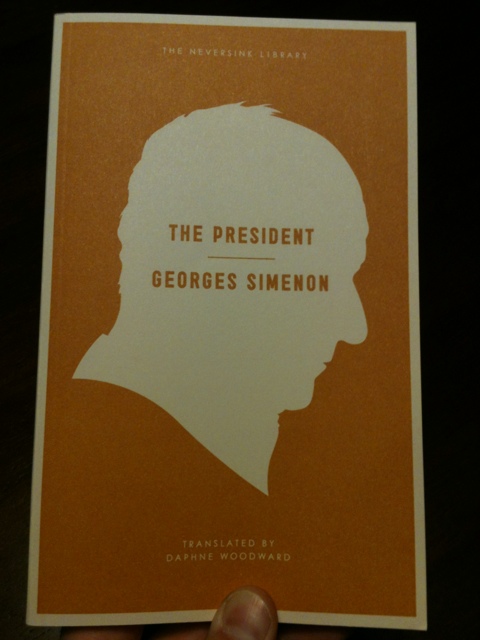
20111018-170446.jpgThe President by Georges Simenon—

At 82, the former premier lives in alert and suspicious retirement— self exile—on the Normandy coast, writing his anxiously anticipated memoirs and receiving visits from statesman and biographers. In his library is the self-condemning, handwritten confession of the premier’s former attaché, Chalamont, hidden between the pages of a sumptuously produced work of privately printed pornography—a confession that the premier himself had dictated and forced Chalamont to sign. Now the long-thwarted Chalamont has been summoned to form a new coalition in the wake of the government’s collapse. The premier alone possesses the secret of Chalamont’s guilt, of his true character—and has publicly vowed: “He’ll never be Premier as long as I’m alive . . . Nor when I’m dead, either.”

Inspired by French Premier Georges Clemenceau, The President is a masterpiece of psychological suspense and a probing account of the decline of power.
20111018-170456.jpg

I think this is the one I’ll dip into first: The Autobiography of a Super-Tramp by W.H. Davies—

An untutored Welsh tramp who became a popular poet acclaimed by the conservative Georgians and the vanguard Ezra Pound alike, W. H. Davies surprised his contemporaries with the unlikeliest portrait of the artist as a young man ever written.

After a delinquent childhood Davies renounced home and apprenticeship and at twenty-two sailed to America—the first of more than a dozen Atlantic crossings, often made by cattle boat. From 1893 to 1899 he was schooled by the hard men of the road, disdaining regular work and subsisting by begging. Crossing Canada to join the “Klondyke” gold rush, Davies fell while hopping a train. His foot was crushed and his leg amputated. “All the wildness had been taken out of me,” Davies wrote, “and my adventures after this were not of my own seeking.”

Praised by Osbert Sitwell for his “primitive splendour and directness,” Davies evokes the beauty and frontier violence of turn-of-the-century America in prose that George Bernard Shaw commended to “literary experts for its style alone.” The insurgent wanderlust that found an American voice in Jack London and Jack Kerouac is expressed here in a raucous true adventure story by the man Shaw called “the incorrigible Supertramp who wrote this amazing book.”

“Art Makes People Aware of What They Know and Don’t Know That They Know” — William S. Burroughs Talks About Creative Thinking

“Some Factors Determining the Quality of a Translation” — Lydia Davis

From Lydia Davis’s insightful and entertaining essay “Some Notes on Translation and on Madame Bovary,” from issue 198 of The Paris Review

The quality and nature of a translation (let’s say from the French) depends on at least three things: the translator’s knowledge of French language, history, and culture; his or her conception of the task of the translation; and his or her ability to write well in English. These three variables have subsets that can recombine infinitely, which is why one work can have such widely differing translations. Publishers selecting a translator seem to proceed on the assumption that the most important qualification is the first. “Let’s ask Professor X, head of the French department at Y!” Often they completely ignore the second factor—how will Professor X approach the task of translating?—and certainly the third—what is Professor X’s writing style like? All three factors are vital, but in many instances, if one has to rank them, the third—how well the translator writes—may be the most important qualification, followed closely or equaled by the second—how he or she approaches translating, and it is the first that comes in last place, since minor lapses in a knowledge of the language, history, and culture may result in mistakes that are, in a beautifully written, generally faithful version, fairly easily corrected, whereas a misconception of the task of the translator and, worse, an inability to write well will doom the entire book through its every sentence.

Curb Dance — Harmony Korine

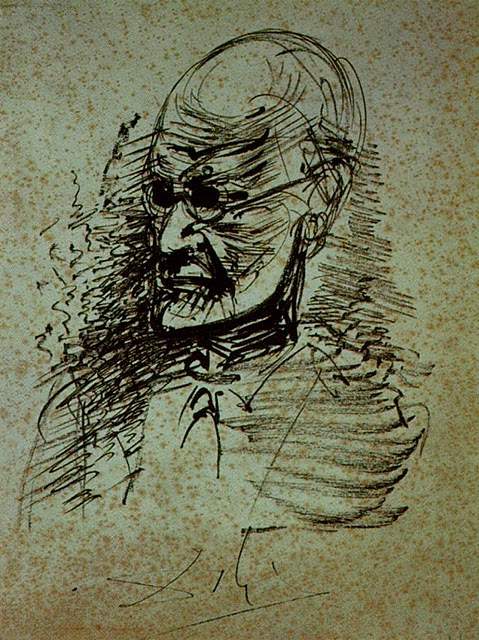
Sigmund Freud (1938) — Salvador Dali

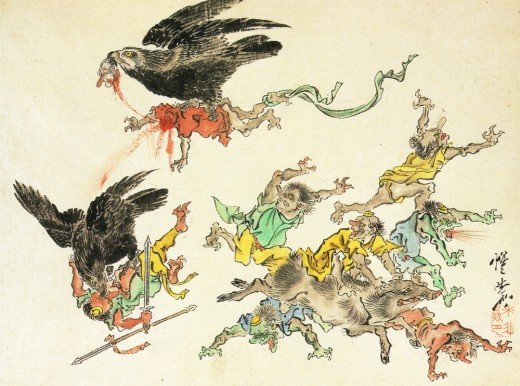
Sketches of Hell — Kawanabe Kyosai’s Dark, Funny, Lurid Paintings of the Underworld

Check out this great collection of Kawanabe Kyosai paintings of hell from the 1870s. (Metaphorical hat tip to @oliverho).