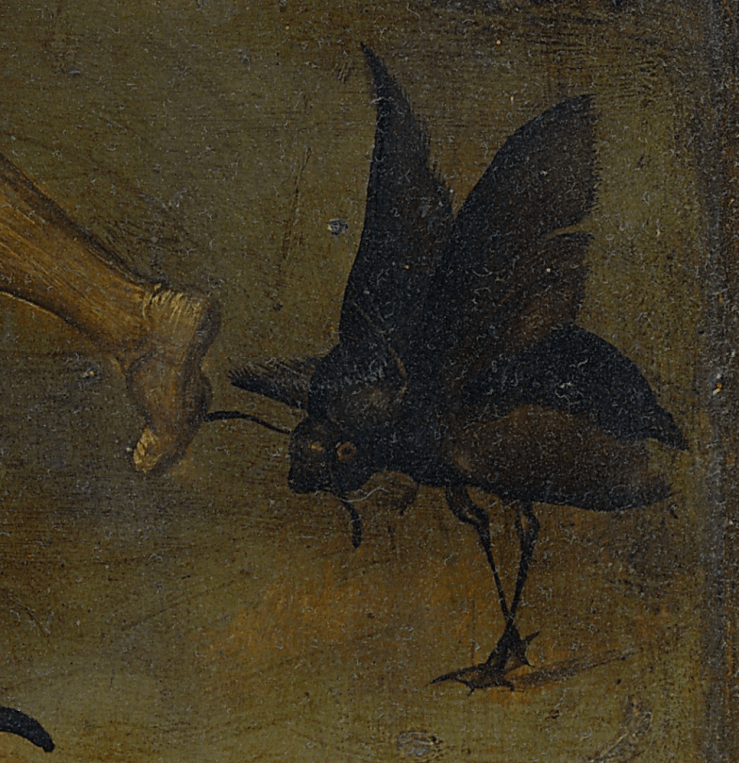
Casanova — Julio Larraz

casanova

Casanova, 1987 by Julio Larraz (b. 1944)

Secret Feast — Leonor Fini

fini

Secret Feast, 1964 by Leonor Fini (1908-1996)

A recipe for Charles Dickens’s hare soup

Skin a hare and put it on to roast. Whilst it is cooking, fry in the best English butter two carrots, a head of celery, two onions, two ounces of raw ham, two bay leaves, two cloves, a blade of mace, four shallots, a little thyme and parsley. Fry all these to a brown color in a stew pan.

When the hare has been roasting for an hour, remove the back fillets and pound the remainder in a mortar and add it to the vegetables. Add to this mixture a half pound of brown thickening which has been made with a pound of butter and sifted flour, and cook over a slow fire. The mixture should be moistened with two quarts of good stock and stirred over a fire until it boils. A glass of wine should be added and a small pinch of cayenne.

The recipe comes from the unsigned article “London Chef Explains Dickens’s Hare Soup,” published in The New York Times, 26 Dec. 1926.

According to the article, a “well-known London chef” shared the recipe as “a kind of Christmas card” with his patrons in 1926. Apparently Dickens enjoyed eating this hare soup regularly “a Strand restaurant” in the 1850s.


Mother Lish’s Bologna Sandwich, a recipe from Gordon Lish

  1. First check the refrigerator to make certain none of the following are in there: lettuce, butter, margarine, mustard, ketchup or mayo.
  2. Remove the jar of mint jelly from the cupboard. (Marmalade is an acceptable substitution.)
  3. Your bread should be of the diet variety, well-aged and adequately chilled. If the counter is wet, place two slices of bread on it. Press down with the heel of your hand to make sure they lie flat. (If you experience some difficulty in separating two slices of bread from the rest of the loaf, rap the loaf smartly on the edge of the counter.)
  4. Never use presliced bologna. Your bologna should be of the sausage type, with good stout rind on it. Working with a dull knife, hack off what you need. What you’re aiming for here are pieces of bologna that display a certain ragged configuration.
  5. Spread mint jelly on one slice of your dampened bread. On the other slice, distribute chunks of bologna. Lift jellied slice up, jellied side up and lower it over the other slice. (If jellied slice sticks to the counter, use screwdriver to pry it off.)
  6. Still working with the same knife, halve the finished product, cutting from one corner to the other. (Bread should come apart into a number of small pieces all by itself. But if this does not occur, start over again.) Serve immediately. (If this is not possible, store in freezer for later use.) keeps indefinitely if wrapped in a brown paper bag with a rubber band around it.)

From “The Day Mother Invented Junk Food” by Gordon Lish. The full piece was published in The New York Times, 2 Aug. 1978. Thanks to David Winters for sharing it with me years ago.

Snare — Paula Rego

730_01-paula-rego_snare

Snare, 1987 by Paula Rego (1935)

(More at Apollo; thanks to Ellen for sending me the link).

The First Thanksgiving — Warrington Colescott

w1siziisijixndkzmijdlfsiccisimnvbnzlcnqilcitcmvzaxplidiwmdb4mjawmfx1mdazzsjdxq

The First Thanksgiving, 1973 by Warrington Colescott (1921 – 2018)

Screenshot 2018-11-19 at 3.38.36 PMScreenshot 2018-11-19 at 3.38.55 PMScreenshot 2018-11-19 at 3.39.56 PMScreenshot 2018-11-19 at 3.38.08 PM

A grave and dark-clad company!” quoth Goodman Brown.

In truth, they were such. Among them, quivering to-and-fro, between gloom and splendor, appeared faces that would be seen, next day, at the council-board of the province, and others which, Sabbath after Sabbath, looked devoutly heavenward, and benignantly over the crowded pews, from the holiest pulpits in the land. Some affirm, that the lady of the governor was there. At least, there were high dames well known to her, and wives of honored husbands, and widows, a great multitude, and ancient maidens, all of excellent repute, and fair young girls, who trembled lest their mothers should espy them. Either the sudden gleams of light, flashing over the obscure field, bedazzled Goodman Brown, or he recognized a score of the church-members of Salem village, famous for their especial sanctity. Good old Deacon Gookin had arrived, and waited at the skirts of that venerable saint, his reverend pastor. But, irreverently consorting with these grave, reputable, and pious people, these elders of the church, these chaste dames and dewy virgins, there were men of dissolute lives and women of spotted fame, wretches given over to all mean and filthy vice, and suspected even of horrid crimes. It was strange to see, that the good shrank not from the wicked, nor were the sinners abashed by the saints. Scattered, also, among their pale-faced enemies, were the Indian priests, or powows, who had often scared their native forest with more hideous incantations than any known to English witchcraft.

–From “Young Goodman Brown,” Nathaniel Hawthorne (1835)

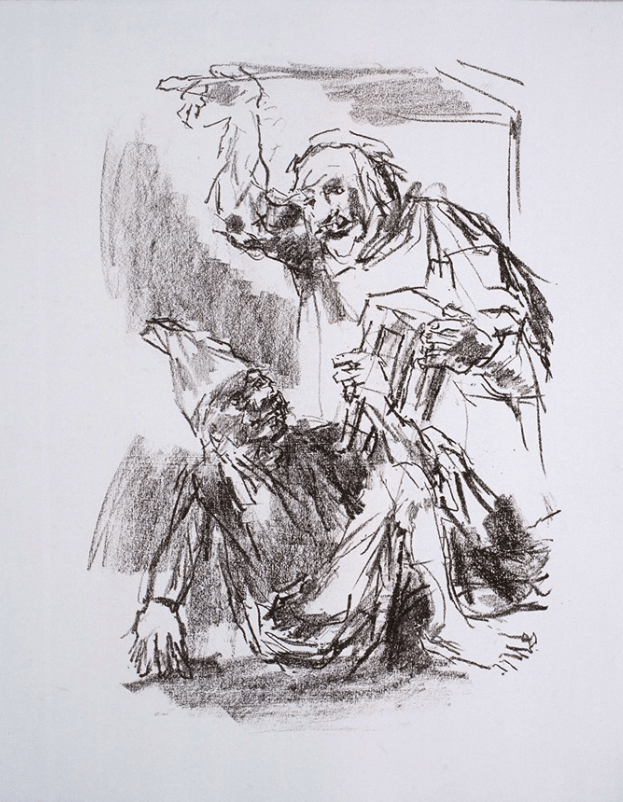
Lear and Fool — Oskar Kokoschka

lear

Lear and Fool, 1963 by Oskar Kokoschka (1886-1980)

Seek it like a dream | Another blog about Gaddis’s The Recognitions

Screenshot 2018-11-18 at 2.44.13 PM

Earlier this week, continuing my audit of William Gaddis’s 1955 novel The Recogntions, I felt a tingling sense of recognition in the following lines from which Basil Valentine reads from “a copy of Thoreau” (this is at the very end of Part I, on page 265):

What you seek in vain for, half your life, one day you come full upon, all the family at dinner. You seek it like a dream, and as soon as you find it you become its prey.

I attributed this tingling recognition to having read The Recognitions before (and to having read Part I once before that)—but then I realized that I’d read the line far, far more recently: It’s the epigraph to Gaddis’s fourth novel A Frolic of His Own, which I’d opened up again just a few weeks ago (and subsequently put back down).

This recognition is nothing special and certainly uninteresting to longtime Gaddis fans, but it motivated me enough to look more into the remark, so I plugged it into Google and quickly found  J. M. Tyree’s essay “Henry Thoreau, William Gaddis, and the Buried History of an Epigraph.” Tyree’s essay was originally published in New England Review but I found it, natch, on Steven Moore’s The Gaddis Annotations.

Tyree’s essay is a fascinating read, tracking the strange history of the line. Thoreau’s words, it turns out, are not exactly Thoreau’s words—rather, they are Emerson’s recollections of a conversation between the pair from a walk in the woods. Additionally, Emerson wrote and attributed these words after Thoreau’s death. The remark initially appeared in Emerson’s literary eulogy “Thoreau,” published in the August 1862 edition of Atlantic Monthly. As Tyree observes,

This detail, which seems highly trivial at first, in fact slyly reinforces the theme of original and copy supersaturating Gaddis’s novel. The very nature of authorship falls into question here, in a manner similar to the problem of Socrates and Plato: is Thoreau’s saying from Emerson or from Thoreau, or is it from both?

While issues of originality and authenticity of authorship clearly correlate to the themes of The Recognitions, Tyree’s essay is most interesting to me in the ways by which it situates Gaddis’s work with/against the American Renaissance tradition. Tyree gives us some of the flavor of that tradition, recontextualizing Gaddis’s epigraph in a full paragraph of Emerson’s. Here’s Emerson eulogizing his friend Thoreau:

It was a pleasure and a privilege to walk with him. He knew the country like a fox or a bird, and passed through it as freely by paths of his own. He knew every track in the snow or on the ground, and what creature had taken this path before him. One must submit abjectly to such a guide, and the reward was great . . . Presently he heard a note which he called that of the night-warbler, a bird he had never identified, had been in search of twelve years, which always, when he saw it, was in the act of diving down into a tree or bush, and which it was vain to seek; the only bird that sings indifferently by night and by day. I told him he must beware of finding and booking it, lest life should have nothing more to show him. He said, “What you seek in vain for, half your life, one day you come full upon, all the family at dinner. You seek it like a dream, and as soon as you find it you become its prey.”

Tyree situates the passage within the contrasting (and quickly diverging) philosophies of the old friends: “Emerson was essentially cosmic in his Transcendentalism, while Thoreau sought the divine in the actual empirical details of nature.”

Tyree’s essay becomes most interesting to me when he begins to interpret just what the hell the quote means. His analysis hovers around the word family, underlining an obsession of American literature: escape from domesticity. Here’s Tyree’s paraphrase of the Thoreau’s/Emerson’s line:

One finds the object of a long quest, quite suddenly, at the family dinner table. But in the moment of discovery, something seems to go wrong; rather than capturing the truth, one becomes its prey.  Clearly, the conversation here has expanded beyond night-warblers. Thoreau is now speaking of truth and its relationship to the family dinner table.

Tyree then susses out Thoreau’s complicated relationship with Emerson’s family:

It is possible to make too much of the fact that Thoreau’s intellectual life, as both a thinker and a man, developed in Emerson’s shade, in the shelter of Emerson’s house and family. But it is clear that Thoreau was often of two minds about living with or near Emerson. In a September 1841 letter….Thoreau told a friend that he was “living with Mr. Emerson in very dangerous prosperity.”

That “dangerous prosperity” of domestic life echoes one of the grand themes of American literature—namely, civilization is a blockade to be surpassed on the trek into wild nature, individuality, and freedom. Domestic duty interferes with such adventures. Just ask Rip Van Winkle, Ishmael, or Huck Finn. (Or perhaps Hawthorne’s cautionary figure, Young Goodman Brown).

Tyree underlines the point (final emphasis mine):

In the exchange over the night-warbler, the family is again identified in terms of danger; the quest is a danger to the family, or the family is a danger to the quest. One might read this as Thoreau’s critique of what would now be called Emerson’s “lifestyle.” A man who is the prey to truth must leave the dinner table to find it, but Emerson, in the comfort of his household, among his family, will never book the night-warbler. Thoreau does not say that having “all the family at dinner” stops one’s seeking, only that one becomes the prey of a protracted, half-conscious quest at mealtime. Then, one must decide what to do about it—whether to search out the night-warbler or not, and how to do it. The question seems to be whether the truth can be found through the life of the family, or whether one must leave it behind in some sense.

In The Recognitions, Wyatt circumvents the danger to his quest by not only removing himself from family (in the form of his wife Esther), but from removing himself from society in general. In J R (1975), most of Gaddis’s heroes find themselves unable to reconcile to Wyatt’s solution; their seeking fumbled out in half measures, neatly figured in the 96th Street apartment apartment shared by Gibbs, Eigen, and Bast. This hellhole is a transitory space, an inbetweeness of domesticity and city wilderness. Carpenter’s Gothic (1985) offers a more thorough critique of the impulse in American literature to send its (generally masculine) characters out into the wild spaces where they can transcend all the trappings of domesticity that bog them down. Carpenter’s Gothic confines its heroine to one haunted house, the men in her life flitting in and out if like silly birds on foiled quests. That domestic confinement reaches a kind of apotheosis in Gaddis’s posthumous novel Agapē Agape (2002), the stifling uninterrupted monologue of a man in a room, fighting against entropy.

And what about A Frolic of His Own (1994)? Well I haven’t read it yet.
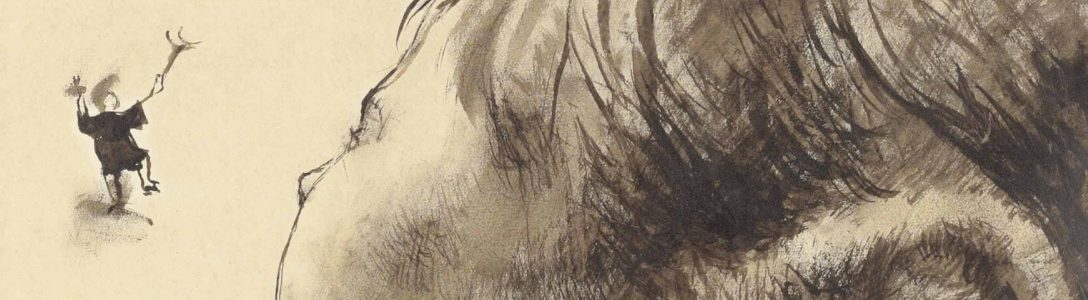
House of Cards — Francine Van Hove

lachc3a2teaudecartes_18x25_2016

House of Cards, 2015 by Francine van Hove (b. 1942)

Nemesis — Agostino Arrivabene

nemesi

Nemesi (Nemesis), 2017 by Agostino Arrivabene (b. 1967)

Barry Hannah reading “All the Old Harkening Faces at the Rail” on his porch swing

Barry Hannah reading “All the Old Harkening Faces at the Rail” (from Airships) and talking about memory and voice at his home in Oxford, Mississippi in February, 1986.

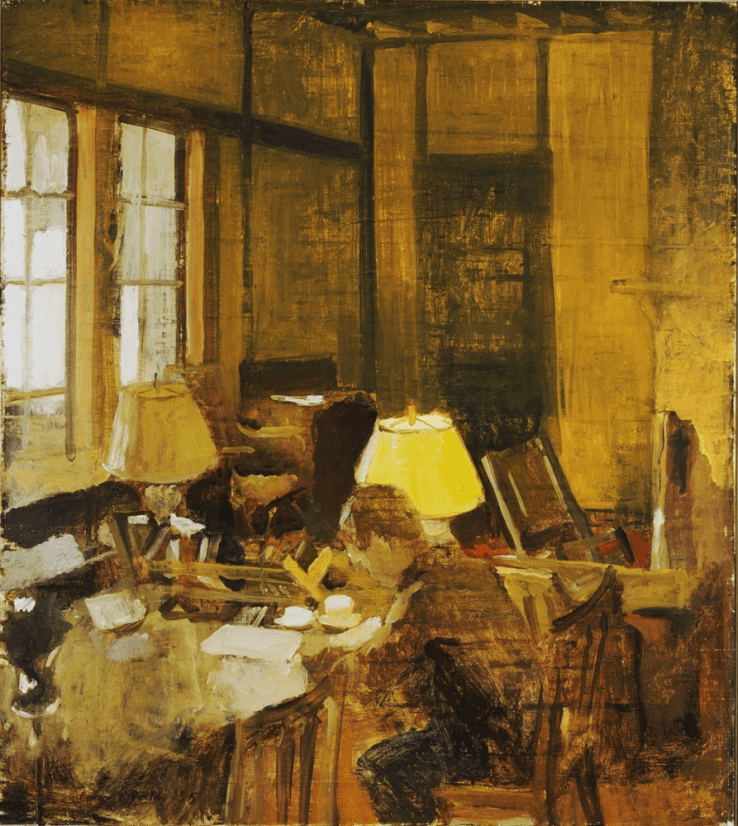
Boy Reading — Fairfield Porter

fp.PNG

Boy Reading, 1955 by Fairfield Porter (1907-1975)

Detail from Saint Michael and the Devil — Raphael

f
Saint Michael and the Devil (detail), c. 1503-04 by Raphael (1483-1520)

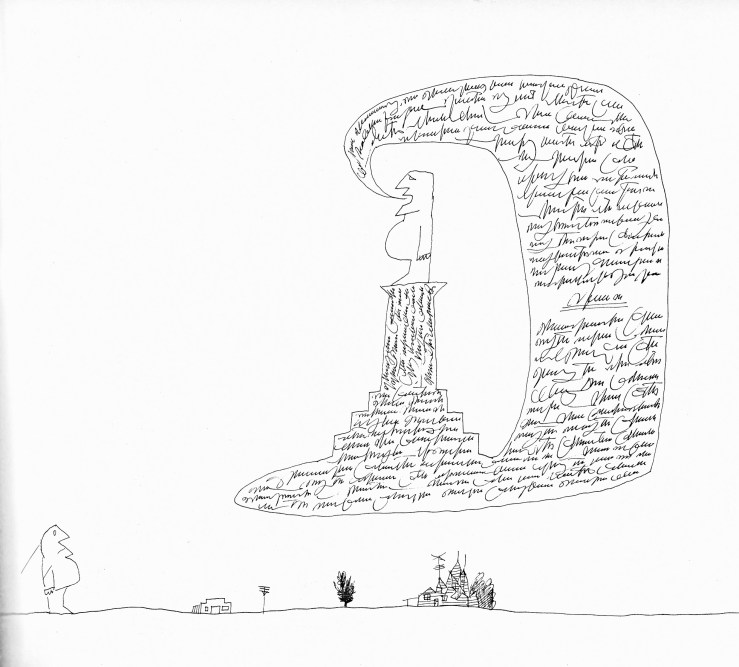
Untitled — Saul Steinberg

ss9

Untitled, c. 1957-60 by Saul Steinberg (1914-1999). From The Labyrinth.

Still-Life with Self-Portrait — Cornelis Norbertus Gysbrechts

still-life-with-self-portrait-1663

Still-Life with Self-Portrait, 1663 by Cornelis Norbertus Gysbrechts (c. 1630 – c. 1675)

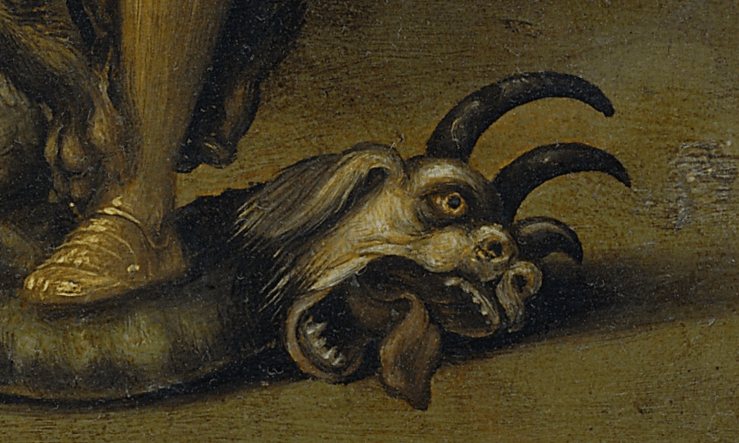
Detail from Saint Michael and the Devil — Raphael

g

Saint Michael and the Devil (detail), c. 1503-04 by Raphael (1483-1520)

Novel factory | A passage from (and a short riff on) William Gaddis’s The Recognitions

In Ch. VII of Part I of William Gaddis’s 1955 novel The Recognitions, the erstwhile hero of the novel, Wyatt Gwyon—who has by this point disappeared into an anonymous he—meets Basil Valentine, a somewhat ambiguous and priestly art-world contact for Recktall Brown, the arch-capitalist Mephistophelean villain of the novel. Brown uses Valentine to arrange the forgeries that Gwyon executes. Here, Valentine and Wyatt discuss Brown, who has left the room. (Brown is the initial He; Valentine speaks first):

—He would absolutely have to have Alexander Pope in a box, to enjoy him. He is beyond anything I’ve ever come upon. Honestly, I never in my life could have imagined that business could live so powerfully independent of every other faculty of the human intelligence. Basil Valentine rested his head back, blowing smoke toward the ceiling, and watching it rise there. —Earlier, you know, he mentioned to me the idea of a novel factory, a sort of assembly line of writers, each one with his own especial little job. Mass production, he said, and tailored to the public taste. But not so absurd, Basil Valentine said sitting forward suddenly.

—Yes, I … I know. I know.

—When I laughed . . . but it’s not so funny in his hands, you know. Just recently he started this business of submitting novels to a public opinion board, a cross-section of readers who give their opinions, and the author makes changes accordingly. Best sellers, of course.

—Yes, good God, imagine if … submitting paintings to them, to a cross section? You’d better take out . . . This color . . . These lines, and . . . He drew his hand down over his face, —You can change a line without even touching it. No, he went on after a pause, and Valentine watched him closely, —nothing is funny in his hands. Everything becomes very . . . real.

Do you like the passage? I do.

I continue to enjoy re-reading Gaddis’s debut novel, aided in large part by an audiobook version read by Nick Sullivan. I’ve also been reading The Recognitions with/against Letters of William Gaddis (ed. Steven Moore, Dalkey Archive, 2013), which I do not recommend doing (especially for first-time readers). Gaddis, paraphrasing his own novel, said that the artist was simply “the dregs of his [own] work,” and much of The Recognitions reads like Gaddis polishing the material from his own early life and travels and readings, and then forcing that material—the nuggets and the morsels (and, let us be honest, the occasional duds)—into an angry demanding sustained attack on the Modern condition. But the material is good ammunition in that oh-so self-conscious attack on Modernism—an attack that in many ways engenders postmodernism, or at least builds a bridge to it, or perhaps sunders links to Modernism—

—look, I have way too many stupid metaphors cooking here, forgive me: What I mean to say, in simpler terms, is that The Recognitions diagnoses the end of big-em Modernism, that it describes something yet-to-emerge, and that it also, significantly, performs that something yet-to-emerge. Gaddis’s letters show the frustrations of a young man trying to cook up adventures in a modern world: a world already explored, mapped, tagged, and written about by other folks. And not just written about im histories and novels, but also in cheap guide books and cheap glossy magazines. This is the world after the age of mechanical reproduction, the world in which Gaddis’s hero Wyatt strives to forge a legitimate forgery of a place for himself.

Gaddis’s novel’s emergent postmodernism—more fully realized in his follow-up, J R—also presciently points to the post-postmodernist storytelling world of late capitalism. Gaddis’s villain Recktall Brown is a brute, but this philistine is perceptive, and he understands the economy of middlebrow aesthetics. As erudite Valentine laments, “I never in my life could have imagined that business could live so powerfully independent of every other faculty of the human intelligence.” Valentine should imagine harder. But this is America, where people frequently mistake wealth and the power to create wealth with creative intelligence.

Maybe I’m too hard here on Valentine, who eventually realizes that an appeal to the lowest common denominator is “not so absurd,” after he reflects on Recktall’s business idea “of a novel factory, a sort of assembly line of writers, each one with his own especial little job. Mass production…tailored to the public taste.” And we then learn that Recktall has already capitalized on his vision of masscult writing: “Just recently he started this business of submitting novels to a public opinion board, a cross-section of readers who give their opinions, and the author makes changes accordingly. Best sellers, of course.”

Reading this, I mentally annotated: Ah, Netflix-that’s the novel factory of 2018. And not just Netflix—I mean, clearly, not just Netflix, that’s simply a signal example—but rather the idea of the data-driven artefact, the non-artefact, the copy of a copy of a copy, the narrative entirely derived from atomizing the masscult nostalgia artefacts of 20, 30, 40 years ago, retrofitting them, repackaging them, and selling them as the real thing. Wyatt’s final observation in the passage laments that Recktall Brown, and the emerging late capitalism he represents, is winning a kind of war on culture and imagination. And nothing is funny in this devil’s busy hands: “Everything becomes very . . . real.” Even the fakes. Even the copies. Especially the copies.