John Brunner’s Stand on Zanzibar (Book acquired, 28 Aug. 2020)

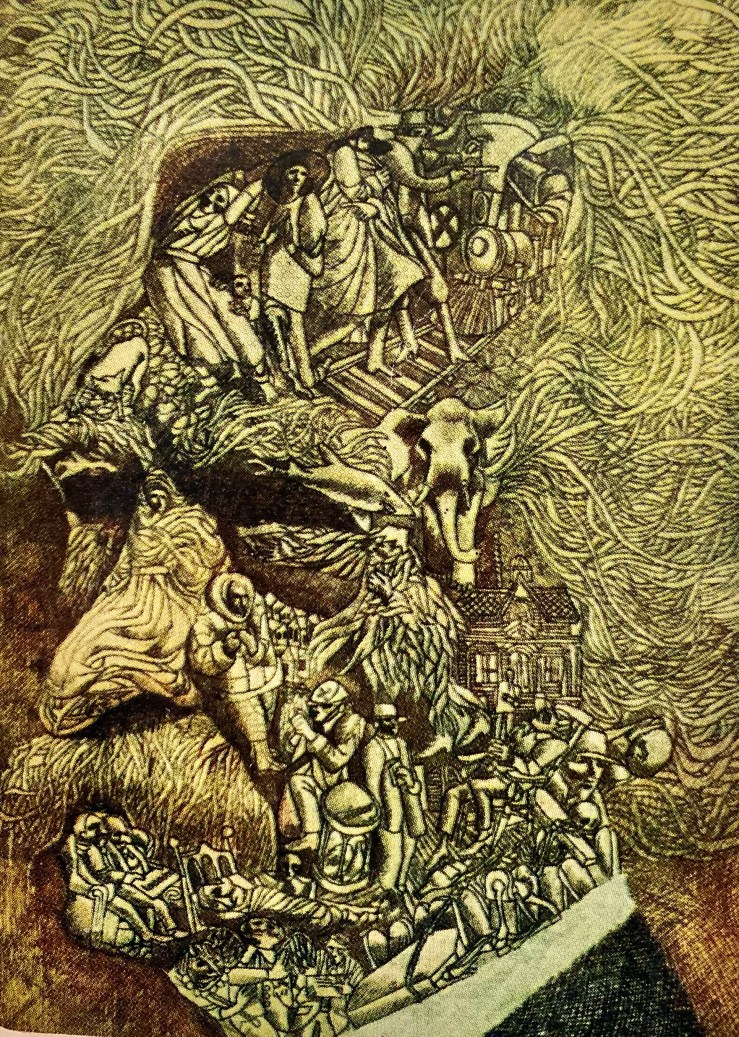
I usually allow myself to peruse my favorite used bookstore every other Friday, poking around for weird finds and etc. I had no luck this week—nothing like a Vintage Contemporaries Barry Hannah—but they did have a copy of John Brunner’s 1968 novel Stand on Zanzibar, which I’d been searching (not-too-hard) for for a few years now. The thing is much longer than I expected (I knew it was long…but it’s long…650 pages). Not sure when I’ll even get to it. It’s supposed to be a cult classic right? Here’s the blurb from my edition:

There are seven billion-plus humans crowding the surface of 21st century Earth. It is an age of intelligent computers, mass-market psychedelic drugs, politics conducted by assassination, scientists who burn incense to appease volcanoes … all the hysteria of a dangerously overcrowded world, portrayed in a dazzlingly inventive style. Employing a dazzling range of literary techniques, John Brunner has created a future world as real as this morning’s newspaper – moving, sensory, impressionistic, as jagged as the times it portrays, this book is a real mind stretcher – and yet beautifully orchestrated to give a vivid picture of the whole.

And here’s an excerpt, via Macmillan’s site:


context (1)

SCANALYZE MY NAME

Stock cue SOUND: “Presenting SCANALYZER, Engrelay Satelserv’s unique thrice-per-day study of the big big scene, the INdepth INdependent INmediate INterface between you and your world!”
Stock cue VISUAL: cliptage, splitscreen, cut in bridge-melder, Mr. & Mrs. Everywhere depthunder (today MAMP, Mid-Atlantic Mining Project), spaceover (today freefly-suiting), transiting (today Simplon Acceleratube), digging (today as every day homimage with autoshout).
Autoshout cue: “It’s happening it’s happening! SCANALYZER SCANALYZER SCANALYZER SCANALYZER SCANALYZER SCANALYZER—”
Stock cue VISUAL: cliptage, wholescreen, planet Earth turning jerk-jerk-jerk and holding meridians for GMT, EST, PCT, Pacific Conflict Zone Time.
Live cue SOUND: “And it’s six poppa-momma for the happening people keeping it straight and steady on that old Greenwich Mean Time—how mean can time get, you tell me, hm? Zee for zero, bee for base, counting down to one after ess ee eks—sorree—ess EYE eks! We know what’s happening happening HAPPENING but that piece of the big big scene is strictly up to you, Mr. and Mrs. Everywhere—or Mr. and Miss, or Miss and Miss, or Mister and Mister, take your pick, hah-hah! Counting down to one after one poppa-momma for that good old Eastern Standard tie-yum, one after ten anti-matter for the Pacific Coast, and for all of you fighting the good fight in lonely midocean one after seven anti-matter—PIPS!”
Clock cue: 5 × 1-sec. countdown pips on G in alt, minute signal on C in alt.
Plug cue: “No time like the present for things to happen in, no better way to keep time straight and steady than by the signal from General Technics’ critonium clock, so accuright it serves to judge the stars.”
Script cue VISUAL: cliptage, splitscreen, excerpts from day’s news.
Live cue SOUND: “And no better way to keep abreast—pardon—than with SCANALYZER!”
Cut autoshout cue. (If they haven’t made it by this time they’ve switched off.)
Plug cue: “SCANALYZER is the one single, the ONLY study of the news in depth that’s processed by General Technics’ famed computer Shalmaneser, who sees all, hears all, knows all save only that which YOU, Mr. and Mrs. Everywhere, wish to keep to yourselves.”
Script cue: the happening world.
the happening world (1)

Continue reading “John Brunner’s Stand on Zanzibar (Book acquired, 28 Aug. 2020)”

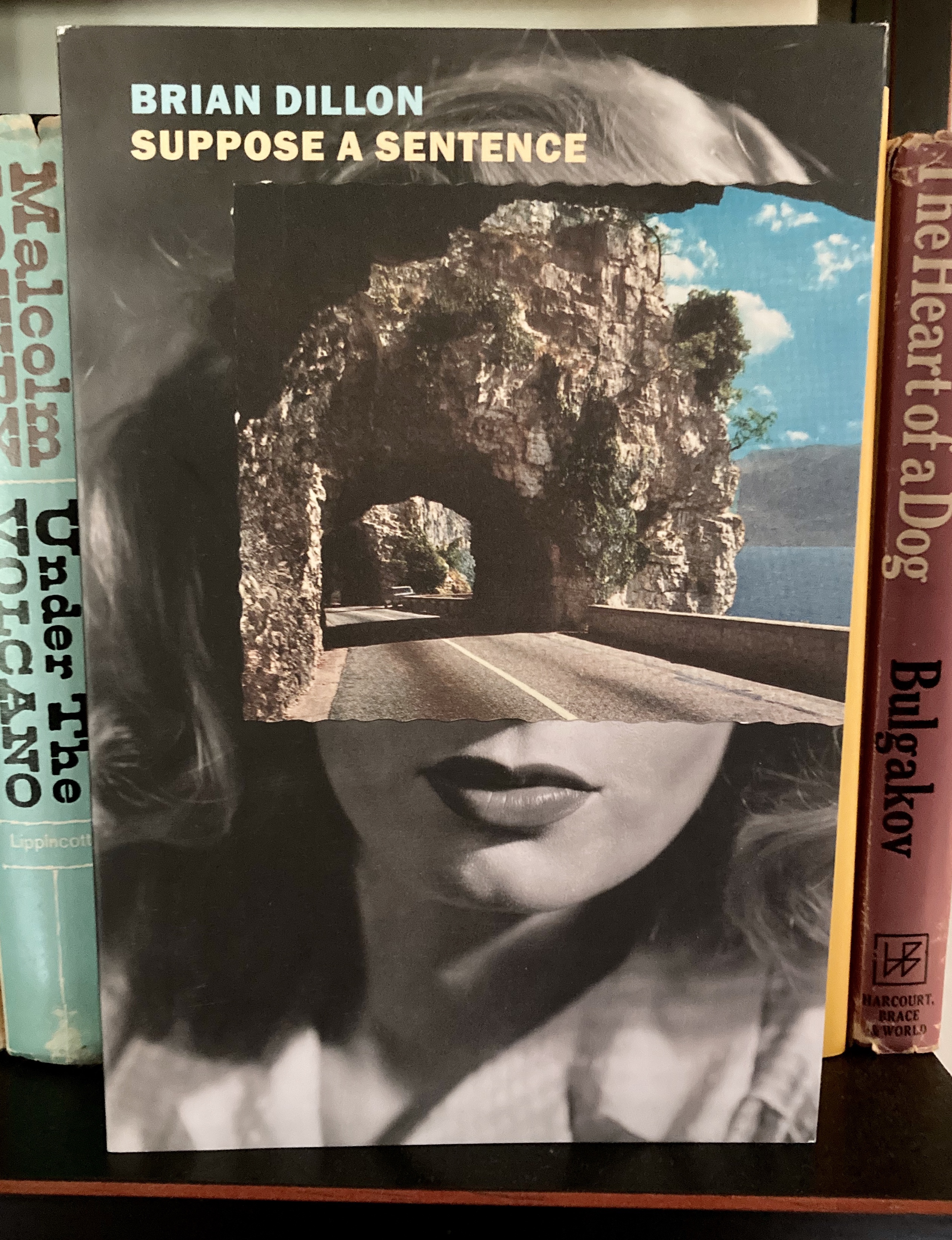
Brian Dillon’s Suppose a Sentence (Book acquired, 14 Aug. 2020)

Brian Dillon’s Suppose a Sentence is a collection of 27 essays that each take a single sentence as their starting point. Organized chronologically by author dates, the collection begins with Shakespeare and Donne and works its way to Anne Carson and Anne Boyer (with Eliot, Stein, Beckett, Bowen et al along the way). When it showed up at Biblioklept World Headquarters last week I was intrigued, and admittedly jumped to the end to read the pieces on Carson and Boyer. In subsequent days I read the pieces on Shakespeare (Dillon takes his sentence “O, o, o, o” from Hamlet, but finds the vowels reputation throughout the playwright’s oeuvre) and Robert Smithson (in the middle of the book). I’ve decided to settle down and read in order at a leisurely pace—a chapter a day?

In the meantime, NYRB’s blurb

In Suppose a Sentence, Brian Dillon, whom John Banville has called “a literary flâneur in the tradition of Baudelaire and Walter Benjamin,” has written a sequel of sorts to Essayism, his roaming love letter to literature. In this new book Dillon turns his attention to the oblique and complex pleasures of the sentence. A series of essays prompted by a single sentence—from Shakespeare to Janet Malcolm, John Ruskin to Joan Didion—the book explores style, voice, and language, along with the subjectivity of reading. Both an exercise in practical criticism and a set of experiments or challenges, Suppose a Sentence is a polemical and personal reflection on the art of the sentence in literature. Whether the sentence in question is a rigorous expression of a state of vulnerability, extremity, even madness, or a carefully calibrated arrangement, Dillon examines not only how it works and why but also, in the course of the book, what the sentence once was, what it is today, and what it might become tomorrow.

Blog about William Melvin Kelley’s satire Dem (book acquired 12 Aug. 2020)

2020-08-13_184241

I managed to snag a cheap used copy of William Melvin Kelley’s fourth novel Dem (or, more properly, dem) yesterday. I usually just snap a pic when I do these book acquired posts, but the cover for this 1969 Collier mass-market, by Leo and Diane Dillon, was simply too good not to scan.

I read not-quite-half of dem today, and the Dillons’ cover captures Kelley’s hypercolor satire of white upper-middle-class America: the infantalized businessman, attended by a black domestic, his bored wife not-quite-off-scene; and hey—look in that mirror.

I’ll admit that the book was hard to break into for the first few moments, until a wild moment around page 20 or so, that I’m still waiting on the novel to deliver upon (or, as it seems at this point, to depart from entirely). Kelley’s style in dem is choppier, sharper, more cartoonish than his Faulknerian debut A Different Drummer and if dem skews towards absurd irony where Drummer was heroic-tragic, both novels are rooted in intense anger tempered by strange empathy.

As its subheading attests, dem is, like Drummer, a take on white people viewing black people, and over a half-century after its publication, many of the tropes Kelley employs here still ring painfully true. His “hero,” Mitchell Pierce is a lazy advertising executive, bored with his wife, a misogynist who occasionally longs to return to the “wars in Asia.” He’s also deeply, profoundly racist; structurally racist; the kind of racist who does not think of his racism as racism. At the same time, Kelley seems to extend little parcels of sympathy to Pierce, even as he reveals the dude to be a piece of shit, as if to say, What else could he end up being in this system but a piece of shit?

The novel I’m most interested in reading by Kelley is his last, 1970’s Dunfords Travels Everywheres, long out of print and hard (read: expensive on the internet) to find. It is, apparently, his most postmodern novel, his most polyglossic, and, if the stuff I’ve read on it is accurate, it represents his most profound satirical break/engagement with reality. Fortunately, it’s getting a reprint this fall. Looking forward to it.

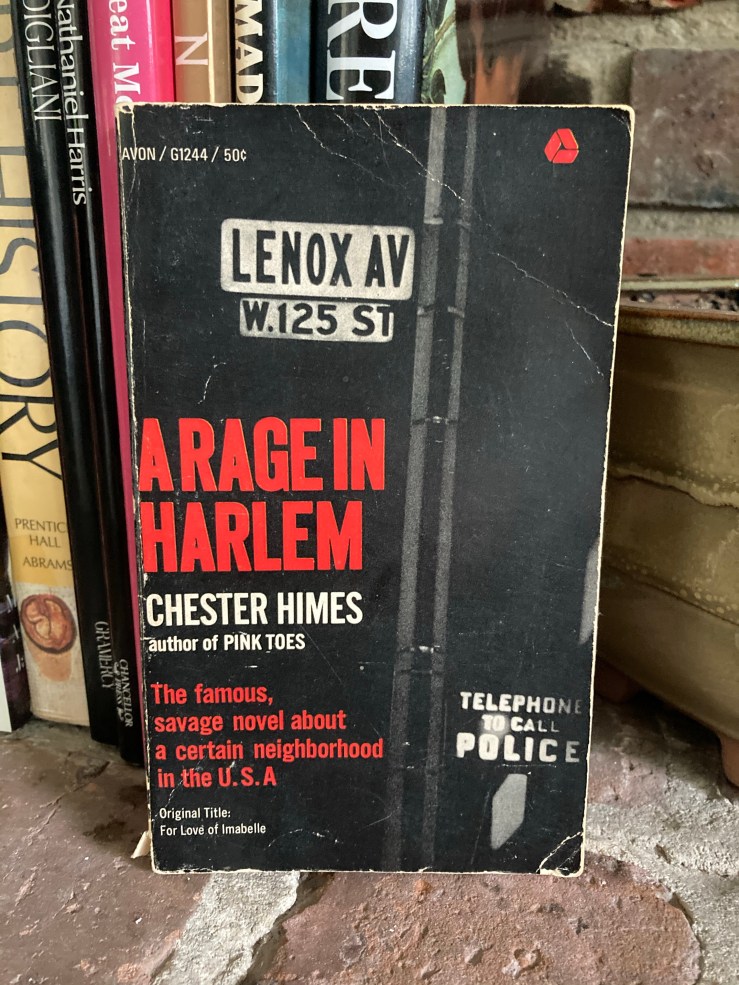
Chester Himes’ A Rage in Harlem (Book acquired, 5 Aug. 2020 and read this past weekend)

img_5907

I’d been meaning to read Chester Himes for a while now (on the recommendation of Ishmael Reed, who cites Himes as a major influence), so I picked up a copy of A Rage in Harlem, the first of his Coffin Ed and Grave Digger detective stories. I was expecting hardboiled crime fiction—and sure, there are elements of it here—but Himes’ 1957 novel was far zanier and more ecstatic than I expected. A Rage in Harlem pops along with wild energy, spinning out into strange directions, donning artful disguises, always on the run. Absolutely loved it. Here’s the blurb:

For love of fine, wily Imabelle, hapless Jackson surrenders his life savings to a con man who knows the secret of turning ten-dollar bills into hundreds—and then he steals from his boss, only to lose the stolen money at a craps table. Luckily for him, he can turn to his savvy twin brother, Goldy, who earns a living—disguised as a Sister of Mercy—by selling tickets to Heaven in Harlem. With Goldy on his side, Jackson is ready for payback.

Three Books (Books acquired, 31 July 2020)

2020-08-02_185600_1

The Dead Father by Donald Barthelme. Mass market paperback from Pocket Books (S&S), 1976. Cover art and design uncredited.

2020-08-02_185600

Unspeakable Practices, Unnatural Acts by Donald Barthelme. Mass market paperback from Bantam, 1969. Cover art and design uncredited.

I found a lovely copy of Donald Barthelme’s story collection Come Back, Dr. Caligari! a few weeks ago, and I’m pretty sure these two guys are twin triplets with that guy. (I found Caligari under “Classic Literature” in my local favorite sweetass bookstore; found these two in “General Fiction.”) No artist credited, which is a shame. I already own a copy of The Dead Father—maybe Barthelme’s best “novel”?—but I couldn’t pass up the mass market edition. I live with myself, but. I’ve read everything in Unspeakable —think — but again, great edition. This is probably the best starting point for Barthelme, with no fewer than five perfect or near-perfect short stories: “The Indian Uprising,” “The Balloon,” “Robert Kennedy Saved from Drowning,” “Game,” and “See the Moon?”

2020-08-02_185600_2

Epitaph of a Small Winner by Machado de Assis. English translation by William L. Grossman. Mass market paperback from Avon-Bard, 1978. Cover art and design uncredited.

I’m a huge fan of these Bard-Avon Latin American editions, and although this cover isn’t one of their weirdest, it’s not bad. I’m not sure if Grossman’s translation is the one to tackle, but I’m up for it.

Sigizmund Krzhizhanovsky’s Unwitting Street (Book acquired, 29 July 2020)

img_5815

Sigizmund Krzhizhanovsky’s Unwitting Street is new in English translation by Joanne Turnbull from NYRB. I loved the first collection of Krzhizhanovsky’s stories that I read, Memories of the Future (also translated by Joanne Turnbull) and wrote about it here, comparing  his weird fables to Kafka, Borges, and Philip K. Dick, among others. (I also really enjoyed the collection Autobiography of a Corpse (another Turnbull translation).

There are eighteen tales in Unwitting Street, most of them rather short. A few of the pieces are fragments or sketches. I read the opener this morning, “Comrade Punt,” which was a bit wacky and unexpectedly whimsical.

Here’s NYRB’s blurb for Unwitting Street, which is out in August:

When Comrade Punt does not wake up one Moscow morning—he has died—his pants dash off to work without him. The ambitious pants soon have their own office and secretary. So begins the first of eighteen superb examples of Sigizmund Krzhizhanovsky’s philosophical and phantasmagorical stories. Where the stories included in two earlier NYRB collections (Memories of the Future and Autobiography of a Corpse) are denser and darker, the creations in Unwitting Street are on the lighter side: an ancient goblet brimful of self-replenishing wine drives its owner into the drink; a hypnotist’s attempt to turn a fly into an elephant backfires; a philosopher’s free-floating thought struggles against being “enlettered” in type and entombed in a book; the soul of a politician turned chess master winds up in one of his pawns; an unsentimental parrot journeys from prewar Austria to Soviet Russia.

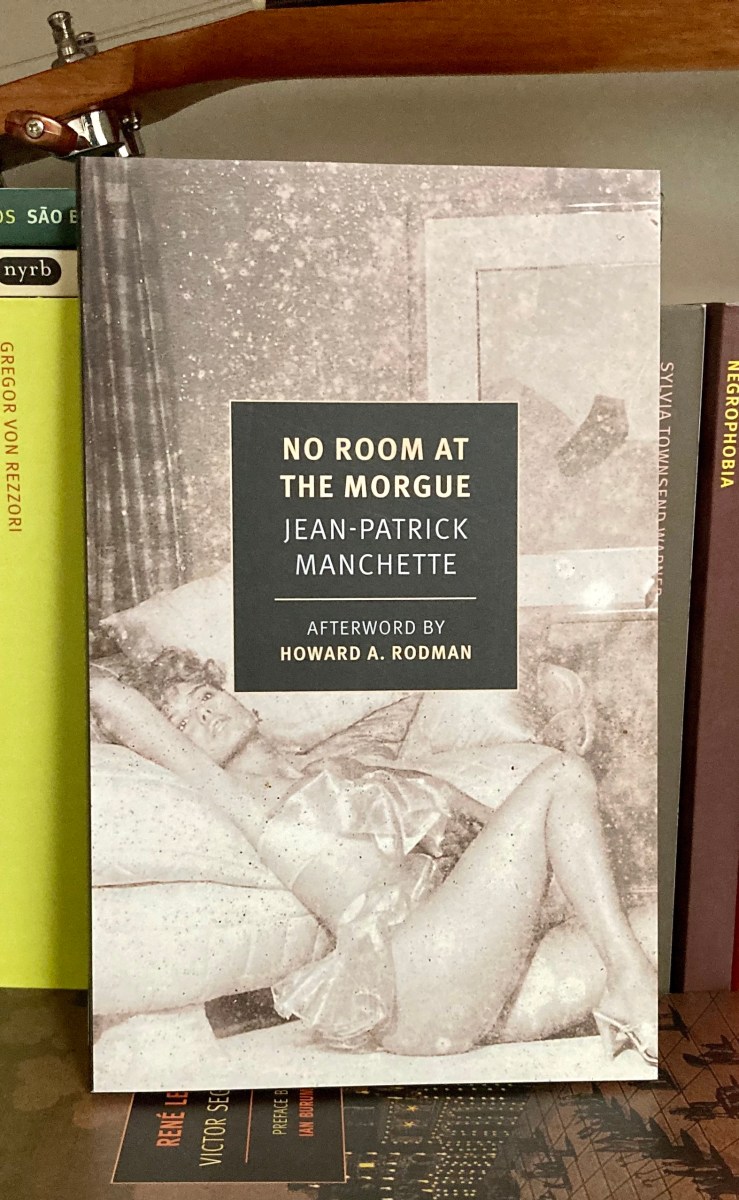
Manchette’s No Room at the Morgue (Book acquired, 22 July 2020)

img_5805

Jean-Patrick Manchette’s detective noir novel No Room at the Morgue (translated by Alyson Waters) is forthcoming in August from NYRB.

Their blurb:

No Room at the Morgue came out after Jean-Patrick Manchette had transformed French crime fiction with such brilliantly plotted, politically charged, unrelentingly violent tales as Nada and The Mad and the Bad. Here, inspired by his love of Dashiell Hammett, Manchette introduces Eugene Tarpon, private eye, a sometime cop who has set up shop after being kicked off the force for accidentally killing a political demonstrator. Months have passed, and Tarpon desultorily tries to keep in shape while drinking all the time. No one has shown up at the door of his office in the midst of the market district of Les Halles. Then the bell rings and a beautiful woman bursts in, her hands dripping blood. It’s Memphis Charles, her roommate’s throat has been cut, and Memphis can’t go to the police because they’ll only suspect her. Can Tarpon help?

Well, somehow he can’t help trying. Soon bodies mount, and the craziness only grows.

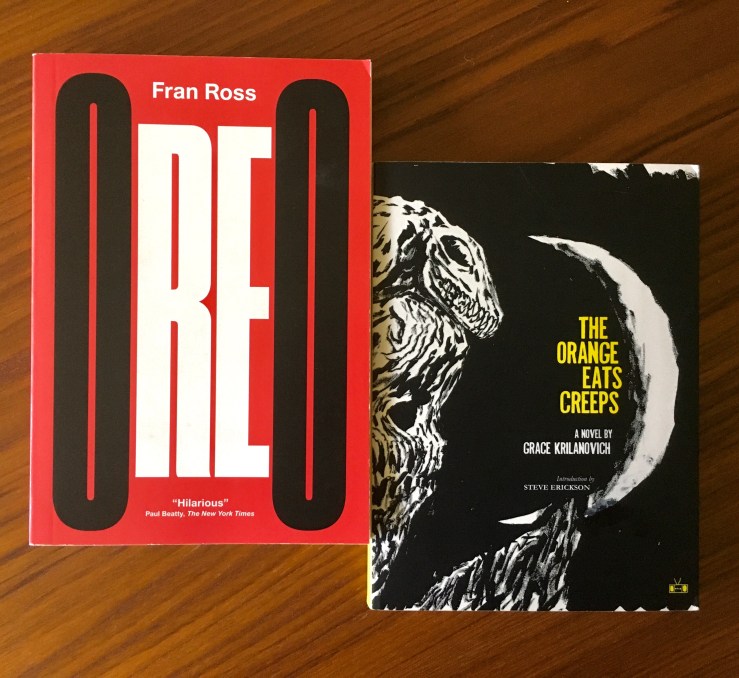
Oreo/Orange (Books acquired, 13 July 2020)

img_5778

I’m like 50 pages from the end of Fran Ross’s 1974  Oreo and I simply don’t understand how this novel is so erased or ignored in most discussions of postmodern classics. (It could be ignorance—mine for sure—or erasure, or sure, structural racism in publishing and literary criticism—I mean, I feel like every list that compels someone to read Thomas Pynchon and Kathy Acker and John Barth and Stanley Elkin and Ishmael Reed and Robert Coover should include Fran Ross, Fran Ross’s novel Oreo, Fran Ross’s only novel Oreo, why is there only one novel by Fran Ross, Oreo? What I’m trying to say is: Why didn’t I read this until now? Although reading it now has felt like a gift of some kind.)

This thing—Oreo, that is—zapped me on like page three or four with this ditty–

Ec1_7BJXkAUYc1q

I mean, c’mon!

I owe Oreo a proper write-up, if I can ever muster such a thing again, which maybe I can’t.

I also picked up, almost entirely at random, Grace Krilanovich’s novel The Orange Eats Creeeps. The spine and title struck me, I saw it was a Two Dollar Radio publication, and when I fished it from the shelf, I read Steve Erickson’s blurb and just went with it. Here’s Two Dollar’s blurb:

A girl with drug-induced ESP and an eerie connection to Patty Reed (a young member of the Donner Party who credited her survival to her relationship with a hidden wooden doll), searches for her disappeared foster sister along “The Highway That Eats People,” stalked by a conflation of Twin Peaks’ “Bob” and the Green River Killer, known as Dactyl.

I also found a Donald Barthelme collection with an Edward Gorey cover:

2020-07-16_161411

Under the Sign of the Labyrinth (Book acquired, 7 July 2020)

img_5756

Christina Tudor-Sideri’s Under the Sign of the Labyrinth adds to Sublunary Editions‘ growing catalog of odd and engaging short volumes.

Their blurb:

There is no need to place your hand on a wound to feel it throbbing in pain. There is no need to see its root to know that a tree is dying. I am renouncing history. A film frame has lost its meaning. Vain and cruel, I have become a self that contains all negations to come, I have escaped the universe of time and space—page after page, touch after touch, train after train. I have become the idea of a sea beast moving in the deep. I have become the labyrinth. I am entombed in poetry. In the first stanza, in the last, in the blueness of thirsting ink—in the bruising of eternity. I have become alone. I am alone.”

Books acquired, 1 July 2020

img_5747

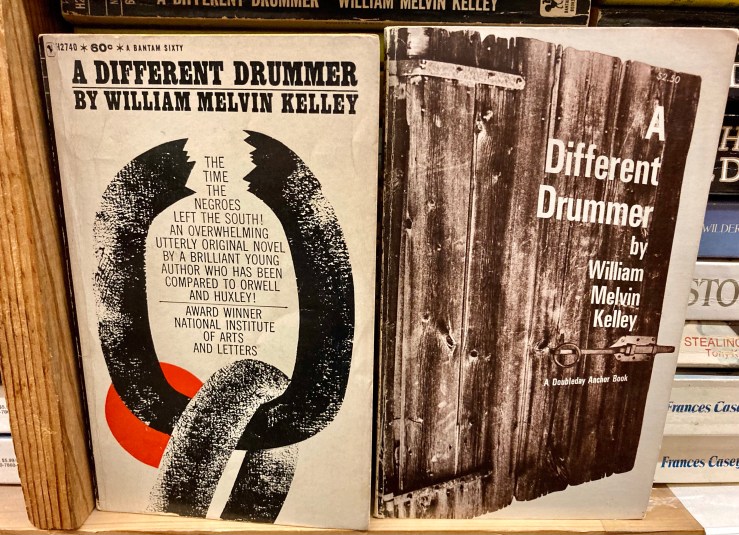
Scored a copy of William Melvin Kelley’s first novel A Different Drummer the other week, along with a copy of Steve Erickson’s novel Rubicon Beach. I was looking for the Kelley; I was looking for a print edition of Erickson’s more recent novel Zeroville (which I loved in audiobook), but there wasn’t one. Still, I can’t resist a Vintage Contemporaries edition. I’d been looking for a copy of Clarence Major’s My Amputations for a while now with no luck; I eventually broke down and bought one on Abebooks for five bucks. It turned out to be an old library copy with no dust jacket. No one ever checked it out. Check it out.

Delany/Spark/Etc. (Books acquired, 24-27 June 2020)

img_5713

Purged some shelves and brought a box of old books to my favorite spot earlier this week. I was looking for books by William Melvin Kelley and Clarence Major but no luck. I picked up yet another Muriel Spark title (I am still hungry for this flavor), and also picked up Samuel Delany’s Nova. I failed Delany’s cult novel Dhalgren, but maybe this earlier novel will work for me. Or I will work for it. Or…you know. Also: Got a bunch of art books today from a neighbor leaving the country. Good for her. (That’s my boy Coyote in the upper left.)

Rédoine Faïd’s Outlaw, a crime memoir-in-interviews (Book acquired, 27 April 2020)

img_5690

I finally made some time this afternoon to dip into Rédoine Faïd’s memoir-in-interviews, Outlaw: Armed and Dangerous. It’s a propulsive, fast read so far–I put away the first 60 pages in one reading. Faïd, fresh out of prison, tells his life story to journalist Jérôme Pierrat. The book is newly-translated by John Galbraith Simmons and J.G. Barque, and available from Contra Mundum Press. Their blurb:

Memoirs of celebrated criminals purvey vivid personal stories while spawning sharp questions about the cultures that produced them. In Outlaw: Author Armed & Dangerous, Rédoine Faïd, of Algerian immigrant parents, born and raised in the housing projects surrounding Paris, recounts his career as an infamous and renowned bandit. Drawing inspiration and instruction from a host of films and television series, Faïd styled himself and was known to friends and accomplices as “Doc” — after Steve McQueen in the legendary suspense thriller, The Getaway.

With self-discipline and a striking ability to learn from experience, Faïd carried off his first robberies while still a teenager. He soon graduated from petty thievery to armed robbery, targeting computer component suppliers, jewelry stores, banks, and most memorably, armored trucks. A master of disguise, with bulletproof vest and a .357 Magnum as a prop to encourage compliance, he led a crew that operated with careful planning but eschewed bloodshed and physical violence.

In imitation of Michael Mann’s Heat, Faïd and his cohorts donned hockey masks for one job, sometimes even quoting from other famous heist films during their capers. When bold plans went wrong, he reacted with fast thinking that served him well — until it didn’t, and he was arrested and imprisoned in 1998.

Outlaw was first published in France in 2009, after which Faïd was imprisoned again. Subsequently, his dramatic escapes from jail, in 2013 and 2018, made front-page news in France and around the world.

Interviewed by journalist Jérôme Pierrat, who specializes in crime and investigative reportage, Rédoine Faïd tells his own story with panache and humor, darkened by introspection and cautionary tales. His story, like that of a character out of a Jean-Pierre Melville film or Dassin’s Rififi, is not only intriguing, it is also as compelling as any high-grade thriller. Three months after his daring helicopter escape from Réau Prison in 2018, Faïd was captured again. He currently remains in jail.

Books acquired, 8 June 2020 and 13 June 2020

img_5670

My birthday was last Sunday. My favorite bookstore is closed on Sundays, so as a treat to myself I browsed it Monday afternoon. I was looking for specific titles by Nalo Hopkinson and Kit Reed (no luck), as well as another Muriel Spark. I picked up Spark’s third novel, Momento Mori and read it this week. It’s a good book, but nowhere near the sharp excellence of Loitering with Intent. I also found a first edition paperback of William H. Gass’s first novel, Omensetter’s Luck. I should’ve left it for some kid to find—I have a Meridian first edition of Omensetter’s already—but I couldn’t. I hate the collector in me.

img_5658

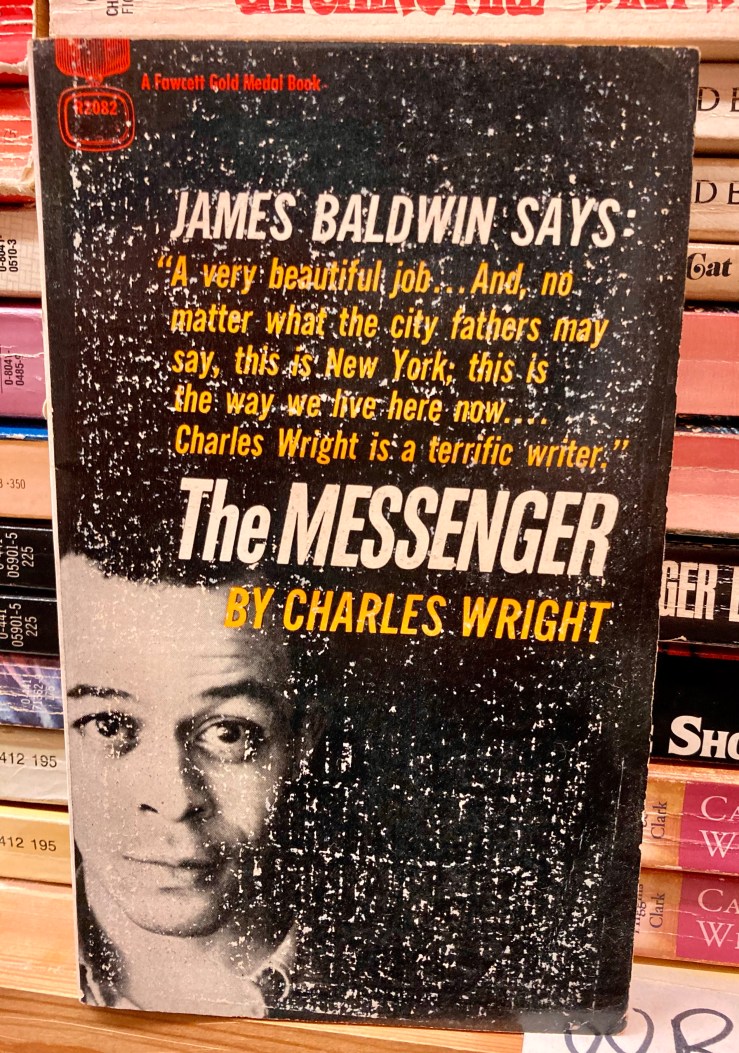
I also picked up Charles Wright’s novel The Messenger, despite already having an omnibus that collects all three of Wright’s novels. Couldn’t help it; the mass-market cover was too good (although James Baldwin’s name doesn’t have to be quite that big, does it?).

Early in the week I got an email containing my daughter’s summer reading directions–Paul Coelho’s The Alchemist and Howard Zinn’s A Young People’s History of the United States. I treated myself to another Muriel Spark–an especially short one, about a nunnery—The Abbess of Crewe. 

img_5668

Curzio Malaparte’s Diary of a Foreigner in Paris (Book acquired 27 April 2020)

Curzio Malaparte’s Diary of a Foreigner in Paris is new from NYRB in translation from Stephen Tilley. NYRB’s blurb:

In 1947 Curzio Malaparte returned to Paris for the first time in fourteen years. In between, he had been condemned by Mussolini to five years in exile and, on release, repeatedly imprisoned. In his intervals of freedom, he had been dispatched as a journalist to the Eastern Front, and though many of his reports from the bloodlands of Poland and Ukraine were censored, his experiences there became the basis for his unclassifiable postwar masterpiece and international bestseller, Kaputt. Now, returning to the one country that had always treated him well, the one country he had always loved, he was something of a star, albeit one that shines with a dusky and disturbing light.

The journal he kept while in Paris records a range of meetings with remarkable people—Jean Cocteau and a dourly unwelcoming Albert Camus among them—and is full of Malaparte’s characteristically barbed reflections on the temper of the time. It is a perfect model of ambiguous reserve as well as humorous self-exposure. There is, for example, Malaparte’s curious custom of sitting out at night and barking along with the neighborhood dogs—dogs, after all, were his only friends when in exile. The French find it puzzling, to say the least; when it comes to Switzerland, it is grounds for prosecution!

Books acquired, 26 May 2020

I dropped by the bookstore yesterday to pick up some more books by Muriel Spark. I finished her novel The Prime of Miss Jean Brodie over the Memorial Day weekend and was hungry for more. I picked out Loitering with Intent and The Girls of Slender Means, mostly because of the covers and titles.

I read about half of The Girls of Slender Means yesterday and this morning, and it’s really good. Set primarily “Long ago in 1945,” Girls focuses on a few months in the lives of some of the titular inhabitants of the “May of Teck Club.” The narrator dips between the consciousness of a few of these “girls of good family but slender means,” but focuses primarily on Jane Wright, a would-be member of the “world of books” whose 1963 phone calls to some of the other “girls” frames the narrative proper. It’s witty stuff, occasionally vicious, and even includes some literary hoaxing! I’ll probably finish it tonight.

I also picked up John Domini’s collection of literary criticism, The Sea-God’s Herb, which I’ve been wanting to pick through for ages now. When I spied the unbroken spine, I assumed it was new, but no–just unread. I opened it up to find the price and saw that not only was the book used (half cover price), it was signed by the author. On top of that, this copy was inscribed to another author, a somewhat-famous sci-fi writer (you might have seen a recent film adaptation of one of his novels). Anyway, it was a strange find.

Melville/Ishiguro (Books acquired, 13 May 2020)

img_5465

My beloved bookstore reopened this Monday. This past Wednesday, I donned my finest mask, got into the car for the first time in a while, and drove the 1.1 miles to my beloved bookstore, which reopened this Monday. I had done curbside pickup on a few books for my kids sometime early in April, but I hadn’t been into a bookstore since the middle of March.

The staff were all wearing masks, as were the few customers in the store (with the exception of two elderly patrons). The store is a sprawling maze of stacks covering close to 25,000 (very irregular, bendy, weird) square feet (it’s not a small space), and the stacks were marked for distancing.

I managed to find all the books on my list—two dystopian teen novels for my not-quite-yet-teen daughter, novels by Roald Dahl and Neil Gaiman for the boy (who’s already finished both), a copy of My Brilliant Friend for my wife, who loved the filmic teevee adaptation (I gave my copy to my department head years ago, thinking she’d love it, but she never mentioned anything about it to me, and I don’t press), and two books for me: Kazuo Ishiguro’s 1995 novel The Unconsoled, which I’ve been meaning to read for ages, and Herman Melville’s fourth novel Redburn (which I’ve been meaning to read for awhile after reading Elizabeth Hardwick’s literary biography of Melville a few weeks ago). Edward Gorey did the Redburn cover, by the way.

Despite already being into four other novels, I started in on The Unconsoled. The novel reads like a hallucinatory series of side quests in the strangest first-person video game ever made–a novel of absurdity and art and time and memory, wherein the first-person narrator Ryder, on a mission he can never quite name or even possibly remember, constructs and deconstructs his (always-deferred) present “reality” on a moment-to-moment basis. The book is weird in the best way—it reminds me a lot of Alasdair Gray’s Lanark, Anna Kavan’s Ice, João Gilberto Noll’s Quiet Creature on the Corner, and pretty much everything by Kafka. I imagine it will frustrate many readers with its refusal to cohere or to settle on a plot, but I’m digging it big time.

Guillermo Stitch’s Lake of Urine (Book acquired, 27 April 2020)

img_5466

I just finished the first section of Guillermo Stitch’s new novel Lake of Urine (from indie Sagging Meniscus). The beginning of the novel has made me want to read the rest of the novel. It is weird, man, which I guess you’d expect from a novel titled Lake of Urine. So far, the book seems to run on its own comic-logic, a verbal slapstick routine that shifts in voice and tone from  paragraph to paragraph. The sentences are fantastic; Stitch’s prose so far reminds me of Barry Hannah and Donald Barthelme, but also definitely its own thing. Here’s a blurb, via the author’s site:

 Once upon a time that doesn’t make a blind bit of sense, in a place that seems awfully familiar but definitely doesn’t exist, Willem Seiler’s obsession with measuring his world—with wrapping it up in his beloved string to keep the madness out—wreaks havoc on the Wakeling family.

Noranbole Wakeling lives in the scrub and toil of the pantry, in the ashes of the cold hearth…which, come to think of it, also sounds pretty familiar…She lives, too, in the shadow of her much wooed and cosseted sister, worshipped by the madman Seiler but overlooked by everyone else.

And that, it turns out, is a good thing.

As lives are lost to Seiler’s vanity, the inattention spares her. She spots her chance to break free of the fetters that tie her to Tiny Village—and bolts.

But some cords are never really cut. In her absence, the unravelling of the world she has escaped is complete. Another madness—her mother’s—reaches out to entangle her newfound Big City freedom. The unpicked quilt-work of a life in ruins threatens to ruin her own. It will be up to Noranbole to stitch it all together, into something she can call true.

The blurb doesn’t really capture the energy and humor in Lake of Urine though (let alone its utter weirdness. Here’s an excerpt; the conversation is between Emma Wakeling (mother of Urine and Noranbole) and her tenant, William Seiler:

The melts are not long off.

. . .

Yes?

Yes.

The days grow lengthier and more detailed.

I’m not, eh . . .

You have been here for nine weeks.

Yes.

You may recall the conversation we had in November, Mr Seiler, which resulted in your entering my employ.

A bit formal.

Just answer.

I do remember, yes.

Your brief which I outlined at the time was to be of assistance to me during the winter in the monitoring of my two girls, both of whom were of marriageable age and one of whom was attractive—a siren to the lads of the county.

Yes.

I haven’t asked much else of you.

No.

Apart from the sharpening of some tools. Indeed your . . . remunerations have exceeded what we originally agreed in both nature and degree. Despite your squirreling yourself away in that shed, increasingly. I am only trying to help, you know.

Yes.

A man’s fluids require frequent liberation or they will stew.

Some of the tools are really very blunt.

I have asked for this little chat Mr Seiler because I wish to express my disappointment.

Oh?

Oh? I surprise you? Really? You are surprised? For reals? You didn’t anticipate disappointment here, today?

Well . . .

You need reminding perhaps of yesterday’s unfortunate events? The toesnappingly cold trek through wolf-infested forest? The yelling and the wailing? The gnashing? The wet clouds of breath in the grief-stricken air, the frozen-teared faces of the bereaved? A quick recap?

No, I do remember.

Excellent. You would acknowledge then that as we approach the end of your tenure here one of my girls appears to be—and I recognize that there is some evidential uncertainty here—dead?

That would appear to be the case, yes, notwithstanding the as you say murky specifics.

I am to be grateful I suppose, to be appreciative of the fact that at least it isn’t my Urine who has been lost.

Eh . . .

You give no indication, Mr Seiler, that you recognize the seriousness of the . . . the precariousness of your . . . hm?

Oh, no . . . no, no I can . . . what?

Be under no illusions, Seiler. One more dead daughter and you’re fired.

That does seem fair.

Now lie still. Stop squirming!