John Barth’s Giles Goat-Boy (Book acquired, 30 Nov. 2019)

img_4536

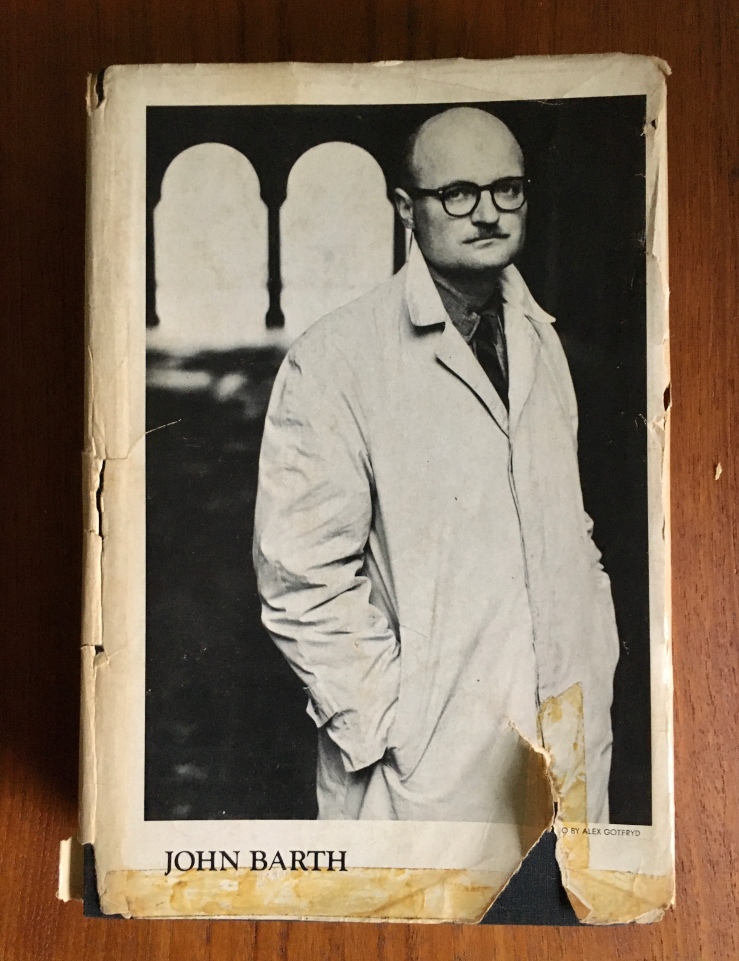
I couldn’t pass up on this used first edition of John Barth’s 1966 novel Giles Goat-Boy when I visited Haslam’s Book Store in downtown St. Petersburg over the Thanksgiving break. Here’s the back cover:

img_4537

From Eliot Fremont-Smith’s 1966 review of Giles Goat-Boy in The New York Times:

There follows the novel proper, which tells how George Giles was born (possibly a computer accident) into a goat herd, made his way into New Tammany College (the world of men), became Grand Tutor and prophet of the West Campus (the Western world as opposed to the Eastern) and, like Don Quixote, Candide, Leopold Bloom, etc., sought the meaning of good and evil, innocence and existence, action and identity, passion and thought.

The message of the syllabus is ambiguous — except perhaps that absolutes are noncognizable, that thinking is a passion and most passionately expressed in humor, and that, except for these, the world is going to hell. Fortunately, it won’t get there because — Mr. Barth proves once more — old jokes never die, they just lie in wait for resurrection. The jokes here — sexual, scatological, gastronomical, existential, political, linguistic, literary conventions and parodies — can be traced to Rabelais, “Tristram Shandy,” Lewis Carroll, Joyce, Nabokov, the Beatles and Bennett Cerf, among others, which should given an idea of the truly astonishing flavor of this lemon meringue pie of a book.

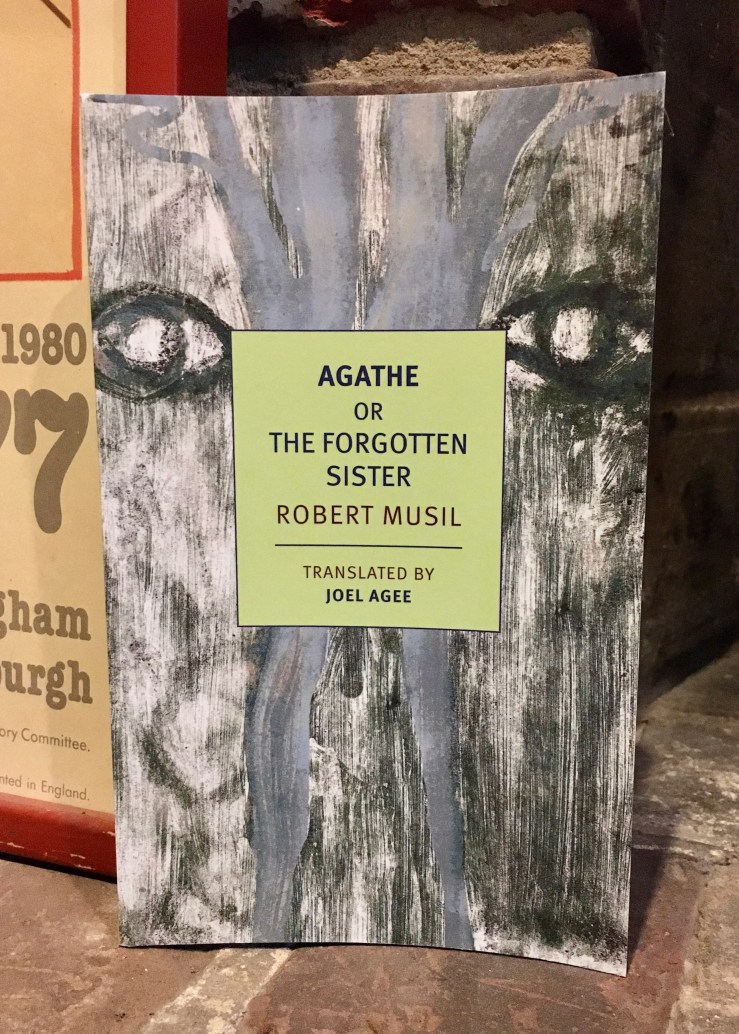
Robert Musil’s Agathe, or The Forgotten Sister (Book acquired like probably the last week of November 2019)

img_4474

In his introduction to Robert Musil’s Agathe, or The Forgotten Sister, NYRB editor Edwin Frank writes that,

Essay, in this quintessentially essayistic novel, is the mode for depicting a mind so active that it nearly constitutes a character independent of the man whose mind it is. That man is a thirty-two-year-old Austrian mathematician known to the reader only by his first name, Ulrich, who, disillusioned in his quest for intellectual glory after reading a newspaper about a racehorse of genius, decides to take a year-long ‘vacation from life,’ which he conceives of as an experiment in pure philosophic contemplation — ‘living essayistically,’ he calls it — in the hope of perhaps, by that pathless route, discovering an occupation better suited to his abilities. If he does not find it within a year, he will put an end to his life, because, to his fanatically logical and consequent mind, an unjustified life is not worth living.

I’ll confess I’ve never read Musil, despite two lukewarm milquetoast attempts, but I liked Frank’s introduction. Seems like I need to read The Man without Qualities before this. Here’s the NYRB blurb:

Agathe is the sister of Ulrich, the restless and elusive “man without qualities” at the center of Robert Musil’s great, unfinished novel of the same name. For years Agathe and Ulrich have ignored each other, but when brother and sister find themselves reunited over the bier of their dead father, they are electrified. Each is the other’s spitting image, and Agathe, who has just separated from her husband, is even more defiant and inquiring than Ulrich. Beginning with a series of increasingly intense “holy conversations,” the two gradually enlarge the boundaries of sexuality, sensuality, identity, and understanding in pursuit of a new, true form of being that they are seeking to discover.

Robert Musil’s The Man Without Qualities is perhaps the most profoundly exploratory and unsettling masterpiece of twentieth-century fiction. Agathe; or, The Forgotten Sister reveals with new clarity a particular dimension of this multidimensional book—the dimension that meant the most to Musil himself and that inspired some of his most searching writing. The outstanding translator Joel Agee captures the acuity, audacity, and unsettling poetry of a book that is meant to be nothing short of life-changing.

Agathe’s English translation is by Joel Agee.

Machines in the Head: Selected Stories of Anna Kavan (Book acquired, 18 Nov. 2019)

img_4405

I’m really excited about this one. Anna Kavan’s novel Ice is one of the best books I read this year (I blogged about it here and here and here. T Machines in the Head: Selected Short Stories of Anna Kavan is out early next year from NYRB. Their blurb:

Anna Kavan is one of the great originals of twentieth-century fiction, comparable to Leonora Carrington and Jean Rhys, a writer whose stories explored and plumbed the depths of her long addiction to heroin. This anthology of Kavan’s stories draws together a selection of her best writing from across her long career. Stories from across her collections show the range of her style: oblique and elegiac tales of breakdown and asylum incarceration from Asylum Piece (1940), moving evocations of wartime from I Am Lazarus (1945), fantastic and surrealist pieces from A Bright Green Field (1958), and stories of addiction from Julia and the Bazooka. Her late sci-fi stories will appeal to fans of her last novel, Ice. “Five Days to Countdown,” first published in Encounter (1968) and later collected in My Soul in China, is preoccupied with Cold War concerns and the sartorial aesthetics of the 1960s, and, published here for the first time, “Starting a Career” is a futuristic spy thriller, whose protagonist sets out to become the world’s greatest enigma.

Kavan was determined to experiment throughout her writing career, and this collection is moving, funny, bizarre, poignant, often unsettling, but always distinctive and often unique. And even though better known as a writer than an artist, Kavan painted throughout her life.

Three Books

2019-11-24-113310

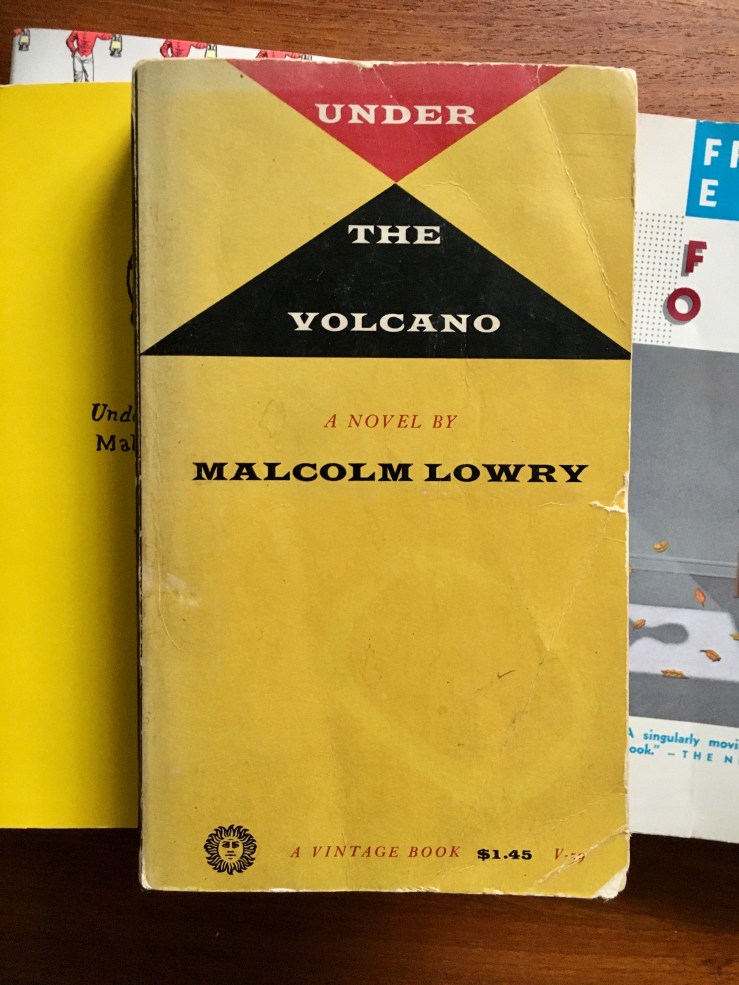
Under the Volcano by Malcolm Lowry. 1965 hardback from Lippincott. Jacket design by David Lunn.

2019-11-24-113310-1

Under the Volcano by Malcolm Lowry. 2014 trade paperback from Harper Perennial Olive Editions. Cover design and illustration by Milan Bozic.

2019-11-24-113310-2

Under the Volcano by Malcolm Lowry. 1962 paperback from Vintage. Cover design by Harry Ford.

I have now bought four copies of Malcolm Lowry’s 1947 novel Under the Volcano. The first copy I bought was a cheap movie tie-in edition with a ghastly cover. I later replaced it with the 1962 edition, and reread it. A few years later I resisted buying a 2007 Harper Perennial paperback edition that featured an afterword by William Vollmann. (You can read Vollmann’s afterword—and the entire book, if a 700 page pdf is your thing—here).

On 8 Nov. 2019, I picked up the 2014 Olive edition.

On 22 Nov. 2019, I picked up the 1965 Lippincott hardback, blowing the rest of my store credit in the process. I couldn’t not buy it. I had to have it.

It also matches a folding hard print of Hokusai’s Red Fuji that a student gave me as a gift when I left Tokyo.

IMG-4400

This clipping of a 1984 not-really review of John Huston’s film adaptation was folded inside of the book.

IMG-4399

I wrote a review of Under the Volcano on this website back in 2011. From that review:

For all its bleak, bitter bile, Volcano contains moments of sheer, raw beauty, especially in its metaphysical evocations of nature, which always twist back to Lowry’s great themes of Eden, expulsion, and death. Lowry seems to pit human consciousness against the naked power of the natural world; it is no wonder then, against such a grand, stochastic backdrop, that his gardeners should fall. The narrative teems with symbolic animals — horses and dogs and snakes and eagles — yet Lowry always keeps in play the sense that his characters bring these symbolic identifications with them. The world is just the world until people walk in it, think in it, make other meanings for it.

Anne Boyer’s The Undying (Book acquired 12 Nov. 2019)

img_4281

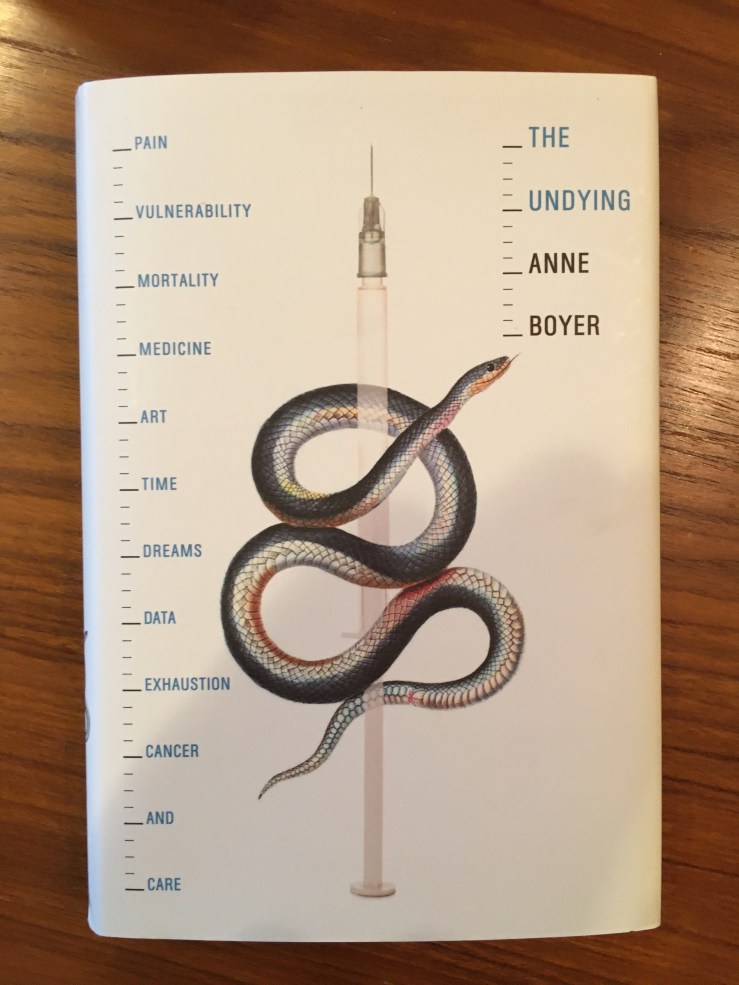
Huge thanks to BLCKDGRD for sending me Anne Boyer’s aphoristic, poetic memoir-essay The Undying. I guess he read that I went to my bookstore to buy it a few weeks ago and came home not empty handed but nevertheless Undyingless. I wanted to read Boyer’s book after reading her essay collection (“essay” isn’t really the right word, but)  A Handbook of Disappointed Fate this summer—-also sent to me by generous Mr. BLCKDGRD

I’m about 100 pages away from finishing The Undying, a book that doesn’t so much chronicle Boyer’s 2014 diagnoses and treatment of breast cancer as it explores and explodes what cancer—a “twentieth-century disease” that we still treat with “twentieth-century” methods, in Boyer’s words—means and is and does in our neoliberal late-capitalist early twenty-first century. Boyer writes,

To become a cancer patient is to become a system-containing object inside another system that only partially allows the recognition of the rest of the systems in which one is a node and also almost wholly obscures the heaviest system of the arrangement of the world as it is, which hangs around, too, in the object that contains a system (by which I mean “me”) as part of the problem in the first place, requiring our latent unhealth just as it profits from our active one.

Later, again addressing that “latent unhealth” which is part and parcel of the system, Boyer declares: “I would rather write nothing at all than propagandize the world as is.” This is a wonderfully angry book.

This is a wonderfully angry, discursive, recursive book: literary biography, literary criticism, art history, art criticism, Foucault, John Donne, Susan Sontag, Lucretius, Virginia Woolf; a howl at the hoaxers, frauds, self-helperists and their pinkwashed platitudes. And lots of pain, expressed with sentiment that bears no trace of sentimentality.

Boyer’s aphoristic style is engrossing. Her paragraphs and one-liners bear a ludic stamp seemingly at odds with her subject matter. The work of the writing, the heavy burden of smithing those sentences is all but elided—instead we get the clarity of a focused mind drawing together seemingly-disparate threads into a cohesive and compelling memoir that transcends the personal without necessarily meaning to.

Showing is a betrayal of the real, which you can never quite know with your eyes in the first place, and if you are trying to survive for the purpose of literature, showing and not telling is reason enough to endure the disabling processes required for staying alive.

Everything here feels and reads True. 

Blog about some books acquired, 8 Nov. 2019

img_4259

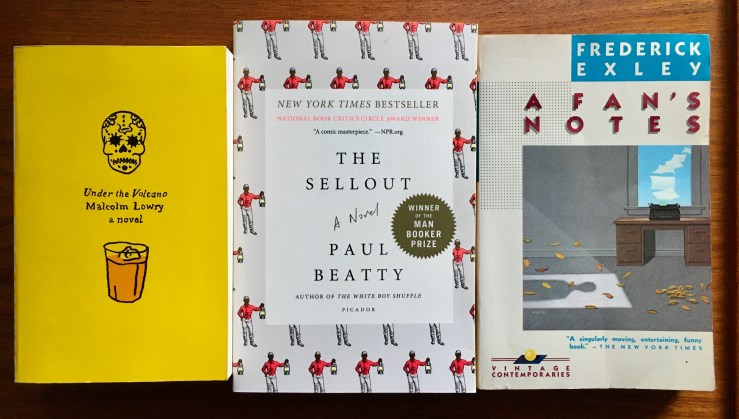
I took a shoebox of old books to my favorite used bookstore this afternoon and came back with three books. I picked up a Vintage Contemporaries edition of Frederick Exley’s novel A Fan’s Notes on something of a whim. Can’t remember what I was looking for when I saw it, but I saw it and grabbed it.

I was shuffling around in the B’s, looking for a copy of Anne Boyer’s The Undying but I did not find it, but I saw Paul Beatty’s The Sellout, which was a big hit a few years ago, which means I sort of ignored it, but I saw it today, a few copies, and grabbed one, after reading “Taken out of Context” at Granta,” but not really in that order—I mean, I’d read that piece earlier this year, my mental ears pricked up, and etc.

I also couldn’t resist another copy of Malcolm Lowry’s novel Under the Volcano. I mean, fuck me, I’m a fucking idiot, I bought it for the cover. Or really, I bought it for the cover and for the handfeel—I mean it felt good as a copy to read, strange short fat like me. Very readable. So maybe I should read it again.

I gave away my ugly movie tie-in cover a few years ago and replaced it with this number, which isn’t so bad:

img_4260

—but this midcentury edition isn’t very readable. I mean, I haven’t ever wanted to thumb through it. Great book though (hard to read, a bit repulsive, thoroughly depressing). Anyway. Peace to you this Friday.

Jiří Kolář’s A User’s Manual (Book acquired, some time in late October)

z

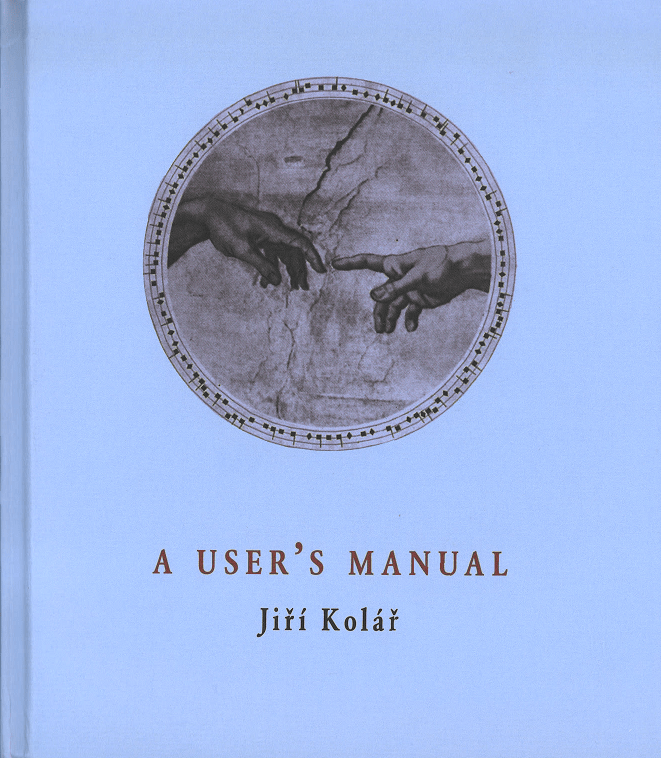
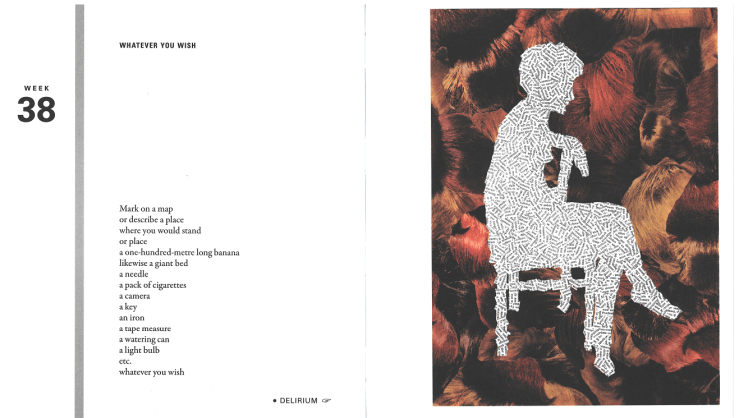
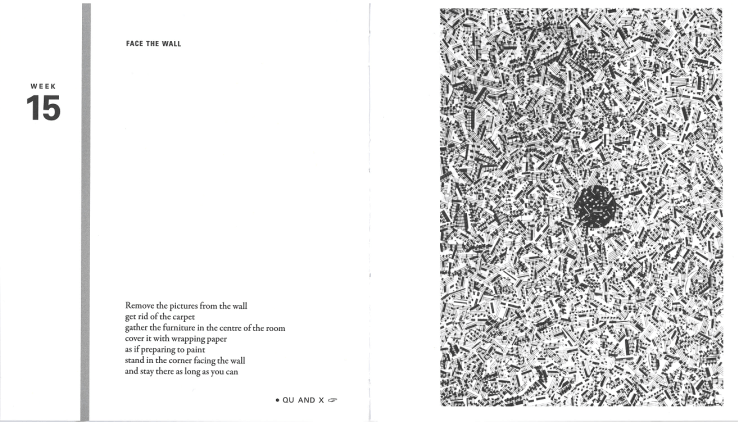
I’ve been slowly enjoying the poems and collages that comprise Jiří Kolář’s collection A User’s Manual (in English translation by Ryan Scott). There are 52 poems and collages here. Each poem is a kind of surrealist recipe, a set of commands that I’ve been trying to follow (in my imagination, I mean).

Capturea

The book itself is beautiful—hardback with full color and black and white illustrations, it fits perfectly with the aesthetic that its publisher Twisted Spoon has been developing for ages now.

Capture

Here’s Twisted Spoon’s blurb:

Written in the 1950s and ’60s, the “action poems” comprising a A User’s Manual were published in their complete form in 1969 when they were paired with the 52 collages of Weekly 1967, the first of Kolář’s celebrated series in which he commented visually on a major event for each week of
the year. Taking the form of directives, largely absurd, the poems mock communist society’s officialese while offering readers an opportunity to create their own poetics by performing the given directions. The collages on the facing pages to the poems are composed of layered documents, image cutouts, newspaper clippings, announcements, letter fragments, reports, or decontextualized words, oftentimes forming concrete patterns or the outlines of figures, to create a sort of “evidential” report on the year. Text and image taken together, the volume displays Kolář’s enduring interest in extracting poetry from the mundane to demolish the barrier separating art from reality, or even to elevate reality itself through this dual poetics to the level of art. What art historian Arsén Pohribný wrote about Weekly 1968 equally applies to Weekly 1967: it “shocks with its abrupt stylistic twists” and is “a Babylonian, hybrid parable of multi-reality.” The volume also includes the complete Czech text as an appendix.

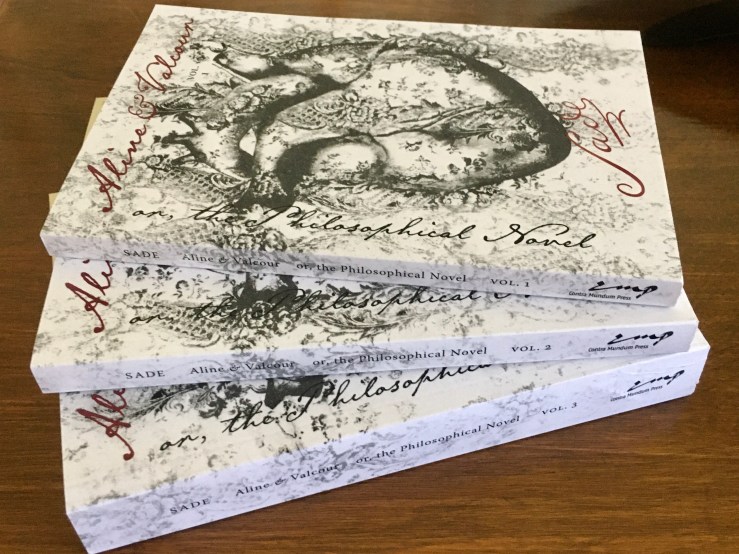
The Marquis de Sade’s Aline and Valcour, or, the Philosophical Novel (Books acquired some time last week)

img_4167

Later this year, indie publisher Contra Mundum Press is releasing a three-volume English translation of the Marquis de Sade’s 1795 epistolary novel Aline and Valcour. The translation is by John Galbraith Simmons and Jocelyne Geneviève Barque.

It looks pretty wild. Here’s Conta Mundum’s blurb:

Set against the impending riptide of the French Revolution and composed while Sade was imprisoned in the Bastille, Aline and Valcour embodies the multiple themes that would become the hallmark of his far more sulfurous works.

This epistolary work combines genres, interweaving the adventure story with the libertine novel and the novel of feelings to create a compelling, unitary tale. Turbulence disrupts virtuous lives when corrupt schemers work incestuous designs upon them that don’t stop with abduction and seduction — as crime imposes tragic obstacles to love and delivers harsh threats to morality and religion.

Embedded within Aline and Valcour are sojourns in unknown lands in Africa and the South Seas: Butua, a cannibalistic dystopia, and Tamoé, a utopian paradise headed by a philosopher-king. In Butua, a lustful chief and callous priesthood rule over a doomed people, with atrocious crimes committed in broad daylight, while in Tamoé happiness and prosperity reign amidst benevolent anarchy.

Although not sexually explicit, Aline and Valcour shared the fate of Sade’s other novels — banned in 1815 and later classified a prohibited work by the French government. Published clandestinely, it did not appear in bookstores until after WWII. Continuously in print in France ever since, today it occupies the first volume of the Pléiade edition of the author’s collected works.

This is the very first rendering of the book into English since its publication in 1795.

D.H. Lawrence’s The Bad Side of Books (Book acquired 16 Oct. 2019)

img_4071

NRYB has compiled a collection of essays from D.H. Lawrence entitled The Bad Side of Books. I’ve always appreciated Lawrence’s nonfiction (particularly Apocalypse) more than his fiction, so this collection (with its great title) piques my interest. NYRB’s blurb:

You could describe D.H. Lawrence as the great multi-instrumentalist among the great writers of the twentieth century. He was a brilliant, endlessly controversial novelist who transformed, for better and for worse, the way we write about sex and emotions; he was a wonderful poet; he was an essayist of burning curiosity, expansive lyricism, odd humor, and radical intelligence, equaled, perhaps, only by Virginia Woolf. Here Geoff Dyer, one of the finest essayists of our day, draws on the whole range of Lawrence’s published essays to reintroduce him to a new generation of readers for whom the essay has become an important genre. We get Lawrence the book reviewer, writing about Death in Venice and welcoming Ernest Hemingway; Lawrence the travel writer, in Mexico and New Mexico and Italy; Lawrence the memoirist, depicting his strange sometime-friend Maurice Magnus; Lawrence the restless inquirer into the possibilities of the novel, writing about the novel and morality and addressing the question of why the novel matters; and, finally, the Lawrence who meditates on birdsong or the death of a porcupine in the Rocky Mountains. Dyer’s selection of Lawrence’s essays is a wonderful introduction to a fundamental, dazzling writer.

Drew Lerman’s Snake Creek

2019-10-14_163321

I got a copy of Drew Lerman’s Snake Creek strips a few weeks ago and have been reading a strip a day, or sometimes reading two or four strips a day, or sometimes reading no strips a day.

Snake Creek comprises the first volume of Snake Creek comix created by Lerman between the summers of ’18 and ’19. Lerman made one each day, as far as I can tell, which, like props.

The heroes of Snake Creek are maybe-human Dav (an altar-ego for Lerman?) and maybe walkin-talkin potato/maybe-mutant Roy, who spend their days and nights strolling the beaches, riffing on life, and extemporizing poems and songs. They take up with a dog and one point, and later encounter strange ducks. (I’m sure there’s more—I’ve been trying, like I said, to limit myself to a few strips a day.) It’s all a big anarchic kick.

2019-10-14_163456

Snake Creek has an absurdist and occasionally nihilist bent, flavors I love. Never too bitter, the strip’s sweetness is anchored in the weird friendship betwixt Dav and Roy, who wander and wonder along a Miami Beach that Lerman turns into a kind of desert island running on Prospero’s magic.

2019-10-14_163605

Snake Island’s chords and rhythms resonate with Walt Kelly’s Pogo, another Floridaish strip, as well as George Herriman’s zany strip Krazy Kat. Lerman seems like a willing descendant of Kelly and Herriman, but Snake Island is also wholly contemporary, a comic that begins with a discussion of old G-chats.

I’m really digging the collection, and I hope not to gobble it up too fast.

2019-10-14_163713

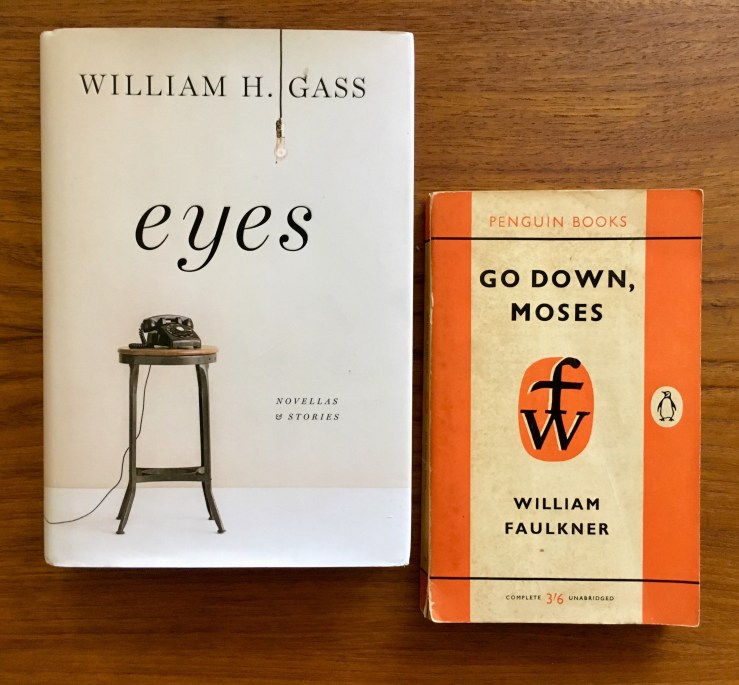
Faulkner/Gass (Two Williams acquired, 4 Oct. 2019)


img_4013

Friday is a day in which I have a few rare spare hours to myself after lunch, and I often like to browse my beloved labyrinthine used bookstore in one of those hours. Last week, I managed to leave without picking anything up, but today I couldn’t resist these two Williams.

Wiliam H. Gass’s last collection of fiction Eyes jumped out at me. I struggled with his bigass opus The Tunnel last year, hardly making a dent, but I loved Middle C as well as the novellas in Cartesian Sonata and Other Novellasso maybe Eyes will be more manageable.

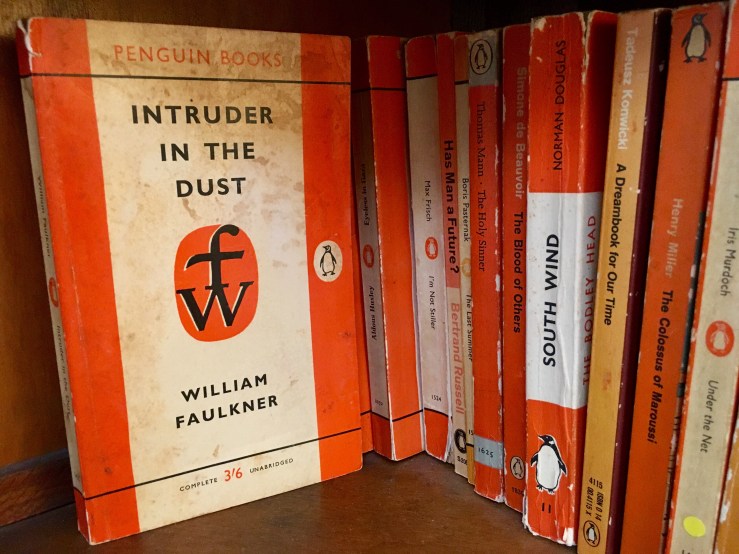
I wasn’t actually browsing the Faulkner section, simply walking past it, but the orange spine of a 1960 Penguin edition of Go Down, Moses jumped out at me. I’m a sucker for these Penguin editions, and Go Down, Moses is my favorite Faulkner (I haven’t read everything Faulkner wrote but I doubt he wrote anything as great as “The Bear”). This edition makes a nice partner with the copy of Intruder in the Dust I picked up a few years ago, too. img_4014

Intruder is a really underrated Faulkner novel in my estimation, and Clarence Brown’s 1949 film adaptation is pretty strong as well.

I was attracted to another orange book, an English-language Japanese publication of Kenzaburo Oe’s The Silent Cry, but I had to pass on it—the print was tiny and my forty-year-old eyes aren’t as strong as they used to be. The cover is gorgeous though:

img_4008


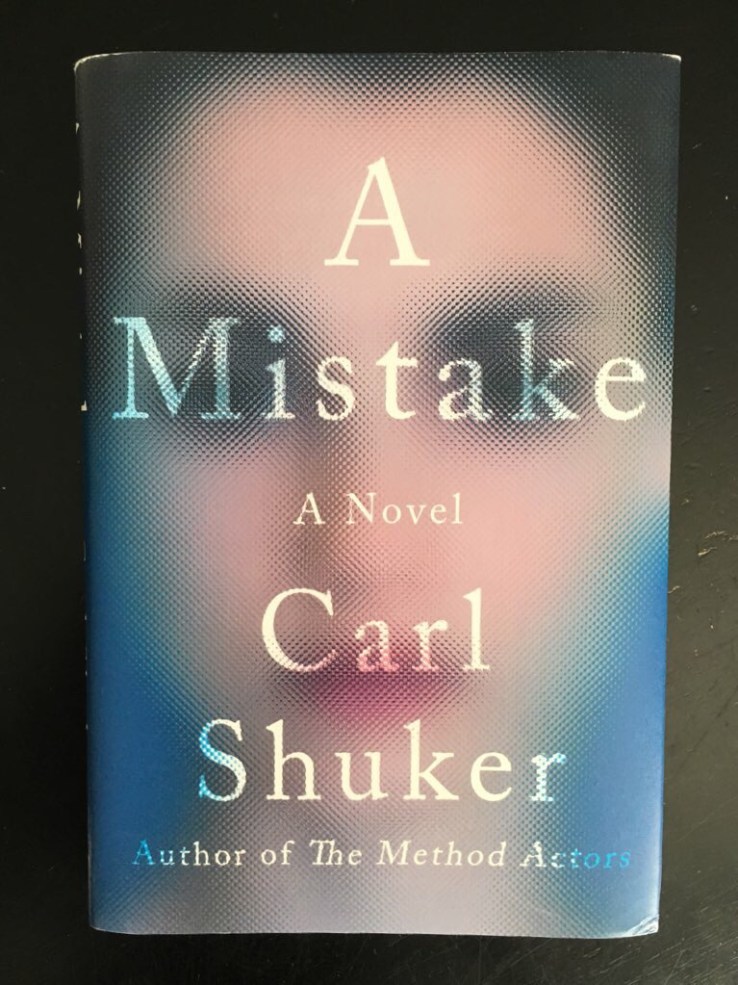
Carl Shuker’s novel A Mistake (Book acquired 27 Sept. 2019)

img_3969

Carl Shuker’s fourth novel A Mistake is new from Counterpress. Their blurb–

Elizabeth is a gifted surgeon—the only female consultant at her hospital. But while she operates on a young woman with life-threatening blood poisoning, something goes horribly wrong. In the midst of a new scheme to publicly report surgeons’ performance, her colleagues begin to close ranks, and Elizabeth’s life is thrown into disarray. Tough and abrasive, Elizabeth has survived and succeeded in this most demanding, palpably sexist field. But can she survive a single mistake?

A Mistake is a page-turning procedural thriller about powerful women working in challenging spheres. The novel examines how a survivor who has successfully navigated years of a culture of casual sexism and machismo finds herself suddenly in the fight of her life. When a mistake is life-threatening, who should ultimately be held responsible?

Carl Shuker has produced some of the finest writing on the physicality of medical intervention, where life-changing surgery is detailed moment by moment in a building emergency. A Mistake daringly illustrates the startling mix of the coolly intellectual and deeply personal inherent in the life and work of a surgeon.

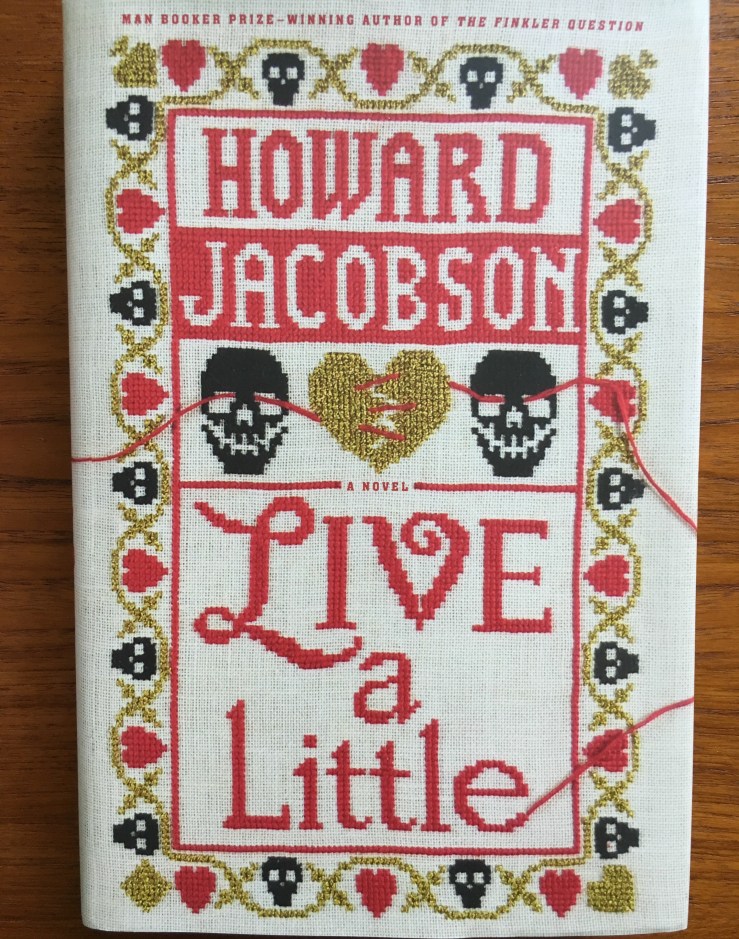
Howard Jacobson’s Live a Little (Book acquired, some time near the end of August, 2019)

img_3917

Howard Jacobson’s Live a Little is new in hardback in the US this month from Penguin Random House. Their blurb–

At the age of ninety-something, Beryl Dusinbery is forgetting everything – including her own children. She spends her days stitching morbid samplers and tormenting her two long-suffering carers, Nastya and Euphoria, with tangled stories of her husbands and love affairs.

Shimi Carmelli can do up his own buttons, walks without the aid of a frame and speaks without spitting. Among the widows of North London, he’s whispered about as the last of the eligible bachelors. Unlike Beryl, he forgets nothing – especially not the shame of a childhood incident that has hung over him ever since.

There’s very little life remaining for either of them, but perhaps just enough to heal some of the hurt inflicted along the way, and find new meaning in what’s left. Told with Jacobson’s trademark wit and style, Live a Little is equal parts funny, irreverent and tender – a novel to make you consider all the paths not taken, and whether you could still change course.

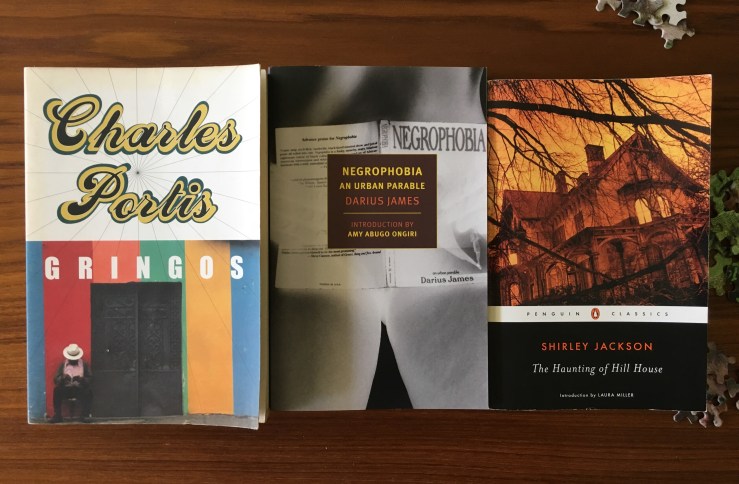
Jackson/James/Portis (Three books acquired, 5 Sept. 2019)

img_3919

I had not intended to pick up any more books.

I’d been cooped up all week, or kinda sorta cooped, with a very mild cabin fever. This cooping and fever were the fault of Hurricane Dorian, which was slowly slowly slowly heading our way, although in the end, at least for us, not really. I’m deeply thankful and also very sorry for the many people who did meet Dorian. It fucking sucks.

We kept power and internet and everything though, and we also kept our kids, as school and work was cancelled, and everything closed down. We enjoyed a few rare 73 degree bike rides and pretended it was fall. We played card games and pretended like the power had gone out, although our air was coolly conditioned. We invented chores. I culled some books, a whole bankers box full. And I think the four of us (moi, wife, daughter, son) grated on each other after four days of this.

I got out for a bit on Thursday to do some made-up errands, including dropping off the culled books box. I said to myself, We will just drop off the box of books and then drive to the Publix to pick up our meds. We will not browse. I dropped off the books, and then I said to myself, We will browse, but we will not acquire. So I browsed, sticking at first to the weird margins I rarely visit of this big sprawling used books—travel writing and food writing, historical fiction and short story anthologies—before saying, Hey, maybe they have a copy of Charles Portis’s Gringos. They had a copy of Charles Portis’s Gringos. I said to myself, You will regret it if you don’t pick this up. (That same morning, I had tried to make a go at John Kennedy Toole’s A Confederacy of Dunces in the hopes of getting more Portis flavors, after finishing True Grit a few days ago. Alas, it didn’t take. Maybe later? I don’t know. I want to read Gringos.)

As I was picking up Portis I overheard a mother and her daughter trying to find Nathaniel Hawthorne’s The Scarlet Letter. They were not in the right place. They were in the westerns, an aisle or two over. The daughter was telling the mother how much anxiety the book produced in her. They turned into my aisle, still struggling against the alphabet, when the mother said to the daughter, We just need to find somebody who works here. I do not work there but I said, Hawthorne is down there, and pointed roughly east, where only a few meters away were literally hundreds and hundreds of copies of The Scarlet Letter. This indication was too vague though, and a few steps in the general direction were needed. The mother and daughter team found their way to Hawthorne though, and I lingered in the Js, where I remembered that I’d been meaning to read Shelly Jackson for years now. I had wanted to read We Have Always Lived in the Castle but there were no copies. There were two copies of The Haunting of Hill House. I got the one without the Netflix logo on it.

My eye is very good at scanning NYRB spines, and, while picking at Jacksons, I spied a book called Negrophobia by Darius James. I had never heard of Negrophobia, but the title alone warranted a pull. I opened the book up somewhere in the middle, flicked through—visually wild, cut up and strange, it reminded me a bit of Burroughs or later avant garde stuff, like Kathy Acker. I flipped it over. Kathy Acker blurbed it. Paul Beatty blurbed it. Kara Walker blurbed it! (More visual artists should blurb books.)

I picked up all three books of course. Then I went home and read another chapter of Sylvia Warner Townsend’s The Corner That Held Them.


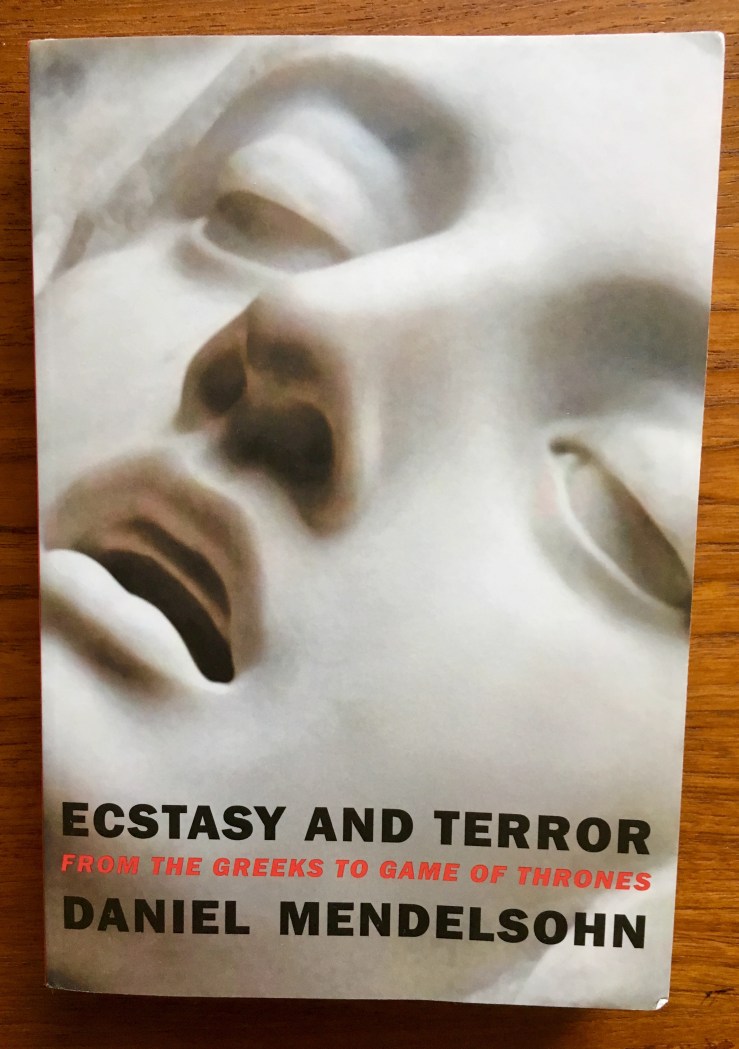
Daniel Mendelsohn’s Ecstasy and Terror (Book acquired, some time last week)

img_3918

I got a review copy of Daniel Mendelsohn’s collection Ecstasy and Terror some time early last week. I’ve read a few of the pieces in here before (“A Critic’s Manifesto” is one that I recalled in particular). Ecstasy and Terror is out in October from NYRB. Their blurb:

This collection of essays exemplifies the range, depth, and erudition that have made Daniel Mendelsohn “required reading for anyone interested in dissecting culture” (The Daily Beast). Here Mendelsohn once again casts an eye at literature, film, television, and the personal essay, filtering his insights through his training as a scholar of classical antiquity in surprising and illuminating ways.

Many of these essays examine how we continue to look to the Greeks and Romans as models: some argue for the surprising modernity of canonical works (Bacchae, the Aeneid), while others detect a “Greek DNA” in our responses to the Boston Marathon bombings and the assassination of JFK. Modern topics are treated, too, from the “aesthetics of victimhood” in Hanya Yanagihara’sA Little Life to the novels of Karl Ove Knausgaard, and from Game of Thrones to recent films about artificial intelligence—a subject, Mendelsohn reminds us, that was already of interest to Homer.

The collection also brings together for the first time a number of Mendelsohn’s personal essays, including his “critic’s manifesto” and a touching memoir of his boyhood correspondence with the historical novelist Mary Renault.

Blog about some recent reading, some books acquired, Hurricane Dorian, etc.

img_3908-1

I am on my second or maybe third dark and stormy and I have cleaned the house twice from top to bottom two days in a row now and I am ready for my kids to go back to school, which was cancelled through Thursday for Hurricane Dorian. My own school, by which I mean my employer, cancelled classes throughout the week, but I’ve been emailing students and trying to maintain some kind of continuity after this weird disruption. We have power here in NE Florida and all seems well. This ride has been a lot easier than Irma.

img_3910-1

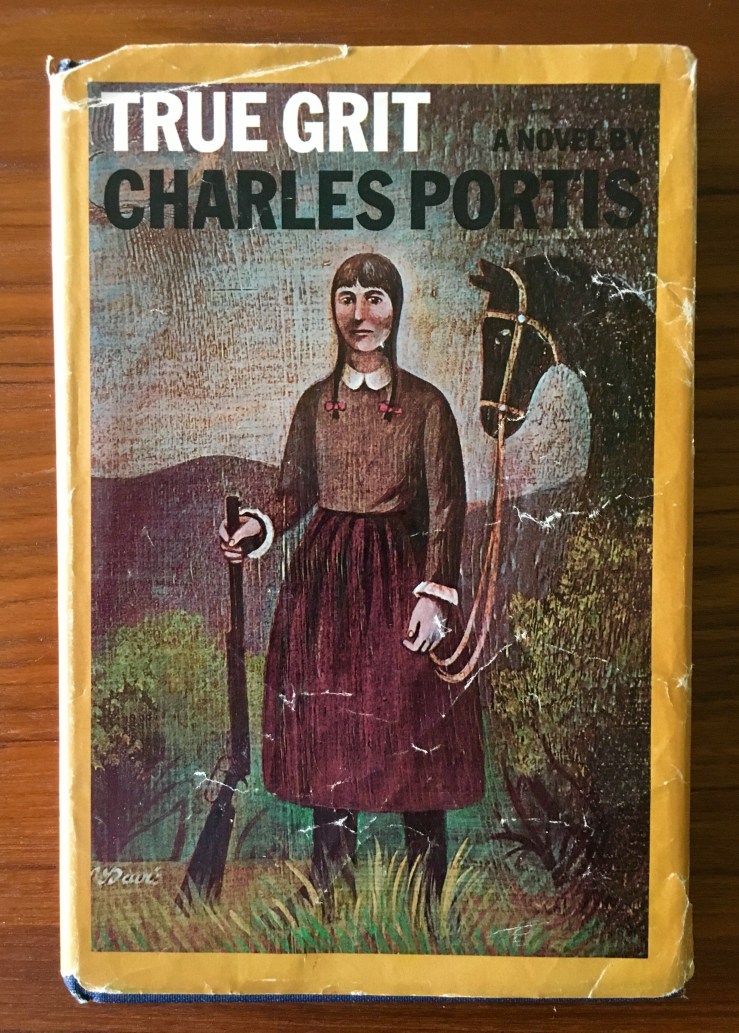
I finished Charles Portis’s famous novel True Grit this afternoon and I must confess it might be my favorite of the four I’ve read by the maestro. I shed a little tear for Little Blackie at the end, and also maybe for Rooster Cogburn. My thought is that I wish I’d read the book years ago, before I’d seen the two film adaptations, both of which are, like, fine, but neither of which capture the pure voice of Mattie Ross. Great stuff. I need to read Gringos next, but maybe I’ll wait a bit.

I have been switching between True Grit and Sylvia Townsend Warner’s nuns-in-the-English-fens-in-the-age-of-the-Black-Death The Corner That Held Them and I love both—both are funny, dry (and wet when they need to be). The Corner That Held Them packs in so much storytelling; pages go on for decades with a sprightly and imaginative and droll clip. I’ve been enjoying it so much I went up to my favorite used bookstore, big box of old books in tow, to find more. I picked up Lolly Willowes, which I understand is excellent, and which I will get to posthaste.

I had burned up most of my credit at this particular bookstore, but the box I done brung afforded me enough trade to not only pick up Lolly Willowes but also a first-edition hardback of Kurt Vonnegut’s Slaughterhouse Five.

img_3909-1

I also got copies of Antoine Volodine’s Writers and Bardo or Not Bardo in the in the mail this week. I don’t rightly recall buying them online, but I know that after finishing In the Time of the Blue Ball by Volodine’s pseudo-pseudonym Manuela Draeger, I went through my Volodines for references to Draeger. I found references in Post-Exoticism in Ten Lessons, Lesson Eleven, but couldn’t find my copy of Writers and then remembered that I gave it to a friend who seemed to promptly move a hundred miles away afterward. (He said he thought it was good.) Anyway: Bardo soon or not soon.

I read Keiler Roberts’ graphic memoir Rat Time yesterday and loved it so much I wrote about it immediately.

Screenshot 2019-09-03 at 3.52.37 PM

The hurricane is not so bad for us.

Books acquired, 15 Aug. 2019

img_3825

I went to the used bookstore last week to pick up some of my daughters required reading for school. I fucked up and picked up a heavily-annotated copy of Elie Wiesel’s Night which I will have to return maybe tomorrow or Wednesday.

While there, I picked up Fup by Jim Dodge. I was looking for Dodge’s novel Stone Junction (a twitter-based recommendation based on my taking to Charles Portis), but I couldn’t find a copy. But Fup looked neat. And it’s illustrated (by Norman Green).

img_3857

I also picked up Manuela Draeger’s In the Time of the Blue Bell in English translation by Brian Evenson. Draeger is one of French author Antoine Volodine’s pseudonyms. It’s good stuff. Here is the first paragraph:

ECDS3K3XUAAkTvN