“Everything has been merely attempted, nothing completed” (Thomas Bernhard)

At the same time I had to tell myself that we invariably made excessive demands of everything and everybody: nothing is done thoroughly enough, everything is imperfect, everything has been merely attempted, nothing completed. My unhealthy craving for perfection had come to the surface again. It actually makes us ill if we always demand the highest standards, the most thorough, the most fundamental, the most extraordinary, when all we find are the lowest, the most superficial, the most ordinary. It doesn’t get us anywhere, except into the grave. We see decline where we expect improvement, we see hopelessness where we still have hope: that’s our mistake, our misfortune. We always demand everything, when in the nature of things we should demand little, and that depresses us. We see somebody on the heights, and he comes to grief while he is still on the low ground. We want to achieve everything, and we achieve nothing. And naturally we make the highest, the very highest demands of ourselves, completely leaving out of account human nature, which is after all not made to meet the highest demands. The world spirit, as it were, overestimates the human spirit. We are always bound to fail because we set our sights a few hundred per cent higher than is appropriate. And if we look, wherever we look, we see only people who have failed because they set their sights too high. But on the other hand, I reflect, where should we be if we constantly set our sights too low?

From Thomas Bernhard’s novel Concrete.

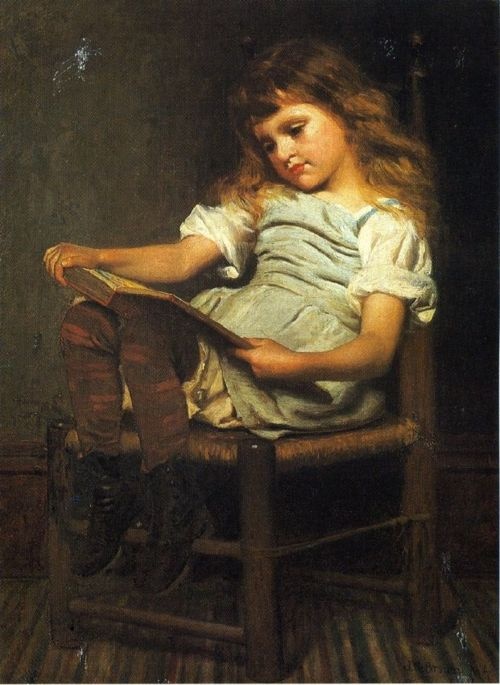
First Reader — John George Brown

f0a8c1518203e6e58749f42315129a4f

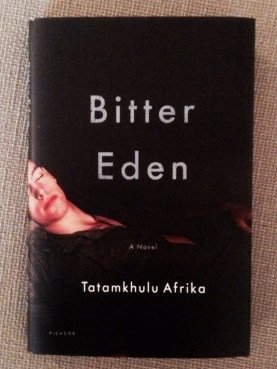
Bitter Eden (Book Acquired, 2.12.2014)

20140223-181957.jpg

This one looks pretty good. Blurb from publisher Picador:

Bitter Eden is based on Tatamkhulu Afrika’s own capture in North Africa and his experiences as a prisoner of war during World War II in Italy and Germany. This frank and beautifully wrought novel deals with three men who must negotiate the emotions that are brought to the surface by the physical closeness of survival in the male-only camps. The complex rituals of camp life and the strange loyalties and deep bonds among the men are heartbreakingly depicted. Bitter Eden is a tender, bitter, deeply felt book of lives inexorably changed, and of a war whose ending does not bring peace.

Read an excerpt here.

“The Breathing Author” by Gerald Murnane

From Delphic Intimations: Dialogues with Australian Writers and Critics, ed. Pradeep Trikha. 2007: Sarup & Sons, New Delhi.

I have preserved Australian spelling and style.

***

“The Breathing Author” — Gerald Murnane

This essay is the edited version of a talk given at the final session of the Gerald Murnane Research Seminar, held at the University of Newcastle on 20-21 September 2001.

I cannot conceive of myself reading a text and being unmindful that the object before my eyes is a product of human effort.

Much of my engagement with a text consists of my speculating about the methods used by the writer in the putting together of the text, or about the feelings and beliefs that drove the writer to write the text, or even about the life story of the writer.

What I am about to tell you today is the sort of detail that I would have been eager to know if it had been my fate to be a person who was drawn to read these books (points to the stack of his books near by) rather than the person who was drawn to write them.

I have for long believed that a person reveals at least as much when he reports what he cannot do or has never done as when he reports what he has done or wants to do.

I have never been in an aeroplane.

I have been as far north from my birthplace as Murwillumbah in New South Wales and as far south as Kettering in Tasmania; as far east as Bemm River in Victoria and as far west as Streaky Bay in South Australia. The distance between Murwillumbah in the north and Kettering in the south is about 1500 km. It so happens that the distance between Streaky Bay in the west and Orbost in the east is about the same. Until I calculated these distances a few days ago, I was quite unaware that my travels had been confined to an area comprising almost a square, but my learning this was no surprise to me.

I became confused, or even distressed, whenever I find myself among streets or roads that are not arranged in a rectangular grid or are so arranged but not so that the streets or roads run approximately north-south and east-west. Whenever I find myself in such a place, I feel compelled to withdraw from social intercourse and all activities other than what I call finding my bearings. These I try to find by reference to the sun or to roads or streets the alignments of which are known to me. I know I have found my bearings when I can visualise myself and my surroundings as details of a map that includes the northern suburbs of Melbourne and such prominent east-west or north-south thoroughfares of those suburbs as Bell Street or Sydney Road.

My trying to find my bearings takes much mental effort, and I fail more often than I succeed. I often believe I have succeeded but later refer to maps and find that my visualised map was wrong. When I discover this, I feel compelled to attempt a complicated exercise that I have probably never succeeded at. I am compelled first to recall the scene where I tried to find my bearings, then to recall the visualised map that proved to be wrong, and last to try to correct my remembered self, as it were: to relive the earlier experience but with the difference that I get my correct bearings. I sometimes feel this compulsion many years after the original event. While writing these notes, for example, I was compelled to recall the evening in November 1956 when I visited for the first time the suburb or Brighton, on Port Phillip Bay. It was my last day of secondary school, and my class had to meet at the home of the school captain and later to take a train into Melbourne to see a film. I arrived in Brighton by bus, in the company of boys who knew their way around that quarter of Melbourne. Later, when our class arrived on foot at Brighton Beach railway station, I stood with them on the platform where they had gathered, but I was convinced that we were waiting for the train from Melbourne. After the train had arrive and we had boarded, I remained convinced for some time that we were travelling away from Melbourne, and my peace of mind was continually disturbed during the rest of the evening by my wondering how I had so utterly lost my bearings at the railway station. Just now, as I said, I was compelled to relive that experience of more than forty years ago, but I failed yet again to understand how the map of Melbourne in my mind had been stood on its head.

I cannot understand the workings of the International Date Line.

Continue reading ““The Breathing Author” by Gerald Murnane”

Macbeth Consulting the Vision of the Armed Head — Henry Fuseli

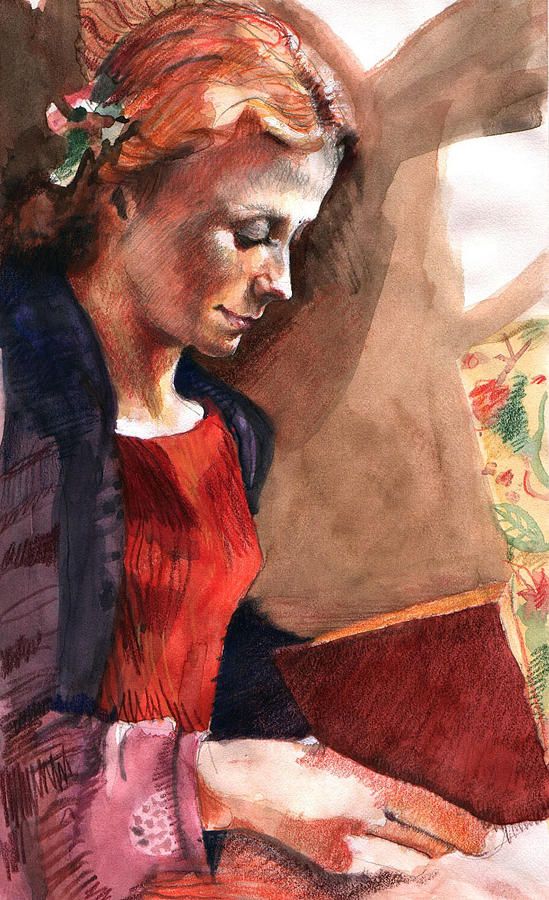
Woman Reading at Home — Karin Kinser

a0966dbeadaa8b582325134919ce5fa7

“To poison a person or a party of persons with the sacramental wine” and other ideas from Nathaniel Hawthorne’s Note-Books


  1. A house to be built over a natural spring of inflammable gas, and to be constantly illuminated therewith. What moral could be drawn from this? It is carburetted hydrogen gas, and is cooled from a soft shale or slate, which is sometimes bituminous, and contains more or less carbonate of lime. It appears in the vicinity of Lockport and Niagara Falls, and elsewhere in New York. I believe it indicates coal. At Fredonia, the whole village is lighted by it. Elsewhere, a farm-house was lighted by it, and no other fuel used in the coldest weather.
  2. Gnomes, or other mischievous little fiends, to be represented as burrowing in the hollow teeth of some person who has subjected himself to their power. It should be a child’s story. This should be one of many modes of petty torment. They should be contrasted with beneficent fairies, who minister to the pleasures of the good.
  3. Some very famous jewel or other thing, much talked of all over the world. Some person to meet with it, and get possession of it in some unexpected manner, amid homely circumstances.
  4. To poison a person or a party of persons with the sacramental wine.
  5. A cloud in the shape of an old woman kneeling, with arms extended towards the moon.


From Nathaniel Hawthorne’s American Note-Books.

Briti — Harold Harvey

8515a39aef9564b8de7e6a5e67a2ee95

“The Death of the Moth” — Virginia Woolf

“The Death of the Moth”

by

Virginia Woolf

Moths that fly by day are not properly to be called moths; they do not excite that pleasant sense of dark autumn nights and ivy-blossom which the commonest yellow-underwing asleep in the shadow of the curtain never fails to rouse in us. They are hybrid creatures, neither gay like butterflies nor sombre like their own species. Nevertheless the present specimen, with his narrow hay-coloured wings, fringed with a tassel of the same colour, seemed to be content with life. It was a pleasant morning, mid-September, mild, benignant, yet with a keener breath than that of the summer months. The plough was already scoring the field opposite the window, and where the share had been, the earth was pressed flat and gleamed with moisture. Such vigour came rolling in from the fields and the down beyond that it was difficult to keep the eyes strictly turned upon the book. The rooks too were keeping one of their annual festivities; soaring round the tree tops until it looked as if a vast net with thousands of black knots in it had been cast up into the air; which, after a few moments sank slowly down upon the trees until every twig seemed to have a knot at the end of it. Then, suddenly, the net would be thrown into the air again in a wider circle this time, with the utmost clamour and vociferation, as though to be thrown into the air and settle slowly down upon the tree tops were a tremendously exciting experience.

The same energy which inspired the rooks, the ploughmen, the horses, and even, it seemed, the lean bare-backed downs, sent the moth fluttering from side to side of his square of the window-pane. One could not help watching him. One was, indeed, conscious of a queer feeling of pity for him. The possibilities of pleasure seemed that morning so enormous and so various that to have only a moth’s part in life, and a day moth’s at that, appeared a hard fate, and his zest in enjoying his meagre opportunities to the full, pathetic. He flew vigorously to one corner of his compartment, and, after waiting there a second, flew across to the other. What remained for him but to fly to a third corner and then to a fourth? That was all he could do, in spite of the size of the downs, the width of the sky, the far-off smoke of houses, and the romantic voice, now and then, of a steamer out at sea. What he could do he did. Watching him, it seemed as if a fibre, very thin but pure, of the enormous energy of the world had been thrust into his frail and diminutive body. As often as he crossed the pane, I could fancy that a thread of vital light became visible. He was little or nothing but life.

Yet, because he was so small, and so simple a form of the energy that was rolling in at the open window and driving its way through so many narrow and intricate corridors in my own brain and in those of other human beings, there was something marvellous as well as pathetic about him. It was as if someone had taken a tiny bead of pure life and decking it as lightly as possible with down and feathers, had set it dancing and zig-zagging to show us the true nature of life. Thus displayed one could not get over the strangeness of it. One is apt to forget all about life, seeing it humped and bossed and garnished and cumbered so that it has to move with the greatest circumspection and dignity. Again, the thought of all that life might have been had he been born in any other shape caused one to view his simple activities with a kind of pity. Continue reading ““The Death of the Moth” — Virginia Woolf”

Woman Reading — Ellen Dreibelbis

a375ff47097e6fea4fb01c01eecf0ce1

Big News! — Lyonel Feininger

Emily Dickinson — Tom Gauld

Reviews Page Redesign (And a Reflection on Sexist Reviewing Habits)

So I updated Biblioklept’s Reviews page.

The page had just been a list of the reviews, riffs, and essays published on the blog, with each new entry stacking up in chronological order. For years I’ve known that this unorganized review dump was essentially useless, and I’d been meaning to turn it into an alphabetical index—and I finally did. (I kept the chronolist too, mostly for myself).

Anyway, as I went through this boring, sort-of-arduous process, I couldn’t help but reflect on a few of the habits that manifest under the surface:

The obvious: The reviews on the blog trend very heavily toward male authors. I already knew this, but counting things up makes it plain:

To date, I’ve run reviews of approximately 221 authors (approximate in the sense that I counted only once); of those reviews, only 36 were books by women. That’s about 16%. (This analysis doesn’t even begin to consider the multiple reviews of authors—for example, there are like a ton of reviews of Roberto Bolaño books, but only one review of a Clarice Lispector book). This ratio runs counter to what I’d like to believe are my principles; the number certainly contrasts with the fiction and poetry that I run on the blog (public domain stuff), which trends toward female authors. The number also contrasts with the ratio of male to female authors — roughly 1:1 — that appear on my course syllabuses.

If my tone sounds defensive, it’s because it is. The Read Women 2014 project has helped to highlight sexist reading habits—including my own. Sexism—any kind of prejudicial ism (and every ism is prejudicial) manifests as a blinding structure: Part of the structuring condition of ideological sexism is that the sexist person usually cannot see that he is sexist (he cannot see that he cannot see). I’m not offering this as a defense of my own habits: I’m not saying, Look, I’m aware of my skewed reviewing habits, and my very awareness of my inherent sexism makes me less sexist, absolves, me, etc. (But look at how I rhetorically dance around simply writing, My reviewing habits are sexist; look at how I’m still unable to simply type I’m probably a sexist, let alone I’m sexist, let me hedge, use parentheses, etc.).

Can I turn attention away from myself and onto the aesthetic critic Harold Bloom? In his Paris Review interview, he claimed:

I do not for a moment yield to the notion that any social, racial, ethnic, or “male” interest could determine my aesthetic choices. I have a lifetime of experience, learning, and insight that tells me this.

Bloom’s statement is a perfect example of I cannot see that I cannot see. (Stephen Colbert essentially ridicules this kind of blindness on his satirical show The Colbert Report by repeatedly claiming that he is not racist because he cannot see color).

I think that (I know that) a certain male interest determines my aesthetic interest. At the same time, I understand Bloom’s resistance to the notion that aesthetics are somehow contingent on gender. Could a man have written “A Good Man Is Hard to Find” or To the Lighthouse or Death Comes to the Archbishop or Their Eyes Were Watching God? (A man didn’t). We’d like to believe that the Great Stuff transcends the material world—that part of its timelessness is that it’s not bound to mortal gendered coils. Etc.

What about now? What about Read Women 2014? I’ve been reading more women authors, I think, but I haven’t been reviewing them. I recently reread Flannery O’Connor’s collection Everything That Rises Must Converge, some Gertrude Stein I’d never read before (including Tender Buttons), and some short stories by Eudora Welty and Willa Cather. I’ve read far less contemporary stuff though, although I did review Jessica Hollander’s excellent collection In These Times the Home Is a Tired Place. In general though, I tend to read less contemporaryish fiction now than I used to—I’m reading three books now, and only one is by a living author (Ben Marcus). Of the three books I’m reading now, only one is by a woman (Zelda Fitzgerald). Of the last ten book reviews published on this site, four are of books by women.

Data and numbers are unappealing—especially when they quantify something we (and when I write we you know I mean I) don’t want to acknowledge. We’d (I’d) rather qualify than quantify. Etc.

I suppose it’s the idea of a conscious effort that so repels some of us (me). The notion that I (we?) might have to make an actual intellectual (not aesthetic, perhaps non-intuitive) effort to differentiate our reading. But that’s what it takes, right? An effort. A recognition. A looking.

Two Women Reading — Robert Reid

c978d2c940027122e8968c2201ae166f

An Excerpt From Gerald Murnane’s “Sipping The Essence”

Even drunk on tepid beer we could not talk honestly. Our messages for one another were obliquely worded, or hidden behind childish mimes and antics. At a certain point in the evening Durkin would make a show of examining the tangle of blankets on my bed and finding evidence that a man and a woman had shared it not long before. I would point out what I claimed were signs that a young adult male had recently masturbated there, using a heap of pillows as a surrogate woman and seeing the furthest wrinkles in his blankets as the coastal hills of the Mornington Peninsula. Durkin would then tidy the bedclothes and demonstrate what I ought to do on the bed as soon as I had come to my senses and invited home one of the thousands of girls in Melbourne who were waiting every night by their telephones as anxious to meet a new man as Carolyn had been at Sorrento. Then, if I was drunk enough, I would argue that all those women must have once been to the Gold Coast of Queensland as Carolyn had been and must have learned there too much for a beginner like myself. And if I saw that he was drunk enough I would announce that my last hope was his sixteen-years-old sister. Had he guarded her honour? I would shout at him. Could he keep her from setting out towards the Gold Coast and deliver her to me instead? I would treat her honourably and do no more than read my poems to her until our wedding night and be a fine, boozy brother-in-law to him for the rest of our lives.

When his sister was mentioned he would offer to fight me, and we would grapple on the floor until our buckets of bottles were in danger. Whenever I was on top of him and had him by the throat I boasted that my strength came from my celibate way of life. But whenever he had pinned me to the floor I begged him to procure me his sister or any girl who would give me a strength like his.

Found in the collection Landscape With Landscape.

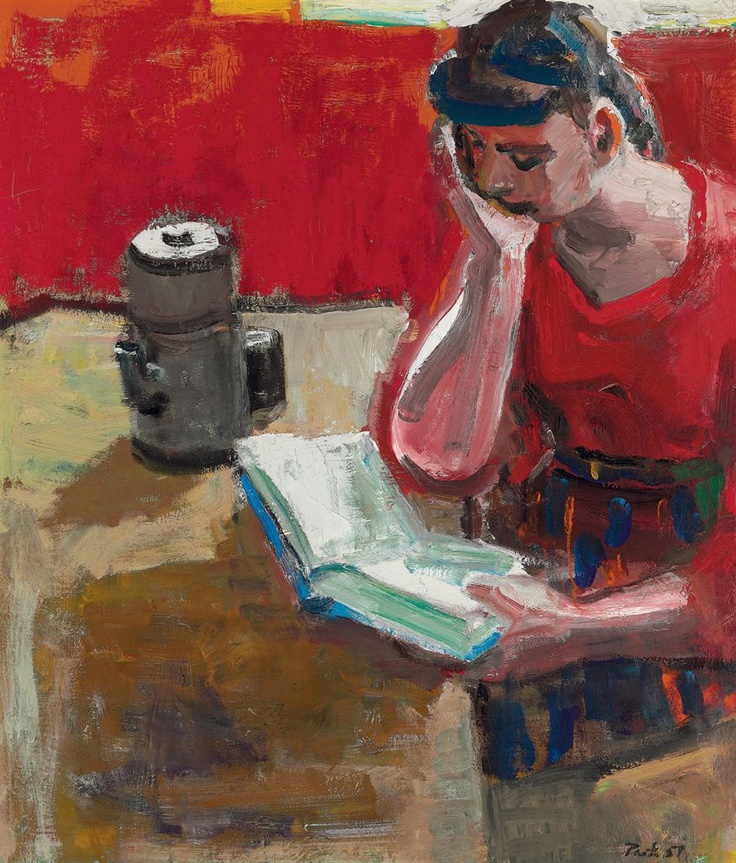
Woman Reading — David Park

1d57a73ac8ce493ac59e37b058b43c71

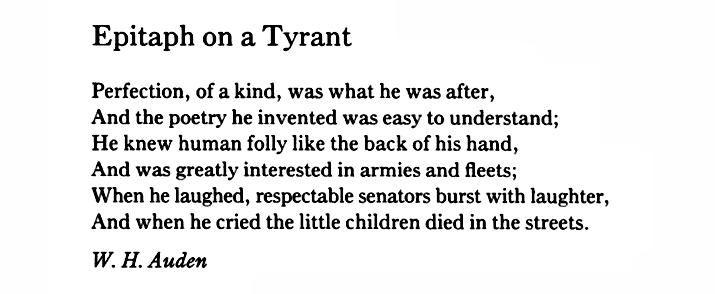
“Epitaph on a Tyrant” — W.H. Auden

tyrant