“His sentences are oar strokes” (Thomas Bernhard)

His sentences are oar strokes that would propel him forward if it weren’t for the powerful current. Sometimes he pauses, falls silent and listens, as though to check whether his present situation might not have been replaced by its successor. “It’s impossible to direct anything.” Things still in the future and the distant past all pull on one string with him, sometimes ten times in the space of a single sentence. He is a man who thinks continually of great losses, without any detachment. The sea surfaces in him, and in the sea is a boulder, part of an enormous sunken city, the end of an unanticipated story, far in the past. Death knots his net … Colors that are nothing but extrusions of flesh narcotize him philosophically … The adducing of extremes, so as to be able to spit them out. Tensions between eerie subaquatic scenes. The word “yoke” occurs frequently. The word “true”—but also “untrue” and “unreal.” The word “ear of corn” may acquire the same meaning as “the whole of our welfare state.” They are his eyes that speak, they enact his thought, they pitch wildness and quiet alternately at the disquiet of others. The painter is such an oddity, I think, that no one understands him. Not a type. Always reliant on himself, and always rejecting everything coming at him, he has taken advantage to excess of all possibilities. To look at him is to look at the millennia. “Mountains, you know, can serve as telescopes, through which one can see into the future.” Or “inhumanly human.” He is able to irritate people, where there are no people. To suppress effervescence, where there is no effervescence. “Isn’t that an animal speaking? Am I not vermin?” Everything purposes the acceleration of his decay. Everything indicates a decisive childhood which was soon injured, a “stung nerve center,” an organically fertile double significance of insanity.

From Thomas Bernhard’s novel Frost.

“A Dream Within A Dream” — Edgar Allan Poe

dream

Reader with Red Book — Andre Masson

Olivetti Poster — Walter Ballmer

ballmer olivetti

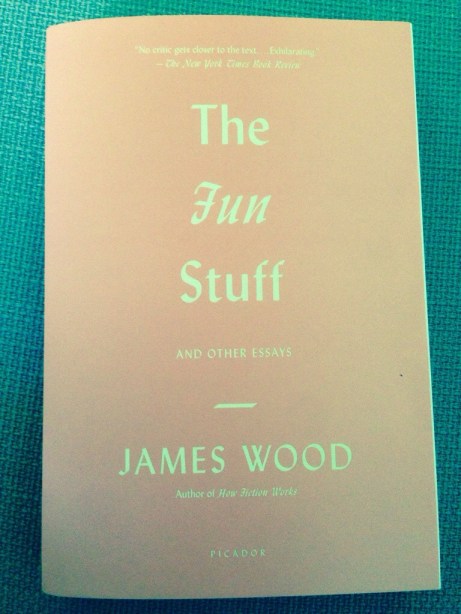
James Wood’s The Fun Stuff Reviewed

20131013-093435.jpg

I hate that I love to hate reading James Wood—and when I love what he writes I hate that I love it. His take on Blood Meridian absolutely infuriated me, but a stray line from an essay he wrote on Virginia Woolf has informed pretty much every real review I’ve tried to write since I read it. Anyone who reads deeply and earnestly and cares about literary criticism is likely to find themselves shouting at Wood, and then maybe agreeing with him—with reserved qualifications, and then shouting again. (There is an entire blog devoted to pointing out the failures of Wood’s often deeply conservative aesthetic criticism, by the way).

The Fun Stuff, collecting many of Wood’s pieces from The New Yorker (but also elsewhere), is less pretentious than How Fiction Works, Wood’s last book, a polemic hiding behind the guise of literary criticism that faulted pretty much any prose stylist who deviated from a certain mode of 19th-century free indirect style.

I’ve already read a number of the pieces collected in The Fun Stuff, which is finally out in the U.S. in trade paperback thanks to Picador. You might have read them too. His essays championing Lydia Davis and László Krasznahorkai are fine fun stuff, as is his take on the late W.G. Sebald (first published as an introduction to Austerlitz). His appreciative review of Cormac McCarthy’s The Road though is in many ways a retake on his review of Blood Meridian—Wood can only view McCarthy’s existential questions through the lens of theodicy.

James Wood is maybe most fun—or most infuriating—when he’s at his harshest. The case file here is his pointed take-down “Paul Auster’s Shallowness.” Here, Wood goes through an Auster plot “checklist”:

 A protagonist, nearly always male, often a writer or an intellectual, lives monkishly, coddling a loss—a deceased or divorced wife, dead children, a missing brother. Violent accidents perforate the narratives, both as a means of insisting on the contingency of existence and as a means of keeping the reader reading—a woman drawn and quartered in a German concentration camp, a man beheaded in Iraq, a woman severely beaten by a man with whom she is about to have sex, a boy kept in a darkened room for nine years and periodically beaten, a woman accidentally shot in the eye, and so on. The narratives conduct themselves like realistic stories, except for a slight lack of conviction and a general B-movie atmosphere. People say things like “You’re one tough cookie, kid,” or “My pussy’s not for sale,” or “It’s an old story, pal. You let your dick do your thinking for you, and that’s what happens.” A visiting text—Chateaubriand, Rousseau, Hawthorne, Poe, Beckett—is elegantly slid into the host book. There are doubles, alter egos, doppelgängers, and appearances by a character named Paul Auster. At the end of the story, the hints that have been scattered like mouse droppings lead us to the postmodern hole in the book where the rodent got in: the revelation that some or all of what we have been reading has probably been imagined by the protagonist. Hey, Roger Phaedo invented Charlie Dark! It was all in his head.

I’m not a particular fan of Paul Auster, but I imagine those who deeply enjoy his work could feel personally insulted by Wood’s take-down. We get close to the books and authors we love. I think what manifests most in Wood’s criticism here—and elsewhere—is the weariness of someone who once deeply loved literature but who is now perhaps oppressed by it—who has become too aware of its mechanics, its forms, its stale formulations and bad parlor tricks.

Wood telegraphs far more passion and generosity in the collection’s title essay, which is about Keith Moon, the legendary drummer of The Who. He compares Moon’s rhythmic chops to D.H. Lawrence’s sentences:

For me, this playing is like an ideal sentence of prose, a sentence I have always wanted to write and never quite had the confidence to: a long, passionate onrush, formally controlled and joyously messy, propulsive but digressively self-interrupted, attired but disheveled, careful and lawless, right and wrong. (You can encounter such sentences in Lawrence’s prose, in Bellow’s, sometimes in David Foster Wallace’s.) Such a sentence would be a breaking out, an escape. And drumming has always represented for me that dream of escape, when the body forgets itself, surrenders its awful self-consciousness.

I like how personal he gets here. This essay opens the collection, and the one that closes it, “Packing My Father-In-Law’s Library” also communicates personally with the reader. Unconstrained by the pretense of a book review, Wood waxes on families and libraries and the meaning of life. When he writes of his father-in-law, whose books he’s sorting through, that “The books somehow made him smaller, not larger,” it’s hard not to hear a strong undertone of autobiography in the note.

Wood’s lyric essays are an unusual standout here (unusual in the sense that if someone had strung together the words James Wood’s lyric essays, I’d probably roll my eyes). They reveal a love of reading that goes missing in his attacks and his quibbling pieces. The serious literary critic is not, of course, beholden to being merely a cheerleader for literature (or worse, a cheerleader for publishing)—but I do think that the serious literary critic should offer something beyond condemnation or unenthusiastic grumbling. The risk the professional critic runs is to see the machinations of art too plainly, to become jaded to the point that experiencing the sublime is no longer possible (Tobias Wolff’s fantastic story “Bullet in the Brain” deals handily with this theme). Wood guides us here to several writers who disrupt, estrange, and resynthesize the tired tropes of literary fiction—and it’s in that strangeness where we can find the real fun stuff.

Iced Coffee — Fairfield Porter

Magdalena Reading — Piero di Cosimo

Moby-Dick(s)

20131019-174532.jpg

These are (as near as I can tell) all the versions (translations, if you will) of Herman Melville’s Moby-Dick at our house.

20131019-174553.jpg

This is my beloved copy, a hardback Signet Classic edition that’s the size of a mass market paperback.

I love this copy because it was the one that I read when I really read Moby-Dick (I also kinda sorta ‘klept it).

20131019-174611.jpg

These abridged versions for young readers are the same, despite the cooler updated cover on the right, which I guess fooled my wife into buying another copy for me to read with my daughter. (She liked it the first time though, so….). Even the illustrations are the same:

20131019-174620.jpg

20131019-174629.jpg

More of a resource than a reading copy—although as Norton Critical Editions go, this one’s footnotes aren’t too obtrusive. Handy dictionary of nautical terms.

20131019-174637.jpg

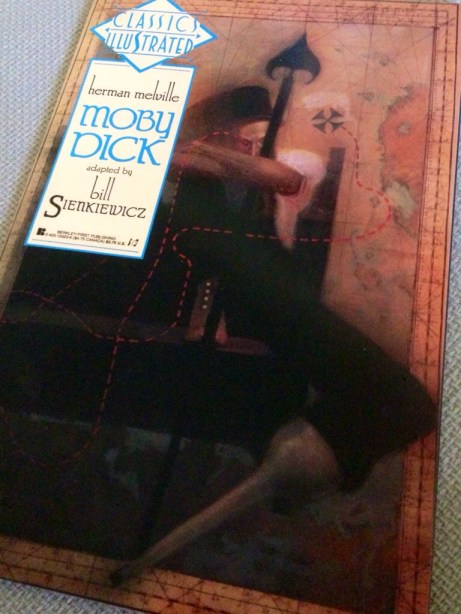
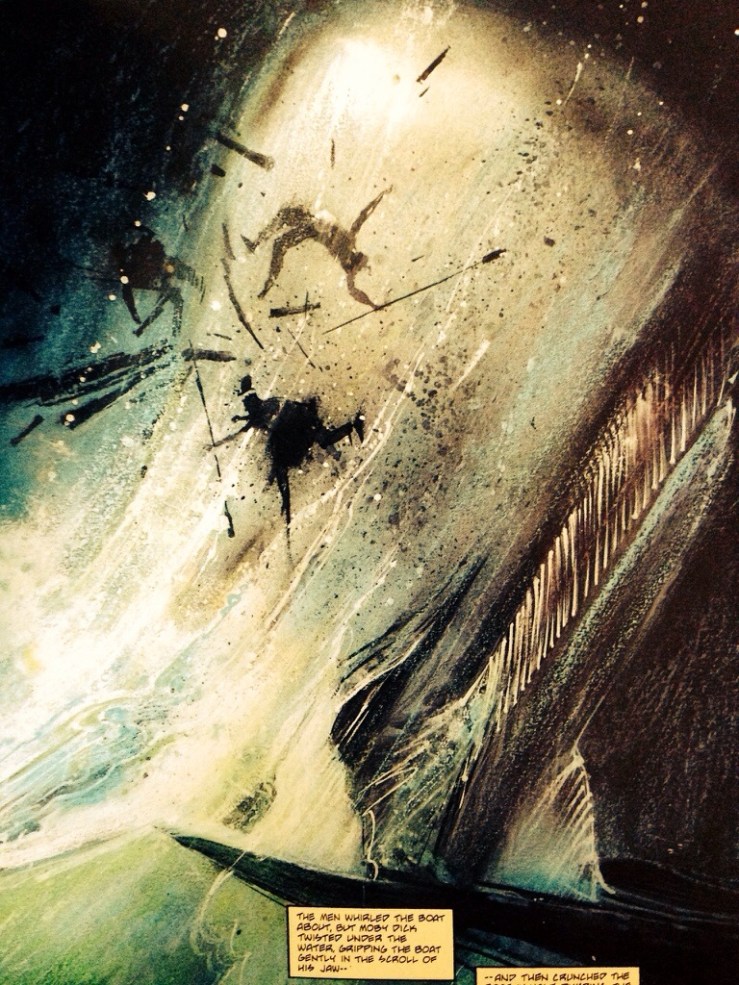
I am a huge fan of Bill Sienkiewicz. And Moby-Dick. I wish his Moby-Dick adaptation had no words though.

20131019-174646.jpg

20131019-174655.jpg

My dad’s childhood adaption, a Grosset & Dunlap from the early ’60s.

20131019-174705.jpg

20131019-174716.jpg

Sam Ita’s fantastic pop-up adaptation fails to mention Herman Melville’s name at all.

Despite the gross oversight, it’s given me hours of joy with my kids.

20131019-174740.jpg

20131019-174748.jpg

Moby-Dick was published on October 18th, 1851 in England.

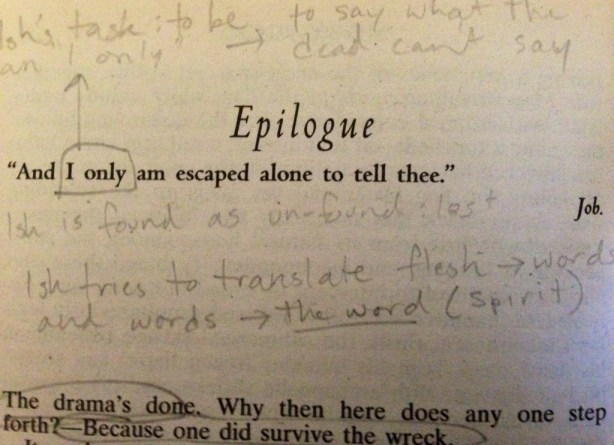
The English printer Peter Bentley’s text contained numerous errors, including leaving out the epilogue, where we learn that Ishmael survives to bear witness to disaster.

Although the American printing in November of 1851 emended many of these errors, the early reviews of Moby-Dick were scathing, and Melville’s career and reputation deteriorated.

It wasn’t until the advent of literary modernism in the first decades of the twentieth century that the world caught up to Moby-Dick.

20131019-174756.jpg

Dancer Resting — Edgar Degas

I am profiled

There is an interview with me at the WordPress news blog today. I talked to WordPress editor Ben Huberman via email; he asked me all kinds of great questions that made me reflect on what I’m doing with Biblioklept, as well as blogging and writing in general.

From the interview:

I don’t think I’d ever call myself a curator — I’m an amateur, and I hold deep respect for what traditional curators do, for their training, and for their discipline and experience. David Foster Wallace suggests that “The curator’s job [is] to recall, choose, arrange: to impose order and so communicate meaning.”

I choose and arrange, but I’m not sure how much order I impose, beyond tagging and titling, and I’m certainly not interested in making meaning for the reader, at least not with the material that I share but do not originate — I’d prefer the audience to do that work.

Our conversation was edited for length, including my response to a question Ben asked me about some of my favorite WordPress blogs; as a bonus, here’s that answer:

I’m a big fan of Time’s Flow Stemmed, a blog that started a year or two after Biblioklept. Anthony, who writes it/runs it is a really smart guy and our interests overlap—but more interestingly they diverge—so I learn a lot from what he shares. I’ve been reading his blog pretty much since it started, so watching it develop and change has been meaningful to me, both as a reader and a blogger.

I also really like Darran Anderson’s blog, Literary Flotsam & Jetsam by an Attempted Human. It’s very wry and funny and comes from this very specific place that intrigues me. He wrote an essay a few months ago called “Albert Camus and the Ventriloquists” that anyone inclined to share images and quotes of authors on the internet should read.

“The Obliterated Man” — H.G. Wells

“The Obliterated Man” by H.G. Wells

I was—you shall hear immediately why I am not now—Egbert Craddock Cummins. The name remains. I am still (Heaven help me!) Dramatic Critic to the Fiery Cross. What I shall be in a little while I do not know. I write in great trouble and confusion of mind. I will do what I can to make myself clear in the face of terrible difficulties. You must bear with me a little. When a man is rapidly losing his own identity, he naturally finds a difficulty in expressing himself. I will make it perfectly plain in a minute, when once I get my grip upon the story. Let me see—where am I? I wish I knew. Ah, I have it! Dead self! Egbert Craddock Cummins!

In the past I should have disliked writing anything quite so full of “I” as this story must be. It is full of “I’s” before and behind, like the beast in Revelation—the one with a head like a calf, I am afraid. But my tastes have changed since I became a Dramatic Critic and studied the masters—G.A.S., G.B.S., G.R.S., and the others. Everything has changed since then. At least the story is about myself—so that there is some excuse for me. And it is really not egotism, because, as I say, since those days my identity has undergone an entire alteration.

That past!… I was—in those days—rather a nice fellow, rather shy— taste for grey in my clothes, weedy little moustache, face “interesting,” slight stutter which I had caught in my early life from a schoolfellow. Engaged to a very nice girl, named Delia. Fairly new, she was— cigarettes—liked me because I was human and original. Considered I was like Lamb—on the strength of the stutter, I believe. Father, an eminent authority on postage stamps. She read a great deal in the British Museum. (A perfect pairing ground for literary people, that British Museum—you should read George Egerton and Justin Huntly M’Carthy and Gissing and the rest of them.) We loved in our intellectual way, and shared the brightest hopes. (All gone now.) And her father liked me because I seemed honestly eager to hear about stamps. She had no mother. Indeed, I had the happiest prospects a young man could have. I never went to theatres in those days. My Aunt Charlotte before she died had told me not to.

Then Barnaby, the editor of the Fiery Cross, made me—in spite of my spasmodic efforts to escape—Dramatic Critic. He is a fine, healthy man, Barnaby, with an enormous head of frizzy black hair and a convincing manner, and he caught me on the staircase going to see Wembly. He had been dining, and was more than usually buoyant. “Hullo, Cummins!” he said. “The very man I want!” He caught me by the shoulder or the collar or something, ran me up the little passage, and flung me over the waste-paper basket into the arm-chair in his office. “Pray be seated,” he said, as he did so. Then he ran across the room and came back with some pink and yellow tickets and pushed them into my hand. “Opera Comique,” he said, “Thursday; Friday, the Surrey; Saturday, the Frivolity. That’s all, I think.” Continue reading ““The Obliterated Man” — H.G. Wells”

Rest on the Way from Kiev — Vladimir Makovsky

Correction (Blanchot)

correction

“The Huldrefish,” A Weird Tale of the Northern Seas

THE HULDREFISH

“The Huldrefish” by Jonas Lie; Translated from Norwegian by Nisbet Bain (Illustration by Laurence Housman)

It was such an odd trout that Nona hauled in at the end of his fishing-line. Large and fat, red spotted and shiny, it sprawled and squirmed, with its dirty yellow belly above the water, to wriggle off the hook. And when he got it into the boat, and took it off the hook, he saw that it had only two small slits where the eyes should have been.

It must be a huldrefish, thought one of the boatmen, for rumour had it that that lake was one of those which had a double bottom.

But Nona didn’t trouble his head very much about what sort of a fish it was, so long as it was a big one. He was ravenously hungry, and bawled to them to row as rapidly as possible ashore so as to get it cooked.

He had been sitting the whole afternoon with empty lines out in the mountain lake there; but as for the trout, it was only an hour ago since it had been steering its way through the water with its rudder of a tail, and allowed itself to be fooled by a hook, and already it lay cooked red there on the dish.

But now Nona recollected about the strange eyes, and felt for them, and pricked away at its head with his fork. There was nothing but slits outside, and yet there was a sort of hard eyeball inside. The head was strangely shaped, and looked very peculiar in many respects.

He was vexed that he had not examined it more closely before it was cooked; it was not so easy now to make out what it really was. It had tasted first-rate, however, and that was something.

But at night there was, as it were, a gleam of bright water before his eyes, and he lay half asleep, thinking of the odd fish he had pulled up.

He was in his boat again, he thought, and it seemed to him as if his hands felt the fish wriggling and sprawling for its life, and shooting its snout backwards and forwards to get off the hook.

All at once it grew so heavy and strong that it drew the boat after it by the line.

It went along at a frightful speed, while the lake gradually diminished, as it were, and dried up.

There was an irresistible sucking of the water in the direction the fish went, which was towards a hole at the bottom of the lake like a funnel, and right into this hole went the boat.

It glided for a long time in a sort of twilight along a subterranean river, which dashed and splashed about him. The air that met him was, at first, chilly and cellar-like; gradually, however, it grew milder and milder, and warmer and warmer.

The stream now flowed along calmly and quietly, and broadened out continually till it fell into a large lake.

Beyond the borders of this lake, but only half visible in the gloom, stretched swamps and morasses, where he heard sounds as of huge beasts wading and trampling. Serpent like they rose and writhed with a crashing and splashing and snorting amidst the tepid mud and mire.

By the phosphorescent gleams he saw various fishes close to his boat, but all of them lacked eyes.

And he caught glimpses of the outlines of gigantic sea-serpents stretching far away into the darkness. He now understood that it was from down here that they pop up their heads off the coast in the dog days when the sea is warm.

The lindworm, with its flat head and duck’s beak, darted after fish, and crept up to the surface of the earth through the slimy ways of mire and marsh.

Through the warm and choking gloom there came, from time to time, a cooling chilling blast from the cold curves and winds of the slimy and slippery greenish lichworm, which bores its way through the earth and eats away the coffins that are rotting in the churchyards.

Horrible shapeless monsters, with streaming manes, such as are said to sometimes appear in mountain tarns, writhed and wallowed and seized their prey in the fens and marshes.

And he caught glimpses of all sorts of humanlike creatures, such as fishermen and sailors meet and marvel at on the sea, and landsmen see outside the elfin mounds.

And, besides, that there was a soft whizzing and an endless hovering and swarming of beings, whose shapes were nevertheless invisible to the eye of man.

Then the boat glided into miry pulpy water, where her course tended downwards, and where the earth-vault above darkened as it sank lower and lower.

All at once a blinding strip of light shot down from a bright blue slit high, high, above him.

A stuffy vapour stood round about him. The water was as yellow and turbid as that which comes out of steam boilers.

And he called to mind the peculiar tepid undrinkable water which bubbles up by the side of artesian wells. It was quite hot. Up there they were boring down to a world of warm watercourses and liquid strata beneath the earth’s crust.

Heat as from an oven rose up from the huge abysses and dizzying clefts, whilst mighty steaming waterfalls roared and shook the ground.

All at once he felt as if his body were breaking loose, freeing itself, and rising in the air. He had a feeling of infinite lightness, of a wondrous capability for floating in higher atmospheres and recovering equilibrium.

And, before he knew how it was, he found himself up on the earth again.

 

Maria Magdalena — Piero di Cosimo

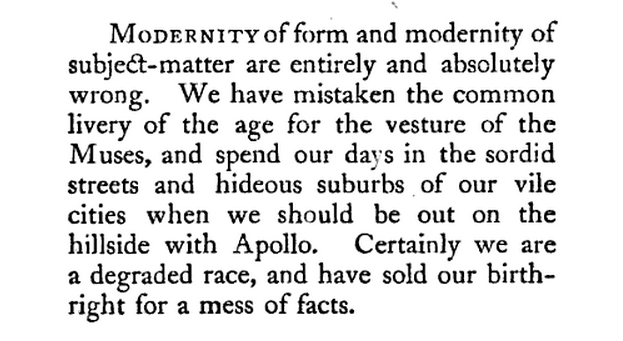
Modernity (Oscar Wilde)

modernity

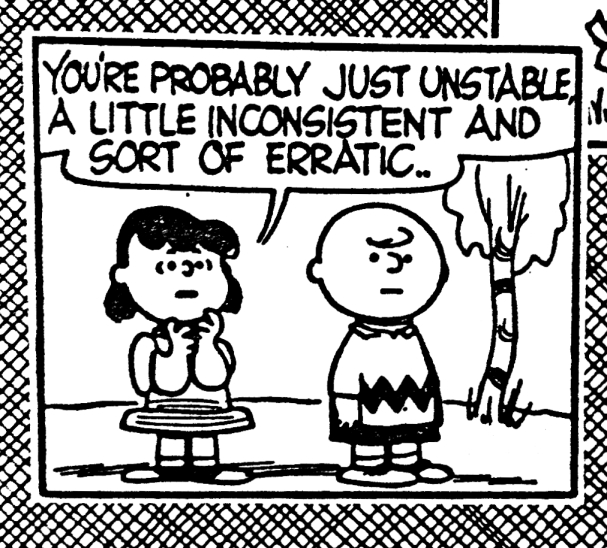
Unstable (Peanuts)

peanuts