Best Books of 1972?

A conversation with a colleague this week led me on a not-entirely successful search for the “best” books of 1972.

The gist of the conversation is something like this: Asked about the “best” books that came out last year, I admitted I don’t read that much new fiction, so I had no idea.

I also said something cavalier along the lines of, It takes like half a century to know if a novel is important or not. (This is not a statement I entirely believe in.)

So what did folks in 1972 think the best books published that year were?

The first thing I did is check the bestsellers of fiction that year.

(I should be clear that I’m mostly interested in novels here, or books of a novelistic/artistic scope, whatever that means–so I didn’t really pursue nonfiction stuff that much here.)

The New York Time’s fiction bestsellers for 1972 is dominated by two novels: Herman Wouk’s The Winds of War (21 weeks) and Richard Bach’s Jonathan Livingstone Seagull (26 weeks). Fiction bestsellers are often (but not always) entertainments that we don’t expect to last over time, and while Wouk and Bach’s titles still get reprints every decade or so, they aren’t exactly Ulysses (published fifty years earlier in 1922).

So I looked for what titles the NYT critics deemed the best books of 1972. The contemporary NYT comes up with a list of ten titles each year (five fiction, five non-), but things were a little looser fifty years ago. In December of that year, the NYT offered just “Five Significant Books of 1972.”

This list is entirely nonfiction:

The Children of Pride: A True Story of Georgia and the Civil War, edited by Robert Manson Myers (“…a loving work of scholarship. From 6,000 letters written among several branches of a Southern family between 1854 and 1865, Robert Manson Myers has woven 1,200 of them into a massive and touching portrait of a bygone society.”)

The Master by Leon Edel (“With…the fifth and final volume of his biography of Henry James, Leon Edel brings to a close a literary labor of 20 years.”)

Fire in the Lake by Frances FitzGerald (“…the richest kind of contemporary history; it places political and military events in cultural perspective—something rarely done in the hundreds of books written about Vietnam during the last dozen years.”)

The Coming of Age by Simone de Beauvoir, translated by Patrick O’Brian (“…confronts a subject of universal private anguish and universal public silence…she has single‐handedly established a history of and a rhetoric for the process of aging.”)

A Theory of Justice by John Rawls (“…a magisterial exercise in ‘moral geometry.'”)

Rawls’s book is the only one I’ve heard of and de Beauvoir is the only other author whose name I recognize on the list (I did know that there was a ridiculously long multi-volume biography of Henry James). Beyond the list’s being all nonfiction (if there was a fiction version somewhere, I could not find it), it’s also remarkable how long each of the books is: the shortest is 491 pages; the longest is 1,845 pages. Those are long books!

I tried searching for other newspaper and magazine lists of best books of 1972 but came up short. If anyone has anything else to offer for contemporary thoughts on the best of ’72 (by which I mean, folks in ’72 on the best of ’72), I’m all virtual ears.

I then looked into what Goodreads had to say.

I have no idea how their list works, but Richard Adams’s Watership Down tops it. That book completely fucked me up as a kid, which is maybe why I didn’t press too hard when both of my children were reluctant to read it when I pressed it on them. I think it’s a classic though (oh, and it made The New York Times year-end list in 1974–I guess it didn’t get an American publication until then?).

I don’t really think Watership Down is a children’s book, but rounding out the top three on the Goodreads list are two classics of the genre: Arnold Lobel’s Frog and Toad Together and Judith Viorst’s Alexander and the Terrible Horrible No Good Very Bad Day. (Judy Blume’s Tales of a Fourth Grade Nothing comes in way too low at #44.)

And now, because I’m lazy, I will use the rest of the list to offer an incomplete, inconclusive, and ultimately unnecessary list of the best books of 1972. There are many books on the list I’m pilfering from I have not read (including ones by authors whose books I esteem, like Nabokov, Welty, DeLillo, and Atwood), and these books may deserve a spot, as might the many many books that have failed through no fault of their own to wind up under the right eyes, ears, hands.

A list:

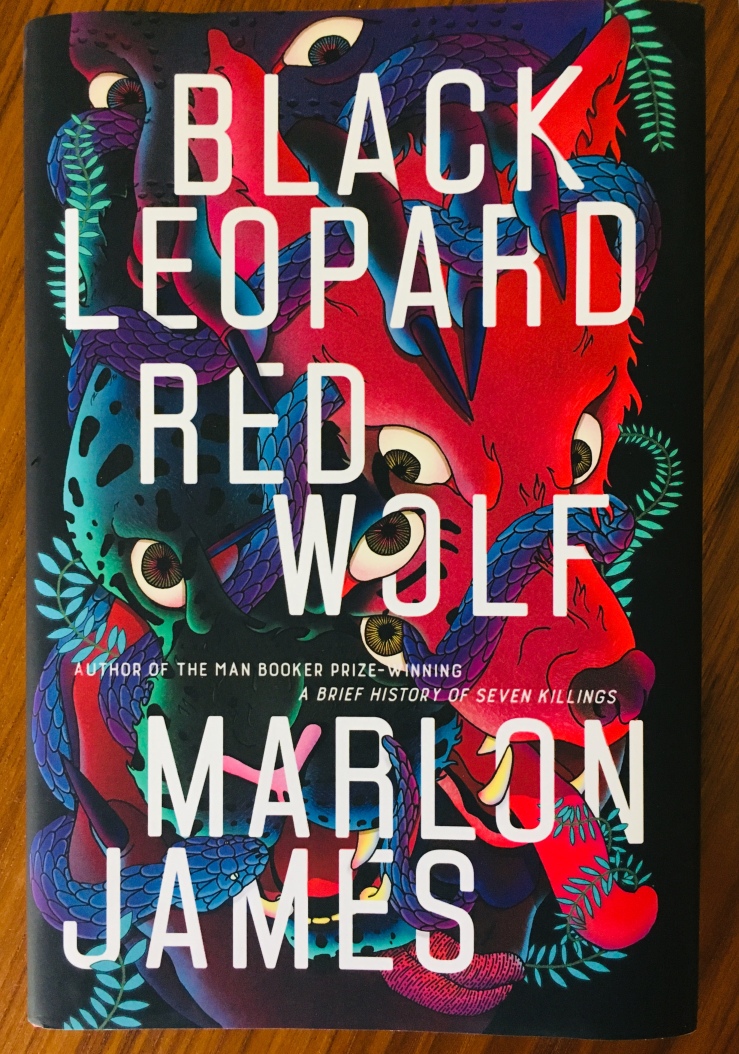
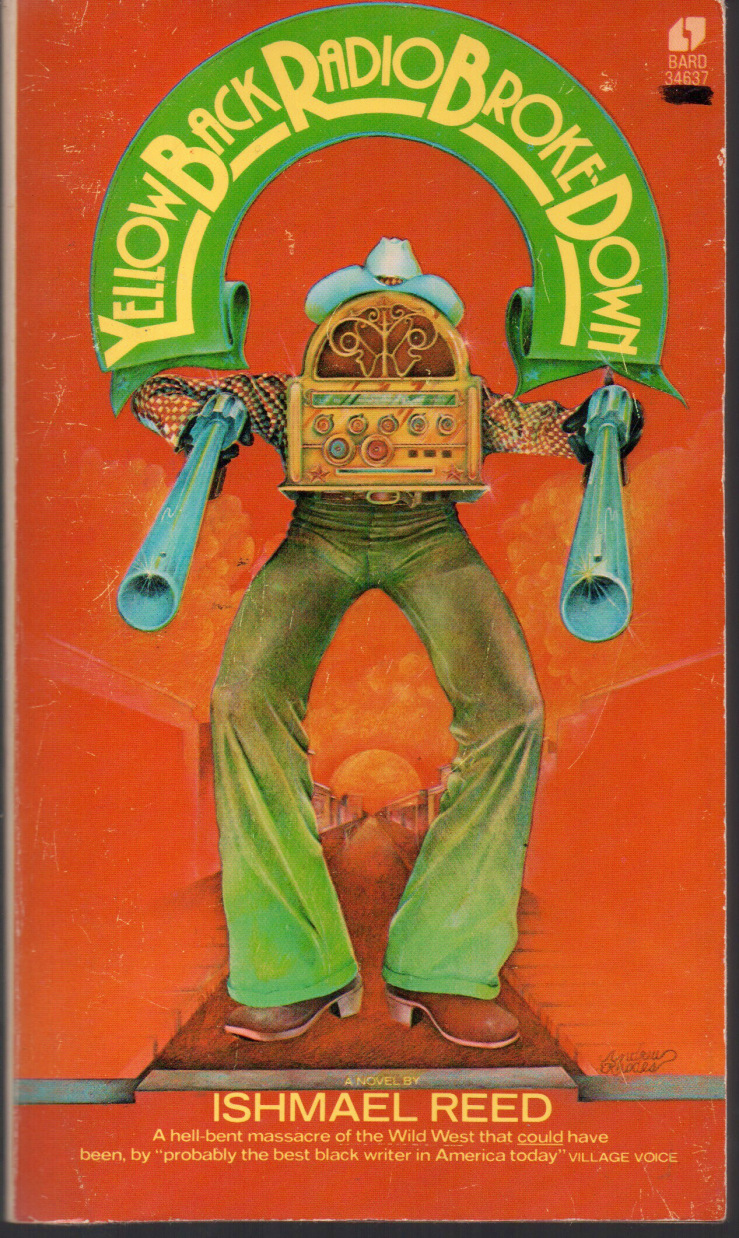
Mumbo Jumbo, Ishmael Reed

Invisible Cities, Italo Calvino

The Infernal Desire Machines of Doctor Hoffman, Angela Carter

Watership Down, Richard Adams

The Farthest Shore, Ursula K. LeGuin

Ways of Seeing, John Berger

Roadside Picnic, Arkady Strugatsky and Boris Strugatsky

Chimera, John Barth

Augustus, John Williams

Sadness, Donald Barthelme

“Libraries Destroyed by Fire” | From William Blades’ The Enemies of Books

“Libraries Destroyed by Fire”

from

William Blades’

The Enemies of Books 


THERE are many of the forces of Nature which tend to injure Books; but among them all not one has been half so destructive as Fire. It would be tedious to write out a bare list only of the numerous libraries and bibliographical treasures which, in one way or another, have been seized by the Fire-king as his own. Chance conflagrations, fanatic incendiarism, judicial bonfires, and even household stoves have, time after time, thinned the treasures as well as the rubbish of past ages, until, probably, not one thousandth part of the books that have been are still extant. This destruction cannot, however, be reckoned as all loss; for had not the “cleansing fires” removed mountains of rubbish from our midst, strong destructive measures would have become a necessity from sheer want of space in which to store so many volumes.

Before the invention of Printing, books were comparatively scarce; and, knowing as we do, how very difficult it is, even after the steam-press has been working for half a century, to make a collection of half a million books, we are forced to receive with great incredulity the accounts in old writers of the wonderful extent of ancient libraries.

The historian Gibbon, very incredulous in many things, accepts without questioning the fables told upon this subject. No doubt the libraries of MSS. collected generation after generation by the Egyptian Ptolemies became, in the course of time, the most extensive ever then known; and were famous throughout the world for the costliness of their ornamentation, and importance of their untold contents. Two of these were at Alexandria, the larger of which was in the quarter called Bruchium. These volumes, like all manuscripts of those early ages, were written on sheets of parchment, having a wooden roller at each end so that the reader needed only to unroll a portion at a time. During Caesar’s Alexandrian War, B.C. 48, the larger collection was consumed by fire and again burnt by the Saracens in A.D. 640. An immense loss was inflicted upon mankind thereby; but when we are told of 700,000, or even 500,000 of such volumes being destroyed we instinctively feel that such numbers must be a great exaggeration. Equally incredulous must we be when we read of half a million volumes being burnt at Carthage some centuries later, and other similar accounts. Continue reading ““Libraries Destroyed by Fire” | From William Blades’ The Enemies of Books”

Two by Pessoa and Zak Smith’s Gravity’s Rainbow Illustrated (Books acquired last week and late last year)

Last week I finally got into a collection of Fernando Pessoa’s writing called Writings on Art and Poetical Theory. The books contains pieces that Pessoa composed in English, and is out next year from Contra Mundum Press. Their blurb:

Writings on Art and Poetical Theory contains a selection of Fernando Pessoa’s writings (or those of his heteronyms) on art and poetical theory, originally written in English. In Pessoa’s oeuvre one finds not only literary and fictional works but also a multiplicity of theoretical texts on the most diverse subjects concerning artistic movements, literature, and writers.

In this book, we witness Pessoa explore, through various heteronyms, general theories on poetics, the poetries of other heteronyms, the uses and abuses of criticism, and more. Also included are essays on sensationism (an aesthetic movement Pessoa dubs a new species of Weltanschauung), translation, and a brief history of English literature, which is comprised of fragments on Shakespeare, Milton, the British Romantics, Dickens, Wilde, and others, as well as additional material, such as Pessoa’s own poem Antinous.

This edition, prepared by Nuno Ribeiro and Cláudia Souza, allows us to have an overview of Pessoa’s writings on art and poetic theory — most of which are presented here for the first time to English readers —, thus opening the way for future studies on one of the most significant authors of Portuguese modernism.

Dabbling about in Writings reminded me that I’ve never made a stab at Pessoa’s monumental work, The Book of Disquiet. I picked up New Directions’ recent Complete Edition in translation by Margaret Jull Costa. I ended up reading a big chunk of it that night and have dipped into it all week and I’m not sure if I love it or hate it. It’s like the anti-Leaves of Grass, if that makes sense. It also seems like the kind of book to just pick up and read and random, which I’ve been doing since my initial fifty-page jog into it. In a short doses the fragments are lovely, poetic, aphoristic, but in longer dives the language becomes oppressive, the spirit draining and even venomous.

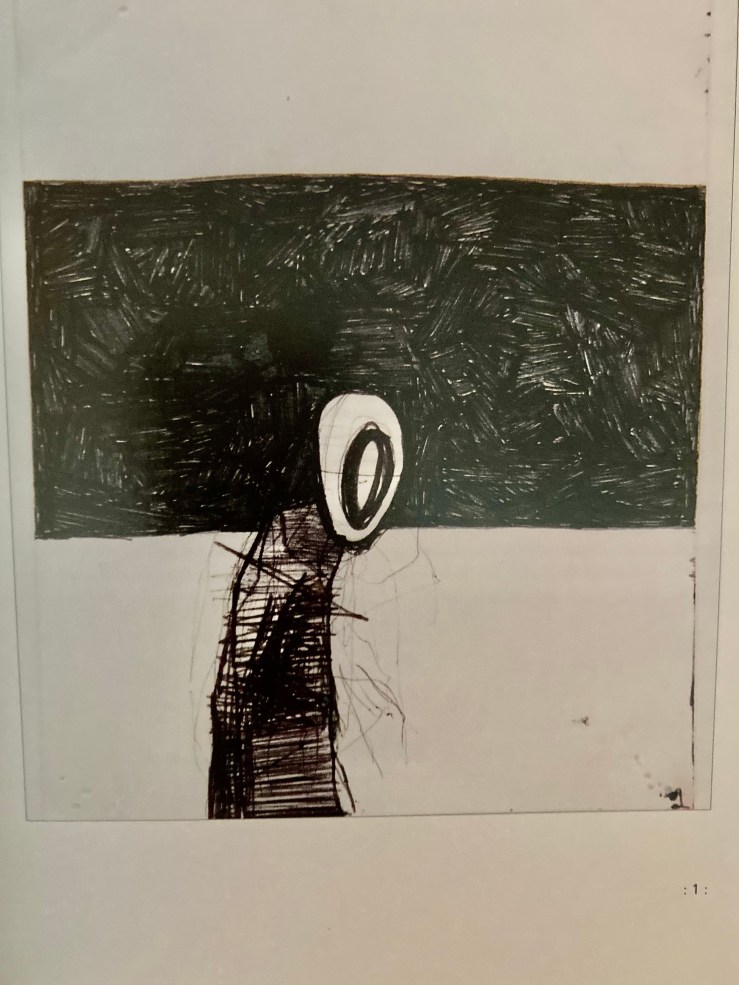
While I was at the bookstore I also spied a copy of Zak Smith’s Gravity’s Rainbow Illustrated. I’d found a used copy at this same story maybe ten years ago and thought twenty bucks was too much for it, and have regretted that decision for years now. Here’s the first page:

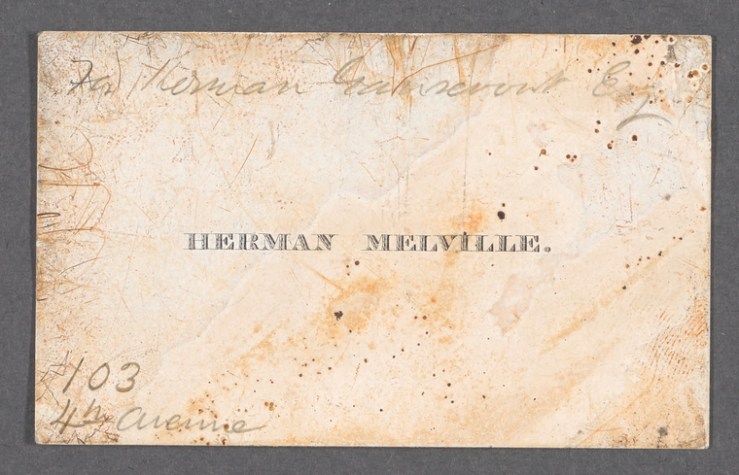
Herman Melville’s calling card

Italian biblioklept arrested by the FBI for stealing unpublished manuscripts

The New York Times and other sources have reported that “Filippo Bernardini, an Italian citizen who worked in publishing,” has been arrested by the FBI for fraud and identity theft. Bernandini stole numerous unpublished manuscripts over five years, mainly through email phishing scams. Bernandini’s motives have yet to surface. From the Times:

For years, the scheme has baffled people in the book world. Works by high-profile writers and celebrities like Margaret Atwood and Ethan Hawke have been targeted, but so have story collections and works by first-time authors. When manuscripts were successfully stolen, none of them seemed to show up on the black market or the dark web. Ransom demands never materialized. Indeed, the indictment details how Mr. Bernardini went about the scheme, but not why.

The New York Times first reported on the as-then-unknown biblioklept in late 2020.

I’m guessing Bernandini may have his own book deal pretty soon.

A (probably incomplete) list of books I read or reread in 2021


☉ indicates a reread.

☆ indicates an outstanding read.


The Real Cool Killers, Chester Himes ☆

The Bachelors, Muriel Spark

Bina, Anakana Schofield

Moby-Dick, Herman Melville ☉☆

Margaret the First, Danielle Dutton ☆

The Florida Keys, Joy Williams

Passages, Ann Quin☆

V., Thomas Pynchon ☉☆

Notes from Childhood, Norah Lange (trans. by Charlotte Whittle)

Albert Angelo, B.S. Johnson ☆

Trawl, B.S. Johnson

House Mother Normal, B.S. Johnson

Outline, Rachel Cusk

Perfume, Patrick Süskind (trans. by John E. Woods) ☆

The Unfortunates, B.S. Johnson

Sassafrass, Cypress, and Indigo, Ntozake Shange

The Final Revival of Opal & Nev, Dawnie Walton

Dope Rider: A Fistful of Delirium, Paul Kirchner

The Postman Always Rings Twice, James M. Cain ☆

By Night in Chile, Roberto Bolaño (trans. by Chris Andrews) ☉☆

Cowboy Graves, Roberto Bolaño (trans. by Natasha Wimmer)

Double Indemnity, James M. Cain

Invisible Cities, Italo Calvino (trans. by William Weaver)☉

If on a winter’s night a traveler…, Italo Calvino (trans. by William Weaver)☉

The Baron in the Trees, Italo Calvino (trans. by Archibald Colquhoun) ☉☆

Mister Boots, Carol Emshwiller

Permanent Earthquake, Evan Dara

The Woman in the Dunes, Kobo Abe (trans. by E. Dale Saunders)

The Slynx, Tatyana Tolstoya (trans. by Jamey Gambrell) ☆

The Shape of Content, Ben Shahn

Anecdotes, Heinrich von Kleist (trans. by Matthew Spencer)

Hurricane Season, Fernanda Melchor (trans. by Sophie Hughes) ☆

Sixty Stories, Donald Barthelme ☉☆

Hiding Man, Tracy Daugherty☉

Body Count, Francie Schwartz

The Old People, A.J. Perry

Carmen Dog, Carol Emshwiller ☆

Remain in Love, Chris Frantz

The Witchcraft of Salem Village, Shirley Jackson

In the Eye of the Wild, Nastassja Martin (trans. Sophie R. Lewis)

Rough Day, Ed Skoog

Letters from Mom, Julio Cortazar (trans. by Magdalena Edwards)

Under the Jaguar Sun, Italo Calvino (trans. by William Weaver)

The Nonexistant Knight, Italo Calvino (trans. by Archibald Colquhoun)

The Cloven Viscount, Italo Calvino (trans. by Archibald Colquhoun)

Don’t Let Me Be Lonely, Claudia Rankine

Blood Meridian, Cormac McCarthy ☉☆

A hat trick in a medicine show, a fevered dream | Blood Meridian

The question was then put as to whether there were on Mars or other planets in the void men or creatures like them. And at this, the judge who had returned to the fire and stood half naked and sweating, spoke and said that there were not and that there were no men anywhere in the universe save those upon the earth. All listened as he spoke; those who had turned to watch him and those who would not.

The truth about the world, he said, is that anything is possible. Had you not seen it all from birth and thereby bled it of its strangeness it would appear to you for what it is, a hat trick in a medicine show, a fevered dream, a trance bepopulate with chimeras having neither analogue nor precedent, an itinerant carnival, a migratory tentshow whose ultimate destination after many a pitch in many a mudded field is unspeakable and calamitous beyond reckoning.

The universe is no narrow thing and the order with it is not constrained by any latitude of its conception to repeat what exists in one part in any other part. Even in this world more things exist without our knowledge than with it and the order in creation which you see is that which you have put there, like a string in a maze, so that you shall not lose your way. For existence has its own order and that no man’s mind can compass, that mind itself being but a fact among others.

A passage from Cormac McCarthy’s Blood Meridian.


A Mason & Dixon Christmastide | Thomas Pynchon

They discharge the Hands and leave off for the Winter. At Christmastide, the Tavern down the Road from Harlands’ opens its doors, and soon ev’ryone has come inside. Candles beam ev’rywhere. The Surveyors, knowing this year they’ll soon again be heading off in different Directions into America, stand nodding at each other across a Punch-bowl as big as a Bathing-Tub. The Punch is a secret Receipt of the Landlord, including but not limited to peach brandy, locally distill’d Whiskey, and milk. A raft of long Icicles broken from the Eaves floats upon the pale contents of the great rustick Monteith. Everyone’s been exchanging gifts. Somewhere in the coming and going one of the Children is learning to play a metal whistle. Best gowns rustle along the board walls. Adults hold Babies aloft, exclaiming, “The little Sausage!” and pretending to eat them. There are popp’d Corn, green Tomato Mince Pies, pickl’d Oysters, Chestnut Soup, and Kidney Pudding. Mason gives Dixon a Hat, with a metallick Aqua Feather, which Dixon is wearing. Dixon gives Mason a Claret Jug of silver, crafted in Philadelphia. There are Conestoga Cigars for Mr. Harland and a Length of contraband Osnabrigs for Mrs. H. The Children get Sweets from a Philadelphia English-shop, both adults being drawn into prolong’d Negotiations with their Juniors, as to who shall have which of. Mrs. Harland comes over to embrace both Surveyors at once. “Thanks for simmering down this Year. I know it ain’t easy.”
“What a year, Lass,” sighs Dixon.
“Poh. Like eating a Bun,” declares Mason.”

The last paragraphs of Ch. 52 of Thomas Pynchon’s novel Mason & Dixon.

A Blood Meridian Christmas

Cormac McCarthy’s seminal anti-Western Blood Meridian isn’t exactly known for visions of peace on earth and good will to man. Still, there’s a strange scene in the book’s final third that subtly recalls (and somehow inverts) the Christmas story. The scene takes place at the end of Chapter 15. The Kid, erstwhile protagonist of Blood Meridian, has just reunited with the rampaging Glanton gang after getting lost in the desert and, in a vision-quest of sorts, has witnessed “a lone tree burning on the desert” (a scene I once argued was the novel’s moral core).

Glanton’s marauders, tired and hungry, find temporary refuge from the winter cold in the town of Santa Cruz where they are fed by Mexicans and then permitted to stay the night in a barn. McCarthy offers a date at the beginning of the chapter — December 5th — and it’s reasonable to assume, based on the narrative action, that the night the gang spends in the manger is probably Christmas Eve. Here is the scene, which picks up as the gang — “they” — are led into the manger by a boy–

The shed held a mare with a suckling colt and the boy would would have put her out but they called to him to leave her. They carried straw from a stall and pitched it down and he held the lamp for them while they spread their bedding. The barn smelled of clay and straw and manure and in the soiled yellow light of the lamp their breath rolled smoking through the cold. When they had arranged their blankets the boy lowered the lamp and stepped into the yard and pulled the door shut behind, leaving them in profound and absolute darkness.

No one moved. In that cold stable the shutting of the door may have evoked in some hearts other hostels and not of their choosing. The mare sniffed uneasily and the young colt stepped about. Then one by one they began to divest themselves of their outer clothes, the hide slickers and raw wool serapes and vests, and one by one they propagated about themselves a great crackling of sparks and each man was seen to wear a shroud of palest fire. Their arms aloft pulling at their clothes were luminous and each obscure soul was enveloped in audible shapes of light as if it had always been so. The mare at the far end of the stable snorted and shied at this luminosity in beings so endarkened and the little horse turned and hid his face in the web of his dam’s flank.

The “shroud of palest fire” made of sparks is a strange image that seems almost supernatural upon first reading. The phenomena that McCarthy is describing is simply visible static electricity, which is not uncommon in a cold, dry atmosphere–particularly if one is removing wool clothing. Still, the imagery invests the men with a kind of profound, bizarre significance that is not easily explainable. It is almost as if these savage men, naked in the dark, are forced to wear something of their soul on the outside. Tellingly, this spectacle upsets both the mare and her colt, substitutions for Mary and Christ child, which makes sense. After all, these brutes are not wise men.

[Ed. note–Biblioklept first ran a version of this post in 2010. I’m currently rereading Blood Meridian and the strange rare pockets of peace and goodness stand out to me more–the woman who tends the kid’s gunshot wound early in the novel, the cattle drovers who feed him and give him a Green River knife—and maybe even the weirdo hermit who offers him shelter. I’ll look for more moments of peace in all the violence.]

Christmas etymologies

A selection from

Christmas in Ritual and Tradition, Christian and Pagan (1912)

by

Clement A. Miles


The names given to the feast by different European peoples throw a certain amount of light on its history. Let us take five of them—ChristmasWeihnachtNoëlCalendas, and Yule—and see what they suggest.

I. The English Christmas and its Dutch equivalent Kerstmisse, plainly point to the ecclesiastical side of the festival; the German Weihnacht (sacred night) is vaguer, and might well be either pagan or Christian; in point of fact it seems to be Christian, since it does not appear till the year 1000, when the Faith was well established in Germany. Christmas and Weihnacht, then, may stand for the distinctively Christian festival, the history of which we may now briefly study. Continue reading “Christmas etymologies”

Darker sensations | A review of Italo Calvino’s Under the Jaguar Sun

I read Italo Calvino’s posthumous collection Under the Jaguar Sun over the past three days (in William Weaver’s 1988 translation). When I bought it last month I had no idea that it was a collection of stories (and not a novella), nor posthumous. I didn’t read the summary on the back. I just knew it was a thin Calvino I hadn’t read and I’ve been into thin reads lately. (I have two fat novels in translation staring me down from across the room as I write this. Their accusations linger.)

But Under the Jaguar Sun is posthumous, and it is a collection–a thin collection, sure, but the stories are strong. In her note at the end of the book, Esther Calvino offers the following:

In 1972 Calvino started writing a book about the five senses. At his death, in 1985, only three stories had been completed: “Under the Jaguar Sun,” “A King Listens,” and “The Name, the Nose.” Had he lived, this book would certainly have evolved into something quite different.

Esther Calvino suggests that Italo “would have provided a frame, as in If on a winter’s night a traveler, a frame that amounts to another novel, virtually a book in itself,” but concludes that the book should be read “simply as three stories written in different periods of his life.” That conclusion was the last thing I read in the book, which I think is fortunate–my reading wasn’t colored by a sense of lack, a sense of what could have been.

The first story, “Under the Jaguar Sun” (1982), is the strongest. The unnamed narrator and his companion Olivia (presumably his wife) are traveling through the state of Oaxaca in Mexico. They visit temples, soak in history, but mostly enjoy the food. “Under the Jaguar Sun” is the “taste” episode of Calvino’s would-be five senses novel, and at times the story reads like a gourmand’s travelogue. The couple, led by Olivia, seek newer, stranger flavors. Calvino’s narrator renders the gustatory titillation in fatty detail. Our boy gets his first taste of guac:

… we found guacamole, to be scooped up with crisp tortillas that snap into many shards and dip like spoons into the thick cream (the fat softness of the aguacate — the Mexican national fruit, known to the rest of the world under the distorted name of “avocado” — is accompanied and underlined by the angular dryness of the tortilla, which, for its part, can have many flavors, pretending to have none); then guajolote con mole poblano — that is, turkey with Puebla-style mole sauce, one of the noblest among the many moles, and most laborious (the preparation never takes less than two days), and most complicated, because it requires several different varieties of chile, as well as garlic, onion, cinnamon, cloves, pepper, cumin, coriander, and sesame, almonds, raisins, and peanuts, with a touch of chocolate; and finally quesa-dillas (another kind of tortilla, really, for which cheese is incorporated in the dough, garnished with ground meat and refried beans).

The real flavor the pair (again, led by Olivia) seems to truly hanker after though is, uh, human flesh. There’s a light parody of tourism happening in “Under the Jaguar Sun,” but the story’s core is cannibalism, victors and victims, the predatory past. Olivia repeatedly seeks to learn about “that flavor” — the flavor of humans sacrificed by Aztecs through ritual sacrifice. She even asks if the priests who oversaw the sacrifices left any recipes.

The cannibal motif slithers into the couple’s (perhaps-failing) relationship. The narrator imagines himself as a willing victim to his partner:

It was the sensation of her teeth in my flesh that I was imagining, and I could feel her tongue lift me against the roof of her mouth, enfold me in saliva, then thrust me under the tips of the canines. I sat there facing her, but at the same time it was as if a part of me, or all of me, were contained in her mouth, crunched, torn shred by shred. The situation was not entirely passive, since while I was being chewed by her I felt also that I was acting on her, transmitting sensations that spread from the taste buds through her whole body. I was the one who aroused her every vibration — it was a reciprocal and complete relationship, which involved us and overwhelmed us.

“Under the Jaguar Sun” is unusually dark for Calvino. The sinister pulse in the background and the enthralling unresolved mystery recall the work of one of Calvino’s descendents, Roberto Bolaño—or really any descendent of the Marquis de Sade.

The next story, “A King Listens” (1984) is also uncharacteristically dark for Calvino, although it is composed in the master’s standby, the second-person perspective. Here, the you is a king. Despite its shadowy contours, “A King Listens” finds Calvino in familiar territory, playing with semiotics:

A king is denoted by the fact that he is sitting on the throne, wearing the crown, holding the scepter. Now that these attributes are yours, you had better not be separated from them even for a moment.

That core anxiety—holding onto the attributes of rule, of the symbols and signs of kingness—form the backbone of the fevered plot. The You-King finds himself imperiled by the ever-present specter of a coup. And the ever-present threat of a coup is, of course, part and parcel of the kingness of being king.

“A King Listens” plays out like something out of Poe:

Your every attempt to get out of the cage is destined to fail: it is futile to seek yourself in a world that does not belong to you, that perhaps does not exist. For you there is only the palace, the great reechoing vaults, the sentries’ watches, the tanks that crunch the gravel, the hurried footsteps on the staircase which each time could be those announcing your end. These are the only signs through which the world speaks to you; do not let your attention stray from them even for an instant; the moment you are distracted, this space you have constructed around yourself to contain and watch over your fears will be rent, torn to pieces.

With its paranoid court intrigues and shadowy dream-logic, “A King Listens” reminded me very much of a sketch that might find its way into Mervyn Peake’s Gormenghast trilogy.

The last piece in Under the Jaguar Sun is “The Name, The Nose” is the shortest and earliest (1972). I imagine Calvino might have expanded (and improved on) it had he lived to see (taste smell feel hear) his five senses book to completion. The narrative trick behind the “The Name the Nose” is a fairly straightforward postmodern conceit: three narrators from different eras tell stories that are archetypically identical. Their stories are all versions of Cinderella, only told from the prince’s perspective. Oh, and that glass slipper is a very specific scent. We get a 17th. century French dandy, a 1960s rock star, and a caveman (had Calvino read William Golding’s The Inheritors?) all sniffing after a particular lady’s singular scent. Calvino’s conceit allows him to riff on anthropology and biology, and the conclusion seems to be that all of the manners, modes, and airs that we might put on doesn’t change the fact that we are beings who sense, who smell to survive and procreate. Our caveboy:

 Odor, that’s what each of us has that’s different from the others. The odor tells you immediately and certainly what you need to know. There are no words, there is no information more precise than what the nose receives.

The dark trajectory of each male pursuant is again Edgar Allan Poe territory, gothic ground. In the end, the odor that haunts them is death. (I wonder if Patrick Süskind read this story, which seems like a condensation of his novel Perfume.)

Under the Jaguar Sun is probably the darkest thing I’ve read by Calvino. The stories here suggest that human perception is inexorably linked to death and sex, and that attempts to turn those links into signs and symbols are survival mechanisms. There might not be a soul in this world. But perhaps the darker sensations here are really just senses evading signs, senses just sensing. The world is dark without sense; sensation illuminates darkness. That’s what Calvino has done here.

I don’t think this collection is the best introduction to Calvino for those interested (although I think anyone interested probably knows to start with If on a winter’s night a traveler or Invisible Cities—or, hey, listen to me, start with The Baron in the Trees). I think Under the Jaguar Sun does offer a different flavor, or scent, or tone to Calvino’s oeuvre, though, and I enjoyed my time in these tales.

F. Scott Fitzgerald’s turkey leftovers

From F. Scott Fitzgerald’s Notebooks

TURKEY REMAINS AND HOW TO INTER THEM WITH NUMEROUS SCARCE RECIPES
At this post holiday season the refrigerators of the nation are overstuffed with large masses of turkey, the sight of which is calculated to give an adult an attack of dizziness. It seems, therefore, an appropriate time to give the owners the benefit of my experience as an old gourmet, in using this surplus material. Some of the recipes have been in my family for generations. (This usually occurs when rigor mortis sets in.) They were collected over years, from old cook books, yellowed diaries of the Pilgrim Fathers, mail order catalogues, golfbags and trash cans. Not one but has been tried and proven—there are headstones all over America to testify to the fact.
Very well then: Here goes:

1. Turkey Cocktail
To one large turkey add one gallon of vermouth and a demijohn of angostura bitters. Shake.

2. Turkey at la Francais.
Take a large ripe turkey, prepare as for basting and stuff with old watches and chains and monkey meat. Proceed as with cottage-pudding.

3. Turkey and Water
Take one turkey and one pan of water. Heat the latter to the boiling point and then put in the refrigerator When it has jelled drown the turkey in it. Eat. In preparing this recipe it is best to have a few ham sandwiches around in case things go wrong.

4. Turkey Mongole
Take three butts of salami and a large turkey skeleton from which the feathers and natural stuffing have been removed. Lay them out on the table and call up some Mongole in the neighborhood to tell you how to proceed from there.

5. Turkey Mousee
Seed a large prone turkey, being careful to remove the bones, flesh, fins, gravy, etc. Blow up with a bicycle pump. Mount in becoming style and hang in the front hall.

6. Stolen Turkey
Walk quickly from the market and if accosted remark with a laugh that it had just flown into your arms and you hadn’t noticed it. Then drop the turkey with the white of one egg-well, anyhow, beat it.

7. Turkey a la Creme.
Prepare the creme a day in advance, or even a year in advance. Deluge the turkey with it and cook for six days over a blast furnace. Wrap in fly paper and serve.

8. Turkey Hash
This is the delight of all connoisseurs of the holiday beast, but few understand how really to prepare it. Like a lobster it must be plunged alive into boiling water, until it becomes bright red or purple or something, and then before the color fades, placed quickly in a washing machine and allowed to stew in its own gore as it is whirled around.
Only then is it ready for hash. To hash, take a large sharp tool like a nail-file or if none is handy, a bayonet will serve the purpose—and then get at it! Hash it well! Bind the remains with dental floss and serve.
And now we come to the true aristocrat of turkey dishes:

9. Feathered Turkey.
To prepare this a turkey is necessary and a one pounder cannon to compell anyone to eat it. Broil the feathers and stuff with sage brush, old clothes, almost anything you can dig up. Then sit down and simmer. The feathers are to be eaten like artichokes (and this is not to be confused with the old Roman custom of tickling the throat).

10. Turkey at la Maryland
Take a plump turkey to a barber’s and have him shaved, or if a female bird, given a facial and a water wave. Then before killing him stuff with with old newspapers and put him to roost. He can then be served hot or raw, usually with a thick gravy of mineral oil and rubbing alcohol. (Note: This recipe was given me by an old black mammy.)

11. Turkey Remnant
This is one of the most useful recipes for, though not, “chic”, it tells what to do with the turkey after the holiday, and extract the most value from it.
Take the remants, or if they have been consumed, take the various plates on which the turkey or its parts have rested and stew them for two hours in milk of magnesia. Stuff with moth-balls.

12. Turkey with Whiskey Sauce.
This recipe is for a party of four. Obtain a gallon of whiskey, and allow it to age for several hours. Then serve, allowing one quart for each guest.
The next day the turkey should be added, little by little, constantly stirring and basting.

13. For Weddings or Funerals. Obtain a gross of small white boxes such as are used for bride’s cake. Cut the turkey into small squares, roast, stuff, kill, boil, bake and allow to skewer. Now we are ready to begin. Fill each box with a quantity of soup stock and pile in a handy place. As the liquid elapses, the prepared turkey is added until the guests arrive. The boxes delicately tied with white ribbons are then placed in the handbags of the ladies, or in the men’s side pockets.

There I guess that’s enough turkey to talk. I hope I’ll never see or hear of another until—well, until next year.

Sassafrass’ Rice Casserole #36, a recipe from Ntozake Shange’s novel Sassafrass, Cypress & Indigo

Sassafrass’ Rice Casserole #36

1 1/2 cups medium grain brown rice

3 ounces pimentos

1 cup baby green peas

1/2 cup fresh walnuts


2/3 pound smoked cheddar cheese

1/2 cup condensed milk

Diced garlic to taste

Cayenne to taste


Cook rice as usual. In an eight-inch baking dish, layer rice, cheese, pimentos, walnuts, and peas. Spread garlic and cayenne as you see fit. Pour milk along side of dish so it cushions rice against the edge. Bake in oven 20-30 minutes, or until all the cheese melts and the top layer has a nice brown tinge.

–From Ntozake’s Shange’s novel Sassafrass, Cypress & Indigo.

Sassafrass’ homemade banner hangs above her stove:

Wherein I suggest Dracula is a character in Roberto Bolaño’s novel 2666

The Self Seers (Death and Man), Egon Schiele

I. Here’s my thesis:

Dracula is a character in Roberto Bolaño’s dark opus 2666.

Specifically, I’m suggesting that Dracula (like, the Count Dracula) is the unnamed SS officer in “The Part About Archimboldi” who hosts a strange party in a Romanian castle.

II.  I’m willing to concede that my idea is probably full of holes and more than a little silly, but I think there’s some textual support for such a claim.

III. I’ve already suggested on this blog that 2666 is full of lycanthropic transformations, and in that earlier essay, I linked werewolves to vampires (using the work of mythologist Sabine Baring-Gould).

I also suggested on this blog that 2666 is a dark ventriloquist act, full of forced possessions and psychic hauntings.

It’s a work of mesmerism and transformation—vampire powers. Dracula showing up is a winking sick joke, a satire.

IV. In his post “Castle Dracula” at Infinite Zombies, Daryl L. L. Houston connects the many strands of vampirism that run through 2666, suggesting that “Bolaño is using the vampirism in the story, and Dracula in particular, to tie together some of the threads he’s been unwinding pertaining to insiders and outsiders, parasitism and consumption of people, and a sort of larger parasitism of nations.” Hence Aztec blood rituals, the Holocaust, the murder of helpless, marginalized women in Santa Teresa . . .

V. Okay, so back to that thesis. Let’s start with the first appearance of the unnamed SS officer:

At midmorning they came to a castle. The only people there were three Romanians and an SS officer who was acting as butler and who put them right to work, after serving them a breakfast consisting of a glass of cold milk and a scrap of bread, which some soldiers left untouched in disgust. Everyone, except for four soldiers who stood guard, among them Reiter, whom the SS officer judged ill suited for the task of tidying the castle, left their rifles in the kitchen and set to work sweeping, mopping, dusting lamps, putting clean sheets on the beds.

Fairly banal, right? Also, “midmorning” would entail, y’know, sunlight, which is poison for most vampires. Let me chalk this up to the idea that the SS officer is inside the castle, which is sufficiently gloomy and dark enough to protect him (I’m not going to get into any vampire rules that might spoil my fun, dammit!). In any case, hardly noteworthy. Indeed, the SS officer—a butler commanding house chores—seems hardly a figure of major importance.

VI. Next, we get the Romanian castle explicitly identified as “Dracula’s castle” and meet the actors for this milieu:

“And what are you doing here, at Dracula’s castle?” asked the baroness.

“Serving the Reich,” said Reiter, and for the first time he looked at her.

He thought she was stunningly beautiful, much more so than when he had known her. A few steps from them, waiting, was General Entrescu, who couldn’t stop smiling, and the young scholar Popescu, who more than once exclaimed: wonderful, wonderful, yet again the sword of fate severs the head from the hydra of chance.

(I love Popescu’s line here).

VII. Our principals soon take a tour of castle and environs, led by the SS officer (boldface emphasis is mine):

Soon they came to a crypt dug out of the rock. An iron gate, with a coat of arms eroded by time, barred the entrance. The SS officer, who behaved as if he owned the castle, took a key out of his pocket and let them in. Then he switched on a flashlight and they all ventured into the crypt, except for Reiter, who remained on guard at the door at the signal of one of the officers.

So Reiter stood there, watching the stone stairs that led down into the dark, and the desolate garden through which they had come, and the towers of the castle like two gray candles on a deserted altar. Then he felt for a cigarette in his jacket, lit it, and gazed at the gray sky, the distant valleys, and thought about the Baroness Von Zumpe’s face as the cigarette ash dropped to the ground and little by little he fell asleep, leaning on the stone wall. Then he dreamed about the inside of the crypt. The stairs led down to an amphitheater only partially illuminated by the SS officer’s flashlight. He dreamed that the visitors were laughing, all except one of the general staff officers, who wept and searched for a place to hide. He dreamed that Hoensch recited a poem by Wolfram von Eschenbach and then spat blood. He dreamed that among them they had agreed to eat the Baroness Von Zumpe.

He woke with a start and almost bolted down the stairs to confirm with his own eyes that nothing he had dreamed was real.

When the visitors returned to the surface, anyone, even the least astute observer, could have seen that they were divided into two groups, those who were pale when they emerged, as if they had glimpsed something momentous down below, and those who appeared with a half smile sketched on their faces, as if they had just been reapprised of the naivete of the human race.

Bolaño concludes the crypt passage by highlighting an essential ambiguity that courses throughout the entire “Castle Dracula” episode, a strange axis of horror/humor, romance/banality. What has been revealed in the crypt? We don’t know, of course, but our surrogate Reiter allows us access to a few visions of what might have happened, including terror and fear and cannibalism. (He employs Hawthorne’s escape hatch too—it was all a dream).

The Knight of Death, Salvador Dali

VIII. Then, supper time:

That night, during dinner, they talked about the crypt, but they also talked about other things. They talked about death. Hoensch said that death itself was only an illusion under permanent construction, that in reality it didn’t exist. The SS officer said death was a necessity: no one in his right mind, he said, would stand for a world full of turtles or giraffes. Death, he concluded, served a regulatory function.

Clearly it’s easy to link any of the dinnertime comments about death to Dracula, but note that the SS officer’s idea that death is a “regulatory function” is terribly banal, is quite literally regular—this idea contrasts with Hoensch’s more poetic notion that death is an illusion (an illusion that the SS officer, if he is in fact Count Dracula, would realize in a perfectly mundane way that foreclosed the necessity of metaphor).

IX. Dinner conversation turns to murder—obviously one of the central themes of 2666:

The SS officer said that murder was an ambiguous, confusing, imprecise, vague, ill-defined word, easily misused.

Again, ambiguity: on one hand, sure, an SS officer’s job was in large part about coordinating and executing mass murder. At the same time, we might appreciate that murder is a vague term if people are one’s lunch.

X. Then conversation turns to culture:

The SS officer said culture was the call of the blood, a call better heard by night than by day, and also, he said, a decoder of fate.

I’m pretty sure that this was the moment I started entertaining the fancy that the SS officer might be Dracula.

XI. Popescu the intellectual also seems to reconsider the SS officer:

The intellectual Popescu remained standing, next to the fireplace, observing the SS officer with curiosity.

XII. Then, they finally riff on Dracula. Significantly, the SS officer believes that Dracula is a good German (bold emphasis mine):

First they praised the assortment of little cakes and then, without pause, they began to talk about Count Dracula, as if they had been waiting all night for this moment. It wasn’t long before they broke into two factions, those who believed in the count and those who didn’t. Among the latter were the general staff officer, General Entrescu, and the Baroness Von Zumpe. Among the former were Popescu, Hoensch, and the SS officer, though Popescu claimed that Dracula, whose real name was Vlad Tepes, aka Vlad the Impaler, was Romanian, and Hoensch and the SS officer claimed that Dracula was a noble Teuton, who had left Germany accused of an imaginary act of treason or disloyalty and had come to live with some of his loyal retainers in Transylvania a long time before Vlad Tepes was born, and while they didn’t deny Tepes a real historical or Transylvanian existence, they believed that his methods, as revealed by his alias or nickname, had little or nothing to do with the methods of Dracula, who was more of a strangler than an impaler, and sometimes a throat slitter, and whose life abroad, so to speak, had been a constant dizzying spin, a constant abysmal penitence.

The SS officer is the noble Teuton. More importantly, we get language that connects Dracula to the murders in Santa Teresa, most of which are stranglings; we also get the idea that Dracula has had a “life abroad”—one outside of time—a life that might see his spirit inhabit and ventriloquize an industrial city in the north of Mexico. (Or not. I know. Look, I’m just riffing here).

We also get the idea of an abyss (this is the structure of 2666), as well as the idea of Dracula as a penitent of sorts.

So, let us recall that early in “The Part About the Crimes,” detective Juan de Dios Martinez is searching for a criminal dubbed The Penitent who desecrates churches and has committed a few murders in the process. He goes to psychologist Elvira Campos for help:

Sacraphobia is fear or hatred of the sacred, of sacred objects, especially from your own religion, said Elvira Campos. He thought about making a reference to Dracula, who fled crucifixes, but he was afraid the director would laugh at him. And you believe the Penitent suffers from sacraphobia? I’ve given it some thought, and I do. A few days ago he disemboweled a priest and another person, said Juan de Dios Martinez.

This is the first mention of Dracula in 2666, and he’s explicitly likened to the Penitent; later, as we see above, Dracula will be explicitly linked to penitence.

(I’m not suggesting that the Penitent is Dracula traveled to Mexico to piss in churches. What I want to say is that Dracula’s dark spirit ventriloquizes the text of 2666).

(I’m also suggesting, again, that 2666 be read intertextaully).

Riding with Death, Jean-Michel Basquiat

XIII. Our other principals continue to discuss Dracula, but I won’t belabor that discussion (I’d prefer you, dear reader, to return to the text).

I will summarize though: Popescu sees Dracula in nationalistic terms (“a Romanian patriot” who repels the Turks), and General Entrescu goes on a long rant about heroism and villainy and history, culminating in a lengthy digression on Jesus Christ (recall now that Entrescu will be crucified JC-style by his men).

One aside on the SS officer bears mentioning: we learn that “the fastidious SS officer” is the most sober conversant as he “scarcely wet his lips with alcohol.” (Because he’s a vampire who prefers blood! Muahahahaha!)

XIV. Fast forward a few hours. Our man Reiter, among fellow soldiers, sets out to explore the secret crannies and passageways of Castle Drac and play voyeur:

The room they came to was empty and cold, as if Dracula had just stepped out. The only thing there was an old mirror that Wilke lifted off the stone wall, uncovering a secret passageway.

Dracula’s spirit leaves the room, creating an opening, behind the ever-symbolic mirror. (Muahahahaha!). (2666: Mirror, tunnels, chambers, labyrinths).

They enter the passageway and come first upon our supposed Dracula, the SS officer:

And so they were able to look into the room of the SS officer, lit by three candles, and they saw the SS officer up, wrapped in a robe, writing something at a table near the fireplace. The expression on his face was forlorn. And although that was all there was to see, Wilke and Reiter patted each other on the back, because only then were they sure they were on the right path. They moved on.

XV. Dracula, the epistolary novel. Count Dracula, troubled writer of letters, will author the following scenes, his spirit ventriloquizing the principals all: Here, we find Reiter and his homeboy Wilke, lurking in a secret passage, jerking off to werewolf-cum-Jesus-Christ-figure Gen. Entrescu screwing the lovely Baroness Von Zumpe and reciting poetry (emphasis per usual mine):

Then Wilke came on the wall and mumbled something too, a soldier’s prayer, and soon afterward Reiter came on the wall and bit his lips without saying a word. And then Entrescu got up and they saw, or thought they saw, drops of blood on his penis shiny with semen and vaginal fluid, and then Baroness Von Zumpe asked for a glass of vodka, and then they watched as Entrescu and the baroness stood entwined, each with a glass in hand and an air of distraction, and then Entrescu recited a poem in his tongue, which the baroness didn’t understand but whose musicality she lauded, and then Entrescu closed his eyes and cocked his head as if to listen to something, the music of the spheres, and then he opened his eyes and sat at the table and set the baroness on his cock, erect again (the famous foot-long cock, pride of the Romanian army), and the cries and moans and tears resumed, and as the baroness sank down onto Entrescu’s cock or Entrescu’s cock rose up into the Baroness Von Zumpe, the Romanian general recited a new poem, a poem that he accompanied by waving both arms (the baroness clinging to his neck), a poem that again neither of them understood, except for the word Dracula, which was repeated every four lines, a poem that might have been martial or satirical or metaphysical or marmoreal or even anti-German, but whose rhythm seemed made to order for the occasion, a poem that the young baroness, sitting astride Entrescu’s thighs, celebrated by swaying back and forth, like a little shepherdess gone wild in the vastness of Asia, digging her nails into her lover’s neck, scrubbing the blood that still flowed from her right hand on her lover’s face, smearing the corners of his lips with blood, while Entrescu, undeterred, continued to recite his poem in which the word Dracula sounded every four lines, a poem that was surely satirical, decided Reiter (with infinite joy) as Wilke jerked off again.

I contend that the poem is the work of the SS officer, psychic mesmerist, the poet Dracula, a poem no one in the scene can understand, a dark satire that might also be a war poem or a love poem or an elegy, but definitely a dark satire, written in violence and sex and blood, a poem that ventriloquizes not only Entrescu, phallic delivery device, but also the baroness, and also Reiter and Wilke. And perhaps the reader.

XVI. Where to go after such a climax? Maybe point out that Dracula infects Reiter and Wilke, of whom we learn:

Some of their battalion comrades dubbed them the vampires.

(But better to return I think to our strange figure, the SS officer).

XVII. Here, his last appearance:

The next morning the detachment left the castle after the departure of the two carloads of guests. Only the SS officer remained behind while they swept, washed, and tidied everything. Then, when the officer was fully satisfied with their efforts, he ordered them off and the detachment climbed into the truck and headed back down to the plain. Only the SS officer’s car—with no driver, which was odd—was left at the castle. As they drove away, Reiter saw the officer: he had climbed up to the battlements and was watching the detachment leave, craning his neck, rising up on tiptoe, until the castle, on the one hand, and the truck, on the other, disappeared from view.

Dracula stays in Dracula’s castle; his spirit, his seed, his blood seeps out.

[Ed. note: This post was originally published in 2012. Happy Halloween!]

Donald Barthelme’s Sixty Stories in reverse, Part IX

I am rereading Donald Barthelme’s Sixty Stories, starting with the sixtieth story and working my way to the first and writing about it.

Previous entries:

Stories 60-55

Stories 54-49

Stories 48-43

Stories 42-37

Stories 36-31

Stories 30-25.

Stories 24-19

Stories 18-13.

In this post, stories 12-7

12. “The Dolt” (Unspeakable Practices, Unnatural Acts, 1968)

An odd domestic tale, “The Dolt” features the hostilities of a young married couple, Edward and Barbara. Edward is “preparing to take the National Writer’s Examination, a five-hour fifty-minute examination, for his certificate.” He squabbles with Barbara, who is “very sexually attractive…but also deeply mean.” Barbara doesn’t seem to think much of Edward’s chances at earning his “certificate.” Her lack of confidence seems to bear out as we hear the details of Edward’s entry story, a nineteenth century goof on a baron and his faithless wife:

The Baron, a man of uncommon ability, is chiefly remembered for his notorious and inexplicable blunder at the Battle of Kolin: by withdrawing the column under his command at a crucial moment in the fighting, he earned for himself the greatest part of the blame for Friedrich’s defeat, which resulted in a loss, on the Prussian side, of 13,000 out of 33,000 men. 

There’s potential in the story, and Barbara begins to be persuaded as Edgar reads the story’s “development.” However, the story is missing something crucial:

“But what about the middle?”

“I don’t have the middle!” he thundered.

There’s a pastiche of ironic biographical details here—writerly anxiety, domestic anxiety—that ultimately gives over to Barthelme’s biggest thematic concern: oedipal anxiety. In an final-act swerve, a surreal figure, “the son manqué,” asking if there’s any “grass in the house.” 

The son manqué was eight feet tall and wore a serape woven out of two hundred transistor radios, all turned on and tuned to different stations. Just by looking at him you could hear Portland and Nogales, Mexico.

The giant figure (a strange filial prefiguration of The Dead Father), girded in an amplified cacophony of mass media, suggests an artistic rival that Edgar is unsure he can surpass—even if that rival is a mere manqué. (The word choice “manqué” here is significant in its oddity. Earlier, Edgar points out that, “You put a word like that in now and then to freshen your line…Even though it’s an old word, it’s so old it’s new.) 

The story’s final moment leave us in a limbo derivative of Barthelme’s hero Beckett:

Edgar tried to think of a way to badmouth this immense son leaning over him like a large blaring building. But he couldn’t think of anything. Thinking of anything was beyond him. I sympathize. I myself have these problems. Endings are elusive, middles are nowhere to be found, but worst of all is to begin, to begin, to begin.

11. “Report” (Unspeakable Practices, Unnatural Acts, 1968)

“Report” distills one of the main themes of Thomas Pynchon’s 1973 novel: technology drives warfare; indeed, war is an excuse for the advancement of modern technologies. This is about as direct an anti-war story as we would get from Donald Barthelme. It begins:

Our group is against the war. But the war goes on. I was sent to Cleveland to talk to the engineers. The engineers were meeting in Cleveland. I was supposed to persuade them not to do what they are going to do.

Of course, the directness of those opening lines gets refracted and tangled in obliquity and fantasy, as the narrator (the “Soft Ware man”) learns of the unspeakable and unnatural practices of the engineers:

“The development of the pseudoruminant stomach for underdeveloped peoples,” he went on, “is one of our interesting things you should be interested in. With the pseudo-ruminant stomach they can chew cuds, that is to say, eat grass. Blue is the most popular color worldwide and for that reason we are working with certain strains of your native Kentucky Poa pratensis, or bluegrass, as the staple input for the p/r stomach cycle, which would also give a shot in the arm to our balance-of -payments thing don’t you know” . . . I noticed about me then a great number of metatarsal fractures in banjo splints.

“The kangaroo initiative . . . eight hundred thousand harvested last year . . . highest percentage of edible protein of any herbivore yet studied …”

“Have new kangaroos been planted?”

The engineer looked at me.

The Soft Ware man leaves with the engineer’s promise:

I confidently predict that, although we could employ all this splendid new weaponry I’ve been telling you about, we’re not going to do it.”

The Soft Ware man’s audience does not believe the engineer’s promise though.

10. “Robert Kennedy Saved from Drowning” (Unspeakable Practices, Unnatural Acts, 1968)

The version of  “Robert Kennedy Saved from Drowning” published in Sixty Stories bears a slight difference from the version first published in New American Review and then later in Unspeakable Practices, Unnatural Act. The Sixty Stories version is the only Barthelme story signed with a date of publication. Here, “April, 1968.”

The date is contextually significant, and something that I overlooked the first time I read ” Robert Kennedy Saved from Drowning” some time around the year 2000. At that time, I read the tale as a kind of hagiography. Barthelme’s Bobby Kennedy — “K,” in the story’s vernacular (a nod perhaps to Kafka’s hero?) — is a Modernist man. In the final vignette, he’s saved by the narrator who emerges in this last paragraph as an “I”:

K. in the water. His flat black hat, his black cape, his sword are on the shore. He retains his mask. His hands beat the surface of the water which tears and rips about him. The white foam, the green depths. I throw a line, the coils leaping out over the surface of the water. He has missed it. No, it appears that he has it. His right hand (sword arm) grasps the line that I have thrown him. I am on the bank, the rope wound round my waist, braced against a rock. K. now has both hands on the line. I pull him out of the water. He stands now on the bank, gasping. “Thank you.”

When I first read this story, I thought it was a sympathetic attempt to save RFK — that the “line” was a metatextual reference to writing itself, an imaginative recouping of yet another assassinated Hero of the Sixties. The parodic Pop Art contours of the story were lost on me.

It wasn’t until I read Tracy Daugerty’s biography Hiding Man (and subsequently read Sixty Stories in full) that I understood that RFK was assassinated in June of 1968—two months after the story was first published. Indeed, Daugherty reports that Barthelme was working on the story as early as 1965, and likely only kept up with it after learning that Saul Bellow, whom Barthelme was competitive with, was working on a profile of RFK for LIFE (the Bellow piece never came out).

In an interview with Arthur Schlesinger, Jr., Barthelme stated,

I cannot account for the concluding impulse of the I-character to ‘save’ him other than by reference to John Kennedy’s death; still, a second assassination was unthinkable at that time. In sum, any precision in the piece was the result of watching television and reading the New York Times.

The story’s publication in April, 1968 also coincided with the assassination of Martin Luther King, Jr. As Daugherty notes in Hiding Man,

[Comedian and activist] Dick Gregory went public with the fact that the FBI harassed King. The agency’s code name for him was “Zorro.” Don had dressed RFK in a Zorro costume, in the story’s final scene, to mock Kennedy’s heroic image. The coincidence unnerved him.

9. “Alice” (Unspeakable Practices, Unnatural Acts, 1968)

“Alice” is probably the most formally challenging and experimental piece in Sixty Stories. I use the word “experimental” here in a pejorative sense—I’m not quite sure Barthelme pulls the experiment off. We get something like the stream of consciousness of an obstetrician who wants to fuck Alice, his friend’s wife. (Is the name an evocation of the Alice of the Wonderland? Stein’s beloved Alice B. Toklas?)

The inside of the narrator is a ball of sticky language:

the hinder portion scalding-house good eating Curve B in addition to the usual baths and ablutions military police sumptuousness of the washhouse risking misstatements kept distances iris to iris queen of holes damp, hairy legs note of anger chanting and shouting konk sense of “mold” on the “muff” sense of “talk” on the “surface” konk all sorts of chemical girl who delivered the letter give it a bone plummy bare legs saturated in every belief and ignorance rational living private client bad bosom uncertain workmen mutton-tugger obedience to the rules of the logical system Lord Muck hot tears harmonica rascal

There are some wonderful fragments there — “mutton-tugger obedience to the rules of the logical system” is a lovely insult from our would-be “harmonica rascal” — but the horny chaos becomes a bit of a headache over seven pages. Still, chaos is the point:

that’s chaos can you produce chaos? Alice asked certainly I can produce chaos I said I produced chaos she regarded the chaos chaos is handsome and attractive she said and more durable than regret I said and more nourishing than regret she said

Chaos—here a disruption of both the (illusion of) prescribed linguistic order and the domestic order—offers both rejuvenation and new possibilities. It may be nourishing and durable, but in “Alice,” it’s also exhausting.

8. “Game” (Unspeakable Practices, Unnatural Acts, 1968)

The narrator of “Game” is a first lieutenant in some unspecified branch of the military. Here is his situation:

Shotwell and I watch the console. Shotwell and I live under the ground and watch the console. If certain events take place upon the console, we are to insert our keys in the appropriate locks and turn our keys. Shotwell has a key and I have a key. If we turn our keys simultaneously the bird flies, certain switches are activated and the bird flies. But the bird never flies. In one hundred thirty-three days the bird has not flown. Meanwhile Shotwell and I watch each other. We each wear a .45 and if Shotwell behaves strangely I am supposed to shoot him. If I behave strangely Shotwell is supposed to shoot me. We watch the console and think about shooting each other and think about the bird.

“Game’s” postmodern paranoia is worth of Poe. The story is full of repetitive tics, frequently about who is “well” and “not well.” While the ostensible object of “Game” is Cold War anxieties about nuclear war, the story’s evocation of paranoia continues to resonate. I won’t say too much more about “Game” here, but it’s a nice little funny horror story and well worth the ten minutes it will take you to read it.

7. “The President” (Unspeakable Practices, Unnatural Acts, 1968)

Is strangeness alone enough?

I am not altogether sympathetic to the new President. He is, certainly, a strange fellow (only forty-eight inches high at the shoulder). But is strangeness alone enough? I spoke to Sylvia: “Is strangeness alone enough?”

The titular President’s strangeness charms the nation, leading to waves of mass faintings. While there’s an absurd comedy to the faintings, they also point towards the story’s sinister, paranoid undertones. For all his charisma, the President is an oddity, an unknowable Pop representation driven by unclear, even mystical motivations. There’s a touch of Invasion of the Body Snatchers here—the seventies one with Sutherland and Nimoy—but just a touch. The whole thing ends in the rapturous applause of an audience overwhelmed by the anachronistic spectacle of Strauss’s operetta The Gypsy Baron.

Summary thoughts: I’m not really sure if “The President” works. “Alice” doesn’t, but is more interesting in its not working than it has any right to be. “Dolt” is good but not great. “Robert Kennedy Saved from Drowning” is as good as a story so situated in a historical moment can be. “Report” is very good. “Game” is excellent.

Going forward (in reverse): The last (by which I mean first) six stories, including some of Barthelme’s Greatest Hits, “The Balloon” and “Me and Miss Mandible.”

Also, I will be happy to be done with this project. It’s better to read these stories as morsels. Better not to pig out. Better not to snort them down or shoot them up. Better to let them breathe a bit.

Donald Barthelme’s Sixty Stories in reverse, Part VI

I am rereading Donald Barthelme’s Sixty Stories, starting with the sixtieth story and working my way to the first and writing about it.

Previous entries:

Stories 60-55

Stories 54-49

Stories 48-43

Stories 42-37

Stories 36-31

This post covers stories 30-25.

30. “The Party” (Sadness, 1972)

A messy bright drunken satire on academia and parties involving academics and pseudointellectuals in general. It opens with assholery, with unnecessary incorrect corrections:

I went to a party and corrected a pronunciation. The man whose voice I had adjusted fell back into the kitchen. I praised a Bonnard. It was not a Bonnard. My new glasses, I explained, and I’m terribly sorry, but significant variations elude me, vodka exhausts me, I was young once, essential services are being maintained.

Essential services are being maintained cracked me up this go around. (I too have been sometimes exhausted by vodka.)

King Kong shows up at the party! Barthelme pulls a few Robert Coover moves, but is less comfortable parodying film than he is parodying modern art (or Modern Art, I mean).

PK_15822_burke_img4
I Don’t Like to Look at Him, Jack by Walton Ford

“The Party” is a sad story, a bad scene with some good cruel jokes. Near the end, our narrator—some ironic extrapolation of Barthelme his own damn self—internally remarks:

What made us think that we could escape things like bankruptcy, alcoholism, being disappointed, having children?

Yuck.

29. “Daumier” (Sadness, 1972)

Probably my favorite story so far in this reverse re-read. “Daumier” is the best sort of metafictional postmodernism: wry, occasionally mean, and fun with a tight little heart, the story never displays its plumage or winks at the reader.

On the outside of “Daumier” is the ostensible narrator who is playing around with a psychological gadget he calls surrogation, a concept the rest of us would identify as identifying with characters we create, avatars we write into being. He causes to be, via surrogation, in his mind’s narrative eye, a Western scene. A band of misunderstood rustlers are herding a herd of French au pairs across the Western plains. There are chili dogs and villainous priests and at least one muskateer. In case we get confused, Barthelme’s narrator offers a resume of the plot:

Ignatius Loyola XVIII, with a band of hard-riding fanatical Jesuits under his command, has sworn to capture the herd and release the girls from the toils so-called of the Traffic, in which Daumier, Mr. Hawkins, and Mr. Bellows are prominent executives of long standing. Daumier meanwhile has been distracted from his proper business by a threat to the queen, the matter of the necklace (see Dumas, The Queen’s Necklace, pp. 76-1 05).

“Daumier” sees Barthelme quick switching between genres, moods, and registers. The story showcases some of the best bits of his midseventies ironic-epic mode. When his metatextual narrative moves back to the “ordinary,” contemporary world, Barthelme paints the scene with heroic bravado:

Immature citizens in several sizes were massed before a large factorylike structure where advanced techniques transformed them into true-thinking right-acting members of the three social classes, lower, middle, and upper middle. Some number of these were engaged in ludic agon with basketballs, the same being hurled against passing vehicles producing an unpredictable rebound. Dispersed amidst the hurly and burly of the children were their tenders, shouting. lnmixed with this broil were ordinary denizens of the quarter-shopmen, rentiers, churls, sellers of vicious drugs, stum-drinkers, aunties, girls whose jeans had been improved with applique rose blossoms in the cleft of the buttocks, practicers of the priest hustle, and the like.

The image of the children “engaged in ludic agon with basketballs” made me laugh aloud.

A penultimate section parodying modern food production surpasses this section, but also ends in a sweet if weird resolution—Barthelme’s surrogate commits to sweet marriage with a character. The last section, simply labeled “Conclusion” blows the phantasy apart. The narrator assures us that he has folded and wrapped up his characters and stuffed them tidily into desk drawers. He will take them out again in the future when he needs them again, “someday when my soul is again sickly and full of sores.” It is the exact same ending of Barthelme’s most-anthologized story, “The Balloon,” wherein the titular balloon is sent off to, what is it, West Virginia, to be stored for a future time, etc. etc. But this later story — “Daumier,” I mean — concludes in a strangely sadly depressive affirmation of life as doing, despite the pain of being:

The self cannot be escaped, but it can be, with ingenuity and hard work, distracted. There are always openings, if you can find them, there is always something to do.

28. “A City of Churches” (Sadness, 1972)

“A City of Churches” is one of Barthelme’s more straightforward satires. A woman named Cecelia plans to move to a new city where she hopes to open a car rental place. The name of the city, Prester, is likely an allusion to Prester John, the mythical Christian king of a lost Christian city. A certain Mr. Phillips shows Cecelia around, informing her that not only do all the citizens of Prester live in churches, but also all businesses are housed in churches. Irreligious Cecelia realizes that she cannot fit into such conformist confines.

27. “The Rise of Capitalism” (Sadness, 1972)

An essentially sad story in a book called Sadness, “The Rise of Capitalism” begins cryptically:

The first thing I did was make a mistake. I thought I had understood capitalism, but what I had done was assume an attitude — melancholy sadness — toward it. This attitude is not correct.

What follows is a pastiche of critical essay and parodic riffs; there’s no real plot but there are plenty of gags. In one memorable passage, capitalism becomes personified and literally rises, presumably to work. But the narration gives way to lamenting the alienation we feel under late capitalism, before shifting into absurdity:

Capitalism arose and took off its pajamas. Another day, another dollar. Each man is valued at what he will bring in the marketplace. Meaning has been drained from work and assigned instead to remuneration. Unemployment obliterates the world of the unemployed individual. Cultural underdevelopment of the worker, as a technique of domination, is found everywhere under late capitalism. Authentic self-domination by individuals is thwarted. The false consciousness created and catered to by mass culture perpetuates ignorance and powerlessness. Strands of raven hair floating on the surface of the Ganges…Why can’t they clean up the Ganges? If the wealthy capitalists who operate the Ganges wig factories could be forced to install sieves, at the mouths of their plants….And now the sacred Ganges is choked with hair, and the river no longer knows where to put its flow, and the moonlight on the Ganges is swallowed by the hair, and the water darkens. By Vishnu! This is an intolerable situation! Shouldn’t something be done about it?

I think something should be done about it.

26. “Träumerei” (Sadness, 1972)

Calling them “the most formally complex pieces” in Sadness, Barthelme’s biographer Tracy Daugherty notes that both “Träumerei” and “Sandman” were rejected by The New Yorker. I read “Träumerei” twice (reread, I suppose) and have no idea what it’s “about.” Formally, it’s a sort of monologue, a tirade even, addressed to “Daniel”:

So there you are, Daniel, reclining, reclining on the chaise, a lovely picture, white trousers, white shirt, red cummerbund, scarlet rather, white suede jacket, sunflower in buttonhole, beard neatly combed, let’s have a look at the fingernails. Daniel, your fingernails are a disgrace. Have a herring. We are hungry, Daniel, we could eat the hind leg off a donkey.

The narrator continues on and on, riffing on music and film and art, dropping composer names (Hadyn, Spontini, Glazunov), and decrying “the damned birds singing.” The title “Träumerei” is perhaps a reference to Schumann’s piece from Scenes from Childhood, as well as an invocation of the word’s translation as dream or reverie. It’s enjoyable as an accretion of images, but a bit frustrating if approached as a puzzle to figure out, which is not how one should necessarily approach it, but which, nevertheless, I did.

25. “The Sandman” (Sadness, 1972)

Another monologue, this time in epistolary form. The unnamed narrator writes a contempt-laden letter to his girlfriend’s psychoanalyst; she wants to terminate the analysis and buy a piano, but the shrink can only see this desire as a displacement. The narrator assures him that sometimes a piano is just a piano. In Hiding Man, Daugherty calls “The Sandman” an “unusually autobiographical story,” noting that the tale reflects Barthelme’s own disenchantment with analysis. The story also includes a scene cribbed from Barthelme’s early days writing for The Houston Post back in the mid-fifties. In it, the narrator describes police brutality:

There was a story that four black teenagers had come across a little white boy, about ten, in a vacant lot, sodomized him repeatedly and then put him inside a refrigerator and closed the door…and he suffocated. I don’t know to this day what actually happened, but the cops had picked up some black kids and were reportedly beating the shit out of them in an effort to make them confess.

The narrator makes a number of calls and finally gets enough pressure on the police force to hold them accountable:

So the long and short of it was that the cops decided to show the four black kids at a press conference to demonstrate that they weren’t really beat all to rags, and that took place at four in the afternoon. I went and the kids looked OK, except for one whose teeth were out and who the cops said had fallen down the stairs.

He concedes that “we all know the falling-down-the-stairs story,” but ultimately decides that,

Now while I admit it sounds callous to be talking about the degree of brutality being minimal, let me tell you that it was no small matter, in that time and place, to force the cops to show the kids to the press at all. It was an achievement, of sorts.

Barthelme’s work rarely—rarely is too big a word—almost never directly addressed the Civil Rights Movement in the same way that it engaged the Youth Movement, the Vietnam War, and second wave feminism. The notations here read almost like a mea culpa, a “this is the best we could do.” There’s no rage there (although there’s little rage in Barthelme—mostly melancholy). The only other story I recall directly addressing racial issues in America is the first story in the collection, “Margins” (which I should be getting to soon).

Another autobiographical detail that Daugherty unpacks in his biography Hiding Man comes from Karen Kennerly, a writer whom Barthelme had an affair with, “Don’s story ‘The Sandman’ is all true. I’m the woman in that story.” In the story, the woman receives a late-night call from another man she was seeing. Kennerly claims that that man was Miles Davis, whom she claimed to be involved with between 1966-1979. She describes an awkward meeting between the two at Elaine’s in NYC. Davis’s nickname for Barthelme was “Texas.” I don’t think it was affectionate.

Ultimately, the narrator of “The Sandman” realizes that the “world is unsatisfactory,” and that depressions are a fine response to this problem. There are solutions, including this one: “Put on a record.”

Summary thoughts:  The weakest story here is “Träumerei.” “A City of Churches” would be a nice starting point for anyone interested in Barthelme, but it’s a bit on-the-nose for me. Both “The Rise of Capitalism” and “The Sandman” seem like attempts at oblique mission statements. “Daumier” is the best of the bunch.

Going forward (in reverse): One more from “Sadness” (maybe the saddest one in the collection—and also an autobiographical jam, for sure), and then we get into 1970’s City Life.

A very incomplete list of good or adequate (and primarily indirect) 9/11 novels and short stories

The Names, Don DeLillo (1982)

In the Shadow of No Towers, Art Spiegelman (2004)

“The Suffering Channel,” David Foster Wallace (2004)

“Twilight of the Superheroes,” Deborah Eisenberg (2006)

Falling Man, Don DeLillo (2007)

“The Vision of Peter Damien,” Chris Adrian (2008)

Point Omega, Don DeLillo (2010)

Open City, Teju Cole (2011)

“Home,” George Saunders (2011)

Bleeding Edge, Thomas Pynchon (2013)

Preparation for the Next Life, Atticus Lish (2014)

“Doppelgänger, Poltergeist,” Denis Johnson (2017)

My Year of Rest and Relaxation, Ottessa Moshfegh (2018)