The substance of Hawthorne is so dripping wet with the supernatural, the phantasmal, the mystical—so surcharged with adventures, from the deeper picturesque to the illusive fantastic, one unconsciously finds oneself thinking of him as a poet of greater imaginative impulse than Emerson or Thoreau. He was not a greater poet possibly than they—but a greater artist. Not only the character of his substance, but the care in his manner throws his workmanship, in contrast to theirs, into a kind of bas-relief. Like Poe he quite naturally and unconsciously reaches out over his subject to his reader. His mesmerism seeks to mesmerize us—beyond Zenobia’s sister. But he is too great an artist to show his hand “in getting his audience,” as Poe and Tschaikowsky occasionally do. His intellectual muscles are too strong to let him become over-influenced, as Ravel and Stravinsky seem to be by the morbidly fascinating—a kind of false beauty obtained by artistic monotony. However, we cannot but feel that he would weave his spell over us—as would the Grimms and Aesop. We feel as much under magic as the “Enchanted Frog.” This is part of the artist’s business. The effect is a part of his art-effort in its inception. Emerson’s substance and even his manner has little to do with a designed effect—his thunderbolts or delicate fragments are flashed out regardless—they may knock us down or just spatter us—it matters little to him—but Hawthorne is more considerate; that is, he is more artistic, as men say.
Hawthorne may be more noticeably indigenous or may have more local color, perhaps more national color than his Concord contemporaries. But the work of anyone who is somewhat more interested in psychology than in transcendental philosophy, will weave itself around individuals and their personalities. If the same anyone happens to live in Salem, his work is likely to be colored by the Salem wharves and Salem witches. If the same anyone happens to live in the “Old Manse” near the Concord Battle Bridge, he is likely “of a rainy day to betake himself to the huge garret,” the secrets of which he wonders at, “but is too reverent of their dust and cobwebs to disturb.” He is likely to “bow below the shriveled canvas of an old (Puritan) clergyman in wig and gown—the parish priest of a century ago—a friend of Whitefield.” He is likely to come under the spell of this reverend Ghost who haunts the “Manse” and as it rains and darkens and the sky glooms through the dusty attic windows, he is likely “to muse deeply and wonderingly upon the humiliating fact that the works of man’s intellect decay like those of his hands” … “that thought grows moldy,” and as the garret is in Massachusetts, the “thought” and the “mold” are likely to be quite native. When the same anyone puts his poetry into novels rather than essays, he is likely to have more to say about the life around him—about the inherited mystery of the town—than a poet of philosophy is. Continue reading ““Hawthorne” — Charles Ives”→
The strongest and strangest literature usually has to teach its reader how to read it, and, consequently, to read in a new way. Jason Schwartz’s new novella John the Posthumous is strong, strange literature, a terrifying prose-poem that seizes history and folklore, science and myth—entomology, etymology, gardening, the architecture of houses, the history of beds, embalming practices, marital law, biblical citations, murder, drowning, fires, knives, etc.—and distills it to a sustained, engrossing nightmare.
What is the book about? Was my list too choppy? Our unnamed, unnameable narrator tells us, late in the book: “Were this a medical, rather than a marital history—you might then excuse so conspicuous a series.” (His series, of course, is different from mine—or perhaps the same. John the Posthumous, as I’ll suggest later, is a series of displacements).
So, John the Posthumous is a marital history. There. That’s a summary, yes? Ah! But there’s conflict! Yes, this is a book about adultery, about cuckoldry! (“Cuckoldry, my proper topic . . .”). Adultery is threaded into the titles of the three sections Schwartz divides his novella into: “Hornbook” — “Housepost, Male Figure” — “Adulterium.” There’s something of a poem, or at least a poetic summary just there.
Do you sense my anxiety about writing about the book? Some need to deliver a summation? Perhaps I’m going about this wrong. How about a sustained passage of Schwartz’s beguiling prose. From the first book, the “Hornbook”:
The lake is named for the town, or for an animal, and is shaped like a blade.
Adulterium, as defined by the Julian Statute, circa 13 B.C., offers fewer charms, given the particulars of winter, not to mention various old-fashioned sentiments concerning execution. Mutilation, for its part, is more common—the adulterous wife, or adultera, to use the legal term, surrenders her ears or nose, and, on occasion, her fingers—with divorce following in short order. Some transcriptions neglect the stranger, or adulterer, in place of graves—a simple matter of manners, this, not withstanding the disquisition upon the marriage bed. Others relate ordinary household details—dismantling the chairs, and visiting the windows, and departing the courtyard.
A gentleman, remember, always averts his eyes.
Cuckold’s Point, near Brockwell, in London, is most notable for its gallows—the red sticks recall horns—and for the drowning of dogs.
Schwartz’s narrator’s sentences do not seem to flow logically into or out of each other. They seem to operate on their own dream/nightmare logic, as if the words of John the Posthumous were the concordance to some other book. The single line paragraph about the lake (source of its name not entirely determined; its shape best expressed in simile) shifts into a horrific legal history of adultery and then into Cuckold’s Point, a bend in the Thames that owes its name to a simile.
Simile is perhaps the dominant mode of John the Posthumous. Schwartz’s narrator condenses and expands and displaces his objects, his characters, his themes. Sentences sometimes seem to belong to other paragraphs, as if multiple discursive discussions wind through the book at once. Our narrator tells us that
The common wasp measures roughly two hundred hertz. This is well below the frequency of, say, a human scream. Anderson compares the sound of a dying beetle with the sound of a dying fly. (The names of the families escape me at the moment.) The common bee, absent its wings, is somewhat higher in pitch. (Carpenter bees would swarm the porch in August.) The true katydid says “Katy did” — or, according to Scudder, “she did.” The false katydid produces a different phrase altogether, something far more fretful. Wheeler concludes with the house ant and the rasp of a pantry door. Douglas prefers a hacksaw drawn across a tin can. (We found termites in the bedclothes one year.) A sixteenth note, poorly formed, may be said to resemble a pipe organ or a hornet. The children set their specimens on black pins.
Here, entomologists (note how Schwartz always pulls his language from his reading, his research) try to describe the language of insects. Interspersed we get images of mutilation and impalement (“The common bee, absent its wings”; “The children set their specimens on black pins”) along with interjections of insects infesting intimate domestic spaces (“We found termites in the bedclothes”). The passage also picks up the novella’s motif of sharp objects (“a hacksaw drawn across a tin can”). There’s something simultaneously banal and horrifying about the tone of this passage, its language a juxtaposition of scientific observation and cloudy personal recollections—all contrasted with “the frequency of, say, a human scream.”
Infestation, violence, and betrayal shudder throughout John the Posthumous, erupting in strange moments of deferral and transference: “When the horse becomes a house, furthermore, termites appear on the floor,” reads one bizarre line. “A woman says ‘dear’ or perhaps ‘door,’ and then two names—or perhaps only one,” we’re told. “Even the earliest primers compare the heart’s shape to a fist or to a hand waving goodbye,” the narrator points out.
At one point, the narrator laments: “how I regret these grisly, inexpert approximations.” In context, he’s working through a series of etymologies (linking shroud to groom and wishing that dagger had some connection to dowager), but the phrase—“grisly, inexpert approximations”—approaches describing the narrator’s program of deferral and displacement.
Etymology repeatedly allows the narrator (an approximation of; an attempt at) a basis of description:
The doorframe disappoints the wall, as the wall disappoints the door. The mullions divide the yard into nine portions. But portions—or, if you like, portion—is an unlovely word. Guest and host, for their part, issue from the same root—ghostis. Which means stranger, villain, enemy—though naturally I had believed it to mean ghost. And the figure in the corner, lower right, is neither my daughter nor her hat, but just a paper bag in the grass.
The passage is remarkable. We begin with the mundane but symbolically over-determined image of a doorframe, along with an equally mundane wall and door—all connected, bizarrely, with the verb disappoints, producing an uncanny effect. The mundane mullions that divide the yard reveal the perspective of our narrator. He is looking out. He seems to be trapped in a house, but the house is always displaced, shifting—it’s many houses. Portion leads him etymologically to ghostis (a root I’ve long been obsessed with), a word that condenses a series of oppositions—and, as the narrator points out, provides its own imaginary ghost. The final sentence shifts us again; it seems to belong to another paragraph. But perhaps not. Perhaps we continue to survey the wall, the door, the mullions—do we look out the window and see the figure that is not (and thus, in the realm of the narrator’s program of imaginative displacement, is, or rather, approximates) his daughter or her hat? Is it a photo on the wall? Both?
I’m tempted to keep on in this manner, pulling out passages from John the Posthumous and riffing on them, but maybe that’s a disservice to its potential readers, who I think should like to be assimilated by its strange strength on their own terms. Schwartz’s narrative doesn’t cohere so much as it enmeshes the reader, who must learn a new way of reading, of grasping (or releasing) his series of objects and histories and rumors and rituals.
The novelist and editor Gordon Lish (who has championed Schwartz) famously advised: “Don’t have stories; have sentences.” Great writing happens at the syntactic level, which cannot be separated from plot—the language is the plot. John the Posthumous embodies this aesthetic, creating its own idiom, composed from the real and the imaginary and the symbolic, an idiom that refuses to yield a straightforward calculus or grammar. The effect is wonderfully frustrating; the novel nags at the reader, confounds the reader, haunts the reader.
Haunt has its own strange etymology, likely deriving from the Old Norse heimta, “to return home,” through to Old French hanter, “to be familiar with,” popping up in Middle English haunten, “to use, to reside.” We can take it all the way back to the Proto-Indo-European root kei — “lie down, sleep, settle, hence home, friendly, dear.” Etymologically, all houses are therefore haunted—the series of houses (all different, all the same) in John the Posthumous especially so. This is a horror story, a haunted house story, a story larded with killers and connivers and adulterers. Another passage (I promise just to share this time and withhold remarks):
In the cellar: a pull saw and a hasp, a jack plane, a wrecking bar, and a claw hammer. A tin contains a cap screw and a razor blade. A jar contains the remains of a carpet beetle.
I dismantle the chairs and place all the parts in a crate. I station the broom beside the garden spade.
The killer in the cellar, in folklore, is discovered by a mute child. The prisoner in the cellar survives a fire or a storm—but is later mauled by wolves.
There were fleas last year, and squirrels the year before that.
I feel like I’ve offered enough of Schwartz’s uncanny prose here to appropriately intrigue or repel readers. The vision here is dark and the prose imposes an alterity that the reader must work through. This book is Not For Everyone, but it might be for you—I loved it. Haunting, frustrating, and disturbing, John the Posthumous is one of the best new books I’ve read this year.
Film footage of the first Bloomsday celebration (June 16, 1954)–a great find by Antoine Malette, who posted the video along with an account of the journey as told in Flann O’Brien: An Illustrated Biography. The film was shot by John Ryan, and shows an extremely inebriated Brian O’Nolan (aka Flann O’Brien) having to be helped around by pals Anthony Cronin and Patrick Kavanagh. We’re also treated to a scene of Kavanagh taking a piss with Joyce’s cousin Tom Joyce, a dentist who joined the merry band. (The scene will undoubtedly recall to you that marvelous moment in Ulysses when “first Stephen, then Bloom, in penumbra urinated“). The troupe didn’t quite finish their mission, getting sidetracked by booze and quarrels. Read the full account at Malette’s site.
The beginning of life is the beginning of an illusion to the effect that there is such a thing as free will and that there is such another thing as necessity – the recognition of the fact that there is an “I can” and an “I cannot,” an “I may” and an “I must.”
Life is not so much a riddle to be read as a Gordian knot that will get cut sooner or later.
Life is the distribution of an error – or errors.
Life is a superstition. But superstitions are not without their value. The snail’s shell is a superstition, slugs have no shells and thrive just as well. But a snail without a shell would not be a slug unless it had also the slug’s indifference to a shell.
Life is one long process of getting tired.
Life is the art of drawing sufficient conclusions from insufficient premises.
Life is eight parts cards and two parts play, the unseen world is made manifest to us in the play.
Life is like music, it must be composed by ear, feeling and instinct, not by rule. Nevertheless one had better know the rules, for they sometimes guide in doubtful cases – though not often.
Two very intriguing new titles from Reality Street: Ken Edwards’s Down with Beauty, and tapestry by Philip Terry.
Here’s the publisher’s blurb for Down with Beauty:
DOWN WITH BEAUTY explores, in a series of linked dialogues, dramatic monologues and short fictions, the themes of exile, the aftermath of war, paranoia, improvised music and nothingness. The collection is completed with the full text of NOSTALGIA FOR UNKNOWN CITIES, previously published separately. Some samples here, here and here – others will be revealed.
A very strange, scattered book—lovely.
Here’s Reality Street’s blurb for tapestry:
Taking as its starting point marginal images in the Bayeux Tapestry, which have been left largely unexplained by historians, Terry retells the story of the Norman Conquest from the point of view of the tapestry’s English embroiderers. Combining magic realism and Oulipian techniques, this is a tour de force of narrative and language.
By showing a language in flux,tapestry draws you into its world: that of the creation of the Bayeux tapestry (which, as we are reminded in the book by an exasperated narrator, isn’t a tapestry at all, but a work of embroidery) by a group of nuns in the late 11th century at a priory in Kent. …
Medieval works lend themselves to the picaresque, or multiple narration – think of The Decameròn or The Canterbury Tales. So while there is an overarching narrative, that of the commission and creation of the tapestry, work is paused while each nun tells a story related to her work. If you look at the tapestry, you will remember, or notice, that there are numerous extraneous designs along the borders that would appear to have nothing to do with the matter of the Norman usurpation. Terry has noticed, as have others, the Aesopian motifs that occur, and includes slender, playful versions, sometimes modernised, of Aesop’s fables himself. My favourite is one in which a lion, confronting Aesop, asks him to tell him a fable before the lion eats him. So Aesop says he was confronted by a lion who asked him to tell a fable … and so on; and eventually the lion gets bored and goes away.
Great to see some new stuff that’s, well, really new.
In an old London newspaper, 1678, there is an advertisement, among other goods at auction, of a black girl, about fifteen years old, to be sold.
We sometimes congratulate ourselves at the moment of waking from a troubled dream: it may be so the moment after death.
The race of mankind to be swept away, leaving all their cities and works. Then another human pair to be placed in the world, with native intelligence like Adam and Eve, but knowing nothing of their predecessors or of their own nature and destiny. They, perhaps, to be described as working out this knowledge by their sympathy with what they saw, and by their own feelings.
A singular fact, that, when man is a brute, he is the most sensual and loathsome of all brutes.
A snake taken into a man’s stomach and nourished there from fifteen years to thirty-five, tormenting him most horribly. A type of envy or some other evil passion.
A sketch illustrating the imperfect compensations which time makes for its devastations on the person,–giving a wreath of laurel while it causes baldness, honors for infirmities, wealth for a broken constitution,–and at last, when a man has everything that seems desirable, death seizes him. To contrast the man who has thus reached the summit of ambition with the ambitious youth.
In his introduction to Mikhail Bulgakov’s novel The Master and Margarita, Richard Pevear (who translated the book with Larissa Volokhonsky) notes
the qualities of the novel itself — its formal originality, its devastating satire of Soviet life, and of Soviet literary life in particular, its ‘theatrical’ rendering of the Great Terror of the thirties, the audacity of its portrayal of Jesus Christ and Pontius Pilate, not to mention Satan.
Pevear also offers a concise (if mechanical) summary:
The novel in its definitive version is composed of two distinct but interwoven parts, one set in contemporary Moscow, the other in ancient Jerusalem (called Yershalaim). Its central characters are Woland (Satan) and his retinue, the poet Ivan Homeless, Pontius Pilate, an unnamed writer known as ‘the master’, and Margarita. The Pilate story is condensed into four chapters and focused on four or five large-scale figures. The Moscow story includes a whole array of minor characters. The Pilate story, which passes through a succession of narrators, finally joins the Moscow story at the end, when the fates of Pilate and the master are simultaneously decided.
As you might gather from its translator’s descriptions, there’s a lot going on in The Master and Margarita.
Bulgakov satirizes early Soviet life, particularly focusing on the phonies and fops who populate Moscow’s art scene. This aspect of the narrative is full of disappearances; characters are taken away forever by the secret police. Bulgakov elides the secret police from the reader, a brilliant rhetorical move that heightens the book’s paranoia. The paranoid comedy edges quickly into horror though as the reality of living in such confined spaces and under such controlled surveillance bleeds into Bulgakov’s fantasy.
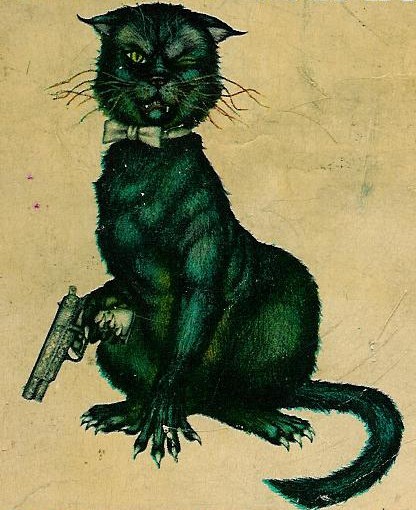
Indeed, the realities of life in the Soviet police state (“No papers, no person”) come across as far scarier than the supernatural characters of The Master and Margarita. Woland’s retinue, in particular his cat Behemoth (who seems to grace—can that be the right verb?—the covers of most editions of the novel), imbue the novel with a compelling manic energy. The most memorable sequences for most readers will likely involve Woland’s troupe’s antics, including their wild performance at the Variety Theatre, which climaxes in this bit of comic violence before culminating in a rush of greed and gratuitous nudity:
And an unheard-of thing occurred. The fur bristled on the cat’s back, and he gave a rending miaow. Then he compressed himself into a ball and shot like a panther straight at Bengalsky’s chest, and from there on to his head. Growling, the cat sank his plump paws into the skimpy chevelure of the master of ceremonies and in two twists tore the head from the thick neck with a savage howl.
The two and a half thousand people in the theatre cried out as one. Blood spurted in fountains from the torn neck arteries and poured over the shirt-front and tailcoat. The headless body paddled its feet somehow absurdly and sat down on the floor. Hysterical women’s cries came from the audience. The cat handed the head to Fagott, who lifted it up by the hair and showed it to the audience, and the head cried desperately for all the theatre to hear:
‘A doctor!’
(Don’t worry, Bengalsky gets his head back. Sort of).
Another highlight of the book is the Walpurgis Night episode—Chapter 23, “The Great Ball at Satan’s”—which I’d argue can stand on its own, free of context, as a lovely, dark, bizarre short story. Margarita plays hostess to a seemingly-endless parade of “kings, dukes, cavaliers, suicides, poisoners, gallowsbirds, procuresses, prison guards and sharpers, executioners, informers, traitors, madmen, sleuths, seducers,” who arrive via fireplace, their corpses reanimated to take part in the grand dance. Bulgakov cribs freely from history, populating the episode with condemned persons obscure and infamous alike.
The Walpurgisknacht episode highlights The Master and Margarita‘s strong Easter/Faust theme, which plays out for several characters who are reborn (figuratively or otherwise). The least interesting of these by far is the master himself. But perhaps this is unfair. It’s entirely plausible that the master is the storyteller of The Master and Margarita. In any case, his unnamed novel (within the text) depicts an alternate version of Jesus of Nazareth’s crucifixion, and it’s here that we find what I take to be The Master and Margarita’s most interesting and complex character, “the fifth procurator of Judea, Pontius Pilate.” The episodes with Pilate (who employs his own secret police, a wonderful parallel to the Soviet setting) offer a kind of moral ballast to the supernatural sequences, which fluctuate between manic-comic anxiety and big-R Romanticism. Of all the souls in turmoil in The Master and Margarita’s, I found the depiction of Pilate’s troubles the most profound.
The Master and Margarita’s lurching structure threatens narrative coherence until the novel’s final moments, when the master meets his creation. The moment is unexpectedly poignant, and does much to amend some of the novel’s ungainliness. The middle sections in particular get bogged down, as Bulgakov subjects his Muscovite extras to all sorts of fates (some more terrible than others). While some of these episodes are funny, and they certainly give the book some of its satirical power, they ultimately read as variations on a theme. I found my eyes glazing over in the novel’s epilogue when Bulgakov decides to check in on the survivors.
I’ve failed to remark on so much of The Master and Margarita, and I’m certain that much of its rich allusive texture was lost on me. (I should point out here how helpful the end notes of my edition were). Persons interested in early Soviet life who have not yet found their way to Bulgakov’s novel will wish to do so (as well as the work of Bulgakov’s contemporary Sigizmund Krzhizhanovsky); the novel also makes a strange but worthy companion piece to William Gaddis’s enormous Faust tale The Recognitions. Although The Master and Margarita sags at times, at its finest moments—of which there are many—it is funny, dark, and engrossing.
Harlin: Incidentally, you wrote your M.A. thesis on Malcolm Lowry, a relatively unknown writer at the time, and became very friendly with him. What was the impulse behind writing him?
Markson: A great percentage of the people in the world haven’t had this experience, but sometimes you read a book, and it’s almost as if it’s been written for you, or you’re the only one who really understands it. The impulse—creatively, artistically, spiritually—was to say, “Be my daddy. Be my father.” It took a letter or two, but obviously I struck a chord. He had done the same thing. As a young boy in England, he’d written to Conrad Aiken, he so admired Aiken’s poetry. I became friendly with Aiken, too, through Lowry. When Malc died, we got back in touch, and when he was in New York he would come to dinner. He kept a cold-water flat—are there still such things?—up on the East Side.
Harlin: You also became friends with Dylan Thomas and Kerouac.
Markson: The Dylan Thomas thing was a fluke. I don’t think I’d ever met a writer. Back then, I was only in correspondence with Lowry. Thomas did a reading, and on impulse I went backstage. You can’t imagine how popular he was or how highly thought-of he was, even though he was a legendary troublemaker. Out of the blue, I said, “How would you like to have a couple of drinks with some graduate students?” He said, “Yeah, I’ll meet you.” One thing led to another, and we had, at most, nine or ten evenings together. Kerouac was sheer chance and non-literary. My next door neighbor at the time, on 11th Street in the Village, was a recording engineer, and he was friendly with Jack. They used to listen to jazz together. In fact, this guy, who’s long-since dead, was one of the first to lug that old-style heavy equipment up to Harlem to record it. Jack loved it, and he’d go with him once in a while. He lived right next-door. Frequently, we’d go from apartment to apartment drinking together. Sometimes, Jack would come to New York, and this fellow, Jerry, would be away, so he’d ring our bell. For about two years—I’m guessing a dozen, fifteen times—the doorbell would ring, never a word in advance, and there he’d be, drunk as hell all the time. Generally he’d stay the night. One time he borrowed a T-shirt. He came back a week later, and we’re sitting in the living room, and I’m recognizing the outer shirt from a week before. I saw this filthy T-shirt and said, “You son of a bitch, is that the shirt of mine that you put on here a week ago?” And he said, “Well, I had a shower.” Then he stopped coming around; I guess he was in Florida. We just lost track of him, and the next thing I knew he was dead.
Harlin: There’s also William Gaddis.
Markson: I thought The Recognitions was—Lowry being English—the great American novel of that period. That’s the only other letter I wrote to a writer, but it was different from the Lowry one. When The Recognitions came out, it was shat on by every reviewer. They said, “How dare he write so long a book? How dare he deliberately try to create a masterpiece?” I wrote this casual letter, saying, “Screw them. Some of us out here know what you did.” When my wife and I went to Mexico for three years, an editor came down there, and Aiken had given him my name. We had him to dinner, and all I did was talk about The Recognitions. And this guy said, “Shut up already. Tell me about Mexico. I’ll read it when I get home.” And he did. The Recognitions came out in 1955, and this would have been about 1961. One day I get a letter there: “Dear David Markson, If I may presume to answer yours of”—whatever it was—”May 16, 1955.” It turned out that this editor, Aaron Asher, had come home, read the book, and decided to resurrect it. There had never been a paperback, and he put it in print, and it brought Gaddis back to life.
Harlin: Anyone else?
Markson: Kurt Vonnegut I’d known for about forty years. We weren’t that intimate, but for the last twenty years, he and I and two other people had dinner twice a year. And Joe Heller. We weren’t buddy-buddy, but I knew him before Catch-22. If you’re writing, who do you know? If you’re a lawyer, you know lawyers. If you’re a dentist, you know dentists. If you’re a writer, you know other writers. Heller was working in public relations. I remember when we came back from Mexico, one of the first people I saw said, “Hey, Joe Heller finished his book, and it’s great.” This all probably sounds very exotic. In fact, a book just came out recently called Sleeping with Bad Boys, by a woman named Alice Denham. She had been a Playboy centerfold, but she was the only Playboy centerfold who was the author of a short story in the same issue. I can say this, because she’s admitted it in her book, but she slept with everybody. She slept with James Jones, with Gaddis, a long list. She and Heller, for some reason, they would just neck or something. And she and I had an affair at one point. In fact, she refers to me as one of her favorite lovers. The Times review reported that she’d slept with this one and that one and then quoted something about each person. After my name, “the novelist David Markson,” was “stud lover boy.” And here I am seventy-nine years old! I still run into Alice; she lives a couple of blocks from me.
Ruperta Chirpingdon-Groin and her party had descended by way of the St.Gotthard Tunnel from league after league of peaks like ocean waves frozen in place, fading into merciless light, tending to eternity—a circuit of Alpine hotels and hydropathics so remote the hotels had to print up their own postal stamps just to get mail as far as a regular Swiss post office, full of giggling nitwits, quite a number of them British actually, running about the corridors, jumping off balconies into the snowdrifts, hiding in servingpantries and falling down dumbwaiter shafts. They had detrained at Bellinzona, where the motordiligence from the Sanatorium was waiting for them, and so up to the famed institution overlooking the Swiss shores of Lago Maggiore. Goats grazing by the roadside turned their heads to watch them pass, as if long familiar with Böpfli-Spazzoletta clientele. From somewhere came a repeated figure being played on an alpenhorn.
Though he was not ready to share it with his brother, not even Reef had been exempt from the folly up there.
“What kind of a dog’s that?” he asked Ruperta at one point.
“Mouffette? She’s a papillon . . . a sort of French ladies’ lapdog.”
“A—You say,” gears in his mind beginning to crank, “ ‘lap’—French . . . lapdog?” Somehow gathering that Ruperta had trained her toy spaniel to provide intimate “French” caresses of the tongue for the pleasure of its mistress. “Well! you two are . . . pretty close then, I guess?”
“I wuv my ickle woofwoof, ess I doo!” Squeezing the animal tightly, one would think painfully, except for the apparent enjoyment with which Mouffette was fluttering her eyelids.
“Hmm,” said Reef.
“And today I must go across the lake, and the mean old people there won’t allow my ickle pwecious to come with Mummy, and we were both wondering if her good Uncle Reef would look after her for the day, see that she gets her chopped filet and her boiled pheasant, as she’s so particular.”
“Sure, you bet!” His thoughts taking wing. The day alone with a French “lap” dog! who might be more than happy to do for Reef what she was obviously already doing for old ’Pert here! who in fact, mmaybe all this time’s been just droolin’ for onethem penises for a change, and will turn out to know plenty of tricks! Aand—
It took a while for Ruperta to get her toilette perfect and her bustle out the door. Reef found himself pacing and smoking, and whenever he took a look over at Mouffette could’ve sworn she was fidgeting too. The dog, it seemed to Reef, was giving him sidewise looks which if they’d come from a woman you would have had to call flirtatious. Finally after an extended farewell notable for its amount of saliva exchange, Mouffette slowly padded over to the divan where Reef was sitting and jumped up to sit next to him. Jumping on the furniture was something Ruperta seldom allowed her to do, and her gaze at Reef clearly assumed that he would not get upset. Far from it, what he actually got was an erection. Mouffette looked it over, looked away, looked back, and suddenly jumped up on his lap.
“Oboy, oboy.” He stroked the diminutive spaniel for a while until, with no warning, she jumped off the couch and slowly went into the bedroom, looking back now and then over her shoulder. Reef followed, taking out his penis, breathing heavily through his mouth. “Here, Mouffie, nice big dog bone for you right here, lookit this, yeah, seen many of these lately? come on, smells good don’t it, mmm, yum!” and so forth, Mouffette meantime angling her head, edging closer, sniffing with curiosity. “That’s right, now, ooopen up . . . good girl, good Mouffette now let’s just put this—yaahhgghh!”
Reader, she bit him. After which, as if surprised at the vehemence of his reaction, Mouffette jumped off the bed and while Reef went looking for an ice bucket, ran off somehow into the vast hotel. Reef chased her for a while but found it was getting him funny looks from the staff.
In the days that followed, Mouffette took every occasion to jump up in Reef’s lap and gaze into his eyes—sarcastically, it seemed to Reef—opening her mouth suggestively, sometimes even drooling. Each time Reef tried not to flinch. Each time Ruperta, exasperated, would cry, “Honestly, it isn’t as if she means to bite you.”
–A sophomoric, dirty joke from Thomas Pynchon’s novel Against the Day.








 Biblioklept
