The elephant is not particularly sagacious in the wild state, but becomes so when tamed. The fox directly the contrary, and likewise the wolf.
A modern Jewish adage,–“Let a man clothe himself beneath his ability, his children according to his ability, and his wife above his ability.”
It is said of the eagle, that, in however long a flight, he is never seen to clap his wings to his sides. He seems to govern his movements by the inclination of his wings and tail to the wind, as a ship is propelled by the action of the wind on her sails.
In old country-houses in England, instead of glass for windows, they used wicker, or fine strips of oak disposed checkerwise. Horn was also used. The windows of princes and great noblemen were of crystal; those of Studley Castle, Holinshed says, of beryl. There were seldom chimneys; and they cooked their meats by a fire made against an iron back in the great hall. Houses, often of gentry, were built of a heavy timber frame, filled up with lath and plaster. People slept on rough mats or straw pallets, with a round log for a pillow; seldom better beds than a mattress, with a sack of chaff for a pillow.
In this dismal chamber FAME was won. (Salem, Union Street.)
Those who are very difficult in choosing wives seem as if they would take none of Nature’s ready-made works, but want a woman manufactured particularly to their order.
A council of the passengers in a street: called by somebody to decide upon some points important to him.
Every individual has a place to fill in the world, and is important, in some respects, whether he chooses to be so or not.
Merry, “in merry England,” does not mean mirthful; but is corrupted from an old Teutonic word signifying famous or renowned.
One day, strolling in the Piazzetta, Hunter motioned her under the arcade and into the Library, and pointed up at Tintoretto’s Abduction of the Body of St. Mark. She gazed for some time. “Well, if that ain’t the spookiest damned thing,” she whispered at last. “What’s going on?” she gestured nervously into those old Alexandrian shadows, where ghostly witnesses, up far too late, forever fled indoors before an unholy offense.
“It’s as if these Venetian painters saw things we can’t see anymore,” Hunter said. “A world of presences. Phantoms. History kept sweeping through, Napoleon, the Austrians, a hundred forms of bourgeois literalism, leading to its ultimate embodiment, the tourist—how beleaguered they must have felt. But stay in this town awhile, keep your senses open, reject nothing, and now and then you’ll see them.”
A few days later, at the Accademia, as if continuing the thought, he said, “The body, it’s another way to get past the body.”
“To the spirit behind it—” “But not to deny the body—to reimagine it. Even”—nodding over at the Titian on the far wall—“if it’s ‘really’ just different kinds of greased mud smeared on cloth—to reimagine it as light.”
“More perfect.”
“Not necessarily. Sometimes more terrible—mortal, in pain, misshapen, even taken apart, broken down into geometrical surfaces, but each time somehow, when the process is working, gone beyond. . . .”
Beyond her, she guessed. She was trying to keep up, but Hunter didn’t make it easy. One day he told her a story she had actually already heard, as a sort of bedtime story, from Merle, who regarded this as a parable, maybe the first on record, about alchemy. It was from the Infancy Gospel of Thomas, one of many pieces of Scripture that early church politics had kept from being included in the New Testament.
“Jesus was sort of a hellraiser as a kid,” as Merle had told it, “the kind of wayward youth I’m always finding you keepin company with, in fact, not that I’m objecting,” as she had sat up in bed and looked for something to assault him with, “used to go around town pulling these adolescent pranks, making little critters out of clay, bringing them to life, birds that could fly, rabbits that talked, and like that, driving his parents crazy, not to mention most of the local adults, who were always coming by to complain—‘You better tell ’at Jesus to watch it.’ One day he’s out with some friends looking for trouble to get into, and they happen to go by the dyer’s shop, where there’s all these pots with different colors of dye and piles of clothes next to them, all sorted and each pile ready to be dyed a different color, Jesus says, ‘Watch this,’ and grabs up all the clothes in one big bundle, the dyer’s yelling, ‘Hey Jesus, what’d I tell you last time?’ drops what he’s doing and goes chasing after the kid, but Jesus is too fast for him, and before anybody can stop him he runs over to the biggest pot, the one with red dye in it, and dumps all the clothes in, and runs away laughing. The dyer is screaming bloody murder, tearing his beard, thrashing around on the ground, he sees his whole livelihood destroyed, even Jesus’s lowlife friends think this time he’s gone a little too far, but here comes Jesus with his hand up in the air just like in the paintings, calm as anything—‘Settle down, everybody,’ and he starts pulling the clothes out of that pot again, and what do you know, each one comes out just the color it’s supposed to be, not only that but the exact shade of that color, too, no more housewives hollerin ‘hey I wanted lime green not Kelly green, you colorblind or something,’ no this time each item is the perfect color it was meant to be.”
“Not a heck of a lot different,” it had always seemed to Dally, “in fact, from that Pentecost story in Acts of the Apostles, which did get in the Bible, not colors this time but languages, Apostles are meeting in a house in Jerusalem, you’ll recall, Holy Ghost comes down like a mighty wind, tongues of fire and all, the fellas come out and start talking to the crowd outside, who’ve all been jabbering away in different tongues, there’s Romans and Jews, Egyptians and Arabians, Mesopotamians and Cappadocians and folks from east Texas, all expecting to hear just the same old Galilean dialect—but instead this time each one is amazed to hear those Apostles speaking to him in his own language.”
Hunter saw her point. “Yes, well it’s redemption, isn’t it, you expect chaos, you get order instead. Unmet expectations. Miracles.”
Another amazing passage from Thomas Pynchon’s novel Against the Day.
Bride of New France, an historical novel by Suzanne Desrochers, was a hit in Canada, where it was published by Penguin. Norton is publishing it in the States in trade paperback. Their blurb:
A Canadian bestseller, this richly imagined novel is about a young French woman sent to settle in the New World.
Transporting readers from cosmopolitan seventeenth-century Paris to the Canadian frontier, this vibrant debut tells of the struggle to survive in a brutal time and place. Laure Beausejour has been taken from her destitute family and raised in an infamous orphanage to be trained as a lace maker. Striking and willful, she dreams of becoming a seamstress and catching the eye of a nobleman. But after complaining about her living conditions, she is sent to Canada as a fille du roi, expected to marry a French farmer there. Laure is shocked by the primitive state of the colony and the mingling of the settlers with the native tribes. When her ill-matched husband leaves her alone in their derelict hut for the winter, she must rely on her wits and her clandestine relationship with an Iroquois man for survival.
THE NEXT TIME he saw Pléiade Lafrisée was at a café-restaurant off the Place d’Armes. It would not occur to him until much later to wonder if she had arranged the encounter. She was in pale violet peau de soie, and a hat so beguiling that Kit was only momentarily surprised to find himself with an erection. It was still early in the study of these matters, only a few brave pioneers like the Baron von Krafft-Ebing had dared peep into the strange and weirdly twilit country of hat-fetishism—not that Kit noticed stuff like that ordinarily, but it happened actually to be a gray toque of draped velvet, trimmed with antique guipure, and a tall ostrich plume dyed the same shade of violet as her dress. . . .
“This? One finds them in every other midinette’s haunt, literally for sous.”
“Oh. I must’ve been staring. What happened to you the other night?”
“Come. You can buy me a Lambic.”
The place was like a museum of mayonnaise. This being just at the height of the culte de la mayonnaise then sweeping Belgium, oversize exhibits of the ovoöleaginous emulsion were to be encountered at every hand. Heaps of Mayonnaise Grenache, surrounded by plates of smoked turkey and tongue, glowed redly as if from within, while with less, if any, reference to actual food it might have been there to modify, mountains of Chantilly mayonnaise, swept upward in gravity-impervious peaks insubstantial as cloud, along with towering masses of green mayonnaise, basins of boiled mayonnaise, mayonnaise baked into soufflés, not to mention a number of not entirely successful mayonnaises, under some obscure attainder, or on occasion passing as something else, dominated every corner.
“How much do you know of La Mayonnaise?” she inquired.
He shrugged. “Maybe up to the part that goes ‘Aux armes, citoyens’—”
But she was frowning, earnest as he had seldom seen her. “La Mayonnaise,” Pléiade explained, “has its origins in the moral squalor of the court of Louis XV—here in Belgium the affinity should not be too surprising. The courts of Leopold and Louis are not that different except in time, and what is time? Both monumentally deluded men, maintaining their power through oppression of the innocent. One might usefully compare Cleo de Mérode and the marquise de Pompadour. Neuropathists would recognize in both kings a desire to construct a self-consistent world to live inside, which allows them to continue the great damage they are inflicting on the world the rest of us must live in.
“The sauce was invented as a new sensation for jaded palates at court by the duc de Richelieu, at first known as mahonnaise after Mahon, the chief port of Minorca, the scene of the due’s dubious ‘victory’ in 1756 over the illfated Admiral Byng. Basically Louis’s drug dealer and pimp, Richelieu, known for opium recipes to fit all occasions, is also credited with the introduction into France of the cantharides, or Spanish fly.” She gazed pointedly at Kit’s trousers. “What might this aphrodisiac have in common with the mayonnaise? That the beetles must be gathered and killed by exposing them to vinegar fumes suggests an emphasis on living or recently living creatures—the egg yolk perhaps regarded as a conscious entity—cooks will speak of whipping, beating, binding, penetration, submission, surrender. There is an undoubtedly Sadean aspect to the mayonnaise. No getting past that.”
Kit was a little confused by now. “It always struck me as kind of, I don’t know . . . bland?”
“Until you look within. Mustard, for example, mustard and cantharides, n’estce pas? Both arousing the blood. Blistering the skin. Mustard is the widelyknown key to resurrecting a failed mayonnaise, as is the cantharides to reviving broken desire.”
“You’ve been thinking about mayonnaise a lot, mademoiselle.”
“Meet me tonight,” a sudden fierce whisper, “out at the Mayonnaise Works, and you shall perhaps understand things it is given only to a few to know. There will be a carriage waiting.” She pressed his hand and was gone in a mist of vetiver, abruptly as the other evening.
Another citation from Thomas Pynchon’s novel Against the Day; I don’t think you need any context to appreciate this passage.
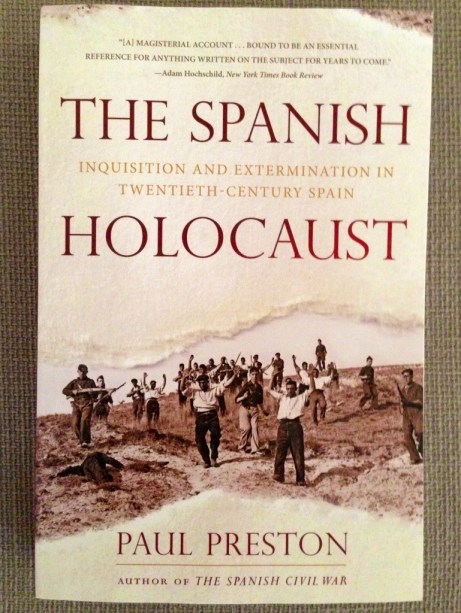
Paul Preston’s history The Spanish Holocaust is now out in trade paperback. Here’s publisher Norton’s blurb:
Long neglected by European historians, the unspeakable atrocities of Franco’s Spain are finally brought to tragic light in this definitive work.
The remains of General Francisco Franco lie in an immense mausoleum near Madrid, built with the blood and sweat of twenty thousand slave laborers. His enemies, however, met less-exalted fates. Besides those killed on the battlefield, tens of thousands were officially executed between 1936 and 1945, and as many again became “non-persons.” As Spain finally reclaims its historical memory, a full picture can now be given of the Spanish Holocaust-ranging from judicial murders to the abuse of women and children. The story of the victims of Franco’s reign of terror is framed by the activities of four key men-General Mola, Quiepo de Llano, Major Vallejo Najera, and Captain Don Gonzalo Aguilera-whose dogma of eugenics, terrorization, domination, and mind control horrifyingly mirror the fascism of Italy and Germany.
Evoking such classics as Gulag and The Great Terror, The Spanish Holocaust sheds crucial light on one of the darkest and most unexamined eras of modern European history.
An eminent and prolific British historian of modern Spain, Preston says this was “an extremely painful book to write.” It is also, unlike several of his other works, a difficult book to read. The newcomer to Spanish history will nowhere learn the difference between the Assault Guard and the Civil Guard, or between a Carlist and an integrist. Chapters roll on for 40 or 50 pages without a break. A blizzard of names of thousands of perpetrators and the towns where they carried out their tortures and killings overwhelms the reader. “The Spanish Holocaust” is not really a narrative but a comprehensive prosecutor’s brief. With its immense documentation — 120 pages of endnotes to both published and unpublished material in at least five languages, including corrections of errors in these sources — it is bound to be an essential reference for anything written on the subject for years to come.
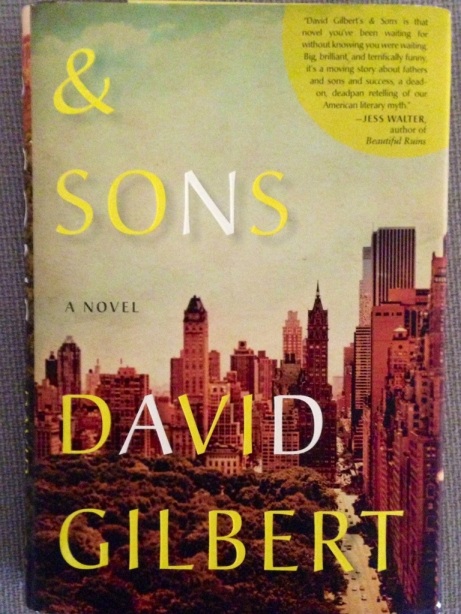
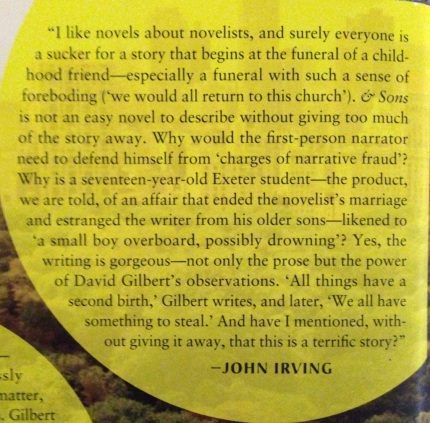
The funeral of Charles Henry Topping on Manhattan’s Upper East Side would have been a minor affair (his two-hundred-word obit in The New York Times notwithstanding) but for the presence of one particular mourner: the notoriously reclusive author A. N. Dyer, whose novel Ampersand stands as a classic of American teenage angst. But as Andrew Newbold Dyer delivers the eulogy for his oldest friend,he suffers a breakdown over the life he’s led and the people he’s hurt and the novel that will forever endure as his legacy. He must gather his three sons for the first time in many years—before it’s too late.
So begins a wild, transformative, heartbreaking week, as witnessed by Philip Topping, who, like his late father, finds himself caught up in the swirl of the Dyer family. First there’s son Richard, a struggling screenwriter and father, returning from self-imposed exile in California. In the middle lingers Jamie, settled in Brooklyn after his twenty-year mission of making documentaries about human suffering. And last is Andy, the half brother whose mysterious birth tore the Dyers apart seventeen years ago, now in New York on spring break, determined to lose his virginity before returning to the prestigious New England boarding school that inspired Ampersand. But only when the real purpose of this reunion comes to light do these sons realize just how much is at stake, not only for their father but for themselves and three generations of their family.
In this daring feat of fiction, David Gilbert establishes himself as one of our most original, entertaining, and insightful authors. & Sons is that rarest of treasures: a startlingly imaginative novel about families and how they define us, and the choices we make when faced with our own mortality.
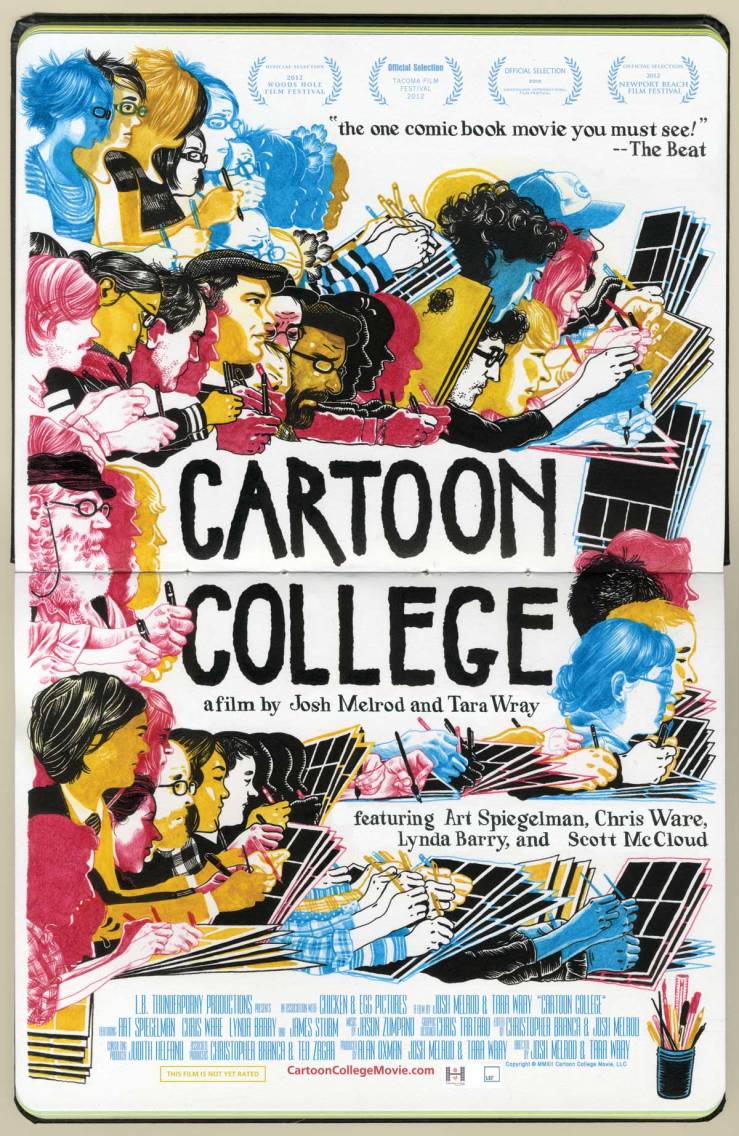
In the opening scene of Josh Melrod and Tara Wray’s new documentary Cartoon College, aspiring cartoonist Ryland Ianelli lays out the reality that, despite all the progress the medium has made as an art form worthy of respect, comic books are still outré: “It’s gotten easier to talk to people who are open to the idea of comics being worthwhile—but at the point you say, Yes I’m going to school for comics, they’re completely ready to dismiss you.”
Cartoonists have always been outsiders—even in art schools, a traditional gathering spot for outsiders—and it’s this feeling of alienation and displacement that undergirds the emotional platform of Cartoon College. The film is not just about the Center for Cartoon Studies (CSS), a highly-selective two year MFA program founded in 2005 in White River Junction, Vermont, or the cadre of master cartoonists who inspired the school, and, in some cases teach there. For plenty of comix nerds (like me), it’s enough to see masters like Art Spiegelman, Charles Burns, Lynda Barry, and Chris Ware talk about the art, medium, and business of cartooning. But this documentary offers more. Cartoon College succeeds because it tells the genuinely moving and engaging story of its students, self-described outcasts who find a sense of community and even family in the program.
Melrod and Wray take us into the extreme demands of the CSS program. In the first year (“boot camp”), students practice fundamentals—drawing, theory, writing, history. In the second year, the students produce a thesis—a finished work of some kind—to determine if they pass the program and receive an MFA. All this work is to ensure that students “will be ready to face the uncertainty of a career in one of the most labor-intensive, drudgery inducing art forms,” as the film puts it.
The faculty (all distinguished cartoonists, including Stephen Bissette, James Sturm, and Alec Longstreth, who are featured prominently in the film) repeatedly remind students and audience alike that most of cartooning is labor-intensive drudgery: it’s not really that fun, it requires lots of discipline, and most people can’t cut it. The CSS, like most art schools, employs a workshop technique to help students grow, get feedback—and also, implicitly, as a means of maintaining quality control. Workshop scenes and other critiques are often some of the most painful moments in the film, as they highlight the very personal stakes for the aspiring cartoonists, who quite literally put their lives into their work.
Melrod and Wray wisely compose their narrative around just a few of these students, while giving us enough scenes with others to flesh out the film. Blair Sterrett gives the film a definitive arc. He’s clearly a troubled, struggling artist, trying to channel his former experiences as a Mormon missionary into a thesis, but as the deadline approaches, it’s clear his book’s unfinished. Sterrett’s scenes (particularly an early critique) are very moving, and—a bit of a spoiler—there’s a triumphant feeling when he returns to the CSS to finish his MFA.
We find another arc in Jen Vaughn, who has too many jobs and too many ideas. Of all the student artists, she seems the most open to the camera, and her self-assured posture by turns belies a greater vulnerability and depth. In one illuminating scene at the MoCCA Fest, Vaughn tries to pique a muted festival goer’s interest in her project Menstruation Station; when he walks away without seeming to say anything we catch a glimpse of weariness bordering on desperation.
There’s also Al Wesolowsky, who at 61 is the oldest student. An archaeologist at Boston University, Wesolowsky tries his hand at the CSS program despite his self-admitted limitations as a draftsman. In some ways he’s the soul of the film. At one point he delivers a brief monologue wherein he describes the loneliness he feels at having no family, but the pleasure he’s found in a makeshift family at CSS.
Loneliness and alienation are perhaps the bedrock themes of comix and cartooning, as anyone who’s read Spiegelman or Ware or Burns—or really any of the master cartoonists interviewed in Cartoon College—can attest. Spiegelman is the first professional to pop up in the film, after the filmmakers have already introduced us to the students, and one of the first comments he makes is that comix allows cartoonists to come into contact with “a bunch of other outcasts.” This sentiment is repeated again and again, by students, teachers, and masters alike; we learn that Ryland Ianelli was voted Prom Queen by the cruel students of his high school; student Casey Bohn tells us that everyone in his small town thought he was “gay or British”; Lynda Barry puts it plain: “Childhood seemed to me like it lasted too long.”
Of all the master cartoonists on screen, I was most captivated by Chris Ware, who comes across as reflective, cerebral, and even philosophical. He points out that cartoonists are always “sifting through generations”,” handing down tropes, skills, ideas. Ware, chronicler of loneliness, perhaps makes the strongest case for cartoonists-as-community.
The idea that the students need to foster a community is reinforced by Bissette, who tells the that they must share contacts, share ideas, and be colleagues. Bissette and the other CSS instructors repeatedly emphasize the publishing dimension of cartooning, paying special attention to the idea that these cartoonists can self-publish. Cartoon College is larded with shots of students hand-crafting their art, and Bissette likens what they are doing to Warhol and his Factory. He also points out that this new generation’s desire is not to draw Spider-Man or Batman but their own creations.
An energetic scene at the MoCCA Fest shows this cottage industry at work, as artists buy and trade for each other’s work. But the instructors and pros are very clear—or try to be clear—about the economic realities most cartoonists will face. Ware and Burns point out that commercial illustration is a necessity to feed their other projects. Juxtaposed with these moments, our students describe their dreams of a comfortable retirement and book deals, a moment undercut by Lynda Barry gleefully pointing out that she makes most of her moeny selling “shit on E-bay.”
It might have been tempting for Melrod and Wray to cram all the footage they had of famous cartoonists like Barry, Françoise Mouly, Scott McCloud, and others into Cartoon College, but to the filmmakers’ credit they use the masters sparingly. Art Spiegelman tells us at one point that “We think in bursts of language, not in long Jamesian sentences…the number of words that might be able to fit in a speech balloon are the core of a linguistic thought.” The insight is intended for cartooning, but the filmmakers apply it to their medium, letting the camera do much of the work for them, offering only the most essential moments (like when Charles Burns completes a sketch and the student audience breaks into applause). Cartoon College is at its best when it shows us the difficult experiences of the students intercut with commentary by the seasoned, successful professionals, who understand precisely the pain these people are undergoing.
Before I started watching Cartoon College, I wondered who it was for. My interest in Spiegelman, Ware, Burns, et al. was enough to prod my interest (and the soundtrack featuring Archers of Loaf, Portastatic, and Tortoise didn’t hurt)—but would the film appeal to, uh, non-geeks? Ultimately, I think the documentary is about the drive toward art and self-expression, and the ways that communities and relationships can form around this drive. Cartoon College offers an intriguing story about real people trying to do something that they love, and I enjoyed that. This is a film about the impetus, motivation, and hard, hard work that goes into the creative process. Great stuff.
Political democracy, as it exists and practically works in America, with all its threatening evils, supplies a training school for making first-class men. It is life’s gymnasium, not of good only, but of all. We try often, though we fall back often. A brave delight, fit for freedom’s athletes, fills these arenas, and fully satisfies, out of the action in them, irrespective of success. Whatever we do not attain, we at any rate attain the experiences of the fight, the hardening of the strong campaign, and throb with currents of attempt at least. Time is ample. Let the victors come after us. Not for nothing does evil play its part among us. Judging from the main portions of the history of theworld, so far, justice is always in jeopardy, peace walks amid hourly pitfalls, and of slavery, misery, meanness, the craft of tyrants and the credulity of the populace, in some of the protean forms, no voice can at any time say, They are not. The clouds break a little, and the sun shines out-but soon and certain the lowering darkness falls again, as if to last forever. Yet is there an immortal courage and prophecy in every sane soul that cannot, must not, under any circumstances, capitulate. Vive, the attack–the perennial assault! Vive, the unpopular cause–the spirit that audacious]y aims–the never-abandoned efforts, pursued the same amid opposing proofs and precedents.
Once, before the war (alas! I dare not say how many times the mood has come!) I, too, was filled with doubt and gloom. A foreigner, an acute and good man, had impressively said to me, that day-putting in form, indeed, my own observations: “I have traveled much in the United States, and watched their politicians, and listened to the speeches of the candidates, and read the journals, and gone into the public-houses, and heard the unguarded talk of men. And I have found your vaunted America honeycombed from top to toe with infidelism, even to itself and its own program. I have marked the brazen hell-faces of secession and slavery gazing defiantly from all the windows and doorways. I have everywhere found, primarily, thieves and scalliwags arranging the nominations to offices, and sometimes filling the offices themselves. I have found the north just as full of bad stuff as the south. Of the holders of public office in the Nation or the States or their municipalities, I have found that not one in a hundred has been chosen by any spontaneous selection of the outsiders, the people, but all have been nominated and put through by little or large caucuses of the politicians, and have got in by corrupt rings and electioneering, not capacity or desert. I have noticed how the millions of sturdy farmers and mechanics are thus the helpless supple-jacks of comparatively few politicians. And I have noticed, more and more, the alarming spectacle of parties usurping the government, and openly and shamelessly wielding it for party purposes. Continue reading ““Democratic Vistas” — Walt Whitman”→






 Biblioklept