The Special Pleasures of Guest Room Reading

20130120-102259.jpg

A few years ago, The New York Times ran a little wisp of an article describing the pleasures many readers take in reading “the moldy, dog-eared paperbacks found on the shelves and bedside tables of summer guest rooms.” The article features writers explaining how, staying somewhere, they reach for books they’d normally never pick up, like Wells Tower describing how he ended up reading The Bridges of Madison County. Like most ardent readers, I take a book (or two or three, or, more recently, a Kindle loaded with hundreds) with me anywhere I’m going to stay a night—but I’ll invariably read something I find in the room I’m staying if possible.

Sometimes I’ll end up reading something terrible—once, staying at a beachfront condo, I read an entire serialized Annie Oakley novel even though it was awful. Other times a stay prompts me to pick up a book I’d never reach for in my civilian life. For example, in a cabin in the Blue Ridge Mountains a few years ago I read a naturalist field guide for the area, written and published in the 1950s. More often than not, guest room reading leads me to read much faster and stay up reading much longer than I normally would, simply because I’m trying to finish the book before I leave. This is how I read Gabriel Garcia Marquez’s Memories of My Melancholy Whores in one long sitting (the book was my uncle), and how I ate up John Barth’s novel The End of the Road in friend’s mother’s childhood room—the book was hers, she had lots of cool books, and I wished I could’ve read more.

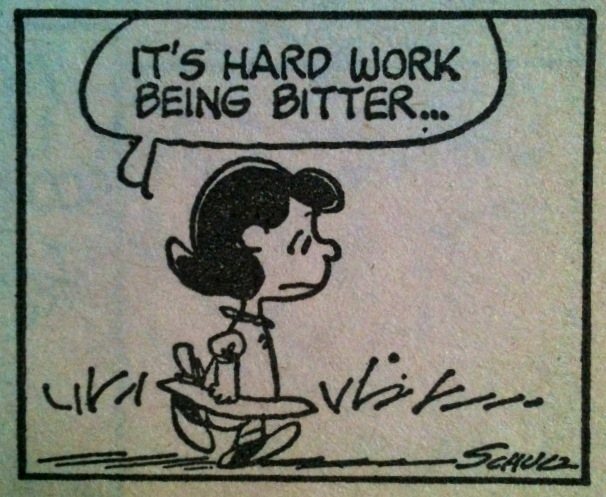
The other night, staying with some longtime friends, I reached for a brittle yellowed Peanuts collection on the nightstand by my bed. There were a few volumes of prose and poetry there, but Charles M. Schulz’s comics seemed more likely to make it through the haze of half a dozen beers. Plus, I’ve always loved Peanuts. I read the book entire, an arc beginning with the gang heading off to summer camp and ending, more or less, with Snoopy’s failed attempts at writing.

20130120-102308.jpg

Like many kids, I grew up with Peanuts, reading Schulz’s work in the paper and also in collected volumes that my grandparents would give me (my grandfather was an especially big fan). The comics were often funny—not funny like my favorite at the time, Gary Larson’s The Far Side to be sure—but they were just as often full of melancholy or even despair, a despair that was mediated, but not necessarily assuaged by, the consolations of friendship.
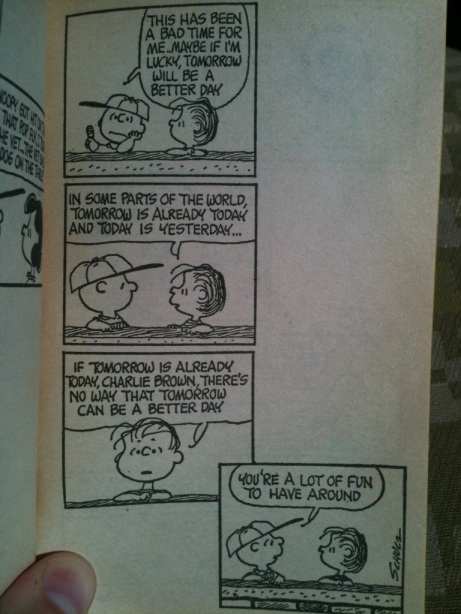
20130120-102345.jpg

I read as gently as possible, trying (and not always succeeding) to prevent any more pages from falling out of the collection. I mentally bookmarked several panels and a few entire strips to photograph the next day to maybe share on the blog. The next morning it occurred to me that I own almost a half dozen Peanuts collections—but I probably hadn’t picked them up in years. And I suppose this is one of the strange pleasures of guest room reading—that it might reintroduce us to an old favorite—but that seems like too pat a conclusion to me. I’ve found over the years that I’m just as likely to remember an awful book I read at random as a guest—and that for some reason the experience of reading someone else’s books—in a guest room, at a river house, in a cabin, at a hostel—is somehow always heightened. I don’t have a distinct explanation, other than the very obvious and simple one that I usually read in the same few places—a chair in my living room, a couch, my office, the bed, the bath, my back porch—and that reading other people’s texts in unfamiliar places estranges what I think of as reading—and that estrangement is invigorating. And pleasurable. 

“Sweat” — Zora Neale Hurston

“Sweat” by Zora Neale Hurston

It was eleven o’clock of a Spring night in Florida. It was Sunday. Any other night, Delia Jones would have been in bed for two hours by this time. But she was a wash-woman, and Monday morning meant a great deal to her. So she collected the soiled clothes on Saturday when she returned the clean things. Sunday night after church, she sorted them and put the white things to soak. It saved her almost a half day’s start. A great hamper in the bedroom held the clothes that she brought home. It was so much neater than a number of bundles lying around.

She squatted in the kitchen floor beside the great pile of clothes, sorting them into small heaps according to color, and humming a song in a mournful key, but wondering through it all where Sykes, her husband, had gone with her horse and buckboard.

Just then something long, round, limp and black fell upon her shoulders and slithered to the floor beside her. A great terror took hold of her. It softened her knees and dried her mouth so that it was a full minute before she could cry out or move. Then she saw that it was the big bull whip her husband liked to carry when he drove.

She lifted her eyes to the door and saw him standing there bent over with laughter at her fright. She screamed at him.

“Sykes, what you throw dat whip on me like dat? You know it would skeer me–looks just like a snake, an’ you knows how skeered Ah is of snakes.”

“Course Ah knowed it! That’s how come Ah done it.” He slapped his leg with his hand and almost rolled on the ground in his mirth. “If you such a big fool dat you got to have a fit over a earth worm or a string, Ah don’t keer how bad Ah skeer you.”

“You aint got no business doing it. Gawd knows it’s a sin. Some day Ah’m goin’ tuh drop dead from some of yo’ foolishness. ‘Nother thing, where you been wid mah rig? Ah feeds dat pony. He aint fuh you to be drivin’ wid no bull whip.”

“You sho is one aggravatin’ nigger woman!” he declared and stepped into the room. She resumed her work and did not answer him at once. “Ah done tole you time and again to keep them white folks’ clothes outa dis house.”

He picked up the whip and glared down at her. Delia went on with her work. She went out into the yard and returned with a galvanized tub and set it on the washbench. She saw that Sykes had kicked all of the clothes together again, and now stood in her way truculently, his whole manner hoping, praying, for an argument. But she walked calmly around him and commenced to re-sort the things.

“Next time, Ah’m gointer kick ’em outdoors,” he threatened as he struck a match along the leg of his corduroy breeches. Continue reading ““Sweat” — Zora Neale Hurston”

“Were this world an endless plain…” (Moby-Dick)

Were this world an endless plain, and by sailing eastward we could for ever reach new distances, and discover sights more sweet and strange than any Cyclades or Islands of King Solomon, then there were promise in the voyage. But in pursuit of those far mysteries we dream of, or in tormented chase of that demon phantom that, some time or other, swims before all human hearts; while chasing such over this round globe, they either lead us on in barren mazes or midway leave us whelmed.

From “The Albatross,” Chapter 52 of Melville’s Moby-Dick.


Alain Robbe-Grillet on Tolstoy, Dostoevsky, and Kafka

Alain Robbe-Grillet in his 1985 interview with The Paris Review:

ROBBE-GRILLET

When a novelist has “something to say,” they mean a message. It has political connotations, or a religious message, or a moral prescription. It means “commitment,” as used by Sartre and other fellow-travelers. They are saying that the writer has a world view, a sort of truth that he wishes to communicate, and that his writing has an ulterior significance. I am against this. Flaubert described a whole world, but he had nothing to say, in the sense that he had no message to transmit, no remedy to offer for the human condition.

INTERVIEWER

But did Dostoyevsky have nothing to say? Tolstoy?

ROBBE-GRILLET

Tolstoy yes. That is why on the whole he doesn’t interest me.

INTERVIEWER

Not even Anna Karenina?

ROBBE-GRILLET

Especially not Anna Karenina! Among Tolstoy’s books the one that interests me is The Death of Ivan Ilych. Ivan is someone who hurts himself while unhooking a curtain, and one sees his death in that gesture. As for Dostoyevsky, perhaps there is a message in his work but for me it is a kind of parasite. In Crime And Punishment, I am much more interested in the first part which is the preparation for the murder. You remember the scene where Raskolnikov is getting the axe ready? And he is fascinated by the act he has to accomplish? The last part of the book, about guilt and moral responsibility and so on, bores me profoundly.

INTERVIEWER

Because you, or your characters, never feel moral responsibility or guilt?

ROBBE-GRILLET

Never!

INTERVIEWER

Aren’t you lucky!

ROBBE-GRILLET

Perhaps. The book of Dostoyevsky’s that interests me most is The Possessed. It is an enigmatic novel; the main protagonist is an enigma. I read it over and over again and find it tremendous—it has a concept of reality that escapes “significance.” That may be my reading of it; someone else might apprehend it differently. I am sure Camus would have said something quite different about it.

INTERVIEWER

Another writer who has had a great influence on you is Kafka. He is someone who has been interpreted in more than one way. What is his fascination for you?

ROBBE-GRILLET

He has been read as having a metaphysical and religious message—the relationship between the Jew and his God. This is the influence of Max Brod, his friend and first biographer. It doesn’t interest me in the least. I read Kafka as the revelation of a world, which is much more important than yet another meditation on the Talmud. Brod’s reading of Kafka is reductive and restrictive, as if his work could be reduced to metaphysical relations. What I find extraordinary is the actual presence of this opaque world.


“…all the waves rolled by like scrolls of silver; and, by their soft, suffusing seethings, made what seemed a silvery silence, not a solitude…” (Moby-Dick)

It was while gliding through these latter waters that one serene and moonlight night, when all the waves rolled by like scrolls of silver; and, by their soft, suffusing seethings, made what seemed a silvery silence, not a solitude; on such a silent night a silvery jet was seen far in advance of the white bubbles at the bow. Lit up by the moon, it looked celestial; seemed some plumed and glittering god uprising from the sea. Fedallah first descried this jet. For of these moonlight nights, it was his wont to mount to the main-mast head, and stand a look-out there, with the same precision as if it had been day. And yet, though herds of whales were seen by night, not one whaleman in a hundred would venture a lowering for them. You may think with what emotions, then, the seamen beheld this old Oriental perched aloft at such unusual hours; his turban and the moon, companions in one sky. But when, after spending his uniform interval there for several successive nights without uttering a single sound; when, after all this silence, his unearthly voice was heard announcing that silvery, moon-lit jet, every reclining mariner started to his feet as if some winged spirit had lighted in the rigging, and hailed the mortal crew. “There she blows!” Had the trump of judgment blown, they could not have quivered more; yet still they felt no terror; rather pleasure. For though it was a most unwonted hour, yet so impressive was the cry, and so deliriously exciting, that almost every soul on board instinctively desired a lowering.

From “The Spirit Spout,” Chapter 51 of Melville’s Moby-Dick


A Riff on Nathaniel Hawthorne’s Tale “The Birth-Mark”

  1. Nathaniel Hawthorne’s tale “The Birth-Mark” — or is it “The Birthmark”? — has been a favorite story of mine for years despite (or maybe because of) its being so damn symbolically overdetermined.
  2. You can read the story online.

  3. Or perhaps you want a quick summary—a refresher—okay:

Aylmer, “a man of science,” has this totally hot wife Georgiana—only she’s got a birthmark on her cheek, a small red mark that resembles a tiny hand—and it drives our scientist mad—so mad that he determines to make her perfect by removing the mark. Tragic ending ensues.

  1. One of the reasons I like “The Birth-Mark” so much is that it so clearly limns the futility of idealism.
  • Aylmer’s driving desire for mastery over Nature (echoing Shelley’s Frankenstein): the desire to “lay his hand on the secret creative force and perhaps make new worlds.”

  • The word “God” does not appear in “The Birth-Mark.”

  • But of course gods and creators are repeatedly invoked.

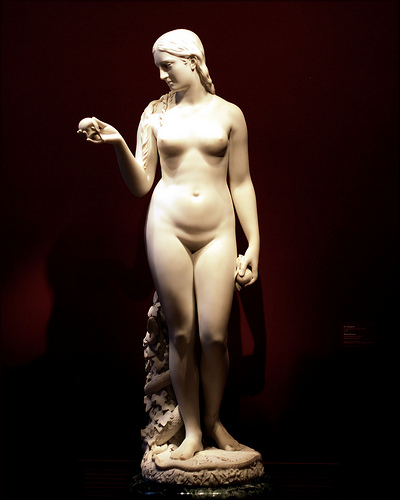
  • One such creator is Hawthorne’s friend Hiram Powers, whose sculpture Eve Tempted is invoked (invoking that other creator, the one who made a garden . . . )

  • powers eve
    Eve Tempted, Hiram Powers
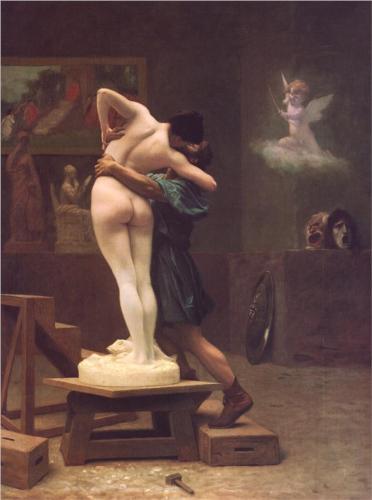
    1. And Pygmalion—
    pygmalion-and-galatea-1.jpg!Blog
    Pygmalion and Galate, Jean-Leon Gerome

    Aylmer, having convinced his wife that he’ll erase her mark: “Even Pygmalion, when his sculptured woman assumed life, felt not greater ecstasy than mine will be!”

    1. Aylmer’s plan is shameful. It’s based on an obsessive misreading of the symbolism of his wife’s birthmark. We’re told that Aylmer “select[s] it as the symbol of his wife’s liability to sin, sorrow, decay, and death, Aylmer’s sombre imagination was not long in rendering the birthmark a frightful object, causing him more trouble and horror than ever Georgiana’s beauty, whether of soul or sense, had given him delight.”

    He’s a very poor reader. His judgments are overawed by idealism.

    1. Georgiana asks him: “Cannot you remove this little, little mark, which I cover with the tips of two small fingers?”

    On one level, Georgiana is offering her husband the opportunity to play doctor with her, to get rid of the mark that’s driving him mad—but I think there’s an ironic second meaning at work here as well. I think she’s suggesting that he remove his perception of the mark, his reading of the mark. That he change his attitude.

    1. Hawthorne’s homeboy Herman Melville, in his big book Moby-Dick, has Ishmael point out—in a simple, charming, homey way—that there is no simply no ideal purity available to us:

    We felt very nice and snug, the more so since it was so chilly out of doors; indeed out of bed-clothes too, seeing that there was no fire in the room. The more so, I say, because truly to enjoy bodily warmth, some small part of you must be cold, for there is no quality in this world that is not what it is merely by contrast. Nothing exists in itself. If you flatter yourself that you are all over comfortable, and have been so a long time, then you cannot be said to be comfortable any more.

    13. Actually, even though we’re told he’s brilliant, it turns out that Aylmer is not the transcendent scientist he’d like to be. In a scene that almost edges into comedy (just a dab to give this tragedy dimension), Georgiana reads

    a large folio from her husband’s own hand, in which he had recorded every experiment of his scientific career, its original aim, the methods adopted for its development, and its final success or failure, with the circumstances to which either event was attributable. The book, in truth, was both the history and emblem of his ardent, ambitious, imaginative, yet practical and laborious life. He handled physical details as if there were nothing beyond them; yet spiritualized them all, and redeemed himself from materialism by his strong and eager aspiration towards the infinite. In his grasp the veriest clod of earth assumed a soul. Georgiana, as she read, reverenced Aylmer and loved him more profoundly than ever, but with a less entire dependence on his judgment than heretofore. Much as he had accomplished, she could not but observe that his most splendid successes were almost invariably failures, if compared with the ideal at which he aimed. His brightest diamonds were the merest pebbles, and felt to be so by himself, in comparison with the inestimable gems which lay hidden beyond his reach. The volume, rich with achievements that had won renown for its author, was yet as melancholy a record as ever mortal hand had penned. It was the sad confession and continual exemplification of the shortcomings of the composite man, the spirit burdened with clay and working in matter, and of the despair that assails the higher nature at finding itself so miserably thwarted by the earthly part. Perhaps every man of genius in whatever sphere might recognize the image of his own experience in Aylmer’s journal.

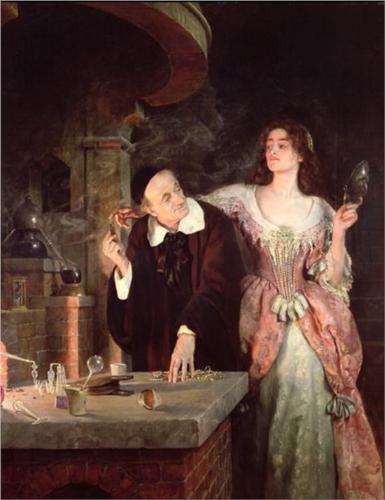
    1. I should clarify, perhaps, that Georgiana reads the journal as she waits out Aylmer’s experiments in his laboratory.
    The Laboratory, John Collier
    The Laboratory, John Collier
    1. Oh, gosh, I almost forgot—there’s a third player in this piece, Aminadab, Aylmer’s manservant/lab assistant, who’s described throughout the text (usually by Aylmer) as “clod,” “man of clay,” “human machine,” “earthly mass,” “thing of the senses” — he’s the pure-material to contrast Aylmer’s (would-be) pure-spirit. Although he’s not described as hunchbacked I can’t help but see him that way, this Igor to a Hollywood Frankenstein. And he laughs.

    2. Aminadab laughs at Aylmer’s folly. Here is the conclusion of this story:

    Alas! it was too true! The fatal hand had grappled with the mystery of life, and was the bond by which an angelic spirit kept itself in union with a mortal frame. As the last crimson tint of the birthmark—that sole token of human imperfection—faded from her cheek, the parting breath of the now perfect woman passed into the atmosphere, and her soul, lingering a moment near her husband, took its heavenward flight. Then a hoarse, chuckling laugh was heard again! Thus ever does the gross fatality of earth exult in its invariable triumph over the immortal essence which, in this dim sphere of half development, demands the completeness of a higher state. Yet, had Alymer reached a profounder wisdom, he need not thus have flung away the happiness which would have woven his mortal life of the selfsame texture with the celestial. The momentary circumstance was too strong for him; he failed to look beyond the shadowy scope of time, and, living once for all in eternity, to find the perfect future in the present.

    17. I won’t comment any further on the story, other than to suggest that the final two lines—in bold above—seem perfectly sensible and wonderfully wise to me. I think Wittgenstein may have been approaching a similar idea some eighty years later in his Tractatus Logico-Philosophicus:

    Death is not an event in life: we do not live to experience death. If we take eternity to mean not infinite temporal duration but timelessness, then eternal life belongs to those who live in the present. Our life has no end in the way in which our visual field has no limits.

    “The Apparition of Mrs. Veal” — Daniel Defoe

    “The Apparition of Mrs. Veal” by Daniel Defoe

    This thing is so rare in all its circumstances, and on so good authority, that my reading and conversation have not given me anything like it. It is fit to gratify the most ingenious and serious inquirer. Mrs. Bargrave is the person to whom Mrs. Veal appeared after her death; she is my intimate friend, and I can avouch for her reputation for these fifteen or sixteen years, on my own knowledge; and I can confirm the good character she had from her youth to the time of my acquaintance. Though, since this relation, she is calumniated by some people that are friends to the brother of Mrs. Veal who appeared, who think the relation of this appearance to be a reflection, and endeavor what they can to blast Mrs. Bargrave’s reputation and to laugh the story out of countenance. But by the circumstances thereof, and the cheerful disposition of Mrs. Bargrave, notwithstanding the ill usage of a very wicked husband, there is not yet the least sign of dejection in her face; nor did I ever hear her let fall a desponding or murmuring expression; nay, not when actually under her husband’s barbarity, which I have been a witness to, and several other persons of undoubted reputation.

    Now you must know Mrs. Veal was a maiden gentlewoman of about thirty years of age, and for some years past had been troubled with fits, which were perceived coming on her by her going off from her discourse very abruptly to some impertinence. She was maintained by an only brother, and kept his house in Dover. She was a very pious woman, and her brother a very sober man to all appearance; but now he does all he can to null and quash the story. Mrs. Veal was intimately acquainted with Mrs. Bargrave from her childhood. Mrs. Veal’s circumstances were then mean; her father did not take care of his children as he ought, so that they were exposed to hardships. And Mrs. Bargrave in those days had as unkind a father, though she wanted neither for food nor clothing; while Mrs. Veal wanted for both, insomuch that she would often say, “Mrs. Bargrave, you are not only the best, but the only friend I have in the world; and no circumstance of life shall ever dissolve my friendship.” They would often condole each other’s adverse fortunes, and read together Drelincourt upon Death, and other good books; and so, like two Christian friends, they comforted each other under their sorrow. Continue reading ““The Apparition of Mrs. Veal” — Daniel Defoe”

    “Epigrams of a Cynic” — Ambrose Bierce

    “Epigrams of a Cynic” by Ambrose Bierce

    If every hypocrite in the United States were to break his leg to-day the country could be successfully invaded to-morrow by the warlike hypocrites of Canada.

    To Dogmatism the Spirit of Inquiry is the same as the Spirit of Evil, and to pictures of the latter it appends a tail to represent the note of interrogation.

    “Immoral” is the judgment of the stalled ox on the gamboling lamb.

    In forgiving an injury be somewhat ceremonious, lest your magnanimity be construed as indifference.

    True, man does not know woman. But neither does woman.

    Age is provident because the less future we have the more we fear it.

    Reason is fallible and virtue invincible; the winds vary and the needle forsakes the pole, but stupidity never errs and never intermits. Since it has been found that the axis of the earth wabbles, stupidity is indispensable as a standard of constancy.

    In order that the list of able women may be memorized for use at meetings of the oppressed sex, Heaven has considerately made it brief.

    Firmness is my persistency; obstinacy is yours.

    A little heap of dust, A little streak of rust, A stone without a name—Lo! hero, sword and fame.

    Our vocabulary is defective; we give the same name to woman’s lack of temptation and man’s lack of opportunity.

    “You scoundrel, you have wronged me,” hissed the philosopher. “May you live forever!” Continue reading ““Epigrams of a Cynic” — Ambrose Bierce”

    W.G. Sebald’s Former Students Share His Writing Advice

    In the fall of 2001—only a few months before his too-early death—W.G. Sebald taught a fiction workshop at the University of East Anglia. Two of the students from the workshop, David Lambert and Robert McGill have revisited their notes from that workshop and have compiled Sebald’s writing advice into a fascinating document, posted at Richard Skinner’s blog.

    My favorite section:

    On Reading and Intertextuality

    • Read books that have nothing to do with literature.
    • Get off the main thoroughfares; you’ll see nothing there. For example, Kant’s Critique is a yawn but his incidental writings are fascinating.
    • There has to be a libidinous delight in finding things and stuffing them in your pockets.
    • You must get the servants to work for you. You mustn’t do all the work yourself. That is, you should ask other people for information, and steal ruthlessly from what they provide.
    • None of the things you make up will be as hair-raising as the things people tell you.
    • I can only encourage you to steal as much as you can. No one will ever notice. You should keep a notebook of tidbits, but don’t write down the attributions, and then after a couple of years you can come back to the notebook and treat the stuff as your own without guilt.
    • Don’t be afraid to bring in strange, eloquent quotations and graft them into your story. It enriches the prose. Quotations are like yeast or some ingredient one adds.
    • Look in older encyclopaedias. They have a different eye. They attempt to be complete and structured but in fact are completely random collected things that are supposed to represent our world.
    • It’s very good that you write through another text, a foil, so that you write out of it and make your work a palimpsest. You don’t have to declare it or tell where it’s from.
    • A tight structural form opens possibilities. Take a pattern, an established model or sub-genre, and write to it. In writing, limitation gives freedom.
    • If you look carefully you can find problems in all writers. And that should give you great hope. And the better you get at identifying these problems, the better you will be at avoiding them.

    (Via Conversational Reading; via Richard Skinner’s blog)