Category: Books
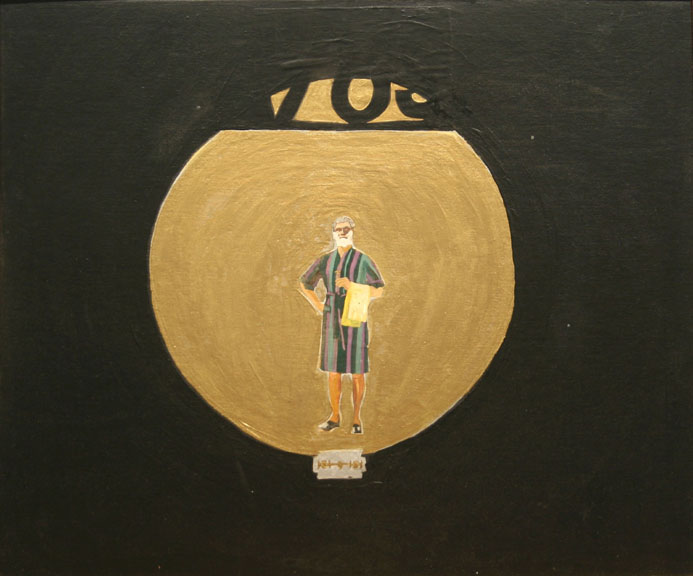
God Shaves — Rosalyn Drexler
Yoko Ogawa’s Revenge (Book Acquired, 1.12.2012)

Revenge is Yoko Ogawa’s new collection of short tales (new from Picador). Their blurb:
An aspiring writer moves into a new apartment and discovers that her landlady has murdered her husband. Elsewhere, an accomplished surgeon is approached by a cabaret singer, whose beautiful appearance belies the grotesque condition of her heart. And while the surgeon’s jealous lover vows to kill him, a violent envy also stirs in the soul of a lonely craftsman. Desire meets with impulse and erupts, attracting the attention of the surgeon’s neighbor—who is drawn to a decaying residence that is now home to instruments of human torture. Murderers and mourners, mothers and children, lovers and innocent bystanders—their fates converge in an ominous and darkly beautiful web.
Revenge is translated by Stephen Snyder, who also translated Hotel Iris—which I really dug. From my review of that book:
Hotel Iris recalls the dread creepiness of David Lynch, as well as that director’s subversion of fairy tale structures (perhaps “subversion” is not the right word–aren’t fairy tales by nature subversive?). There are also obvious parallels between Mari’s story and The Story of O andPeter Greenaway’s fantastic film The Cook, the Thief, His Wife, & Her Lover. But these are perhaps lazy comparisons–I should talk about Ogawa’s deft writing, her supple, slippy sentences, her sharpness of details, the exquisite ugliness of her depictions of sex and eating. She’s a very good writer, and translator Stephen Snyder has done a marvelous job rendering Ogawa’s Japanese into smooth, rhythmic sentences that resist idiomatic placeholders.
Revenge seems just as creepy. You can read the first story “Afternoon at the Bakery” in full at Macmillan/Picador’s site; a few sample sentences to entice or repel you:
He died twelve years ago. Suffocated in an abandoned refrigerator left in a vacant lot. When I first saw him, I didn’t think he was dead. I thought he was just ashamed to look me in the eye because he had stayed away from home for three days.
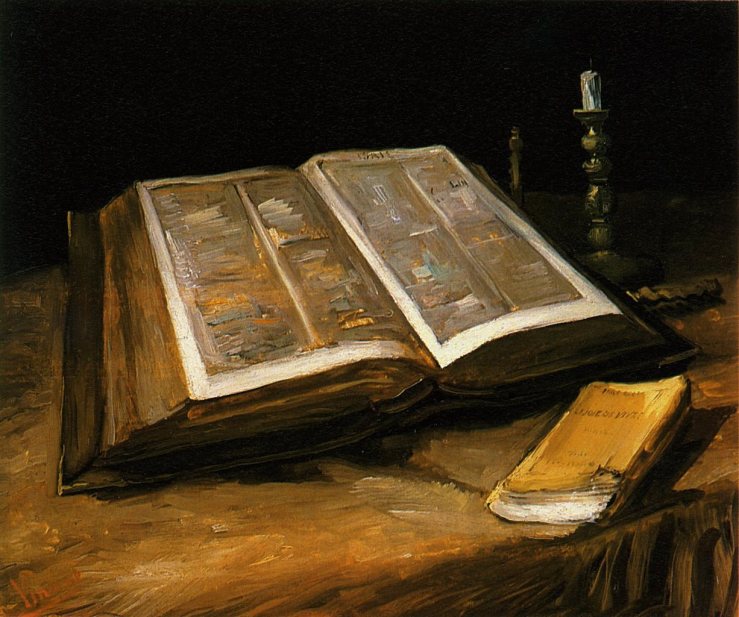
Still Life with Bible — Vincent van Gogh
Ben Marcus’s The Flame Alphabet (Book Acquired, 1.11.2013)

Ben Marcus’s The Flame Alphabet is newish in trade paperback from the nice people at Vintage. I’ve been wanting to read it after absorbing Marcus’s The Age of Wire and String last year. I hear that The Flame Alphabet is more conventional than that earlier work, although a breakfast-menu-as-novel would be more conventional, really. Anyway, this one is up on deck, so no blurbage this time.
In place of the normal blurb I offer with these “book acquired” posts, here’s Marcus on David Markson (from “The Genre Artist,” published in a 2003 issue of The Believer):
. . . when, for example, David Markson, an expository novelist who fired the starting gun for fictions of information and proved that pure exposition can be alarmingly moving, who purposefully tells instead of shows, is dismissed in The New York Times for failing to provide a story in his novel Reader’s Block, no discussion follows about why, exactly, fiction must have one (at 150 words in the book review, how could any discussion follow?). Nor do we learn what a story might have looked like in such an exquisitely felt book that, to summarize, catalogs the various ways historical figures have hated whole races of people and/or died by their own hands. (Yes, you should read this book.)
Markson should have presumably, under the fiction-must-have-a-story criteria, zeroed in on one of his hundreds of characters and gone deep, doing that good old-time psychological work, the person-making stuff, dramatizing how such an interesting fellow had gone on to hate Jews and/or kill himself. Markson should have used more words like “then.” He should have sequenced. He seems to have forgotten that literature is supposedly a time-based art.
Markson’s amnesia is one of the happy accidents of the last decade of fiction writing. By eschewing a fetishistic, conventional interest in character, or a dutiful allegiance to moment creation, to occurrence itself, Markson accomplishes what a story, slogging through time and obedient to momentum, arguably could not: a commanding, obsessive portrait of single behaviors throughout history, a catalog of atrocity that overwhelms through relentless example. In truth, it’s a novel that can be read as an essay, but unlike most essays, it’s lyrically shrewd, poetry in the form of history, and it’s brave enough to provide creepy, gaping holes where we normally might encounter context (the burden of the conventional essayist).
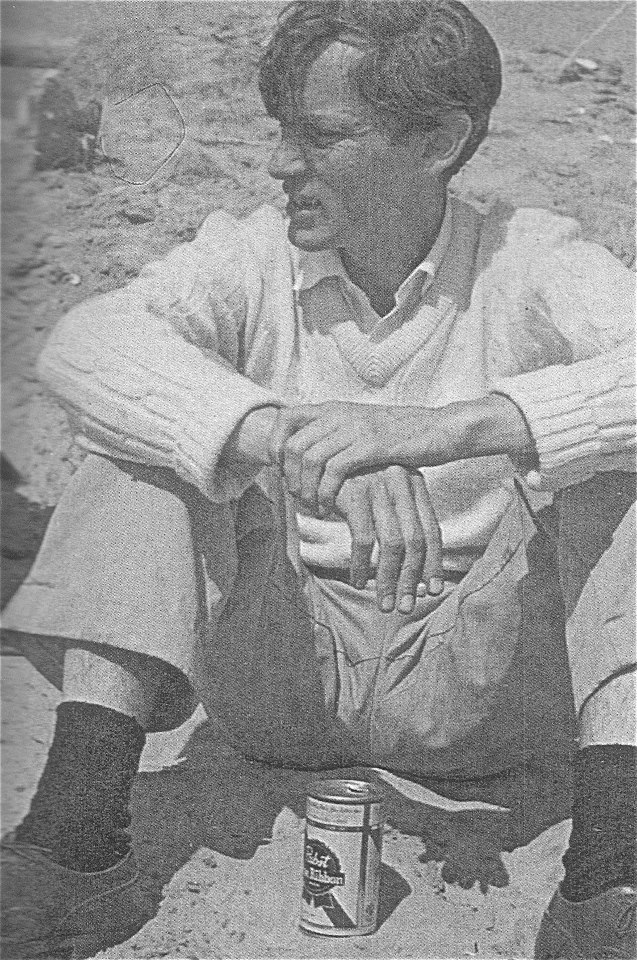
William Gaddis Cold Kickin’ It on the Beach with a Can of PBR
“Fear” — Guy de Maupassant
“Fear” by Guy de Maupassant
We went up on deck after dinner. Before us the Mediterranean lay without a ripple and shimmering in the moonlight. The great ship glided on, casting upward to the star-studded sky a long serpent of black smoke. Behind us the dazzling white water, stirred by the rapid progress of the heavy bark and beaten by the propeller, foamed, seemed to writhe, gave off so much brilliancy that one could have called it boiling moonlight.
There were six or eight of us silent with admiration and gazing toward far-away Africa whither we were going. The commandant, who was smoking a cigar with us, brusquely resumed the conversation begun at dinner.
“Yes, I was afraid then. My ship remained for six hours on that rock, beaten by the wind and with a great hole in the side. Luckily we were picked up toward evening by an English coaler which sighted us.”
Then a tall man of sunburned face and grave demeanor, one of those men who have evidently traveled unknown and far-away lands, whose calm eye seems to preserve in its depths something of the foreign scenes it has observed, a man that you are sure is impregnated with courage, spoke for the first time.
“You say, commandant, that you were afraid. I beg to disagree with you. You are in error as to the meaning of the word and the nature of the sensation that you experienced. An energetic man is never afraid in the presence of urgent danger. He is excited, aroused, full of anxiety, but fear is something quite different.”
The commandant laughed and answered: “Bah! I assure you that I was afraid.”
Then the man of the tanned countenance addressed us deliberately as follows:
“Permit me to explain. Fear—and the boldest men may feel fear—is something horrible, an atrocious sensation, a sort of decomposition of the soul, a terrible spasm of brain and heart, the very memory of which brings a shudder of anguish, but when one is brave he feels it neither under fire nor in the presence of sure death nor in the face of any well-known danger. It springs up under certain abnormal conditions, under certain mysterious influences in the presence of vague peril. Real fear is a sort of reminiscence of fantastic terror of the past. A man who believes in ghosts and imagines he sees a specter in the darkness must feel fear in all its horror.
“As for me I was overwhelmed with fear in broad daylight about ten years ago and again one December night last winter.
“Nevertheless, I have gone through many dangers, many adventures which seemed to promise death. I have often been in battle. I have been left for dead by thieves. In America I was condemned as an insurgent to be hanged, and off the coast of China have been thrown into the sea from the deck of a ship. Each time I thought I was lost I at once decided upon my course of action without regret or weakness.
“That is not fear. Continue reading ““Fear” — Guy de Maupassant”
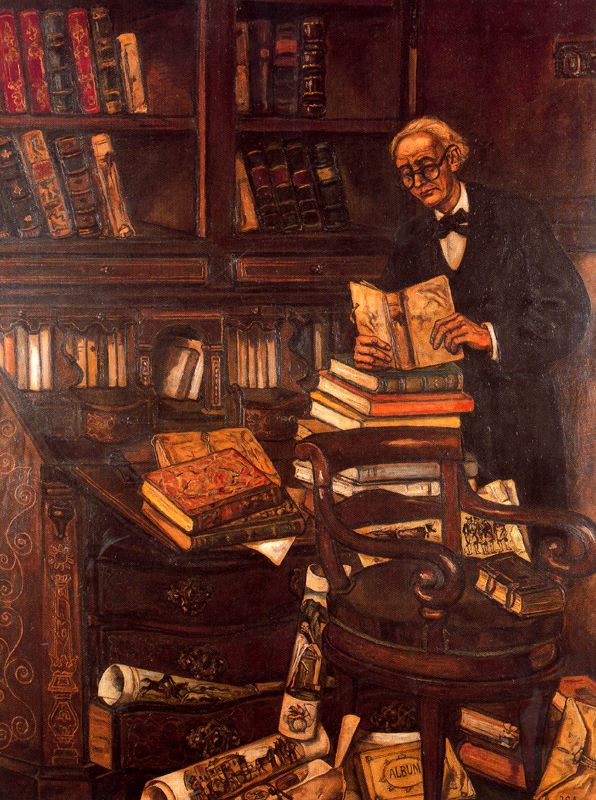
The Bibliophile — Jose Gutierrez Solana
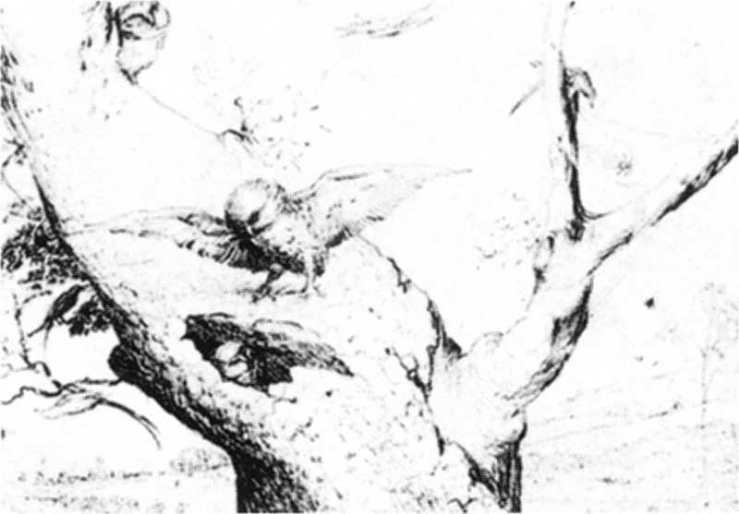
Nest of Owls — Hieronymus Bosch
“… this easy, indifferent sword must be chance…” (Moby-Dick)
I was the attendant or page of Queequeg, while busy at the mat. As I kept passing and repassing the filling or woof of marline between the long yarns of the warp, using my own hand for the shuttle, and as Queequeg, standing sideways, ever and anon slid his heavy oaken sword between the threads, and idly looking off upon the water, carelessly and unthinkingly drove home every yarn: I say so strange a dreaminess did there then reign all over the ship and all over the sea, only broken by the intermitting dull sound of the sword, that it seemed as if this were the Loom of Time, and I myself were a shuttle mechanically weaving and weaving away at the Fates. There lay the fixed threads of the warp subject to but one single, ever returning, unchanging vibration, and that vibration merely enough to admit of the crosswise interblending of other threads with its own. This warp seemed necessity; and here, thought I, with my own hand I ply my own shuttle and weave my own destiny into these unalterable threads. Meantime, Queequeg’s impulsive, indifferent sword, sometimes hitting the woof slantingly, or crookedly, or strongly, or weakly, as the case might be; and by this difference in the concluding blow producing a corresponding contrast in the final aspect of the completed fabric; this savage’s sword, thought I, which thus finally shapes and fashions both warp and woof; this easy, indifferent sword must be chance—aye, chance, free will, and necessity—nowise incompatible—all interweavingly working together. The straight warp of necessity, not to be swerved from its ultimate course—its every alternating vibration, indeed, only tending to that; free will still free to ply her shuttle between given threads; and chance, though restrained in its play within the right lines of necessity, and sideways in its motions directed by free will, though thus prescribed to by both, chance by turns rules either, and has the last featuring blow at events.
From “The Mat-Maker,” Chapter 47 of Moby-Dick by Herman Melville.
Orson Welles Talks About Making Fun of Ernest Hemingway
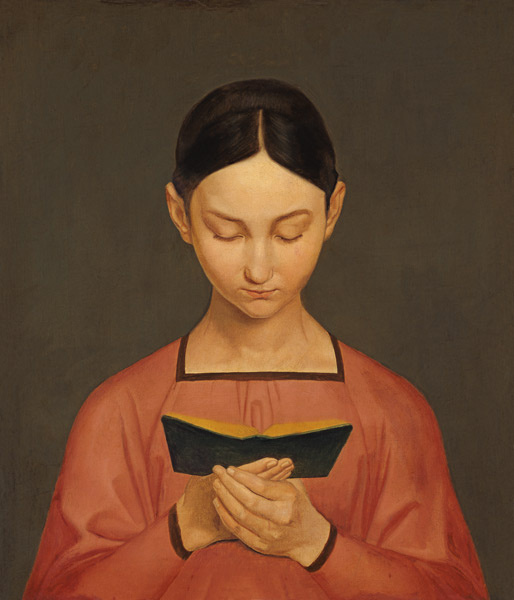
Reading Girl — Gustav Hennig
Summary of Bloom’s Day in Ulysses — Evan Lavender-Smith (From Old Notebooks)
Makes breakfast for his wife. Goes to the butcher. Goes to the post office. Goes to church. Goes to a chemist. Goes to a public bath. Goes to a funeral. Goes to a newspaper press. Goes to a locksmith to canvass an ad. Feeds some seagulls. Goes to a bar. Helps a blind man cross the street. Goes to the museum. Goes to to the library. Visits a bookseller. Window-shops. Goes to a restaurant. Listens to some live music. Writes a love letter. Goes to another bar. Nearly gets in a fight. Masturbates to a beautiful eighteen-year-old exhibitionist giving him a private show. Takes an alfresco nap. Takes up a collection for a widow. Goes to a hospital to visit a pregnant woman. Flits with a nurse. Feeds a stray dog. Goes to a whorehouse. Helps avert a row with the police. Goes to a cabman’s shelter and listens to a sailor tell stories. Breaks into his own house. Urinates under the stars with another man. Watches the sunrise. Kisses his wife on her arse.
It would have been the single busiest, most adventurous day of my life.
From Evan Lavender-Smith’s From Old Notebooks.
“…by its indefiniteness it shadows forth the heartless voids and immensities of the universe…” (Moby-Dick)
But not yet have we solved the incantation of this whiteness, and learned why it appeals with such power to the soul; and more strange and far more portentous—why, as we have seen, it is at once the most meaning symbol of spiritual things, nay, the very veil of the Christian’s Deity; and yet should be as it is, the intensifying agent in things the most appalling to mankind.
Is it that by its indefiniteness it shadows forth the heartless voids and immensities of the universe, and thus stabs us from behind with the thought of annihilation, when beholding the white depths of the milky way? Or is it, that as in essence whiteness is not so much a colour as the visible absence of colour; and at the same time the concrete of all colours; is it for these reasons that there is such a dumb blankness, full of meaning, in a wide landscape of snows—a colourless, all-colour of atheism from which we shrink? And when we consider that other theory of the natural philosophers, that all other earthly hues—every stately or lovely emblazoning—the sweet tinges of sunset skies and woods; yea, and the gilded velvets of butterflies, and the butterfly cheeks of young girls; all these are but subtile deceits, not actually inherent in substances, but only laid on from without; so that all deified Nature absolutely paints like the harlot, whose allurements cover nothing but the charnel-house within; and when we proceed further, and consider that the mystical cosmetic which produces every one of her hues, the great principle of light, for ever remains white or colourless in itself, and if operating without medium upon matter, would touch all objects, even tulips and roses, with its own blank tinge—pondering all this, the palsied universe lies before us a leper; and like wilful travellers in Lapland, who refuse to wear coloured and colouring glasses upon their eyes, so the wretched infidel gazes himself blind at the monumental white shroud that wraps all the prospect around him. And of all these things the Albino whale was the symbol. Wonder ye then at the fiery hunt?
From “The Whiteness of the Whale,” Chapter 42 of Moby-Dick by Herman Melville.
Nelson Algren’s Mugshot

“A Dry Spell” — Einar Hjörleifsson Kvaran
“A Dry Spell” by Einar Hjörleifsson Kvaran
It had rained for a fortnight—not all the time heavily, but a fog had sullenly hung about the mountain tops, clinging to the atmosphere and rendering the whole of existence a dull gray colour. Every little while it would discharge a fine drizzle of rain or a heavy shower down upon the hay and everything else on earth, so that only the stones would occasionally be dry—but the grass never.
We were tired of the store—indeed, I should like to know who would have enjoyed it. It dated back to the beginning of the last century, a tarred, coal-black, ramshackle hut. The windows were low and small, the windowpanes diminutive. The ceiling was low. Everything was arranged in such a way as to exclude the possibility of lofty flights of thought or vision.
Just now, not a living soul looked in—not even those thriftless fellows who lived by chance jobs in the village and met in daily conclave at the store. We had often cursed their lengthy visits, but now that they had hired themselves out during the haymaking, we suddenly realized that they had often been entertaining. They had made many amusing remarks and brought us news of the neighbourhood. And now we cursed them for their absence.
We sat there and smoked, staring vacantly at the half-empty shelves, and all but shivering in the damp room. There was no heater in the store at any season, and the one in the office, if used, emitted spurts of smoke through every aperture except the chimney. It had not been cleaned since sometime during winter, and we were not ambitious enough for such an undertaking in the middle of the summer.
We tried to transfer our thoughts from the store to the world outside. We made clever comments to the effect that the farmers were now getting plenty of moisture for the hay-fields, and that it would be a pity if rain should set in now, right at the beginning of the haying season. We had nothing further to say on the subject, but this we repeated from day to day. In short, we were depressed and at odds with things in general. Until the dry spell.
One morning, about nine o’clock, the bank of fog began to move. First, there appeared an opening about the size of your hand, and through it the eastern sky showed a bright blue. Then another opening, and through it shone the sun. Continue reading ““A Dry Spell” — Einar Hjörleifsson Kvaran”
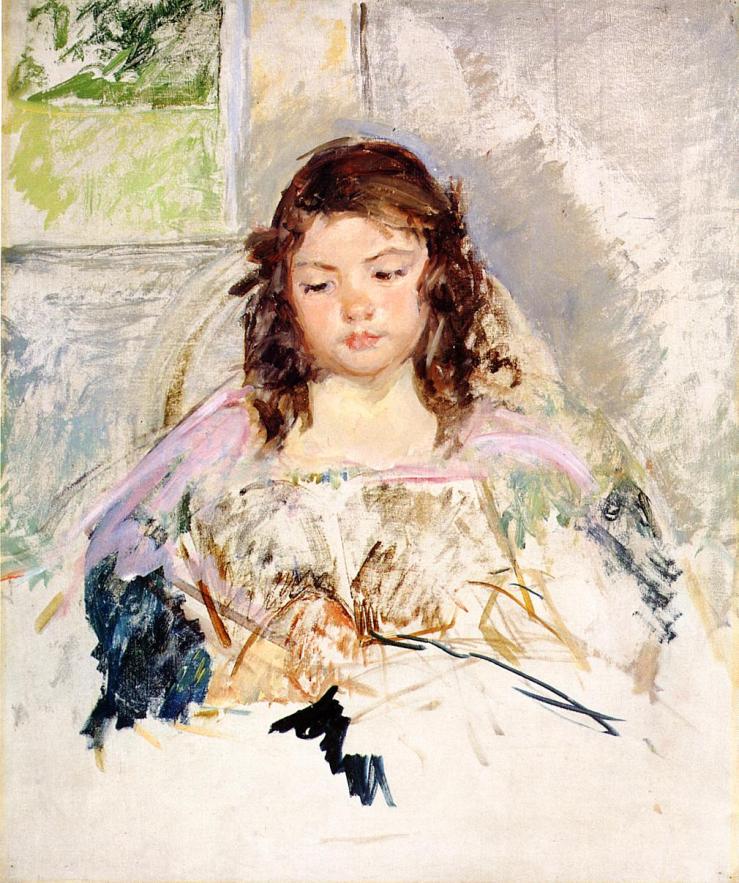
Girl in Pink — Mary Cassatt
 M
M
 Biblioklept