For localish readers: Jacksonville Public Library will host a graphic novel workshop for parents and kids this Saturday. Info:


For localish readers: Jacksonville Public Library will host a graphic novel workshop for parents and kids this Saturday. Info:
At Hark, A Vagrant!, Kate Beaton spoofs Charlotte Perkins Gilman’s seminal feminist/horror short story “The Yellow Wallpaper”–

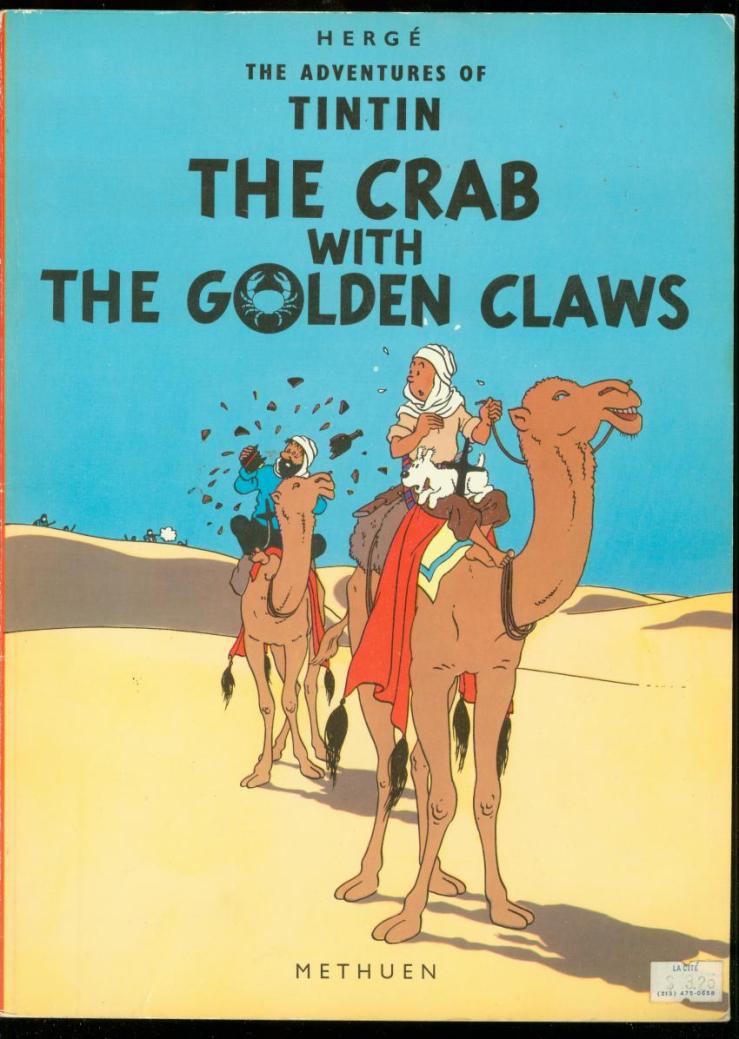 I’ve long been interested in Hergé’s Belgian comic series Tintin, which chronicles the adventures of Tintin, boy reporter, and his faithful dog Snowy. When a batch of hardback three-in-one editions showed up at my favorite used book store I picked up Vol. 3, which collects The Crab with the Golden Claws, The Shooting Star, and The Secret of the Unicorn. I read The Crab with the Golden Claws in one pleasant sitting that night and finished the other two adventures in similar fashion. Then I went back to the bookshop and picked up the other four three-in-one editions they had in stock.
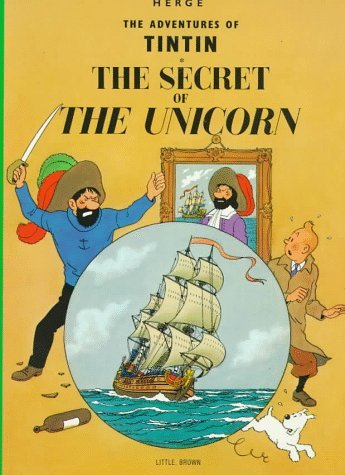
It’s hard to divide the tales, which are all fun adventures in the high style of boy-adventuring, but I think Crab was my favorite of the three. It involves a drug smuggling ring and a trip to the Sahara desert. It also introduces Captain Haddock, an alcoholic lummox who tips into a verbose stream of insults whenever he’s in a rage (he merely stutters when in his cups). Haddock is Tintin’s unlikely (but totally likely) sidekick in the other tales in the volume, and he shows up in the other books I bought as well. The Shooting Star is a bit more sporadic in its plot–it begins with the end of the world (by asteroid!) and when that doesn’t pan out, moves into an ocean race to recover a meteorite. Unicorn also boasts a nautical theme; Tintin finds part of a treasure map in a model ship and fights against antique-collecting brothers to recover the booty (Keno Bros. beware). These adventure stories share more in common with Indiana Jones and Edgar Rice Burroughs than Marvel or DC comics; there’s a prevalent sense of danger, fun, and mystery that underscores the series.
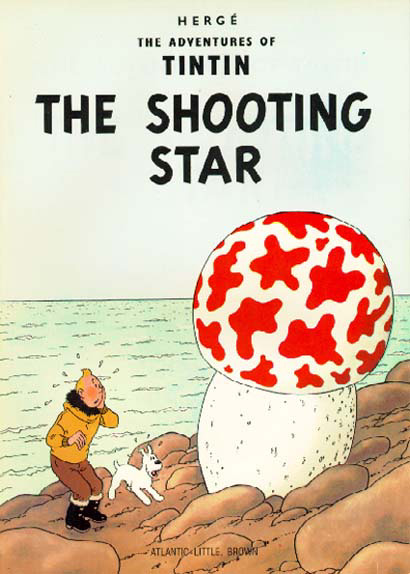 Hergé’s clean, efficient style evokes beautiful and strange worlds. His economy of storytelling is simply brilliant; he knows how to connote his characters’ movements–including some sweaty action sequences–and he also knows how to move the plot forward without resorting to talking heads (although you will find the occasional expository-friendly radio broadcast pop up in a Tintin comic). It’s when Hergé drops a luscious market scene or a crowded basement-dungeon larded with antiquities that the art in Tintin shines. Hergé’s great talent is to evoke a startling sense of place for each setting in his comics, a fully-realized set that creates a sort of visual (and emotional) baseline for the reader. This allows for the cleaner, crisper panels to relay action without clutter. Hergé’s knack for storytelling cannot be underestimated either. He blends high adventure with slapstick and verbal comedy, much of it courtesy Tintin’s foils: the Thompsons, bungling detectives, precisely, who provide Tintin with many of his cases; Haddock; and Snowy, of course.
 If you know a bit about Hergé’s Tintin series, you may know that its depiction of non-white and non-European characters has come under attack in recent years; Tintin in the Congo has been singled out in particular. I haven’t read Congo, but Crab’s representation of Arabs (and Asians) is riddled with all kinds of wrong–at least when viewed from a PC postmodern post-colonialist post-whatever perspective. Hergé’s comics reveal at times a particularly suspect Western European ideology, one that privileges white male authority in the form of white male adventure. We can see the same colonialism and Orientalism at work decades later in the Indiana Jones movies (particularly Temple of Doom). This comparison is not meant to indict Indy (or Spielberg, rather) or excuse Tintin (and Hergé); instead, I’m merely pointing out that adventure tales that feature white heroes exploring–and dominating–the Other are hardly new; nor have they disappeared. The big mistake would be not to read Hergé’s work for fear of tripping over politically-correct mores. Banning a book is never a smart practice.
Far better is Charles Burns’s recent Tintin revisionism in X’ed Out: he moves his inverted hero Nitnit to a bizarro world version of the Saharan market, a place teeming with strangeness that is also largely indebted to William Burroughs’s Interzone. The inversion reverses Tintin’s a priori white male domination into an equally fantastic (but far more horrific) vision of confrontation with radical Otherness. Shit gets weird (as alien encounters should). Nitnit is not in control, not the master of this domain, which is plainly not his. Burns’s Tintin revision saliently calls attention to the ways that the best in art might be transformed and reinterpreted. It points toward the subconscious inheritance intrinsic to art.
But back to the book I am ostensibly reviewing. The Adventures of Tintin, Vol 3 seems to me as good a place as any to start with Tintin, and those interested should dig in. These three-in-one editions are smaller than the traditional oversized format, but you can compensate by holding the book closer to your face (ah, intimacy). Lovely stuff.
At Vice, Sammy Markham (Crickets) interviews one of our heroes of Charles Burns. Read our review of Burns’s latest, X’ed Out. From the interview with Markham, Burns discusses subconscious influences–
There’s work that I grew up with and looked at and internalized. It is still in my subconscious, and I pay attention to that part of myself, and those images come through. For example, I looked at Tintin books when I was really, really young—before I could even read—and so there were elements of the stories that I didn’t understand the relevance of. In The Secret of the Unicorn there’s one scene where Tintin is down in this basement. He’s been kidnapped. He wakes up and there’s this intercom that’s stuck on the wall. And in my mind, I had no idea what an intercom was, but I could tell that there was a voice balloon coming from this little hole in the wall.
In a weird and felicitous coincidence, I happened to have read The Secret of the Unicorn just last week and then read a comic by Burns in the May or June 2010 issue of The Believer where he riffs on the very scene he’s described above, a comic I only understood after reading Unicorn. Here’s the comic–

Kate Beaton’s “Santa,” from her site Hark, a Vagrant!—

 The AV Club’s Tasha Robinson interviews comix legend Lynda Barry. In the (rather lengthy) interview, Barry discusses teaching her craft–
It’s a really hard thing to teach students. The two things I always try to teach them is, one, you have to stay in motion. It doesn’t mean that you have to just write blah, blah, blah, blah, blah. Write the alphabet. You have to stay in motion. And the other thing is, when you get stuck, don’t read over what you just wrote. Especially if you have a computer. Maybe by hand is not so bad, but with a computer, what happens is… My experience has always been that there is a point when the story just stops. Always. You know, it’s just like when you’re dancing. There’s a time when you’re fake-dancing, because the groove has stopped. Then you’re back in the groove. So if people understood that that’s a natural part of making something, and they knew what to do during that time… But what people will do if they’re writing on a computer is, when that time comes and it’s quiet for a minute, they panic and go back and start fixing stuff above it that was not even broken. You can’t start to fix something until you know what it’s for, you know? So I always try to get my students to just sustain the state of mind for a certain amount of time. Even though I use 24 panels for my students, they’ll have seven minutes to just sustain this open state of mind while they’re writing, keep their hand in motion. But it’s really tough to get them to believe me, to just to even give it a try. And then once they do, it’s really fun.
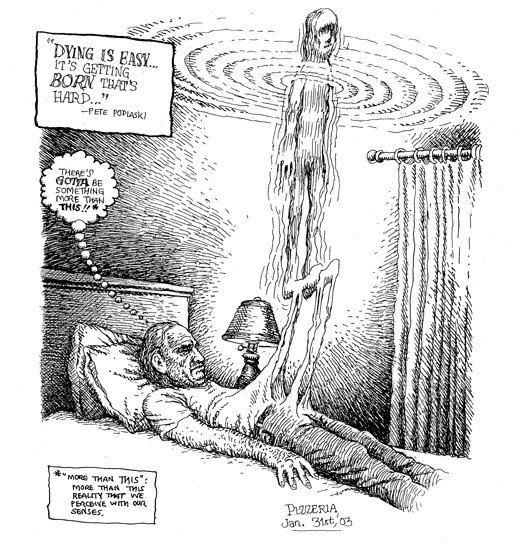
(Via).
“Treasure,” a creepy/fun webcomic by Edgar R. McHerly. From his website The Invisible Hair Suit.

Cartoonist Kate Beaton riffs on Macbeth. From her site Hark! A Vagrant.

 The AV Club’s Sam Adams interviews Charles Burns about Tintin, Burroughs, why he’s not involved in making the Black Hole movie, 1977, why he had to change how he colored his art, and his new book, X’ed Out. There’s also this nugget (we’d been wondering)–
AVC: Is the completed three-volume work going to be called X’ed Out?
CB: They’re all going to be different stories. So for the next one, it says “Next: The Hive.” So the next book is called The Hive.
AVC: Is there a name for the trilogy?
CB: No, not in my mind.
Vodpod videos no longer available.
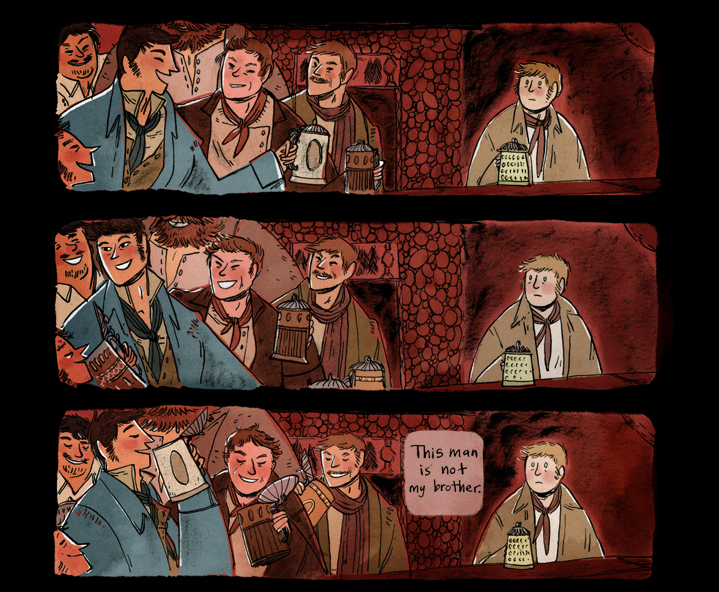
“His Face All Red” is a lovely, disturbing little self-contained webcomic by Em Carroll. Fratricide, an American gothic setting, and a horrifyingly ambiguous conclusion: what’s not to love? Read it here.

Robert Crumb and his daughter Sophie Crumb spoke with Neal Conan on on NPR’s Talk of the Nation program today to discusses her art, her new book, Evolution of a Crazy Artist, and her relationship with her parents. From the web edition’s write-up:
Sophie Crumb grew up in a family of artists — her parents, Robert Crumb and Aline Kominsky-Crumb, are two of the most famous graphic artists in the world. So it’s only natural that she found herself gravitating toward their profession as early as the age of 2.
Her new book, Sophie Crumb: Evolution Of A Crazy Artist, is a collection of her work up to age 28. She and her father tell NPR’s Neal Conan about collaborating on her book and life in the Crumb household.
Sophie Crumb features a comprehensive collection of Sophie’s drawings, and that was no accident.
“My dad is a compulsive archivist,” she says. “He was into them, so I kind of did them to make him laugh.”
Sophie Crumb grew up in a family of artists — her parents, Robert Crumb and Aline Kominsky-Crumb, are two of the most famous graphic artists in the world. So it’s only natural that she found herself gravitating toward their profession as early as the age of 2.
Her new book, Sophie Crumb: Evolution Of A Crazy Artist, is a collection of her work up to age 28. She and her father tell NPR’s Neal Conan about collaborating on her book and life in the Crumb household.
Sophie Crumb features a comprehensive collection of Sophie’s drawings, and that was no accident.
“My dad is a compulsive archivist,” she says. “He was into them, so I kind of did them to make him laugh.”

Earlier this week, I pulled out From Hell with the bold intention of re-reviewing it for this site. I love Halloween and I love Alan Moore and Eddie Campbell’s epic revision of the Jack the Ripper murders, so this seemed as good an occasion as any for a reread (especially considering the “review” I wrote back in October of 2006 is so lazy that I won’t even link to it). Alas, I misjudged or misremembered the sheer density of From Hell–so, on Halloween day, I’m still only half way through, despite staying up way past my bed time, crouching under my sheets with a quavering flashlight, scanning Moore’s erudite words and Campbell’s scratchy inks (okay, that image is an exaggeration). I’ve read it at least thrice before, so I’ll review it anyway.
From Hell posits Sir William Gull, a physician to Queen Victoria, as the orchestrator of the Jack the Ripper murders that terrified Londoners at the end of the 19th century. Although the murders initially arise out of the need to cover up the knowledge of the existence of an illegitimate son begat by foolish Prince Albert, Victoria’s grandson. However, for Gull the murders represent much more–they are part of the continued forces of “masculine rationality” that will constrain “lunar female power.” Gull is a high-level Mason; during a stroke, he experiences a vision of the Masonic god Jahbulon, one which prompts him to his “great work”–namely, the murders that will reify masculine dominance.
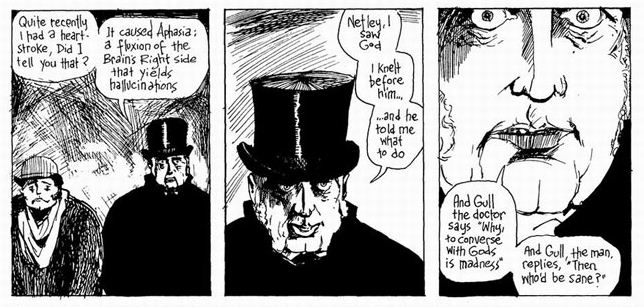
One of the standout chapters in the book is Gull’s tour of London, with his hapless (and witless) sidekick Netley. In a trip that weds geography, religion, politics, and mythology, Gull riffs on a barbaric, hermetic history of London, revealing the gritty city as an ongoing site of conflict between paganism and orthodoxy, artistic lunacy and scientific rationality, female and male, left brain and right brain. The tour ends with a plan to commit the first murder. From there, the book picks up the story of Frederick Abberline, the Scotland Yard inspector charged with solving the murders. Of course, the murders are unsolvable, as the hierarchy of London–from the Queen down to the head of police–are well aware of who the (government-commissioned) murderer is. The police procedural aspects of the plot are fascinating and offer a balanced contrast with Gull’s mystical visions–visions that culminate in a climax of a sort of time-travel, in which Gull not only sees London at the end of the twentieth century, but also receives a guarantee that his murder plot has had its intended effect. From Hell takes many of its cues from the idea that history is shaped not by random events, but rather by tragic conspiracies that force people to willingly give up freedom to a “rational” authority. The book points repeatedly to the 1811 Ratcliffe Highway murders, which led directly to the world’s first modern police force. In our own time, if we’re open to conspiracy theories, we might find the same pattern in the 21st century responses to terrorism (Patriot Act, anyone?).
Although From Hell features moments of supernatural horror in Gull’s mysticism, it is the book’s grimy realism that is far more terrifying. London in the late 1880s is no place you want to be, especially if you are poor, especially if you are a woman. The city is its own character, a labyrinth larded with ancient secrets the inhabitants of which cannot hope to plumb. Despite the nineteenth century’s claims for enlightenment and rationality, this London is bizarrely cruel and deeply unfair. Campbell’s style evokes this London and its denizens with a surreal brilliance; his dark inks are by turns exacting and then erratic, concentrated and purposeful and then wild and severe. The art is somehow both rich and stark, like the coal-begrimed London it replicates. Although Moore has much to say, he allows Campbell’s art to forward the plot whenever possible. Moore is erudite and fascinating; even when one of his characters is lecturing us, it’s a lecture we want to hear. His ear for dialog and tone lends great sympathy to each of the characters, especially the unfortunate women who must turn to prostitution to earn their “doss” money. And while Abberline’s frustrations at having to solve a crime that no higher-ups want solve make him the hero of this story, Gull’s mystic madness makes him the narrative’s dominant figure. Rereading this time, I realized there is no character he reminds me of as much as Judge Holden from Cormac McCarthy’s Blood Meridian. I’m also reading Joseph Conrad’s The Secret Agent now, a book that dovetails neatly with From Hell, both in its time and setting, but also in its exploration of social unrest and duplicitous authority. Both novels feature detectives fighting a complacent system, and both novels feature a working class that threatens to erupt in socialist or anarchist rebellion.
From Hell is a fantastic starting place for anyone interested in Moore’s work, more self-contained than his comics that reimagine superhero myths, like Watchmen or Swamp Thing, and more satisfying and fully achieved than Promethea or V Is for Vendetta. Be forewarned that it is a graphic graphic novel, although I do not believe its violence is gratuitous or purposeless. Indeed, From Hell aspires to remark upon the futility and ugliness of cyclical violence, and it does so with wisdom and verve. Highly recommended.
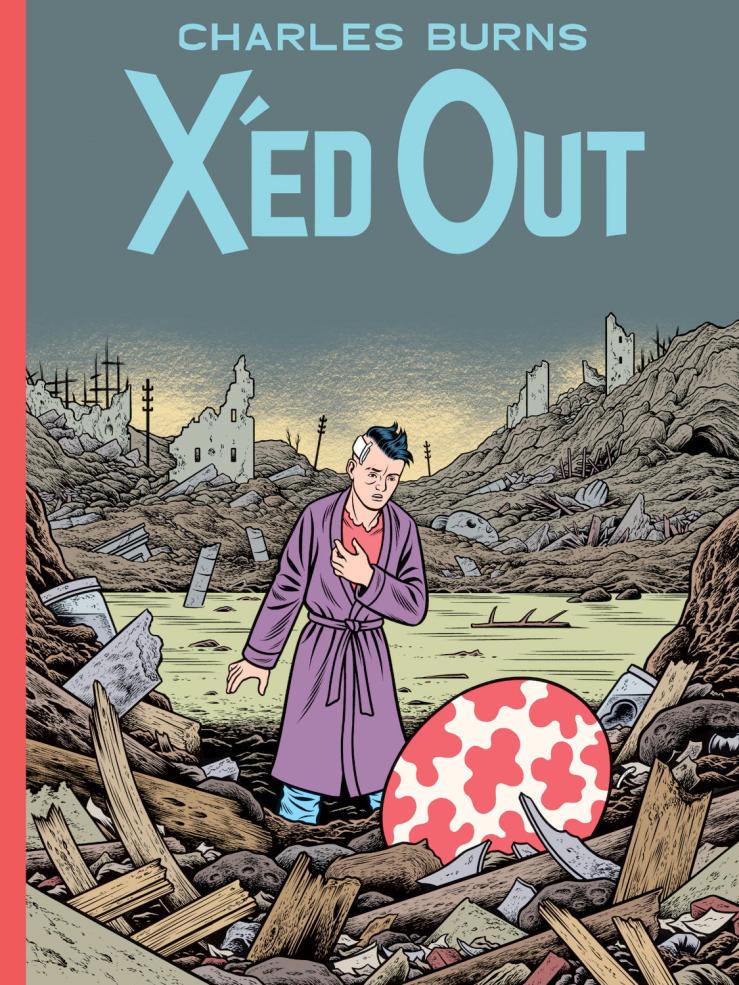
If you like Charles Burns, go ahead and pick up X’ed Out, the first (and very promising) entry in a new trilogy. Skip this review. You’ll probably be happier (and more unsettled) just experiencing all that vivid, glorious weirdness for yourself without any potential spoilers. If you need convincing, read on.
X’ed Out begins in a strange fever-dreamland that doesn’t immediately announce itself as such. Instead, we tentatively enter this weird world with Doug, the book’s protagonist, who, like Alice following the white rabbit, chases his (long dead) childhood cat through a crack in the wall. Doug traverses a cavernous, ruinous place, littered with murky detritus and swamped in a strange flood, to finally arrive in a bizarre desert town that approximates William Burroughs’s Interzone. Populated by mean lizards who dress like Mormon slackers and other grubby grotesques, the terrain readily recalls both Tatooine and Asian bazaars. Hapless Doug, still in pajamas, house coat, and slippers — and marked by an as-yet-unexplained head wound — soon finds himself under the guidance of a strange little diapered dwarf, who may or may not have his best interest in mind. The dreamworld unravels as Doug glances an old man — an “oldie,” as the dwarf says — who we will learn later is Doug’s father. An all of a sudden we’re back in the real world, back in waking life.
But no. That’s not right. Not “back” — we were never in the waking world to begin with. Significantly, X’ed Out begins in the Burroughsian dreamworld and then moves to a conscious, concrete reality. Burns’s dreamworld sequences explicitly reference Belgian cartoonist Hergé’s seminal Tintin comics (you can see how X’ed Out’s cover riffs on the Tintin adventure The Shooting Star here). Doug’s dream face is an expressive, stark mask, a naïve, cartoonish contrast to the bizarre nightmare to which it reacts.

Doug — the waking world Doug, the “real” Doug, that is — pulls a similar mask over his more realistically drawn face later in the story when he does his “Burroughs thing” at a slummy art punk party. Alienated from the scenesters who don’t get his cut-up poetry performance, Doug takes up with Sarah, a girl from his photography class with a thing for razor blades and pig hearts. The same night they meet, he loses his girlfriend, and her crazy boyfriend goes to jail for assaulting a cop. They initiate their romance in Patti Smith records, lines of cocaine, and sick Polaroids. Ah, young love.
But all of that is in another kind of dreamworld, the past, a retreat for the “real,” contemporary Doug, who spends his few waking hours cringing in his bathrobe, poring over old photos, and eating the occasional Pop Tart. At night he eats pain pills and goes to Interzone-land, a place that seems as real and solid and valid as his past with Sarah, a past he has apparently lost. Doug bears a huge patch over half his head (significantly x-shaped in his Interzone version), and both this wound as well as the psychic trauma he’s obviously endured (and is enduring) remain unexplained throughout X’ed Out. However, Burns’s often-grisly images hint repeatedly at a past event filled with violence and loss. X’ed Out leaves us in the Interzone, with the dwarf making long-term plans for Tintinized Doug. There’s even talk of establishing residency and employment–it feels like Doug is here to stay (at least in his non-waking hours). X’ed Out ends maddeningly with a girl who visually recalls Sarah being borne by lizard men to a giant hive. The dwarf explains that she is their new queen–and like some insect queen, she is a breeder. Yuck. The ending is the biggest problem with X’ed Out, simply because it leaves one stranded, wanting more weirdness.
In Black Hole, Burns established himself as a master illustrator and a gifted storyteller, using severe black and white contrast to evoke that tale’s terrible pain and pathos. X’ed Out appropriately brings rich, complex color to Burns’s method, and the book’s oversized dimensions showcase the art beautifully. This is a gorgeous book, both attractive and repulsive (much like Freud’s concept of “the uncanny,” which is very much at work in Burns’s plot). Like I said at the top, fans of Burns’s comix likely already know they want to read X’ed Out; weirdos who love Burroughs and Ballard and other great ghastly fiction will also wish to take note. Highly recommended.
X’ed Out is available in hardback from Pantheon on October 19th, 2010.


 Biblioklept