
…the weird thing is that I actually saw this as a kid. A few years later I saw Belle du jour (thanks to my uncle!) and then of course Un chien andalou and L’age d’or in college…
Category: Film
“Home Run” — Steven Millhauser
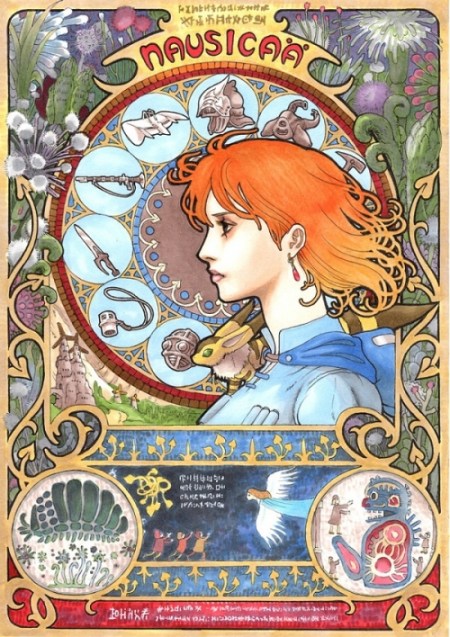
Hayao Miyazaki Through an Art Nouveau Lens

Slavoj Žižek on Atheism and Christianity
John Huston’s Film Adaptation of Under the Volcano (Full Film)
(Here’s my review of Malcolm Lowry’s novel Under the Volcano).
Fantastical Fictive Beers

Serge Gainsbourg’s Histoire de Melody Nelson Gets the 33 1/3 Treatment (Book Acquired, 10.23.2013)
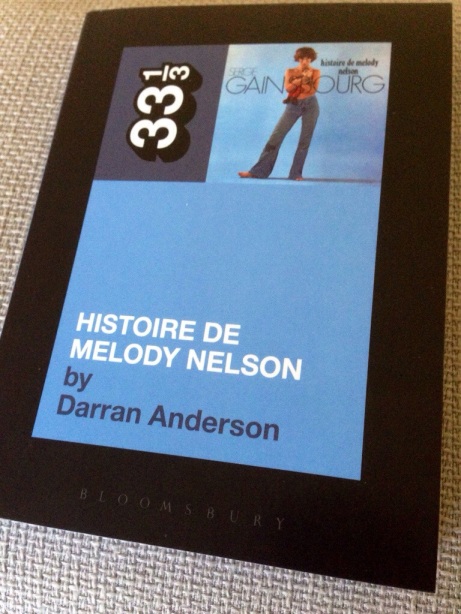
Things I am a fan of: Serge Gainsbourg, Darran Anderson, and the 33 1/3 series. The 33 1/3 imprint focuses on specific albums, and the results are usually far more engaging than standard biographical fare. Histoire de Melody Nelson is the series’s latest entry; here, Darran Anderson takes on Serge Gainsbourg’s dark, moody, sexy, weird album (listen to it/see it here). I still remember the first time I heard Melody, back in college. Gainsbourg’s track with a breathy, orgasmic Brigitte Bardot “Je t’aime… moi non plus” was pretty much a party standard for my friends and me, and “Bonnie & Clyde” found its way onto plenty of mixtapes in the late ’90s. These bubblegum vamps didn’t really prepare me for Melody. I remember going to a friend’s apartment; he had just bought the album and had it playing on repeat. Dark, spacious, very short and full of strange shifts, from orchestral bombast to odd moments of quiet, the album made me feel weird. Such a weird album is a worthy topic for a book, and Anderson’s entry is a marvelous description and analysis of the artistic, cultural, and philosophical sources that Gainsbourg synthesized in Melody. Check out some of Anderson’s blog entries; they provide a compelling overview of his book:
The Origins of Melody – Nabokov’s Lolita, Barbarella, Boris Vian, Sibelius, Mondo Cane.
The Avant Garde or Nothing – Gainsbourg and Vannier as innovators and a focus on their lost classics.
Initials O.G. – Serge Gainsbourg’s Hip-hop afterlife.
Connan Mockasin – Kiwi Psychedelia and the Ghost of Melody Nelson.
The book’s blurb:
Outside his native France, the view of Serge Gainsbourg was once of a one-hit wonder lothario. This has been slowly replaced by an awareness of how talented and innovative a songwriter he was. Gainsbourg was an eclectic, protean figure; a Dadaist, poète maudit, Pop-Artist, libertine and anti-hero. An icon and iconoclast.
His masterpiece is arguably Histoire de Melody Nelson, an album suite combining many of his signature themes; sex, taboo, provocation, humour, exoticism and ultimately tragedy. Composed and arranged with the great Jean-Claude Vannier, its score of lush cinematic strings and proto-hip hop beats, combined with Serge’s spoken-word poetry, has become remarkably influential across a vast musical spectrum; inspiring soundtracks, indie groups and electronic artists. In recent years, the album’s reputation has grown from cult status to that of a modern classic with the likes of Beck, Portishead, Mike Patton, Air and Pulp paying tribute.
How did the son of Jewish Russian immigrants, hounded during the Nazi Occupation, rise to such notoriety and acclaim, being celebrated by President François Mitterand as “our Baudelaire, our Apollinaire”? How did the early chanson singer evolve into a musical visionary incorporating samples, breakbeats and dub into his music, decades ahead of the curve? And what are the roots and legacy of a concept album about a Rolls Royce, a red-haired Lolita muse, otherworldly mansions, plane crashes and Cargo Cults?
Werner Herzog Talks About His Film Nosferatu

Skeleton Frolic — Ub Iwerks
Watch Can–The Documentary, a Film about Can–The Band
SNL Parodies Wes Anderson with The Midnight Coterie of Sinister Intruders Trailer
Run for Your Life, Charlie Brown

Tokyo Story — Yasujiro Ozu (Full Film)
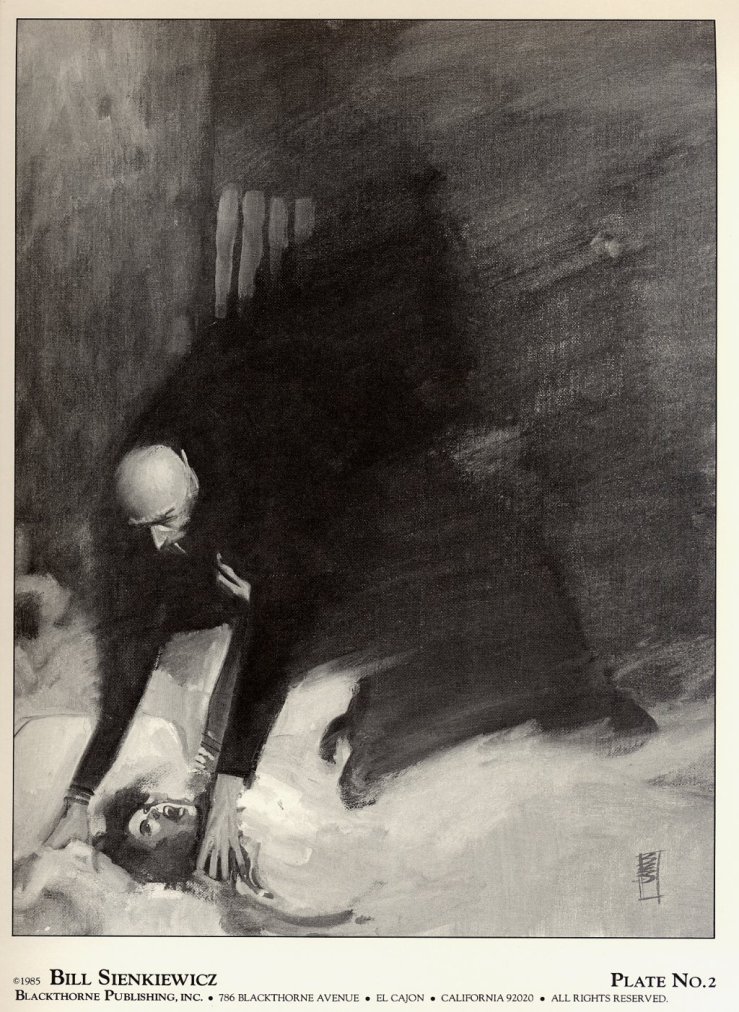
Nosferatu — Bill Sienkiewicz
Wim Wenders Riffing on Ozu
Vice Interviews Žižek
Alfonso Cuarón’s Gravity Is a Worthy Sequel to Children of Men
The final sequence of Alfonso Cuarón’s 2006 film Children of Men offers an example of film-making at its finest. Theo Faron, played by Clive Owen, frantically guides refugee Kee (Clare-Hope Ashitey) and her newborn through a hellish internment camp to an ostensible escape by sea. Kee, her name symbolically overdetermined, is the first person on earth to become pregnant after a generation of sterility.
Children of Men is set against the backdrop of militarized dystopia (Slavoj Žižek has suggested that this background is the essence of the film), a vile, clamorous police state that its hero Theo mutes with alcohol. Theo has yet to come to terms with the grief of losing his son, a plot conceit that mirrors the infinite loss figured in humanity’s sterility (and looming extinction). The film’s thrilling final third sees Theo convert his paralysis into radical action, as he ushers Kee and her newborn through the dystopic background, a violent blur the ideological details of which the audience is free to ignore.
Cuarón strips meaning down to raw, simple, archetypal impulses—Theo is a stand-in for any parent, Kee and her daughter emblematic of genetic futurity. The film sublimates its underlying existential discourse into a gripping narrative fueled by its audience’s own anxieties. The drama culminates in a final sequence in which Cuarón amplifies and extends the existential anxiety by refusing to cut his shots for minutes at a time. The audience finds a surrogate in both Theo and cinematographer Emmanuel Lubezki, who moves us physically through violence and disaster.
While directors like Chris Nolan and Michael Bay produce anxiety in their films through frenetic editing and rapid jump cuts, Cuarón’s long takes force the viewer to engage the drama directly. The payoff is that rare creature: A film with an ending stronger than its beginning—a film that goes, that moves, that grips its audience right up until the credits.

Cuarón’s newest film Gravity follows this same template. For ninety minutes, Cuarón—again working with cinematographer Lubezki—forces the audience into a propulsive and sustained anxiety trip. Gravity features astronauts as its heroes, but its technological milieu (space stations, shuttles, astronaut suits) belies its radical simplicity. This is a film about survival that questions why there is indeed a human impulse to survive.
Like Theo of Children of Men, the hero of Gravity Dr. Ryan Stone (Sandra Bullock) has also lost a child. She too has yet to come to terms with her grief. While Children of Men used a dystopic, politicized backdrop to highlight its character’s grief—and, significantly, the specter of infinite infanticide—Gravity offers up an existential void. The film’s near-perfection is that it refuses any other plot elements, giving us only Ryan’s literal attempt to save herself paired with the film’s overdetermined but singular metaphor: outer space as a beautiful, nihilistic abyss.
Gravity has been out for a few weeks now and has done gangbusters at the box office. I take this as a positive sign. This is the kind of blockbuster we need more of, a personal spectacle, a huge film in a minimalist mode. I could pick on a few things, maybe—the score is heavy-handed and obtrusive (and could probably be dispensed with entirely) and some of the dialogue falls clumsily—but I think that Cuarón has made the film he intended to, a sequel of sorts to Children of Men, and one worthy of that film’s climax.
I can’t end here though without addressing Richard Brody’s negative review of Gravity in The New Yorker. Brody is admittedly hard to take seriously after his opening claim that the film is simultaneously “viscerally thrilling and…deadly boring,” a statement that immediately highlights Brody’s biggest critical failure: He wants the film to be something that it is not trying to be.
Brody at length:
Cuarón has done a formidable job of piecing together a plausibly coherent material world of space, of conveying the appearance of that setting and the sensations of the characters who inhabit it. But he has created those sensations generically, with no difference between the subjectivity of his characters and the ostensible appearance to a camera of those phenomena. He offers point-of-view images that are imbued with no actual point of view. The movie, with its near-absolute absence of inner life, presents a material fantasy that flatters the studious humanism of critics who honor the attention to so-called reality—as an aesthetic endowed with a quasi-political virtue.
I’ve included the hyperlink in that last phrase to a confused essay in which Brody decries what he perceives as the failure of contemporary directors to address the imaginative capacity of their characters. For Brody, Gravity has to be a failure—by design, it is a thoroughly concrete transmission of events, a causal chain of consequences. Brody wants flashbacks, moments of introspection; he explicitly calls for the “moral forthrightness of a foregrounded speaker bearing witness.” In Gravity, Bullock’s Ryan is agent and surrogate for the audience, who process and bear witness to her choices and changes. The film’s minimalism strips her choices down to an extended but focused exploration of the problem Hamlet voiced centuries earlier: “To be or not to be.” And Cuarón has offered a moral forthrightness and a clear point of view, even if Brody is uncomfortable with the mechanisms through which Cuarón would have us access it: Gravity chooses To be.
 Biblioklept