New Gordon Lish

There’s a new Gordon Lish rant in this month’s issue of Harper’s. The selection, titled “The Boys on the Block,” is collected in the forthcoming Goings: In Thirteen Sittings, out early next year from O/R Books.

First paragraph:

There was a game we played. Maybe it wasn’t a game in and of itself. Is a ball a game? A ball is not a game. But you can make a game with it, can’t you? What can’t you make a game with or of? You just have to decide you’re going to do it, is all. Or not even make up your mind and go ahead and decide as such. All you have to do is take the thing and start doing something with it and then say to a boy on the block, Can you do this? and then you show the boy that you can, and then the next thing is that that particular boy has to see if he can do it too or even if he can’t, well, I ask you, is there or is there not already enough of a game going from just that much of it already? Or even better, let’s say he can’t do it, the boy, that particular boy, then even better, even better that he can’t, except who can say, maybe before you know it you’re the boy who’s sorry you started the whole thing in the first place, because maybe the boy we’re talking about, maybe he can go ahead and do it better than you can do it, and then you wish you had never even taken the reins and started the game and could instead of any of that just stop playing it, but you can’t stop playing it, because every time that particular boy on the block comes around he’s got the thing you need for the game with him and he says to you, Hey look, can you do this, can you, can you? even if all you have to do is do it as many times as he can, or do it a little farther than he can, or do it faster than he can, or, you know, more times, or do it some other way different like that.


“A Christmas Number” — A.A. Milne

“A Christmas Number” — A.A. Milne

The common joke against the Christmas number is that it is planned in July and made up in September. This enables it to be published in the middle of November and circulated in New Zealand by Christmas. If it were published in England at Christmas, New Zealand wouldn’t get it till February. Apparently it is more important that the colonies should have it punctually than that we should.

Anyway, whenever it is made up, all journalists hate the Christmas number. But they only hate it for one reason—this being that the ordinary weekly number has to be made up at the same time. As a journalist I should like to devote the autumn exclusively to the Christmas number, and as a member of the public I should adore it when it came out. Not having been asked to produce such a number on my own I can amuse myself here by sketching out a plan for it. I follow the fine old tradition. First let us get the stories settled. Story No. 1 deals with the escaped convict. The heroine is driving back from the country- house ball, where she has had two or three proposals, when suddenly, in the most lonely part of the snow-swept moor, a figure springs out of the ditch and covers the coachman with a pistol. Alarms and confusions. “Oh, sir,” says the heroine, “spare my aunt and I will give you all my jewels.” The convict, for such it is, staggers back. “Lucy!” he cries. “Harold!” she gasps. The aunt says nothing, for she has swooned. At this point the story stops to explain how Harold came to be in knickerbockers. He had either been falsely accused or else he had been a solicitor. Anyhow, he had by this time more than paid for his folly, and Lucy still loved him. “Get in,” she says, and drives him home. Next day he leaves for New Zealand in an ordinary lounge suit. Need I say that Lucy joins him later? No; that shall be left for your imagination. The End.

So much for the first story. The second is an “i’-faith-and-stap- me” story of the good old days. It is not seasonable, for most of the action takes place in my lord’s garden amid the scent of roses; but it brings back to us the old romantic days when fighting and swearing were more picturesque than they are now, and when women loved and worked samplers. This sort of story can be read best in front of the Christmas log; it is of the past, and comes naturally into a Christmas number. I shall not describe its plot, for that is unimportant; it is the “stap me’s” and the “la, sirs,” which matter. But I may say that she marries him all right in the end, and he goes off happily to the wars.

We want another story. What shall this one be about? It might be about the amateur burglar, or the little child who reconciled old Sir John to his daughter’s marriage, or the ghost at Enderby Grange, or the millionaire’s Christmas dinner, or the accident to the Scotch express. Personally, I do not care for any of these; my vote goes for the desert-island story. Proud Lady Julia has fallen off the deck of the liner, and Ronald, refused by her that morning, dives off the hurricane deck—or the bowsprit or wherever he happens to be—and seizes her as she is sinking for the third time. It is a foggy night and their absence is unnoticed. Dawn finds them together on a little coral reef. They are in no danger, for several liners are due to pass in a day or two and Ronald’s pockets are full of biscuits and chocolate, but it is awkward for Lady Julia, who had hoped that they would never meet again. So they sit on the beach back to back (drawn by Dana Gibson) and throw sarcastic remarks over their shoulders at each other. In the end he tames her proud spirit—I think by hiding the turtles’ eggs from her—and the next liner but one takes the happy couple back to civilization.

But it is time we had some poetry. I propose to give you one serious poem about robins, and one double-page humorous piece, well illustrated in colours. I think the humorous verses must deal with hunting. Hunting does not lend itself to humour, for there are only two hunting jokes —the joke of the horse which came down at the brook and the joke of the Cockney who overrode hounds; but there are traditions to keep up, and the artist always loves it. So far we have not considered the artist sufficiently. Let us give him four full pages. One of pretty girls hanging up mistletoe, one of the squire and his family going to church in the snow, one of a brokendown coach with highwaymen coming over the hill, and one of the postman bringing loads and loads of parcels. You have all Christmas in those four pictures. But there is room for another page—let it be a coloured page, of half a dozen sketches, the period and the lettering very early English. “Ye Baron de Marchebankes calleth for hys varlet.” “Ye varlet cometh righte hastilie—-” You know the delightful kind of thing.

I confess that this is the sort of Christmas number which I love. You may say that you have seen it all before; I say that that is why I love it. The best of Christmas is that it reminds us of other Christmases; it should be the boast of Christmas numbers that they remind us of other Christmas numbers.

But though I doubt if I shall get quite what I want from any one number this year, yet there will surely be enough in all the numbers to bring Christmas very pleasantly before the eyes. In a dull November one likes to be reminded that Christmas is coming. It is perhaps as well that the demands of the colonies give us our Christmas numbers so early. At the same time it is difficult to see why New Zealand wants a Christmas number at all. As I glance above at the plan of my model paper I feel more than ever how adorable it would be—but not, oh not with the thermometer at a hundred in the shade.

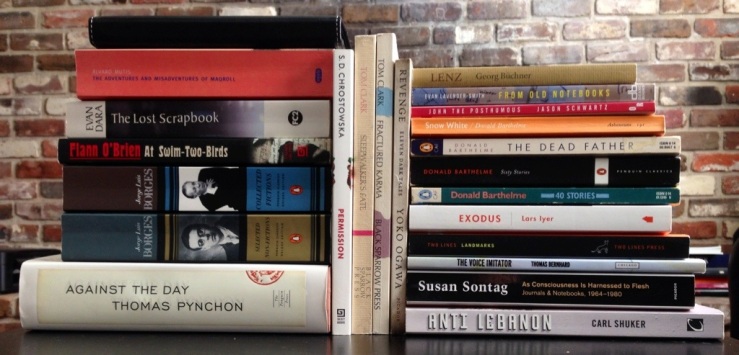
The books I liked the most in 2013

20131217-144555.jpg


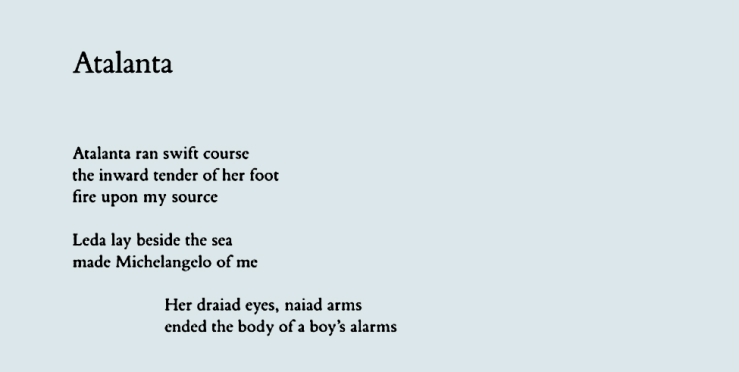
“Atalanta” — Charles Olson

atalanta

“A Birthday”– Christina Rossetti

birthday

Read My Interview with S.D. Chrostowska at 3:AM Magazine

I interviewed S.D. Chrostowska for 3:AM Magazine. I reviewed Chrostowska’s novel Permission here.

3:AM also features a new piece of short fiction from Chrostowska, “How to Avoid the Cardinal Sins /A Nominalistic Pamphlet/“.

From the interview:


3:AM: How did Permission begin? Did it begin as a novel? As something else?

S D Chrostowska: It began with the first message, and ended with the last. It was principally a literary effort subordinated to communication. To me this remains a crucial difference, itsdifferentia specifica. The origin of the now-book Permission was in an illegitimate literary dimension outside the frame of book authorship. You have to understand that, though I had chosen my reader, this reader could not know what if anything would become of the writing that came their way. Naturally I wonder whether and how it changes things for readers today, who approach them as a bound book, to know that the letters, just as they are, were once for real.

3:AM: Why write the letters under a pseudonym? How did you arrive at “Fearn Wren”?

SDC: For the sake of ambiguity. Knowing too much, or for that matter anything, about the artist-producer prejudices us about their work. The prejudice is not just personal or social but also simply contextual. It is all but unavoidable in visual and performing artworks requiring direct human contact, where other people are involved from the start rather than just on the receiving end. Sitting for a portrait or mounting a play depends on direct interaction. But we have already chosen the photographer based on their reputation. And we know something about the director before we get involved in their production or, if we happen to be directors, select actors based on their training or past work.

But writing, usually done at some distance from readers, can minimize our reader’s prejudices—at least until the finished work is judged, and the reviews and exposés come out. One way it can do this is by appearing anonymously or pseudonymously. Such publishing has a long history. As, one should add, does letter-writing under a pseudonym. Permission’s first reader would have had no context to go on.

Being read as an unknown author, not part of the literary scene, mimics that condition somewhat. But almost everyone nowadays can be googled, which is to say traced. I imagine that many people who would pick up a book like mine would be curious in this way.

I’m not sure how I settled on this particular pen-name. I do like ferns and wrens, their behaviors and the myths around them.

Bonus:

So, my signature interview question — “Have you ever stolen a book?” — had to be cut because it was just kind of confusing on 3:AM, but I couldn’t not ask it, so:

3:AM: Have you ever stolen a book?

SDC: Of course. 


“A Visit to Walt Whitman”

“A Visit to Walt Whitman”

From James Huneker’s Ivory Apes and Peacocks

My edition of Walt Whitman’s Leaves of Grass is dated 1867, the third, if I am not mistaken, the first appearing in 1855. Inside is pasted a card upon which is written in large, clumsy letters: “Walt Whitman, Camden, New Jersey, July, 1877.” I value this autograph, because Walt gave it to me; rather I paid him for it, the proceeds, two dollars (I think that was the amount), going to some asylum in Camden. In addition, the “good grey poet” was kind enough to add a woodcut of himself as he appeared in the 1855 volume, “hankering, gross, mystical, nude,” and another of his old mother, with her shrewd, kindly face. Walt is in his shirt-sleeves, a hand on his hip, the other in his pocket, his neck bare, the pose that of a nonchalant workman—though in actual practice he was always opposed to work of any sort; on his head is a slouch-hat, and you recall his line: “I wear my hat as I please, indoors or out.” The picture is characteristic, even to the sensual mouth and Bowery-boy pose. You almost hear him say: “I find no sweeter fat than sticks to my own bones.” Altogether a different man from the later bard, the heroic apparition of Broadway, Pennsylvania Avenue, and Chestnut Street. I had convalesced from a severe attack of Edgar Allan Poe only to fall desperately ill with Whitmania. Youth is ever in revolt, age alone brings resignation. My favourite reading was Shelley, my composer among composers, Wagner. Chopin came later. This was in 1876, when the Bayreuth apotheosis made Wagner’s name familiar to us, especially in Philadelphia, where his empty, sonorous Centennial March was first played by Theodore Thomas at the Exposition. The reading of a magazine article by Moncure D. Conway caused me to buy a copy, at an extravagant price for my purse, of The Leaves of Grass, and so uncritical was I that I wrote a parallel between Wagner and Whitman; between the most consciously artistic of men and the wildest among improvisators. But then it seemed to me that both had thrown off the “shackles of convention.” (What prison-like similes we are given to in the heady, generous impulses of green adolescence.) I was a boy, and seeing Walt on Market Street, as he came from the Camden Ferry, I resolved to visit him. It was some time after the Fourth of July, 1877, and I soon found his little house on Mickle Street. A policeman at the ferry-house directed me. I confess I was scared after I had given the bell one of those pulls that we tremblingly essay at a dentist’s door. To my amazement the old man soon stood before me, and cordially bade me enter. Continue reading ““A Visit to Walt Whitman””

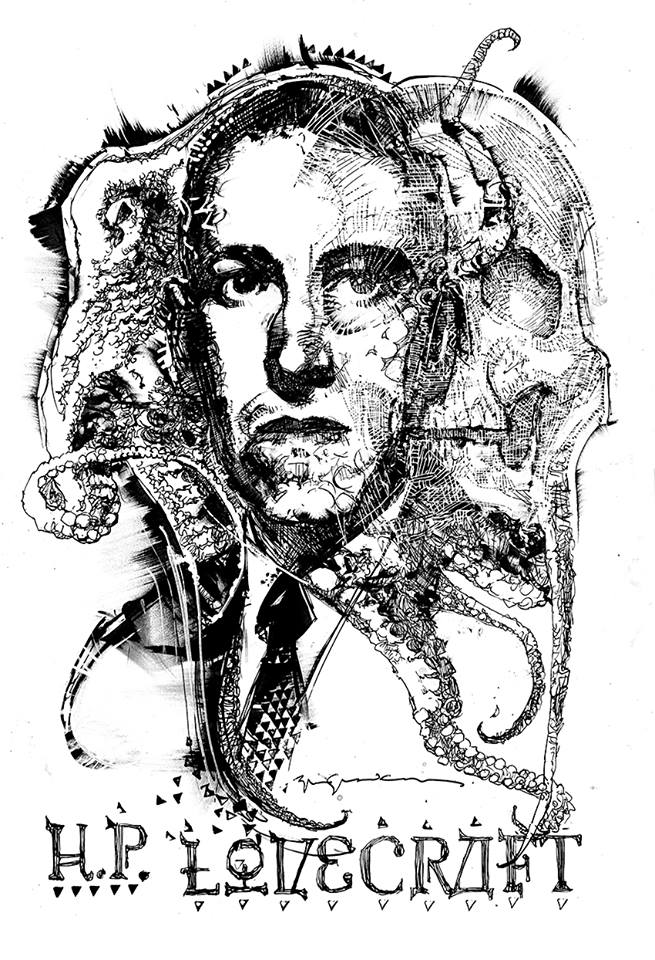
H.P. Lovecraft — Bill Sienkiewicz

lovecraft

“Egotism; Or, The Bosom Serpent” — Nathaniel Hawthorne

 “Egotism; Or, The Bosom Serpent” — Nathaniel Hawthorne

“Here he comes!” shouted the boys along the street. “Here comes the man with a snake in his bosom!”

This outcry, saluting Herkimer’s ears as he was about to enter the iron gate of the Elliston mansion, made him pause. It was not without a shudder that he found himself on the point of meeting his former acquaintance, whom he had known in the glory of youth, and whom now after an interval of five years, he was to find the victim either of a diseased fancy or a horrible physical misfortune.

“A snake in his bosom!” repeated the young sculptor to himself. “It must be he. No second man on earth has such a bosom friend. And now, my poor Rosina, Heaven grant me wisdom to discharge my errand aright! Woman’s faith must be strong indeed since thine has not yet failed.”

Thus musing, he took his stand at the entrance of the gate and waited until the personage so singularly announced should make his appearance. After an instant or two he beheld the figure of a lean man, of unwholesome look, with glittering eyes and long black hair, who seemed to imitate the motion of a snake; for, instead of walking straight forward with open front, he undulated along the pavement in a curved line. It may be too fanciful to say that something, either in his moral or material aspect, suggested the idea that a miracle had been wrought by transforming a serpent into a man, but so imperfectly that the snaky nature was yet hidden, and scarcely hidden, under the mere outward guise of humanity. Herkimer remarked that his complexion had a greenish tinge over its sickly white, reminding him of a species of marble out of which he had once wrought a head of Envy, with her snaky locks.

The wretched being approached the gate, but, instead of entering, stopped short and fixed the glitter of his eye full upon the compassionate yet steady countenance of the sculptor.

“It gnaws me! It gnaws me!” he exclaimed.

And then there was an audible hiss, but whether it came from the apparent lunatic’s own lips, or was the real hiss of a serpent, might admit of a discussion. At all events, it made Herkimer shudder to his heart’s core.

“Do you know me, George Herkimer?” asked the snake-possessed.

Herkimer did know him; but it demanded all the intimate and practical acquaintance with the human face, acquired by modelling actual likenesses in clay, to recognize the features of Roderick Elliston in the visage that now met the sculptor’s gaze. Yet it was he. It added nothing to the wonder to reflect that the once brilliant young man had undergone this odious and fearful change during the no more than five brief years of Herkimer’s abode at Florence. The possibility of such a transformation being granted, it was as easy to conceive it effected in a moment as in an age. Inexpressibly shocked and startled, it was still the keenest pang when Herkimer remembered that the fate of his cousin Rosina, the ideal of gentle womanhood, was indissolubly interwoven with that of a being whom Providence seemed to have unhumanized. Continue reading ““Egotism; Or, The Bosom Serpent” — Nathaniel Hawthorne”

“First he slew a snowshoe rabbit cleaving it in twain with a single blow and then he slew a spiny anteater” (Donald Barthelme)

They found the Dead Father standing in a wood, slaying. First he slew a snowshoe rabbit cleaving it in twain with a single blow and then he slew a spiny anteater and then he slew two rusty numbats and then whirling the great blade round and round his head he slew a wallaby and a lemur and a trio of ouakaris and a spider monkey and a common squid. Then moving up and down the green path in his rage he dispatched a macaque and a gibbon and fourscore innocent chinchillas who had been standing idly by watching the great slaughter. Then he rested standing with the point of his sword stuck in the earth and his two hands folded upon the hilt. Then he again as if taken by a fit set about the bloody work slaying a prairie dog and a beaver and a gopher and a dingo and a honey badger and an otter and a house cat and a tapir and a piglet. Then his anger grew and he called for a brand of even greater weight and length which was brought him by a metaphorically present gillie and seizing it with his two fine-formed and noble hands he raised it above his head, and every living thing within his reach trembled and every dead thing within his reach remembered how it got that way, and the very trees of the wood did seem to shrink and step away. Then the Dead Father slew a warthog and a spotted fawn and a trusting sheep and a young goat and a marmoset and two greyhounds and a draghound. Then, kicking viciously with his noble and shapely foot at the piles of the slain, raw and sticky corpses drenching the earth in blood on every side, he cleared a path to a group of staring pelicans slicing the soft white thin necks of them from the bodies in the wink of an eye. Then he slew a cassowary and a flamingo and a grebe and a heron and a bittern and a pair of ducks and a shouting peacock and a dancing crane and a bustard and a lily-trotter and, wiping the sacred sweat from his brow with one ermine-trimmed sleeve, slew a wood pigeon and a cockatoo and a tawny owl and a snowy owl and a magpie and three jackdaws and a crow and a jay and a dove. Then he called for wine. A silver flagon was brought him and he downed the whole of it in one draught looking the while out of the corner of his ruby eye at a small iguana melted in terror against the limb of a tree. Then he tossed the silver flagon into the arms of a supposititious cupbearer sousing the cupbearer’s hypothetical white tunic with the red of the (possible) wine and split the iguana into two halves with the point of his sword as easily as one skilled in the mystery fillets a fish. Then the Dead Father resumed his sword work in earnest slaying diverse small animals of every kind, so that the heaps mounted steaming to the right and to the left of him with each passionate step. A toad escaped.

From Donald Barthelme’s novel The Dead Father.

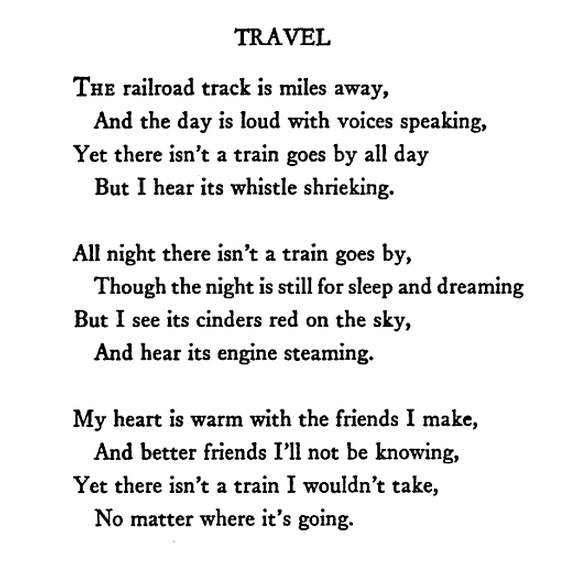
“Travel” — Edna St. Vincent Millay

travel

Although Of Course You End Up Riffing Obliquely on How a David Foster Wallace Road Trip Movie Is a Terrible Idea

  1. In 1992 I asked my grandmother to rent Steven Soderbergh’s film Kafka from Blockbuster so I could watch it. We watched it together. I was intrigued; she found it dull. I saw it again in college and then again a few years ago. It’s nothing special.
  2. In my freshman year of college I lived right next to a big video rental place that rented most old films for a dollar. This is where I discovered Where the Buffalo Roam, a 1980 semi-biopic starring Bill Murray as Hunter S. Thompson with music from Neil Young. My metaphorical lid flipped. I returned to my apartment to screen this strange find. Disappointment.
  3. Seeing and immediately being disappointed by Where the Buffalo Roam fits neatly into another memory: In 1991 a record store clerk dissuaded me from buying an expensive bootleg recording of Jimi Hendrix featuring Jim Morrison. The clerk went to great lengths to do this (short of opening the CD, of course), insisting that the record was awful, that it should never have been released. A few weeks later a friend loaned me a tape of the recording he’d somehow acquired. Total garbage. I didn’t even bother to dub it.
  4. (Sometimes when I see that some new scrap and tittle of a dead author’s work is going to be posthumously published, I think of that Hendrix/Morrison recording).
  5. In 1998 I saw Terry Gilliam’s adaptation of Fear and Loathing in Las Vegas. Sloppy, cartoonish, vivid, and occasionally incoherent, Fear and Loathing is successful mostly because it isn’t a film about Hunter S. Thompson. It’s a film about the end of the illusion of the 1960s.
  6. I don’t remember when I first saw Barfly. Sometime in college. Undoubtedly I tried to keep pace with old Hank on-screen. Hence the poor memory.
  7. Factotum: I fell asleep at the end. But it wasn’t bad, I guess. A good attempt at interpreting Bukowski’s autobiographical novel.
  8. (But obviously the documentaries that feature Bukowski himself are so much more alive than any interpretation).
  9. Some interpretations of writers’ lives benefit from the distance—the distortion—of time: QuillsThe LibertineMarat/Sade, any riff on Shakespeare (although I can’t think of one that isn’t crap, actually, right this minute), etc.
  10. In particular, Jane Campion’s film Bright Star is excellent, but it’s not really about John Keats: The film is really about Fanny Brawne. Again though, I think time’s distortion helps.
  11. (And oh lord I would love to see Val Kilmer’s one-man Mark Twain show, but that’s a whole other thing, not a film thing, not even a writer thing, more of a Kilmer thing).
  12. The Faulkner/Hemingway amalgamation in Barton Fink is something else.
  13. I turned off Capote.
  14. I turned off The Motorcycle Diaries.
  15. A few weeks ago I turned off Walter Salles’s adaptation of On the Road.
  16. The Guardian and other sources report that Jason Segel will play David Foster Wallace in a film adaptation of David Lipsky’s Rolling Stone interview-turned-full-length-book, Although Of Course You End Up Becoming Yourself: A Road Trip With David Foster Wallace. Jesse Eisenberg will reportedly take awkwardly stammer through Lipsky’s role.
  17. Jason Segel, of the hit CBS comedy How I Met Your Mother, will play the late David Foster Wallace, who wrote “Good Old Neon.”
  18. Jason Segel, a Judd Apatow stable staple, will play the late David Foster Wallace, who wrote an essay about misanthropy and a cruise ship.
  19. Jason Segel, whose goofy charm and lovable good-nature belie a sensitive temperament, will play the late David Foster Wallace, who often wore a bandanna on his head.
  20. Although Of Course You End Up Becoming Yourself covers Wallace touring on his Infinite Jest book tour; his fame explodes and he’s not entirely sure what any of it means yet—whether to enjoy it, how to enjoy it, is it even possible to enjoy it, etc. Lipsky inserts a heavy editorial hand—lots of bracketed thoughts in this one, as our interlocutor repeatedly registers, or attempts to register, his own verbal dexterity, his own writerliness. And who can blame him? What writer-critic can resist showing a little plumage to the writer under discussion (to steal James Wood’s phrase)?
  21. Lipsky’s book features one of the most intriguing characters in late twentieth-century literature: David Foster Wallace performing David Foster Wallace attempting to not-perform David Foster Wallace by acknowledging that David Foster Wallace is self-consciously aware of performing himself.
  22. I can easily envision the shape, the tone, the contours, the set-pieces of this proposed film adaptation. A road trip film, a buddy film, but a film about antagonists, bullshitters, waxing hard, some high laughs, some intense moments (gaining so much easy shallow depth from Wallace’s suicide), maybe a few reading scenes. Etc.
  23. And that’s what most bothers me about this film adaptation: How easily I can imagine what it will likely look and sound and feel like. How comfortable it all is.
  24. There’s just not enough of that magical temporal distortion I referenced in point nine. The film is likely to piss off real fans of Wallace’s work and give anyone else interested a facile notion of who the writer was and what he thought and how he thought and how he represented and shared what he thought. How is such a film not a crass cash grab? Even if the film were artistically successful (leave aside what that nebulous term could mean for a moment, please)—again, how is such a film not a crass cash grab?
  25. I could be wrong though. I’m fine with being wrong.

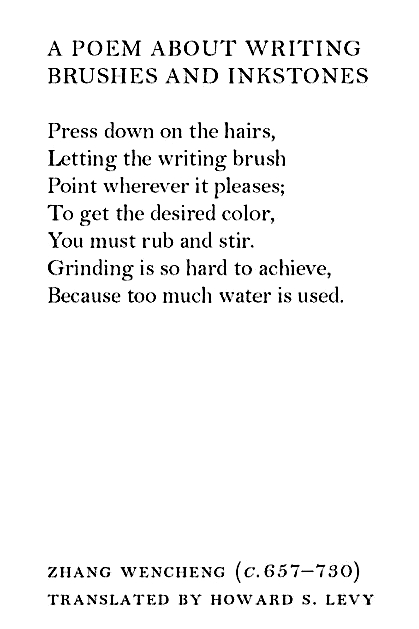
“A Poem About Writing Brushes and Inkstones” — Zhang Wencheng

brushes

“A sublime murkiness and original pent fury” | Walt Whitman on Millet’s Paintings

The Diggers, Jean-Francois Millet

April 18.—Went out three or four miles to the house of Quincy Shaw, to see a collection of J. F. Millet’s pictures. Two rapt hours. Never before have I been so penetrated by this kind of expression. I stood long and long before “the Sower.” I believe what the picture-men designate “the first Sower,” as the artist executed a second copy, and a third, and, some think, improved in each. But I doubt it. There is something in this that could hardly be caught again—a sublime murkiness and original pent fury. Besides this masterpiece, there were many others, (I shall never forget the simple evening scene, “Watering the Cow,”) all inimitable, all perfect as pictures, works of mere art; and then it seem’d to me, with that last impalpable ethic purpose from the artist (most likely unconscious to himself) which I am always looking for. To me all of them told the full story of what went before and necessitated the great French revolution—the long precedent crushing of the masses of a heroic people into the earth, in abject poverty, hunger—every right denied, humanity attempted to be put back for generations—yet Nature’s force, titanic here, the stronger and hardier for that repression—waiting terribly to break forth, revengeful—the pressure on the dykes, and the bursting at last—the storming of the Bastile—the execution of the king and queen—the tempest of massacres and blood. Yet who can wonder?

Could we wish humanity different? Could we wish the people made of wood or stone? Or that there be no justice in destiny or time?

The true France, base of all the rest, is certainly in these pictures. I comprehend “Field-People Reposing,” “the Diggers,” and “the Angelus” in this opinion. Some folks always think of the French as a small race, five or five and a half feet high, and ever frivolous and smirking. Nothing of the sort. The bulk of the personnel of France, before the revolution, was large-sized, serious, industrious as now, and simple. The revolution and Napoleon’s wars dwarf’d the standard of human size, but it will come up again. If for nothing else, I should dwell on my brief Boston visit for opening to me the new world of Millet’s pictures. Will America ever have such an artist out of her own gestation, body, soul?

—From Walt Whitman’s journal of 1881


“The same blue rocks and spectral grottos could be seen in Leonardo’s Virgin of the Rocks” | J.G. Ballard

From J.G. Ballard’s short story “The Gioconda of the Twilight Noon”:

‘There’s a postcard from your mother. They’re near Malta, somewhere called Gozo.’

‘Give it to me.’ Maitland felt the card in his hands.

‘Gozo – that was Calypso’s island. She kept Ulysses there for seven years, promised him eternal youth if he’d stay with her forever.’

‘I’m not surprised.’ Judith inclined the card towards her. ‘If we could spare the time, you and I should go there for a holiday. Wine–dark seas, a sky like heaven, blue rocks. Bliss.’

‘Blue?’

‘Yes. I suppose it’s the bad printing. They can’t really be like that.’

‘They are, actually.’

Still holding the card, Maitland went out into the garden, feeling his way along the string guiderail. As he settled himself in the wheelchair he reflected that there were other correspondences in the graphic arts. The same blue rocks and spectral grottos could be seen in Leonardo’s Virgin of the Rocks, one of the most forbidding and most enigmatic of his paintings. The madonna sitting on a bare ledge by the water beneath the dark overhang of the cavern’s mouth was like the presiding spirit of some enchanted marine realm, waiting for those cast on to the rocky shores of this world’s end. As in so many of Leonardo’s paintings, all its unique longings and terrors were to be found in the landscape in the background. Here, through an archway among the rocks, could be seen the crystal blue cliffs that Maitland had glimpsed in his reverie.


“Here is the riddle, and it is a son-of-a-bitch” (Donald Barthelme)

Here is the riddle said the Great Father Serpent with a great flourishing of his two-tipped tongue, and it is a son-of-a-bitch I will tell you that, the most arcane item in the arcana, you will never guess it in a hundred thousand human years some of which I point out have already been used up by you in useless living and breathing but have a go, have a go, do: What do you really feel? Like murderinging, I answered, because that is what I had read on the underside of the tin, the wording murderinging inscribed in a fine thin cursive. Why bless my soul, said the Great Father Serpent, he’s got it, and the two ruffians blinked at me in stunned wonder and I myself wondered, and marveled, but what I was wondering and marveling at was the closeness with which what I had answered accorded with my feelings, my lost feelings that I had never found before. I suppose, the Father Serpent said, that the boon you wish granted is the ability to carry out this foulness? Of course, I said, what else? Granted then, he said, but may I remind you that having the power is often enough. You don’t have to actually do it. For the soul’s ease. I thanked the Great Father Serpent; he bowed most cordially; my companions returned me to the city. I was abroad in the city with murderinging in mind — the dream of a stutterer.

That is a tall tale, said the Dead Father. I don’t believe it ever happened.

No tale ever happened in the way we tell it, said Thomas, but the moral is always correct.

What is the moral?

Murderinging, Thomas said.

From Donald Barthelme’s novel The Dead Father.


“The Darling” — Anton Chekhov

“The Darling” by Anton Chekhov

Olenka, the daughter of the retired collegiate assessor Plemyanikov, was sitting on the back-door steps of her house doing nothing. It was hot, the flies were nagging and teasing, and it was pleasant to think that it would soon be evening. Dark rain clouds were gathering from the east, wafting a breath of moisture every now and then.

Kukin, who roomed in the wing of the same house, was standing in the yard looking up at the sky. He was the manager of the Tivoli, an open-air theatre.

“Again,” he said despairingly. “Rain again. Rain, rain, rain! Every day rain! As though to spite me. I might as well stick my head into a noose and be done with it. It’s ruining me. Heavy losses every day!” He wrung his hands, and continued, addressing Olenka: “What a life, Olga Semyonovna! It’s enough to make a man weep. He works, he does his best, his very best, he tortures himself, he passes sleepless nights, he thinks and thinks and thinks how to do everything just right. And what’s the result? He gives the public the best operetta, the very best pantomime, excellent artists. But do they want it? Have they the least appreciation of it? The public is rude. The public is a great boor. The public wants a circus, a lot of nonsense, a lot of stuff. And there’s the weather. Look! Rain almost every evening. It began to rain on the tenth of May, and it’s kept it up through the whole of June. It’s simply awful. I can’t get any audiences, and don’t I have to pay rent? Don’t I have to pay the actors?”

The next day towards evening the clouds gathered again, and Kukin said with an hysterical laugh:

“Oh, I don’t care. Let it do its worst. Let it drown the whole theatre, and me, too. All right, no luck for me in this world or the next. Let the actors bring suit against me and drag me to court. What’s the court? Why not Siberia at hard labour, or even the scaffold? Ha, ha, ha!”

It was the same on the third day.

Olenka listened to Kukin seriously, in silence. Sometimes tears would rise to her eyes. At last Kukin’s misfortune touched her. She fell in love with him. He was short, gaunt, with a yellow face, and curly hair combed back from his forehead, and a thin tenor voice. His features puckered all up when he spoke. Despair was ever inscribed on his face. And yet he awakened in Olenka a sincere, deep feeling. Continue reading ““The Darling” — Anton Chekhov”