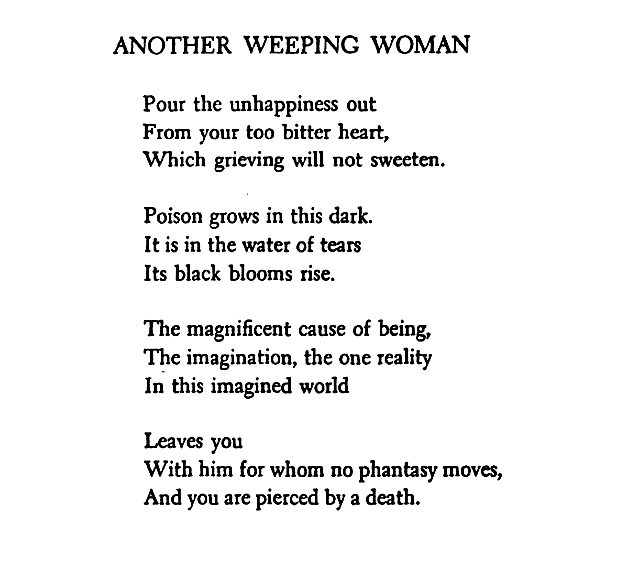
“Another Weeping Woman” — Wallace Stevens

ws

Film Footage of the First Bloomsday Celebration in 1954

Film footage of the first Bloomsday celebration (June 16, 1954)–a great find by Antoine Malette, who posted the video along with an account of the journey as told in Flann O’Brien: An Illustrated Biography. The film was shot by John Ryan, and shows an extremely inebriated Brian O’Nolan (aka Flann O’Brien) having to be helped around by pals Anthony Cronin and Patrick Kavanagh. We’re also treated to a scene of Kavanagh taking a piss with Joyce’s cousin Tom Joyce, a dentist who joined the merry band. (The scene will undoubtedly recall to you that marvelous moment in Ulysses when “first Stephen, then Bloom, in penumbra urinated“). The troupe didn’t quite finish their mission, getting sidetracked by booze and quarrels. Read the full account at Malette’s site.

Eight Notes on “Life” from Samuel Butler’s Note-Books

  1. The beginning of life is the beginning of an illusion to the effect that there is such a thing as free will and that there is such another thing as necessity – the recognition of the fact that there is an “I can” and an “I cannot,” an “I may” and an “I must.”
  2. Life is not so much a riddle to be read as a Gordian knot that will get cut sooner or later.
  3. Life is the distribution of an error – or errors.
  4. Life is a superstition.  But superstitions are not without their value.  The snail’s shell is a superstition, slugs have no shells and thrive just as well.  But a snail without a shell would not be a slug unless it had also the slug’s indifference to a shell.
  5. Life is one long process of getting tired.
  6. Life is the art of drawing sufficient conclusions from insufficient premises.
  7. Life is eight parts cards and two parts play, the unseen world is made manifest to us in the play.
  8. Life is like music, it must be composed by ear, feeling and instinct, not by rule.  Nevertheless one had better know the rules, for they sometimes guide in doubtful cases – though not often.

—From Samuel Butler’s Note-Books.


“Herman Melville” — Conrad Aiken

“Herman Melville” by Conrad Aiken:

‘My towers at last!’—
What meant the word
from what acknowledged circuit sprung
and in the heart and on the tongue
at sight of few familiar birds
when seaward his last sail unfurled
to leeward from the wheel once more
bloomed the pale crags of haunted shore
that once-more-visited notch of world:
and straight he knew as known before
the Logos in Leviathan’s roar
he deepest sounding with his lead
who all had fathomed all had said.

Much-loving hero—towers indeed
were those that overhung your log
with entries of typhoon and fog
and thunderstone for Adam’s breed:
man’s warm Sargasso Sea of faith
dislimned in light by luck or fate
you for mankind set sail by hate
and weathered it, and with it death.
And now at world’s end coasting late
in dolphined calms beyond the gate
which Hercules flung down, you come
to the grim rocks that nod you home.
Depth below depth this love of man:
among unnumbered and unknown
to mark and make his cryptic own
one landfall of all time began:
of all life’s hurts to treasure one
and hug it to the wounded breast,
in this to dedicate the rest,
all injuries received or done.
Your towers again but towers now blest
your haven in a shoreless west
o mariner of the human soul
who in the landmark notched the Pole
and in the Item loved the Whole.


Down with Beauty/tapestry (Books Acquired, 7.17.2013)

20130723-112451.jpg

Two very intriguing new titles from Reality Street: Ken Edwards’s Down with Beauty, and tapestry by Philip Terry.

Here’s the publisher’s blurb for Down with Beauty:

DOWN WITH BEAUTY explores, in a series of linked dialogues, dramatic monologues and short fictions, the themes of exile, the aftermath of war, paranoia, improvised music and nothingness. The collection is completed with the full text of NOSTALGIA FOR UNKNOWN CITIES, previously published separately.  Some samples herehere and here – others will be revealed.

A very strange, scattered book—lovely.

Here’s Reality Street’s blurb for tapestry:

Taking as its starting point marginal images in the Bayeux Tapestry, which have been left largely unexplained by historians, Terry retells the story of the Norman Conquest from the point of view of the tapestry’s English embroiderers. Combining magic realism and Oulipian techniques, this is a tour de force of narrative and language.

tapestry also got a great review from The Guardian’s Nicholas Lezard:

By showing a language in flux,tapestry draws you into its world: that of the creation of the Bayeux tapestry (which, as we are reminded in the book by an exasperated narrator, isn’t a tapestry at all, but a work of embroidery) by a group of nuns in the late 11th century at a priory in Kent. …

Medieval works lend themselves to the picaresque, or multiple narration – think of The Decameròn or The Canterbury Tales. So while there is an overarching narrative, that of the commission and creation of the tapestry, work is paused while each nun tells a story related to her work. If you look at the tapestry, you will remember, or notice, that there are numerous extraneous designs along the borders that would appear to have nothing to do with the matter of the Norman usurpation. Terry has noticed, as have others, the Aesopian motifs that occur, and includes slender, playful versions, sometimes modernised, of Aesop’s fables himself. My favourite is one in which a lion, confronting Aesop, asks him to tell him a fable before the lion eats him. So Aesop says he was confronted by a lion who asked him to tell a fable … and so on; and eventually the lion gets bored and goes away.

Great to see some new stuff that’s, well, really new

Six Ideas and Images from Nathaniel Hawthorne’s Note-Books

  1. In an old London newspaper, 1678, there is an advertisement, among other goods at auction, of a black girl, about fifteen years old, to be sold.
  2. We sometimes congratulate ourselves at the moment of waking from a troubled dream: it may be so the moment after death.
  3. The race of mankind to be swept away, leaving all their cities and works. Then another human pair to be placed in the world, with native intelligence like Adam and Eve, but knowing nothing of their predecessors or of their own nature and destiny. They, perhaps, to be described as working out this knowledge by their sympathy with what they saw, and by their own feelings.
  4. A singular fact, that, when man is a brute, he is the most sensual and loathsome of all brutes.
  5. A snake taken into a man’s stomach and nourished there from fifteen years to thirty-five, tormenting him most horribly. A type of envy or some other evil passion.
  6. A sketch illustrating the imperfect compensations which time makes for its devastations on the person,–giving a wreath of laurel while it causes baldness, honors for infirmities, wealth for a broken constitution,–and at last, when a man has everything that seems desirable, death seizes him. To contrast the man who has thus reached the summit of ambition with the ambitious youth.

Notations from Nathaniel Hawthorne’s American Note-Books.

Mikhail Bulgakov’s Novel The Master and Margarita Reviewed

masterandmargarita4

In his introduction to Mikhail Bulgakov’s novel The Master and Margarita, Richard Pevear (who translated the book with Larissa Volokhonsky) notes

the qualities of the novel itself — its formal originality, its devastating satire of Soviet life, and of Soviet literary life in particular, its ‘theatrical’ rendering of the Great Terror of the thirties, the audacity of its portrayal of Jesus Christ and Pontius Pilate, not to mention Satan.

Pevear also offers a concise (if mechanical) summary:

The novel in its definitive version is composed of two distinct but interwoven parts, one set in contemporary Moscow, the other in ancient Jerusalem (called Yershalaim). Its central characters are Woland (Satan) and his retinue, the poet Ivan Homeless, Pontius Pilate, an unnamed writer known as ‘the master’, and Margarita. The Pilate story is condensed into four chapters and focused on four or five large-scale figures. The Moscow story includes a whole array of minor characters. The Pilate story, which passes through a succession of narrators, finally joins the Moscow story at the end, when the fates of Pilate and the master are simultaneously decided.

As you might gather from its translator’s descriptions, there’s a lot going on in The Master and Margarita. 

Bulgakov satirizes early Soviet life, particularly focusing on the phonies and fops who populate Moscow’s art scene. This aspect of the narrative is full of disappearances; characters are taken away forever by the secret police. Bulgakov elides the secret police from the reader, a brilliant rhetorical move that heightens the book’s paranoia. The paranoid comedy edges quickly into horror though as the reality of living in such confined spaces and under such controlled surveillance bleeds into Bulgakov’s fantasy.

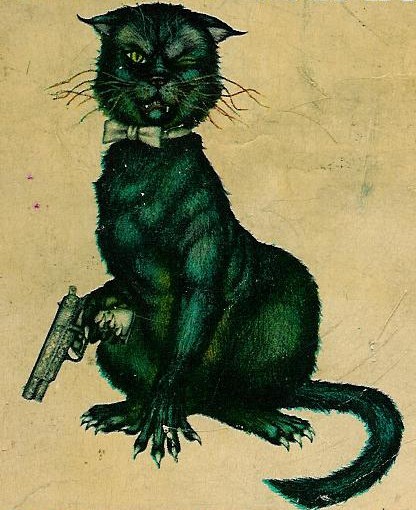
Indeed, the realities of life in the Soviet police state (“No papers, no person”) come across as far scarier than the supernatural characters of The Master and Margarita. Woland’s retinue, in particular his cat Behemoth (who seems to grace—can that be the right verb?—the covers of most editions of the novel), imbue the novel with a compelling manic energy. The most memorable sequences for most readers will likely involve Woland’s troupe’s antics, including their wild performance at the Variety Theatre, which climaxes in this bit of comic violence before culminating in a rush of greed and gratuitous nudity:

And an unheard-of thing occurred. The fur bristled on the cat’s back, and he gave a rending miaow. Then he compressed himself into a ball and shot like a panther straight at Bengalsky’s chest, and from there on to his head. Growling, the cat sank his plump paws into the skimpy chevelure of the master of ceremonies and in two twists tore the head from the thick neck with a savage howl.

The two and a half thousand people in the theatre cried out as one. Blood spurted in fountains from the torn neck arteries and poured over the shirt-front and tailcoat. The headless body paddled its feet somehow absurdly and sat down on the floor. Hysterical women’s cries came from the audience. The cat handed the head to Fagott, who lifted it up by the hair and showed it to the audience, and the head cried desperately for all the theatre to hear:

‘A doctor!’

(Don’t worry, Bengalsky gets his head back. Sort of).

Another highlight of the book is the Walpurgis Night episode—Chapter 23, “The Great Ball at Satan’s”—which I’d argue can stand on its own, free of context, as a lovely, dark, bizarre short story. Margarita plays hostess to a seemingly-endless parade of “kings, dukes, cavaliers, suicides, poisoners, gallowsbirds, procuresses, prison guards and sharpers, executioners, informers, traitors, madmen, sleuths, seducers,” who arrive via fireplace, their corpses reanimated to take part in the grand dance. Bulgakov cribs freely from history, populating the episode with condemned persons obscure and infamous alike.

The Walpurgisknacht episode highlights The Master and Margaritastrong Easter/Faust theme, which plays out for several characters who are reborn (figuratively or otherwise). The least interesting of these by far is the master himself. But perhaps this is unfair. It’s entirely plausible that the master is the storyteller of The Master and Margarita. In any case, his unnamed novel (within the text) depicts an alternate version of Jesus of Nazareth’s crucifixion, and it’s here that we find what I take to be The Master and Margarita’s most interesting and complex character, “the fifth procurator of Judea, Pontius Pilate.” The episodes with Pilate (who employs his own secret police, a wonderful parallel to the Soviet setting) offer a kind of moral ballast to the supernatural sequences, which fluctuate between manic-comic anxiety and big-R Romanticism. Of all the souls in turmoil in The Master and Margarita’s, I found the depiction of Pilate’s troubles the most profound.

The Master and Margarita’s lurching structure threatens narrative coherence until the novel’s final moments, when the master meets his creation. The moment is unexpectedly poignant, and does much to amend some of the novel’s ungainliness. The middle sections in particular get bogged down, as Bulgakov subjects his Muscovite extras to all sorts of fates (some more terrible than others). While some of these episodes are funny, and they certainly give the book some of its satirical power, they ultimately read as variations on a theme. I found my eyes glazing over in the novel’s epilogue when Bulgakov decides to check in on the survivors.

I’ve failed to remark on so much of The Master and Margarita, and I’m certain that much of its rich allusive texture was lost on me. (I should point out here how helpful the end notes of my edition were). Persons interested in early Soviet life who have not yet found their way to Bulgakov’s novel will wish to do so (as well as the work of Bulgakov’s contemporary Sigizmund Krzhizhanovsky); the novel also makes a strange but worthy companion piece to William Gaddis’s enormous Faust tale The RecognitionsAlthough The Master and Margarita sags at times, at its finest moments—of which there are many—it is funny, dark, and engrossing.

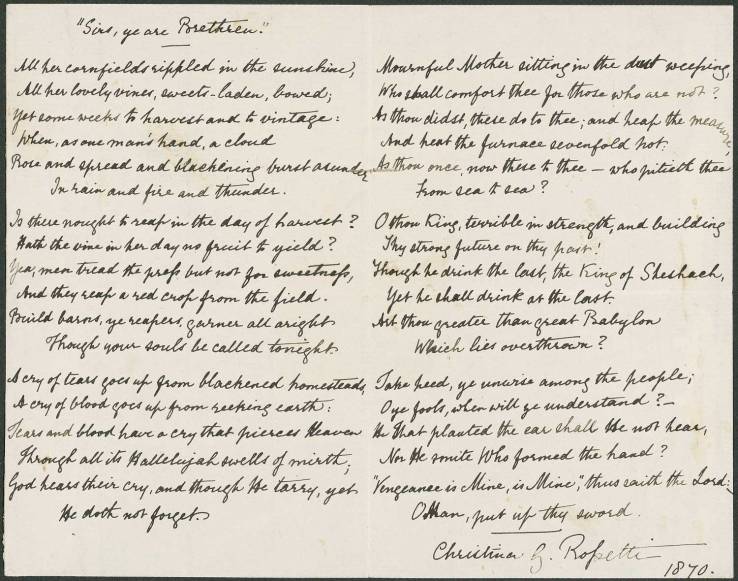
Christina Rossetti’s Manuscript for “Sirs, Ye Are Brethren”

sirsyearebrethren_holograph

(Via/about).

David Markson on Lowry, Gaddis, Vonnegut, Etc.

From David Markson’s 2007 interview in Conjunctions:

Harlin: Incidentally, you wrote your M.A. thesis on Malcolm Lowry, a relatively unknown writer at the time, and became very friendly with him. What was the impulse behind writing him?

Markson: A great percentage of the people in the world haven’t had this experience, but sometimes you read a book, and it’s almost as if it’s been written for you, or you’re the only one who really understands it. The impulse—creatively, artistically, spiritually—was to say, “Be my daddy. Be my father.” It took a letter or two, but obviously I struck a chord. He had done the same thing. As a young boy in England, he’d written to Conrad Aiken, he so admired Aiken’s poetry. I became friendly with Aiken, too, through Lowry. When Malc died, we got back in touch, and when he was in New York he would come to dinner. He kept a cold-water flat—are there still such things?—up on the East Side.

Harlin: You also became friends with Dylan Thomas and Kerouac.

Markson: The Dylan Thomas thing was a fluke. I don’t think I’d ever met a writer. Back then, I was only in correspondence with Lowry. Thomas did a reading, and on impulse I went backstage. You can’t imagine how popular he was or how highly thought-of he was, even though he was a legendary troublemaker. Out of the blue, I said, “How would you like to have a couple of drinks with some graduate students?” He said, “Yeah, I’ll meet you.” One thing led to another, and we had, at most, nine or ten evenings together. Kerouac was sheer chance and non-literary. My next door neighbor at the time, on 11th Street in the Village, was a recording engineer, and he was friendly with Jack. They used to listen to jazz together. In fact, this guy, who’s long-since dead, was one of the first to lug that old-style heavy equipment up to Harlem to record it. Jack loved it, and he’d go with him once in a while. He lived right next-door. Frequently, we’d go from apartment to apartment drinking together. Sometimes, Jack would come to New York, and this fellow, Jerry, would be away, so he’d ring our bell. For about two years—I’m guessing a dozen, fifteen times—the doorbell would ring, never a word in advance, and there he’d be, drunk as hell all the time. Generally he’d stay the night. One time he borrowed a T-shirt. He came back a week later, and we’re sitting in the living room, and I’m recognizing the outer shirt from a week before. I saw this filthy T-shirt and said, “You son of a bitch, is that the shirt of mine that you put on here a week ago?” And he said, “Well, I had a shower.” Then he stopped coming around; I guess he was in Florida. We just lost track of him, and the next thing I knew he was dead.

Harlin: There’s also William Gaddis.

Markson: I thought The Recognitions was—Lowry being English—the great American novel of that period. That’s the only other letter I wrote to a writer, but it was different from the Lowry one. When The Recognitions came out, it was shat on by every reviewer. They said, “How dare he write so long a book? How dare he deliberately try to create a masterpiece?” I wrote this casual letter, saying, “Screw them. Some of us out here know what you did.” When my wife and I went to Mexico for three years, an editor came down there, and Aiken had given him my name. We had him to dinner, and all I did was talk about The Recognitions. And this guy said, “Shut up already. Tell me about Mexico. I’ll read it when I get home.” And he did. The Recognitions came out in 1955, and this would have been about 1961. One day I get a letter there: “Dear David Markson, If I may presume to answer yours of”—whatever it was—”May 16, 1955.” It turned out that this editor, Aaron Asher, had come home, read the book, and decided to resurrect it. There had never been a paperback, and he put it in print, and it brought Gaddis back to life.

Harlin: Anyone else?

Markson: Kurt Vonnegut I’d known for about forty years. We weren’t that intimate, but for the last twenty years, he and I and two other people had dinner twice a year. And Joe Heller. We weren’t buddy-buddy, but I knew him before Catch-22. If you’re writing, who do you know? If you’re a lawyer, you know lawyers. If you’re a dentist, you know dentists. If you’re a writer, you know other writers. Heller was working in public relations. I remember when we came back from Mexico, one of the first people I saw said, “Hey, Joe Heller finished his book, and it’s great.” This all probably sounds very exotic. In fact, a book just came out recently called Sleeping with Bad Boys, by a woman named Alice Denham. She had been a Playboy centerfold, but she was the only Playboy centerfold who was the author of a short story in the same issue. I can say this, because she’s admitted it in her book, but she slept with everybody. She slept with James Jones, with Gaddis, a long list. She and Heller, for some reason, they would just neck or something. And she and I had an affair at one point. In fact, she refers to me as one of her favorite lovers. The Times review reported that she’d slept with this one and that one and then quoted something about each person. After my name, “the novelist David Markson,” was “stud lover boy.” And here I am seventy-nine years old! I still run into Alice; she lives a couple of blocks from me.


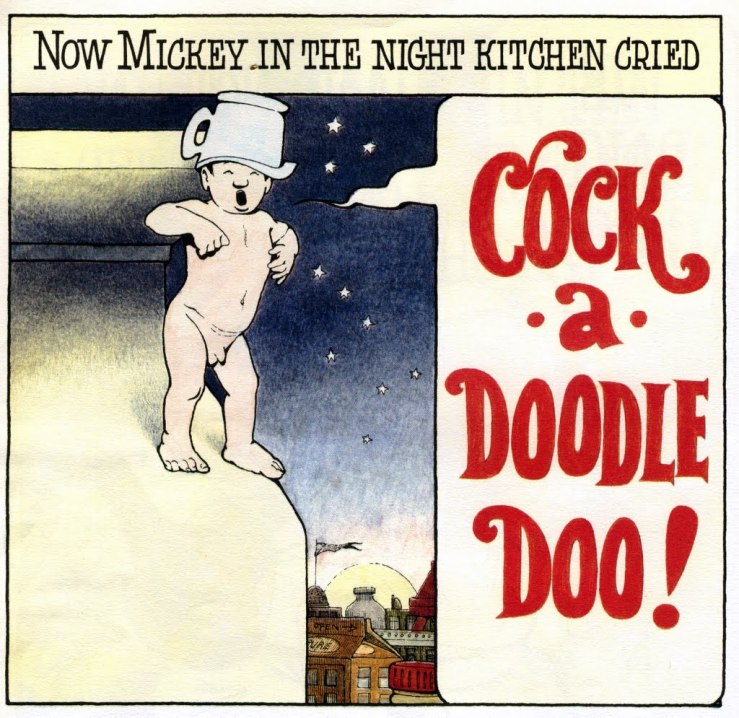
“Cock a Doodle Doo!” — Maurice Sendak

in_the_night_kitchen031

A Dirty Lapdog Joke from Thomas Pynchon’s Against the Day

Ruperta Chirpingdon-Groin and her party had descended by way of the St.Gotthard Tunnel from league after league of peaks like ocean waves frozen in place, fading into merciless light, tending to eternity—a circuit of Alpine hotels and hydropathics so remote the hotels had to print up their own postal stamps just to get mail as far as a regular Swiss post office, full of giggling nitwits, quite a number of them British actually, running about the corridors, jumping off balconies into the snowdrifts, hiding in servingpantries and falling down dumbwaiter shafts. They had detrained at Bellinzona, where the motordiligence from the Sanatorium was waiting for them, and so up to the famed institution overlooking the Swiss shores of Lago Maggiore. Goats grazing by the roadside turned their heads to watch them pass, as if long familiar with Böpfli-Spazzoletta clientele. From somewhere came a repeated figure being played on an alpenhorn.

Though he was not ready to share it with his brother, not even Reef had been exempt from the folly up there.

“What kind of a dog’s that?” he asked Ruperta at one point.

“Mouffette? She’s a papillon . . . a sort of French ladies’ lapdog.”

“A—You say,” gears in his mind beginning to crank, “ ‘lap’—French . . . lapdog?” Somehow gathering that Ruperta had trained her toy spaniel to provide intimate “French” caresses of the tongue for the pleasure of its mistress. “Well! you two are . . . pretty close then, I guess?”

“I wuv my ickle woofwoof, ess I doo!” Squeezing the animal tightly, one would think painfully, except for the apparent enjoyment with which Mouffette was fluttering her eyelids.

“Hmm,” said Reef.

“And today I must go across the lake, and the mean old people there won’t allow my ickle pwecious to come with Mummy, and we were both wondering if her good Uncle Reef would look after her for the day, see that she gets her chopped filet and her boiled pheasant, as she’s so particular.”

“Sure, you bet!” His thoughts taking wing. The day alone with a French “lap” dog! who might be more than happy to do for Reef what she was obviously already doing for old ’Pert here! who in fact, mmaybe all this time’s been just droolin’ for onethem penises for a change, and will turn out to know plenty of tricks! Aand—

It took a while for Ruperta to get her toilette perfect and her bustle out the door. Reef found himself pacing and smoking, and whenever he took a look over at Mouffette could’ve sworn she was fidgeting too. The dog, it seemed to Reef, was giving him sidewise looks which if they’d come from a woman you would have had to call flirtatious. Finally after an extended farewell notable for its amount of saliva exchange, Mouffette slowly padded over to the divan where Reef was sitting and jumped up to sit next to him. Jumping on the furniture was something Ruperta seldom allowed her to do, and her gaze at Reef clearly assumed that he would not get upset. Far from it, what he actually got was an erection. Mouffette looked it over, looked away, looked back, and suddenly jumped up on his lap.

“Oboy, oboy.” He stroked the diminutive spaniel for a while until, with no warning, she jumped off the couch and slowly went into the bedroom, looking back now and then over her shoulder. Reef followed, taking out his penis, breathing heavily through his mouth. “Here, Mouffie, nice big dog bone for you right here, lookit this, yeah, seen many of these lately? come on, smells good don’t it, mmm, yum!” and so forth, Mouffette meantime angling her head, edging closer, sniffing with curiosity. “That’s right, now, ooopen up . . . good girl, good Mouffette now let’s just put this—yaahhgghh!”

Reader, she bit him. After which, as if surprised at the vehemence of his reaction, Mouffette jumped off the bed and while Reef went looking for an ice bucket, ran off somehow into the vast hotel. Reef chased her for a while but found it was getting him funny looks from the staff.

In the days that followed, Mouffette took every occasion to jump up in Reef’s lap and gaze into his eyes—sarcastically, it seemed to Reef—opening her mouth suggestively, sometimes even drooling. Each time Reef tried not to flinch. Each time Ruperta, exasperated, would cry, “Honestly, it isn’t as if she means to bite you.”

–A sophomoric, dirty joke from Thomas Pynchon’s novel Against the Day.


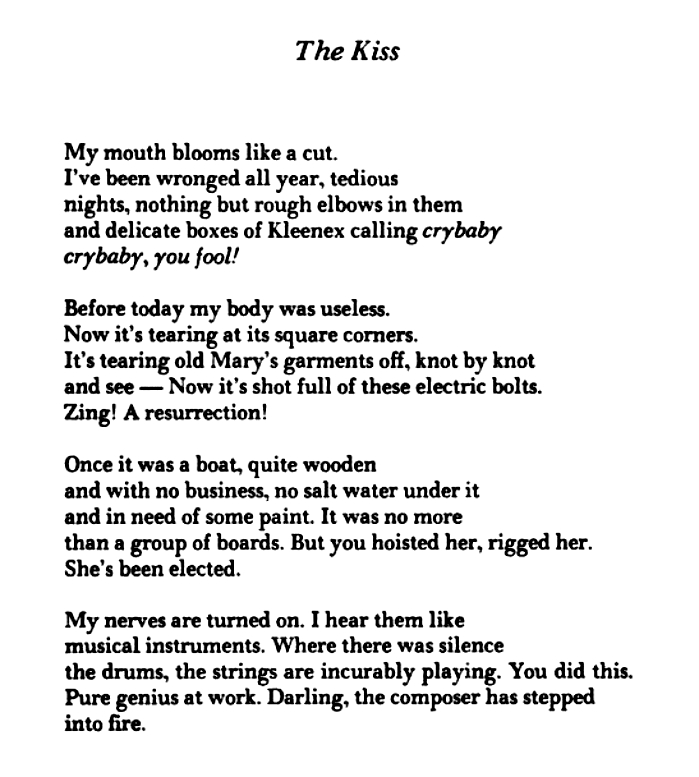
“The Kiss” — Anne Sexton

kiss

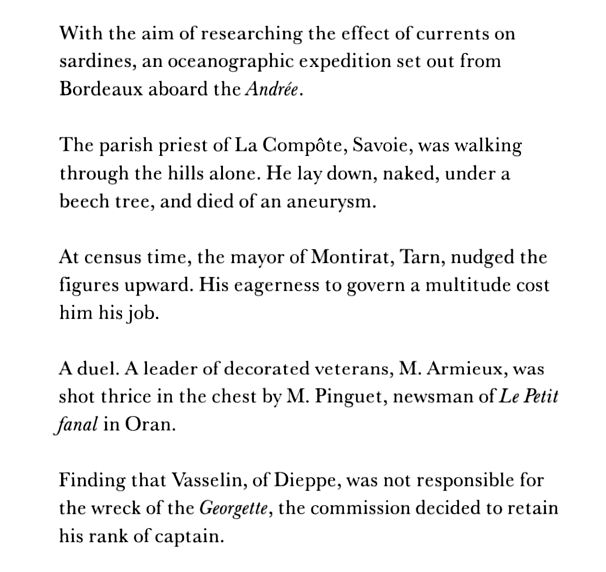
Five from Félix Fénéon

ff

Félix Fénéon at the Revue Blanche — Felix Vallotton

New Issue of Asymptote Features David Mitchell, László Krasznahorkai, Fady Joudah and More

The July issue of Asymptote, a journal devoted to literary translation, is chock-full of goodies, including a long interview with David Mitchell, a shorty from László Krasznahorkai translation, and an essay by Fady Joudah with the marvelous title  “Dear God, Your Message Was Received in Error.” Here’s the beginning of that essay:

In Borges’ story, “Averroës’ Search,” Averroës interrupts his long day of contemplating the problem that confronts him in Aristotle’s Poetics (how to translate ‘tragedy’ and ‘comedy’ into Arabic) and joins friends for dinner. The Andalusian philosopher seems to be listening (against hope or “without conviction” as Borges put it) for a solution to his problem in something that any of his guests might say. Maybe the answer is “near at hand” or, as in Lydia Davis’ “The Walk,” right “across the street.”

As the conversation meanders through various subjects about writing, God, and art, one of Averroës’ guests brings up the account of the seven sleepers:

“Let us imagine that someone shows a story instead of telling it—the story of the seven sleepers of Ephesus, say.* We see them retire into the cavern, we see them pray and sleep, we see them sleep with their eyes open, we see them grow while they are asleep, we see them awaken after three hundred nine years, we see them hand the merchant an ancient coin, we see them awaken with the dog.”

Borges’ mention of the seven sleepers comforts me, perhaps because I know the story from the Koran. Or perhaps because it serves as yet another cornerstone of what translation work can perform: transforming telling into seeing. Telling a story through seeing is also a gesture at what Averroës could not grasp when he encountered Aristotle’s ‘tragedy’ and ‘comedy’: theatre.

Lots of great stuff–check it out.


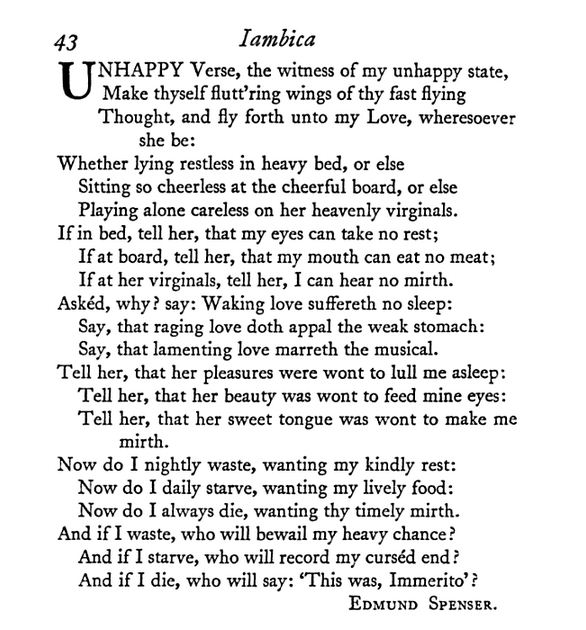
“Iambica” — Edmund Spenser

imabica

“—boys to your bellybone and chuck a chum a chance!” — Pynchon Riff + Joyce + Moebius + Chloral Hydrate Party

75883c2d61c7b1ea157f39a036480922

1. Here is a rambling riff if ever I rambled and riffed:

2, First, look, that lovely image—it’s by Jean Giraud, aka Moebius. I came across it a week or two ago and digitally nabbed it.

I love Moebius’s work in general and something about the image reminds me of Thomas Pynchon’s Against the Day, although maybe I’m too immersed in the thick novel to not have much of what I see recall it in some ways.

Something about the airship and the horseman recalls an early passage where Reef Traverse, in the American West, dream-reads the airship adventures of The Chums of Chance into existence. (There are parts of Against the Day that recall to me Cormac McCarthy’s westerns (sometimes—often—called anti-westerns, but come, let’s be adults)…where was I going here? It’s Friday and I’ve consumed the better part (aka “all”) of a bottle of rosé and now I’m circling round some odd notes here—yes—the western/Western thing: Manifest Destiny, etc. — I see it in the Moebius illustration, but of course I bring it with me like a sickness. I move on).

3. ” . . . boys to your bellybone and chuck a chum a chance!” — This is from James Joyce’s Finnegans Wake (85.8). Pointed out to me by Roman Tsivkin, this seems like a most reasonable/splendid source for the namesake of our aeronaut adventurers (who seem rather, uh, absent of late in the final moments of the Bilocations book I’m in right now).

4. Data, perhaps imperfect (again, digitally nabbed)—

In Against the Day:

—Some form of the word invisible appears 173 times—

—The word inconvenience or inconvenient — 84 times—

—The phrase the day — 213 times (usually in a cadence suggestive of the book’s title—some kind of rhythm to it, anyway)—

—The phrase against the day — once (unless you count the chapter (book, really) called “Against the Day,” or the colophon, or what-have-you)—

5. I’m a few sections past this, but a nice passage to end on of a Friday night:

Among students of mathematics here, chloral hydrate was the preferred drug. Sooner or later, whatever the problem being struggled with, having obsessed themselves into nightly insomnia, they would start taking knockout drops to get to sleep—Geheimrat Klein himself was a great advocate of the stuff—and next thing they knew, they were habitués, recognizing one another by the side-effects, notably eruptions of red pimples, known as “the dueling scars of chloralomania.” On Saturday nights in Göttingen, there was always sure to be at least one chloral party, or Mickifest.

It was a peculiar gathering, only intermittently, as you’d say, brisk. People were either talking wildly, often to themselves and without seeming to pause for breath, or lounging draped in pleasurable paralysis across the furniture or, as the evening went along, flat on the floor in deep narcosis.