“The End of the World” — G.K. Chesterton

“The End of the World” by G.K. Chesterton

For some time I had been wandering in quiet streets in the curious town of Besançon, which stands like a sort of peninsula in a horse-shoe of river. You may learn from the guide books that it was the birthplace of Victor Hugo, and that it is a military station with many forts, near the French frontier. But you will not learn from guide books that the very tiles on the roofs seem to be of some quainter and more delicate colour than the tiles of all the other towns of the world; that the tiles look like the little clouds of some strange sunset, or like the lustrous scales of some strange fish. They will not tell you that in this town the eye cannot rest on anything without finding it in some way attractive and even elvish, a carved face at a street corner, a gleam of green fields through a stunted arch, or some unexpected colour for the enamel of a spire or dome.

…..Evening was coming on and in the light of it all these colours so simple and yet so subtle seemed more and more to fit together and make a fairy tale. I sat down for a little outside a café with a row of little toy trees in front of it, and presently the driver of a fly (as we should call it) came to the same place. He was one of those very large and dark Frenchmen, a type not common but yet typical of France; the Rabelaisian Frenchman, huge, swarthy, purple-faced, a walking wine-barrel; he was a sort of Southern Falstaff, if one can imagine Falstaff anything but English. And, indeed, there was a vital difference, typical of two nations. For while Falstaff would have been shaking with hilarity like a huge jelly, full of the broad farce of the London streets, this Frenchman was rather solemn and dignified than otherwise—as if pleasure were a kind of pagan religion. After some talk which was full of the admirable civility and equality of French civilisation, he suggested without either eagerness or embarrassment that he should take me in his fly for an hour’s ride in the hills beyond the town. And though it was growing late I consented; for there was one long white road under an archway and round a hill that dragged me like a long white cord. We drove through the strong, squat gateway that was made by Romans, and I remember the coincidence like a sort of omen that as we passed out of the city I heard simultaneously the three sounds which are the trinity of France. They make what some poet calls “a tangled trinity,” and I am not going to disentangle it. Whatever those three things mean, how or why they co-exist; whether they can be reconciled or perhaps are reconciled already; the three sounds I heard then by an accident all at once make up the French mystery. For the brass band in the Casino gardens behind me was playing with a sort of passionate levity some ramping tune from a Parisian comic opera, and while this was going on I heard also the bugles on the hills above, that told of terrible loyalties and men always arming in the gate of France; and I heard also, fainter than these sounds and through them all, the Angelus. Continue reading ““The End of the World” — G.K. Chesterton”

Old Money

Capture

(More Gatsby comics by Kate Beaton at her site Hark, a vagrant).

Hawthorne Anecdote

I was sent for to the police court the other morning, in the case of an American sailor accused of robbing a shipmate at sea. A large room, with a great coal-fire burning on one side, and above it the portrait of Mr. Rushton, deceased, a magistrate of many years’ continuance. A long table, with chairs, and a witness-box. One of the borough magistrates, a merchant of the city, sat at the head of the table, with paper and pen and ink before him; but the real judge was the clerk of the court, whose professional knowledge and experience governed all the proceedings. In the short time while I was waiting, two cases were tried, in the first of which the prisoner was discharged. The second case was of a woman,—a thin, sallow, hard-looking, careworn, rather young woman,—for stealing a pair of slippers out of a shop: The trial occupied five minutes or less, and she was sentenced to twenty-one days’ imprisonment,—whereupon, without speaking, she looked up wildly first into one policeman’s face, then into another’s, at the same time wringing her hands with no theatric gesture, but because her torment took this outward shape,—and was led away. The Yankee sailor was then brought up,—an intelligent, but ruffian-like fellow,—and as the case was out of the jurisdiction of the English magistrates, and as it was not worth while to get him sent over to America for trial, he was forthwith discharged. He stole a comforter.

If mankind were all intellect, they would be continually changing, so that one age would be entirely unlike another. The great conservative is the heart, which remains the same in all ages; so that commonplaces of a thousand years’ standing are as effective as ever.

–From the January 6th, 1854 entry of Nathaniel Hawthorne’s English note-books.

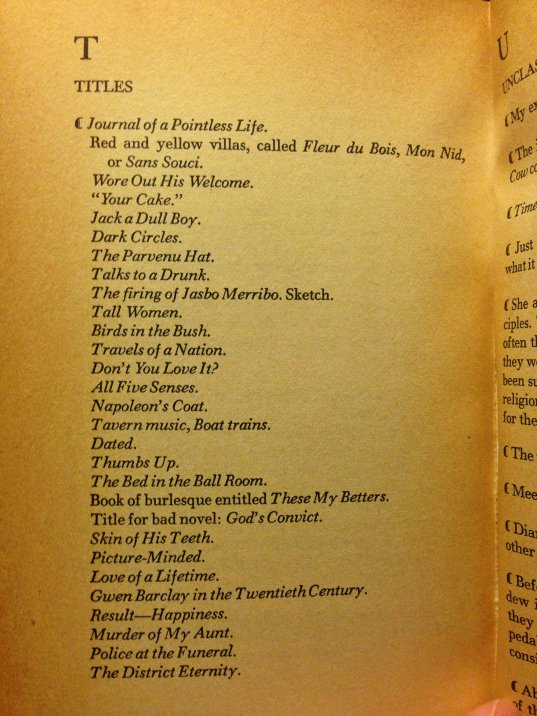
Journal of a Pointless Life, and Other Titles from F. Scott Fitzgerald’s Notebooks

IMG_5729

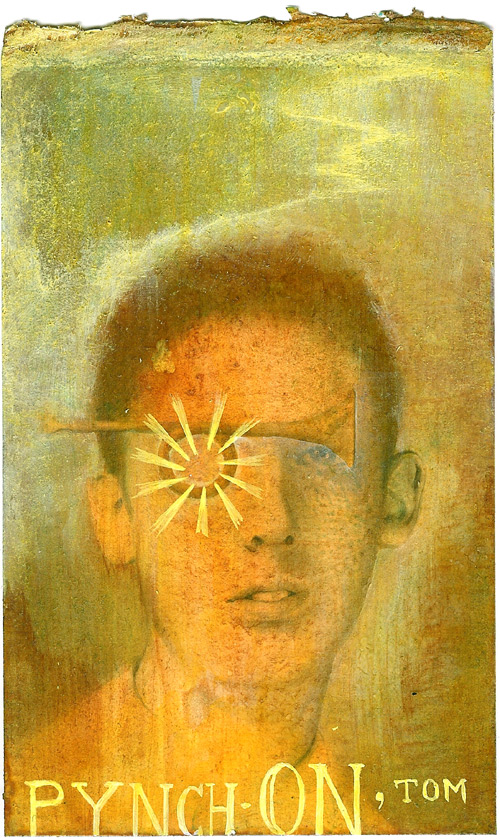
Thomas Pynchon Portrait — James Jean

James Jean does Thomas Pynchon. (Via Hey Oscar Wilde!).

“An Ideal Family” — Katherine Mansfield

“An Ideal Family” by Katherine Mansfield

That evening for the first time in his life, as he pressed through the swing door and descended the three broad steps to the pavement, old Mr. Neave felt he was too old for the spring. Spring—warm, eager, restless—was there, waiting for him in the golden light, ready in front of everybody to run up, to blow in his white beard, to drag sweetly on his arm. And he couldn’t meet her, no; he couldn’t square up once more and stride off, jaunty as a young man. He was tired and, although the late sun was still shining, curiously cold, with a numbed feeling all over. Quite suddenly he hadn’t the energy, he hadn’t the heart to stand this gaiety and bright movement any longer; it confused him. He wanted to stand still, to wave it away with his stick, to say, “Be off with you!” Suddenly it was a terrible effort to greet as usual—tipping his wide-awake with his stick—all the people whom he knew, the friends, acquaintances, shopkeepers, postmen, drivers. But the gay glance that went with the gesture, the kindly twinkle that seemed to say, “I’m a match and more for any of you”—that old Mr. Neave could not manage at all. He stumped along, lifting his knees high as if he were walking through air that had somehow grown heavy and solid like water. And the homeward-looking crowd hurried by, the trams clanked, the light carts clattered, the big swinging cabs bowled along with that reckless, defiant indifference that one knows only in dreams…

It had been a day like other days at the office. Nothing special had happened. Harold hadn’t come back from lunch until close on four. Where had he been? What had he been up to? He wasn’t going to let his father know. Old Mr. Neave had happened to be in the vestibule, saying good-bye to a caller, when Harold sauntered in, perfectly turned out as usual, cool, suave, smiling that peculiar little half-smile that women found so fascinating.

Ah, Harold was too handsome, too handsome by far; that had been the trouble all along. No man had a right to such eyes, such lashes, and such lips; it was uncanny. As for his mother, his sisters, and the servants, it was not too much to say they made a young god of him; they worshipped Harold, they forgave him everything; and he had needed some forgiving ever since the time when he was thirteen and he had stolen his mother’s purse, taken the money, and hidden the purse in the cook’s bedroom. Old Mr. Neave struck sharply with his stick upon the pavement edge. But it wasn’t only his family who spoiled Harold, he reflected, it was everybody; he had only to look and to smile, and down they went before him. So perhaps it wasn’t to be wondered at that he expected the office to carry on the tradition. H’m, h’m! But it couldn’t be done. No business—not even a successful, established, big paying concern—could be played with. A man had either to put his whole heart and soul into it, or it went all to pieces before his eyes… Continue reading ““An Ideal Family” — Katherine Mansfield”

Kinda Sorta Reading List of Novels from Ezra Pound

I have not written a good novel. I have not written a novel. I don’t expect to write any novels and shall not tell anyone else how to do it until I have.

If you want to study the novel, go, READ the best you can find. All I know about it, I have learned from reading:

Tom Jones, by Fielding.

Tristram Shandy and The Sentimental Journey by Sterne (and I don’t recommend anyone ELSE to try to do another Tristram Shandy).

The novels of Jane Austen and Trollope.

[Note: If you compare the realism of Trollope’s novels with the realism of Robert McAlmon’s stories you will get a fair idea of what a good novelists means by ‘construction’. Trollope depicts a scene or a person, and you can clearly see how he ‘leads up to an effect’.]


Continuing:

The novels of Henry James, AND especially the prefaces to his collected edition; which are the one extant great treatise on novel writing in English.

In French you can form a fairly good ideogram from:

Benjamin Constant’s Adolphe.

The first half of Stendhal’s Rouge et Noir and the first eighty pages of La Chartreuse de Parme.

Madame BovaryL’Education SentimentaleTrois Contes, and the unfinished Brouvard et Pecuchet of FLAUBERT, with Goncourt’s preface to Germinie Lacerteux.


After that you would do well to look at Madox Ford’s A Call.

When you have read Jame’s prefaces and twenty of his other novels, you would do well to read The Sacred Fount.

There for perhaps the first time since about 1300 a writer has been able to deal with a sort of content wherewith Cavalcanti has been ‘concerned’.

You can get a very brilliant cross-light via Donne. I mean the difference and nuances between psychology in Guido, abstract philosophic statement in Guido, the blend in Donne, and again psychology in Henry James, and in all of them the underlying concept of FORM, the structure of the whole work, including its parts.

This is a long way from an A B C. In fact it opens the vistas of post-graduate study.

From Ezra Pound’s ABC of Reading (New Directions).


Margaret Atwood Offers Three Reasons to Keep Physical Books

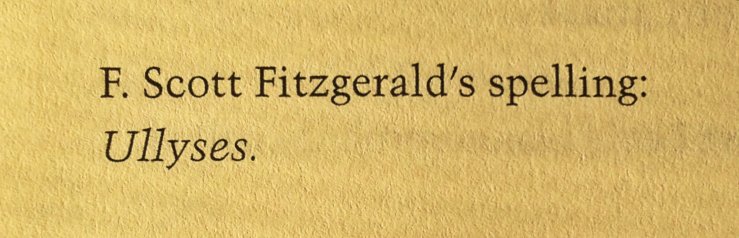
Ullyses

IMG_5709

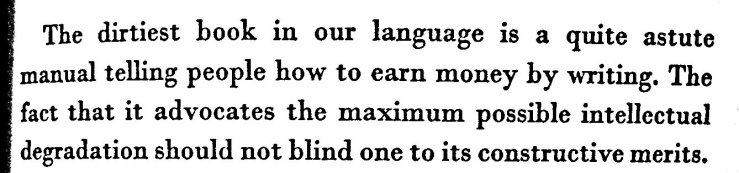
The dirtiest book (Ezra Pound)

20130506-200713

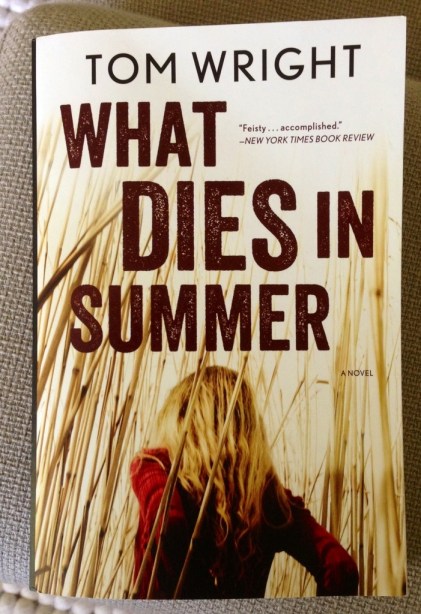
What Dies in Summer (Book Acquired, 5.02.2013)

20130505-185201.jpg

Tom Wright’s What Dies in Summer is new in trade paperback. Pub’s blurb:

A riveting Southern Gothic coming-of-age debut by major new talent.

“I did what I did, and that’s on me.” From that tantalizing first sentence, Tom Wright sweeps us up in a tale of lost innocence. Jim has a touch of the Sight. It’s nothing too spooky and generally useless, at least until the summer his cousin L.A. moves in with him and their grandmother. When Jim and L.A. discover the body of a girl, brutally raped and murdered in a field, an investigation begins that will put both their lives in danger. In the spirit of The Lovely Bones and The Little FriendWhat Dies in Summer is a novel that casts its spell on the very first page and leaves an indelible mark.

And the lede from Julie Myerson’s review last year in the NYT:

Why do teenagers make such ideal protagonists? Maybe it’s because they’re doing just what novels do: struggling to make sense of a troubling and imperfect world. And at first, Jim, called Biscuit, and L. A. (Lee Ann), the teenage cousins at the heart of Tom Wright’s feisty first novel, are ­exactly what you hope they’ll be: funny, frank, mouthy and more than a touch off kilter. Both are forced to live with their grandmother because their mothers aren’t up to the task of child rearing. Their homes are haunted by alcoholism and violence, but Gram takes a simple, affectionate, responsibility for them — though it’s almost inevitable that certain questions, if not the answers, will push their ugly way to the surface sooner or later.

“Spring Spleen” — Lydia Davis

IMG_5712

“On Dress and Deportment” — Jerome K. Jerome

“ON DRESS AND DEPORTMENT” by Jerome K. Jerome

They say—people who ought to be ashamed of themselves do—that the consciousness of being well dressed imparts a blissfulness to the human heart that religion is powerless to bestow. I am afraid these cynical persons are sometimes correct. I know that when I was a very young man (many, many years ago, as the story-books say) and wanted cheering up, I used to go and dress myself in all my best clothes. If I had been annoyed in any manner—if my washerwoman had discharged me, for instance; or my blank-verse poem had been returned for the tenth time, with the editor’s compliments “and regrets that owing to want of space he is unable to avail himself of kind offer;” or I had been snubbed by the woman I loved as man never loved before—by the way, it’s really extraordinary what a variety of ways of loving there must be. We all do it as it was never done before. I don’t know how our great-grandchildren will manage. They will have to do it on their heads by their time if they persist in not clashing with any previous method.

Well, as I was saying, when these unpleasant sort of things happened and I felt crushed, I put on all my best clothes and went out. It brought back my vanishing self-esteem. In a glossy new hat and a pair of trousers with a fold down the front (carefully preserved by keeping them under the bed—I don’t mean on the floor, you know, but between the bed and the mattress), I felt I was somebody and that there were other washerwomen: ay, and even other girls to love, and who would perhaps appreciate a clever, good-looking young fellow. I didn’t care; that was my reckless way. I would make love to other maidens. I felt that in those clothes I could do it.

They have a wonderful deal to do with courting, clothes have. It is half the battle. At all events, the young man thinks so, and it generally takes him a couple of hours to get himself up for the occasion. His first half-hour is occupied in trying to decide whether to wear his light suit with a cane and drab billycock, or his black tails with a chimney-pot hat and his new umbrella. He is sure to be unfortunate in either decision. If he wears his light suit and takes the stick it comes on to rain, and he reaches the house in a damp and muddy condition and spends the evening trying to hide his boots. If, on the other hand, he decides in favor of the top hat and umbrella—nobody would ever dream of going out in a top hat without an umbrella; it would be like letting baby (bless it!) toddle out without its nurse. How I do hate a top hat! One lasts me a very long while, I can tell you. I only wear it when—well, never mind when I wear it. It lasts me a very long while. I’ve had my present one five years. It was rather old-fashioned last summer, but the shape has come round again now and I look quite stylish.

But to return to our young man and his courting. If he starts off with the top hat and umbrella the afternoon turns out fearfully hot, and the perspiration takes all the soap out of his mustache and converts the beautifully arranged curl over his forehead into a limp wisp resembling a lump of seaweed. The Fates are never favorable to the poor wretch. If he does by any chance reach the door in proper condition, she has gone out with her cousin and won’t be back till late. Continue reading ““On Dress and Deportment” — Jerome K. Jerome”

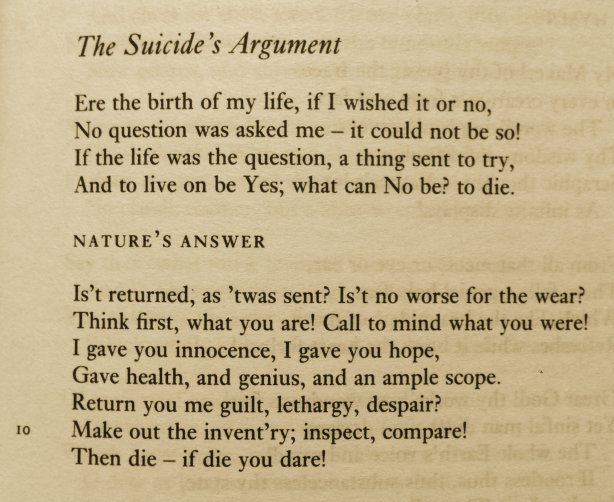
“The Suicide’s Argument” — Samuel Taylor Coleridge

IMG_5666

“Drowne’s Wooden Image” — Nathaniel Hawthorne

“Drowne’s Wooden Image” — Nathaniel Hawthorne

One sunshiny morning, in the good old times of the town of Boston, a young carver in wood, well known by the name of Drowne, stood contemplating a large oaken log, which it was his purpose to convert into the figure-head of a vessel. And while he discussed within his own mind what sort of shape or similitude it were well to bestow upon this excellent piece of timber, there came into Drowne’s workshop a certain Captain Hunnewell, owner and commander of the good brig called the Cynosure, which had just returned from her first voyage to Fayal.

“Ah! that will do, Drowne, that will do!” cried the jolly captain, tapping the log with his rattan. “I bespeak this very piece of oak for the figure-head of the Cynosure. She has shown herself the sweetest craft that ever floated, and I mean to decorate her prow with the handsomest image that the skill of man can cut out of timber. And, Drowne, you are the fellow to execute it.”

“You give me more credit than I deserve, Captain Hunnewell,” said the carver, modestly, yet as one conscious of eminence in his art. “But, for the sake of the good brig, I stand ready to do my best. And which of these designs do you prefer? Here,”—pointing to a staring, half-length figure, in a white wig and scarlet coat,—”here is an excellent model, the likeness of our gracious king. Here is the valiant Admiral Vernon. Or, if you prefer a female figure, what say you to Britannia with the trident?”

“All very fine, Drowne; all very fine,” answered the mariner. “But as nothing like the brig ever swam the ocean, so I am determined she shall have such a figure-head as old Neptune never saw in his life. And what is more, as there is a secret in the matter, you must pledge your credit not to betray it.”

“Certainly,” said Drowne, marvelling, however, what possible mystery there could be in reference to an affair so open, of necessity, to the inspection of all the world as the figure-head of a vessel. “You may depend, captain, on my being as secret as the nature of the case will permit.”

Captain Hunnewell then took Drowne by the button, and communicated his wishes in so low a tone that it would be unmannerly to repeat what was evidently intended for the carver’s private ear. We shall, therefore, take the opportunity to give the reader a few desirable particulars about Drowne himself.

He was the first American who is known to have attempted—in a very humble line, it is true—that art in which we can now reckon so many names already distinguished, or rising to distinction. From his earliest boyhood he had exhibited a knack—for it would be too proud a word to call it genius—a knack, therefore, for the imitation of the human figure in whatever material came most readily to hand. The snows of a New England winter had often supplied him with a species of marble as dazzingly white, at least, as the Parian or the Carrara, and if less durable, yet sufficiently so to correspond with any claims to permanent existence possessed by the boy’s frozen statues. Yet they won admiration from maturer judges than his school-fellows, and were indeed, remarkably clever, though destitute of the native warmth that might have made the snow melt beneath his hand. As he advanced in life, the young man adopted pine and oak as eligible materials for the display of his skill, which now began to bring him a return of solid silver as well as the empty praise that had been an apt reward enough for his productions of evanescent snow. He became noted for carving ornamental pump heads, and wooden urns for gate posts, and decorations, more grotesque than fanciful, for mantelpieces. No apothecary would have deemed himself in the way of obtaining custom without setting up a gilded mortar, if not a head of Galen or Hippocrates, from the skilful hand of Drowne. Continue reading ““Drowne’s Wooden Image” — Nathaniel Hawthorne”

“Charity” — Thomas Bernhard

20130504-100435.jpg

“The Jockey,” A Short Story by Carson McCullers

“The Jockey” by Carson McCullers

The jockey came to the doorway of the dining room, then after a moment stepped to one side and stood motionless, with his back to the wall. The room was crowded, as this was the third day of the season and all the hotels in the town were full. In the dining room bouquets of August roses scattered their petals on the white table linen and from the adjoining bar came a warm, drunken wash of voices. The jockey waited with his back to the wall and scrutinized the room with pinched, crêpy eyes. He examined the room until at last his eyes reached a table in a corner diagonally across from him, at which three men were sitting. As he watched, the jockey raised his chin and tilted his head back to one side, his dwarfed body grew rigid, and his hands stiffened so that the fingers curled inward like gray claws. Tense against the wall of the dining room, he watched and waited in this way.

He was wearing a suit of green Chinese silk that evening, tailored precisely and the size of a costume outfit for a child. The shirt was yellow, the tie striped with pastel colors. He had no hat with him and wore his hair brushed down in a stiff, wet bang on his forehead. His face was drawn, ageless, and gray. There were shadowed hollows at his temples and his mouth was set in a wiry smile. After a time he was aware that he had been seen by one of the three men he had been watching. But the jockey did not nod; he only raised his chin still higher and hooked the thumb of his tense hand in the pocket of his coat.

The three men at the corner table were a trainer, a bookie, and a rich man. The trainer was Sylvester — a large, loosely built fellow with a flushed nose and slow blue eyes. The bookie was Simmons. The rich man was the owner of a horse named Seltzer, which the jockey had ridden that afternoon. The three of them drank whiskey with soda, and a white-coated waiter had just brought on the main course of the dinner. Continue reading ““The Jockey,” A Short Story by Carson McCullers”