Raskolnikov’s Horse Dream (Dostoevsky)

Raskolnikov had a fearful dream. He dreamt he was back in his childhood in the little town of his birth. He was a child about seven years old, walking into the country with his father on the evening of a holiday. It was a grey and heavy day, the country was exactly as he remembered it; indeed he recalled it far more vividly in his dream than he had done in memory. The little town stood on a level flat as bare as the hand, not even a willow near it; only in the far distance, a copse lay, a dark blur on the very edge of the horizon. A few paces beyond the last market garden stood a tavern, a big tavern, which had always aroused in him a feeling of aversion, even of fear, when he walked by it with his father. There was always a crowd there, always shouting, laughter and abuse, hideous hoarse singing and often fighting. Drunken and horrible-looking figures were hanging about the tavern. He used to cling close to his father, trembling all over when he met them. Near the tavern the road became a dusty track, the dust of which was always black. It was a winding road, and about a hundred paces further on, it turned to the right to the graveyard. In the middle of the graveyard stood a stone church with a green cupola where he used to go to mass two or three times a year with his father and mother, when a service was held in memory of his grandmother, who had long been dead, and whom he had never seen. On these occasions they used to take on a white dish tied up in a table napkin a special sort of rice pudding with raisins stuck in it in the shape of a cross. He loved that church, the old-fashioned, unadorned ikons and the old priest with the shaking head. Near his grandmother’s grave, which was marked by a stone, was the little grave of his younger brother who had died at six months old. He did not remember him at all, but he had been told about his little brother, and whenever he visited the graveyard he used religiously and reverently to cross himself and to bow down and kiss the little grave. And now he dreamt that he was walking with his father past the tavern on the way to the graveyard; he was holding his father’s hand and looking with dread at the tavern. A peculiar circumstance attracted his attention: there seemed to be some kind of festivity going on, there were crowds of gaily dressed townspeople, peasant women, their husbands, and riff-raff of all sorts, all singing and all more or less drunk. Near the entrance of the tavern stood a cart, but a strange cart. It was one of those big carts usually drawn by heavy cart-horses and laden with casks of wine or other heavy goods. He always liked looking at those great cart-horses, with their long manes, thick legs, and slow even pace, drawing along a perfect mountain with no appearance of effort, as though it were easier going with a load than without it. But now, strange to say, in the shafts of such a cart he saw a thin little sorrel beast, one of those peasants’ nags which he had often seen straining their utmost under a heavy load of wood or hay, especially when the wheels were stuck in the mud or in a rut. And the peasants would beat them so cruelly, sometimes even about the nose and eyes, and he felt so sorry, so sorry for them that he almost cried, and his mother always used to take him away from the window. All of a sudden there was a great uproar of shouting, singing and the balalaïka, and from the tavern a number of big and very drunken peasants came out, wearing red and blue shirts and coats thrown over their shoulders.

“Get in, get in!” shouted one of them, a young thick-necked peasant with a fleshy face red as a carrot. “I’ll take you all, get in!”

But at once there was an outbreak of laughter and exclamations in the crowd.

“Take us all with a beast like that!”

“Why, Mikolka, are you crazy to put a nag like that in such a cart?”

“And this mare is twenty if she is a day, mates!”

“Get in, I’ll take you all,” Mikolka shouted again, leaping first into the cart, seizing the reins and standing straight up in front. “The bay has gone with Matvey,” he shouted from the cart—”and this brute, mates, is just breaking my heart, I feel as if I could kill her. She’s just eating her head off. Get in, I tell you! I’ll make her gallop! She’ll gallop!” and he picked up the whip, preparing himself with relish to flog the little mare.

“Get in! Come along!” The crowd laughed. “D’you hear, she’ll gallop!”

“Gallop indeed! She has not had a gallop in her for the last ten years!”

“She’ll jog along!”

“Don’t you mind her, mates, bring a whip each of you, get ready!”

“All right! Give it to her!”

They all clambered into Mikolka’s cart, laughing and making jokes. Six men got in and there was still room for more. They hauled in a fat, rosy-cheeked woman. She was dressed in red cotton, in a pointed, beaded headdress and thick leather shoes; she was cracking nuts and laughing. The crowd round them was laughing too and indeed, how could they help laughing? That wretched nag was to drag all the cartload of them at a gallop! Two young fellows in the cart were just getting whips ready to help Mikolka. With the cry of “now,” the mare tugged with all her might, but far from galloping, could scarcely move forward; she struggled with her legs, gasping and shrinking from the blows of the three whips which were showered upon her like hail. The laughter in the cart and in the crowd was redoubled, but Mikolka flew into a rage and furiously thrashed the mare, as though he supposed she really could gallop.

“Let me get in, too, mates,” shouted a young man in the crowd whose appetite was aroused.

“Get in, all get in,” cried Mikolka, “she will draw you all. I’ll beat her to death!” And he thrashed and thrashed at the mare, beside himself with fury.

“Father, father,” he cried, “father, what are they doing? Father, they are beating the poor horse!”

“Come along, come along!” said his father. “They are drunken and foolish, they are in fun; come away, don’t look!” and he tried to draw him away, but he tore himself away from his hand, and, beside himself with horror, ran to the horse. The poor beast was in a bad way. She was gasping, standing still, then tugging again and almost falling.

“Beat her to death,” cried Mikolka, “it’s come to that. I’ll do for her!”

“What are you about, are you a Christian, you devil?” shouted an old man in the crowd.

“Did anyone ever see the like? A wretched nag like that pulling such a cartload,” said another.

“You’ll kill her,” shouted the third.

“Don’t meddle! It’s my property, I’ll do what I choose. Get in, more of you! Get in, all of you! I will have her go at a gallop!…”

All at once laughter broke into a roar and covered everything: the mare, roused by the shower of blows, began feebly kicking. Even the old man could not help smiling. To think of a wretched little beast like that trying to kick!

Two lads in the crowd snatched up whips and ran to the mare to beat her about the ribs. One ran each side.

“Hit her in the face, in the eyes, in the eyes,” cried Mikolka.

“Give us a song, mates,” shouted someone in the cart and everyone in the cart joined in a riotous song, jingling a tambourine and whistling. The woman went on cracking nuts and laughing.

… He ran beside the mare, ran in front of her, saw her being whipped across the eyes, right in the eyes! He was crying, he felt choking, his tears were streaming. One of the men gave him a cut with the whip across the face, he did not feel it. Wringing his hands and screaming, he rushed up to the grey-headed old man with the grey beard, who was shaking his head in disapproval. One woman seized him by the hand and would have taken him away, but he tore himself from her and ran back to the mare. She was almost at the last gasp, but began kicking once more.

“I’ll teach you to kick,” Mikolka shouted ferociously. He threw down the whip, bent forward and picked up from the bottom of the cart a long, thick shaft, he took hold of one end with both hands and with an effort brandished it over the mare.

“He’ll crush her,” was shouted round him. “He’ll kill her!”

“It’s my property,” shouted Mikolka and brought the shaft down with a swinging blow. There was a sound of a heavy thud.

“Thrash her, thrash her! Why have you stopped?” shouted voices in the crowd.

And Mikolka swung the shaft a second time and it fell a second time on the spine of the luckless mare. She sank back on her haunches, but lurched forward and tugged forward with all her force, tugged first on one side and then on the other, trying to move the cart. But the six whips were attacking her in all directions, and the shaft was raised again and fell upon her a third time, then a fourth, with heavy measured blows. Mikolka was in a fury that he could not kill her at one blow.

“She’s a tough one,” was shouted in the crowd.

“She’ll fall in a minute, mates, there will soon be an end of her,” said an admiring spectator in the crowd.

“Fetch an axe to her! Finish her off,” shouted a third.

“I’ll show you! Stand off,” Mikolka screamed frantically; he threw down the shaft, stooped down in the cart and picked up an iron crowbar. “Look out,” he shouted, and with all his might he dealt a stunning blow at the poor mare. The blow fell; the mare staggered, sank back, tried to pull, but the bar fell again with a swinging blow on her back and she fell on the ground like a log.

“Finish her off,” shouted Mikolka and he leapt beside himself, out of the cart. Several young men, also flushed with drink, seized anything they could come across—whips, sticks, poles, and ran to the dying mare. Mikolka stood on one side and began dealing random blows with the crowbar. The mare stretched out her head, drew a long breath and died.

“You butchered her,” someone shouted in the crowd.

“Why wouldn’t she gallop then?”

“My property!” shouted Mikolka, with bloodshot eyes, brandishing the bar in his hands. He stood as though regretting that he had nothing more to beat.

“No mistake about it, you are not a Christian,” many voices were shouting in the crowd.

But the poor boy, beside himself, made his way, screaming, through the crowd to the sorrel nag, put his arms round her bleeding dead head and kissed it, kissed the eyes and kissed the lips…. Then he jumped up and flew in a frenzy with his little fists out at Mikolka. At that instant his father, who had been running after him, snatched him up and carried him out of the crowd.

“Come along, come! Let us go home,” he said to him.

“Father! Why did they… kill… the poor horse!” he sobbed, but his voice broke and the words came in shrieks from his panting chest.

“They are drunk…. They are brutal… it’s not our business!” said his father. He put his arms round his father but he felt choked, choked. He tried to draw a breath, to cry out—and woke up.

He waked up, gasping for breath, his hair soaked with perspiration, and stood up in terror.

—From Chapter V of Dostoevsky’s novel Crime and Punishment
Tolstoy on Film

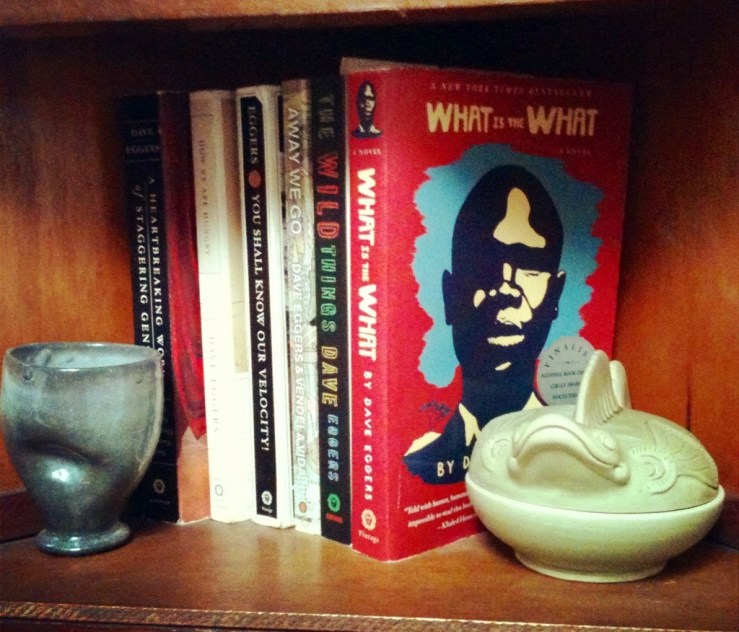
Book Shelves #37, 9.09.2012

20120909-105221.jpg

Book shelves series #37, thirty-seventh Sunday of 2012

Eggers, Dave. Beloved, reviled, sainted, hated.

I wrote about Eggers at some length here already, so I won’t repeat myself.

“Three Questions,” a Short Story by Leo Tolstoy

“Three Questions” by Leo Tolstoy —

It once occurred to a certain king, that if he always knew the right time to begin everything; if he knew who were the right people to listen to, and whom to avoid; and, above all, if he always knew what was the most important thing to do, he would never fail in anything he might undertake.

And this thought having occurred to him, he had it proclaimed throughout his kingdom that he would give a great reward to any one who would teach him what was the right time for every action, and who were the most necessary people, and how he might know what was the most important thing to do.

And learned men came to the King, but they all answered his questions differently.

In reply to the first question, some said that to know the right time for every action, one must draw up in advance, a table of days, months and years, and must live strictly according to it. Only thus, said they, could everything be done at its proper time. Others declared that it was impossible to decide beforehand the right time for every action; but that, not letting oneself be absorbed in idle pastimes, one should always attend to all that was going on, and then do what was most needful. Others, again, said that however attentive the King might be to what was going on, it was impossible for one man to decide correctly the right time for every action, but that he should have a Council of wise men, who would help him to fix the proper time for everything.

But then again others said there were some things which could not wait to be laid before a Council, but about which one had at once to decide whether to undertake them or not. But in order to decide that, one must know beforehand what was going to happen. It is only magicians who know that; and, therefore, in order to know the right time for every action, one must consult magicians.

Equally various were the answers to the second question. Some said, the people the King most needed were his councillors; others, the priests; others, the doctors; while some said the warriors were the most necessary.

To the third question, as to what was the most important occupation: some replied that the most important thing in the world was science. Others said it was skill in warfare; and others, again, that it was religious worship.

All the answers being different, the King agreed with none of them, and gave the reward to none. But still wishing to find the right answers to his questions, he decided to consult a hermit, widely renowned for his wisdom.

The hermit lived in a wood which he never quitted, and he received none but common folk. So the King put on simple clothes, and before reaching the hermit’s cell dismounted from his horse, and, leaving his body-guard behind, went on alone.

When the King approached, the hermit was digging the ground in front of his hut. Seeing the King, he greeted him and went on digging. The hermit was frail and weak, and each time he stuck his spade into the ground and turned a little earth, he breathed heavily.

The King went up to him and said: “I have come to you, wise hermit, to ask you to answer three questions: How can I learn to do the right thing at the right time? Who are the people I most need, and to whom should I, therefore, pay more attention than to the rest? And, what affairs are the most important, and need my first attention?”

The hermit listened to the King, but answered nothing. He just spat on his hand and recommenced digging.

“You are tired,” said the King, “let me take the spade and work awhile for you.”

“Thanks!” said the hermit, and, giving the spade to the King, he sat down on the ground.

When he had dug two beds, the King stopped and repeated his questions. The hermit again gave no answer, but rose, stretched out his hand for the spade, and said:

“Now rest awhile-and let me work a bit.”

But the King did not give him the spade, and continued to dig. One hour passed, and another. The sun began to sink behind the trees, and the King at last stuck the spade into the ground, and said:

“I came to you, wise man, for an answer to my questions. If you can give me none, tell me so, and I will return home.”

“Here comes some one running,” said the hermit, “let us see who it is.”

The King turned round, and saw a bearded man come running out of the wood. The man held his hands pressed against his stomach, and blood was flowing from under them. When he reached the King, he fell fainting on the ground moaning feebly. The King and the hermit unfastened the man’s clothing. There was a large wound in his stomach. The King washed it as best he could, and bandaged it with his handkerchief and with a towel the hermit had. But the blood would not stop flowing, and the King again and again removed the bandage soaked with warm blood, and washed and rebandaged the wound. When at last the blood ceased flowing, the man revived and asked for something to drink. The King brought fresh water and gave it to him. Meanwhile the sun had set, and it had become cool. So the King, with the hermit’s help, carried the wounded man into the hut and laid him on the bed. Lying on the bed the man closed his eyes and was quiet; but the King was so tired with his walk and with the work he had done, that he crouched down on the threshold, and also fell asleep–so soundly that he slept all through the short summer night. When he awoke in the morning, it was long before he could remember where he was, or who was the strange bearded man lying on the bed and gazing intently at him with shining eyes.

“Forgive me!” said the bearded man in a weak voice, when he saw that the King was awake and was looking at him.

“I do not know you, and have nothing to forgive you for,” said the King.

“You do not know me, but I know you. I am that enemy of yours who swore to revenge himself on you, because you executed his brother and seized his property. I knew you had gone alone to see the hermit, and I resolved to kill you on your way back. But the day passed and you did not return. So I came out from my ambush to find you, and I came upon your bodyguard, and they recognized me, and wounded me. I escaped from them, but should have bled to death had you not dressed my wound. I wished to kill you, and you have saved my life. Now, if I live, and if you wish it, I will serve you as your most faithful slave, and will bid my sons do the same. Forgive me!”

The King was very glad to have made peace with his enemy so easily, and to have gained him for a friend, and he not only forgave him, but said he would send his servants and his own physician to attend him, and promised to restore his property.

Having taken leave of the wounded man, the King went out into the porch and looked around for the hermit. Before going away he wished once more to beg an answer to the questions he had put. The hermit was outside, on his knees, sowing seeds in the beds that had been dug the day before.

The King approached him, and said:

“For the last time, I pray you to answer my questions, wise man.”

“You have already been answered!” said the hermit, still crouching on his thin legs, and looking up at the King, who stood before him.

“How answered? What do you mean?” asked the King.

“Do you not see,” replied the hermit. “If you had not pitied my weakness yesterday, and had not dug those beds for me, but had gone your way, that man would have attacked you, and you would have repented of not having stayed with me. So the most important time was when you were digging the beds; and I was the most important man; and to do me good was your most important business. Afterwards when that man ran to us, the most important time was when you were attending to him, for if you had not bound up his wounds he would have died without having made peace with you. So he was the most important man, and what you did for him was your most important business. Remember then: there is only one time that is important– Now! It is the most important time because it is the only time when we have any power. The most necessary man is he with whom you are, for no man knows whether he will ever have dealings with any one else: and the most important affair is, to do him good, because for that purpose alone was man sent into this life!”

Portrait of Leo Tolstoy — Mikhail Nesterov

“Man Grows Used to Everything, the Scoundrel” — Raskolnikov (Dostoevsky’s Crime and Punishment)

” . . . Man grows used to everything, the scoundrel!”

He sank into thought.

“And what if I am wrong,” he cried suddenly after a moment’s thought. “What if man is not really a scoundrel, man in general, I mean, the whole race of mankind—then all the rest is prejudice, simply artificial terrors and there are no barriers and it’s all as it should be.”

—From Chapter II of Fyodor Dostoevsky’s novel Crime and Punishment.

“Cowshed” — Robert Walser

“Cowshed,” a short story by Robert Walser—

I went to see Bonn. I beheld him in his famous checked Sherlock Holmes suit. The sight of his tawny leather spats devastated me. But it is far from my intention to make so bold as to speak of Bonn, whom I also learned to admire as Edmund Kean in the play by Dumas. Today, with the kind reader’s permission, I wish to speak of the Cowshed, an artistic singsong and jinglejangle establishment that lies in the northern reaches of our beloved city, Berlin. At the Cowshed, among other things, I met and learned to revere beyond all measure a Swiss girl who figured as a waitress there. There are figures galore at the Cowshed. I myself am a not unpopular, at times even celebrated regular. When I set foot on the premises, which are redolent of an aging, half-dead elegance, the publican gets up from his seat where he is keeping watch and greets me with great amicability by making a thoroughly courteous, suave bow, the significance of which is that I should buy a round of cognac. Oh, the conduct I display here at the Cowshed. It resembles the conduct of a Prince Dolgoroucki, a Count Osten-Sacken, a Prince Poniatowski. I always treat the artistes assembled upon the small triangular stage, which is stuck in a corner as if lost in indeterminacy and incertitude, to a boot. The significance of the term boot in localities such as the Cowshed is no doubt unfamiliar to most ladies and gentlemen of a literary bent. A boot of this sort is quite simply a tankard of beer shaped like a lady’s boot, made of glass and holding nearly two liters. The music made at the Cowshed is often ear-rending; nonetheless I do adore it and dream of divinely beautiful things whenever it creeps into my ear to ensnare me with melodies. Invariably I have some refreshment placed upon the fortepiano of the bushy-haired, gasconading lout of a band leader. This amenity, which he loses no time in appreciating and, as for the rest, most artfully guzzling, ah pardon, I mean drinking, consists in nothing other than various glasses of beer. Yes, I do have to say that quite a lot of money exits my pockets at the Cowshed. Excellent interest accrues on the capital thus invested, and this interest takes the form of merriments that give me no end of pleasure. For the most part I am a most cleverly respectable fellow, but at times, at times when the mood happens to strike.

Žižek’s Lacan, Houellebecq’s Lovecraft (Books Acquired, 9.7.2012)

20120907-172419.jpg

“The Voice Imitator” — Thomas Bernhard

“Descent of Species” — David Eagleman

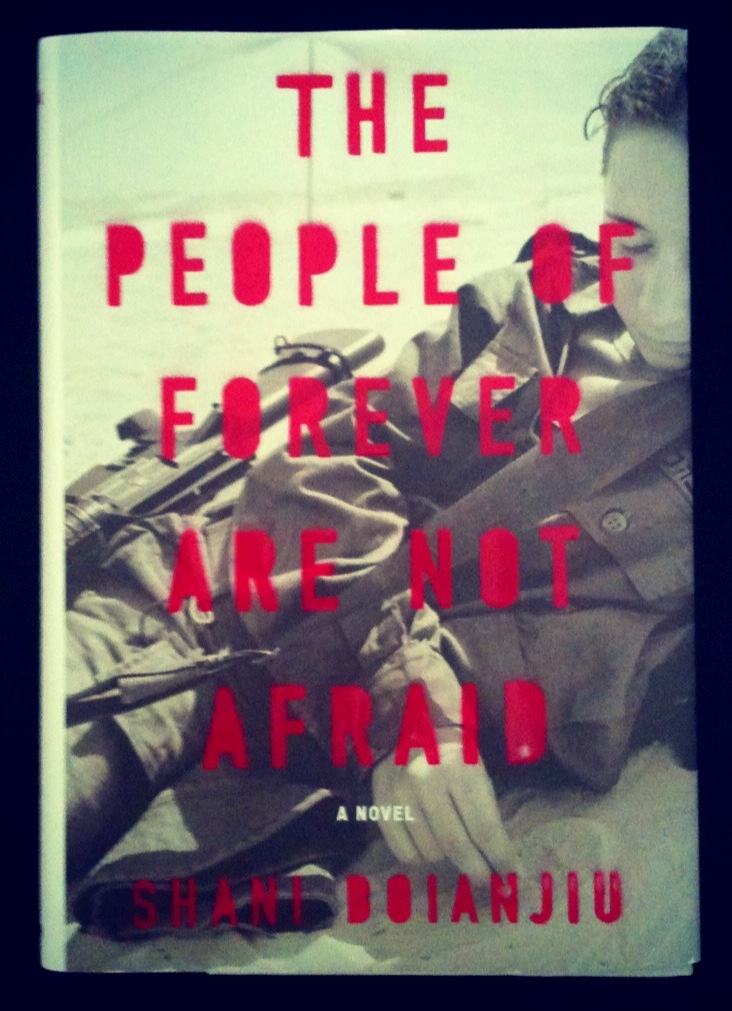
The People of Forever Are Not Afraid (Book Acquired, 8.25.2012)

20120902-141516.jpg

The People of Forever Are Not Afraid by Shani Boianjiu. New in hardback later this week from Random House. Their blurb:

Yael, Avishag, and Lea grow up together in a tiny, dusty Israeli village, attending a high school made up of caravan classrooms, passing notes to each other to alleviate the universal boredom of teenage life. When they are conscripted into the army, their lives change in unpredictable ways, influencing the women they become and the friendship that they struggle to sustain. Yael trains marksmen and flirts with boys. Avishag stands guard, watching refugees throw themselves at barbed-wire fences. Lea, posted at a checkpoint, imagines the stories behind the familiar faces that pass by her day after day. They gossip about boys and whisper of an ever more violent world just beyond view. They drill, constantly, for a moment that may never come. They live inside that single, intense second just before danger erupts.
In a relentlessly energetic and arresting voice marked by humor and fierce intelligence, Shani Boianjiu, winner of the National Book Foundation’s “5 Under 35,” creates an unforgettably intense world, capturing that unique time in a young woman’s life when a single moment can change everything.

Boianjiu is a young’an—she was born in ’87! Anyway, you can read an excerpt at Vice.

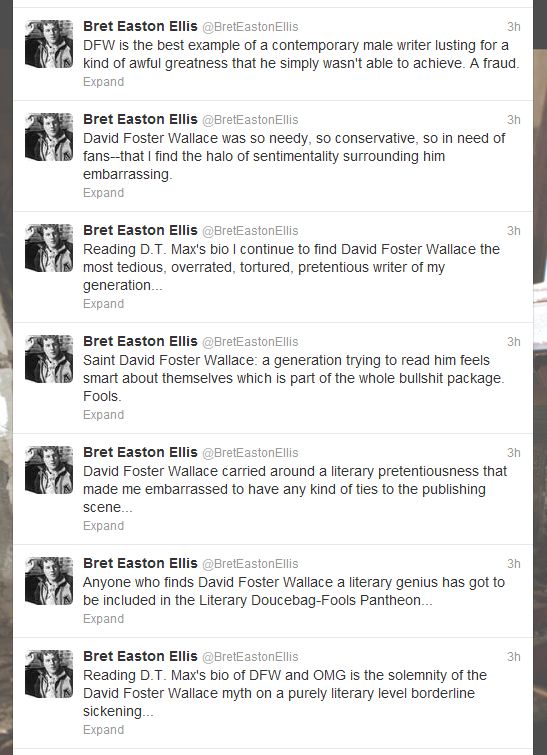
Bret Easton Ellis on David Foster Wallace: “The Most Tedious, Overrated, Tortured, Pretentious Writer of My Generation”

(A bit of background).

Don Quixote and Sancho Pansa Having a Rest under a Tree — Honore Daumier

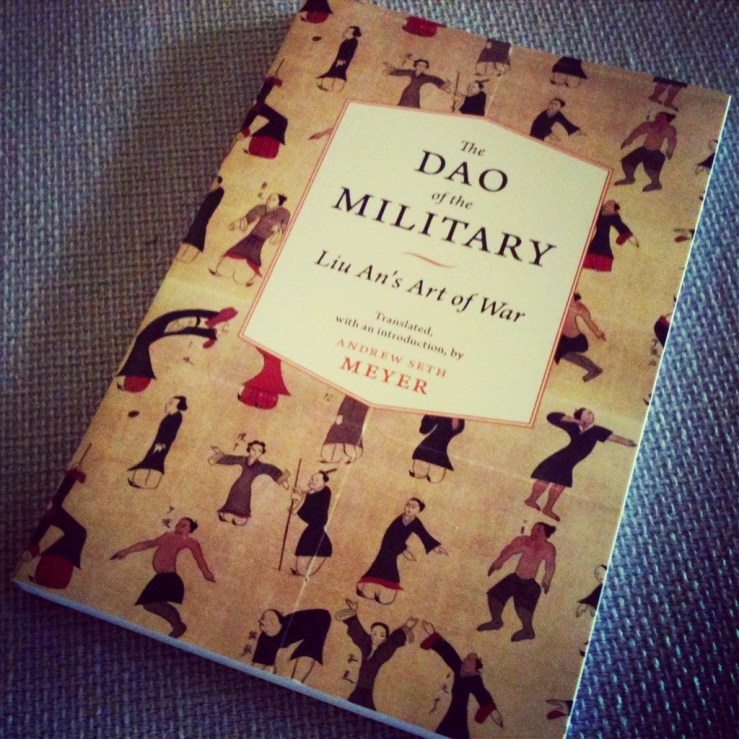
The Dao of the Military (Book Acquired, 8.27.2012)


20120902-141439.jpg

The Dao of the Military: Liu An’s Art of War is new in translation by Andrew Seth Meyer from Columbia University Press. Their blurbs:

The Dao of the Military makes a welcome addition to the growing literature on early Chinese strategy. The translation is exacting and felicitous. It should serve well for those interested in the history of Chinese thought and Chinese military thought.” — Victor H. Mair, University of Pennsylvania

The Dao of the Military summarizes and reflects on many aspects of the theory and practice of warfare developed in the Warring States period. It incorporates much of the theorizing of several traditions of military thought not well represented in the Seven Military Classics, and it is an important and valuable treatise that enriches our understanding of the history of Chinese military theory, the military tradition, Chinese intellectual history, and early China studies.” — Robin D. S. Yates, McGill University

The Dao of the Military is a valuable addition to the body of early China’s military texts available in English. Meyer’s learned introduction and admirably readable translation provide new and fascinating insights into the intellectual world and the military thinking of ancient Chinese philosophers. It is an essential read for everyone interested in how the Chinese tradition has understood warfare.” — Nicola Di Cosmo, Institute for Advanced Study, Princeton University


Franzen’s Desert Island Reading List Includes Russian Grammar Books; Fails to Include Flowers in the Attic or Uncanny X-Men

Don Quixote — Pablo Picasso

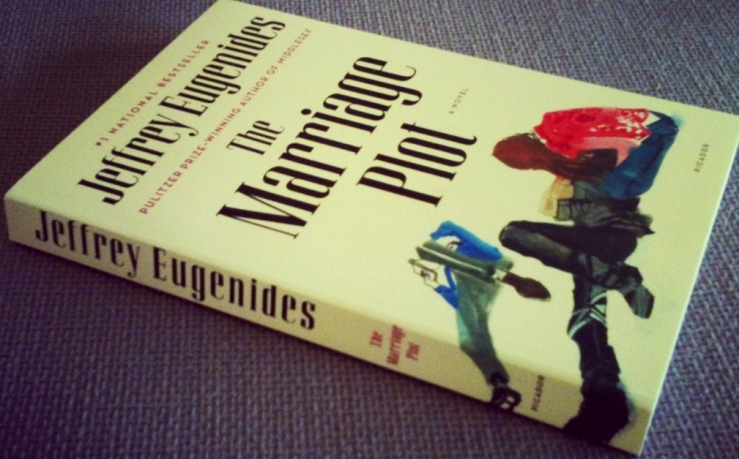
I Riff on Eugenides’s The Marriage Plot, Which I Haven’t Read (Book Acquired, 8.22.2012)


20120902-141345.jpg

1. Jeffrey Eugenides’s third novel The Marriage Plot is out in paperback from Picador this month. I haven’t read it.

2. I like the cover, a sort of watercolor job on thick textured paper.

3. I read Eugenides’s first novel The Virgin Suicides in 1997 or 1998. I was a freshman or sophomore in college. It was one of those books that everyone had on their shelves (I read my girlfriend’s roommate’s copy in maybe two sittings). I recall liking its style but the story had no emotional impact on me.

I was suspicious of the talent everyone ascribed to Eugenides.

4. I bought Eugenides’s second novel Middlesex in a train station in Rome. I bought it because I needed something to read. I read most of it on trains. This was the summer of 2005 or 2006, I think.

5. Middlesex is one of the first novels I can think of that I read and thought, “Here is a writer trying to fool me. Here is a writer trying to hide a fairly predictable plot under a mask of thematic importance. Here is a writer trying to hide mundane and often clunky prose beneath relevant issues. Here is an author trying to hide a lack of penetrating insight beneath the dazzle of historical sweep.”

6. Middlesex: The seams show. It’s literary-fiction-as-genre. And I have no problem with that. I wish it was weirder.

7. Here’s the back cover blurb for The Marriage Plot:

It’s the early 1980s. In American colleges, the wised-up kids are inhaling Derrida and listening to Talking Heads. But Madeleine Hanna, dutiful English major, is writing her senior thesis on Jane Austen and George Eliot, purveyors of the marriage plot that lies at the heart of the greatest English novels. As Madeleine studies the age-old motivations of the human heart, real life, in the form of two very different guys, intervenes—the charismatic and intense Leonard Bankhead, and her old friend the mystically inclined Mitchell Grammaticus. As all three of them face life in the real world they will have to reevaluate everything they have learned.

8. I sort of feel like I’ve already read the novel after reading this. Or maybe I feel like I could guess the trajectory of the novel.

9. Okay, so maybe I should read the first few pages . . .

10. I stopped on page 11, at this paragraph:

The cafe had just opened. The guy behind the counter, who was wearing Elvis Costello glasses, was rinsing out the espresso machine. At a table against the wall, a girl with stiff pink hair was smoking a clove cigarette and reading Invisible Cities. “Tainted Love” played from the stereo on top of the refrigerator.

Espresso! Cloves! Soft Cell! Calvino! Costello!

Okay. Maybe it’s Gloria Jones’s version of “Tainted Love.”

Anyway. There’s something insufferable about the paragraph.

I suppose I need to name or define the “something.”

11. Let me backtrack then, to the first paragraphs of the novel, to its first line even: “To start with, look at all the books.”

I like that as an opening line. I do. And I don’t mind an intertextual read. I’ll even accept this opening gambit as a form of characterization for our heroine Madeleine—this listing of authors—Wharton, Henry James, “a lot of Dickens, a smidgen of Trollope” (a smidgen!), “good helpings of Austen, George Eliot” etc. etc. We learn she reads Collette “on the sly” (who is stopping her?).

The references pile up: The surroundings of College Hill are compared to a “Charles Addams cartoon or a Lovecraft story”; those damn RISD kids are “blaring Patti Smith”; Madeleine has borrowed her roommate’s Betsey Johnson dress; you might recognize Madeleine by her “Katherine Hepburn-ish cheekbones and jawline”; etc.

For, fun, let me pick three pages at random:

On page 75, we find out that someone named Dinky is “a frosted blonde with late-de Kooning teeth.”

Page 187 is clean.

Page 87: Roland Barthes. Harpo Marx. Grolsch beer.

(I can’t help but skim over 86, a motherlode: Kafka, Borges, Musil, Vanity FairThe Sorrows of Young Werther, Derrida).

12. Erudition in a novel can be a fine thing, and works that explicitly reference and engage other works can be marvelous (Sebald’s The Rings of Saturn is an easy example to go to here). But references can also be used lazily as placeholders for real meaning, or even as a substitution for an entire milieu. (This is what I mean by the “something insufferable,” re: point 10).

13. There seems to be a trend in genre-bound “literary fiction” novels (again, I mean literary-fiction-as-genre) that lazily tie themselves to another, greater novel, without actually adding to the themes. I’m thinking explicitly of Franzen trying to borrow some of the weight of War and Peace in Freedom and Chad Harbach’s bid for Moby-Dick comparisons in The Art of Fielding. My intuition is that Eugenides is doing the same thing in The Marriage Plot.

14. Of course I’m probably (improbably enough) not the ideal audience for The Marriage Plot, not despite the fact but because of the fact that I happen to dig Talking Heads and Derrida and Barthes and literary theory &c. A romcom that involves a semiotics seminar as a setting is especially unappealing to me.

My wife, on the other hand, snapped up the copy of The Marriage Plot that the kind people at Picador sent me. I had to pull it from her night stand to write this riff. I’ll get her reaction down the line, which will certainly be more informed than my own.