1. Jeffrey Eugenides’s third novel The Marriage Plot is out in paperback from Picador this month. I haven’t read it.
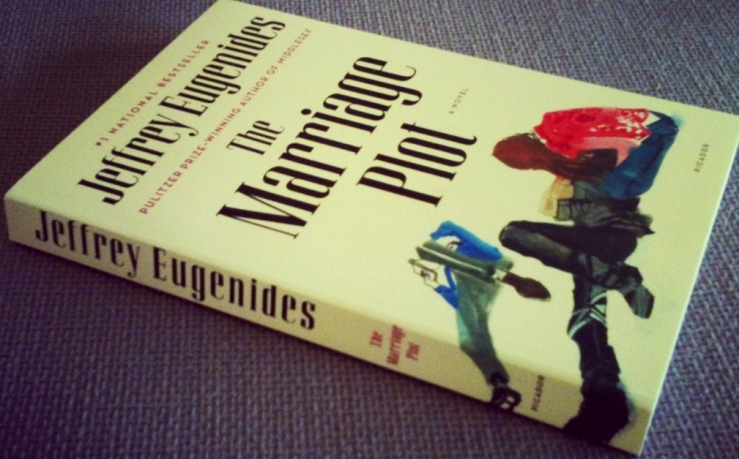
2. I like the cover, a sort of watercolor job on thick textured paper.
3. I read Eugenides’s first novel The Virgin Suicides in 1997 or 1998. I was a freshman or sophomore in college. It was one of those books that everyone had on their shelves (I read my girlfriend’s roommate’s copy in maybe two sittings). I recall liking its style but the story had no emotional impact on me.
I was suspicious of the talent everyone ascribed to Eugenides.
4. I bought Eugenides’s second novel Middlesex in a train station in Rome. I bought it because I needed something to read. I read most of it on trains. This was the summer of 2005 or 2006, I think.
5. Middlesex is one of the first novels I can think of that I read and thought, “Here is a writer trying to fool me. Here is a writer trying to hide a fairly predictable plot under a mask of thematic importance. Here is a writer trying to hide mundane and often clunky prose beneath relevant issues. Here is an author trying to hide a lack of penetrating insight beneath the dazzle of historical sweep.”
6. Middlesex: The seams show. It’s literary-fiction-as-genre. And I have no problem with that. I wish it was weirder.
7. Here’s the back cover blurb for The Marriage Plot:
It’s the early 1980s. In American colleges, the wised-up kids are inhaling Derrida and listening to Talking Heads. But Madeleine Hanna, dutiful English major, is writing her senior thesis on Jane Austen and George Eliot, purveyors of the marriage plot that lies at the heart of the greatest English novels. As Madeleine studies the age-old motivations of the human heart, real life, in the form of two very different guys, intervenes—the charismatic and intense Leonard Bankhead, and her old friend the mystically inclined Mitchell Grammaticus. As all three of them face life in the real world they will have to reevaluate everything they have learned.
8. I sort of feel like I’ve already read the novel after reading this. Or maybe I feel like I could guess the trajectory of the novel.
9. Okay, so maybe I should read the first few pages . . .
10. I stopped on page 11, at this paragraph:
The cafe had just opened. The guy behind the counter, who was wearing Elvis Costello glasses, was rinsing out the espresso machine. At a table against the wall, a girl with stiff pink hair was smoking a clove cigarette and reading Invisible Cities. “Tainted Love” played from the stereo on top of the refrigerator.
Espresso! Cloves! Soft Cell! Calvino! Costello!
Okay. Maybe it’s Gloria Jones’s version of “Tainted Love.”
Anyway. There’s something insufferable about the paragraph.
I suppose I need to name or define the “something.”
11. Let me backtrack then, to the first paragraphs of the novel, to its first line even: “To start with, look at all the books.”
I like that as an opening line. I do. And I don’t mind an intertextual read. I’ll even accept this opening gambit as a form of characterization for our heroine Madeleine—this listing of authors—Wharton, Henry James, “a lot of Dickens, a smidgen of Trollope” (a smidgen!), “good helpings of Austen, George Eliot” etc. etc. We learn she reads Collette “on the sly” (who is stopping her?).
The references pile up: The surroundings of College Hill are compared to a “Charles Addams cartoon or a Lovecraft story”; those damn RISD kids are “blaring Patti Smith”; Madeleine has borrowed her roommate’s Betsey Johnson dress; you might recognize Madeleine by her “Katherine Hepburn-ish cheekbones and jawline”; etc.
For, fun, let me pick three pages at random:
On page 75, we find out that someone named Dinky is “a frosted blonde with late-de Kooning teeth.”
Page 187 is clean.
Page 87: Roland Barthes. Harpo Marx. Grolsch beer.
(I can’t help but skim over 86, a motherlode: Kafka, Borges, Musil, Vanity Fair, The Sorrows of Young Werther, Derrida).
12. Erudition in a novel can be a fine thing, and works that explicitly reference and engage other works can be marvelous (Sebald’s The Rings of Saturn is an easy example to go to here). But references can also be used lazily as placeholders for real meaning, or even as a substitution for an entire milieu. (This is what I mean by the “something insufferable,” re: point 10).
13. There seems to be a trend in genre-bound “literary fiction” novels (again, I mean literary-fiction-as-genre) that lazily tie themselves to another, greater novel, without actually adding to the themes. I’m thinking explicitly of Franzen trying to borrow some of the weight of War and Peace in Freedom and Chad Harbach’s bid for Moby-Dick comparisons in The Art of Fielding. My intuition is that Eugenides is doing the same thing in The Marriage Plot.
14. Of course I’m probably (improbably enough) not the ideal audience for The Marriage Plot, not despite the fact but because of the fact that I happen to dig Talking Heads and Derrida and Barthes and literary theory &c. A romcom that involves a semiotics seminar as a setting is especially unappealing to me.
My wife, on the other hand, snapped up the copy of The Marriage Plot that the kind people at Picador sent me. I had to pull it from her night stand to write this riff. I’ll get her reaction down the line, which will certainly be more informed than my own.