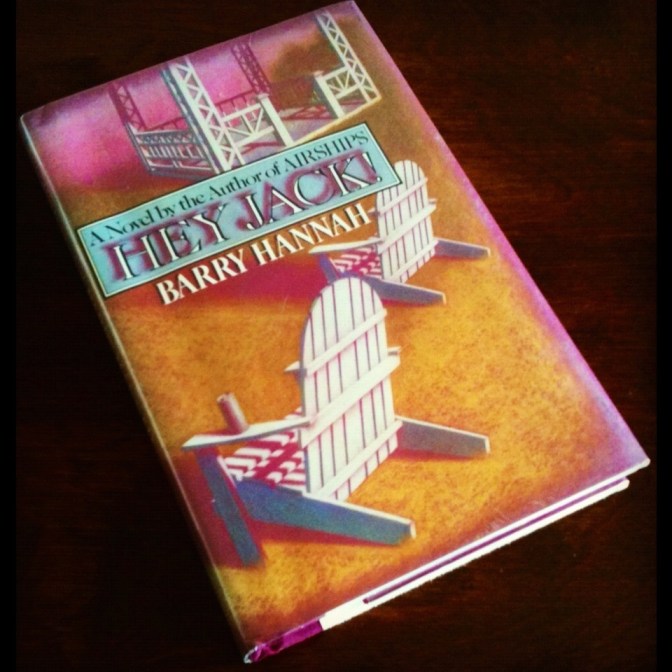
Barry Hannah’s Novella Hey Jack! Is a Loose, Hilarious Tragedy

20120410-174027.jpg

The loose, brief breeziness of Barry Hannah’s 1987 novella Hey Jack! belies the terror and rage at the heart of this hilarious tragedy. It’s a slim volume—133 pages in my hardback copy—with the same rambling flightiness that characterizes Hannah’s better known 1980 novel-in-vignettes, Ray.

Hey Jack! bears many comparisons with Ray: Like Ray, this novel is told from the perspective of a war vet (Korea this time, not ‘Nam); like the eponymous speaker of Ray, the narrator of Hey Jack!, Homer, finds himself frequently besotted, binged out, or horny; like Ray, Homer tries to make a marriage work; like Ray, Homer comes into conflict with a poor white trash family.

And like Ray, Hey Jack! tests the boundaries of what is and is not a “novel.” Hey Jack! is discontinuous and meandering; there’s a plot, sure, but Hannah’s apt to jump over place and time freely, tripping over months at a time, sparing not even a sentence to cue his readers in the right direction. No exposition here, folks. I suppose I should summarize the plot though: Homer, passing middle age, takes up a friendship with Jack, an older man, a former sheriff and fellow Korean War vet who runs a coffee shop popular with the college kids. Together, the pair (sort of) face off against Ronnie Foot, a local boy turned rock star who has the gall to begin an affair with Jack’s forty-year old daughter:

Ronnie Foot, the rock star had her. Or Jack thought he had her, he was sure he had her. Jack was mumbling. Jack was talking about ingratitude and pride and scum hanging on meat, things of that nature. It was astonishing to see him creep and rise suddenly, like a crazy old man. . . . “Nobody ever had a daughter like me. You want me to just her go, like a fart?” He was fingering the gun again.

Jack, once the lone bastion of sanity and order in Homer’s small, chaotic Mississippi town, begins to slide into the insanity and violence that marks the rest of the populace. Jack’s stability is the closest thing Hey Jack! offers as a slice of normalcy (to be clear though, Hannah’s characters skew grotesque, not quirky).

What unites the volume isn’t Jack’s slow slide to the dark side, but rather the narrative’s distinctive, ornery voice. It’s worth quoting Homer at length; here he condenses several of the novel’s themes in the sort of crazy-or-wise? rant indicative of the novella’s tone and rhythm:

In love, in love, in love. A mule can climb a tree if it’s in love. A man like me can look himself in the mirror and say, I’m all right, everything is beloved, I’m no stranger to anywhere any more. I’m a man full of life and a lot of time to kill, shoot every minute down with a straight blast of his eye across the bountiful landscape, from the minnow to the Alps. Something looks back at you with an eye of insane approval. Something looks back at you; out of belligerent ignorance of you it has come to a delighted focus on you and your love, together, sending up gasses of collision that make a rainbow over the poor masses who are changing a tire on the side of the road on a hot Saturday afternoon, felling like niggers. There is a law that every nigger spends a quarter of every weekend changing tires, my friend George, the biochemist, says. What do we know? What do we mere earthlings, unpublished and heaving out farts like puzzled sighs, know, but what is in our blood? I had broken up once with a woman who was in Europe, and coming out of the mall movie (I don’t even remember the movie) I gave out this private marvelous fart that was equal to a paragraph of Henry James, so churned were my guts and so lingering. And I was free. Free to discuss it. Delighted in the boundless ignorance and destruction that lay out there under the dumb lit cold moon. Enough about me and my poetry.

There’s so many shifts here. Hannah’s Homer comes off like a besotted barstool philosopher, gazing at his navel through an empty tumbler and finding both gut and abyss. We see the casual racism that so many of Hannah’s characters dip into; we see the conflation of art, spirit, and expulsion. Need I comment on the fart joke? It’s worth just repeating: “I gave out this private marvelous fart that was equal to a paragraph of Henry James” — if you don’t like that you’re not going to like Hey Jack!

Beyond that voice, there’s little to organize Hey Jack!—it’s a riff, sometimes a howl, often a jape, a joke, sometimes a verbal slap. This isn’t to say there isn’t a trajectory to the novella or a payoff at the end. Hannah seems unable to resist a tragic arc, the same one he pulls through the whiskey haze of  Ray. Perhaps he takes his cues from Edgar Allan Poe’s essay “The Philosophy of Composition“: ” . . . the death, then, of a beautiful woman is, unquestionably, the most poetical topic in the world.” (To be fair Poe is hardly the first fella to find a dead beauty such a worthy topic; also, I’ve never really been sure how to measure the tone of his essay—I can’t help but think he’s being somehow simultaneously tongue-in-cheek and deadly earnest. But enough about Poe).

But arcs be damned. The best bits of Hey Jack! are the stray little paragraphs that erupt from nowhere either to fizzle out or burn up in a bang. At its best, the novella offers bizarre little stories piecemeal that read equally absurd and true. To wit:

I began hollering at my wife for her shortcomings. She left the house, 11 P.M. I’d quit drinking and smoking. She brought me back a bottle of rye and a pack of Luckies, too. I hadn’t smoked for two weeks. I must have been a horrible nuisance.

I took a drink and a smoke.

Then I was normal. My lungs and my liver cried out: At last, again! The old abuse! I am a confessed major organ beater. I should turn myself in on the hotline to normalcy.

I hope by now that you have a sense of whether or not Hey Jack! is for you. It’s probably not going to gel with most readers: Too ugly, too loose, too nihilistic, perhaps; at heart a sloppy affair . . . but I loved it—it was the perfect book to riffle through over a few Saturday or Sunday afternoons on my back porch, its pages blotting up the condensation from a glass of sangria or can of beer, Homer’s consciousness as loose and discontinuous as my own. Not the best starting place for those interested in Hannah—that might be Airships—but great stuff.
Barry Hannah Fragment

From Barry Hannah’s novel Hey Jack!:

I began hollering at my wife for her shortcomings. She left the house, 11 P.M. I’d quit drinking and smoking. She brought me back a bottle of rye and a pack of Luckies, too. I hadn’t smoked for two weeks. I must have been a horrible nuisance.

I took a drink and a smoke.

Then I was normal. My lungs and my liver cried out: At last, again! The old abuse! I am a confessed major organ beater. I should turn myself in on the hotline to normalcy.

“How few of the tales we listen to can lay any claim to originality!”

How many brothers, sisters, uncles, aunts, and cousins of all degrees a little story has! And how few of the tales we listen to can lay any claim to originality! There is scarcely a story which I hear which I cannot connect with some family of myths, and whose pedigree I cannot ascertain with more or less precision.

Shakespeare drew the plots of his plays from Boccaccio or Straparola; but these Italians did not invent the tales they lent to the English dramatist. King Lear does not originate with Geofry of Monmouth, but comes from early Indian stores of fable, whence also are derived the Merchant of Venice and the pound of flesh, ay, and the very incident of the three caskets. But who would credit it, were it not proved by conclusive facts, that Johnny Sands is the inheritance of the whole Aryan family of nations, and that Peeping Tom of Coventry peeped in India and on the Tartar steppes ages before Lady Godiva was born?

If you listen to Traviata at the opera, you have set before you a tale which has lasted for centuries, and which was perhaps born in India. If you read in classic fable of Orpheus charming woods and meadows, beasts and birds, with his magic lyre, you remember to have seen the same fable related in the Kalewala of the Finnish Wainomainen, and in the Kaleopoeg of the Esthonian Kalewa. If you take up English history, and read of William the Conqueror slipping as he landed on British soil, and kissing the earth, saying he had come to greet and claim his own, you remember that the same story is told of Napoleon in Egypt, of King Olaf Harold’s son in Norway, and in classic history of Junius Brutus on his return from the oracle . . .

From Sabine Baring-Gould’s indispensable work Curious Myths of the Middle Ages (1866).

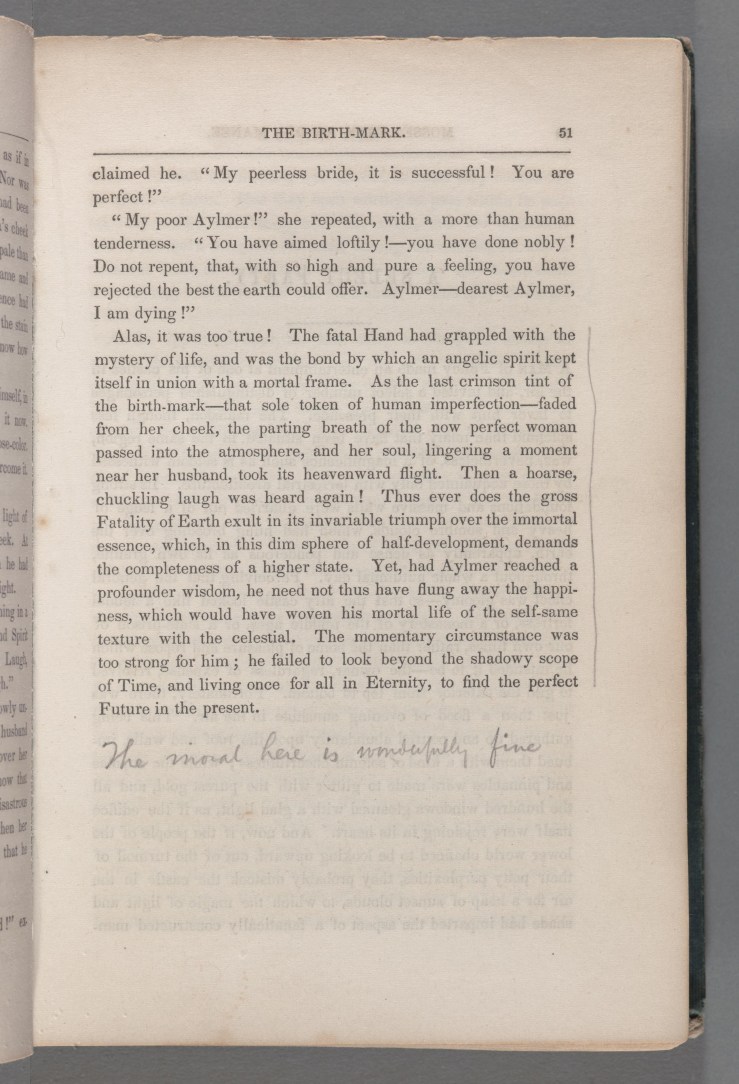
“The Moral Here Is Wonderfully Fine” — Melville Annotates Hawthorne

Herman Melville’s markings and annotations on the last page of Nathaniel Hawthorne’s short story “The Birth-mark.” From Melville’s Marginalia Online.

“A Good Book Needs Time” — Nietzsche

153. A Good Book Needs Time. —Every good book tastes bitter when it first comes out, for it has the defect of newness. Moreover, it suffers damage from its living author, if he is well known and much talked about. For all the world is accustomed to confuse the author with his work. Whatever of profundity, sweetness, and brilliance the work may contain must be developed as the years go by, under the care of growing, then old, and lastly traditional reverence. Many hours must pass, many a spider must have woven its web about the book. A book is made better by good readers and clearer by good opponents.

—Friedrich Nietzsche, Human, All Too Human, Part II.

I Burn Paris (Book Acquired, Some Time Last Week, Or Maybe Late the Week Before)

20120403-153842.jpg

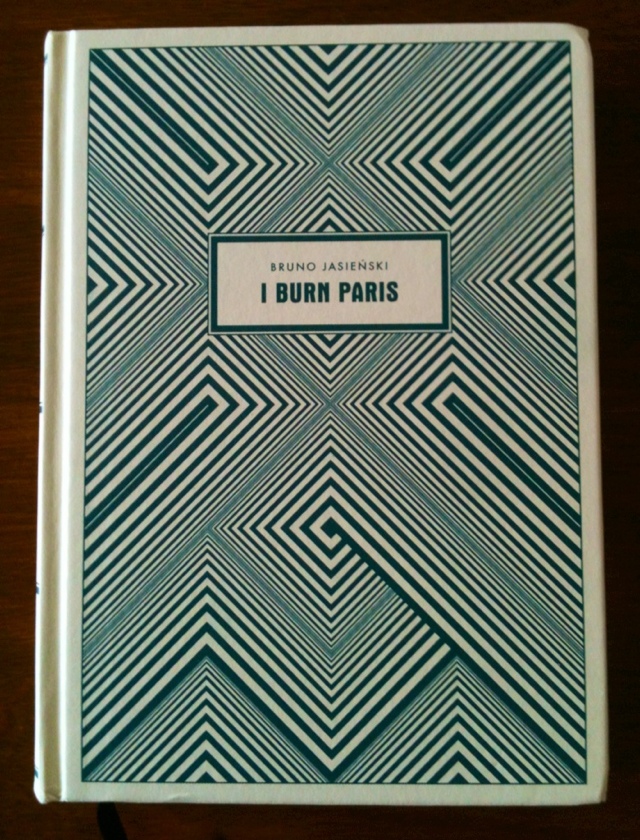
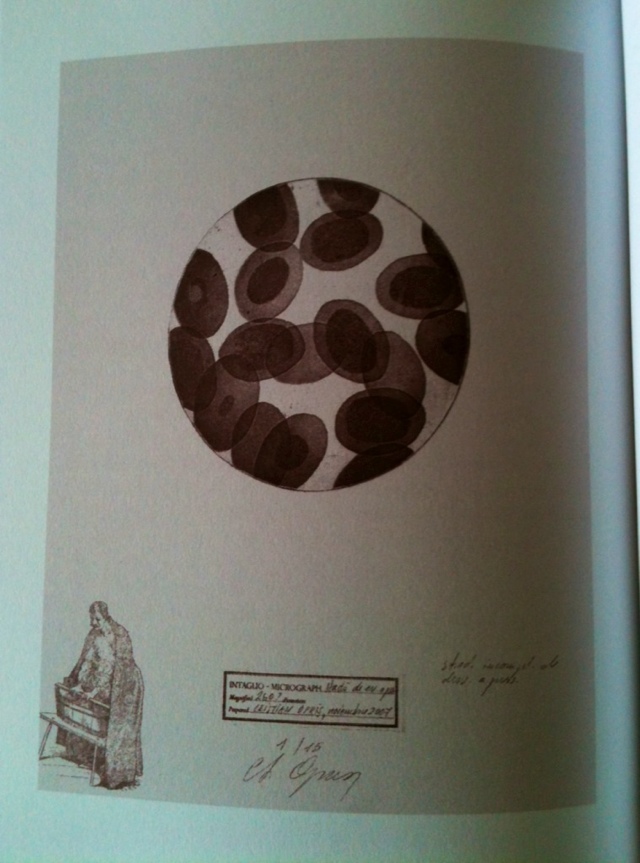
Bruno Jasieński was one of the leaders of the Polish Futurist movement, and his novel I Burn Paris looks fascinating. It’s also a beautiful looking book — publisher Twisted Spoon has done a lovely job here — an embossed hardback with no superfluous jacket, and even a nice lace bookmark (doesn’t show up in my photo). There are also illustrations by Cristian Opris.

20120403-153853.jpg

I’m hoping to get into this this weekend, but for now, here’s publisher Twisted Spoon’s description:

I Burn Paris has remained one of Poland’s most uncomfortable masterstrokes of literature since its initial and controversial serialization by Henri Barbusse in 1928 inL’Humanité (for which Jasienski was deported for disseminating subversive literature). It tells the story of a disgruntled factory worker who, finding himself on the streets, takes the opportunity to poison Paris’s water supply. With the deaths piling up, we encounter Chinese communists, rabbis, disillusioned scientists, embittered Russian émigrés, French communards and royalists, American millionaires and a host of others as the city sections off into ethnic enclaves and everyone plots their route of escape. At the heart of the cosmopolitan city is a deep-rooted xenophobia and hatred — the one thread that binds all these groups together. As Paris is brought to ruin, Jasienski issues a rallying cry to the downtrodden of the world, mixing strains of “The Internationale” with a broadcast of popular music.

With its montage strategies reminiscent of early avant-garde cinema and fist-to-the-gut metaphors, I Burn Parishas lost none of its vitality and vigor. Ruthlessly dissecting various utopian fantasies, Jasienski is out to disorient, and he has a seemingly limitless ability to transform the Parisian landscape into the product of disease-addled minds. An exquisite example of literary Futurism and Catastrophism, the novel presents a filthy, degenerated world where factories and machines have replaced the human and economic relationships have turned just about everyone into a prostitute. Yet rather than cliché and simplistic propaganda, there is an immediacy to the writing, and the modern metropolis is starkly depicted as only superficially cosmopolitan, as hostile and animalistic at its core.

This English translation of I Burn Paris fills a major gap in the availability of works from the interwar Polish avant-garde, an artistic phenomenon receiving growing attention with recent publications such as Caviar and Ashes.

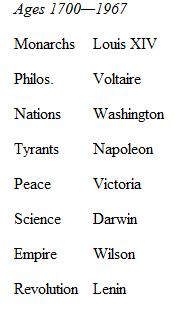
“Ages 1700-1967” — F. Scott Fitzgerald

From F. Scott Fitzgerald’s Notebooks.

Book Shelves #15, 4.08.2012

20120407-140053.jpg

1st Gent. How class your man? – as better than the most,

Or, seeming better, worse beneath that cloak?

As saint or knave, pilgrim or hypocrite?

2nd Gent. Nay, tell me how you class your wealth of books

The drifted relics of all time.

As well sort them at once by size and livery:

Vellum, tall copies, and the common calf

Will hardly cover more diversity

Than all your labels cunningly devised

To class your unread authors.

—George Eliot, Middlemarch, epigraph to Chapter 13

Book shelves series #15, fifteenth Sunday of 2012

A new book-case this week; the shorter triplet of the twin ladders seen here. What do the volumes on this top shelf hold in common? They are hardback. That’s about it. Yes, I actually go through The Riverside Shakespeare every now and then, especially when sparking new ideas for class lectures. The Balthus memoir is pretty good. No, I never finished Godel, Escher, Bach. It’s not hardback, come to think of it. The Fallada books are good stuff. Will Dylan ever finish up the Chronicles? Probably not. Maybe so. Who knows? We all love Shel Silverstein, of course.

Easter in Shakespeare

From Thomas Firminger Thiselton-Dyer’s indispensable volume Folk-lore in Shakespeare:

Easter. According to a popular superstition, it is considered unlucky to omit wearing new clothes on Easter Day, to which Shakespeare no doubt alludes in “Romeo and Juliet” (iii. 1), when he makes Mercutio ask Benvolio whether he did “not fall out with a tailor for wearing his new doublet before Easter.” In East Yorkshire, on Easter Eve, young folks go to the nearest market-town to buy some new article of dress or personal adornment to wear for the first time on Easter Day, as otherwise they believe that birds—notably rooks or “crakes”—will spoil their clothes. In “Poor Robin’s Almanac” we are told: “At Easter let your clothes be new, Or else be sure you will it rue.” Some think that the custom of “clacking” at Easter—which is not quite obsolete in some counties—is incidentally alluded to in “Measure for Measure” (iii. 2) by Lucio: “his use was, to put a ducat in her clack-dish.” [649] The clack or clap dish was a wooden dish with a movable cover, formerly carried by beggars, which they clacked and clattered to show that it was empty. In this they received the alms. Lepers and other paupers deemed infectious originally used it, that the sound might give warning not to approach too near, and alms be given without touching the person. A popular name for Easter Monday was Black Monday, so called, says Stow, because “in the 34th of Edward III. (1360), the 14th of April, and the morrow after Easter Day, King Edward, with his host, lay before the city of Paris; which day was full dark of mist and hail, and so bitter cold, that many men died on their horses’ backs with the cold. Wherefore unto this day it hath been call’d the Blacke Monday.” Thus, in the “Merchant of Venice” (ii. 5), Launcelot says, “it was not for nothing that my nose fell a-bleeding on Black Monday last at six o’clock i’ the morning.”

“I shall tell you a story about four little rabbits whose names were Flopsy, Mopsy, Cottontail and Peter” — Beatrix Potter Letter

‘Eastwood, Dunfield. Sept 4th ’93
My dear Noel, I don’t know what to write to you, so I shall tell you a story about four little rabbits whose names were – Flopsy, Mopsy, Cottontail and Peter. They lived with their mother in a sand bank under the root of a big fir tree.’

(Via/more).

“Holy Thursday” — William Blake

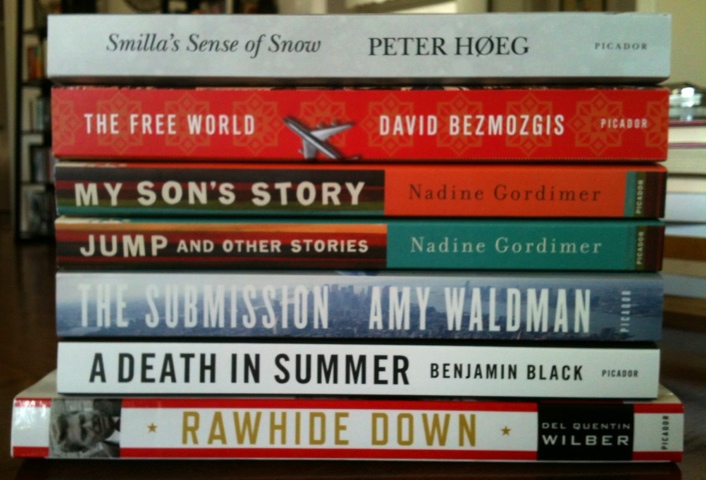
Books Acquired, 3.19.2012 — Or, Here’s What’s New From Picador

20120403-153037.jpg

New and newish titles from the good people at Picador. A few highlights:

20120403-153044.jpg

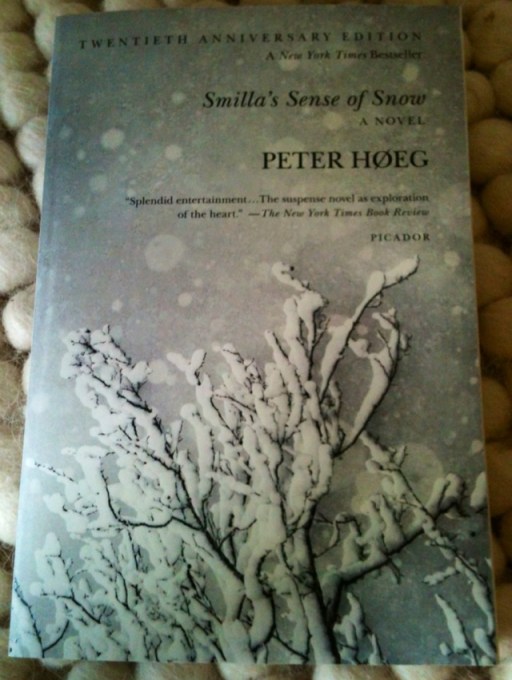
I read Peter Hoeg’s bestseller Smilla’s Sense of Snow over a decade ago; I recall reading it in a day or two, maybe as part of a long bus ride somewhere, and enjoying caustic Smilla’s murder investigation. It’s 20 years old now and getting the rerelease treatment. From Robert Nathan’s original 1993 review at The New York Times:

TRY this for an offer you could easily refuse. How would you like to be locked in a room for a couple of days with an irritable, depressed malcontent who also happens to be imperiously smart, bored and more than a little spoiled? Say no, and you will miss not only a splendid entertainment but also an odd and seductive meditation on the human condition. With “Smilla’s Sense of Snow,” his American debut following two previous books, the Danish novelist Peter Hoeg finds his own uncommon vein in narrative territory worked by writers as varied as Martin Cruz Smith and Graham Greene — the suspense novel as exploration of the heart. Mr. Hoeg’s heroine, Smilla Jaspersen, is the daughter of an Eskimo mother who was a nomadic native of Greenland and a wealthy Danish anesthesiologist father, parentage that endows her with the resilience of the frozen north and urban civilization’s existential malaise. One day just before Christmas, Smilla arrives at her Copenhagen apartment building to find a neighbor boy, 6-year-old Isaiah Christiansen, sprawled face down in the snow, dead after a fall from the roof of a nearby warehouse.

20120403-153052.jpg

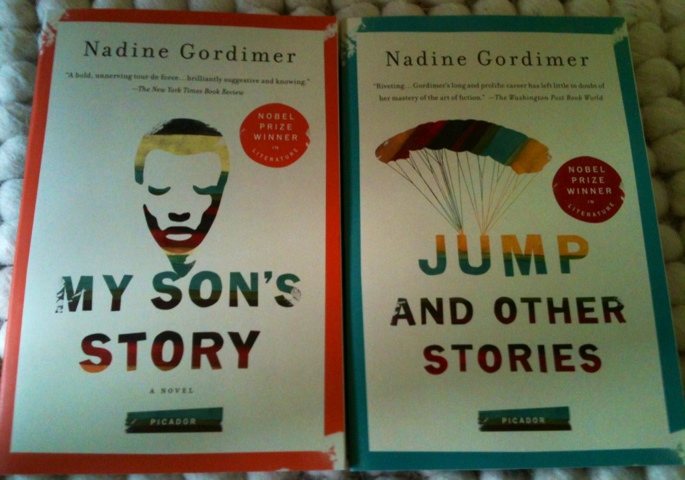
Love love love the covers for these pair by Nadine Gordimer—nice design work. I haven’t read Gordimer’s stuff — she’s a South African writer who won the Nobel in 1991 — so Jump and Other Stories seems like a good starting place. Here’s James Wood on Gordimer:

Gordimer’s talent is poetic and intellectual…Her best writing, sensuous, but aerated with deep intelligence, moving shrewdly between the serene claims of the poetic and the frantic compulsions of the political, makes her the lyrical analyst of an entire country

20120403-153103.jpg

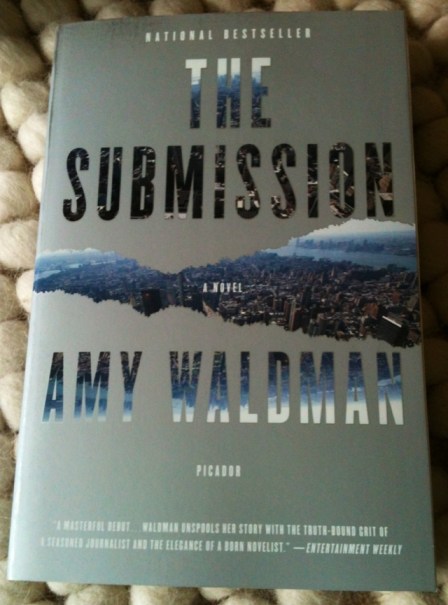
Amy Waldman’s The Submission is a 9/11 novel. Here’s Michiko Kakutani gushing in The New York Times:

A decade after 9/11, Amy Waldman’s nervy and absorbing new novel, “The Submission,” tackles the aftermath of such a terrorist attack head-on. The result reads as if the author had embraced Tom Wolfe’s famous call for a new social realism — for fiction writers to use their reporting skills to depict “this wild, bizarre, unpredictable, Hog-stomping baroque country of ours” — and in doing so, has come up with a story that has more verisimilitude, more political resonance and way more heart than Mr. Wolfe’s own 1987 best seller, “The Bonfire of the Vanities.”

20120403-153120.jpg

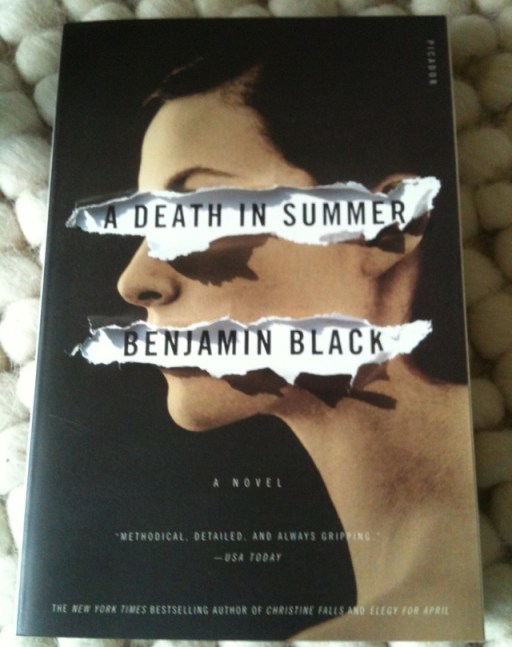
A Death in the Summer is new in trade paperback. It’s another in the Quirke crime series from Benjamin Black — pen name of writer John Banville. Jacket copy:

On a sweltering summer afternoon, newspaper tycoon Richard Jewell—known to his many enemies as Diamond Dick—is discovered with his head blown off by a shotgun blast. But is it suicide or murder? For help with the investigation, Detective Inspector Hackett calls in his old friend Quirke, who has unusual access to Dublin’s elite.

Jewell’s coolly elegant French wife, Françoise, seems less than shocked by her husband’s death. But Dannie, Jewell’s high-strung sister, is devastated, and Quirke is surprised to learn that in her grief she has turned to an unexpected friend: David Sinclair, Quirke’s ambitious assistant in the pathology lab at the Hospital of the Holy Family. Further, Sinclair has been seeing Quirke’s fractious daughter Phoebe, and an unlikely romance is blossoming between the two. As a record heat wave envelops the city and the secret deals underpinning Diamond Dick’s empire begin to be revealed, Quirke and Hackett find themselves caught up in a dark web of intrigue and violence that threatens to end in disaster.

Tightly plotted and gorgeously written, A Death in Summer proves to the brilliant but sometimes reckless Quirke that in a city where old money and the right bloodlines rule, he is by no means safe from mortal danger.

20120403-153135.jpg

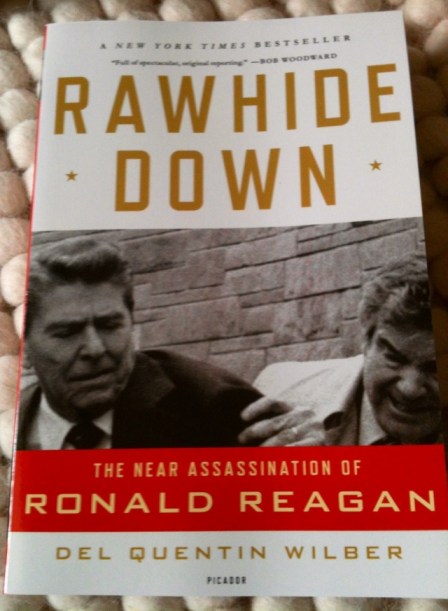
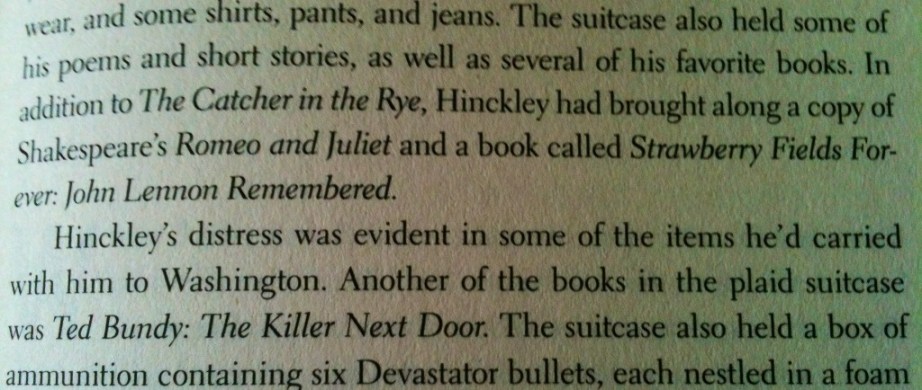
Del Quentin Wilber’s Rawhide Down: The Near Assassination of Ronald Reagan demanded more of my attention than I thought it would. It’s tightly paced book, telegraphed in sharp language—but most of all, the story of John Hinckley is just too bizarre. Here’s a sample of the would

20120403-153153.jpg

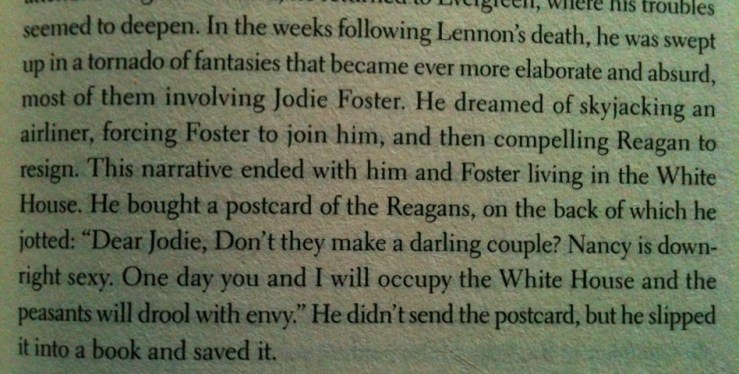
And if that’s not weird enough for you, check out Hinckley’s fantasy life:

20120403-153208.jpg

Trapper’s Wedding — Walt Whitman

I saw the marriage of the trapper in the open air in the far west,
the bride was a red girl,
Her father and his friends sat near cross-legged and dumbly smoking,
they had moccasins to their feet and large thick blankets
hanging from their shoulders,
On a bank lounged the trapper, he was drest mostly in skins, his luxuriant
beard and curls protected his neck, he held his bride by the hand,
She had long eyelashes, her head was bare, her coarse straight locks
descended upon her voluptuous limbs and reach’d to her feet.

—Walt Whitman, Song of Myself, section 10.

21 Citations on Pablo Picasso — David Markson

Pablo Picasso, Les Demoiselles d'Avignon, oil on canvas, 1907 (MoMA)

Painting is not done to decorate apartments –PICASSO

People speak of naturalism in opposition to modern painting.
Where and when has anyone ever seen a natural work of art?
Asked Picasso.

Depressed at the apparent lack of interest in one of his early still lifes, Matisse visited his dealer to retrieve it, only to learn that it had been purchased after all.
By Picasso.

The interrelationship of Picasso and Braque during Cubism:
Like being roped together on a mountain, Braque said.

The oddity that Velazquez and Picasso, surely two of the three greatest Spanish-born painters, each used his mother’s name rather than his father’s.

Among the many paintings in her Paris flat, Gertrude Stein had two exceptional Picassos.
If there were a fire, and I could save only one picture, it would be those two. Unquote.

The Bateau-Lavoir, the legendary former Montmartre piano factory broken up into artists’ studios, where Picasso contrived any number of his early masterpieces — while living with no running water and only one communal toilet.

The so-called anarchist artist who in 1988 smeared a large X in his own blood on a wall in the Museum of Modern Art — and in the process splattered an adjacent Picasso.

Picasso. Cézanne. Matisse. Braque. Bonnard. Renoir.
All of whom painted portraits of Ambroise Vollard.

Cartier-Bresson. Brassaï. Man Ray. Lee Miller. Robert Doisneau. Robert Capa. David Douglas Duncan. Cecil Beaton.
All of whom photographed Picasso.

Picasso’s play, Desire Caught by the Tail — which could be performed for the first time only privately, because of the Nazi occupation of Paris.
But avec Camus, Sartre, Michel Leiris, Raymond Queneau, Dora Maar, Pierre Reverdy, Simone de Beauvoir.

There is no such thing as abstract art, said Picasso.
You always have to start somewhere or other.

Gertrude Stein once delighted Picasso by reporting that a collector had been dumbfounded, years afterward, to hear that Picasso had given her her portrait as a gift, rather than asking payment.
Not understanding that that early in Picasso’s career, the difference had been next to negligible.

You never paint the Parthenon; you never paint a Louis XV armchair. You make pictures out of some little house in the Midi, a packet of tobacco, or an old chair.
Said Picasso.

Future generations will regard Bob Dylan with the awe reserved for Blake, Whitman, Picasso and the like.
Said an otherwise seemingly rational writer named Jonathan Lethem.

Picasso, avec laughter, after being asked if he had used models for Les Demoiselles d’Avignon:
Where would I have found them?

Picasso’s admiration for Charlie Chaplin.
Diego Rivera’s.
Stalin’s.

Kees van Dongen’s admission that there were occasions during his own early Montmartre years when he was forced to filch milk and/or bread from neighborhood doorsteps — with an accomplice named Picasso.

Picasso, in Paris during the Nazi occupation and learning that someone had accused him of having Jewish blood:
I wish I had.

A rejection of all that civilization has done.
Said the London Times of a first Post-Impressionist exhibition, in 1910 — which included Cézanne, van Gogh, Gauguin, Matisse, Picasso, others.

My old paintings no longer interest me. I’m much more curious about those I haven’t done yet.
Said Picasso, at seventy-nine.

From David Markson’s The Last Novel

Birdseed Anecdote — F. Scott Fitzgerald

Once there was a whole lot of bird seed around the room because an author had adopted a chicken. It was impossible to explain to anyone just why he had adopted the chicken but still more impossible to know why he had bought the bird seed for the chicken. The chicken was later broiled and the bird seed thrown out, but the question of whether the man was an author or a lunatic was still unsolved in the minds of the hotel servants who had to deal with the situation. The hotel servants didn’t understand it. They didn’t understand how months later the author could write a story about it but they all bought the magazine.

—F. Scott Fitzgerald, The Notebooks

“My Precious!”

Topless Hemingway Slideshow

This slideshow requires JavaScript.