The Hobbit Film Trailer

Jonathan Franzen Talks About Dysfunctional Families

The Myth of The Vollmann

  • Europe Central: 832 pages
  • Imperial: 1344 pages
  • The Royal Family: 800 pages
  • Rising Up and Rising Down: 3352 pages

I still hesitate to believe that William T. Vollmann actually exists. Has anyone ever read one of his super-long books? Can we prove that somewhere around page 700 of Imperial that the text doesn’t just become

ALLWORKANDNOPLAYMAKEWILLIAMLOVEPROSTITUESALLWORKANDNOPLAYMAKEWILLIAMLOVEPROSTITUES ALLWORKANDNOPLAYMAKEWILLIAMLOVEPROSTITUESALLWORKANDNOPLAYMAKEWILLIAMLOVEPROSTITUES ALLWORKANDNOPLAYMAKEWILLIAMLOVEPROSTITUESALLWORKANDNOPLAYMAKEWILLIAMLOVEPROSTITUES ALLWORKANDNOPLAYMAKEWILLIAMLOVEPROSTITUESALLWORKANDNOPLAYMAKEWILLIAMLOVEPROSTITUES ALLWORKANDNOPLAYMAKEWILLIAMLOVEPROSTITUESALLWORKANDNOPLAYMAKEWILLIAMLOVEPROSTITUES ALLWORKANDNOPLAYMAKEWILLIAMLOVEPROSTITUESALLWORKANDNOPLAYMAKEWILLIAMLOVEPROSTITUES ALLWORKANDNOPLAYMAKEWILLIAMLOVEPROSTITUESALLWORKANDNOPLAYMAKEWILLIAMLOVEPROSTITUES ALLWORKANDNOPLAYMAKEWILLIAMLOVEPROSTITUESALLWORKANDNOPLAYMAKEWILLIAMLOVEPROSTITUES ALLWORKANDNOPLAYMAKEWILLIAMLOVEPROSTITUESALLWORKANDNOPLAYMAKEWILLIAMLOVEPROSTITUES ALLWORKANDNOPLAYMAKEWILLIAMLOVEPROSTITUESALLWORKANDNOPLAYMAKEWILLIAMLOVEPROSTITUES

for the next 600 pages? How can we prove this if no one has actually read it? Can we prove that somewhere someone actually read Imperial (and I mean all of it)? What about that seven-volume first edition of Rising Up and Rising Down? Sure we all know about it, but has anyone actually SEEN the thing? I don’t even mean OWN it, certainly not that, none of you OWN the first edition of RURD. Oh heavens no, but have any of you seen it in person, to verify for me its actual existence?

It’s sort of like those kids who had pet monkeys when you were in elementary school, always someone’s cousin, or their neighbor’s friend from another school; sometimes the story was accompanied by a thumbprint-smudged Polaroid of the creature, clutching lovingly to some human torso. But did you ever actually see it? No never. Not once. And anyone who says they did is part of the conspiracy. Sure, maybe somewhere in Mexico someone has a monkey for a pet, but not here, no way, and certainly not your cousin. And look, I agree that it’s a weird thing to lie about, but that’s part of what makes good liars good, it’s some sort of weird emotional long-con that you are complicit in by listening to them.

Why would someone lie about writing a 3000 page book about violence? I have no idea. And why the hell would the same guy write 800 pages about Shostakovich and the Russians during World War Two? You got me. It’s a brilliant scheme in a way. If Vollmann is lying about something, then he has avoided attention by writing books so long and esoteric that NO ONE can prove or disprove their legitimacy.

Of course, whatever game he’s playing at, it isn’t money.

I contacted Mr. Bob Amazon (the guy who started Amazon.com) and he confirmed my suspicion that literally no human has ever purchased a copy of either Imperial or The Royal Family. When asked if physical copies of these books were actually housed in an Amazon facility somewhere, just in case someone ever actually did buy one he hung up on me.

So, I’m thinking this thing goes deep, deeper than any of us ever imagined. Obviously Dave Eggers is involved somehow, either as the mastermind behind the whole thing, or just another pawn like the rest of us. I emailed Mr. Heartbreaking Jerk himself, asking if even he of all people can claim to have actually read all of Rising Up and Rising Down, and in return I received an auto-reply, something about the volume of emails he receives blah blah blah—the point is I think I scared him, and now I know I’m on the right trail . . .

The funny thing with all of this is that I’m pretty sure there is no hoax going on. I have no reason to think William T. Vollmann is anything but a real guy, a weirdo dude who writes epically long books that no one reads. But if you read about his life at all it sounds more made up than any of the recently famous literary hoaxes. Maybe only that old asshole with his holocaust apples can really claim to have a bigger imagination, because neither James Frey nor JT Leroy can hold a candle to this (straight from Wikipedia):

In his youth, Vollmann’s younger sister drowned while under his supervision, a tragedy for which he felt responsible. This experience, according to him, influences much of his work.

What? Really? So he’s literature’s own Batman, The Dark Knight . . . or, wait for it: Vollman!

And I’m not even going to get into all the crack smoking with prostitutes and moving to Afghanistan in the 1980s. But I will talk briefly about his “hobby” of aimlessly train-hopping, which he apparently chronicled in Riding Toward Everywhere (a book whose existence I can confirm, as I bought it as a gift for a friend). Honestly though, that’s his hobby?

“So Mr. Vollmann, when you’re not hanging out with prostitutes in Cambodia, smoking crack, dodging bullets in Bosnia, spending 20 years writing a 3000 page book about violence, running around in the desert with a rebel army, or any of your other notable pursuits . . . what do you do for fun? How does William T. Vollmann relax?”

“Oh you know, I hop trains and just go where they take me.”

What? How do we know that Vollmann’s entire “career” isn’t the longest viral marketing campaign ever for a Wes Anderson movie that’s coming out ten years from now?

I’m not really heading towards anything conclusive or coherent here. I have no big point and the answer to all of my questions is that I should just devote the next few years of my life to actually reading these books instead of doubting their existence. But that would take 1) time and 2) money. Maybe I should turn it into some kind of art project and get funding on Kickstarter or something. Or maybe I could get review copies somehow.

Actually I just looked on Amazon and I see that Imperial is no longer the $40 book it once was. A new copy in paperback will run just $3.23 and with that free prime shipping I could be reading this thing by Friday.

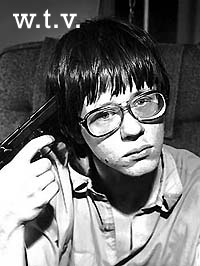
So I just did it,  it is on its way, but we all know I’m not going to actually read it, right? It’s gonna go on the shelf next to Europe Central and the abridged copy of RURD and it will damn well stay there until, I don’t know, I become the omega man or something and I literally have nothing else to do and no one to talk to and no pointless articles to write and nothing to do with my boredom besides consume 1300 pages about border-crossing by a guy who looks like a serial killer.

“The Magi,” A Stark Christmas Poem by William Butler Yeats

“The Magi” by William Butler Yeats. A Christmas poem that’s not about Christmas, I guess. I love the final image:

Now as at all times I can see in the mind’s eye,
In their stiff, painted clothes, the pale unsatisfied ones
Appear and disappear in the blue depth of the sky
With all their ancient faces like rain-beaten stones,
And all their helms of silver hovering side by side,
And all their eyes still fixed, hoping to find once more,
Being by Calvary’s turbulence unsatisfied,
The uncontrollable mystery on the bestial floor.

(An Incomplete) List of Writers Who Died in 2011

Vaclav Havel

Christopher Hitchens

Russell Hoban

Ken Russell

Joe Simon

Stetson Kennedy

Sidney Lumet

George Whitman

Lilian Jackson Braun

Edwin Honig

Michael S. Hart

Gil Scott-Heron

Bill Keane

Jerry Leiber

Diana Wynne Jones

Bert Jansch

Leonora Carrington

Brian Jacques

Barbara Grier

Edouard Glissant

Dwayne McDuffie

Hisaye Yamamoto

Phoebe Snow

Anne McCaffrey

Leonard B. Stern

Vincent Cronin

Tony Geiss

MK Binodini

Kenneth Grant

Joe Gores

Maria Elena Walsh

Del Reisman

Christopher Trumbo

Loreen Rice Lucas

Diana Norman

Reynolds Price

John Ross

David Hart

B.H. Friedman

Dick King-Smith

Susana Chavez

Park Wun-suh

Wilfrid Sheed

Jean Dutord

Sun Axelsson

Ruth Cavin

Max Wilk

Hans Joachim Alpers

Donald S. Sanford

Peter J. Gomes

Ion Hobana

Rudi Bass

Anson Rainey

Perry Moore

Sean Boru

Bo Carpelan

Elaine Crowley

Martin Quigley Jr.

Charles E. Silberman

Andree Chedid

Iakovos Kambanelis

Sara Ruddick

Doris Burn

Steven Kroll

May Cutler

Thor Vilhjálmsson

H.R.F. Keating

Joe Bageant

Jean Liedloff

Bill Blackbeard

Alberto Granado

Hazel Rowley

Al Morgan

Raymond Garlick

John Haines

Ernesto Sabato

Abdul Hameed

Rafael Menjívar Ochoa

John Sullivan

Sidney Michaels

Madelyn Pugh

Sol Saks

Arthur Marx

Bill Brill

L.J. Davis

Ulli Beier

Kevin Jarre

Joanna Russ

David Wilkerson

Beverly Barton

Craig Thomas

Ira Cohen

W.J. Gruffydd

Anne Blonstein

Paul Violi

Johanna Fiedler

Dick Wimmer

Oniroku Dan

Hans Keilson

Martin Woodhouse

Newton Thornburg

Patrick Galvin

Wallace Clark

Carlos Trillo

Kate Swift

Arthur Laurents

Frans Sammut

William Kloefkorn

Thierry Martens

E.M. Broner

Tom Hungerford

Kathryn Tucker Windham

Harry Bernstein

Joel Rosenberg

Simon Heere Heeresma

David Rayfiel

Oscar Sambrano Urdaneta

Robert Kroetsch

Josephine Hart

Gloria Sawai

Anne LaBastille

Blaize Clement

Sissel Solbjørg Bjugn

Francis King

Agota Kristof

Henry Carlisle

Iain Blair

Hideo Tanaka

Michael Legat

Ruth Thomas

Colin Harvey

David Holbrook

Simona Monyová

William Sleator

Samuel Menashe

Selwyn Griffith

Sara Douglass

Ida Fink

Sergio Bonelli

Arthur Evans

Hella Haasse

David Croft

David Zelag Goodman

Emanuel Litvinoff

José Miguel Varas

Jo Carson

Cengiz Dağcı

Frank Parkin

Hugh Fox

Herbert Lomas

Florence Parry Heide

Stanley Mitchell

Uno Röndahl

Mildred Savage

Mick Anglo (LINK)

Alvin Schwartz

Sri Lal Sukla

Piri Thomas

Gerald Shapiro

Vittorio Curtoni

Morio Kita

Andrea Zonzotto

Taha Muhammad Ali

Georg Kreisler

Daniel Sada

H.G. Francis

Helen Forrester

Čestmír Vejdělek

Hal Kanter

Les Daniels

Leonid Borodin

Franz Josef Degenhardt

Morris Philipson

Ana Daniel

Ruth Stone

Peter Reading

Ruslan Akhtakhanov

Ivan Martin Jirous

Tomás Segovia

Kabir Chowdhury

Hans Heinz Holz

Ke Yan

Mario Miranda

Jean Baucus

Gilbert Adair

Jerry Robinson

Ambika Charan Choudhury

Matti Yrjänä Joensuu

Louky Bersianik

Christopher Logue

Christa Wolf

Elisabeth Young-Bruehl

“Here You See Some of the Clutter but You Can’t See the Danger” — Russell Hoban’s Writing Room

(From The Guardian’s Writer’s Rooms series)

RIP Russell Hoban

Russell Hoban, author of Riddley Walker and other cult classics, died last night at the age of 86. The first “review” I ever wrote on this site was for Riddley Walker (the review is so bad that I won’t link to it out of shame); that was back when Biblioklept’s primary mission was to document stolen books. I stole the book from a dear friend and subsequently lent it to a student who never returned it. Oh, the circle of theft! Riddley Walker is the sort of book that begs to be stolen (or never returned, or passed on to another). It’s an apocalyptic Huckleberry Finn, a coming of age story set against the backdrop of a new dark age. Riddley Walker is deeply weird and strongly strange; I don’t know what a “cult” novel is, but I know of no better example.

Riddley Walker might be Hoban’s most famous work (aside from his children’s works, including the Frances the Badger series), but readers who stopped there would do well to pick up some of his earlier books. The Lion of Boaz-Jachin and Jachin-Boaz is a fantasy piece about fathers, sons, and map-making; Kleinzheit, a baffling schizophrenic novel, explores death and illness in an animistic world; Pilgermann plumbs the medieval intersection of Judaism, Christianity, and Islam, narrated through the eyes of the ghost of a castrated European Jew on a bizarre holy quest—it’s like Hieronymous Bosch on LSD.

The Guardian has a short but lucid biographical obit for Hoban, which ends with Hoban contemplating how death might affect his career:

Death, Hoban predicted in 2002, would “be a good career move”. “People will say, ‘yes, Hoban, he seems an interesting writer, let’s look at him again’,” he said.

The grim humor there was always part of Hoban’s program, and I hope that he’s right: I hope that folks who haven’t heard of Hoban will pick up Riddley Walker, and perhaps those who haven’t read beyond that book will make time to read another.

Read Nathaniel Hawthorne’s Short Story “The Christmas Banquet”

“The Christmas Banquet,” a tale from Nathaniel Hawthorne (from Mosses from an Old Manse; it might be, like, an allegory or something):

“I HAVE HERE attempted,” said Roderick, unfolding a few sheets of manuscript, as he sat with Rosina and the sculptor in the summer-house–“I have attempted to seize hold of a personage who glides past me, occasionally, in my walk through life. My former sad experience, as you know, has gifted me with some degree of insight into the gloomy mysteries of the human heart, through which I have wandered like one astray in a dark cavern, with his torch fast flickering to extinction. But this man–this class of men–is a hopeless puzzle.”

“Well, but propound him,” said the sculptor. “Let us have an idea of him, to begin with.”

“Why, indeed,” replied Roderick, “he is such a being as I could conceive you to carve out of marble, and some yet unrealized perfection of human science to endow with an exquisite mockery of intellect; but still there lacks the last inestimable touch of a divine Creator. He looks like a man, and, perchance, like a better specimen of man than you ordinarily meet. You might esteem him wise–he is capable of cultivation and refinement, and has at least an external conscience–but the demands that spirit makes upon spirit, are precisely those to which he cannot respond. When, at last, you come close to him, you find him chill and unsubstantial–a mere vapor.”

Continue reading “Read Nathaniel Hawthorne’s Short Story “The Christmas Banquet””

“Letter from Santa Claus” — Mark Twain

Hey, didn’t we just accuse Mark Twain of dissing Santa? Dude had a heart, of course. Here’s a letter he ghost wrote for St. Nick to his beloved daughter Susie:

Palace of St. Nicholas
In the Moon
Christmas Morning

MY DEAR SUSIE CLEMENS:

I have received and read all the letters which you and your little sister have written me by the hand of your mother and your nurses; I have also read those which you little people have written me with your own hands–for although you did not use any characters that are in grown peoples’ alphabet, you used the characters that all children in all lands on earth and in the twinkling stars use; and as all my subjects in the moon are children and use no character but that, you will easily understand that I can read your and your baby sister’s jagged and fantastic marks without any trouble at all. But I had trouble with those letters which you dictated through your mother and the nurses, for I am a foreigner and cannot read English writing well. You will find that I made no mistakes about the things which you and the baby ordered in your own letters–I went down your chimney at midnight when you were asleep and delivered them all myself–and kissed both of you, too, because you are good children, well trained, nice mannered, and about the most obedient little people I ever saw. But in the letter which you dictated there were some words which I could not make out for certain, and one or two small orders which I could not fill because we ran out of stock. Our last lot of kitchen furniture for dolls has just gone to a very poor little child in the North Star away up, in the cold country above the Big Dipper. Your mama can show you that star and you will say: “Little Snow Flake,” (for that is the child’s name) “I’m glad you got that furniture, for you need it more than I.” That is, you must write that, with your own hand, and Snow Flake will write you an answer. If you only spoke it she wouldn’t hear you. Make your letter light and thin, for the distance is great and the postage very heavy.

There was a word or two in your mama’s letter which I couldn’t be certain of. I took it to be “a trunk full of doll’s clothes.” Is that it? I will call at your kitchen door about nine o’clock this morning to inquire. But I must not see anybody and I must not speak to anybody but you. When the kitchen doorbell rings, George must be blindfolded and sent to open the door. Then he must go back to the dining room or the china closet and take the cook with him. You must tell George he must walk on tiptoe and not speak–otherwise he will die someday. Then you must go up to the nursery and stand on a chair or the nurse’s bed and put your car to the speaking tube that leads down to the kitchen and when I whistle through it you must speak in the tube and say, “Welcome, Santa Claus!” Then I will ask whether it was a trunk you ordered or not. If you say it was, I shall ask you what color you want the trunk to be. Your mama will help you to name a nice color and then you must tell me every single thing in detail which you want the trunk to contain. Then when I say “Good-by and a merry Christmas to my little Susie Clemens,” you must say “Good-by, good old Santa Claus, I thank you very much and please tell that little Snow Flake I will look at her star tonight and she must look down here–I will be right in the west bay window; and every fine night I will look at her star and say, ‘I know somebody up there and like her, too.’ ” Then you must go down into the library and make George close all the doors that open into the main hall, and everybody must keep still for a little while. I will go to the moon and get those things and in a few minutes I will come down the chimney that belongs to the fireplace that is in the hall–if it is a trunk you want–because I couldn’t get such a thing as a trunk down the nursery chimney, you know.

People may talk if they want, until they hear my footsteps in the hall. Then you tell them to keep quiet a little while till I go back up the chimney. Maybe you will not hear my footsteps at all–so you may go now and then and peep through the dining-room doors, and by and by you will see that thing which you want, right under the piano in the drawing room-for I shall put it there. If I should leave any snow in the hall, you must tell George to sweep it into the fireplace, for I haven’t time to do such things. George must not use a broom, but a rag–else he will die someday. You must watch George and not let him run into danger. If my boot should leave a stain on the marble, George must not holystone it away. Leave it there always in memory of my visit; and whenever you look at it or show it to anybody you must let it remind you to be a good little girl. Whenever you are naughty and somebody points to that mark which your good old Santa Claus’s boot made on the marble, what will you say, little sweetheart?

Good-by for a few minutes, till I come down to the world and ring the kitchen doorbell.

Your loving SANTA CLAUS
Whom people sometimes call “The Man in the Moon”

Mark Twain Disses Santa Claus

In Chapter 31 of his travel piece A Tramp Abroad, Mark Twain wonders (in typical cynical fashion) why dear ole Saint Nick, who abandoned his kids, should deserve a loving reputation:

Presently we passed the place where a man of better odor was born. This was the children’s friend, Santa Claus, or St. Nicholas. There are some unaccountable reputations in the world. This saint’s is an instance. He has ranked for ages as the peculiar friend of children, yet it appears he was not much of a friend to his own. He had ten of them, and when fifty years old he left them, and sought out as dismal a refuge from the world as possible, and became a hermit in order that he might reflect upon pious themes without being disturbed by the joyous and other noises from the nursery, doubtless.

Judging by Pilate and St. Nicholas, there exists no rule for the construction of hermits; they seem made out of all kinds of material. But Pilate attended to the matter of expiating his sin while he was alive, whereas St. Nicholas will probably have to go on climbing down sooty chimneys, Christmas eve, forever, and conferring kindness on other people’s children, to make up for deserting his own. His bones are kept in a church in a village (Sachseln) which we visited, and are naturally held in great reverence. His portrait is common in the farmhouses of the region, but is believed by many to be but an indifferent likeness. During his hermit life, according to legend, he partook of the bread and wine of the communion once a month, but all the rest of the month he fasted.

Riffing on Michel Houellebecq’s Novel The Elementary Particles

1. If I had anything resembling a decent thesis about Michel Houellebecq’s 1998 novel The Elementary Particles, I’d try to write a proper review; but I don’t have anything approaching a thesis about it, so I’ll just riff a bit.

2. Re: item 1: there are just too many “big ideas” to hash out without a second reading. The book tackles social and cultural evolution, taking a hard aim at what the boomers hath wrought: it attacks the concepts of the free market, free love, and even free will.

3. The themes of The Elementary Particles: sex and death.

4.  Les Particules élémentaires is the original French title. The book was sold with the title Atomised in its British publication. The Elementary Particles is the “American” title; it’s fine, I suppose, but Atomised strikes me as more fitting. Both titles allude to the book’s plot, which involves molecular biology as well as the “metaphysical mutations” that happen over human history. But the American title seems too positive—it connotes imagery of building blocks, of growth, of possibility. Atomised conjures disintegration, which is more in tune with the novel’s tone.

5. Frank Wynne translates.

6. Is it silly to say that I find the novel very French? I think this is a silly comment, one that says more about me than the book.

7. Still, I find the book very French.

8. The Elementary Particles isn’t a “novelly novel.” Don’t read this book if you are interested in plot arc, character development, or emotional uplift.  Catharsis? Validation of the existential human drama? Not gonna happen here.

9. This isn’t a book for everyone. This is probably not a book for most people, in fact.

10. I loved it though. It was funny and mean and shocking. Bristly, brisk, engaging. Most of all, I was fascinated by Houellebecq’s intelligence.

11. It is possible that many readers will be annoyed or aggravated at Houellebecq’s artless ventriloquizing of his characters, who often deliver long, occasionally polemical, speeches on any number of subjects, including the Huxleys (Aldous and his brother Julian), problems with the French education system, the merits and tragedies of anonymous sex, the emotional cost of a culture mediated by advertising and consumerist desire, the terrors of post-boomer moral fallout (ritualized slayings and the like) . . .

12. Things that The Elementary Particles reminds me of:

Louis-Ferdinand Céline

William Burroughs

Albert Camus

The Marquis de Sade

Aldous Huxley

J.G. Ballard

Neuromancer

Pornography

Wikipedia

Flat narrative voice-overs in films both foreign and domestic

Nietzsche

Peter Greenaway’s film A Zed and Two Noughts

The late twentieth century

13. What do the two half-brothers of The Elementary Particles crave? Motherly love.

14. Sensationalism that repels more than it titillates in The Elementary Particles: group sex, voyeurism, exhibitionism, ritualistic Satanic murder.

15. A weak shot at plot summary: Michel and Bruno are half-brothers. Their mother, a selfish hippie (there can be no other kind in Houellebecq’s world), abandons them to be raised by different family members. Bruno, more or less forgotten by his father, is brutalized in boarding school. Michel, raised by his paternal grandmother, becomes emotionally isolated and withdrawn. He grows up to become a brilliant molecular biologist whose work on DNA mapping leads to a new type of cow (later he does something that changes the course of humanity forever, but hey, no spoilers). Michel cannot make human connection and finds no interest in sex. Bruno, in contrast, spends his life in arrested development, lusting after young girls like a sex-crazed maniac (which he kinda sorta technically is, I suppose). Both men reconnect with each other, connect with meaningful women, and some other stuff happens too.

16. Look, the plot isn’t really that important in The Elementary Particles. It’s an idea novel. A novel of ideas. [Shudders].

17. A lot of people hated this book; that is, they hated the ideas in this book and the presentation of those ideas.

18. Here’s Michiko Kakutani in The New York Times:

The reader of the newly translated English version can only conclude that controversy — over the book’s right-wing politics and willfully pornographic passages — accounts for the novel’s high profile. As a piece of writing, ”The Elementary Particles” feels like a bad, self-conscious pastiche of Camus, Foucault and Bret Easton Ellis. And as a philosophical tract, it evinces a fiercely nihilistic, anti-humanistic vision built upon gross generalizations and ridiculously phony logic. It is a deeply repugnant read.

19. I generally disagree with Kakutani, who is often disingenuous or lazy as a critic. I think that she completely misreads the novel.

20. I find it reassuring that Houellebecq offends Kakutani.

21. Kakutani loved Gary Shteyngart’s awful dystopian sex and death and aging novel Super Sad True Love StoryI super hated it! While reading Houellebecq’s novel, I occasionally thought about Shteyngart’s book, which I think seems not just watery and weak next to The Elementary Particles, but cowardly.

22. Is The Elementary Particles sci-fi? Maybe. Sort of. Not really.

23. Is it dystopian? I think that it posits the globalized, post-boomer world as a dystopia, as a place obsessed with aging and image, as a world of enslaved people who falsely extol their own freedom. But it works its way toward a positive vision of life.

24. Is it utopian then? No, not really. I mean, this positive vision of life doesn’t include human beings.

25. The ending of the book is a philosophical dodge, the kind of misanthropy that too easily dismisses the entirety of history, philosophy, religion, and even basic biological impulses.

26. Maybe the ending is ironic. So much of the book is blackly bleakly ironic, that, hey, yeah, it’s possible the ending is ironic.

27. I’m not really sure, of course.

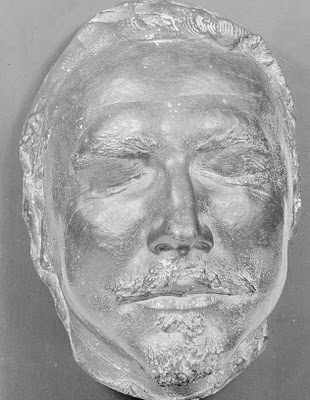
Ezra Pound’s Death Mask

(Yes, yes; we know it’s a life mask. We use the term “death mask” for editorial reasons).

“Brave New World Is Our Idea of Heaven” — A Passage from Michel Houellebecq’s Novel The Elementary Particles

The following passage from Michel Houellebecq’s novel The Elementary Particles is part of a dialog between half brothers Michel and Bruno. Otherwise, context unimportant:

When Bruno arrived at about nine o’clock, he had already had a couple of drinks and was eager to talk philosophy. “I’ve always been struck by how accurate Huxley was in Brave New World,” he began before he’d even sat down. “It’s phenomenal when you think he wrote it in 1932. Everything that’s happened since simply brings Western society closer to the social model he described. Control of reproduction is more precise and eventually will be completely disassociated from sex altogether, and procreation will take place in tightly guarded laboratories where perfect genetic conditions are ensured. Once that happens, any sense of family, of father-son bonds, will disappear. Pharmaceutical companies will break down the distinction between youth and old age. In Huxley’s world, a sixty-year-old man is as healthy as a man of twenty, looks as young and has the same desires. When we get to the point that life can’t be prolonged any further, we’ll be killed off by voluntary euthanasia; quick, discreet, emotionless. The society Huxley describes in Brave New World is happy; tragedy and extremes of human emotion have disappeared. Sexual liberation is total—nothing stands in the way of instant gratification. Oh, there are little moments of depression, of sadness or doubt, but they’re easily dealt with using advances in anti-depressants and tranquilizers. ‘Once cubic centimeter cures ten gloomy sentiments.’ This is exactly the sort of world we’re trying to create, the world we want to live in.

“Oh, I know, I know,” Bruno went on, waving his hand as if to dismiss an objection Michel had not voiced. “Everyone says Brave New World is supposed to be a totalitarian nightmare, a vicious indictment of society, but that’s hypocritical bullshit. Brave New World is our idea of heaven: genetic manipulation, sexual liberation, the war against aging, the leisure society. This is precisely the world that we have tried—and so far failed—to create.”

“Sybil, You Were Raped by Santa Claus” (Ellison’s Invisible Man)

From Ralph Ellison’s Invisible Man, a shocking, weird, gross, Christmasy reference near the end of the book. The context is that, in 1950s America, Sibyl, a white woman, wants the narrator, a black man, to fulfill her rape fantasy. Page 522 of my edition–

“Winter-Time” — Robert Louis Stevenson

“Winter-Time,” a poem by Robert Louis Stevenson:

Late lies the wintry sun a-bed,
A frosty, fiery sleepy-head;
Blinks but an hour or two; and then,
A blood-red orange, sets again.

Before the stars have left the skies,
At morning in the dark I rise;
And shivering in my nakedness,
By the cold candle, bathe and dress.

Close by the jolly fire I sit
To warm my frozen bones a bit;
Or with a reindeer-sled, explore
The colder countries round the door.

When to go out, my nurse doth wrap
Me in my comforter and cap;
The cold wind burns my face, and blows
Its frosty pepper up my nose.

Black are my steps on silver sod;
Thick blows my frosty breath abroad;
And tree and house, and hill and lake,
Are frosted like a wedding cake.

A Blood Meridian Christmas

Cormac McCarthy’s seminal anti-Western Blood Meridian isn’t exactly known for visions of peace on earth and good will to man. Still, there’s a strange scene in the book’s final third that subtly recalls (and somehow inverts) the Christmas story. The scene takes place at the end of Chapter 15. The kid, erstwhile protagonist of Blood Meridian, has just reunited with the rampaging Glanton gang after getting lost in the desert and, in a vision-quest of sorts, has witnessed “a lone tree burning on the desert” (a scene I have argued is the novel’s moral core).

Glanton’s marauders, tired and hungry, find temporary refuge from the winter cold in the town of Santa Cruz where they are fed by Mexicans and then permitted to stay the night in a barn. McCarthy offers a date at the beginning of the chapter — December 5th — and it’s reasonable to assume, based on the narrative action, that the night the gang spends in the manger is probably Christmas Eve. Here is the scene, which picks up as the gang — “they” — are led into the manger by a boy–

The shed held a mare with a suckling colt and the boy would would have put her out but they called to him to leave her. They carried straw from a stall and pitched it down and he held the lamp for them while they spread their bedding. The barn smelled of clay and straw and manure and in the soiled yellow light of the lamp their breath rolled smoking through the cold. When they had arranged their blankets the boy lowered the lamp and stepped into the yard and pulled the door shut behind, leaving them in profound and absolute darkness.

No one moved. In that cold stable the shutting of the door may have evoked in some hearts other hostels and not of their choosing. The mare sniffed uneasily and the young colt stepped about. Then one by one they began to divest themselves of their outer clothes, the hide slickers and raw wool serapes and vests, and one by one they propagated about themselves a great crackling of sparks and each man was seen to wear a shroud of palest fire. Their arms aloft pulling at their clothes were luminous and each obscure soul was enveloped in audible shapes of light as if it had always been so. The mare at the far end of the stable snorted and shied at this luminosity in beings so endarkened and the little horse turned and hid his face in the web of his dam’s flank.

The “shroud of palest fire” made of sparks is a strange image that seems almost supernatural upon first reading. The phenomena that McCarthy is describing is simply visible static electricity, which is not uncommon in a cold, dry atmosphere–particularly if one is removing wool clothing. Still, the imagery invests the men with a kind of profound, bizarre significance that is not easily explainable. It is almost as if these savage men, naked in the dark, are forced to wear something of their soul on the outside. Tellingly, this spectacle upsets both the mare and her colt, substitutions for Mary and Christ child, which makes sense. After all, these brutes are not wise men.

[Ed. note — Yes, this post is recycled (regifted?) from last year].

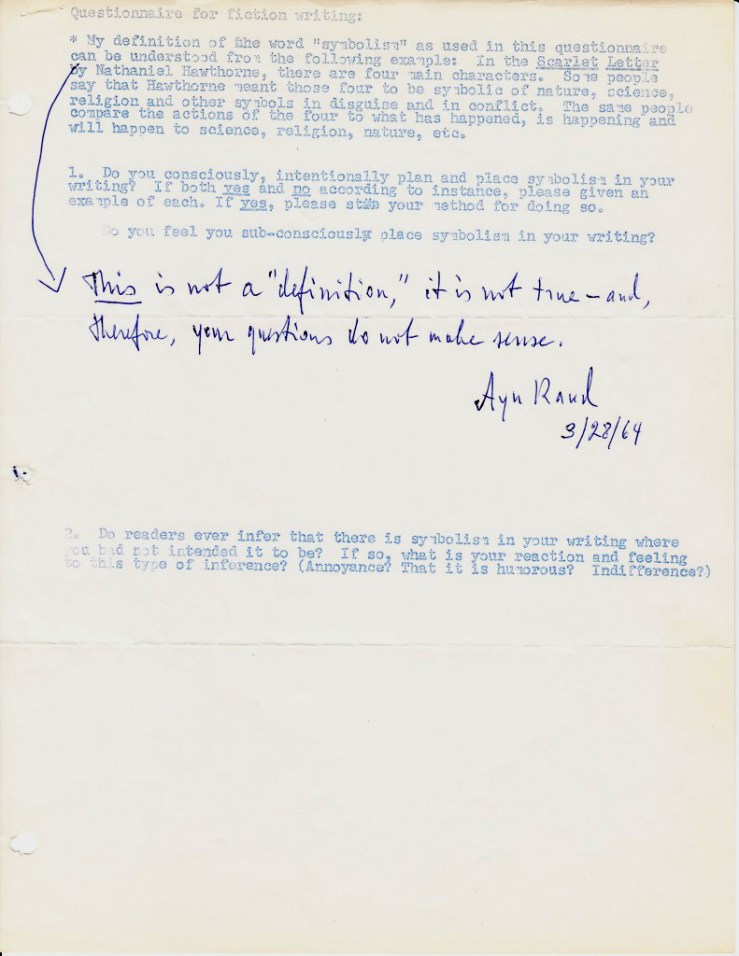
Ayn Rand Being a Jerk to a High School Kid

Part of a great write-up at The Paris Review. Some context (from the article):

In 1963, a sixteen-year-old San Diego high school student named Bruce McAllister sent a four-question mimeographed survey to 150 well-known authors of literary, commercial, and science fiction. Did they consciously plant symbols in their work? he asked. Who noticed symbols appearing from their subconscious, and who saw them arrive in their text, unbidden, created in the minds of their readers? When this happened, did the authors mind?