“A Nation of Cowards” — Ta-Nehisi Coates on the New Mark Twain Edit

At The AtlanticTa-Nehisi Coates weighs in on the new edit of Mark Twain’s The Adventures of Huckleberry Finn that replaces the word “nigger” with “slave”–

I’m obviously not Mark Twain, but having written a book, I can only imagine how hard Twain worked. I would be incensed if someone went through my book and took out all the “niggers” or “bitches” or “motherfuckers.” It’s really just a hair short of some stranger, in their preening ignorance, putting their hands on your kid.

[. . .] the invocation of nigger by Twain is not a moral failing. But because of our needs, Twain isn’t good enough. Because we can’t handle the story of who we were, and evidently who we are, Twain must be summoned up from the dead and, all against himself, submitted before the edits of amateurs.This is our system of fast-food education laid bare: Children are roaming the halls singing “Sexy Bitch,” while their neo-Confederate parents are plotting to chop the penis off Michelangelo’s David, and clamoring for Gatsby and Daisy to be reunited.

The Adventures of Huckleberry Finn: One of Our Favorite Challenged Books

E.W. Kemble's frontispiece to the original 1884 edition
E.W. Kemble’s frontispiece to the original illustrated edition

The Adventures of Huckleberry Finn by Mark Twain, undoubtedly one of the Great American Novels, ranks a healthy #5 on the ALA’s list the 100 Most Frequently Challenged Books. Young Huck’s casual colloquial use of the word “nigger” and the cruel hijinks Huck and Tom play on Jim at the novel’s end are two reasons that many have sought to suppress Twain’s masterpiece, including educator and critic John Wallace, who famously called it “the most grotesque example of racist trash ever given our children to read.” Wallace went so far as to suggest that “Any teacher caught trying to use that piece of trash with our children should be fired on the spot, for he or she is either racist, insensitive, naive, incompetent or all of the above.”

I guess I should’ve been fired on the spot, as I’ve used Huck Finn in my classroom a number of times, almost always in conjunction with excerpts from Olaudah Equiano’s Interesting Narrative, some Philis Wheatley poems, and a UN report on modern human trafficking. Context is everything.

While I can concede readily that Huck, the voice of the novel, says some pretty degrading things about Jim, often meant (on Twain’s part) to create humor for the reader, to expect Twain’s treatment of race to be what we in the 21st century want it to be is to not treat the material with any justice. And while Huck Finn may be insensitive at times, it handles the issues of race, slavery, class, and escape from the dominant social order with the complexity and thought that such weighty issues deserve. Ultimately, the novel performs a critique on the hypocrisy of a “Christian,” “democratic” society that thought it was okay to buy and sell people. This critique shows up right in the second page. Consider these lines (boldface mine):

The widow rung a bell for supper, and you had to come to time. When you got to the table you couldn’t go right to eating, but you had to wait for the widow to tuck down her head and grumble a little over the victuals, though there warn’t really anything the matter with them,—that is, nothing only everything was cooked by itself. In a barrel of odds and ends it is different; things get mixed up, and the juice kind of swaps around, and the things go better.

After supper she got out her book and learned me about Moses and the Bulrushers, and I was in a sweat to find out all about him; but by and by she let it out that Moses had been dead a considerable long time; so then I didn’t care no more about him, because I don’t take no stock in dead people.

Huck’s dream is of a delicious mix, a swapping of juices — integration. Additionally, his disregard for the dead Bible heroes reveals that the white Christian society’s obsession with the ancient past comes at the expense of contemporary value. Huck, an orphan, and Jim, separated from his family, will symbolically echo Moses in the bulrushes as they use the great Mississippi as a conduit for escape, for freedom. Huck (or Twain, really) here points out that it’s not enough to look at dead words on a page, on old dead lawgivers–we have to pay attention to the evils and wrongs and hypocrisies that live today.

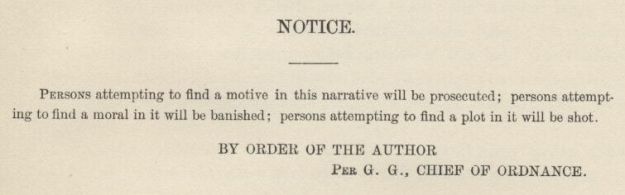
Twain even tells us how to read his book from the outset:

Now, it’s impossible to read a book–a good book–without finding its plot, searching for its moral, or caring about its characters, and Twain knows this. His “Notice” is tantamount to saying “don’t think about an elephant”–he uses irony to tell us we must find motive, moral, and plot here, and that we must do so through this lens of irony.

But of course, you have to read closely for all these things. I suppose it’s technically easier to call something trash, throw it in the garbage, and not have to devote time and energy to thinking about it. Who knows? You might learn something–and we wouldn’t want that, would we?

[Editorial note: Biblioklept originally published this piece in September of 2008].

“He Had Three Sizes” (An Ozark Folktale)

“He Had Three Sizes,” an Ozark folktale from Vance Randolph’s indispensable collection, Pissing in the Snow & Other Ozark Folktales

Told by Bob Wyrick, Eureka Springs, Ark., March, 1950. He heard it near Green Forest, Ark., about 1900.

One time a young fellow was going to marry a girl up on Panther Creek, but they hadn’t done no screwing yet. The girl seen him taking a leak out behind the barn, so then she begun to holler that the wedding will have to be called off. “You’re a-carrying more than I can take,” she says, “that thing is too big for a little girl like me!” But the young fellow just laughed. “I’ve got three of ’em,” says he. “One is lady size, another’n is whore size, and the third is mare size. I always use the mare size to piss with.”

So the girl says all right, and they got married right away. The first night she tried the lady size, and everything went fine. The second night she latched onto the whore size, and that was wonderful, too. The third night she called for the mare size, and it was the best of all. Him and her both had a good time, and you’d think they would live happy ever after.

About three weeks after the wedding, the girl woke up one morning, and she just laid there and yawned. “Honey,” she says, “fetch me one of the garters that is hanging on the chair.” The young fellow just grinned at her. “You ain’t got no stockings on,” says he. “What do you want with a garter?” The girl yawned again, and snuggled up against him. “I just thought of something,” she says. “If we can tie all three of them pricks together, maybe I could get some good fucking for a change!”

William Burroughs Shows Off His Weapons

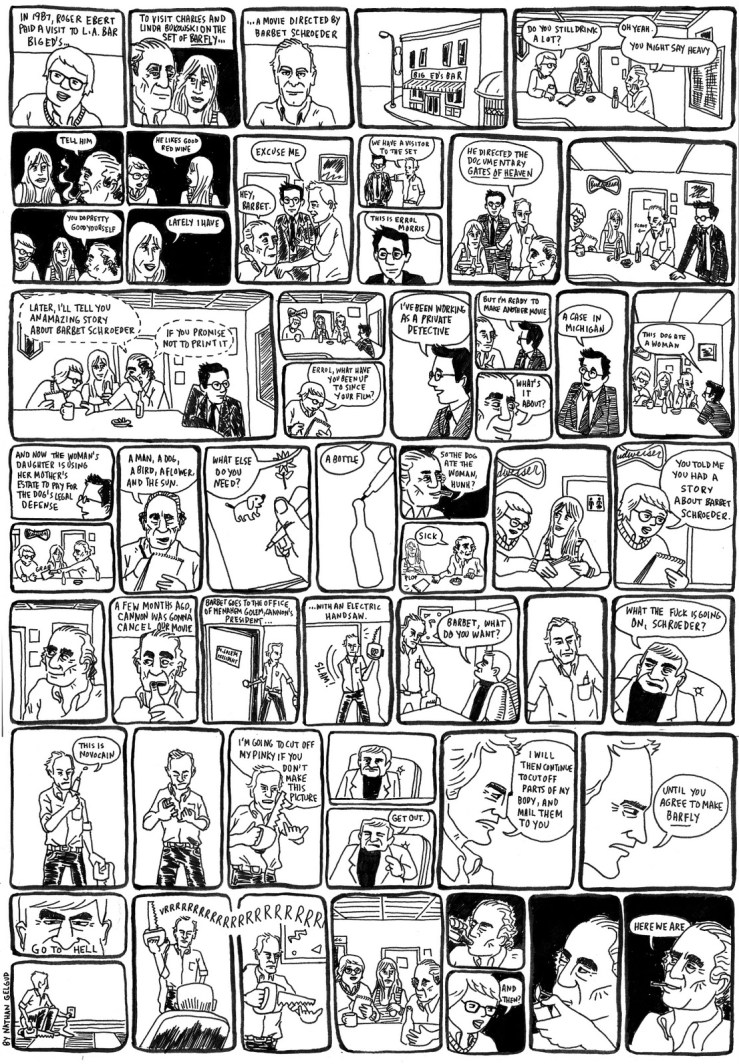
Charles Bukowski + Roger Ebert + Errol Morris

I don’t know the name of this comic strip by Nathan Gelgud. Barfly was kind of terrible. This is a good story though–

“Guadalupe in the Promised Land” — Sam Shepard

“Guadalupe in the Promised Land” — a very short story by Sam Shepard.

Guadalupe hit the skids and fishtailed into a ditch, crawled out of the wreck bleeding from the neck, saw the moon, laid his head in a mud puddle, said “Todo el Mundo” three times and snuffed out. Him and Manolete got together after that and Manolete told him it wasn’t enough just to be a man. The thing was to shoot for sainthood. He said he almost hit it. A saint of the cape. Jackson Pollock joined them and told Manolete he was full of shit. A man was good enough. That was harder than sainthood. There’s too many saints anyway. Guadalupe didn’t know what to think. He ran into Jimmy Dean and Jimmy just looked confused. Marilyn Monroe had no opinion. Brecht kept talking about Germany and shame. Satchmo kept wiping his sweat and shuffling. Janis wanted more. Crazy Horse said: “Fight and die young.” Brian Jones just played the harpoon. Dylan Thomas said “Rage.” Jimi Hendrix said “Slide.” Big Bopper said “What?” Johnny Ace said “Shoot.” And Davey Moore said “Take it all on.” That made sense to Guadalupe. And with that he lay down for a nice long rest.

(From Micro Fiction, edited by Jerome Stern).

Electric Literature Shoots Guns at Jonathan Franzen, David Mitchell, the Kindle, and Others

Allen Ginsberg Talks to Neal Cassady

Books I Will (Make Every Reasonable Attempt to) Read in 2011

If you’re looking for a comprehensive “Books to Look Forward to in 2011” kind of list, The Millions has you covered. This post is not about books that are coming out in 2011, although some books mentioned here will come out in 2011. This post is really just about books I’d like to/plan to read in 2011 (it’s also kind of a dare to myself).
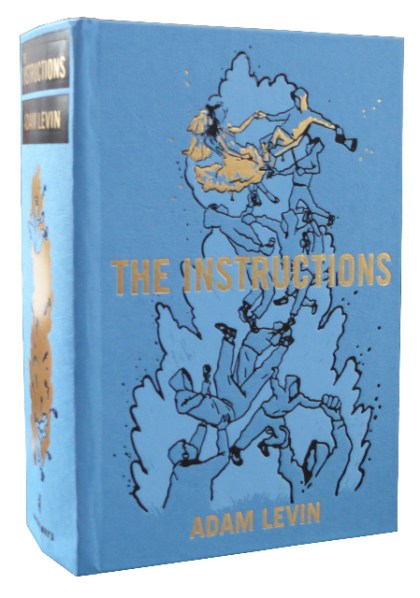
First up, I will finish the books I’m reading/listening to now. This means Adam Levin’s The Instructions (reading; McSweeney’s) and Lydia Millet’s Oh Pure and Radiant Heart (listening; Iambik Audio). I’m on page 342 of The Instructions; there are 1030 pages; a calculator tells me that that is 33.2%. It’s easy reading, often entertaining, but it’s hard to see, even a third of the way in, how Levin can justify taking up this much space. Oh, what is it about? Okay, this kid Gurion Maccabee may or may not be the Messiah. In the meantime, he rules the special ed program at his suburban Chicago school, writes scripture, and gets in lots of fights. The best parts of the book (so far, anyway) are Gurion’s comments on Torah (I would’ve written “the Torah,” but this book seems to suggest that the definite article is pretty Gentile).

Oh Pure and Radiant Heart has been enjoyable, sardonic — funny but sad — and I’m coming up to the end soon. Basically, a trinity of scientists who helped invent the atom bomb (Robert Oppenheimer is the famous one) come back from the dead (sort of) to . . . I don’t know yet. It’s unclear. To hang out with a quiet librarian and her gardener husband as their marriage slowly dissolves? To lead our nation to world wide peace? To take part in a movable circus of weirdos and End Times prophets? Not sure. Full review forthcoming.

I already wrote about one of the Tintin collections I picked up late last year; I will read the other three collections (and likely hunt down more). I’ll also read (hopefully; that is, hopefully it will come out) the next installment in Charles Burns’s X’ed Out trilogy.

Also on the proverbial plate, non-illustratedwise, is Heinrich Böll’s The Clown, the story of a clown in post-Reich Germany who can smell through the phone (I think there’s more to it than that). Melville House is actually releasing several new editions of Böll’s novels this year, and they have a pretty excellent track record with the Germans, what with Hans Fallada and all, so hey, why not.

On the I-will-read-everything-Sam-Lipsyte-writes front, Picador is putting out a new edition of his first novel The Subject Steve (perhaps in concordance with The Ask coming out in paperback?). I will read The Subject Steve.

Books I bought this year and didn’t read but will make every reasonable attempt to read this year—

William Gaddis’s JR was, I think anyway, the last book I picked up in 2010. It’s really long, seems to be written entirely as a dialog, and hey, I read 2/3rds of The Recognitions and then didn’t even finish it (yet?) which is kinda remarkable/totally lazy. Maybe I should just finish The Recognitions. I just feel like “I get it already.” Lazy, lazy, lazy.

Loved the first chapter of Katherine Dunn’s Geek Love, even though it was really silly. Stay tuned, folks.

I read the first two stories in Barry Hannah’s Airships and then a few galleys bombed my doorstep and then I got distracted, but these things have Spring Break written all over them, so, yes, look for the Airships report in the future (or be a hipster douchebag and write in to tell me how awesome you already know Hannah is now that he’s dead blah blah blah).

I remember that I bought Renata Adler’s Speed Boat the same day I bought Airships (because, y’know, the titles). I read the first 30 or so pages and then read them again and then read them again a week or so ago. Kind of dumbfounding stuff. It’s been hovering around the coffee table, the nightstand; it’s been jammed in briefcases, wedged in coat pockets. What is it? What is she doing?

After slowing down my consumption in 2010, I’m ready to feed the addiction again in 2011: Bolaño, Bolaño, Bolaño. I need to read Amulet; I’ll also read The Insufferable Gaucho and probably something else.

And:

The Pale King

But everyone’s buzzing about that already, right?
Charles Bukowski, Drunken Creep

“I Don’t Feel Any Wiser” — Philip Roth on the Myths of Aging

“At the Entering of the New Year” — Thomas Hardy

“At the Entering of the New Year” by Thomas Hardy–

I
(OLD STYLE)

Our songs went up and out the chimney,
And roused the home-gone husbandmen;
Our allemands, our heys, poussettings,
Our hands-across and back again,
Sent rhythmic throbbings through the casements
On to the white highway,
Where nighted farers paused and muttered,
“Keep it up well, do they!”

The contrabasso’s measured booming
Sped at each bar to the parish bounds,
To shepherds at their midnight lambings,
To stealthy poachers on their rounds;
And everybody caught full duly
The notes of our delight,
As Time unrobed the Youth of Promise
Hailed by our sanguine sight.

II
(NEW STYLE)

We stand in the dusk of a pine-tree limb,
As if to give ear to the muffled peal,
Brought or withheld at the breeze’s whim;
But our truest heed is to words that steal
From the mantled ghost that looms in the gray,
And seems, so far as our sense can see,
To feature bereaved Humanity,
As it sighs to the imminent year its say:—

“O stay without, O stay without,
Calm comely Youth, untasked, untired;
Though stars irradiate thee about
Thy entrance here is undesired.
Open the gate not, mystic one;
Must we avow what we would close confine?
With thee, good friend, we would have converse none,
Albeit the fault may not be thine.”

December 31. During the War


“A Song for New Year’s Eve” — William Cullen Bryant

“A Song for New Year’s Eve” by William Cullen Bryant–

Stay yet, my friends, a moment stay—
Stay till the good old year,
So long companion of our way,
Shakes hands, and leaves us here.
Oh stay, oh stay,
One little hour, and then away.

The year, whose hopes were high and strong,
Has now no hopes to wake;
Yet one hour more of jest and song
For his familiar sake.
Oh stay, oh stay,
One mirthful hour, and then away.

The kindly year, his liberal hands
Have lavished all his store.
And shall we turn from where he stands,
Because he gives no more?
Oh stay, oh stay,
One grateful hour, and then away.

Days brightly came and calmly went,
While yet he was our guest;
How cheerfully the week was spent!
How sweet the seventh day’s rest!
Oh stay, oh stay,
One golden hour, and then away.

Dear friends were with us, some who sleep
Beneath the coffin-lid:
What pleasant memories we keep
Of all they said and did!
Oh stay, oh stay,
One tender hour, and then away.

Even while we sing, he smiles his last,
And leaves our sphere behind.
The good old year is with the past;
Oh be the new as kind!
Oh stay, oh stay,
One parting strain, and then away

Ernest Hemingway Writes Archibald MacLeish About Ezra Pound’s Craziness

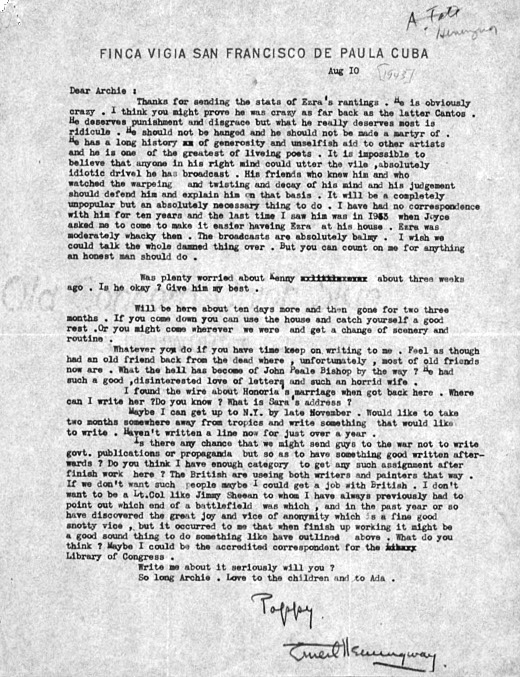
Ernest Hemingway writes Archibald MacLeish about Ezra Pound. Here’s the letter, via the excellent folks at Letters of Note, also responsible for the bit of transcription we’ve excised below–

Thanks for sending the stats of Ezra’s rantings. He is obviously crazy. I think you might prove he was crazy as far back as the latter Cantos. He deserves punishment and disgrace but what he really deserves most is ridicule. He should not be hanged and he should not be made a martyr of. He has a long history of generosity and unselfish aid to other artists and he is one of the greatest living poets. It is impossible to believe that anyone in his right mind could utter the vile, absolutely idiotic drivel he has broadcast. His friends who knew him and who watched the warpeing and twisting and decay of his mind and his judgement should defend him and explain him on that basis. It will be a completely unpopular but an absolutely necessary thing to do. I have had no correspondence with him for ten years and the last time I saw him was in 1933 when Joyce asked me to come to make it easier haveing Ezra at his house. Ezra was moderately whacky then. The broadcasts are absolutely balmy. I wish we could talk the whole damned thing over. But you can count on me for anything an honest man should do.

Gordon Lish on Beckett’s Boils and Other Matters of Literary Import

Hey. Do yourself a favor and listen to Iambik’s first podcast, a raucous, rambling conversation with legendary editor/short story author Gordon Lish. I finally got around to listening to the discussion between Lish and his publisher John Oakes. (Why the delay? I’ve been listening to and very much enjoying another Iambik recording, an audiobook of Lydia Millet’s Oh Pure and Radiant Heart, and I needed to get to a decent stopping place before the Lish (review of the Millet forthcoming)) . I had already listened to Lish reading a selection of his own stories which was nine kinds of awesome (thanks again to the good folks at Iambik, whose hooking me up with the sweet mp3age has in no way affected my fondness for their operation (review of the Lish selections forthcoming)).

Hearing Lish in this conversational, easy manner is revelatory. Wise and funny, erudite and crafty, you’ll learn something and be entertained:

Iambikcast #1a (mp3)
Iambikcast #1b (mp3)

What does he talk about? I’ll crib from Iambikist Miette’s write-up, which hardly sums it up but does a nice job of surveying the discussion–

In the first part of the conversation, Lish covers Beckett’s boils and other afflictions of our literary heroes, remembrances of Neal Cassady, and the writer as witch doctor.

The second part focuses on Lish’s (as always, uncensored) assertions on the state of contemporary American letters, in which we’re imparted with opinions on Allen Ginsberg and Philip Roth, achieving religious experience through DeLillo, the finer points of book blurbing, and encouraging the further crimes of Tao Lin.

“Declaration on the Notion of ‘The Future'” — The International Necronautical Society

At The Believer, you can read the entirety of “Declaration on the Notion of ‘The Future’by The International Necronautical Society (aka Simon Critchley and Tom McCarthy (although we’re pretty sure that the essay’s authorization code TMcC010910 indicates that McCarthy is its author)). Playful and provocative stuff. A sample–

5. The INS rejects the Enlightenment’s version of time: of time as progress, a line growing stronger and clearer as it runs from past to future. This version is tied into a narrative of transcendence: in the Hegelian system, of Aufhebung, in which thought and matter ascend to the realm of spirit as the projects of philosophy and art perfect themselves. Against this totalizing (we would say, totalitarian) idealist vision, we pit counter-Hegelians like Georges Bataille, who inverts this upward movement, miring spirit in the trough of base materialism. Or Joyce’s Stephen Dedalus, who, hearing the moronic poet Russel claim that “art has to reveal to us ideas, formless spiritual essences,” pictures Platonists crawling through Blake’s buttocks to eternity, and silently retorts: “Hold to the now, the here, through which all future plunges to the past.”

6. To phrase it in more directly political terms: the INS rejects the idea of the future, which is always the ultimate trump card of dominant socioeconomic narratives of progress. As our Chief Philosopher Simon Critchley has recently argued, the neoliberal versions of capitalism and democracy present themselves as an inevitability, a destiny to whom the future belongs. We resist this ideology of the future, in the name of the sheer radical potentiality of the past, and of the way the past can shape the creative impulses and imaginative landscape of the present. The future of thinking is its past, a thinking which turns its back on the future.


“The Old Year” — John Clare

John Clare’s poem “The Old Year”—

The Old Year’s gone away
To nothingness and night:
We cannot find him all the day
Nor hear him in the night:
He left no footstep, mark or place
In either shade or sun:
The last year he’d a neighbour’s face,
In this he’s known by none.

All nothing everywhere:
Mists we on mornings see
Have more of substance when they’re here
And more of form than he.
He was a friend by every fire,
In every cot and hall–
A guest to every heart’s desire,
And now he’s nought at all.

Old papers thrown away,
Old garments cast aside,
The talk of yesterday,
Are things identified;
But time once torn away
No voices can recall:
The eve of New Year’s Day
Left the Old Year lost to all.