Plastics and paranoia (Harold Bloom on Thomas Pynchon)

For Pynchon, ours is the age of plastics and paranoia, dominated by the System. No one is going to dispute such a conviction; reading the New York Times first thing every morning is sufficient to convince one that not even Pynchon’s imagination can match journalistic irreality. What is more startling about Pynchon is that he has found ways of representing the impulse to defy the System, even though both impulse and its representations always are defeated. In the Zone (which is our cosmos as the Gnostics saw it, the kenoma or Great Emptiness) the force of the System, of They (whom the Gnostics called Archons), is in some sense irresistible, as all overdetermination must be irresistible. Yet there is a Counterforce, hardly distinguished in its efficacy, but it never does (or can) give up. Unfortunately, its hero is the extraordinarily ordinary Tyrone Slothrop, who is a perpetual disaster, and whose ultimate fate, being “scattered” (rather in biblical sense), is accomplished by Pynchon with dismaying literalness. And yet—Slothrop, who has not inspired much affection even in Pynchon’s best critics, remains more Pynchon himself.

From Harold Bloom’s introduction to Bloom’s Critical Modern Views: Thomas Pynchon.

“For the portrait of an African boy after the manner of Gauguin” — Langston Hughes

Capture

One reads for oneself and for strangers (Harold Bloom)

The terms “power” and “authority” have pragmatically opposed meanings in the realms of politics and what we still ought to call “imaginative literature.” If we have difficulty in seeing the opposition, it may be because of the intermediate realm that calls itself “spiritual.” Spiritual power and spiritual authority notoriously shade over into both politics and poetry. Thus we must distinguish the aesthetic power and authority of the Western Canon from whatever spiritual, political, or even moral consequences it may have fostered. Although reading, writing, and teaching are necessarily social acts, even teaching has its solitary aspect, a solitude only the two could share, in Wallace Stevens’s language. Gertrude Stein maintained that one wrote for oneself and for strangers, a superb recognition that I would extend into a parallel apothegm: one reads for oneself and for strangers. The Western Canon does not exist in order to augment preexisting societal elites. It is there to be read by you and by strangers, so that you and those you will never meet can encounter authentic aesthetic power and the authority of what Baudelaire (and Erich Auerbach after him) called “aesthetic dignity.” One of the ineluctable stigmata of the canonical is aesthetic dignity, which is not to be hired.

From The Western Canon by Harold Bloom.

Avant-gardes are fragile affairs (William H. Gass)

Avant-gardes are fragile affairs. The moment they become established, they cease to be – success as well as failure finishes them off. Their unity depends upon a common “no,” not on some “yes” that is jointly loved. And insofar as the movement moves at all, it requires the shoulders of many others at its wheels, support which most of the artists suspect is actually their exploitation. Poems must be written, paintings must be painted, but mere coffeehouse talk is not irrelevant to the success of the cause, nor are letters, broadsides, feuilletons, essays, reviews, catalogue copy, the quarrels of the cafés and the slanders of the salons; nor are tumults in the stalls, outrages of public decency, arrests, or other excursions and alarms.


Every effort to prolong an avant-garde beyond a certain point becomes of doubtful value, because an avant-garde can have but a mayfly’s life: the artists have only their negations to chorus; both their attitudes and their art will alter as they age; society’s methods of co-optation and disarmament will, in general, be effective; their anger will be softened by success and their aims divided, their attention distracted; the institutions set up by most Establishments, even if assaulted, will take longer dying than most avant-gardes can expect to live; while the strength of the support groups, so necessary to the energy of any movement, are even more fragile and momentary, depending, as they do, on the loyalty of a publisher, the generosity of a patron, the length of a love life, the cuisine of a café.

From William H. Gass’s essay “The Vicissitudes of the Avant-Garde.”

Reading There Will Be Blood as the expanded epilogue to Blood Meridian

Watching (again) Paul Thomas Anderson’s 2007 film There Will Be Blood last night, it struck me that the film can be read as an expansion of the epilogue to Cormac McCarthy’s 1985 novel Blood Meridian.

Here is that infamously perplexing passage, a strange note that punctuates the devastating infanticidal horror at the novel’s core:

In the dawn there is a man progressing over the plain by means of holes which he is making in the ground. He uses an implement with two handles and he chucks it into the hole and he enkindles the stone in the hole with his steel hole by hole striking the fire out of the rock which God has put there. On the plain behind him are the wanderers in search of bones and those who do not search and they move haltingly in the light like mechanisms whose movements are monitored with escapement and pallet so that they appear restrained by a prudence or reflectiveness which has no inner reality and they cross in their progress one by one that track of holes that runs to the rim of the visible ground and which seems less the pursuit of some continuance than the verification of a principle, a validation of sequence and causality as if each round and perfect hole owed its existence to the one before it there on that prairie upon which are the bones and the gatherers of bones and those who do not gather. He strikes fire in the hole and draws out his steel. Then they all move on again.

I’ve heard numerous interpretations of this passage over the years. Many of the interpretations dwell on the metaphorical power of the epilogue—it’s the final gnostic clue in the Judge’s web of mysteries; it’s the Promethean redemption of humanity against the Judge’s evil; it’s the spirit of civilization that will measure and conquer the bloody West, a progressive new dawn; it’s Cormac McCarthy’s signature, his designation of himself as the writer who carries the fire.

I’m fine with all of these interpretations, for I foolishly take Judge Holden at his word when he points out that, “Your heart’s desire is to be told some mystery. The mystery is that there is no mystery.” Let me eschew the symbolic then, at least momentarily, for the literal.

The epilogue’s literal imagery suggests a man working with post hole diggers: Is he building a fence? Constructing telegraph poles? Exploring? Surveying? Whatever his intentions, he marks and measures the land.

Whether the digger is a leader or not, he has followers, “the wanderers in search of bones” as well as “those who do not search.” Bones of what? Are the searchers hunting relics? (To revert to the metaphorical—sorry—are these bones the dead eyes Emerson warned us not to look through?). Or are the bones something else—dinosaur bones, Texas tea, carbon, fuel?

there will be blood

So There Will Blood and there will be bones: Daniel Day-Lewis’s Daniel Plainview, a misanthropic, near-malevolent, and ultimately murderous oil man—what I want to say is that he is (a failed version of) McCarthy’s Epilogue Digger. Is not There Will Be Blood  a film about digging, about holes, falling in holes, dying in holes, striking fire from holes? And is not There Will Be Blood also a film about the abjection of holes—the oil, the mud, the muck, the blood that coats hands and faces, eyes, lips, ears burst? Of the recapitulation of the hole as the primal space for culture—a fertile, generative, fecund, deadly space? The hole as the space of shame and possibility? Daniel Plainview, surveying California, marking lines for his followers to follow, striking oil, striking fire. No?

There-Will-Be-Blood-daniel-day-lewis-859163_427_321

We might see in Paul Thomas Anderson’s film a repetitious revision of McCarthy’s novel—a recasting of sorts, with Plainview possessed by Glanton’s maniacal spirit—and Glanton in turn possessed by the spirit of the Judge, the dark omnipresent bad father. Both film and novel mediate their Oedipal dramas in an utterly masculine world. Blood Meridian affords more speaking roles to women than There Will Be Blood does, but both see fit to discharge any notion of a mother from the Oedipal contests they depict, rendering the kid in each narrative the warden of strange gangs, strange wanderers. Anderson allows H.W. to suffer but live and perhaps thrive, to find a mate, to escape into new and alien territory, outside of the holes his surrogate father has dug. Our would-be hero of Blood Meridian, the kid, dies in an outhouse, an abject hole.

And Daniel Plainview—he murders the false priest (which the judge failed to do—although Tobin was a true priest though ex-priest), murders a version of himself—another brother, another Abel. He’s not a good guy. If we read McCarthy’s epilogue through his latest novel, The Road, or even through some of the lines in No Country for Old Men, we can see that “the good guys” are charged with carrying the fire—and is this not what the Epilogue Digger is doing? Carrying the fire, freeing the fire from the earth? Plainview would like to carry the fire, to generate new life, new communities, but he fails, he falls, he crumbles. He abandons his child, and then denies his child. “I’m finished!”

Am I finished? I’m now more confused than when I started this riff. The germ of the idea woke with me this morning—the alien landscape of PTA’s film seemed to restage for me moments in McCarthy’s novel in some waking dream—and like a dream seemed perfectly illogically logical. But bound up in my language I’m not so sure. What I did detect in the film, last night, that I had previously perhaps missed, or maybe forgotten, was how admirable Daniel Plainview often is, especially early on in the film—decisive, bold, asserting his own agency and working with his own hands, he’s a Nietzschean figure. But his paranoia gives way to madness and corruption. Okay. I’m finished.

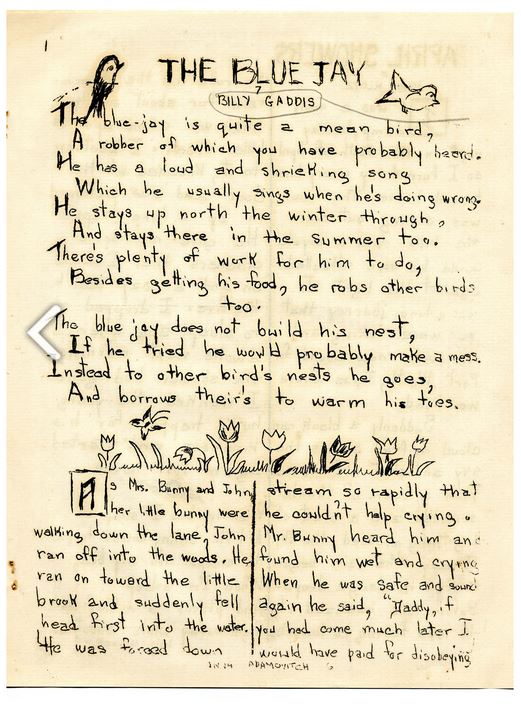
“The Blue Jay” by Billy Gaddis — Juvenilia from William Gaddis

billy

William Gaddis juvenilia from Washington University’s Modern Literature collection. (You can read the entire piece there).

Read “Entropy,” a short story by Thomas Pynchon

“Entropy”

by

Thomas Pynchon

Boris has just given me a summary of his views. He is weather prophet. The weather will continue bad, he says. There will be more calamities, more death, more despair. Not the slightest indication of a change anywhere…. We must get into step, a lockstep toward the prison of death. There is no escape. The weather will not change. – Tropic of Cancer

Downstairs, Meatball Mulligan’s lease-breaking party was moving into its 40th hour. On the kitchen floor, amid a litter of empty champagne fifths, were Sandor Rojas and three friends, playing spit in the ocean and staying awake on Heidseck and benzedrine pills. In the living room Duke, Vincent, Krinkles and Paco sat crouched over a 15-inch speaker which had been bolted into the top of a wastepaper basket, listening to 27 watts’ worth of The Heroes’ Gate at Kiev. They all wore hornrimmed sunglasses and rapt expressions, and smoked funny-looking cigarettes which contained not, as you might expect, tobacco, but an adulterated form of cannabis sativa. This group was the Duke di Angelis quartet. They recorded for a local label called Tambú and had to their credit one 10″ LP entitled Songs of Outer Space. From time to time one of them would flick the ashes from his cigarette into the speaker cone to watch them dance around. Meatball himself was sleeping over by the window, holding an empty magnum to his chest as if it were a teddy bear. Several government girls, who worked for people like the State Department and NSA, had passed out on couches, chairs and in one case the bathroom sink.

This was in early February of’57 and back then there were a lot of American expatriates around Washington, D.C., who would talk, every time they met you, about how someday they were going to go over to Europe for real but right now it seemed they were working for the government. Everyone saw a fine irony in this. They would stage, for instance, polyglot parties where the newcomer was sort of ignored if he couldn’t carry on simultaneous conversations in three or four languages. They would haunt Armenian delicatessens for weeks at a stretch and invite you over for bulghour and lamb in tiny kitchens whose walls were covered with bullfight posters. They would have affairs with sultry girls from Andalucía or the Midi who studied economics at Georgetown. Their Dôme was a collegiate Rathskeller out Wisconsin Avenue called the Old Heidelberg and they had to settle for cherry blossoms instead of lime trees when spring came, but in its lethargic way their life provided, as they said, kicks.

At the moment, Meatball’s party seemed to be gathering its second wind. Outside there was rain. Rain splatted against the tar paper on the roof and was fractured into a fine spray off the noses, eyebrows and lips of wooden gargoyles under the eaves, and ran like drool down the windowpanes. The day before, it had snowed and the day before that there had been winds of gale force and before that the sun had made the city glitter bright as April, though the calendar read early February. It is a curious season in Washington, this false spring. Somewhere in it are Lincoln’s Birthday and the Chinese New Year, and a forlornness in the streets because cherry blossoms are weeks away still and, as Sarah Vaughan has put it, spring will be a little late this year. Generally crowds like the one which would gather in the Old Heidelberg on weekday afternoons to drink Würtzburger and to sing Lili Marlene (not to mention The Sweetheart of Sigma Chi) are inevitably and incorrigibly Romantic. And as every good Romantic knows, the soul (spiritus, ruach, pneuma) is nothing, substantially, but air; it is only natural that warpings in the atmosphere should be recapitulated in those who breathe it. So that over and above the public components—holidays, tourist attractions—there are private meanderings, linked to the climate as if this spell were a stretto passage in the year’s fugue: haphazard weather, aimless loves, unpredicted commitments: months one can easily spend in fugue*, because oddly enough, later on winds, rains, passions of February and March are never remembered in that city, it is as if they had never been.

Read the rest of “Entropy” online here—alongside a Spanish translation and explanatory notes—or read it in the collection of early Pynchon shorties Slow Learner.

“Welt” — Georgia Douglas Johnson

welt

Read “Schrödinger’s Cat” by Ursula K. Le Guin

“Schrödinger’s Cat”

by Ursula K. Le Guin

As things appear to be coming to some sort of climax, I have withdrawn to this place. It is cooler here, and nothing moves fast.

On the way here I met a married couple who were coming apart. She had pretty well gone to pieces, but he seemed, at first glance, quite hearty. While he was telling me that he had no hormones of any kind, she pulled herself together and, by supporting her head in the crook of her right knee and hopping on the toes of her right foot, approached us shouting, “Well what’s wrong with a person trying to express themselves?” The left leg, the arms, and the trunk, which had remained lying in the heap, twitched and jerked in sympathy. “Great legs,” the husband pointed out, looking at the slim ankle. “My wife had great legs.”

A cat has arrived interrupting my narrative. It is a striped yellow tom with white chest and paws. He has long whiskers and yellow eyes. I never noticed before that cats had whiskers above their eyes; is that normal? There is no way to tell. As he has gone to sleep on my knee, I shall proceed.

Where?

Nowhere, evidently. Yet the impulse to narrate remains. Many things are not worth doing, but almost anything is worth telling. In any case, I have a severe congenital case of Ethica laboris puritanica,1 or Adam’s Disease. It is incurable except by total decapitation. I even like to dream when asleep, and to try and recall my dreams: it assures me that I haven’t wasted seven or eight hours just lying there. Now here I am, lying, here. Hard at it.

Read the rest. 

A (probably incomplete) list of films mentioned in Thomas Pynchon’s novel Inherent Vice

Below: A (probably incomplete) list of films mentioned in Thomas Pynchon’s novel Inherent Vice.

I’ve listed them in the order in which they show up, and also in the editorial style in which they appear—initially, Pynchon separates the release year with a comma or doesn’t give a year at all, before settling on parenthetical citations—with the one quirk of A Summer Place—its year is indicated in brackets. Obviously this inconsistency is actually some kind of super-meaningful clue, a key that will unlock any unresolved mysteries of Inherent Vice—right?

Black Narcissus, 1947

Caligari

Metropolis

Dr. No, 1962

Now, Voyager (1942)

Fort Apache (1948)

He Ran All the Way (1951)

I Walked with a Zombie (1943)

Ghidrah, the Three-Headed Monster (1964)

Roman Holiday (1953)

The Wizard of Oz (1939)

Vertigo (1958)

The Big Bounce (1969)

Champion (1949)

The Postman Always Rings Twice (1946)

A Summer Place [1959]

The Sea Wolf (1941)

Little Miss Broadway (1938)

Paranoia Alert (Inherent Vice)

paranoia alert

Read “A Chameleon,” a short story by Anton Chekhov

“A Chameleon”

by

Anton Chekhov

The police superintendent Otchumyelov is walking across the market square wearing a new overcoat and carrying a parcel under his arm. A red-haired policeman strides after him with a sieve full of confiscated gooseberries in his hands. There is silence all around. Not a soul in the square. . . . The open doors of the shops and taverns look out upon God’s world disconsolately, like hungry mouths; there is not even a beggar near them.

“So you bite, you damned brute?” Otchumyelov hears suddenly. “Lads, don’t let him go! Biting is prohibited nowadays! Hold him! ah . . . ah!”

There is the sound of a dog yelping. Otchumyelov looks in the direction of the sound and sees a dog, hopping on three legs and looking about her, run out of Pitchugin’s timber-yard. A man in a starched cotton shirt, with his waistcoat unbuttoned, is chasing her. He runs after her, and throwing his body forward falls down and seizes the dog by her hind legs. Once more there is a yelping and a shout of “Don’t let go!” Sleepy countenances are protruded from the shops, and soon a crowd, which seems to have sprung out of the earth, is gathered round the timber-yard.

“It looks like a row, your honour . . .” says the policeman.

Otchumyelov makes a half turn to the left and strides towards the crowd.

He sees the aforementioned man in the unbuttoned waistcoat standing close by the gate of the timber-yard, holding his right hand in the air and displaying a bleeding finger to the crowd. On his half-drunken face there is plainly written: “I’ll pay you out, you rogue!” and indeed the very finger has the look of a flag of victory. In this man Otchumyelov recognises Hryukin, the goldsmith. The culprit who has caused the sensation, a white borzoy puppy with a sharp muzzle and a yellow patch on her back, is sitting on the ground with her fore-paws outstretched in the middle of the crowd, trembling all over. There is an expression of misery and terror in her tearful eyes.

“What’s it all about?” Otchumyelov inquires, pushing his way through the crowd. “What are you here for? Why are you waving your finger . . . ? Who was it shouted?”

“I was walking along here, not interfering with anyone, your honour,” Hryukin begins, coughing into his fist. “I was talking about firewood to Mitry Mitritch, when this low brute for no rhyme or reason bit my finger. . . . You must excuse me, I am a working man. . . . Mine is fine work. I must have damages, for I shan’t be able to use this finger for a week, may be. . . . It’s not even the law, your honour, that one should put up with it from a beast. . . . If everyone is going to be bitten, life won’t be worth living. . . .”

“H’m. Very good,” says Otchumyelov sternly, coughing and raising his eyebrows. “Very good. Whose dog is it? I won’t let this pass! I’ll teach them to let their dogs run all over the place! It’s time these gentry were looked after, if they won’t obey the regulations! When he’s fined, the blackguard, I’ll teach him what it means to keep dogs and such stray cattle! I’ll give him a lesson! . . . Yeldyrin,” cries the superintendent, addressing the policeman, “find out whose dog this is and draw up a report! And the dog must be strangled. Without delay! It’s sure to be mad. . . . Whose dog is it, I ask?”

“I fancy it’s General Zhigalov’s,” says someone in the crowd.

“General Zhigalov’s, h’m. . . . Help me off with my coat, Yeldyrin . . . it’s frightfully hot! It must be a sign of rain. . . . There’s one thing I can’t make out, how it came to bite you?” Otchumyelov turns to Hryukin. “Surely it couldn’t reach your finger. It’s a little dog, and you are a great hulking fellow! You must have scratched your finger with a nail, and then the idea struck you to get damages for it. We all know . . . your sort! I know you devils!”

“He put a cigarette in her face, your honour, for a joke, and she had the sense to snap at him. . . . He is a nonsensical fellow, your honour!”

“That’s a lie, Squinteye! You didn’t see, so why tell lies about it? His honour is a wise gentleman, and will see who is telling lies and who is telling the truth, as in God’s sight. . . . And if I am lying let the court decide. It’s written in the law. . . . We are all equal nowadays. My own brother is in the gendarmes . . . let me tell you. . . .”

“Don’t argue!”

“No, that’s not the General’s dog,” says the policeman, with profound conviction, “the General hasn’t got one like that. His are mostly setters.”

“Do you know that for a fact?”

“Yes, your honour.”

“I know it, too. The General has valuable dogs, thoroughbred, and this is goodness knows what! No coat, no shape. . . . A low creature. And to keep a dog like that! . . . where’s the sense of it. If a dog like that were to turn up in Petersburg or Moscow, do you know what would happen? They would not worry about the law, they would strangle it in a twinkling! You’ve been injured, Hryukin, and we can’t let the matter drop. . . . We must give them a lesson! It is high time . . . . !”

“Yet maybe it is the General’s,” says the policeman, thinking aloud. “It’s not written on its face. . . . I saw one like it the other day in his yard.”

“It is the General’s, that’s certain!” says a voice in the crowd.

“H’m, help me on with my overcoat, Yeldyrin, my lad . . . the wind’s getting up. . . . I am cold. . . . You take it to the General’s, and inquire there. Say I found it and sent it. And tell them not to let it out into the street. . . . It may be a valuable dog, and if every swine goes sticking a cigar in its mouth, it will soon be ruined. A dog is a delicate animal. . . . And you put your hand down, you blockhead. It’s no use your displaying your fool of a finger. It’s your own fault. . . .”

“Here comes the General’s cook, ask him. . . Hi, Prohor! Come here, my dear man! Look at this dog. . . . Is it one of yours?”

“What an idea! We have never had one like that!”

“There’s no need to waste time asking,” says Otchumyelov. “It’s a stray dog! There’s no need to waste time talking about it. . . . Since he says it’s a stray dog, a stray dog it is. . . . It must be destroyed, that’s all about it.”

“It is not our dog,” Prohor goes on. “It belongs to the General’s brother, who arrived the other day. Our master does not care for hounds. But his honour is fond of them. . . .”

“You don’t say his Excellency’s brother is here? Vladimir Ivanitch?” inquires Otchumyelov, and his whole face beams with an ecstatic smile. “‘Well, I never! And I didn’t know! Has he come on a visit?

“Yes.”

“Well, I never. . . . He couldn’t stay away from his brother. . . . And there I didn’t know! So this is his honour’s dog? Delighted to hear it. . . . Take it. It’s not a bad pup. . . . A lively creature. . . . Snapped at this fellow’s finger! Ha-ha-ha. . . . Come, why are you shivering? Rrr . . . Rrrr. . . . The rogue’s angry . . . a nice little pup.”

Prohor calls the dog, and walks away from the timber-yard with her.
The crowd laughs at Hryukin.

“I’ll make you smart yet!” Otchumyelov threatens him, and wrapping himself in his greatcoat, goes on his way across the square.
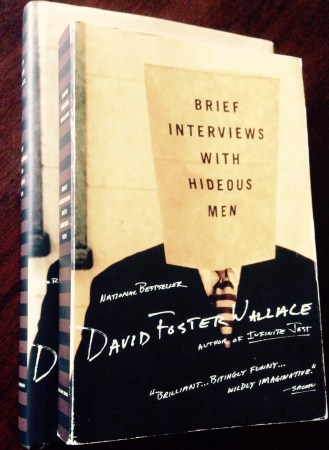
DFW’s Brief Interviews with Hideous Men, books as memory objects, etc.

2015/01/img_4925.jpg

On our short walk home from her school yesterday, my darling daughter inquires if we can go to the bookstore. She needs some new Junie B. Jones, she reports. I assent.

This particular bookstore is about a mile away, a big labyrinth of shelves and stacks and strange little closets crammed with books. The owner once kindly estimated to me that the place houses somewhere between one million and two million books, but probably not more than three million books. The place is a hive, or better yet a brain. An archive.

On this warmish January afternoon, a coverless paperback wedged and warped keeps the front door propped open. My daughter doesn’t dally, fetching up a bevy of Ms. Jones’ adventures (and the third volume of Ivy + Bean to boot: “It’s Ivy “plus” Bean, not Ivy “and” Bean, her graceful correction).

We have a few minutes before we need to pick up my son, so I do a fairly regular patrol about the premises, looking for a copy of Jane Bowles’s Two Serious Ladies for a colleague. No dice. And, out of weird old habits, go past the last shelf, where Vollmann’s underattended tomes rest near David Foster Wallace novels, always depleted. I like to look at the new covers, I guess.

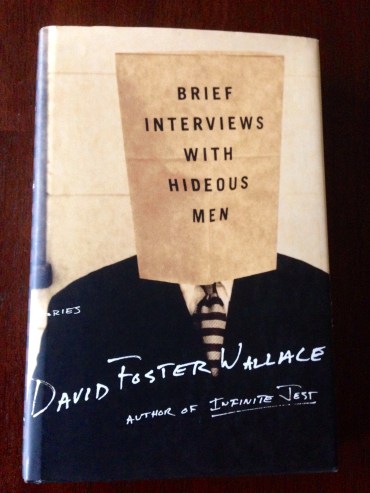
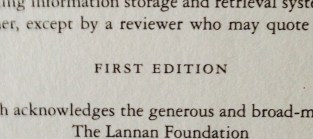
Well so and anyway, I spied a pristine hardcover copy of Brief Interviews with Hideous Men, clearly never read, and thought, Oh hey, this must be a first edition. Which it was and Oh hey you don’t need this book.

2015/01/img_4926.jpg

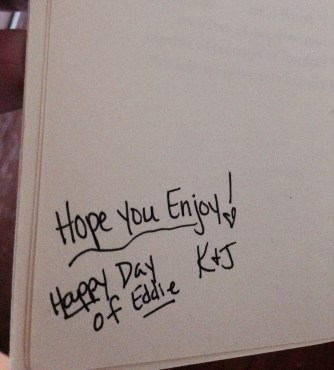
There is nothing rare or especially valuable about a first hardback U.S. edition of Hideous Men. The store is selling it for half of the publisher’s recommended price, but I have more than enough credit (thanks unsolicited review copies!) to pick it up. Which I do. Despite of course already owning it in the far more flexible trade paperback edition (first edition!) inscribed by some of the dearest damn friends who gave it to me for a birthday, an edition I reread memorably over a few weeks in Italy, an edition warped by strange moistures (I’d love to pretend the warping arose from the salty splash of the ancient Mediterranean but my own body sweat is a far more likely culprit).

2015/01/img_4927.jpg

Brief Interviews is my favorite collection of David Foster Wallace stories. The stories here are much better than those in his first collection, Girl with Curious Hair (which, the first DFW I read, has a special place in my gizzards), and though there’s nothing here that can touch the best moments of Oblivion (“The Suffering Channel” and “Good Old Neon”), the collection is cohesive, propulsive, engaging, its longer pieces punctuated by blips and vignettes. Here is the first selection, “A Radically Condensed History of Postindustrial Life”:

When they were introduced, he made a witticism, hoping to be liked. She laughed very hard, hoping to be liked. Then each drove home alone, staring straight ahead, with the very same twist to their faces.

The man who’d introduced them didn’t much like either of them, though he acted as if he did, anxious as he was to preserve good relations at all times. One never knew, after all, now did one now did one now did one.

So I picked up the hardback first edition, realizing that what I really wanted (in addition to this edition that I didn’t and don’t really need) was the copy that I read in college, the copy I borrowed from UF’s Library West (I’ll pay you $10,000 if you can think of a better library name, which you can’t), a flat brown squashed brick—-I must’ve been one of the first to read it, this was in ’99 or early ’00—I checked it out three times and then I had to return it. I ripped off “Adult World (I)” and “Adult World (II)” (these are actually the same story, but…) for a project in some bullshit class I was taking at the time, some class called Post-Historical Visual Culture or some other such nonsense—I didn’t rip off the plot, but the structure, the whole narrative/outline thing that Wallace did there. (My story was about a geneticist trying to clone a son or maybe someone to love, I can’t recall, shudder to recall…And why was I turning in a story and not an essay?!).

Why do I want the very edition that I first read, Dewey’s decimals imprinted on its drab jacketless spine? Why do I want an object that proclaims first, first, first, even though I don’t need it—why the compulsion? And then the sentimental compulsion to keep a less sturdy paperback version just because my name is incribed in itjust because I recall so vividly shaving my beard in Minori in Amalfi after reading “Tri-Stan: I Sold Sissee Nar to Ecko” and realizing that Oh my god this story is fucking terrible, DFW, I get what you’re doing, but my god. 

A book is a memory object, a placeholder, a bookmark for the memory of the reading experience, because we don’t remember what we read, not really. I have a few novels committed to memory (more or less) through yearly rereading, through teaching, but on the whole the details fade, the misremembering opens to misreading. My dream is to disband all of my books, march them out into the world, my memory secure, transcendent, stable, eternal, etc.—the objects gone, their dusty physicality imprinted in some psychic library of the soul. But I don’t believe in my dream, and even though I dig e-books, they don’t shock my memory in the same way that old pressed leaves do. So I live with these guys, nestled together unnecessarily, necessarily so.

2015/01/img_4928.jpg

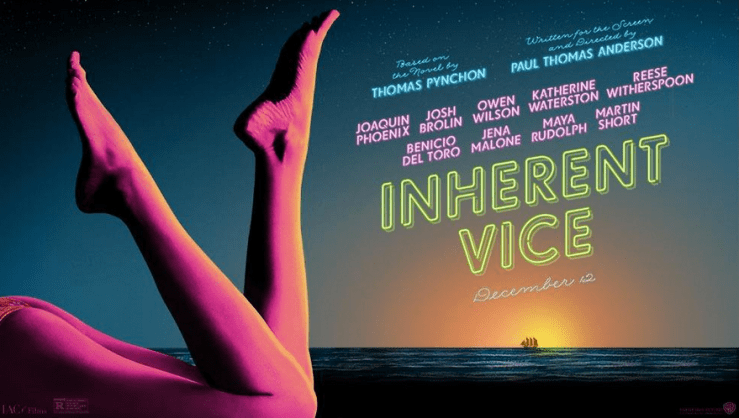
A few quick thoughts on Paul Thomas Anderson’s film Inherent Vice

IV POSTER HORIZONTAL

A. Let’s start with this: I need to see Paul Thomas Anderson’s film adaptation of Thomas Pynchon’s novel Inherent Vice again. Like, I’m compelled. 

B. But maybe a quick sketch before, no? Like, here in my office hours, before an afternoon class, when I should be shuffling through a few early papers—and, like away from the novel, which I’ve been rereading bits of? With the intention of re: point A seeing it again this weekend.

C. A claim, bold or otherwise: PTA’s film is better than Pynchon’s novel.

D. (Apples and oranges, bro, thou protest).

E. Okay so point C: What do I mean by better? I’m not really sure.

F. Maybe what I mean is: PTA slows down Pynchon’s novel. Expands the tension, the euphoria, the weirdness under the lines of dialogue.

G. (The film’s dialogue seems composed entirely from the text of the novel. Verbatim).

H. (But verbatim—how verbatim?: There are those gaps, those wonderful gaps that PTA fills—with color and smoke and sound and legs legs legs).

I. PTA also underlines plot connections for the reader, limning the paranoid contours that connect conspiracy-theory paranoia to vertically-integrated capitalism.

J. Okay, so point I: I’m not saying that clarifying the plot for the viewer (in a way that Pynchon arguably does not) makes the film, better—what I’m saying is that critics who contend the film fails to cohere are maybe missing the point.

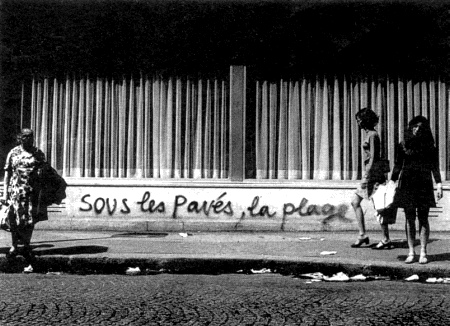
K. Here’s a point: Inherent Vice offers the most coherent and balanced conclusion of any of Paul Thomas Anderson’s film. The final act performs the spirit behind Pynchon’s letters, offering a vision of fraternal love, or of caritas, if not love—of partnerships, of how to feed the hungry, the famished. (Poor famished Bigfoot). Of resistance to the pavement.

tumblr_l13jimngTJ1qahhqf

L. Or, another way to flesh out point C, or revise point C:

PTA gives us—and by us let’s be clear I mean me—a new reading of the novel. (And of course not just PTA, but his marvelous ensemble, too marvelous to remark on at length here). PTA’s reading of Doc’s reunion with Shasta—surely one of the film’s most intense moments—is entirely different than my own reading, and rereading that scene after viewing, I feel like Anderson and Joaquin Phoenix and Katherine Waterston read the scene right, or read the scene, depict the scene, perform the scene in a way that illustrates the darkest strands of sunny smoky searing Inherent Vice.

M. The aforementioned scene—Doc reunited with one (sort of) partner—is balanced neatly against two other key scenes: The final scene between Doc and (sort of) partner Bigfoot, and the scene in which Doc restores Coy to his family. Brother’s keeper.

N. (Parenthetically: I fell in love with the movie in its opening minutes. In those opening drumbeats of Can’s “Vitamin C”).

O. So I have to rush to class and discuss Kate Chopin and not PTA’s Inherent Vice, which is what I’d rather riff on. Not really a world of inconvenience, but…(oh, and I love how that Pynchonian byword echoed through the film).

P. End on P for Pynchon and Paul TA and Promise: Promise to rewatch, reread, rewrite.

The true paranoid for whom all is organized in spheres joyful or threatening (Pynchon’s The Crying of Lot 49)

“Please,” the sailor said. “Go on now. You don’t want to stay here.” She looked in her purse, found a ten and a single, gave him the ten. “I’ll spend it on booze,” he said.
“Remember your friends,” said the arthritic, watching the ten.
“Bitch,” said the sailor. “Why didn’t you wait till he was gone?”
Oedipa watched him make adjustments so he’d fit easier against the mattress. That stuffed memory. Register A . . .
“Give me a cigarette, Ramírez,” the sailor said. “I know you got one.”
Would it be today? “Ramírez,” she cried. The arthritic looked around on his rusty neck. “He’s going to die,” she said.
“Who isn’t?” said Ramírez.
She remembered John Nefastis, talking about his Machine, and massive destructions of information. So when this mattress flared up around the sailor, in his Viking’s funeral: the stored, coded years of uselessness, early death, self-harrowing, the sure decay of hope, the set of all men who had slept on it, whatever their lives had been, would truly cease to be, forever, when the mattress burned. She stared at it in wonder. It was as if she had just discovered the irreversible process. It astonished her to think that so much could be lost, even the quantity of hallucination belonging just to the sailor that the world would bear no further trace of. She knew, because she had held him, that he suffered DT’s. Behind the initials was a metaphor, a delirium tremens, a trembling unfurrowing of the mind’s plowshare. The saint whose water can light lamps, the clairvoyant whose lapse in recall is the breath of God, the true paranoid for whom all is organized in spheres joyful or threatening about the central pulse of himself, the dreamer whose puns probe ancient fetid shafts and tunnels of truth all act in the same special relevance to the word, or whatever it is the word is there, buffering, to protect us from. The act of metaphor then was a thrust at truth and a lie, depending where you were: inside, safe, or outside, lost. Oedipa did not know where she was. Trembling, unfurrowed, she slipped sidewise, screeching back across grooves of years, to hear again the earnest, high voice of her second or third collegiate love Ray Glozing bitching among “uhs” and the syncopated tonguing of a cavity, about his freshman calculus; “dt,” God help this old tattooed man, meant also a time differential, a vanishingly small instant in which change had to be confronted at last for what it was, where it could no longer disguise itself as something innocuous like an average rate; where velocity dwelled in the projectile though the projectile be frozen in midflight, where death dwelled in the cell though the cell be looked in on at its most quick. She knew that the sailor had seen worlds no other man had seen if only because there was that high magic to low puns, because DT’s must give access to dt’s of spectra beyond the known sun, music made purely of Antarctic loneliness and fright. But nothing she knew of would preserve them, or him.

From Thomas Pynchon’s novel The Crying of Lot 49.

To give the spirit flesh. The words, who cares? (Thomas Pynchon’s The Crying of Lot 49)

“You don’t understand,” getting mad. “You guys, you’re like Puritans are about the Bible. So hung up with words, words. You know where that play exists, not in that file cabinet, not in any paperback you’re looking for, but—” a hand emerged from the veil of shower-steam to indicate his suspended head—“in here. That’s what I’m for. To give the spirit flesh. The words, who cares? They’re rote noises to hold line bashes with, to get past the bone barriers around an actor’s memory, right? But the reality is in this head. Mine. I’m the projector at the planetarium, all the closed little universe visible in the circle of that stage is coming out of my mouth, eyes, sometimes other orifices also.”

A favorite little riff from Pynchon’s novel The Crying of Lot 49.

Chapter X of James Weldon Johnson’s Masterpiece, The Autobiography of an Ex-Colored Man

Among the first of my fellow-passengers of whom I took any particular notice was a tall, broad-shouldered, almost gigantic, colored man. His dark-brown face was clean-shaven; he was well-dressed and bore a decidedly distinguished air. In fact, if he was not handsome, he at least compelled admiration for his fine physical proportions. He attracted general attention as he strode the deck in a sort of majestic loneliness. I became curious to know who he was and determined to strike up an acquaintance with him at the first opportune moment. The chance came a day or two later. He was sitting in the smoking-room, with a cigar, which had gone out, in his mouth, reading a novel. I sat down beside him and, offering him a fresh cigar, said: “You don’t mind my telling you something unpleasant, do you?” He looked at me with a smile, accepted the proffered cigar, and replied in a voice which comported perfectly with his size and appearance: “I think my curiosity overcomes any objections I might have.” “Well,” I said, “have you noticed that the man who sat at your right in the saloon during the first meal has not sat there since?” He frowned slightly without answering my question. “Well,” I continued, “he asked the steward to remove him; and not only that, he attempted to persuade a number of the passengers to protest against your presence in the dining-saloon.” The big man at my side took a long draw from his cigar, threw his head back, and slowly blew a great cloud of smoke toward the ceiling. Then turning to me he said: “Do you know, I don’t object to anyone’s having prejudices so long as those prejudices don’t interfere with my personal liberty. Now, the man you are speaking of had a perfect right to change his seat if I in any way interfered with his appetite or his digestion. I should have no reason to complain if he removed to the farthest corner of the saloon, or even if he got off the ship; but when his prejudice attempts to move me one foot, one inch, out of the place where I am comfortably located, then I object.” On the word “object” he brought his great fist down on the table in front of us with such a crash that everyone in the room turned to look. We both covered up the slight embarrassment with a laugh and strolled out on the deck.

We walked the deck for an hour or more, discussing different phases of the Negro question. In referring to the race I used the personal pronoun “we”; my companion made no comment about it, nor evinced any surprise, except to raise his eyebrows slightly the first time he caught the significance of the word. He was the broadest-minded colored man I have ever talked with on the Negro question. He even went so far as to sympathize with and offer excuses for some white Southern points of view. I asked him what were his main reasons for being so hopeful. He replied: “In spite of all that is written, said, and done, this great, big, incontrovertible fact stands out—the Negro is progressing, and that disproves all the arguments in the world that he is incapable of progress. I was born in slavery, and at emancipation was set adrift a ragged, penniless bit of humanity. I have seen the Negro in every grade, and I know what I am talking about. Our detractors point to the increase of crime as evidence against us; certainly we have progressed in crime as in other things; what less could be expected? And yet, in this respect, we are far from the point which has been reached by the more highly civilized white race. As we continue to progress, crime among us will gradually lose much of its brutal, vulgar, I might say healthy, aspect, and become more delicate, refined, and subtle. Then it will be less shocking and noticeable, although more dangerous to society.” Then dropping his tone of irony, he continued with some show of eloquence: “But, above all, when I am discouraged and disheartened, I have this to fall back on: if there is a principle of right in the world, which finally prevails, and I believe that there is; if there is a merciful but justice-loving God in heaven, and I believe that there is, we shall win; for we have right on our side, while those who oppose us can defend themselves by nothing in the moral law, nor even by anything in the enlightened thought of the present age.” Continue reading “Chapter X of James Weldon Johnson’s Masterpiece, The Autobiography of an Ex-Colored Man”