An Interview with Christopher K. Coffman and Daniel Lukes, Editors of William T. Vollmann: A Critical Companion (Part I)

William T. Vollmann: A Critical Companion, new from University of Delaware Press, collects academic essays and memoir-vignettes by a range of critics and authors to make the case that Vollmann is, as the blurb claims, the “most ambitious, productive, and important living author in the US.” I interviewed the book’s editors, Christopher K. Coffman and Daniel Lukes, over a series of emails.

If you live in NYC (or feel like traveling), you can check out the book launch for William T. Vollmann: A Critical Companion this weekend, hosted by Coffman and Lukes (4:30pm at the 11th Street Bar).

This is the first part of a two-part interview.

IMG_5107

Biblioklept: How did William T. Vollmann: A Critical Companion come about?

Daniel Lukes: The starting point would be the MLA panel I put together in January 2011, called “William T. Vollmann: Methodologies and Morals.” Chris’s was the first abstract I received and I remember being impressed with its confidence of vision. Michael Hemmingson also gave a paper, and Larry McCaffery was kind enough to act as respondent. Joshua Jensen was also a panelist. I kept in touch with Chris and we very soon decided that there was a hole in the market, so to speak, so we put out a call for papers and took it from there.

One of my favorite things about putting together this book has been connecting with – and being exposed to – such a range of perspectives on Vollmann: people seem to come at him from – and find in his works – so many different angles. It’s bewildering and thrilling to talk about the same author with someone and not quite believe you are doing so. And I think this started for me, in a way, at least as far as this book is concerned, with reading Chris’ MLA abstract.

Biblioklept: I first heard about Vollmann in connection to David Foster Wallace (Wallace namechecks him in his essay “A Supposedly Fun Thing I’ll Never Do Again”). A friend “loaned” me his copy of The Ice-Shirt and I never gave it back. When was the first time you read Vollmann?

Christopher K. Coffman: I first encountered William T. Vollmann’s work about ten years ago. At the time, I had just finished grad school, and as my dissertation work had been focused on aspects of modern and contemporary poetry, I had let my attention to contemporary prose slip a bit. When I realized this had happened, I starting reading a lot of recent fiction. Of course David Foster Wallace’s books were part of this effort, and I, like so many others, really developed a love for Infinite Jest and some of the stories in Girl with Curious Hair. My memory’s a bit fuzzy on the timeline, but my best guess, given what I know I was reading and thinking about at the time, is that in my reading around DFW I discovered the Summer 1993 issue of The Review of Contemporary Fiction with which Larry McCaffery had been involved, and that the interview with DFW in that issue–along with the WTV materials themselves–woke me up to WTV and his work. I can’t say enough about how important Larry’s championing of WTV has been, and continues to be. Of course, one could say that about his support for so many of the interesting things that have happened in fiction during the past three or four decades. His interviews, his editorial work, the part he played with the Fiction Collective …. the list of the ways that he identifies and promotes some of the best work out there could go on for a while, and no one else that I know of has done it as well as Larry has for as long as he has. Anyway, as I was pretty much broke at the time, my reading choices were governed in large part by what I could find at libraries or local used bookstores, and The Ice-Shirt was the first volume I came across in one of these venues. I was already a huge fan of The Sot-Weed Factor and Mason & Dixon, and the entire Seven Dreams project very much struck me as a next step forward along the trajectory those books described. As a consequence, I immediately started tracking down and reading not only the rest of the Dreams, but also everything else I could find by WTV.

What about The Ice-Shirt that really won me over, aside from my impression that this was another brilliant reinterpretation of the historical novel, is that WTV was clearly bringing together and pushing to their limits some of my favorite characteristics of post-1945 American fiction (structural hijinks of a sort familiar from works by figures like Barth and Barthelme, a fearlessness in terms of subject matter and the occasional emergence of a vatic tone that reminded me of Burroughs, an autofictional element of the sort you see in Hunter S. Thompson). Furthermore, as a literary critic, I was really intrigued by two additional aspects of the text: the degree to which The Ice-Shirt foregrounds the many ways that it is itself an extended interpretation of earlier texts (the sagas on which he draws for many of the novel’s characters and much of its action), and the inclusion of extensive paratexts–the notes, glossaries, timelines, and so forth. In short, this seemed like a book that united my favorite characteristics of contemporary literary fiction with a dedication to the sort of work that I, as a scholar, spend a lot of my time doing. How could I resist? It took my readings of a few more of WTV’s books for me to be able to recognize what I would argue are his other most significant characteristics: his global scope and his deep moral vision.

As for your also having begun reading WTV with The Ice-Shirt: It’s an interesting coincidence to me that we both started with that book. I have always assumed that most people start into WTV via either the prostitute writings (which have a sort of underground cachet by virtue of subject matter) or Europe Central (which is of course the book that got the most mainstream attention), but here we both are with The Ice-Shirt. WTV has indicated he sees it as under-realized in certain ways, but I am still quite fond of it, even in comparison to some of the later books. Continue reading “An Interview with Christopher K. Coffman and Daniel Lukes, Editors of William T. Vollmann: A Critical Companion (Part I)” →
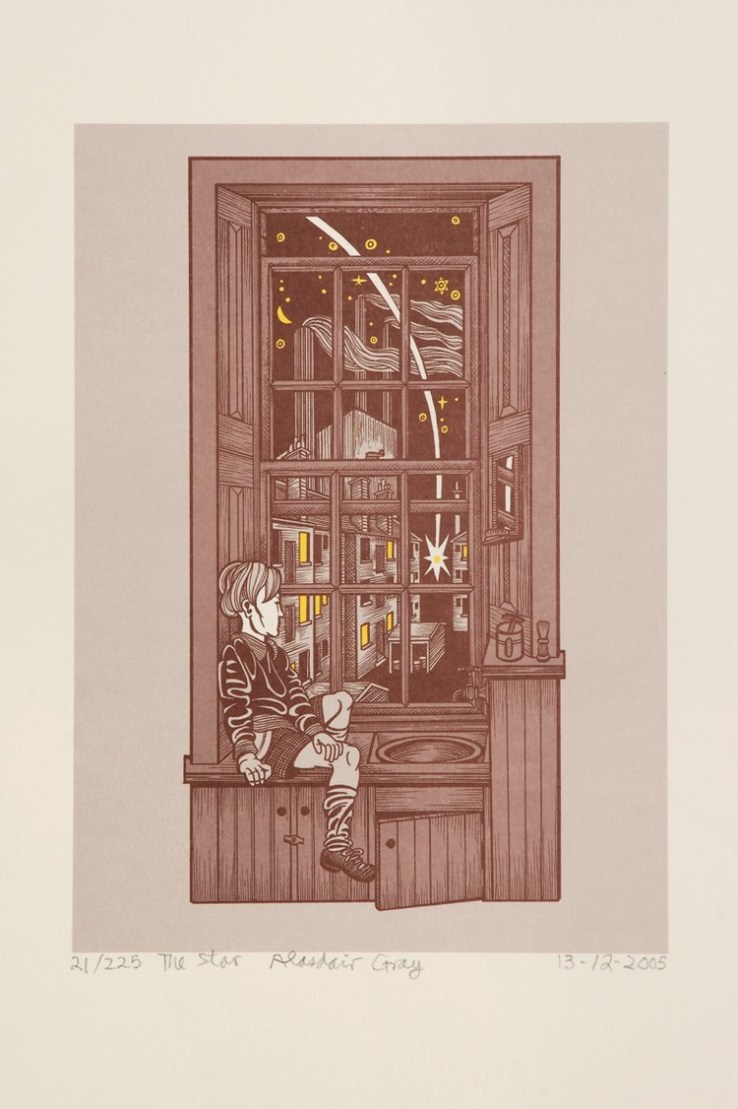
The Star — Alasdair Gray

3914-graya052094-alasdair-gray-the-star-2005

The Star is one of several pieces of art by Alasdair Gray that accompany Rodge Glass’s review of the Scottish novelist’s collection of non-fiction pieces, Of Me & Others. The first paragraph of Glass’s piece:

At the time I finished my biography of the polymath Alasdair Gray, in 2008, my subject was at a curious juncture. Though an artist for six decades, he remained a footnote in his country’s art world. Though the author of the most celebrated Scottish novel in the last hundred years, Lanark, and several others which altered the literary landscape of his home city, Glasgow, beyond recognition (Poor Things, 1982, Janine, Unlikely Stories, Mostly) he was dependent on a small Royal Literary Fund grant and regular scraps from various overdue projects for his living. (Gray is, was, and always will be a Republican. He once turned down a knighthood.) 2007 saw the publication of what he called “my final novel,” labeled as such because he’d quite simply run out of old unpublished manuscripts to pilfer ideas from. The spares drawer was now empty. Meanwhile, no matter how many times he reminded folks that he had stolen it from the Canadian poet Dennis Lee, he was still always credited with the only quote outside the still-new Scottish Parliament building: Work as if you live in the early days of a better nation. In his old age, there was talk of him becoming that most disgraceful of things—an uncontroversial “national treasure,” awaiting death, then platitudes from the great and the good, and then probably—the horror!—a statue. All this was an ominous sign for an artist who had always defined himself in opposition to political power.

“Language” — Ezra Pound

“Language”

by

Ezra Pound

from A Retrospect

Use no superfluous word, no adjective which does not reveal something.

Don’t use such an expression as “dim lands of peace.” It dulls the image. It mixes an abstraction with the concrete. It comes from the writer’s not realizing that the natural object is always the adequate symbol.

Go in fear of abstractions. Do not retell in mediocre verse what has already been done in good prose. Do’t think any intelligent person is going to be decieved when you try to shirk all the difficulties of the unspeakably difficult art of good prose by chopping your composition into line lengths.

What the expert is tired of today the public will be tired of tomorrow.

Don’t imagine that the art of poetry is any simpler than the art of music, or that you can please the expert before you have spent at least as much effort on the art of verse as an average piano teacher spends on the art of music.

Be influenced by as many great artists as you can, but have the decency either to acknowledge the debt outright, or to try to conceal it.

Don’t allow “influence” to mean merely that you mop up the particular decorative vocabulary of some one or two poets whom you happen to admire. A Turkish war correspondent was recently caught red-handed babbling in his despatches of “dove-grey” hills, or else it was “pearl-pale,” I can not remember.

Use either no ornament or good ornament.

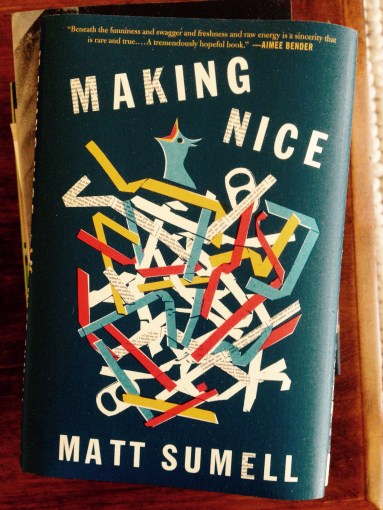
Matt Sumell’s Making Nice (Book acquired some time in January)

IMG_4953

I was hoping to save up a little energy to write a bit about the stories I’ve read in Matt Sumell’s debut collection Making Nice…but I don’t seem to have it. There’s a macho swagger here that will repel a lot of folks but hell I’m a barbarian and I dig what he’s doing, even if it’s been done by a few (many) other folks before (there’s that Carver/Johnson/Lipsyte axis, yes)—it’s funny and savage stuff. Continue reading “Matt Sumell’s Making Nice (Book acquired some time in January)” →

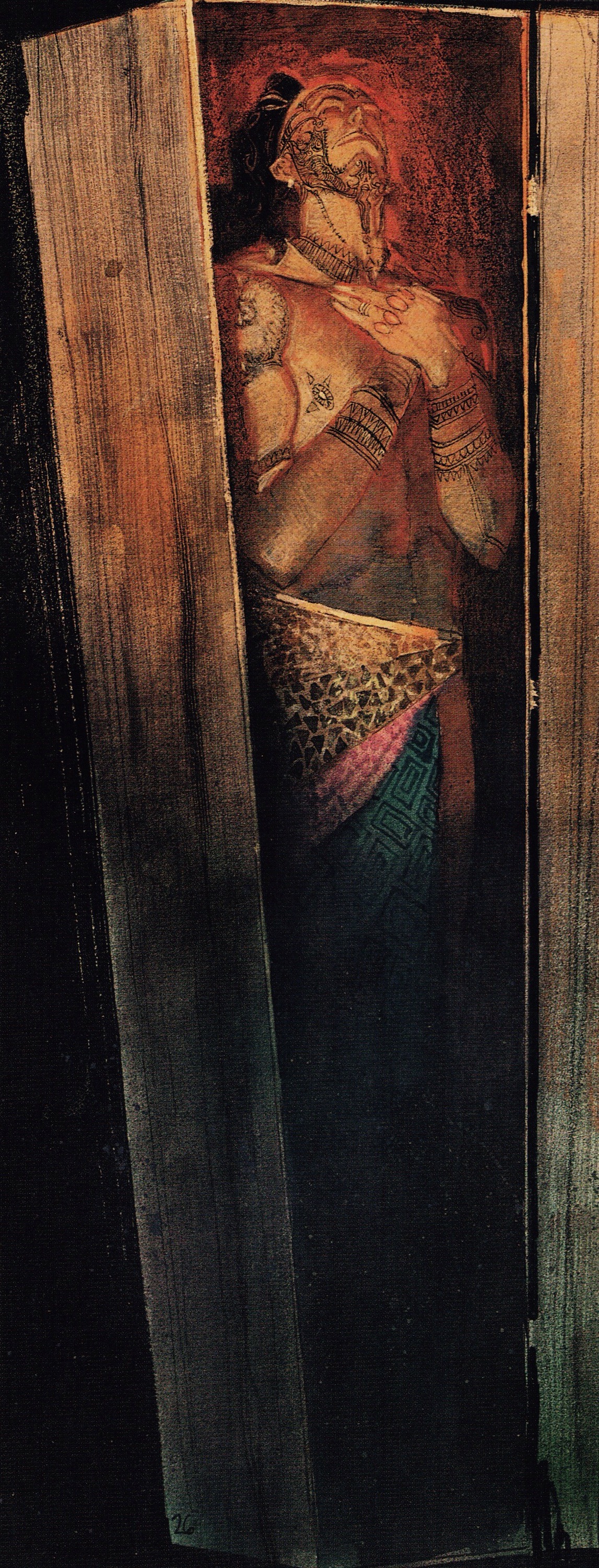
Queequeg in His Coffin — Bill Sienkiewicz

IMG_5094

Happy Breece D’J Pancake Day

bdjp

Today is Shrove Tuesday or Fat Tuesday or Mardi Gras—or Pancake Day if you like. Besides his unusual last name, there is basically no connection between this pre-Lenten day and the West Virginian writer Breece D’J Pancake. But whatever. Pancake remains woefully under-read—so any occasion for notice, yes?

Breece Pancake’s stories are compact, sad, and beautiful. Haunting is a fair word—these tales stick with you. Pancake’s evocation of place and mood are so strong that it’s often a relief to leave the little world he’s painted for the reader. (Does that sound like a negative criticism? ‘Twas not meant to be).

There’s not much Pancake to read—just one collection of short stories, posthumously published. Pancake shot himself in the head a few months before his 27th birthday. In his afterword to The Stories of Breece D’J Pancake, John Casey points out that Pancake had not yet achieved his full vision of his writing (he also explains the unusual punctuation in the author’s name):

When he sold his first story to The Atlantic he scarcely took a breath. (He did do one thing by way of celebration. The galley proofs came back with the middle initials of his name set up oddly: Breece D’J Pancake. He said fine, let it stay that way. It made him laugh, and, I think, it eased his sense of strain—the strain of trying to get things perfect—to adopt an oddity committed by a fancy magazine.) He was glad, but the rhythm of his work didn’t let him glory or even bask. He had expected a great deal from his work, and I think he began to feel its power, but he also felt he was still far from what he wanted.

Obviously, we can lament that we don’t get to read what Pancake might have written—or we can read what he gave us and be grateful. There’s “Hollow”, “The Honored Dead,” and “In the Dry”—go ahead, those links are for full-text stories. Don’t be afraid to click.

Pancake’s most well-known story might be “Trilobites” — here are the first few paragraphs:

I open the truck’s door, step onto the brick side street. I look at Company Hill again, all sort of worn down and round. A long time ago it was real craggy, and stood like an island in the Teays River. It took over a million years to make that smooth little hill, and I’ve looked all over it for trilobites. I think how it has always been there and always will be, least for as long as it matters. The air is smoky with summertime. A bunch of starlings swim over me. I was born in this country and I have never very much wanted to leave. I remember Pop’s dead eyes looking at me. They were real dry, and that took something out of me. I shut the door, head for the café.


I see a concrete patch in the street. It’s shaped like Florida, and I recollect what I wrote in Ginny’s yearbook: “We will live on mangoes and love.” And she up and left without me—two years she’s been down there without me. She sends me postcards with alligator wrestlers and flamingos on the front. She never asks me any questions. I feel like a real fool for what I wrote, and go into the café.


The place is empty, and I rest in the cooled air. Tinker Reilly’s little sister pours my coffee. She has good hips. They are kind of like Ginny’s and they slope nice curves to her legs. Hips and legs like that climb steps into airplanes. She goes to the counter end and scoffs down the rest of her sundae. I smile at her, but she’s jailbait. Jailbait and black snakes are two things “Won’t touch with a window pole. One time I used an old black snake for a bullwhip, snapped the sucker’s head off, and Pop beat hell out of me with it. I think how Pop could make me pretty mad sometimes. I grin.

Why isn’t the story in my Norton Anthology of American Literature?

Do you want more than those paragraphs? Here’s Joyce Carol Oates on Pancake, from her 1983 NYT review of the collection:

The most powerful of the stories – ”Trilobites,” ”Hollow,” ”Fox Hunters,” ”The Scrapper,” ”In the Dry” – are as compactly and tightly written as prose poems and should be read (and reread) with extreme care. The author’s method is to create an atmosphere of extreme tension in his readers as well as in his protagonists. The stories’ opening paragraphs often announce in embryo what will follow, so that the narrative is thematically complete before, in a sense, it begins, and one feels the inexorable bars of circumstance closing about the characters. And the writing, lean, taut, pared back, near-flawless in its uninflected cadences, is perfectly suited to its content.

Over three decades after that review, there’s still a sense that Pancake hasn’t quite gotten his due. Here’s Jon Michaud, writing almost exactly a year ago in The New Yorker:

…Pancake deserves to be more than a writer’s writer. In his stories, objects are constantly being unearthed: fossils and coal from the earth, skeletons and arrowheads from Indian burial grounds. “The Stories of Breece D’J Pancake” is a sharp, flinty object, an arrowhead left behind by a talented and tragic young author. It would be easy to allow his one collection of stories to be buried under the landslide of books published every year. But it’s worth doing a little excavating to dig it up. The past few years have seen late-in-the-day and posthumous revivals of interest in writers such as Renata Adler, Elena Ferrante, and John Williams. Get out your pickaxes. It’s high time for a Pancake revival.

I agree.

“Hinges” — Shel Silverstein

IMG_5093

Read “Uncle Sam Carrington,” a short story by Leonora Carrington

“Uncle Sam Carrington”

by

Leonora Carrington

When Uncle Sam Carrington saw the full moon he was never able to stop laughing. A sunset had the same effect on Aunt Edgeworth. These two events created much suffering for my mother who took pleasure in a certain social prestige.

At the age of eight I was considered the most serious person in the family. My mother confided in me. She said that it was shameful that nobody would invite her out, that Lady Cholmendley-Bottame did not say Good Afternoon to her in the street. I was deeply upset.

Uncle Sam Carrington and Aunt Edgeworth lived in the house. They occupied the first floor. Thus, nothing could be done to hide this lamentable state of affairs. During the daytime I asked myself how I could free the family of this shame. Finally, it was impossible for me to bear the tension and my mother’s tears, things that made me suffer greatly. I decided to search for the solution. One afternoon when the sun had become very red and Aunt Edgeworth rejoiced in an especially repugnant manner, I took a jar of sweets, a loaf of bread and took to the road. In order to frighten the bats, I sang “O come into the garden, Maude, and hear the blackbirds sing!” (O, van al jardín, Maude, y escucha el canto de los miñes!)

My father sang this song when he wasn’t going to church, and another that began so: “It cost me seven shillings and sixpence.” (Esto me costo siete chelines y seis peniques.) I sang both songs with the same emotion.

“Good—” I thought, the trip has begun. Night certainly will bring me a solution. If I count the trees up to the place where I am going, I will not lose my way. Upon returning I will remember the number of trees.” But I forgot that I only knew how to count up to ten, and even then I made mistakes. So, in a little while I counted up to 10 several times until I became completely lost. Trees surrounded me everywhere.

“I am in the forest,” I said to myself. I was right.

The full moon diffused its clarity among the trees which permitted me to see some meters in front of me and the reason for a disquieting noise. Two cabbages that were fighting terribly made the disturbance. They tore off each other’s leaves with such ferocity that soon there were only a few sad leaves everywhere, and nothing of the cabbages.

“It doesn’t matter,” I said to myself. “It’s nothing more than a nightmare.” But suddenly I remembered that that night I had not gone to bed and, therefore, I could not treat it as a nightmare.

“It’s horrible,” I thought.

After that, I picked up the cadavers and continued my walk. In a little while, I came across a friend: the horse that, years later, would play an important part in my life.

“Hello!” he said to me. “Are you looking for something?” I explained to him the object of my excursion at such an advanced hour in the evening.

“Evidently,” he said, “from the social point of view it’s most complicated. Around here live two ladies who are occupied with similar questions. Your pursued goal consists in the eradication of your family shame. They are two very wise ladies. If you want, I will take you to them.”

The Señoritas Cunningham-Jones had a house surrounded discretely by uncultivated weeds and moss of another era. They were found in the garden about to play a game of checkers. The horse stuck out his head between the legs of some 1890 knickers and directed the word to the señoritas Cunningham-Jones.

“Let your little friend enter,” said the señorita who was seated at the right in a very distinct accent. “We are always ready to help in the matter of respectability.”

The other señorita bent her head benevolently. She was wearing a huge hat adorned with all kinds of horticultural specimens.

“Your family, señorita,” she said to me, offering me a Louis XV style chair, “does it continue the line of our beloved and lamented Duke of Wellington or that of Sir Walter Scott, that noble aristocrat of fine literature?”

I was a bit confused. There were no aristocrats in my family.

Taking notice of my fright, she said to me with the most enchanting smile: “Dear girl, you must realize that here we only arrange matters of the oldest and most noble families of England.”

A sudden inspiration illuminated my face. “In the dining room, at home…” I said.

The horse gave me a strong kick in the backseat.

“Don’t ever speak of anything so vulgar as food,” he said to me in a low voice.

Luckily, the señoritas were a little deaf. Correcting myself, I continued, perplexed. ln the living room there is a table upon which, it is said, a duchess left her glasses in 1700.”

“In that case,” the señorita answered, “Perhaps we can come to an agreement, but naturally, señorita, we will see ourselves obliged to ask for a somewhat steep reward.”

We easily understood each other. The señoritas got up saying: “Wait here some minutes; we will give you what you need. Meanwhile you can look at the illustrations in this book. It’s instructive and interesting. No library is complete without this volume. My sister and I always have lived by that admirable example.”

The book was titled: The Secrets of the Flowers of Distinction and the Coarseness of Food. When the two women had left, the horse asked: “Do you know how to walk without making a sound?”

“Certainly,” I answered.

“Then let’s see the señoritas devoted to their work,” he said. “But if your life matters to you, don’t make a sound.”

The señoritas were in their orchard which extended behind the house, surrounded by a wide wall. I mounted the horse and a surprising scene offered itself to my eyes: the señoritas Cunningham-Jones, each armed with an immense whip, were striking the vegetables, and shouting: “It’s necessary to suffer in order to go to heaven. Those who do not wear corsets will never arrive.”

The vegetables, on their part, fought among themselves, and the older ones threw the smaller ones at the señoritas with angry screams.

“Each time it happens so,” murmured the horse. “They are the vegetables that suffer on behalf of humanity. Soon you will see how they pick one for you, one that will die for the cause.”

The vegetables did not have an enthusiastic air over dying an honorable death. But the señoritas were stronger. Soon two carrots and a little cabbage fell between their hands.

“Quickly!” exclaimed the horse. “Back.”

Scarcely had we again sat down in front of THE COARSENESS OF FOOD, when the señoritas entered with the exact appearance as before. They gave me a little package that contained the vegetables, and in exchange for this I paid them with the jar of sweets and the little fritters.

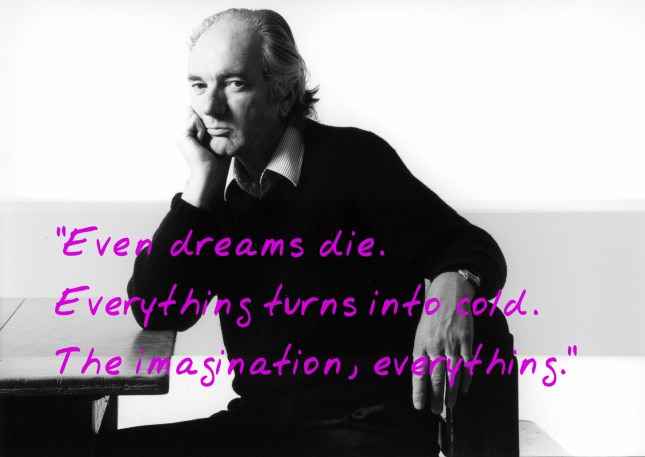
Valentine’s Day Wishes from Thomas Bernhard

tb1

tb2

tb3

tb5

tb6

ThomasBernhardWalking

Zora Neale Hurston’s Love Spells

Conjure up some last-minute romance. In the appendix to her collection of Florida folktales, Mules and Men, author Zora Neale Hurston offers up a host of Hoodoo, including the following love spells:

TO MAKE A MAN COME HOME

Take nine deep red or pink candles. Write his name three times on each candle. Wash the candles with Van-Van. Put the name three times on paper and place under the candles, and call the name of the party three times as the candle is placed at the hours of seven, nine or eleven.

TO MAKE PEOPLE LOVE YOU

Take nine lumps of starch, nine of sugar, nine teaspoons of steel dust. Wet it all with Jockey Club cologne. Take nine pieces of ribbon, blue, red or yellow. Take a dessertspoonful and put it on a piece of ribbon and tie it in a bag. As each fold is gathered together call his name. As you wrap it with yellow thread call his name till you finish. Make nine bags and place them under a rug, behind an armoire, under a step or over a door. They will love you and give you everything they can get. Distance makes no difference. Your mind is talking to his mind and nothing beats that.

TO BREAK UP A LOVE AFFAIR

Take nine needles, break each needle in three pieces. Write each person’s name three times on paper. Write one name backwards and one forwards and lay the broken needles on the paper. Take five black candles, four red and three green.

Tie a string across the door from it, suspend a large candle upside down, It will hang low on the door; bum one each day for one hour. If you burn your first in the daytime, keep on in the day; if at night, continue at night. A tin plate with paper and needles in it must be placed to catch wax in.

When the ninth day is finished, go out into the street and get some white or black dog dung. A dog only drops his dung in the street when he is running and barking, and whoever you curse will run and bark likewise. Put it in a bag with the paper and carry it to running water, and one of the parties will leave town.

Ticket of Admission to a Lecture by Walt Whitman on Abraham Lincoln

Ticket of admission to a lecture by Walt Whitman on Abraham Lincoln,"  initialed by Whitman at lower right. Lecture "to be delivered on Thursday, April 14th [1887], at 4 o'clock P. M., in the Madison Square Theatre, New-York."

(Via/about).

Conversation (Tom Clark fragment)

Tom Clark

(From “Bugs Ate This Lake Clean,” collected in Light & Shade).

“When the Devil Was Well” — Gertrude Atherton

“When the Devil Was Well”

by

Gertrude Atherton

The Devil locked the copper gates of Hell one night, and sauntered down a Spacian pathway. The later arrivals from the planet Earth had been of a distressingly commonplace character to his Majesty–a gentleman of originality and attainments, whatever his disagreements with the conventions. He was become seriously disturbed about the moral condition of the sensational little twinkler.

“What are my own about?” he thought, as he drifted past planets which yielded up their tributes with monotonous regularity. “What a squeezed old orange would Earth become did I forsake it! I must not neglect it so long again; my debt of gratitude is too great. Let me see. Where shall I begin? It is some years since I have visited America in person, and unquestionably she has most need of my attention; Europe is in magnificent running order. This is a section of her, if my geography does not fail me; but what? I do not recall it.”

He poised above a country that looked as if it still hung upon the edge of chaos: wild, fertile, massive, barren, luxuriant, crouching on the ragged line of the Pacific. From his point of vantage he saw long ranges of stupendous mountains, some but masses of scowling crags, some green with forests of mammoth trees projecting their gaunt rigid arms above a carpet of violets; indolent valleys and swirling rivers; snow on the black peaks of the North; the riotous colour of eternal summer in the South. Suddenly he uttered a sharp exclamation and swept downward, halting but a mile above the ground. He frowned heavily, then smiled–a long, placid, sardonic smile. There appeared to be but few inhabitants in this country, and those few seemed to live either in great white irregular buildings, surmounted by crosses, in little brown huts near by, in the caves, or in hollowed trees on the mountains. The large buildings were situated about sixty miles apart, in chosen valleys; they were imposing and rambling, built about a plaza. They boasted pillared corridors and bright red tiles on their roofs. Within the belfries were massive silver bells, and the crosses could be seen to the furthermost end of the valley and from the tops of the loftiest mountain.

“California!” exclaimed the Devil. “I know of her. Her scant history is outlined in the Scarlet Book. I remember the points: Climate, the finest, theoretically, in the world; satanically, simply magnificent. I have waited impatiently for the stream of humanity to deflect thitherward, but priests will answer my present purpose exactly–unless they are all too tough. To continue, gold under that grass in chunks–aha! I shall have to throw out an extra wing in Hell! Parched deserts where men will die cursing; fruitful valleys, more gratifying to my genius; about as much of one as of the other, but the latter will get all the advertising, and the former be carefully kept out of sight. Everything in the way of animal life, from grizzly bears to fleas. A very remarkable State! Well, I will begin on the priests.” Continue reading ““When the Devil Was Well” — Gertrude Atherton” →

“Wake” — Langston Hughes

wake

Read “Spunk,” a short story by Zora Neale Hurston

“Spunk”

by

Zora Neale Hurston

A giant of a brown-skinned man sauntered up the one street of the Village and out into the palmetto thickets with a small pretty woman clinging lovingly to his arm.

“Looka theah, folkses!” cried Elijah Mosley, slapping his leg gleefully. “Theah they go, big as life an’ brassy as tacks.”

All the loungers in the store tried to walk to the door with an air of nonchalance but with small success.

“Now pee-eople!” Walter Thomas gasped. “Will you look at ’em!”

“But that’s one thing Ah likes about Spunk Banks—he ain’t skeered of nothin‘ on God’s green footstool—nothin’! He rides that log down at saw-mill jus‘ like he struts ’round wid another man’s wife—jus‘ don’t give a kitty. When Tes’ Miller got cut to giblets on that circle-saw, Spunk steps right up and starts ridin’. The rest of us was skeered to go near it.”

A round-shouldered figure in overalls much too large, came nervously in the door and the talking ceased. The men looked at each other and winked.

“Gimme some soda-water. Sass’prilla Ah reckon,” the newcomer ordered, and stood far down the counter near the open pickled pig-feet tub to drink it.

Elijah nudged Walter and turned with mock gravity to the new-comer.

“Say, Joe, how’s everything up yo‘ way? How’s yo’ wife?”

Joe started and all but dropped the bottle he held in his hands. He swallowed several times painfully and his lips trembled.

“Aw ‘Lige, you oughtn’t to do nothin’ like that,” Walter grumbled. Elijah ignored him.

“She jus‘ passed heah a few minutes ago goin’ theta way,” with a wave of his hand in the direction of the woods.

Now Joe knew his wife had passed that way. He knew that the men lounging in the general store had seen her, moreover, he knew that the men knew he knew. He stood there silent for a long moment staring blankly, with his Adam’s apple twitching nervously up and down his throat. One could actually see the pain he was suffering, his eyes, his face, his hands and even the dejected slump of his shoulders. He set the bottle down upon the counter. He didn’t bang it, just eased it out of his hand silently and fiddled with his suspender buckle.

“Well, Ah’m goin‘ after her to-day. Ah’m goin’ an’ fetch her back. Spunk’s done gone too fur.”

He reached deep down into his trouser pocket and drew out a hollow ground razor, large and shiny, and passed his moistened thumb back and forth over the edge.

“Talkin‘ like a man, Joe. Course that’s yo’ fambly affairs, but Ah like to see grit in anybody.”

Joe Kanty laid down a nickel and stumbled out into the street.

Dusk crept in from the woods. Ike Clarke lit the swinging oil lamp that was almost immediately surrounded by candle-flies. The men laughed boisterously behind Joe’s back as they watched him shamble woodward.

“You oughtn’t to said whut you did to him, Lige—look how it worked him up,” Walter chided.

“And Ah hope it did work him up. ‘Tain’t even decent for a man to take and take like he do.”

“Spunk will sho’ kill him.”

“Aw, Ah doan’t know. You never kin tell. He might turn him up an‘ spank him fur gettin’ in the way, but Spunk wouldn’t shoot no unarmed man. Dat razor he carried outa heah ain’t gonna run Spunk down an‘ cut him, an’ Joe ain’t got the nerve to go up to Spunk with it knowing he totes that Army 45. He makes that break outa heah to bluff us. He’s gonna hide that razor behind the first likely palmetto root an‘ sneak back home to bed. Don’t tell me nothin’ ’bout that rabbit-foot colored man. Didn’t he meet Spunk an‘ Lena face to face one day las’ week an‘ mumble sumthin’ to Spunk ‘bout lettin’ his wife alone?”

“What did Spunk say?” Walter broke in—“Ah like him fine but ‘tain’t right the way he carries on wid Lena Kanty, jus’ cause Joe’s timid ‘bout fightin’.”

“You wrong theah, Walter. ‘Tain’t cause Joe’s timid at all, it’s cause Spunk wants Lena. If Joe was a passle of wile cats Spunk would tackle the job just the same. He’d go after anything he wanted the same way. As Ah wuz sayin’ a minute ago, he tole Joe right to his face that Lena was his. ‘Call her,’ he says to Joe. ‘Call her and see if she’ll come. A woman knows her boss an’ she answers when he calls.‘ ’Lena, ain’t I yo‘ husband?’ Joe sorter whines out. Lena looked at him real disgusted but she don’t answer and she don’t move outa her tracks. Then Spunk reaches out an‘ takes hold of her arm an’ says: ‘Lena, youse mine. From now on Ah works for you an’ fights for you an‘ Ah never wants you to look to nobody for a crumb of bread, a stitch of close or a shingle to go over yo’ head, but me long as Ah live. Ah’ll git the lumber foh owah house to-morrow. Go home an‘ git yo’ things together! ‘

” ‘Thass mah house,’ Lena speaks up. ‘Papa gimme that.’

“‘Well,’ says Spunk, ‘doan give up whut’s yours, but when youse inside don’t forgit youse mine, an’ let no other man git outa his place wid you!’

“Lena looked up at him with her eyes so full of love that they wuz runnin‘ over, an’ Spunk seen it an‘ Joe seen it too, and his lip started to tremblin’ and his Adam’s apple was galloping up and down his neck like a race horse. Ah bet he’s wore out half a dozen Adam’s apples since Spunk’s been on the job with Lena. That’s all he’ll do. He’ll be back heah after while swallowin‘ an’ workin‘ his lips like he wants to say somethin’ an’ can’t.”

“But didn’t he do nothin‘ to stop ’em?”

“Nope, not a frazzlin‘ thing—jus’ stood there. Spunk took Lena’s arm and walked off jus‘ like nothin’ ain’t happened and he stood there gazin‘ after them till they was outa sight. Now you know a woman don’t want no man like that. I’m jus’ waitin‘ to see whut he’s goin’ to say when he gits back.” Continue reading “Read “Spunk,” a short story by Zora Neale Hurston” →

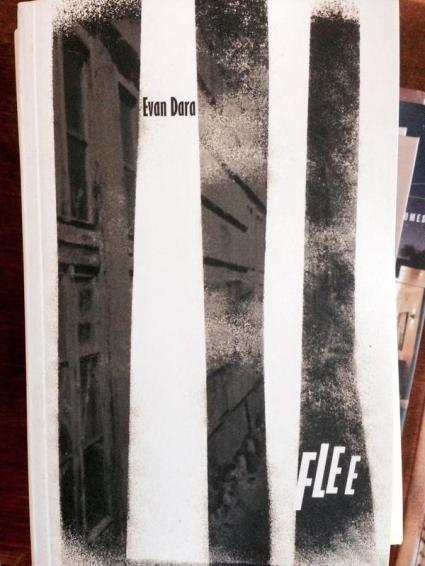
Some notes on beginning Evan Dara’s novel Flee

B8jFz0WCYAAghDz

A. What a cover on Evan Dara’s 2013 novel Flee, don’t you agree?

B. From the back cover:

IMG_5030

C. That’s all there is. Well, okay, there’s an ISBN too. But no blurbs, no other text.

D. “Something always going on—” is the first line of Flee. It’s also an apt description of Dara’s formal technique, a constantly-shifting series of dialogues, monologues, overlapping, cross-cutting, diverging—always out there ahead of the reader. That dash there—that dash is the simple summative signal of it all, a little typographic pole that simultaneously connects and interrupts.

E. The most obvious point of comparison for Dara’s technique (besides his amazing debut novel The Lost Scrapbook) is William Gaddis’s stuff, particularly J R—the verbal dazzle, the few stray lines of poetic stage-setting in lieu of traditional exposition—the throw-the-reader-in-the-deep-end stuff. David Foster Wallace frequently attempted the same rhetorical mode, most successfully in §19 of The Pale King. (It’s entirely likely that The Lost Scrapbook could have had the same following that Infinite Jest achieved had Dara done anything to promote the book. But here I think of Gaddis in his Paris Review interview: “I’d go back to The Recognitions where Wyatt asks what people want from the man they didn’t get from his work, because presumably that’s where he’s tried to distill this ‘life and personality and views’ you speak of. What’s any artist but the dregs of his work: I gave that line to Wyatt thirty-odd years ago and as far as I’m concerned it’s still valid”).

F. The point of contrast though is Dara’s abrupt transition, sometimes it seems mid-sentence, from one speaker to the next. Just as we feel (nearly) comfortable with who this particular narrator might be, another voice interjects, or rather continues, or re-trajects the discourse—as in the second chapter of Flee (“38,842”), where a college student driving home in snowy weather to pick up a book by Paul Krugman gives over to a number of speakers all describing the closing of the local university, Pitkinson (this closing’s being the presumable, like, plot of Flee so far I suppose)—faculty and staff and townies and residents—until a grad student takes over to report the speech of one Professor Gray, himself bearing witness to the downfall of the school (Ghost Sociology is the issue)—and then of course the chapter gives over to more rumor, more speculation. “Something always going on—.”

G. So I’ve read the first three chapters (“38,839,” “38,842,” “36,551”). But wait: The next chapter (“35,717”–do the titles reflect the dwindling population of the town (Anderburg)?)—but wait the next chapter, I see by scanning, offers some new, perhaps, rhetorical gesture—a section in a different font? Chunkier paragraphs?

I have to go see about this. (More to come).

Jane Bowles’s novel Two Serious Ladies confounds with sinister humor and dark delight

Two Women, Gwen John

Here’s a short review of Jane Bowles’s only novel, Two Serious Ladies: The book is amazing, a confounding, energetic picaresque suffused with sinister humor and dark delight. I read it knowing nothing about the plot on the recommendation of Ben Marcus, who described it as “so insane, so beautiful, and in some sense, unknowable to me. On the surface, it’s not really about much, but the arrangement of words does something chemical to me.” My recommendation is to dispense with the rest of my review and read Bowles’s novel.

“Unknowable” is a fair description, and Two Serious Ladies was met with bewilderment when it was first published in 1943, as Negar Azimi points out in the comprehensive essay “The Madness of Queen Jane”:

Edith Walton, writing in the Times Book Review, called the book senseless and silly: “To attempt to unravel the plot of ‘Two Serious Ladies’ would be to risk, I am sure, one’s own sanity.” Another reviewer said, simply, “The book is about nothing.” Jane’s family, in the meantime, found it unseemly in its stark depiction of lesbianism. Its characters, who have goals and motivations that are hard to grasp, were difficult to relate to. Yet another critic wrote, “The only shocking thing about this novel is that it ever managed to find its way to print.” Jane was only twenty-four.

The notion that “The book is about nothing,” is corrected by Marcus’s qualifier about its “surface”: Two Serious Ladies moves through the phenomenological world that its characters experience, but it does not mediate the concrete contours of that world in a way that its characters can name for the reader. When the characters, those two serious ladies, do stumble into language that might name, pin down, or otherwise fix their experience, fix their consciousness into a stable relation with the world, Bowles spins the wheel again, flings her characters into new scenarios. Moments of epiphany are transitory and hard-purchased. A (perhaps) illustrating passage, offered without context:

Mrs. Copperfield started to tremble after the girl had closed the door behind her. She trembled so violently that she shook the bed. She was suffering as much as she had ever suffered because she was going to do what she wanted to do. But it would not make her happy. She did not have the courage to stop from doing what she wanted to do. She knew that it would not make her happy, because only the dreams of crazy people come true. She thought that she was only interested in duplicating a dream, but in doing so she necessarily became the complete victim of a nightmare.

The free indirect style here still hides so much from the reader, who must suss the characters’ unnamed desires from bewildering details alone. The passage above shows us fear and trembling, dream, nightmare—and crazy people. What does Copperfield want to do? One subtext here is a lesbian desire seemingly comprehended by everyone but Mrs. Copperfield herself. (In some of the book’s strangest moments, Mr. Copperfield leaves his near-mad wife in a dangerous part of a foreign city to encounter hookers of every stripe). Two Serious Ladies is about women searching for something, but something they can’t name, can’t conceive in language—but can perhaps imagine. Continue reading “Jane Bowles’s novel Two Serious Ladies confounds with sinister humor and dark delight” →