DFW’s Brief Interviews with Hideous Men, books as memory objects, etc.

2015/01/img_4925.jpg

On our short walk home from her school yesterday, my darling daughter inquires if we can go to the bookstore. She needs some new Junie B. Jones, she reports. I assent.

This particular bookstore is about a mile away, a big labyrinth of shelves and stacks and strange little closets crammed with books. The owner once kindly estimated to me that the place houses somewhere between one million and two million books, but probably not more than three million books. The place is a hive, or better yet a brain. An archive.

On this warmish January afternoon, a coverless paperback wedged and warped keeps the front door propped open. My daughter doesn’t dally, fetching up a bevy of Ms. Jones’ adventures (and the third volume of Ivy + Bean to boot: “It’s Ivy “plus” Bean, not Ivy “and” Bean, her graceful correction).

We have a few minutes before we need to pick up my son, so I do a fairly regular patrol about the premises, looking for a copy of Jane Bowles’s Two Serious Ladies for a colleague. No dice. And, out of weird old habits, go past the last shelf, where Vollmann’s underattended tomes rest near David Foster Wallace novels, always depleted. I like to look at the new covers, I guess.

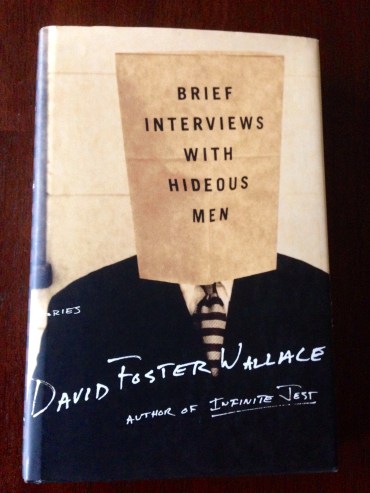
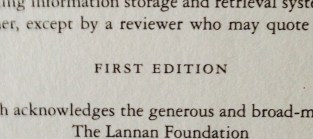
Well so and anyway, I spied a pristine hardcover copy of Brief Interviews with Hideous Men, clearly never read, and thought, Oh hey, this must be a first edition. Which it was and Oh hey you don’t need this book.

2015/01/img_4926.jpg

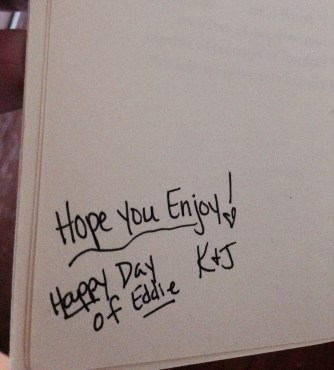
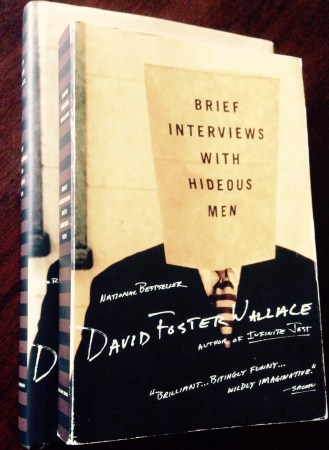
There is nothing rare or especially valuable about a first hardback U.S. edition of Hideous Men. The store is selling it for half of the publisher’s recommended price, but I have more than enough credit (thanks unsolicited review copies!) to pick it up. Which I do. Despite of course already owning it in the far more flexible trade paperback edition (first edition!) inscribed by some of the dearest damn friends who gave it to me for a birthday, an edition I reread memorably over a few weeks in Italy, an edition warped by strange moistures (I’d love to pretend the warping arose from the salty splash of the ancient Mediterranean but my own body sweat is a far more likely culprit).

2015/01/img_4927.jpg

Brief Interviews is my favorite collection of David Foster Wallace stories. The stories here are much better than those in his first collection, Girl with Curious Hair (which, the first DFW I read, has a special place in my gizzards), and though there’s nothing here that can touch the best moments of Oblivion (“The Suffering Channel” and “Good Old Neon”), the collection is cohesive, propulsive, engaging, its longer pieces punctuated by blips and vignettes. Here is the first selection, “A Radically Condensed History of Postindustrial Life”:

When they were introduced, he made a witticism, hoping to be liked. She laughed very hard, hoping to be liked. Then each drove home alone, staring straight ahead, with the very same twist to their faces.

The man who’d introduced them didn’t much like either of them, though he acted as if he did, anxious as he was to preserve good relations at all times. One never knew, after all, now did one now did one now did one.

So I picked up the hardback first edition, realizing that what I really wanted (in addition to this edition that I didn’t and don’t really need) was the copy that I read in college, the copy I borrowed from UF’s Library West (I’ll pay you $10,000 if you can think of a better library name, which you can’t), a flat brown squashed brick—-I must’ve been one of the first to read it, this was in ’99 or early ’00—I checked it out three times and then I had to return it. I ripped off “Adult World (I)” and “Adult World (II)” (these are actually the same story, but…) for a project in some bullshit class I was taking at the time, some class called Post-Historical Visual Culture or some other such nonsense—I didn’t rip off the plot, but the structure, the whole narrative/outline thing that Wallace did there. (My story was about a geneticist trying to clone a son or maybe someone to love, I can’t recall, shudder to recall…And why was I turning in a story and not an essay?!).

Why do I want the very edition that I first read, Dewey’s decimals imprinted on its drab jacketless spine? Why do I want an object that proclaims first, first, first, even though I don’t need it—why the compulsion? And then the sentimental compulsion to keep a less sturdy paperback version just because my name is incribed in itjust because I recall so vividly shaving my beard in Minori in Amalfi after reading “Tri-Stan: I Sold Sissee Nar to Ecko” and realizing that Oh my god this story is fucking terrible, DFW, I get what you’re doing, but my god. 

A book is a memory object, a placeholder, a bookmark for the memory of the reading experience, because we don’t remember what we read, not really. I have a few novels committed to memory (more or less) through yearly rereading, through teaching, but on the whole the details fade, the misremembering opens to misreading. My dream is to disband all of my books, march them out into the world, my memory secure, transcendent, stable, eternal, etc.—the objects gone, their dusty physicality imprinted in some psychic library of the soul. But I don’t believe in my dream, and even though I dig e-books, they don’t shock my memory in the same way that old pressed leaves do. So I live with these guys, nestled together unnecessarily, necessarily so.

2015/01/img_4928.jpg

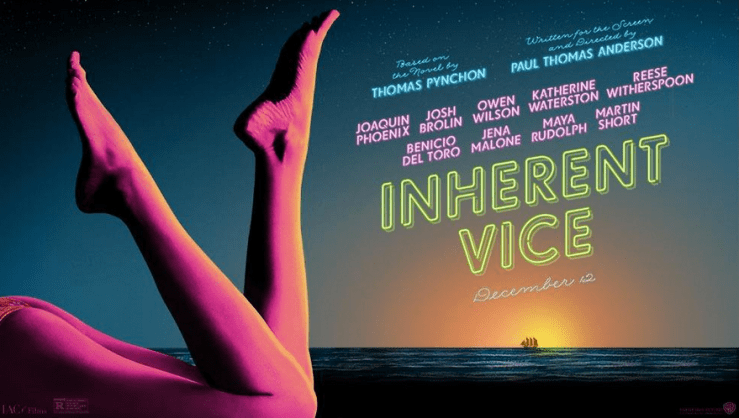
A few quick thoughts on Paul Thomas Anderson’s film Inherent Vice

IV POSTER HORIZONTAL

A. Let’s start with this: I need to see Paul Thomas Anderson’s film adaptation of Thomas Pynchon’s novel Inherent Vice again. Like, I’m compelled. 

B. But maybe a quick sketch before, no? Like, here in my office hours, before an afternoon class, when I should be shuffling through a few early papers—and, like away from the novel, which I’ve been rereading bits of? With the intention of re: point A seeing it again this weekend.

C. A claim, bold or otherwise: PTA’s film is better than Pynchon’s novel.

D. (Apples and oranges, bro, thou protest).

E. Okay so point C: What do I mean by better? I’m not really sure.

F. Maybe what I mean is: PTA slows down Pynchon’s novel. Expands the tension, the euphoria, the weirdness under the lines of dialogue.

G. (The film’s dialogue seems composed entirely from the text of the novel. Verbatim).

H. (But verbatim—how verbatim?: There are those gaps, those wonderful gaps that PTA fills—with color and smoke and sound and legs legs legs).

I. PTA also underlines plot connections for the reader, limning the paranoid contours that connect conspiracy-theory paranoia to vertically-integrated capitalism.

J. Okay, so point I: I’m not saying that clarifying the plot for the viewer (in a way that Pynchon arguably does not) makes the film, better—what I’m saying is that critics who contend the film fails to cohere are maybe missing the point.

K. Here’s a point: Inherent Vice offers the most coherent and balanced conclusion of any of Paul Thomas Anderson’s film. The final act performs the spirit behind Pynchon’s letters, offering a vision of fraternal love, or of caritas, if not love—of partnerships, of how to feed the hungry, the famished. (Poor famished Bigfoot). Of resistance to the pavement.

tumblr_l13jimngTJ1qahhqf

L. Or, another way to flesh out point C, or revise point C:

PTA gives us—and by us let’s be clear I mean me—a new reading of the novel. (And of course not just PTA, but his marvelous ensemble, too marvelous to remark on at length here). PTA’s reading of Doc’s reunion with Shasta—surely one of the film’s most intense moments—is entirely different than my own reading, and rereading that scene after viewing, I feel like Anderson and Joaquin Phoenix and Katherine Waterston read the scene right, or read the scene, depict the scene, perform the scene in a way that illustrates the darkest strands of sunny smoky searing Inherent Vice.

M. The aforementioned scene—Doc reunited with one (sort of) partner—is balanced neatly against two other key scenes: The final scene between Doc and (sort of) partner Bigfoot, and the scene in which Doc restores Coy to his family. Brother’s keeper.

N. (Parenthetically: I fell in love with the movie in its opening minutes. In those opening drumbeats of Can’s “Vitamin C”).

O. So I have to rush to class and discuss Kate Chopin and not PTA’s Inherent Vice, which is what I’d rather riff on. Not really a world of inconvenience, but…(oh, and I love how that Pynchonian byword echoed through the film).

P. End on P for Pynchon and Paul TA and Promise: Promise to rewatch, reread, rewrite.

The true paranoid for whom all is organized in spheres joyful or threatening (Pynchon’s The Crying of Lot 49)

“Please,” the sailor said. “Go on now. You don’t want to stay here.” She looked in her purse, found a ten and a single, gave him the ten. “I’ll spend it on booze,” he said.
“Remember your friends,” said the arthritic, watching the ten.
“Bitch,” said the sailor. “Why didn’t you wait till he was gone?”
Oedipa watched him make adjustments so he’d fit easier against the mattress. That stuffed memory. Register A . . .
“Give me a cigarette, Ramírez,” the sailor said. “I know you got one.”
Would it be today? “Ramírez,” she cried. The arthritic looked around on his rusty neck. “He’s going to die,” she said.
“Who isn’t?” said Ramírez.
She remembered John Nefastis, talking about his Machine, and massive destructions of information. So when this mattress flared up around the sailor, in his Viking’s funeral: the stored, coded years of uselessness, early death, self-harrowing, the sure decay of hope, the set of all men who had slept on it, whatever their lives had been, would truly cease to be, forever, when the mattress burned. She stared at it in wonder. It was as if she had just discovered the irreversible process. It astonished her to think that so much could be lost, even the quantity of hallucination belonging just to the sailor that the world would bear no further trace of. She knew, because she had held him, that he suffered DT’s. Behind the initials was a metaphor, a delirium tremens, a trembling unfurrowing of the mind’s plowshare. The saint whose water can light lamps, the clairvoyant whose lapse in recall is the breath of God, the true paranoid for whom all is organized in spheres joyful or threatening about the central pulse of himself, the dreamer whose puns probe ancient fetid shafts and tunnels of truth all act in the same special relevance to the word, or whatever it is the word is there, buffering, to protect us from. The act of metaphor then was a thrust at truth and a lie, depending where you were: inside, safe, or outside, lost. Oedipa did not know where she was. Trembling, unfurrowed, she slipped sidewise, screeching back across grooves of years, to hear again the earnest, high voice of her second or third collegiate love Ray Glozing bitching among “uhs” and the syncopated tonguing of a cavity, about his freshman calculus; “dt,” God help this old tattooed man, meant also a time differential, a vanishingly small instant in which change had to be confronted at last for what it was, where it could no longer disguise itself as something innocuous like an average rate; where velocity dwelled in the projectile though the projectile be frozen in midflight, where death dwelled in the cell though the cell be looked in on at its most quick. She knew that the sailor had seen worlds no other man had seen if only because there was that high magic to low puns, because DT’s must give access to dt’s of spectra beyond the known sun, music made purely of Antarctic loneliness and fright. But nothing she knew of would preserve them, or him.

From Thomas Pynchon’s novel The Crying of Lot 49.

To give the spirit flesh. The words, who cares? (Thomas Pynchon’s The Crying of Lot 49)

“You don’t understand,” getting mad. “You guys, you’re like Puritans are about the Bible. So hung up with words, words. You know where that play exists, not in that file cabinet, not in any paperback you’re looking for, but—” a hand emerged from the veil of shower-steam to indicate his suspended head—“in here. That’s what I’m for. To give the spirit flesh. The words, who cares? They’re rote noises to hold line bashes with, to get past the bone barriers around an actor’s memory, right? But the reality is in this head. Mine. I’m the projector at the planetarium, all the closed little universe visible in the circle of that stage is coming out of my mouth, eyes, sometimes other orifices also.”

A favorite little riff from Pynchon’s novel The Crying of Lot 49.

Chapter X of James Weldon Johnson’s Masterpiece, The Autobiography of an Ex-Colored Man

Among the first of my fellow-passengers of whom I took any particular notice was a tall, broad-shouldered, almost gigantic, colored man. His dark-brown face was clean-shaven; he was well-dressed and bore a decidedly distinguished air. In fact, if he was not handsome, he at least compelled admiration for his fine physical proportions. He attracted general attention as he strode the deck in a sort of majestic loneliness. I became curious to know who he was and determined to strike up an acquaintance with him at the first opportune moment. The chance came a day or two later. He was sitting in the smoking-room, with a cigar, which had gone out, in his mouth, reading a novel. I sat down beside him and, offering him a fresh cigar, said: “You don’t mind my telling you something unpleasant, do you?” He looked at me with a smile, accepted the proffered cigar, and replied in a voice which comported perfectly with his size and appearance: “I think my curiosity overcomes any objections I might have.” “Well,” I said, “have you noticed that the man who sat at your right in the saloon during the first meal has not sat there since?” He frowned slightly without answering my question. “Well,” I continued, “he asked the steward to remove him; and not only that, he attempted to persuade a number of the passengers to protest against your presence in the dining-saloon.” The big man at my side took a long draw from his cigar, threw his head back, and slowly blew a great cloud of smoke toward the ceiling. Then turning to me he said: “Do you know, I don’t object to anyone’s having prejudices so long as those prejudices don’t interfere with my personal liberty. Now, the man you are speaking of had a perfect right to change his seat if I in any way interfered with his appetite or his digestion. I should have no reason to complain if he removed to the farthest corner of the saloon, or even if he got off the ship; but when his prejudice attempts to move me one foot, one inch, out of the place where I am comfortably located, then I object.” On the word “object” he brought his great fist down on the table in front of us with such a crash that everyone in the room turned to look. We both covered up the slight embarrassment with a laugh and strolled out on the deck.

We walked the deck for an hour or more, discussing different phases of the Negro question. In referring to the race I used the personal pronoun “we”; my companion made no comment about it, nor evinced any surprise, except to raise his eyebrows slightly the first time he caught the significance of the word. He was the broadest-minded colored man I have ever talked with on the Negro question. He even went so far as to sympathize with and offer excuses for some white Southern points of view. I asked him what were his main reasons for being so hopeful. He replied: “In spite of all that is written, said, and done, this great, big, incontrovertible fact stands out—the Negro is progressing, and that disproves all the arguments in the world that he is incapable of progress. I was born in slavery, and at emancipation was set adrift a ragged, penniless bit of humanity. I have seen the Negro in every grade, and I know what I am talking about. Our detractors point to the increase of crime as evidence against us; certainly we have progressed in crime as in other things; what less could be expected? And yet, in this respect, we are far from the point which has been reached by the more highly civilized white race. As we continue to progress, crime among us will gradually lose much of its brutal, vulgar, I might say healthy, aspect, and become more delicate, refined, and subtle. Then it will be less shocking and noticeable, although more dangerous to society.” Then dropping his tone of irony, he continued with some show of eloquence: “But, above all, when I am discouraged and disheartened, I have this to fall back on: if there is a principle of right in the world, which finally prevails, and I believe that there is; if there is a merciful but justice-loving God in heaven, and I believe that there is, we shall win; for we have right on our side, while those who oppose us can defend themselves by nothing in the moral law, nor even by anything in the enlightened thought of the present age.” Continue reading “Chapter X of James Weldon Johnson’s Masterpiece, The Autobiography of an Ex-Colored Man”

Literature is a point outside of our hodiernal circle through which a new one may be described (Ralph Waldo Emerson)

Literature is a point outside of our hodiernal circle through which a new one may be described. The use of literature is to afford us a platform whence we may command a view of our present life, a purchase by which we may move it. We fill ourselves with ancient learning, install ourselves the best we can in Greek, in Punic, in Roman houses, only that we may wiselier see French, English and American houses and modes of living. In like manner we see literature best from the midst of wild nature, or from the din of affairs, or from a high religion. The field cannot be well seen from within the field. The astronomer must have his diameter of the earth’s orbit as a base to find the parallax of any star.

Therefore we value the poet. All the argument and all the wisdom is not in the encyclopaedia, or the treatise on metaphysics, or the Body of Divinity, but in the sonnet or the play. In my daily work I incline to repeat my old steps, and do not believe in remedial force, in the power of change and reform. But some Petrarch or Ariosto, filled with the new wine of his imagination, writes me an ode or a brisk romance, full of daring thought and action. He smites and arouses me with his shrill tones, breaks up my whole chain of habits, and I open my eye on my own possibilities. He claps wings to the sides of all the solid old lumber of the world, and I am capable once more of choosing a straight path in theory and practice.

From Ralph Waldo Emerson’s essay “Circles.”

“In the New Garden, In All the Parts” — Walt Whitman

a

I review my review of Thomas Pynchon’s novel Inherent Vice an hour before seeing PTA’s film adaptation

I’m leaving to (finally) see Paul Thomas Anderson’s film Inherent Vice in a few minutes.

I’m going with my uncle. (I also saw No Country for Old Men with him in the theater. This point seems hardly worth these parentheses).

Below, in block quotes, is my review of Thomas Pynchon’s Inherent Vice (which I published here—the review obviously—in 2009). My 2015 comments are interposed.

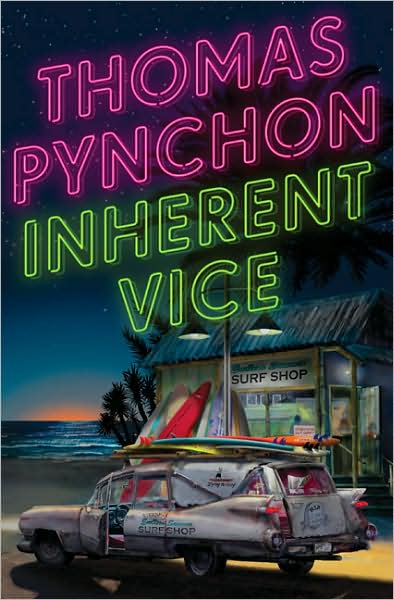
inherent_vice

Thomas Pynchon’s latest novel, Inherent Vice

Oh god I used to bold face key terms jesus christ sorry.

is a detective-fiction genre exercise/parody set in a cartoonish, madcap circa-1970 L.A. redolent with marijuana smoke, patchouli, and paranoia.

“genre exercise”…”madcap”…ugh!

Navigating this druggy haze is private detective Doc Sportello, who, at the behest of his ex-girlfriend, searches for a missing billionaire in a plot tangled up with surfers, junkies, rock bands, New Age cults, the FBI, and a mysterious syndicate known as the Golden Fang–and that’s not even half of it.

Not a bad little summary, bro.

At a mere 369 pages, Inherent Vice is considerably shorter than Pynchon’s last novel Against the Day, not to mention his masterpieces Gravity’s Rainbow and Mason & Dixon, and while it might not weigh in with those novels, it does bear plenty of the same Pynchonian trademarks: a strong picaresque bent, a mix of high and low culture, plenty of pop culture references, random sex, scat jokes, characters with silly names (too many to keep track of, of course), original songs, paranoia, paranoia, paranoia, and a central irreverence that borders on disregard for the reader.

Uh…

And like Pynchon’s other works, Inherent Vice is a parody, a take on detective noir, but also a lovely little rip on the sort of novels that populate beaches and airport bookstores all over the world. It’s also a send-up of L.A. stories and drug novels, and really a hate/love letter to the “psychedelic 60s” (to use Sportello’s term), with much in common with Pynchon’s own Vineland (although comparisons to Elmore Leonard, Raymond Chandler, The Big Lebowski and even Chinatown wouldn’t be out of place either).

When I heard the PTA was adapting Inherent Vice, I thought: Wait, the Coens already did that before Pynchon wrote the book.

While most of Inherent Vice reverberates with zany goofiness and cheap thrills,

Clichés, bro.

Pynchon also uses the novel as a kind of cultural critique, proposing that modern America begins at the end of the sixties (the specter of the Manson family, the ultimate outsiders, haunts the book). The irony, of course–and undoubtedly it is purposeful irony–is that Pynchon has made similar arguments before: Gravity’s Rainbow locates the end of WWII as the beginning of modern America; the misadventures of the eponymous heroes of Mason & Dixon foreground an emerging American mythology; V. situates American place against the rise of a globally interdependent world.

Uh…

If Inherent Vice works in an idiom of nostalgia, it also works to undermine and puncture that nostalgia. Feeling a little melancholy, Doc remarks on the paradox underlying the sixties that “you lived in a climate of unquestioning hippie belief, pretending to trust everybody while always expecting be sold out.” In one of the novel’s most salient passages–one that has nothing to do with the plot, of course–Doc watches a music store where “in every window . . . appeared a hippie freak or a small party of hippie freaks, each listening on headphones to a different rock ‘n’ roll album and moving around at a different rhythm.” Doc’s reaction to this scene is remarkably prescient:

. . . Doc was used to outdoor concerts where thousands of people congregated to listen to music for free, and where it all got sort of blended together into a single public self, because everybody was having the same experience. But here, each person was listening in solitude, confinement and mutual silence, and some of them later at the register would actually be spending money to hear rock ‘n’ roll. It seemed to Doc like some strange kind of dues or payback. More and more lately he’d been brooding about this great collective dream that everybody was being encouraged to stay tripping around in. Only now and then would you get an unplanned glimpse at the other side.

Oh cool you finally quoted from the book. Not a bad little riff.

If Doc’s tone is elegiac, the novel’s discourse works to undercut it, highlighting not so much the “great collective dream” of “a single public self,” but rather pointing out that not only was such a dream inherently false, an inherent vice, but also that this illusion came at a great price–one that people are perhaps paying even today. Doc’s take on the emerging postmodern culture is ironized elsewhere in one of the book’s more interesting subplots involving the earliest version of the internet. When Doc’s tech-savvy former mentor hips him to some info from ARPANET – “I swear it’s like acid,” he claims – Doc responds dubiously that “they outlawed acid as soon as they found out it was a channel to somethin they didn’t want us to see? Why should information be any different?” Doc’s paranoia (and if you smoked a hundred joints a day, you’d be paranoid too) might be a survival trait, but it also sometimes leads to this kind of shortsightedness.

Will PTA’s film convey the ironies I found here? Or were the ironies even there?

Intrinsic ironies aside, Inherent Vice can be read straightforward as a (not-so-straightforward) detective novel, living up to the promise of its cheesy cover. Honoring the genre, Pynchon writes more economically than ever, and injects plenty of action to keep up the pace in his narrative. It’s a page-turner, whatever that means, and while it’s not exactly Pynchon-lite, it’s hardly a heavy-hitter, nor does it aspire to be.

I’m not sure if I believe any of that, bro. Did I believe it even when I wrote it? It’s a shaggy dog story, and shaggy dogs unravel, or tangle, rather—they don’t weave into a big clear picture. And maybe it is a heavy hitter. (Heavy one-hitter).

At the same time, Pynchon fans are going to find plenty to dissect in this parody, and should not be disappointed with IV‘s more limited scope (don’t worry, there’s no restraint here folks–and who are we kidding, Pynchon is more or less critic-proof at this point in his career, isn’t he?). Inherent Vice is good dirty fun, a book that can be appreciated on any of several different levels, depending on “where you’re at,” as the hippies in the book like to say. Recommended.

Oh geez.

Okay, I should write more but my uncle says it’s time to roll.

“Civilization” — Tom Clark

a

Read “The Storm,” a short story by Kate Chopin

“The Storm”

by

Kate Chopin

I

The leaves were so still that even Bibi thought it was going to rain. Bobint, who was accustomed to converse on terms of perfect equality with his little son, called the child’s attention to certain sombre clouds that were rolling with sinister intention from the west, accompanied by a sullen, threatening roar. They were at Friedheimer’s store and decided to remain there till the storm had passed. They sat within the door on two empty kegs. Bibi was four years old and looked very wise.

“Mama’ll be ‘fraid, yes, he suggested with blinking eyes.

“She’ll shut the house. Maybe she got Sylvie helpin’ her this evenin’,” Bobint responded reassuringly.

“No; she ent got Sylvie. Sylvie was helpin’ her yistiday,’ piped Bibi.

Bobint arose and going across to the counter purchased a can of shrimps, of which Calixta was very fond. Then he retumed to his perch on the keg and sat stolidly holding the can of shrimps while the storm burst. It shook the wooden store and seemed to be ripping great furrows in the distant field. Bibi laid his little hand on his father’s knee and was not afraid.

II

Calixta, at home, felt no uneasiness for their safety. She sat at a side window sewing furiously on a sewing machine. She was greatly occupied and did not notice the approaching storm. But she felt very warm and often stopped to mop her face on which the perspiration gathered in beads. She unfastened her white sacque at the throat. It began to grow dark, and suddenly realizing the situation she got up hurriedly and went about closing windows and doors.

Out on the small front gallery she had hung Bobint’s Sunday clothes to dry and she hastened out to gather them before the rain fell. As she stepped outside, Alce Laballire rode in at the gate. She had not seen him very often since her marriage, and never alone. She stood there with Bobint’s coat in her hands, and the big rain drops began to fall. Alce rode his horse under the shelter of a side projection where the chickens had huddled and there were plows and a harrow piled up in the corner.

“May I come and wait on your gallery till the storm is over, Calixta?” he asked.

Come ‘long in, M’sieur Alce.”

His voice and her own startled her as if from a trance, and she seized Bobint’s vest. Alce, mounting to the porch, grabbed the trousers and snatched Bibi’s braided jacket that was about to be carried away by a sudden gust of wind. He expressed an intention to remain outside, but it was soon apparent that he might as well have been out in the open: the water beat in upon the boards in driving sheets, and he went inside, closing the door after him. It was even necessary to put something beneath the door to keep the water out.

“My! what a rain! It’s good two years sence it rain’ like that,” exclaimed Calixta as she rolled up a piece of bagging and Alce helped her to thrust it beneath the crack.

She was a little fuller of figure than five years before when she married; but she had lost nothing of her vivacity. Her blue eyes still retained their melting quality; and her yellow hair, dishevelled by the wind and rain, kinked more stubbornly than ever about her ears and temples.

The rain beat upon the low, shingled roof with a force and clatter that threatened to break an entrance and deluge them there. They were in the dining room the sitting room the general utility room. Adjoining was her bed room, with Bibi’s couch along side her own. The door stood open, and the room with its white, monumental bed, its closed shutters, looked dim and mysterious.

Alce flung himself into a rocker and Calixta nervously began to gather up from the floor the lengths of a cotton sheet which she had been sewing.

lf this keeps up, Dieu sait if the levees goin’ to stan it!” she exclaimed.

“What have you got to do with the levees?”

“I got enough to do! An’ there’s Bobint with Bibi out in that storm if he only didn’ left Friedheimer’s!”

“Let us hope, Calixta, that Bobint’s got sense enough to come in out of a cyclone.”

She went and stood at the window with a greatly disturbed look on her face. She wiped the frame that was clouded with moisture. It was stiflingly hot. Alce got up and joined her at the window, looking over her shoulder. The rain was coming down in sheets obscuring the view of far-off cabins and enveloping the distant wood in a gray mist. The playing of the lightning was incessant. A bolt struck a tall chinaberry tree at the edge of the field. It filled all visible space with a blinding glare and the crash seemed to invade the very boards they stood upon. Continue reading “Read “The Storm,” a short story by Kate Chopin”

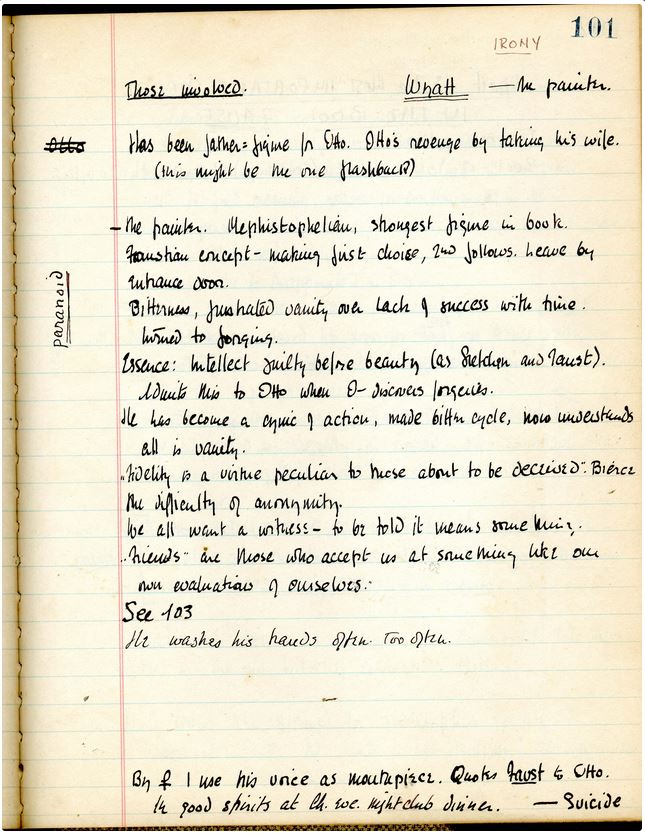
“Those involved. Wyatt — A painter” — William Gaddis’s autograph notes for The Recognitions

irony

More great stuff from Washington University’s Modern Literature Collection.


“I was simply trying to write about people” — Faulkner on the origins of “A Rose for Emily”

William Faulkner: Yes, sir.

Unidentified participant: Sir, it has been argued that “A Rose for Emily” is a criticism of the North, and others have argued saying that it is a criticism of the South. Now, could this story, shall we say, be more properly classified as a criticism of the time?

William Faulkner: Now that I don’t know because I was simply trying to write about people. The writer uses environment—what he knows—and if there’s a symbolism in which the—the lover represented the North and the—and the—the woman who murdered him represents the South, I don’t say that’s not valid and not there, but it was no intention of the writer to—to say, “Now let’s see, I’m going to write a piece in which I will—will use a symbolism for the North and another symbol for the South,” that he was simply writing about people, a story which he thought was—was tragic and true because it—it came out of the—out of the human heart, of human aspiration, the human—the conflict of—of conscience with—with glands, with the Old Adam. It was a conflict not between the North and South so much as between, well, you might say, God and Satan.
Yes, sir.

Unidentified participant: Sir, just a little more on that thing. You say it’s a conflict between God and Satan. Well, I don’t quite understand what—what you mean there. Who is—did one represent the […]?

William Faulkner: The conflict was—was in Miss Emily, that she knew that you do not murder people. She was—she had been trained that—that—that you do not take a lover, you marry. You don’t take a lover. She had broken all the—the—the laws of her tradition, her background, and she had finally broken the law of God, too, which says you do not take human life. And she knew she was doing wrong, and that’s why her—her own life was wrecked. Instead of having murdered one lover, and then to go on and—and take another and when she used him up to murder him, she was expiating her crime.
Yes, ma’am.

Unidentified participant: But can’t a person like Miss Emily, though she did do all the things that she had been taught not to, and being a sensitive sort of a woman, it was sure to have told on her, but do you think it’s fair to feel pity for her because, in a way, she made her adjustment, and it seemed to have wound up in a happy sort of a way—certainly tragic—but maybe it suited her just fine.

William Faulkner: Yes, it may have, but then I don’t think that—that one should withhold pity simply because the—the subject of the pity, object of the pity, is pleased and satisfied. I think the—the pity is in—in the—the human striving against its own nature, against its own conscience. That’s what deserves the pity. It’s not the fate of the individual. It’s man in conflict with his heart or with his fellows or with his environment. That’s—that’s what deserves the pity. It’s not that the man suffered or that he fell off the house or was run over by the train. It’s that he was—that man is trying to do the best he can with his—his desires and impulses, against his—his own moral conscience and the— the conscience of—the social conscience of—of his time and his place, the—the little town he must live in, the family he’s a part of.

Via/audio.

Falstaff in the Laundry Basket — Henry Fuseli

“A Sweet Tail (Gypsies)” — Gertrude Stein

“A Sweet Tail (Gypsies)”

by

Gertrude Stein

Curves.

Hold in the coat. Hold back ladders and a creation and nearly sudden extra coppery ages with colors and a clean voice gyp hoarse. Hold in that curl with a good man. Hold in cheese. Hold in cheese. Hold in cheese.

A cool brake, a cool brake not a success not a re-sound a re-sound and a little pan with a yell oh yes so yet change, famous, a green a green colored oak, a handsome excursion, a really handsome log, a regulation to exchange oars, a regulation or more press more precise cold pieces, more yet in the teeth within the teeth. This is the sun in. This is the lamb of the lantern with chalk. With chalk a shadow shall be a sneeze in a tooth in a tin tooth, a turned past, a turned little corset, a little tuck in a pink look and with a pin in, a pin in.

Win lake, eat splashes dig salt change benches.

Win lake eat splashes dig salt change benches.

Can in.

Come a little cheese. Come a little cheese and same same tall sun with a little thing to team, team now and a bass a whole some gurgle, little tin, little tin soak, soak why Sunday, supreme measure. Continue reading ““A Sweet Tail (Gypsies)” — Gertrude Stein”

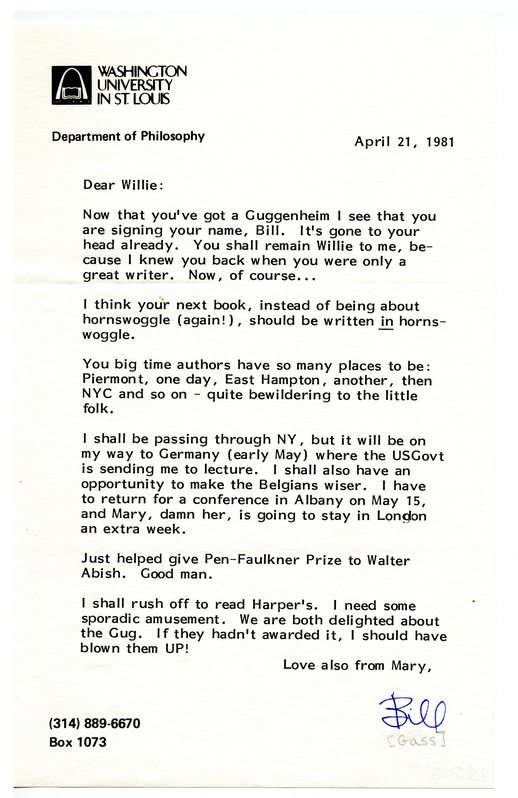
“Dear Willie” — William H. Gass Writes to William Gaddis

dear

From Washington University’s marvelous Modern Literature Collection.


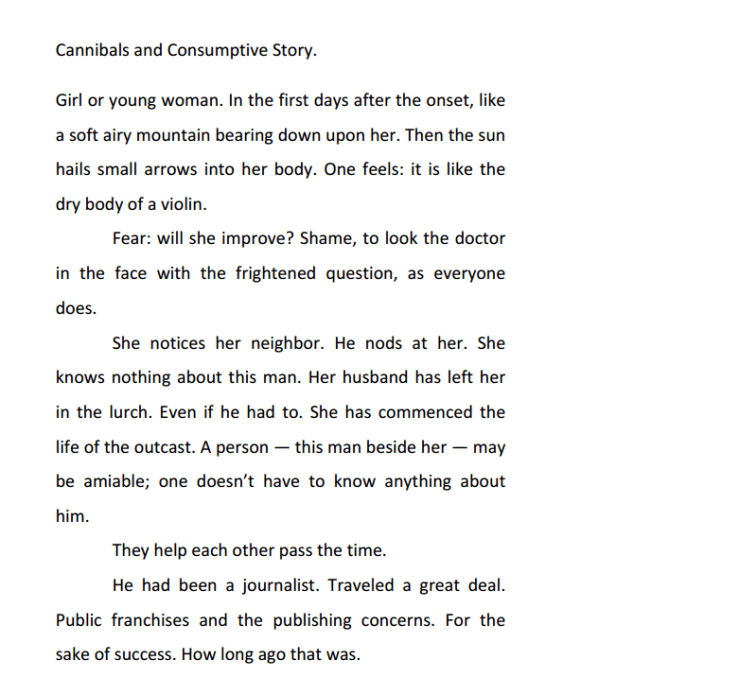
Cannibals (Excerpt) — Robert Musil

cannibalsRead more excerpts from Robert Musil’s short prose in the winter issue of Hyperion, which features all kinds of intriguing stuff, including Rainer Maria Rilke, Valery on Nietzsche, Fredrico Fellini answers “Why Satyricon?” and much more.


Gorey’s Kafka

tumblr_nhw07dGxn01s9jvclo1_1280