Nine Figments from Nathaniel Hawthorne’s Notebook

  1. An ancient wineglass (Miss Ingersol’s), long-stalked, with a small, cup-like bowl, round which is wreathed a branch of grape-vine, with a rich cluster of grapes, and leaves spread out. There is also some kind of a bird flying. The whole is excellently cut or engraved.
  2. In the Duke of Buckingham’s comedy, “The Chances,” Don Frederic says of Don John (they are two noble Spanish gentlemen), “One bed contains us ever.”
  3. A person, while awake and in the business of life, to think highly of another, and place perfect confidence in him, but to be troubled with dreams in which this seeming friend appears to act the part of a most deadly enemy. Finally it is discovered that the dream-character is the true one. The explanation would be–the soul’s instinctive perception.
  4. Pandora’s box for a child’s story.
  5. Moonlight is sculpture; sunlight is painting.
  6. “A person to look back on a long life ill-spent, and to picture forth a beautiful life which he would live, if he could be permitted to begin his life over again. Finally to discover that he had only been dreaming of old age,–that he was really young, and could live such a life as he had pictured.”
  7. A newspaper, purporting to be published in a family, and satirizing the political and general world by advertisements, remarks on domestic affairs,–advertisement of a lady’s lost thimble, etc.
  8. L. H—-. She was unwilling to die, because she had no friends to meet her in the other world. Her little son F. being very ill, on his recovery she confessed a feeling of disappointment, having supposed that he would have gone before, and welcomed her into heaven!
  9. H. L. C—- heard from a French Canadian a story of a young couple in Acadie. On their marriage day, all the men of the Province were summoned to assemble in the church to hear a proclamation. When assembled, they were all seized and shipped off to be distributed through New England,–among them the new bridegroom. His bride set off in search of him,–wandered about New England all her lifetime, and at last, when she was old, she found her bridegroom on his death-bed. The shock was so great that it killed her likewise.

From Nathaniel Hawthorne’s American Note-Books.

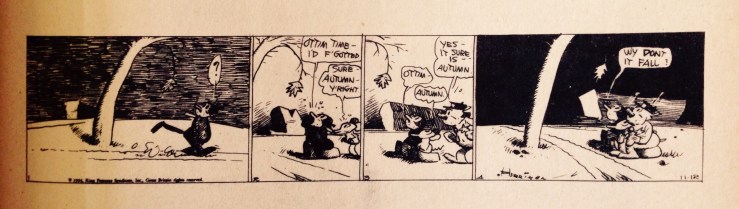
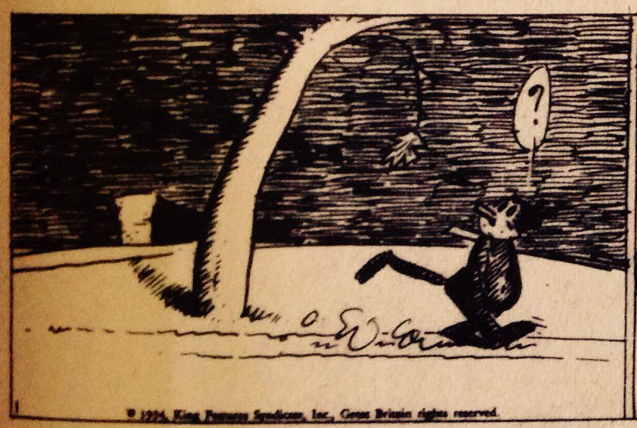
Autumn (Krazy Kat)

1 2 3

I have never written a novel (Thomas Bernhard)

JEAN-LOUIS DE RAMBURES: Why since 1975 have you set aside novel-writing in favor of autobiography?

THOMAS BERNHARD: I have never written a novel, but merely prose texts of greater or lesser length, and I’m going to take care not to describe them as novels; I don’t know what the word means.  I haven’t ever wanted to write an autobiographical work either; I have a genuine aversion to all things autobiographical.  The fact is that at a certain moment in my life I got curious about my childhood.  I said to myself, “I haven’t much longer to live.  Why not try to record my life up to the age of nineteen?  Not as it was in reality—there’s no such thing as objectivity—but as I see it today.”

When I was planning the book I envisaged it as a single slim volume.  A second one emerged.  Then yet another one…until the point when I started to get bored.  In the end childhood is always just childhood.  After the fifth volume I decided to call it a day. In the case of each my books I’m always torn this way and that between a passion and a loathing for my chosen subject.

Every time my second thoughts get the upper hand, I resolve to give up intellectual pursuits for good and dedicate myself instead to purely material tasks, for example to chopping wood or plastering a wall, in the hope of recovering my good cheer.  My dream is of a never-ending wall and never-ending good cheer.  But after a stretch of time of greater or lesser length, I once again start to loathe myself for being unproductive, and despair about this drives me to seek refuge in my brain.  Sometimes I tell myself my instability is something I’ve inherited from my ancestors, who were a very heterogeneous bunch.  This bunch included farmers, philosophers, laborers, writers, geniuses, and morons, mediocre petit-bourgeois types, and even criminals.  All these people exist within me, and they never leave off fighting each other.  Sometimes I feel like committing myself into the custody of the goose-keeper, at other times into the custody of the thief or the murderer.  Because you’ve got to make choices, and every choice means precluding other choices; this round-dance ultimately drives me to the brink of madness.  Such that if I make it to the end of my matutinal shaving routine without killing myself in front of the mirror, I have only my cowardice to thank for it.

Cowardice, vanity, and curiosity are the three basic and essential impetuses to life, the things that keep it moving along, even though every conceivable rational argument gainsays this movement.  At any rate, that’s the way it seems to me today.  Because it may very well happen that tomorrow I’ll think something completely different.

From an interview with Thomas Bernhard originally published in Le Monde. The English translation is by Douglas Robertson. You can read the entire translated interview at his blog.

A Short Riff on the Inherent Vice Film Trailer

2

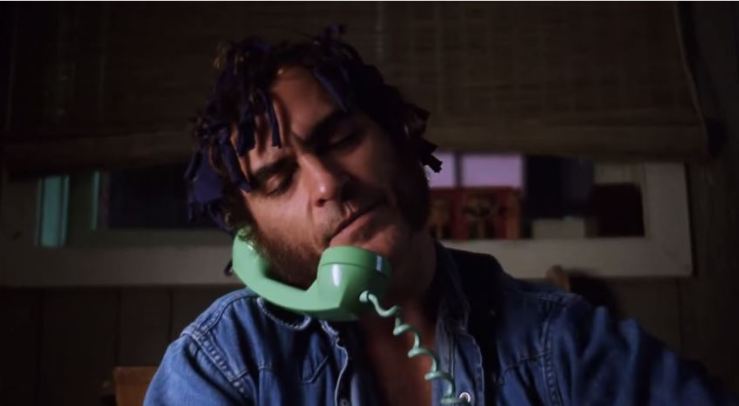
A. It’s likely that if you care about these things you’ve already seen the first full (non-teaser) trailer for Paul Thomas Anderson’s film adaptation of Thomas Pynchon’s novel Inherent Vice.

B. Here is that trailer:


C. What do you think?

D. I think it looks pretty great.

E. Well, I mean, the trailer still has the, I don’t know, rhythms and contours and tropes of, like, quirky indie comedy film trailers—verbal slapstick, slapstick slapstick (I love the bit at 00:27 when the cop knocks Sportello down, but the callback at 1:52 seems like it could squash a punchline), an affected scream, up-tempo soundtrack (although “Don’t Know Much About History” isn’t one of the many, many songs mentioned in the book). But hey, target audience, etc. etc. etc.

F. And I’m sure the target audience here loves to get a taste of Owen Wilson looking vulnerable and sensitive and just very Owen Wilsonish. (I, a target, enjoyed the taste).

G. And apparently Michael K. Williams is in this movie making his Michael K. Williams face.

H. And also: Joanna Newsom is supposedly in the film—both as a character and narrator. She narrates the trailer, but if she’s in it, like, physically, I think I missed that.

I. And we get this:

1

J. And a New Age cult pizza party, staged in a loose approximation of The Last Supper.

K. And Eric Roberts.

L. And Josh Brolin shouting for pancakes in sloppy Japanese.

M. And guns! Yes, guns in the trailer, audience!

N. And some ass shots to boot, including our man Sportello, prostrate, cowering.

O. I like that the trailer—and I’m guessing the film itself (?)—uses the same neon-noir font that the book did; I thought the cover of Inherent Vice was horrendous, but ultimately made sense.

P. But what I find most fascinating here is how neatly Newsom’s narration sums up the novel’s plot in the first 20 seconds of the trailer, highlighting just how irrelevant the plot is in Pynchon’s novel. Inherent Vice: The Novel eschews plotting in favor of verbal style, mood, and imagery—which makes Paul Thomas Anderson an ideal filmmaker to handle the first (and maybe we should hope only) Pynchon adaptation.

Q. I’m usually pretty wary of film adaptations of big-ell Literature, but Inherent Vice is kind of on the bubble there. It’s a shaggy dog tale, just like the Coen brothers’ classic The Big Lebowski, or Tarantino’s best film Jackie Brown. (When I reviewed the book a few years ago, I brought up Elmore Leonard and Lebowski, along with Chinatown).

R. My big concern is that PTA, like his hero Robert Altman, can get a bit too shaggy. When he’s got a clear trajectory to follow (Boogie NightsPunch Drunk Love), PTA offers up a deep comic complex humanism. But then there’s that fine mess Magnolia. 

S. I loved the last film that Joaquin Phoenix and PTA did together though, 2012’s The Master.

T. And what do we think of Joaquin Phoenix as Doc Sportello? Does he look a little bit, I don’t know, too old? I don’t know. He kind of looks a little bit like a stoned Hugh-Jackman-as-Wolverine here.

U. (That’s not necessarily, like, bad).

V. The trailer makes me want to see the film more than I had wanted to see it before, which was its job, so, like, good trailer, I guess.

Never was there more hollowness at heart than at present (Walt Whitman)

I say we had best look our times and lands searchingly in the face, like a physician diagnosing some deep disease. Never was there, perhaps, more hollowness at heart than at present, and here in the United States. Genuine belief seems to have left us. The underlying principles of the States are not honestly believ’d in, (for all this hectic glow, and these melodramatic screamings,) nor is humanity itself believ’d in. What penetrating eye does not everywhere see through the mask? The spectacle is appaling. We live in an atmosphere of hypocrisy throughout. The men believe not in the women, nor the women in the men. A scornful superciliousness rules in literature. The aim of all the littérateurs is to find something to make fun of. A lot of churches, sects, &c., the most dismal phantasms I know, usurp the name of religion. Conversation is a mass of badinage. From deceit in the spirit, the mother of all false deeds, the offspring is already incalculable. An acute and candid person, in the revenue department in Washington, who is led by the course of his employment to regularly visit the cities, north, south and west, to investigate frauds, has talk’d much with me about his discoveries. The depravity of the business classes of our country is not less than has been supposed, but infinitely greater. The official services of America, national, state, and municipal, in all their branches and departments, except the judiciary, are saturated in corruption, bribery, falsehood, mal-administration; and the judiciary is tainted. The great cities reek with respectable as much as non-respectable robbery and scoundrelism. In fashionable life, flippancy, tepid amours, weak infidelism, small aims, or no aims at all, only to kill time. In business, (this all-devouring modern word, business,) the one sole object is, by any means, pecuniary gain. The magician’s serpent in the fable ate up all the other serpents; and money-making is our magician’s serpent, remaining to-day sole master of the field.

From Walt Whitman’s Democratic Vistas (1871).

“October” — Robert Frost

Capture

“Discovery” — Guy de Maupassant

The steamer was crowded with people and the crossing promised to be good. I was going from Havre to Trouville.

The ropes were thrown off, the whistle blew for the last time, the whole boat started to tremble, and the great wheels began to revolve, slowly at first, and then with ever-increasing rapidity.

We were gliding along the pier, black with people. Those on board were waving their handkerchiefs, as though they were leaving for America, and their friends on shore were answering in the same manner.

The big July sun was shining down on the red parasols, the light dresses, the joyous faces and on the ocean, barely stirred by a ripple. When we were out of the harbor, the little vessel swung round the big curve and pointed her nose toward the distant shore which was barely visible through the early morning mist. On our left was the broad estuary of the Seine, her muddy water, which never mingles with that of the ocean, making large yellow streaks clearly outlined against the immense sheet of the pure green sea.

As soon as I am on a boat I feel the need of walking to and fro, like a sailor on watch. Why? I do not know. Therefore I began to thread my way along the deck through the crowd of travellers. Suddenly I heard my name called. I turned around. I beheld one of my old friends, Henri Sidoine, whom I had not seen for ten years. Continue reading ““Discovery” — Guy de Maupassant”

“The Absence of Any Purpose Is the Starting Point for My Work” | An Interview with Roman Muradov

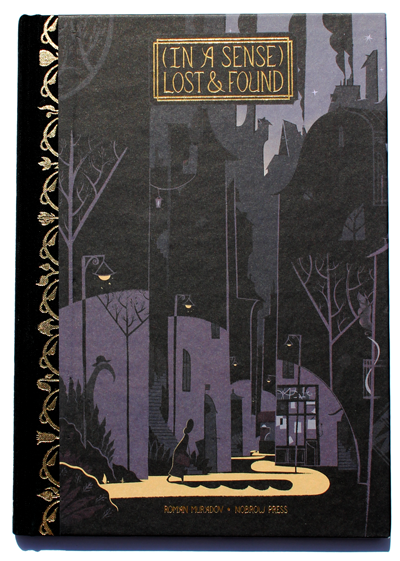
I’ve been a fan of Roman Muradov’s strange and wonderful illustrations for a while now, so I was excited late this summer to get my hands on his début graphic novella, (In a Sense) Lost and Found (Nobrow Press). In my review, I wrote: “I loved Lost and Found, finding more in its details, shadowy corners, and the spaces between the panels with each new reading.” The book is a beauty, so I was thrilled when Roman agreed to discuss it with me over a series of emails. We also discussed his influences, his audience, his ongoing Yellow Zine projects, his recent cover for Joyce’s Dubliners, and his reaction to some of the confused Goodreads reviews his novella received. Check out Roman’s work at his website. You won’t be disappointed.
inasense400photo

Biblioklept: When did you start working on (In a Sense) Lost and Found? Did you always have the concept kicking around?

Roman Muradov: The idea came to me in 2010 in the form of the title and the image of a protracted awakening. I wrote it as a short story, which had a much more conventional development and actually had some characters and plot movements, all of them completely dropped one by one on the way to the final version apart from the basic premise. I didn’t have a clear understanding of what was to be done with that premise, but the idea kept bothering me for some time, until I rewrote it a few times into a visual novella when Nobrow asked me if I wanted to pitch them something. Since then it went through several more drafts and even after everything was drawn and colored I had to go back and edit most of the dialogues, which is a nightmarish task in comics, since it involved re-lettering everything by hand.

Biblioklept: When you say you wrote it as a short story, I’m intrigued—like, do you mean as a sketch, or a set of directions, or as a tale with imagery? Part of the style of the book (and your style in general) is a confidence in the reader and the image to work together to make the narrative happen. When you were editing the dialogues, were you cutting out exposition, cues, contours?

RM: No, I mean a traditional pictureless short story. I was struggling with forms at the time and didn’t feel confident with any of them. In a way this still persists, because my comics are often deliberately deviating from the comics form, partially in my self-published experiments. The story itself was still ambiguous, I never considered showing what she lost, or how. With time I edited down all conversation to read as one self-interrupting monologue.

Biblioklept: I want to circle back to (In a Sense) Lost and Found, but let’s explore the idea that your work intentionally departs from the conventions of cartooning. When did you start making comics? What were the early comics that you were reading, absorbing, understanding, and misunderstanding?

RM: I came to comics pretty late; I only discovered Chris Ware & co around 2009. As a child I spent one summer drawing and writing little stories, ostensibly comics, then I stopped for a couple of decades. I’m not really sure why I started or stopped. In general my youth was marked by extraordinary complacency and indifference. I followed my parents’ advice and studied petroleum engineering, then worked as a petroleum engineer of sorts for a year and a half, then quit and decided to become an artist. I still feel that none of these decisions were made by me. Occasionally certain parts of my work seem to write themselves and I grow to understand them much later, which is weird.

Biblioklept: Was Ware a signal figure for you? What other comic artists did you find around that time?

Ware, Clowes & Jason were the first independent cartoonist I discovered and I ended up ripping them off quite blatantly for a year or so. Seth was also a big influence, particularly his minute attention to detail and his treatment of time, the way he stretches certain sequences into pages and pages, then skips entire plot movements altogether. Reading Tim Hensley’s Wally Gropius was a huge revelation, it felt like I was given permission to deviate from the form. Similarly, I remember reading Queneau’s “Last Days” in Barbara Wright’s translation, and there was the phrase “the car ran ovaries body” or something like that, and I thought “oh, I didn’t know this was allowed.”

saladface

Biblioklept: Your work strikes me as having more in common with a certain streak of modernist and postmodernist prose literature than it does with alt comix. Were you always reading literature in your petroleum engineer days?

RM: That’s certainly true, nowadays I’m almost never influenced by other cartoonists. I wasn’t a good reader until my mid-twenties, certainly not back in Russia. I stumbled upon Alfred Jarry (not in person) while killing time in the library, and then it was a chain reaction to Quenau, Perec and Roussel, then all the modernists and postmodernists, particularly Kafka, Joyce, Nabokov and Proust.

Biblioklept: How do you think those writers—the last four you mention in particular—influence your approach to framing your stories?

RM: From Nabokov I stole his love for puzzles and subtle connections, a slightly hysterical tone, his shameless use of puns and alliteration, from Kafka–economy of language and a certain mistrust of metaphors–it always seems to me that his images and symbols stretch into an infinite loop defying straightforward interpretation by default, from Joyce and Proust the mix of exactitude and vagueness, and the prevalence of style over story, the choreography of space and time. I should’ve say “I’m in the process of stealing,” I realize that all of these things are far too complex, and I doubt that I’ll ever feel truly competent with any of these authors as a reader, let alone as a follower.

Biblioklept:(In a Sense) Lost and Found begins with a reference to Kafka’s Metamorphosis, and then plunges into a Kafkaesque—to use your phrasing—“infinite loop defying straightforward interpretation.” How consciously were you following Kafka’s strange, skewed lead?

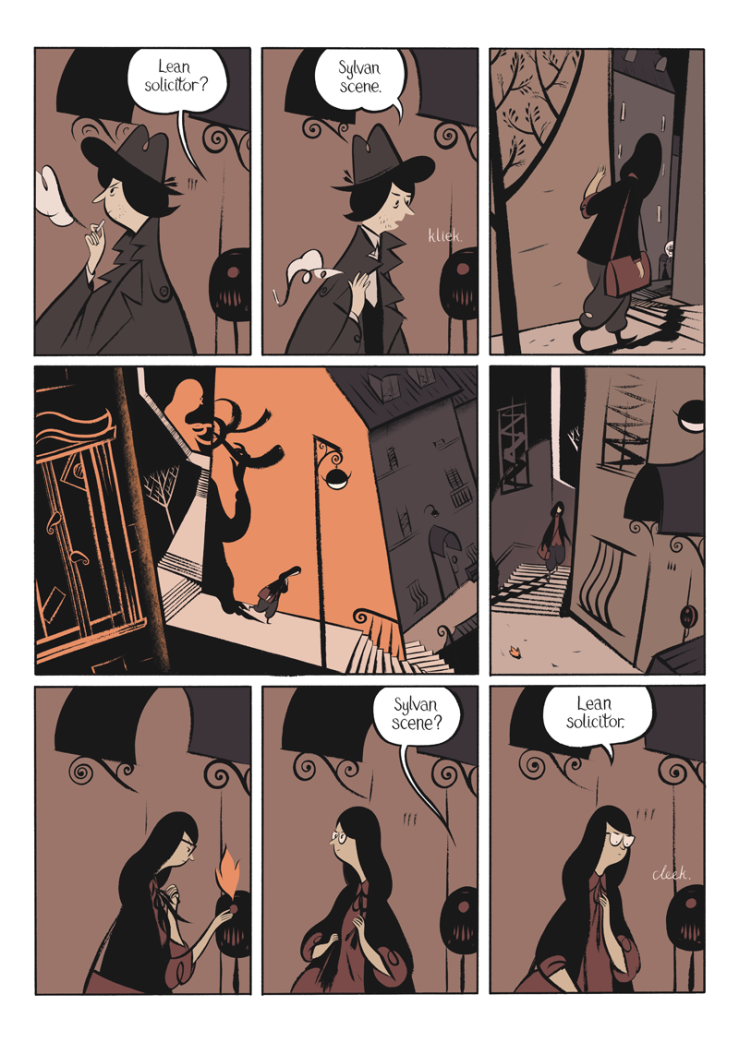
RM: I wanted the reference to be as obvious as possible, almost a direct copy, as if it’s placed there as an act of surrender–I’m not going to come up with a story, here’s one of most famous opening lines that you already know. Usually I know the beginning and the ending and I often downplay their importance, so that the work becomes focused mostly on the process and so that readers don’t expect any kind of resolution or satisfactory narrative development. In the password scene the phrases are copied directly from Eliot’s Wasteland, which itself refers to Paradise Lost in these passages. It’s a bit like a broken radio, shamelessly borrowing from the narrator’s visual and literary vocabulary, the way it happens in a dream.
premise_0022_22.psd Continue reading ““The Absence of Any Purpose Is the Starting Point for My Work” | An Interview with Roman Muradov”

“The Chemist’s Wife” — Anton Chekhov

“The Chemist’s Wife”

by

Anton Chekhov

The little town of B——, consisting of two or three crooked streets, was sound asleep. There was a complete stillness in the motionless air. Nothing could be heard but far away, outside the town no doubt, the barking of a dog in a thin, hoarse tenor. It was close upon daybreak.

Everything had long been asleep. The only person not asleep was the young wife of Tchernomordik, a qualified dispenser who kept a chemist’s shop at B——. She had gone to bed and got up again three times, but could not sleep, she did not know why. She sat at the open window in her nightdress and looked into the street. She felt bored, depressed, vexed . . . so vexed that she felt quite inclined to cry—again she did not know why. There seemed to be a lump in her chest that kept rising into her throat. . . . A few paces behind her Tchernomordik lay curled up close to the wall, snoring sweetly. A greedy flea was stabbing the bridge of his nose, but he did not feel it, and was positively smiling, for he was dreaming that every one in the town had a cough, and was buying from him the King of Denmark’s cough-drops. He could not have been wakened now by pinpricks or by cannon or by caresses.

The chemist’s shop was almost at the extreme end of the town, so that the chemist’s wife could see far into the fields. She could see the eastern horizon growing pale by degrees, then turning crimson as though from a great fire. A big broad-faced moon peeped out unexpectedly from behind bushes in the distance. It was red (as a rule when the moon emerges from behind bushes it appears to be blushing).

Suddenly in the stillness of the night there came the sounds of footsteps and a jingle of spurs. She could hear voices. Continue reading ““The Chemist’s Wife” — Anton Chekhov”

Harold Bloom on Wallace Stevens

The dark patches fall (Walt Whitman)

Capture

They will not do us any good—the good books (William H. Gass)

They will not do us any good—the good books—no—if by good we mean good looks, good times, good shoes; yet they still offer us salvation, for salvation does not wait for the next life, which is anyhow a vain and incautious delusion, but is to be had, if at all, only here—in this one. It is we who must do them honor by searching for our truth there, by taking their heart as our heart, by refusing to let our mind flag so that we close their covers forever, and spend our future forgetting them, denying the mind’s best moments. They extend the hand; we must grip it. Spinach never made Popeye strong sitting in the can. And the finest cookbook ever compiled put not one pot upon the stove or dish upon the table. Here, in the library that has rendered you suspect, you have made their acquaintance—some of the good books. So now that you’ve been nabbed for it, you must become their lover, their friend, their loyal ally. But that is what the rest of your life is for. Go now, break jail, and get about it.

From William H. Gass’s essay “To a Young Friend Charged with Possession of the Classics.” Collected in A Temple of Texts.

“On Being in the Blues” — Jerome K. Jerome

“On Being in the Blues”

by

Jerome K. Jerome

I can enjoy feeling melancholy, and there is a good deal of satisfaction about being thoroughly miserable; but nobody likes a fit of the blues. Nevertheless, everybody has them; notwithstanding which, nobody can tell why. There is no accounting for them. You are just as likely to have one on the day after you have come into a large fortune as on the day after you have left your new silk umbrella in the train. Its effect upon you is somewhat similar to what would probably be produced by a combined attack of toothache, indigestion, and cold in the head. You become stupid, restless, and irritable; rude to strangers and dangerous toward your friends; clumsy, maudlin, and quarrelsome; a nuisance to yourself and everybody about you.

While it is on you can do nothing and think of nothing, though feeling at the time bound to do something. You can’t sit still so put on your hat and go for a walk; but before you get to the corner of the street you wish you hadn’t come out and you turn back. You open a book and try to read, but you find Shakespeare trite and commonplace, Dickens is dull and prosy, Thackeray a bore, and Carlyle too sentimental. You throw the book aside and call the author names. Then you “shoo” the cat out of the room and kick the door to after her. You think you will write your letters, but after sticking at “Dearest Auntie: I find I have five minutes to spare, and so hasten to write to you,” for a quarter of an hour, without being able to think of another sentence, you tumble the paper into the desk, fling the wet pen down upon the table-cloth, and start up with the resolution of going to see the Thompsons. While pulling on your gloves, however, it occurs to you that the Thompsons are idiots; that they never have supper; and that you will be expected to jump the baby. You curse the Thompsons and decide not to go. Continue reading ““On Being in the Blues” — Jerome K. Jerome”

“The Rowboat” — Robert Walser

Capture

“Secret Breathing Techniques” — Ben Marcus

I HAD APPARENTLY BEEN living in one of the towns that was now gone. According to reports, I held my own against one of the younger organizations. I fought well and long. The ending of the report is muddy, with many foreign words and phrases, and an indecipherable series of pictures. There is no clear sense that I survived.

Photographs of my body had circulated, flags had been stitched with secret instructions.

There were instances of my name in the registry—the spelling varied, and my date of birth was frequently listed as unknown. A scroll of hair, probably my own, was taped to the paper. Mention was made of what must have been my house, a vehicle I summoned to cross the water (skirmishes, courtship, evasions—the report is unclear), and the amount of sacking I had contributed to the yearly mountain effort. I ranked slightly above average.

People wrote of seeing me in the morning by the water; several photographs featured me wearing a beard, concealing something in my coat. A Nacht diagram rated me favorably, prior to the revision. The Wixx index claimed I might have perished. I read accounts of myself ostensibly accompanying a family to the market on Saturdays. I may have been their assistant; I may have been their captor. The wording is vague. Some sentences depicted me handling the bread in an aggressive manner, as if searching for something inside it.

It is possible I was collecting samples. I would not rule it out. It would explain the long clear jars I found stored in my clothing that day when I woke. But it would not explain why those jars were empty.

Read the rest of “Secret Breathing Techniques” by Ben Marcus in Conjunctions.

“The Motive for Metaphor” — Wallace Stevens

“The Motive for Metaphor”

by

Wallace Stevens

You like it under the trees in autumn,
Because everything is half dead.
The wind moves like a cripple among the leaves
And repeats words without meaning.

In the same way, you were happy in spring,
With the half colors of quarter-things,
The slightly brighter sky, the melting clouds,
The single bird, the obscure moon–

The obscure moon lighting an obscure world
Of things that would never be quite expressed,
Where you yourself were not quite yourself,
And did not want nor have to be,

Desiring the exhilarations of changes:
The motive for metaphor, shrinking from
The weight of primary noon,
The A B C of being,

The ruddy temper, the hammer
Of red and blue, the hard sound–
Steel against intimation–the sharp flash,
The vital, arrogant, fatal, dominant X.


September 23, 1843 — From Nathaniel Hawthorne’s Journal

September 23d.–I have gathered the two last of our summer-squashes to-day. They have lasted ever since the 18th of July, and have numbered fifty-eight edible ones, of excellent quality. Last Wednesday, I think, I harvested our winter-squashes, sixty-three in number, and mostly of fine size. Our last series of green corn, planted about the 1st of July, was good for eating two or three days ago. We still have beans; and our tomatoes, though backward, supply us with a dish every day or two. My potato-crop promises well; and, on the whole, my first independent experiment of agriculture is quite a successful one. 

This is a glorious day,–bright, very warm, yet with an unspeakable gentleness both in its warmth and brightness. On such days it is impossible not to love Nature, for she evidently loves us. At other seasons she does not give me this impression, or only at very rare intervals; but in these happy, autumnal days, when she has perfected the harvests, and accomplished every necessary thing that she had to do, she overflows with a blessed superfluity of love. It is good to be alive now. Thank God for breath,–yes, for mere breath! when it is made up of such a heavenly breeze as this. It comes to the cheek with a real kiss; it would linger fondly around us, if it might; but, since it must be gone, it caresses us with its whole kindly heart, and passes onward, to caress likewise the next thing that it meets. There is a pervading blessing diffused over all the world. I look out of the window and think, “O perfect day! O beautiful world! O good God!” And such a day is the promise of a blissful eternity. Our Creator would never have made such weather, and given us the deep heart to enjoy it, above and beyond all thought, if he had not meant us to be immortal. It opens the gates of heaven and gives us glimpses far inward.

Bless me! this flight has carried me a great way; so now let me come back to our old abbey. Our orchard is fast ripening; and the apples and great thumping pears strew the grass in such abundance that it becomes almost a trouble–though a pleasant one–to gather them. This happy breeze, too, shakes them down, as if it flung fruit to us out of the sky; and often, when the air is perfectly still, I hear the quiet fall of a great apple. Well, we are rich in blessings, though poor in money. . . .

From Nathaniel Hawthorne’s American Note-Books.