Milton When a Boy Instructed by His Mother — Henry Fuseli

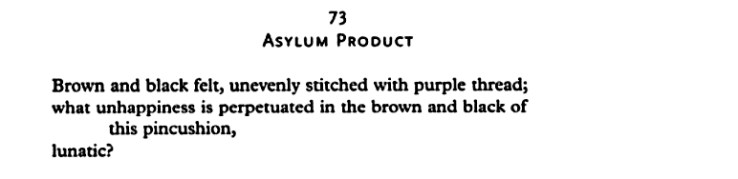
“Asylum Product” — Charles Reznikoff

as

True Detective, Bolaño’s 2666, Werewolves, Etc.

03-true-detective-1

1. A couple of years ago I wrote a pretty long essay about rereading Roberto Bolaño’s novel 2666, a dark, compelling, violent, mysterious book that I’ve reread in full three times now, a book that I frequently return to, a book that seems to leer from the shelf too often, Hey, you’re not done with me, you know that, right? 

2. Anyway, this long essay about rereading 2666 was also about another book: Sabine Baring-Gould’s 1865 folklore-horror hybrid, The Book of Were-Wolves (download it here). I argued that

What Bolaño and Baring-Gould do in these books is explore madness and violence and the ways that our world tries to (or fails to) contain madness and violence.

—and suggested that

Bolaño’s werewolves are, in line with Baring-Gould’s, people fated to madness and violence, but also relatively normal people. These werewolves contain within them a dreadful capacity for violence.

3. (What I want to say is that any speculation I might offer about the forthcoming conclusion of season one of True Detective I have already offered, at some length, in an essay (about two other texts) which I composed a few years before True Detective aired).

4. Well so and anyway: “After You’ve Gone,” the penultimate episode of True Detective.

In some ways the most straightforward episode to date, even disappointingly so, a bit of a police procedural, serving mostly to realign Cohle and Hart, demonstrating that despite their fight and their differences, they are also very similar. But you already know that, you know what happened in the episode, right? The obsession then is for an answer: Where does this all go? Who did the crimes? Who is The King in Yellow? How does it end?

5. I now lazily link to an article that rounds up some of the conjecture — the “theories” — about how the show will end. You’ve read some of these, right?

6. This kind of conjecture is fun, or maybe “fun” isn’t the right word—maybe what I want to say instead is:

True Detective compels many of its viewers to obsessively hunt down clues in each frame. There’s a thickness to the show’s repetition of key images and phrases—spirals, stars, sets of five figures, antlers, crowns, crosses that dissolve into targets, etc.—a seeming preciseness that invites us to impose our own order, our own narrative.

(This is the kind of conjecture that Hart repeatedly warns Cohle not to indulge in).

7. I’m reminded here of Juan Antonio Masoliver Ródenas’s prologue to Roberto Bolaño’s unfinished novel Woes of the True Policeman:

What matters is the active participation of the reader, concurrent with the act of writing. Bolaño makes this very clear in his explanation of the title: “The policeman is the reader, who tries in vain to decipher this wretched novel.” And in the body of the book itself there is an insistence on this conception of the novel as a life: we exist—we write, we read—so long as we’re alive, and the only conclusion is death.

True Detective, like True Policeman—and, like Bolaño’s masterpiece 2666—all invite the active participation of the reader. But also the woe.

8. There is no supernatural solution to the mysteries of True Detective. From the outset, True Detective has posited (the illusion of) human consciousness as a part of nature that seeks to define itself against naturethe real.

In True Detective, the supernatural is the product of terror and fantasy. It is imaginary. (And of course therefore no less real than the natural, the real, thanks to human consciousness).

audrey

9. From the beginning of Baring-Gould’s The Book of Were-Wolves:

It will then be seen that under the veil of mythology lies a solid reality, that a floating superstition holds in solution a positive truth.

This I shall show to be an innate craving for blood implanted in certain natures, restrained under ordinary circumstances, but breaking forth occasionally, accompanied with hallucination, leading in most cases to cannibalism. I shall then give instances of persons thus afflicted, who were believed by others, and who believed themselves, to be transformed into beasts, and who, in the paroxysms of their madness, committed numerous murders, and devoured their victims.

The emphasis is mine.

10. In the sixth episode of True Detective, Cohle says to Hart: “You, these people, this place … you’ll eat your fucking young as long as you have something to salute.” The indictment is broad, dark, and perhaps paranoid, but it serves to highlight the series’s keen attenuation to infanticide, to the infinite loss and dramatic mourning that underpins begetting.

11. Cohle has lost his daughter, and her death at such a young age, he says, spared him “the sin of fatherhood.”

Hart has essentially lost his daughters, ruined his life, ruined his (illusion of the) status as a family man. The thing that mattered—his family—was “right under his nose” the whole time.

On the job, both Cohle and Hart—separately—witness the awful deaths of infants; in both cases, the men snap, disconnect, quit.

12. (At this time, the reader is invited to sift through his or her own recollections of True Detective (if he or she so desires) and set aside examples of infanticidal violence).

13. Many fans of the show have speculated that Martin Hart is the King in Yellow, a notion fueled by the show’s stores of symbolic images, as well as Hart’s own actions.

The theory is intriguing, but I seriously doubt that Hart will be revealed as a perpetrator in the crimes of the Tuttle case. However, he is capable of slipping into werewolf mode: Threatening his lover Lisa’s new beau with horrific violence and then declaring, “I’m not a psycho–I wouldn’t have done those things” (the past perfect tense there is so strange); slipping on gloves to assault the boys who had consensual sex with his daughter Audrey; etc. etc. etc.

Hart’s actions are the strange double bind of the patriarchal lawman who sets to rule with sanctioned order—and, specifically, to rule and control the sexualized female body, which is oh-so-important to begettingDoes he serve and protect? Does he terrorize and menace? Both and at the same time.

But I’d argue that Hart is illusioned, that his identity is constituted in maintaining an illusion, an illusion that Cohle is too keenly aware of (“…you’ll eat your fucking young as long as you have something to salute”).

14. There’s a heap of corpses at the core of Bolaño’s 2666—women who are raped, murdered, discarded. Bolaño sends various detectives—many of them good detectives, true policeman—to find the killers, but there’s no satisfying answer: Just plenty of killers, plenty of werewolves. As the novel reaches its (non)end, we await the promise of a Giant (The Tall Man), a Big Answer. But the answer is inadequate, incomplete.

15. The capacity to transform into a killer, a werewolf is always there. Just put on some gloves. Just slip on a mask.

Or maybe take your mask off.

jpJvNrI

“The King of Jazz” — Donald Barthelme

“The King of Jazz”

by

Donald Barthelme

Well, I’m the king of jazz now, thought Hokie Mokie to himself as he oiled the slide on his trombone. Hasn’t been a ‘bone man been king of jazz for many years. But now that Spicy MacLammermoor, the old king, is dead, I guess I’m it. Maybe I better play a few notes out of this window here, to reassure myself.

“Wow!” said somebody standing on the sidewalk. “Did you hear that?”

“I did,” said his companion.

“Can you distinguish our great homemade American jazz performers, each from the other?”

“Used to could.”

“Then who was that playing?”

“Sounds like Hokie Mokie to me. Those few but perfectly selected notes have the real epiphanic glow.”

“The what?”

“The real epiphanic glow, such as is obtained only by artists of the caliber of Hokie Mokie, who’s from Pass Christian, Mississippi. He’s the king of jazz, now that Spicy MacLammermoor is gone.”

Hokie Mokie put his trombone in its case and went to a gig. At the gig everyone fell back before him, bowing.

“Hi Bucky! Hit Zoot! Hi Freddie! Hi George! Hi Thad! Hi Roy! Hi Dexter! Hi Jo! Hi Willie! Hi Greens!”

“What we gonna play, Hokie? You the king of jazz now, you gotta decide.”

“How ’bout ‘Smoke’?”

“Wow!” everybody said. “Did you hear that? Hokie Mokie can just knock a fella out, just the way he pronounces a word. What an intonation on that boy! God Almighty!” Continue reading ““The King of Jazz” — Donald Barthelme”

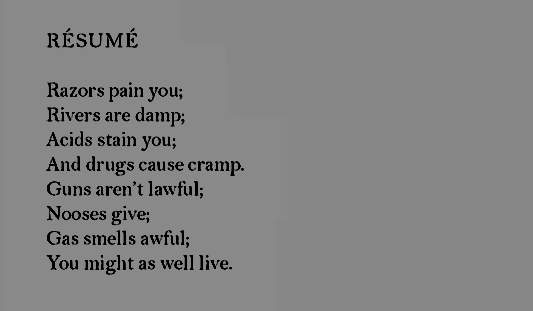
“Résumé” — Dorothy Parker

dp

The London Jungle Book (Book Acquired, 2.28.2014)

20140303-140624.jpg

Bhajju Shyam’s The London Jungle Book arrived a few days ago: Beautiful stuff. Full review to come, but blurb for now:

Hailed as a book that reverses the anthropological gaze, ‘The London Jungle Book’ is the personal story of Indian tribal artist Bhajju Shyam’s first encounter with a western city. Revised & fully updated to mark the 10th anniversary of that momentous journey, Bhajju’s rich art and poignant reflections are as relevant today as they ever were.

20140303-140645.jpg

“A Carnival Jangle” — Alice Dunbar

“A Carnival Jangle”

by

Alice Dunbar

There is a merry jangle of bells in the air, an all-pervading sense of jester’s noise, and the flaunting vividness of royal colours. The streets swarm with humanity,—humanity in all shapes, manners, forms, laughing, pushing, jostling, crowding, a mass of men and women and children, as varied and assorted in their several individual peculiarities as ever a crowd that gathered in one locality since the days of Babel.

It is Carnival in New Orleans; a brilliant Tuesday in February, when the very air gives forth an ozone intensely exhilarating, making one long to cut capers. The buildings are a blazing mass of royal purple and golden yellow, national flags, bunting, and decorations that laugh in the glint of the Midas sun. The streets are a crush of jesters and maskers, Jim Crows and clowns, ballet girls and Mephistos, Indians and monkeys; of wild and sudden flashes of music, of glittering pageants and comic ones, of befeathered and belled horses; a dream of colour and melody and fantasy gone wild in an effervescent bubble of beauty that shifts and changes and passes kaleidoscope-like before the bewildered eye.

A bevy of bright-eyed girls and boys of that uncertain age that hovers between childhood and maturity, were moving down Canal Street when there was a sudden jostle with another crowd meeting them. For a minute there was a deafening clamour of shouts and laughter, cracking of the whips, which all maskers carry, a jingle and clatter of carnival bells, and the masked and unmasked extricated themselves and moved from each other’s paths. But in the confusion a tall Prince of Darkness had whispered to one of the girls in the unmasked crowd: “You’d better come with us, Flo; you’re wasting time in that tame gang. Slip off, they’ll never miss you; we’ll get you a rig, and show you what life is.”

And so it happened, when a half-hour passed, and the bright-eyed bevy missed Flo and couldn’t find her, wisely giving up the search at last, she, the quietest and most bashful of the lot, was being initiated into the mysteries of “what life is.”

Down Bourbon Street and on Toulouse and St. Peter Streets there are quaint little old-world places where one may be disguised effectually for a tiny consideration. Thither, guided by the shapely Mephisto and guarded by the team of jockeys and ballet girls, tripped Flo. Into one of the lowest-ceiled, dingiest, and most ancient-looking of these shops they stepped.

“A disguise for the demoiselle,” announced Mephisto to the woman who met them. She was small and wizened and old, with yellow, flabby jaws, a neck like the throat of an alligator, and straight, white hair that stood from her head uncannily stiff.

“But the demoiselle wishes to appear a boy, un petit garcon?” she inquired, gazing eagerly at Flo’s long, slender frame. Her voice was old and thin, like the high quavering of an imperfect tuning-fork, and her eyes were sharp as talons in their grasping glance.

“Mademoiselle does not wish such a costume,” gruffly responded Mephisto.

“Ma foi, there is no other,” said the ancient, shrugging her shoulders. “But one is left now; mademoiselle would make a fine troubadour.”

“Flo,” said Mephisto, “it’s a dare-devil scheme, try it; no one will ever know it but us, and we’ll die before we tell. Besides, we must; it’s late, and you couldn’t find your crowd.”

And that was why you might have seen a Mephisto and a slender troubadour of lovely form, with mandolin flung across his shoulder, followed by a bevy of jockeys and ballet girls, laughing and singing as they swept down Rampart Street.

When the flash and glare and brilliancy of Canal Street have palled upon the tired eye, when it is yet too soon to go home to such a prosaic thing as dinner, and one still wishes for novelty, then it is wise to go into the lower districts. There is fantasy and fancy and grotesqueness run wild in the costuming and the behaviour of the maskers. Such dances and whoops and leaps as these hideous Indians and devils do indulge in; such wild curvetings and long walks! In the open squares, where whole groups do congregate, it is wonderfully amusing. Then, too, there is a ball in every available hall, a delirious ball, where one may dance all day for ten cents; dance and grow mad for joy, and never know who were your companions, and be yourself unknown. And in the exhilaration of the day, one walks miles and miles, and dances and skips, and the fatigue is never felt.

In Washington Square, away down where Royal Street empties its stream of children great and small into the broad channel of Elysian Fields Avenue, there was a perfect Indian pow-wow. With a little imagination one might have willed away the vision of the surrounding houses, and fancied one’s self again in the forest, where the natives were holding a sacred riot. The square was filled with spectators, masked and un-masked. It was amusing to watch these mimic Red-men, they seemed so fierce and earnest.

Suddenly one chief touched another on the elbow. “See that Mephisto and troubadour over there?” he whispered huskily.

“Yes; who are they?”

“I don’t know the devil,” responded the other, quietly, “but I’d know that other form anywhere. It’s Leon, see? I know those white hands like a woman’s and that restless head. Ha!”

“But there may be a mistake.”

“No. I’d know that one anywhere; I feel it is he. I’ll pay him now. Ah, sweetheart, you’ve waited long, but you shall feast now!” He was caressing something long and lithe and glittering beneath his blanket.

In a masked dance it is easy to give a death-blow between the shoulders. Two crowds meet and laugh and shout and mingle almost inextricably, and if a shriek of pain should arise, it is not noticed in the din, and when they part, if one should stagger and fall bleeding to the ground, can any one tell who has given the blow? There is nothing but an unknown stiletto on the ground, the crowd has dispersed, and masks tell no tales anyway. There is murder, but by whom? for what? Quien sabe?

And that is how it happened on Carnival night, in the last mad moments of Rex’s reign, a broken-hearted mother sat gazing wide-eyed and mute at a horrible something that lay across the bed. Outside the long sweet march music of many bands floated in as if in mockery, and the flash of rockets and Bengal lights illumined the dead, white face of the girl troubadour.

“Monday or Tuesday” — Virginia Woolf

“Monday or Tuesday”

by

Virginia Woolf

Lazy and indifferent, shaking space easily from his wings, knowing his way, the heron passes over the church beneath the sky. White and distant, absorbed in itself, endlessly the sky covers and uncovers, moves and remains. A lake? Blot the shores of it out! A mountain? Oh, perfect-the sun gold on its slopes. Down that falls. Ferns then, or white feathers, for ever and ever-

Desiring truth, awaiting it, laboriously distilling a few words, for ever desiring-(a cry starts to the left, another to the right. Wheels strike divergently. Omnibuses conglomerate in conflict)-for ever desiring-(the clock asseverates with twelve distinct strokes that it is midday; light sheds gold scales; children swarm)-for ever desiring truth. Red is the dome; coins hang on the trees; smoke trails from the chimneys; bark, shout, cry “Iron for sale”-and truth?

Radiating to a point men’s feet and women’s feet, black or gold-encrusted-(This foggy weather-Sugar? No, thank you-The commonwealth of the future)-the firelight darting and making the room red, save for the black figures and their bright eyes, while outside a van discharges, Miss Thingummy drinks tea at her desk, and plate-glass preserves fur coats-

Flaunted, leaf-light, drifting at corners, blown across the wheels, silver-splashed, home or not home, gathered, scattered, squandered in separate scales, swept up, down, torn, sunk, assembled-and truth?

Now to recollect by the fireside on the white square of marble. From ivory depths words rising shed their blackness, blossom and penetrate. Fallen the book; in the flame, in the smoke, in the momentary sparks-or now voyaging, the marble square pendant, minarets beneath and the Indian seas, while space rushes blue and stars glint-truth? content with closeness?

Lazy and indifferent the heron returns; the sky veils her stars; then bares them.

“I like the delete key best” (William H. Gass)

When Skizzen first became aware of it, he laughed, for he had miss-spelled “spell.” Well, not exactly. The additional l was a typo. “Spelll.” It was a machine-mad error, but the extra l could be easily deleted. That was one of the great virtues of this new invention. If words magically appeared on the screen (he was often unaware he was typing his fingers flew so fast, so briefly did they need to light upon the keys), they could be sent away just as readily. Not like a note that would leave of its own accord yet could not be erased and could not be said to have disappeared. He had been saying that a spell had been put upon mankind. Writing, not saying. He had been writing that a spell had been put upon our race. As if Circe had changed us into swine so that our little noses were wrinkled by concealed snouts, and inside those of us who possessed a male member a hog’s reproductive implement curled—a pig’s … sexual implement—a memoir of the moment of enchantment. Anyway, we did not see how foolish, how absurd, how wicked we were being. That was the gist.

Joseph had pursued a request for some books that he had asked the library to acquire as far as the library entrance, where a smilling young man had greeted him with this suitcase fulll of magic. We ordered some of these computers, he said with some excitement, and they just came. Want to play? The Music Department had been threatened with digitization, but their three-person claim on modernity was weak. So Professor Skizzen dutifullly sat at one end of a long library table and began pecking away: It is as if a spelll had been put upon mankind. How quickly the spelll enveloped the screen. We oinked and thought it singing, he wrote. The young man approached bearing his grin like a tidbit on a salver, so Skizzen hit DELETE and saw nothing more, neither his practice sentence nor the grin. Go on, the young man said, take it for a spin. Our new system will make it easy for us to keep records, he boasted. The bursar is out of his mind with delight. We rolled in the mud and believed we were bathing, Skizzen wrote, with his best hunt-and-peck. He knew Grin was grinning again, over his shoulder. Let the piker peek, Skizzen thought, I shall complete my edifying lines about the spelll that been put upon mankind. “We fought one another and afterward celebrated the carnage” soon materialized. With writing, he said aloud, the writing inscribes the letters, letters build the words, and, subsequently, the thought arrives—handmade like kneaded bread. With typewriting, you get letters by hammering them into existence. Or out, with x’s, if you don’t like them. With this sweet machine here, you issue a requisition. Well, now, I hadn’t thought about it that way, the Grinner said. With pen and ink, before we write, we think, because we hate the sight of corrections. With the computer we write first and think later, corrections are so easy to perform. I like the delete key best; it has a good appearance, Skizzen said, typing furiously. “We ate our farrow and supposed it was a splendidly healthy, indeed toothsome, way to dine.” Joseph determined to leave something behind as an animal might to signal its presence, so he keyed: “We eagerly awaited our own slaughter, as though we were receiving an award.” Now he spoke it as he played it. “Our haunch would hang in the smokehouse to season, and those of us who remained to feel would feel, like parvenus, that we had Arrived.” I’m glad you got these, he said to the Grin, though the young man didn’t seem to have any more grins to spend. I wonder how many unordered books these cost me. He slid his words the length of the long table where they disappeared over its edge into delete. Then Skizzen took his goatee away where it would be better appreciated.

From William H. Gass’s  novel Middle C.

The Complete Short Stories of J.G. Ballard (Eleventh Riff: The Nineties)

jgb_complete_ss4003111

PREVIOUSLY:

Introductions + stories 1956-1959

Stories of 1960

Stories of 1961

Stories of 1962

“The Subliminal Man,” Black Friday, and Consumerism

Stories of 1963-1964

Stories of 1966

Closing out the sixties

The seventies

The eighties

IN THIS RIFF:

“Dream Cargoes” (1990)

“A Guide to Virtual Death” (1992)

“The Message from Mars” (1992)

“Report from an Obscure Planet” (1992)

“The Secret Autobiography of J G B” (1981/2009)

“The Dying Fall” (1996)

1. “Dream Cargoes” (1990)

By the 1990s Ballard had written essentially the same stories over and over—with diminishing returns. Some of the weakness in the later entries in the Complete Short Stories can be attributed to Ballard’s prescience. The world caught up to him at some point, blunting his satire into something goofier, more cartoonish, but also sharpening the reactionary streak that always glowed under the surface of his writing. At his peak, Ballard used his stories to provoke readers into looking at their culture in a new way, and the best of those stories still retain a futurist power. However, many of the late period stories blazon their moral outrage in a wearisome didactic streak.

1990’s “Dream Cargoes” is paint-by-numbers Ballard: Themes of time, sleep, mutation, ecological disaster, birds, etc. The plot anticipates one of Ballard’s weaker novels, Rushing to Paradise (1994), a day-glo nightmare about misguided attempts to steward the forces of nature. And like Rushing to Paradise, the prose here is weak—Ballard relies on the stock phrases that litter his earliest stories.

2. “The Message from Mars” (1992) / “Report from an Obscure Planet” (1992) / “A Guide to Virtual Death” (1992)

“The Message from Mars” anticipates public disinterest in astronomy (and science in general), the end of NASA’s space shuttle program, and China’s emerging dominance as a world power with space flight capability. So there you go. (It also posits the horror of a President Quayle!). Ballard sends a group of astronauts on a Mars mission, refuses to share their findings with us, and then leaves them, once they land, in their space shuttle, where they live on for decades, silent, incommunicado, alienated from humanity in their self-imposed exile. Ballard’s cynicism is balanced by his refusal to overstate any kind of moral here—the story succeeds in its evocation of mystery.

“Report from an Obscure Planet” is another riff on millennial anxieties, written in the perspective of a “we” condemning the human race for its shortsighted, disastrous treatment of the planet. Ballard doesn’t seem to keen on the future wonders promised by computers:

Driven by the need for a more lifelike replica of the scenes of carnage that most entertained them, the people of this unhappy world had invented an advanced and apparently interiorised version of their television screens, a virtual replica of reality in which they could act out their most deviant fantasies. These three–dimensional simulations were generated by their computers, and had reached a stage of development in the last years of the millennium in which the imitation of reality was more convincing than the original. It may even have become the new reality to the extent that their cities and highways, their fellow citizens and, ultimately, themselves seemed mere illusions by comparison with the electronically generated amusement park where they preferred to play. Here they could assume any identity, create and fulfill any desire, and explore the most deviant dreams.  

While “Report from an Obscure Planet” uses a didactic narrator and a heavy hand to telegraph its message, its companion piece “A Guide to Virtual Death” is far more fun, wicked, and shockingly accurate (if wildly hyperbolic). Sure, yes, okay—another list from Ballard, and okay, yes, sure—I tend to be keen on his lists (“The Index,” “The Assassination of John Fitzgerald Kennedy Considered as a Downhill Motor Race”)—but they also tend to be his strongest pieces. As usual with his list-stories, Ballard feels obligated to begin with a note:

For reasons amply documented elsewhere, intelligent life on earth became extinct in the closing hours of the 20th Century. Among the clues left to us, the following schedule of a day’s television programmes transmitted to an unnamed city in the northern hemisphere on December 23, 1999, offers its own intriguing insight into the origins of the disaster.

6.00 am Porno–Disco. Wake yourself up with his–and–her hard–core sex images played to a disco beat.

7.00 Weather Report. Today’s expected micro–climates in the city’s hotel atriums, shopping malls and office complexes. Hilton International promises an afternoon snow–shower as a Christmas appetiser.

7.15 News Round–up. What our news–makers have planned for you. Maybe a small war, a synthetic earthquake or a famine–zone! charity tie–in.

7.45 Breakfast Time. Gourmet meals to watch as you eat your diet cellulose.

Brief but Essential. Go ahead and read the whole thing.

3. “The Dying Fall” (1996) / “The Secret Autobiography of J G B” (1981/2009)

The American edition of Complete Stories is more complete than the British volume, including two extra stories. “The Dying Fall” (read it here if you like) is an unfortunate last entry, a weak note in a grand tome. It’s not bad; it’s simply not good, yet another revenge tale with a bad wife, etc. It feels like a frame for Ballard to riff on architecture and psychoanalysis.

“The Secret Autobiography of J G B” is much stronger (you can read it here), although it was also composed at his peak and republished (“rediscovered”) after his death. The final lines would have made a fitting end for the entire collection:

When the summer was followed by a mild autumn, B had established a pleasant and comfortable existence for himself. He had abundant stocks of tinned food, fuel, and water with which to survive the winter. The river was nearby, clear and free of all pollution, and petrol was easy to obtain, in unlimited quantities, from the filling stations and parked cars. At the local police station, he assembled a small armory of pistols and carbines, to deal with any unexpected menace that might appear.

But his only visitors were the birds, and he scattered handfuls of rice and seeds on his lawn and on those of his former neighbors. Already he had begun to forget them, and Shepperton soon became an extraordinary aviary, filled with birds of every species.

Thus the year ended peacefully, and B was ready to begin his true work.

4. On the horizon:

I am done! Sort of. One more post—I’ll revisit these riffs and select the tales that I would include in a collection I would call The Essential Short Stories of J.G. Ballard.

“A Guide to Virtual Death” — J.G. Ballard

“A Guide to Virtual Death”

by

J.G. Ballard

For reasons amply documented elsewhere, intelligent life on earth became extinct in the closing hours of the 20th Century. Among the clues left to us, the following schedule of a day’s television programmes transmitted to an unnamed city in the northern hemisphere on December 23, 1999, offers its own intriguing insight into the origins of the disaster.

6.00 am Porno–Disco. Wake yourself up with his–and–her hard–core sex images played to a disco beat.

7.00 Weather Report. Today’s expected micro–climates in the city’s hotel atriums, shopping malls and office complexes. Hilton International promises an afternoon snow–shower as a Christmas appetiser.

7.15 News Round–up. What our news–makers have planned for you. Maybe a small war, a synthetic earthquake or a famine–zone! charity tie–in.

7.45 Breakfast Time. Gourmet meals to watch as you eat your diet cellulose.

8.30 Commuter Special. The rush–hour game–show. How many bottoms can you pinch, how many faces can you slap?

9.30 The Travel Show. Visit the world’s greatest airports and under ground car parks.

10.30 Home–makers of Yesterday. Nostalgic scenes of old–fashioned housework. No.7 – The Vacuum Cleaner.

11.00 Office War. Long–running serial of office gang–wars.

12.00 Newsflash. The networks promise either a new serial killer or a deadly food toxin.

1.00 pm Live from Parliament. No .12 – The Alcoholic MP.

1.30 The Nose–Pickers. Hygiene programme for the kiddies.

2.00 Caress Me. Soft–porn for the siesta hour.

2.30 Your Favourite Commericials. Popular demand re–runs of golden oldie TV ads.

3.00 Housewives’ Choice. Rape, and how to psychologically prepare yourself.

4.00 Count–down. Game show in which contestants count backwards from one million.

5.00 Newsflash. Either an airliner crash or a bank collapse. Viewers express preference.

6.00 Today’s Special. Virtual Reality TV presents ‘The Kennedy Assassination.’ The Virtual Reality head–set takes you to Dallas, Texas, on November 22, 1963. First you fire the assassin’s rifle from the Book Depository window, and then you sit between Jackie and JFK in the Presidential limo as the bullet strikes. For premium subscribers only – feel the Presidential brain tissue spatter your face OR wipe Jackie’s tears onto your handkerchief.

8.00 Dinner Time. More gourmet dishes to view with your evening diet–cellulose.

9.00 Science Now. Is there life after death? Micro–electrodes pick up ultra–faint impulses from long–dead brains. Relatives question the departed.

10.00 Crime–Watch. Will it be your home that is broken into tonight by the TV Crime Gang?

11.00 Today’s Special. Tele–Orgasm. Virtual Reality TV takes you to an orgy. Have sex with the world’s greatest movie–stars. Tonight: Marilyn Monroe and Madonna OR Warren Beatty and Tom Cruise. For premium subscribers only – experience transexualism, paedophiia, terminal syphilis, gang–rape, and bestiality (choice: German Shepherd or Golden Retriever).

1.00 am Newsflash. Tonight’s surprise air–crash.

2.00 The Religious Hour. Imagine being dead. Priests and neuroscientists construct a life–like mock–up of your death.

3.00 Night–Hunter. Will the TV Rapist come through your bedroom window?

4.15 Sex for Insomniacs. Soft porn to rock you to sleep.

5.00 The Charity Hour. Game show in which Third–World contestants beg for money.


“Martyrdom of Saint Erasmus” (William H. Gass)

week11-0064

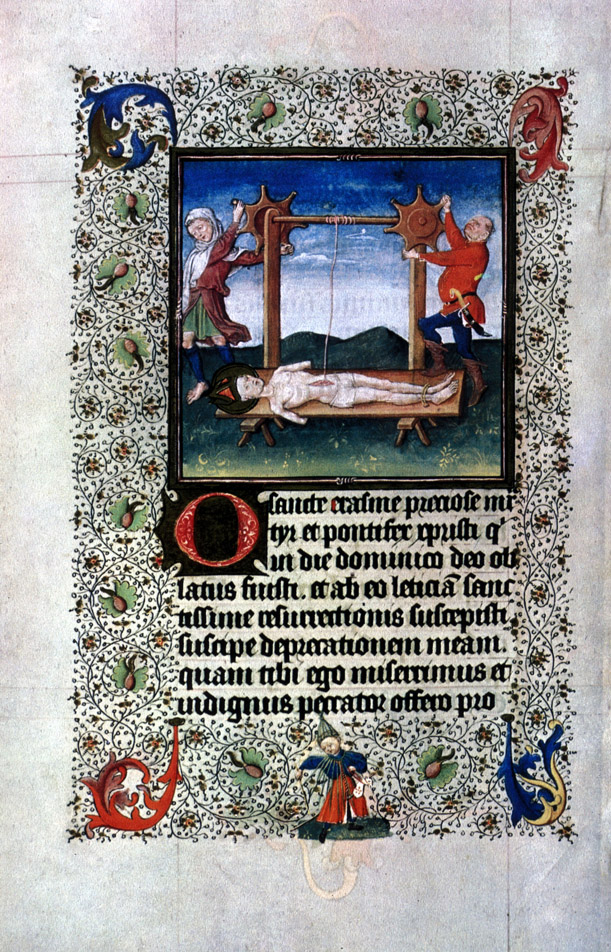
There were images that had nowhere to hang but in his head, images he remembered from books but of which he had no other copy; particularly one, from a strangely beautiful illuminated manuscript called The Hours of Catherine of Cleves, that depicted the martyrdom of Saint Erasmus. The presumptive saint lies on a raised plank, naked except for a loincloth. His abdomen has been opened and his intestines attached to a windlass erected above him. Thereupon, like a length of sausage or a length of rope, his innards are being wound by two figures, one male, one possibly female, each working hard to turn the spokes, their faces, however, averted from the scene. The saint does not appear to have wrists or hands. Eight turns have already been taken. The sky is empty except for a few clouds; the earth is empty except for two hills and some small yellow flowers. Around this painting, framed like a picture, is a delicate thin line made of curlicues and a field of tiny petals stalked by imaginary butterflies. At the bottom a small boy wearing a collar of thin sticks is riding a hobbyhorse.

His curiosity aroused by this calamitous vision, Skizzen sought more bio concerning Saint Erasmus. One source simply said that “although he existed, almost nothing is known about him.” This sentence stayed with Skizzen as stubbornly as the piteous illumination. What a blessed condition Erasmus must have enjoyed! Although he existed, almost nothing was known of him. Although nothing was known of him, as a saint, he existed. He existed, yet he had lived such a saintly life there was nothing of him to be known. Still another authority was not as sanguine. It claimed that the cult of Erasmus spread with such success that twelve hundred years later the martyr was invoked as one of the Fourteen Holy Helpers, whoever they were, and had become patron saint of sailors as well as kids who had colic. What was known, during those hundreds of years, was not known of the saint but of some figure he had thrown about himself as you would a ghostly garment or a costume for the dance. Proudly, Professor Skizzen pasted Erasmus in his memory book. A.d. 300. He was sprayed with tar and set alight. He was jailed, rescued by an angel, disemboweled. On a day in a.d. He died for me.

From William H. Gass’s novel  Middle C.

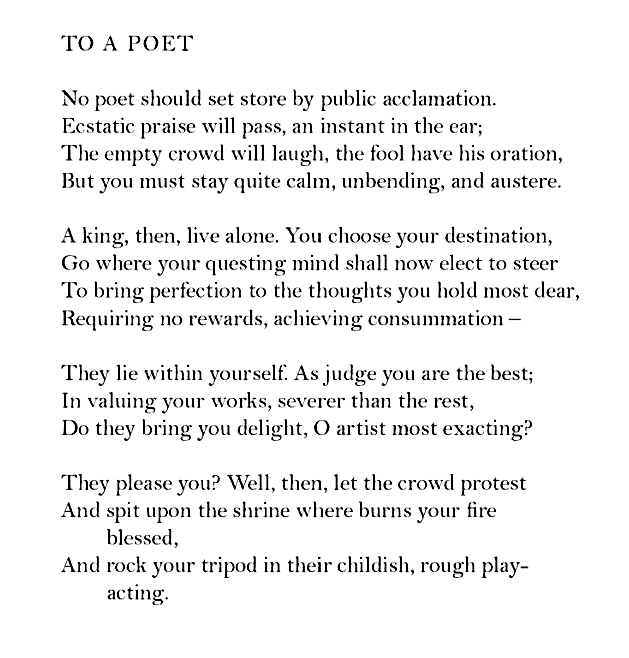
“To a Poet” — Alexander Pushkin

poet

“Good Old Neon” — David Foster Wallace

“Good Old Neon”

by

David Foster Wallace

My whole life I’ve been a fraud. I’m not exaggerating. Pretty much all I’ve ever done all the time is try to create a certain impression of me in other people. Mostly to be liked or admired. It’s a little more complicated than that, maybe. But when you come right down to it it’s to be liked, loved. Admired, approved of, applauded, whatever. You get the idea. I did well in school, but deep down the whole thing’s motive wasn’t to learn or improve myself but just to do well, to get good grades and make sports teams and perform well. To have a good transcript or varsity letters to show people. I didn’t enjoy it much because I was always scared I wouldn’t do well enough. The fear made me work really hard, so I’d always do well and end up getting what I wanted. But then, once I got the best grade or made All City or got Angela Mead to let me put my hand on her breast, I wouldn’t feel much of anything except maybe fear that I wouldn’t be able to get it again. The next time or next thing I wanted. I remember being down in the rec room in Angela Mead’s basement on the couch and having her let me get my hand up under her blouse and not even really feeling the soft aliveness or whatever of her breast because all I was doing was thinking, ‘Now I’m the guy that Mead let get to second with her.’ Later that seemed so sad. This was in middle school. She was a very big-hearted, quiet, self-contained, thoughtful girl — she’s a veterinarian now, with her own practice — and I never even really saw her, I couldn’t see anything except who I might be in her eyes, this cheerleader and probably number two or three among the most desirable girls in middle school that year. She was much more than that, she was beyond all that adolescent ranking and popularity crap, but I never really let her be or saw her as more, although I put up a very good front as somebody who could have deep conversations and really wanted to know and understand who she was inside. Continue reading ““Good Old Neon” — David Foster Wallace”

Macbeth Consulting the Vision of the Armed Head — Henry Fuseli

“Sonet in Orknay” — William Fowler

sonet

“Fixed moral boundaries are harmful” (Ben Marcus)

—But can you sketch for me a picture of your ethics?

—I think that fixed moral boundaries are harmful, even if they provide momentary comfort and save lives. I think our ethical duty is to eliminate the behavioral corsets that are cinched over children just as their explosive energy is at its most threatening. Is a tantrum disruptive, or does it point to an emotional tunnel we’re afraid of entering? The doctrines of the tantras involve meditation, mantras, ritual, and explosive behavior. We’re talking about ancient ideas that are elementary and obvious to high schoolers. My ethics? I’d like to shed the strictures of adulthood and make maturity an optional result of a freely lived human life, not the necessary path to power and success, lorded over by depressed, overweight, unimaginative corpses. The twenty most central mantras have their roots in baby talk. No one disputes this anymore. A syntax comprised of these mantras, which should not be confused with NASA’s failed language, can marshal the force of an entire infant society, but— and this is key— this syntax is not capable of instructional phrasings, so nothing can be taught, which keeps maturity and its death mask perfectly at bay.

From Ben Marcus’s story “On Not Growing Up.”

Read it at Conjunctions or in Marcus’s latest collection Leaving the Sea: Stories.