“The Death of the Moth” — Virginia Woolf

“The Death of the Moth”

by

Virginia Woolf

Moths that fly by day are not properly to be called moths; they do not excite that pleasant sense of dark autumn nights and ivy-blossom which the commonest yellow-underwing asleep in the shadow of the curtain never fails to rouse in us. They are hybrid creatures, neither gay like butterflies nor sombre like their own species. Nevertheless the present specimen, with his narrow hay-coloured wings, fringed with a tassel of the same colour, seemed to be content with life. It was a pleasant morning, mid-September, mild, benignant, yet with a keener breath than that of the summer months. The plough was already scoring the field opposite the window, and where the share had been, the earth was pressed flat and gleamed with moisture. Such vigour came rolling in from the fields and the down beyond that it was difficult to keep the eyes strictly turned upon the book. The rooks too were keeping one of their annual festivities; soaring round the tree tops until it looked as if a vast net with thousands of black knots in it had been cast up into the air; which, after a few moments sank slowly down upon the trees until every twig seemed to have a knot at the end of it. Then, suddenly, the net would be thrown into the air again in a wider circle this time, with the utmost clamour and vociferation, as though to be thrown into the air and settle slowly down upon the tree tops were a tremendously exciting experience.

The same energy which inspired the rooks, the ploughmen, the horses, and even, it seemed, the lean bare-backed downs, sent the moth fluttering from side to side of his square of the window-pane. One could not help watching him. One was, indeed, conscious of a queer feeling of pity for him. The possibilities of pleasure seemed that morning so enormous and so various that to have only a moth’s part in life, and a day moth’s at that, appeared a hard fate, and his zest in enjoying his meagre opportunities to the full, pathetic. He flew vigorously to one corner of his compartment, and, after waiting there a second, flew across to the other. What remained for him but to fly to a third corner and then to a fourth? That was all he could do, in spite of the size of the downs, the width of the sky, the far-off smoke of houses, and the romantic voice, now and then, of a steamer out at sea. What he could do he did. Watching him, it seemed as if a fibre, very thin but pure, of the enormous energy of the world had been thrust into his frail and diminutive body. As often as he crossed the pane, I could fancy that a thread of vital light became visible. He was little or nothing but life.

Yet, because he was so small, and so simple a form of the energy that was rolling in at the open window and driving its way through so many narrow and intricate corridors in my own brain and in those of other human beings, there was something marvellous as well as pathetic about him. It was as if someone had taken a tiny bead of pure life and decking it as lightly as possible with down and feathers, had set it dancing and zig-zagging to show us the true nature of life. Thus displayed one could not get over the strangeness of it. One is apt to forget all about life, seeing it humped and bossed and garnished and cumbered so that it has to move with the greatest circumspection and dignity. Again, the thought of all that life might have been had he been born in any other shape caused one to view his simple activities with a kind of pity. Continue reading ““The Death of the Moth” — Virginia Woolf”

“Sonnet” — Elizabeth Bishop

sonnet

Emily Dickinson — Tom Gauld

Reviews Page Redesign (And a Reflection on Sexist Reviewing Habits)

So I updated Biblioklept’s Reviews page.

The page had just been a list of the reviews, riffs, and essays published on the blog, with each new entry stacking up in chronological order. For years I’ve known that this unorganized review dump was essentially useless, and I’d been meaning to turn it into an alphabetical index—and I finally did. (I kept the chronolist too, mostly for myself).

Anyway, as I went through this boring, sort-of-arduous process, I couldn’t help but reflect on a few of the habits that manifest under the surface:

The obvious: The reviews on the blog trend very heavily toward male authors. I already knew this, but counting things up makes it plain:

To date, I’ve run reviews of approximately 221 authors (approximate in the sense that I counted only once); of those reviews, only 36 were books by women. That’s about 16%. (This analysis doesn’t even begin to consider the multiple reviews of authors—for example, there are like a ton of reviews of Roberto Bolaño books, but only one review of a Clarice Lispector book). This ratio runs counter to what I’d like to believe are my principles; the number certainly contrasts with the fiction and poetry that I run on the blog (public domain stuff), which trends toward female authors. The number also contrasts with the ratio of male to female authors — roughly 1:1 — that appear on my course syllabuses.

If my tone sounds defensive, it’s because it is. The Read Women 2014 project has helped to highlight sexist reading habits—including my own. Sexism—any kind of prejudicial ism (and every ism is prejudicial) manifests as a blinding structure: Part of the structuring condition of ideological sexism is that the sexist person usually cannot see that he is sexist (he cannot see that he cannot see). I’m not offering this as a defense of my own habits: I’m not saying, Look, I’m aware of my skewed reviewing habits, and my very awareness of my inherent sexism makes me less sexist, absolves, me, etc. (But look at how I rhetorically dance around simply writing, My reviewing habits are sexist; look at how I’m still unable to simply type I’m probably a sexist, let alone I’m sexist, let me hedge, use parentheses, etc.).

Can I turn attention away from myself and onto the aesthetic critic Harold Bloom? In his Paris Review interview, he claimed:

I do not for a moment yield to the notion that any social, racial, ethnic, or “male” interest could determine my aesthetic choices. I have a lifetime of experience, learning, and insight that tells me this.

Bloom’s statement is a perfect example of I cannot see that I cannot see. (Stephen Colbert essentially ridicules this kind of blindness on his satirical show The Colbert Report by repeatedly claiming that he is not racist because he cannot see color).

I think that (I know that) a certain male interest determines my aesthetic interest. At the same time, I understand Bloom’s resistance to the notion that aesthetics are somehow contingent on gender. Could a man have written “A Good Man Is Hard to Find” or To the Lighthouse or Death Comes to the Archbishop or Their Eyes Were Watching God? (A man didn’t). We’d like to believe that the Great Stuff transcends the material world—that part of its timelessness is that it’s not bound to mortal gendered coils. Etc.

What about now? What about Read Women 2014? I’ve been reading more women authors, I think, but I haven’t been reviewing them. I recently reread Flannery O’Connor’s collection Everything That Rises Must Converge, some Gertrude Stein I’d never read before (including Tender Buttons), and some short stories by Eudora Welty and Willa Cather. I’ve read far less contemporary stuff though, although I did review Jessica Hollander’s excellent collection In These Times the Home Is a Tired Place. In general though, I tend to read less contemporaryish fiction now than I used to—I’m reading three books now, and only one is by a living author (Ben Marcus). Of the three books I’m reading now, only one is by a woman (Zelda Fitzgerald). Of the last ten book reviews published on this site, four are of books by women.

Data and numbers are unappealing—especially when they quantify something we (and when I write we you know I mean I) don’t want to acknowledge. We’d (I’d) rather qualify than quantify. Etc.

I suppose it’s the idea of a conscious effort that so repels some of us (me). The notion that I (we?) might have to make an actual intellectual (not aesthetic, perhaps non-intuitive) effort to differentiate our reading. But that’s what it takes, right? An effort. A recognition. A looking.

The Pervert’s Guide to Cinema — Slavoj Žižek (Full Film)

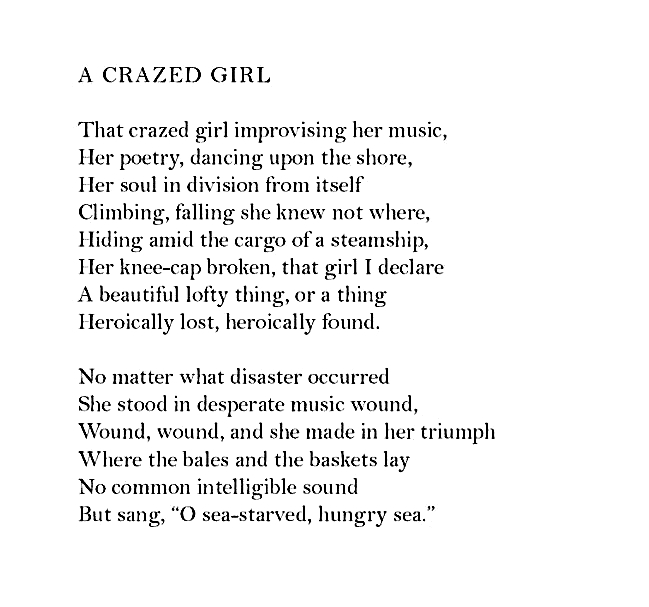
“A Crazed Girl” — William Butler Yeats

wby

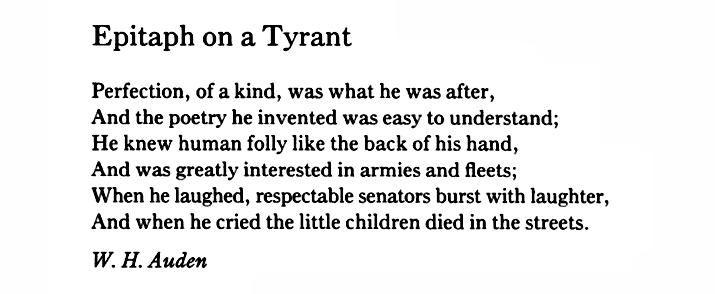
“Epitaph on a Tyrant” — W.H. Auden

tyrant

“The Repairer of Reputations” — Robert W. Chambers

“The Repairer of Reputations”

by Robert W. Chambers

I

“Ne raillons pas les fous; leur folie dure plus longtemps que la nôtre…. Voila toute la différence.”

Toward the end of the year 1920 the Government of the United States had practically completed the programme, adopted during the last months of President Winthrop’s administration. The country was apparently tranquil. Everybody knows how the Tariff and Labour questions were settled. The war with Germany, incident on that country’s seizure of the Samoan Islands, had left no visible scars upon the republic, and the temporary occupation of Norfolk by the invading army had been forgotten in the joy over repeated naval victories, and the subsequent ridiculous plight of General Von Gartenlaube’s forces in the State of New Jersey. The Cuban and Hawaiian investments had paid one hundred per cent and the territory of Samoa was well worth its cost as a coaling station. The country was in a superb state of defence. Every coast city had been well supplied with land fortifications; the army under the parental eye of the General Staff, organized according to the Prussian system, had been increased to 300,000 men, with a territorial reserve of a million; and six magnificent squadrons of cruisers and battle-ships patrolled the six stations of the navigable seas, leaving a steam reserve amply fitted to control home waters. The gentlemen from the West had at last been constrained to acknowledge that a college for the training of diplomats was as necessary as law schools are for the training of barristers; consequently we were no longer represented abroad by incompetent patriots. The nation was prosperous; Chicago, for a moment paralyzed after a second great fire, had risen from its ruins, white and imperial, and more beautiful than the white city which had been built for its plaything in 1893. Everywhere good architecture was replacing bad, and even in New York, a sudden craving for decency had swept away a great portion of the existing horrors. Streets had been widened, properly paved and lighted, trees had been planted, squares laid out, elevated structures demolished and underground roads built to replace them. The new government buildings and barracks were fine bits of architecture, and the long system of stone quays which completely surrounded the island had been turned into parks which proved a god-send to the population. The subsidizing of the state theatre and state opera brought its own reward. The United States National Academy of Design was much like European institutions of the same kind. Nobody envied the Secretary of Fine Arts, either his cabinet position or his portfolio. The Secretary of Forestry and Game Preservation had a much easier time, thanks to the new system of National Mounted Police. We had profited well by the latest treaties with France and England; the exclusion of foreign-born Jews as a measure of self-preservation, the settlement of the new independent negro state of Suanee, the checking of immigration, the new laws concerning naturalization, and the gradual centralization of power in the executive all contributed to national calm and prosperity. When the Government solved the Indian problem and squadrons of Indian cavalry scouts in native costume were substituted for the pitiable organizations tacked on to the tail of skeletonized regiments by a former Secretary of War, the nation drew a long sigh of relief. When, after the colossal Congress of Religions, bigotry and intolerance were laid in their graves and kindness and charity began to draw warring sects together, many thought the millennium had arrived, at least in the new world which after all is a world by itself.

But self-preservation is the first law, and the United States had to look on in helpless sorrow as Germany, Italy, Spain and Belgium writhed in the throes of Anarchy, while Russia, watching from the Caucasus, stooped and bound them one by one.

In the city of New York the summer of 1899 was signalized by the dismantling of the Elevated Railroads. The summer of 1900 will live in the memories of New York people for many a cycle; the Dodge Statue was removed in that year. In the following winter began that agitation for the repeal of the laws prohibiting suicide which bore its final fruit in the month of April, 1920, when the first Government Lethal Chamber was opened on Washington Square. Continue reading ““The Repairer of Reputations” — Robert W. Chambers”

Go Away | From Thomas Bernhard’s Novel Concrete

If I go away, I said to myself, sitting in the iron chair, I shall simply be leaving a country whose absolute futility utterly depresses me every single day, whose imbecilities daily threaten to stifle me, and whose idiocies will sooner or later be the end of me, even without my illnesses. Whose political and cultural conditions have of late become so chaotic that they turn my stomach when I wake up every morning, even before I am out of bed. Whose indifference to the intellect has long since ceased to cause the likes of me to despair, but if I am to be truthful only to vomit. I shall be going away from a country, I told myself, sitting in my iron chair, in which everything that once gave pleasure to so-called thinking people, or at least made it possible for them to go on existing, has been expelled, expunged and extinguished, in which only the most primitive instinct for survival prevails and the slightest pretension to thought is stifled at birth. In which a corrupt state and a corrupt church join forces to pull at the endless rope which, with the utmost ruthlessness and callousness, they have for centuries wound round the neck of a blind and stupid people, a people imprisoned in its stupidity by its rulers. In which truth is trodden underfoot, and lies are sanctified by all official organs as the only means to any end. I shall be leaving a country, I told myself, sitting in the iron chair, in which truth is not understood or quite simply not accepted, and falsehood is the only legal tender in all transactions. I shall be leaving a country in which the church practises hypocrisy and in which socialism, having come to power, practises exploitation, and in which art says whatever is acceptable to these two. I shall be leaving a country in which a people educated to stupidity allows its ears to be stopped by the church and its mouth by the state, and in which everything I hold sacred has for centuries ended up in the slop pails of the rulers. If I go away, I told myself, sitting in the iron chair, I shall only be going away from a country in which I no longer have any place and in which I have never found happiness. If I go away, I shall be going away from a country in which the towns stink and the inhabitants of the towns have become coarsened. I shall be going away from a country in which the language has become vulgar and the minds of those who speak this vulgar language have for the most part become deranged. I shall be going away from a country, I told myself, sitting in the iron chair, in which the only model of behaviour is set by the so-called wild animals. I shall be going away from a country in which darkest night prevails at noonday, and in which virtually the only people in power are blustering illiterates. If I go away, I told myself, sitting in the iron chair, I shall be leaving the disgusting, depressing and unconscionably filthy public lavatory of Europe. To go away, I told myself, sitting in the iron chair, means leaving behind me a country which for years has done nothing but afflict me with the most damaging depression and has taken every opportunity, no matter where or when, of insidiously and malignantly urinating on my head.

From Thomas Bernhard’s novel Concrete.

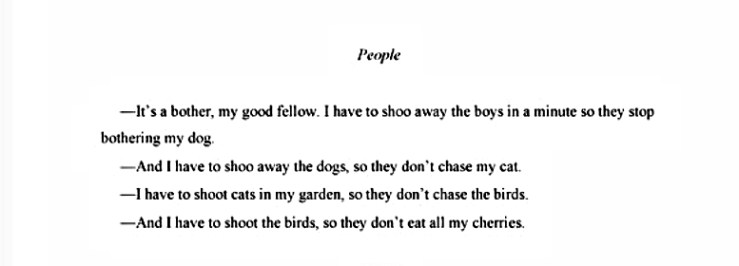
“People” — Karel Čapek

people

The Complete Short Stories of J.G. Ballard (Tenth Riff: The Eighties)

jgb_complete_ss4003111

PREVIOUSLY:

Introductions + stories 1956-1959

Stories of 1960

Stories of 1961

Stories of 1962

“The Subliminal Man,” Black Friday, and Consumerism

Stories of 1963-1964

Stories of 1966

Closing out the sixties

The seventies

IN THIS RIFF:

“A Host of Furious Fancies” (1980)

“News from the Sun” (1981)

“Memories of the Space Age” (1982)

“Myths of the Near Future” (1982)

“Report on an Unidentified Space Station” (1982)

“The Object of the Attack” (1984)

“Answers to a Questionnaire” (1985)

“The Man Who Walked on the Moon” (1985)

“The Secret History of World War 3” (1988)

“Love in a Colder Climate” (1989)

“The Enormous Space” (1989)

“The Largest Theme Park in the World” (1989)

“War Fever” (1989)

1. “News from the Sun” (1981) / “Myths of the Near Future” (1982) / “Memories of the Space Age” (1982)

Let me first confess how happy I am to be finished with this enormously enormous book (okay, not physically enormous on my Kindle, but still…). Let me also confess to dread at having to finish out these riffs (no, no one is forcing me, but still…). At this point, I feel like I could write my own Ballard story—a crazed astronaut here, a drained swimming pool there, a femme fatale, some psychotropic drugs, armchair psychology, a swamp, some birds (perhaps), a plane or two, time obsession, sex obsession, space obsession. Obsession obsession Anyway. Ballard arguably peaks in the early 1980s; everything after reads like a day-glow Keith Haringesque pop-approximation of his grittier seventies stuff—or (worse) scolding wrapped up in little morality plays.

But, like I said (wrote), Ballard is in his prime in the early 1980s, and “News,” “Myths,” and “Memories” are some of his finest stories (file these triplets in my quasi-fictional-but-c’mon-we-can-make-this-happen collection The Essential Short Stories of J.G. Ballard)—they are also some of his most Ballardian, riffing on space-travel-as-cosmic-taboo, paranoid parables obsessed with time. A particularly Ballardian paragraph (from “Memories”):

He had almost ceased to breathe. Here, at the centre of the space grounds, he could feel time rapidly engorging itself. The infinite pasts and future of the forest had fused together. A long–tailed parakeet paused among the branches over his head, an electric emblem of itself more magnificent than a peacock. A jewelled snake hung from a bough, gathering to it all the embroidered skins it had once shed.

(Parenthetical aside: “Myths” and “Memories” are both set in Florida. Ballard’s depiction of Florida feels thoroughly inauthentic (I’m Floridian), but that inauthenticity also feels thoroughly appropriate).

2. “A Host of Furious Fancies” (1980)

Ballard constructs this little tale around a psychoanalytic reading of Cinderella:

The entire fairy tale of Cinderella was being enacted, perhaps unconsciously, by this deranged heiress. If she herself was Cinderella, Dr Valentina Gabor was the fairy godmother, and her magic wand the hypodermic syringe she waved about so spectacularly. The role of the pumpkin was played by the ‘sacred mushroom’, the hallucinogenic fungus from which psilocybin was extracted. Under its influence even an ancient laundry van would seem like a golden coach. And as for the ‘ball’, this of course was the whole psychedelic trip.

But who then was Prince Charming? As I arrived at the great mansion at the end of its drive it occurred to me that I might be unwittingly casting myself in the role, fulfilling a fantasy demanded by this unhappy girl. . . .

For all my resistance to that pseudo–science, it occurred to me that once again a psychoanalytic explanation made complete sense of these bizarre events and the fable of Cinderella that underpinned them. I walked up the staircase past the dismembered clock. Despite the fear–crazed assault on them, the erect hands still stood upright on the midnight hour – that time when the ball ended, when the courtships and frivolities of the party were over and the serious business of a real sexual relationship began. Fearful of that male erection, Cinderella always fled at midnight.

Etc.

Ballard’s Freudian riff would be more interesting as an essay.

(The story also showcases some of his typical chauvinism: The psychiatrist is described as the “woman psychiatrist” — just as earlier a dentist is referred to as a “lady dentist,” etc. Straight through to the end of the collection. In the 1990s).

3. “Report on an Unidentified Space Station” (1982) / “The Enormous Space” (1989)

“Report” and “Space” both read like takes on Sigizmund Krzhizhanovsky’s Soviet-era short story “Quadraturin” — both concern space, that corollary to time, and, just as Ballard repeatedly posits time as a matter of perspective, he treats space—area—the same way here. “Report” is a bit more satisfying than “Space,” which feels like a retread of so many of Ballard’s revenge stories—only with, uh, some comical cannibalism.

4. “The Object of the Attack” (1984) / “Answers to a Questionnaire” (1985)

“Attack” and “Questionnaire” are maybe the same story—only “Questionnaire” is essentially perfect, whereas “Attack” feels like a clumsy, heavy first draft (but only because “Questionnaire” exists—do you see what I mean by this?)

Both stories showcase Ballard’s syntheses of religion (messianic; apocalyptic) and assassination (political; media-saturated). While “Attack” employs a discursive-but-still-linear approach to the theme, “Answers to a Questionnaire” gives us a discontinuous but more engaging riff in the form of (uh) exactly what its title promises.  First fifth:

1) Yes.

2) Male (?)

3) do Terminal 3, London Airport, Heathrow.

4) Twenty–seven.

5) Unknown.

6) Dr Barnardo’s Primary, Kingston–upon–Thames; HM Borstal, Send, Surrey; Brunel University Computer Sciences Department.

7) Floor cleaner, Mecca Amusement Arcades, Leicester Square.

8) If I can avoid it.

9) Systems Analyst, Sperry–Univac, 1979–83.

10) Manchester Crown Court, 1984.

11) Credit card and computer fraud.

12) Guilty.

13) Two years, HM Prison, Parkhurst.

14) Stockhausen, de Kooning, Jack Kerouac.

15) Whenever possible.

16) Twice a day.

17) NSU, Herpes, gonorrhoea.

18) Husbands.

19) My greatest ambition is to turn into a TV programme.

20) I first saw the deceased on 17 February 1986, in the chapel at London Airport. He was praying in the front pew.

Essential, natch.

5. “The Man Who Walked on the Moon” (1985)

I should’ve wedged this passable but ultimately forgettable little tale in elsewhere. J.G. Ballard’s faux memoir of a faux astronaut. Pass.

6. “The Secret History of World War 3” (1988)

“The Secret History of World War 3” is Ballard’s “I told you so” sequel to one of his best stories (frankly a much better story), 1968’s “Why I Want to Fuck Ronald Reagan.” In his unofficial sequel, Ballard imagines (the horror!) of a third Reagan term (post-Bush 1), in which the country is obsessed with the President’s (lack of) health:

…the nation’s TV screens became a scoreboard registering every detail of the President’s physical and mental functions. His brave, if tremulous, heartbeat drew its trace along the lower edge of the screen, while above it newscasters expanded on his daily physical routines, on the twenty–eight feet he had walked in the rose garden, the calorie count of his modest lunches, the results of his latest brain–scan, read–outs of his kidney, liver and lung function. In addition, there was a daunting sequence of personality and IQ tests, all designed to reassure the American public that the man at the helm of the free world was more than equal to the daunting tasks that faced him across the Oval Office desk.

The story concerns a man who—alone, always alone, despite his wife, I mean this is Ballard here, hero’s alone (and rightjustified) in his paraonoia—a man who is the only person to remember the brief outbreak of WW3, wedged, as it is, among updates of Ronnie and Nancy’s bowel movements. The story is farcical but juvenile, and if it seems surprisingly sophomoric, it’s worth noting that “TSHofWW3” echoes not just “Fuck Ronald Reagan,” but also one of Ballard’s earliest efforts, “Escapement” (1956), where a man sits on his couch in disbelief as his wife (stand-in for the whole world) fails to perceive what he perceives.

7. “Love in a Colder Climate” (1989) / “The Largest Theme Park in the World” (1989) /“War Fever” (1989)

A trio of late period lectures blazoned in the day glow approximations that anyone who live in the late eighties will not-so-fondly recall. Ballard evokes the neon apocalyptic impulses of the day, reworking his familiar themes—reproduction, civilization, war (etc.). Our baroque surrealist’s strokes are broader, not as sharp, more magnified—more Haring than Delvaux. Michel Houellebecq will pick up JGB’s torch here (with arguably better results) a decade and a half later.

8. On the horizon:

A handful of stories of the nineties: Or: Ballard returns to the same well with diminishing returns.

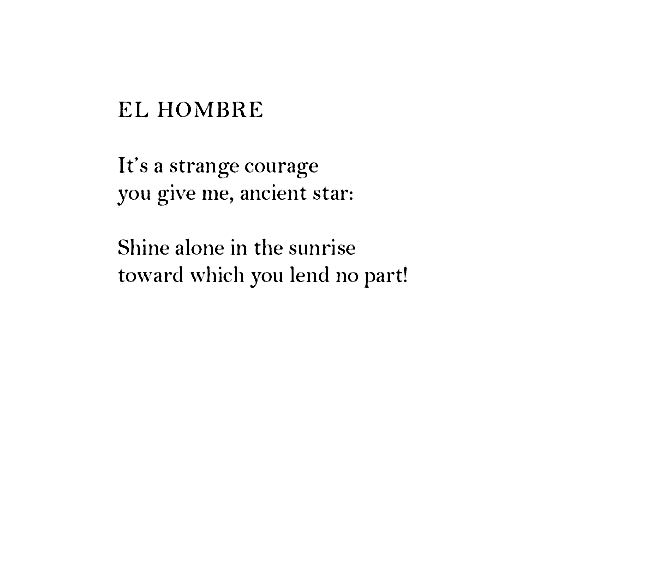
“El Hombre” — William Carlos Williams

eh

“The String Quartet” — Virginia Woolf

“The String Quartet”

by Virginia Woolf

Well, here we are, and if you cast your eye over the room you will see that Tubes and trams and omnibuses, private carriages not a few, even, I venture to believe, landaus with bays in them, have been busy at it, weaving threads from one end of London to the other. Yet I begin to have my doubts-

If indeed it’s true, as they’re saying, that Regent Street is up, and the Treaty signed, and the weather not cold for the time of year, and even at that rent not a flat to be had, and the worst of influenza its after effects; if I bethink me of having forgotten to write about the leak in the larder, and left my glove in the train; if the ties of blood require me, leaning forward, to accept cordially the hand which is perhaps offered hesitatingly-

“Seven years since we met!”

“The last time in Venice.”

“And where are you living now?”

“Well, the late afternoon suits me the best, though, if it weren’t asking too much-”

“But I knew you at once!”

“Still, the war made a break-”

If the mind’s shot through by such little arrows, and-for human society compels it-no sooner is one launched than another presses forward; if this engenders heat and in addition they’ve turned on the electric light; if saying one thing does, in so many cases, leave behind it a need to improve and revise, stirring besides regrets, pleasures, vanities, and desires-if it’s all the facts I mean, and the hats, the fur boas, the gentlemen’s swallow-tail coats, and pearl tie-pins that come to the surface-what chance is there? Continue reading ““The String Quartet” — Virginia Woolf”

“Too Blue” — Langston Hughes

tooblue

RIP Mavis Gallant

mg

RIP Mavis Gallant, 1922-2014

The Globe and Mail has reported the death of Mavis Gallant, the Canadian writer who lived much of her life in Paris, writing sharp, observant short stories.

I had never read Gallant until last year, when The New Yorker fiction podcast introduced me to her work via Margaret Atwood, who read Gallant’s story “Voices in the Snow” for the series. Years earlier, Antonya Nelson read Gallant’s story “When We Were Nearly Young” for the same series.

Gallant published many, many stories for The New Yorker (which may consider unlocking some of them, yes?), including “Florida,” which you can read here.

Gallant will be remembered for her short stories, of course. her Paris Review interview:

With few exceptions, books of short stories seldom sell well. Short-story readers are a special kind of reader, like readers of poetry. Many novel readers don’t like collections of stories—I think that they dislike the frequent change of time, place and people. Of course, stories should not be read one after the other. A book of stories is not a novel. Someone once said to me, “Katherine Mansfield died before she was ready to write a novel. Perhaps she would never have been ready.” I thought that was just stupid.

“Variation on a Theme by Wordsworth” — Marvin Bell

mb

Carvings in Natural Concrete — Siri Derkert