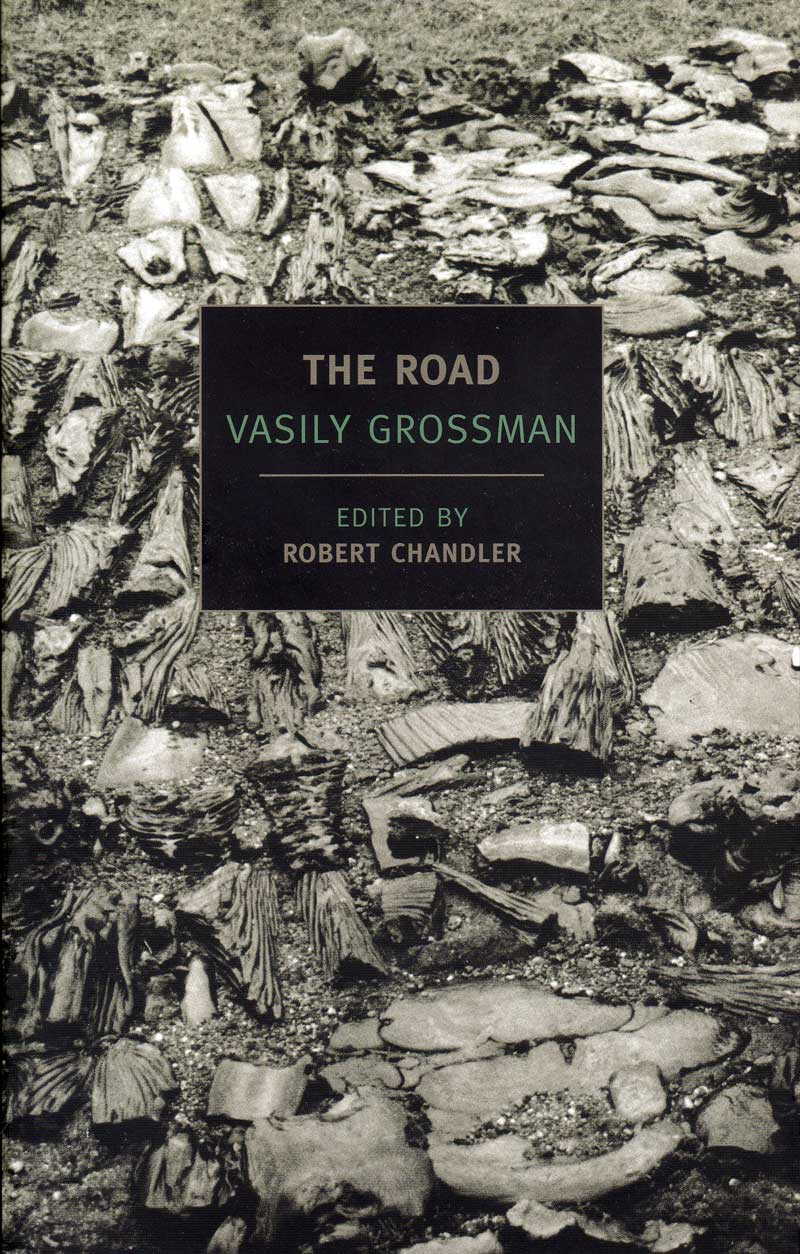
The Road — Vasily Grossman

I’d never heard of Vasily Grossman until Timothy Snyder referred to him, briefly, as a Soviet journalist who published some of the first unflinching reports of atrocities committed by Nazi soldiers and Hitler’s secret police during their conquest of eastern Europe. In Bloodlands, Snyder lauded Grossman as a reporter guided by a clear moral vision and a keen understanding of the tenuousness of human life.  A Ukrainian Jew who rhapsodized the Red Army’s defense of Stalingrad and then followed it all the way to Berlin, he built a literary career under the Soviet system before passing away with little fanfare. Although his early novels sold in the millions, at the time of his death in 1964 his reputation in his homeland was shattered, his health had deteriorated, and his final novels were blacklisted.  He could count himself lucky to have lived through a number of purges of the U.S.S.R.’s literary elite.  Edited and compiled by Robert Chandler for the impressive New York Review Books imprint, The Road collects of a number of his short stories, essays, letters, and articles in one well-curated volume, an excellent introduction to an important but neglected voice.

Organized chronologically, Grossman’s stories are separated by brief biographical notes thoughtfully included by Chandler. Although the selections fall into early, middle, and later works, it becomes clear that Grossman’s life as a man and as a writer (at least how it is presented here) can be broken up into distinct periods marked by increasing dissatisfaction with life under Soviet rule. Chandler labels the periods, from earliest to latest: “The 1930s,” The War, The Shoah,” and “Late Stories.”  The works in this collection are sad—truly sad—but throughout he returns to remembrances of love and small gestures of tenderness.  He is marked by the excesses of the totalitarian regimes he waged war upon and lived under. As a result, his writing demonstrates an appreciation of kindness that could only arise from a true comprehension of both humanity’s potential for cruelty and the limitless power of an autonomous mind.

The first short section, “The 1930s,” collects three concise stories concerning the creation and dissolution of family bonds.  “A Small Life” describes a couple that decides to foster a child from their village orphanage who ultimately finds them weird and boring, while in “In the Town of Berdichev” a rough female commander in a military unit must take a forced leave when her pregnancy makes it impossible for her to fulfill her duties to her company. She fondly remembers the father who was shot down in battle, but struggles to balance her duty to protect her child against her duty to protect her county.  Perhaps the most striking of the three stories is the last, titled “A Young Woman and an Old Woman.” The title characters are both rewarded by their state employers with a free trip to a seaside resort and share a train cabin as they journey to the coast.   They talk.  The young woman, enjoying her rise through the Soviet system, befriends the older woman who has been saddened by the surprising detention of her daughter and her own stalled professional ambitions. These two subtly drawn characters never fully understand the hidden mechanisms behind their fleeting instances of happiness. Perhaps these mechanisms have been hidden by the totalitarian state or, maybe because they’re people, they will always be doomed to wonder.

As the book transitions to its second section, Grossman seems torn between his duty as a reporter to inspire his fellow citizens to sacrifice for the greater good and his need to rail against the injustices perpetrated by warring totalitarian regimes. Like “In the Town of Berdichev,” “The Old Man” finds Grossman adopting a tone that might almost be described as propagandistic. A quiet old man, a beekeeper whose livelihood requires patience and silence, overcomes a lifetime of reticence by braining a German soldier with a shovel.  Much better is “The Old Teacher,” a story about a village’s elderly teacher, a Jew.  Distraught by what he sees as Nazi soldiers advance on his town—long simmering feuds settled by prompt denunciations, families thrown out of houses, all sorts of groveling and obsequiousness—the old man reflects on his failings and his fleeting successes.  The teacher and the town’s other Jews are forcefully marched to a ravine.  There they are made to lie down and wait for the firing squad, positioned above them on a hill, to reload.  The victims, in their last moments, see brave assertions of individual dignity, dole out small kindnesses, and console each other with the hope that others will not suffer similar fates. “The Hell of Treblinka” and “The Sistene Madonna” close this section. The former is Grossman’s terrible and moving account of the discovery of the death camp at Treblinka, written while reporting the westward march of the Soviet Red Army. The latter is an attempt to explain the power of Raphael’s rendering of The Sistene Madonna. The Madonna and her child symbolize the universal mother’s struggle to  protect a child —  a child she must relinquish to the world. For Grossman,  the mother and son are recurring historical figures who reappear wherever human life is reduced to a simple mathematical calculation: at the death camps; in blackened cities throughout Europe; in the famine-ravaged Ukraine; at Hiroshima. Freedom requires individuals to confront existential fears — “Their human strength triumphed over the violence. The Madonna walked toward the gas chamber, treading lightly on small bare feet. She carried her son over the swaying earth of Treblinka.”

The final section contains a number of staggering stories, the type you shove into a stranger’s hand with a wild look in your eye. These are stories that remind you of the masters of the form, writers like Hemingway, Chekov, Eudora Welty, and Cortazar. “The Elk” is a fantastic rumination on illness, love, and political repression. “The Road” is written from the vantage point of an Italian mule conscripted into the war on the side of the Axis powers. As he is forcefully marched through northern Africa and then the Russian steppe strapped to heavy artillery he forgets the pleasure taken from green shoots and visions of young mares. His indifference permits his survival. In “Mama,” one of Stalin’s top advisers adopts the orphaned child of parents he may have had a hand in killing. Grossman gives his readers a glance of the luxurious and precarious lives of those residing at the very top of the Soviet system. Even Isaac Babel makes an appearance (read Red Calvary if you haven’t already).

The Road brings together a number of works by an artist who deserves greater recognition. Grossman witnessed some of worst atrocities of the twentieth century, and his writing demonstrates a need to speak out against a particular brand of cruelty.  His writing in The Road is brave not only because a number of these stories could probably have led to his imprisonment, exile, or condemnation, but also because he utilizes terrible situations to illustrate humanity’s best qualities. Without being obvious, he champions mercy, understanding, and unconditional love. Beautiful stuff. Pick it up if you can.

The Collected Fictions of Gordon Lish (as Read by Gordon Lish)

Listening to Gordon Lish read selections from Iambik Audio’s compendium of his Collected Fictions for the fourth time today, it occurred to me that I should just go ahead and review the damn thing. Quit stalling. Get to it. I hope that pointing out that I’ve listened to Lish narrate ten of his odd, funny, gut-wrenching tales four times now (and will surely listen again) is enough to motivate thee, gentle reader, to follow my example—but that’s lazy, wishful thinking, right? There needs to be a proper review. Here goes—
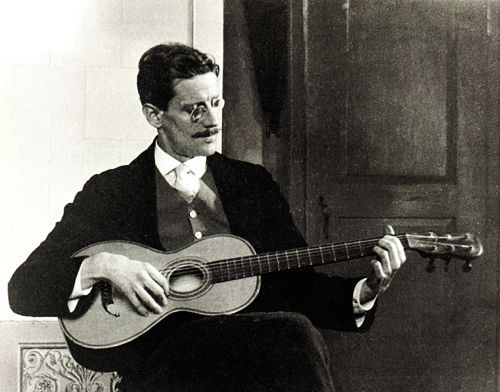
Lish is perhaps more famous as an editor than a writer of short fiction. He worked for years at Vanity Fair and later for Knopf, and the list of writers that he championed reads like a who’s-who of contemporary greats: Don DeLillo, Cynthia Ozick, Amy Hempel, Barry Hannah, David Leavitt, and Harold Brodkey, just to name a few. The writer he is perhaps most associated with though is Raymond Carver. By paring down sentence after sentence, Lish helped Carver develop his spare, minimalist style.

It’s that attention to sentences, to the truth of each sentence, to their individual force, that shines through in the collection. Consider this beauty, from “The Death of Me,” a story about a boy (surely Gordon Lish, hero of all Gordon Lish stories) who peaks too early, winning first place in all five field events at his summer camp one fine day in 1944, and then succumbing to the realization that this apex is, frankly, the end of it all–

I felt like going to sleep and staying asleep until someone came and told me that my parents were dead and that I was all grown up and that there was a new God in heaven and that he liked me better even than the old God had.

This sentence seems to me to be the expression of an emotion that I’ve felt for which I have no name. Lish’s sentences can move through tragedy and pathos to devastating comedy, a kind of comedy that collapses the auditor. Check out a line from “Mr. Goldbaum”–

What if your father was the kind of father who was dying and he called you to him and you were his son and he said for you to come lie down on the bed with him so that he could hold you and so that you could hold him so that you both could be like that hugging with each other like that to say goodbye before you had to actually go leave each other and did it, you did it, you god down on the bed with your father and you got up close to your father and you got your arms around your father and your father was hugging you and you were hugging your father and there was one of you who could not stop it, who could not help it, but who just got a hard-on?

Lish advised, “Don’t have stories — have sentences,” but “The Death of Me” and “Mr. Goldbaum” are more than the sum of their parts, more than just a collection of sculpted, scalpeled syntax. From the 1988 collection Mourner at the Door (the only Lish book I’d read before Collected Fictions), both stories announce Lish’s major theme of death, the absurdity of death, or the absurdity of life against the inevitability of death—but also the heavy truth of death, the ugly truth of death, the powerlessness of language against the finality of death. “Spell Bereavement,” also from Mourner, is essentially a prequel to “Mr. Goldbaum”: Gordon gets the news of his father’s death from his sister and mother. The story takes place over the phone as a sort of switch-hit interrogation, as mom and sis caustically berate the speechless man, who tells us, at the end, “There are not people in my heart of hears. There are just sentences in my heart of hearts.” Why does Gordon the narrator of “Spell Bereavement” fail to respond to the news of his father’s death? He is “too disabled to talk . . . going crazy with pencil and paper so as not to miss one word.”

Lish means to capture the ecstatic truth in death, and truth is at the core of all these stories, even when they are fables of a sort, like “After the Beanstalk,” which features a bewitched princess who has been transmogrified into a dog. The tale is hilarious and cutting and sad. There’s also “Squeak in the Sycamore,” which begins as a child’s list of fears and enumerations of death and longing and nature and ends in a joke and then an insult to the reader for laughing at the joke. (Best line: “Six is: the gardener died from digging up a basilisk”). “How to Write a Poem” is a caustic rant that argues that literary theft is really a matter of stern guts, of facing truth, and “Everything I Know” problematizes the very act of storytelling — it’s a story about how we tell stories, or our versions of stories. By far the most affecting piece that Lish reads though is “Eats with Ozick and Lentricchia,” about which he tells us, before reading it, “there is not a word of it that is not true.” It is a story that hovers around the death, or the dying of, more accurately, Lish’s wife Barbara; its details are almost too cruel, too true to bear.

Lish reads his tales in a bold voice that seems to challenge the auditor at all angles, as if his sentences were prodding you, poking you, pinching you even. He claims, in one of the many asides that precede these tales, to have never really read his work aloud before, and not to have really read the work in years, but his confidence seems to belie this notion; maybe, more accurately, it conveys the intense concentration of his intellect. His tone fascinates, and then he cracks out something like: “It always astonishes me I could have written such a thing” in such a dry honest voice that, while his quip hangs ambiguous, it remains utterly sincere. There’s a wonderful moment in the recording when he moves from reading “Mr. Goldbaum” to “Spell Bereavement” and seems to notice, as if for the first time, their close connection. He then remarks–

It shames me in one kind of way to see that my writing gathers itself into such a rut, but on the other hand it does please me to have spoken again and again and again about that which occurred to me at the time to be of consequence. I haven’t written fiction or anything else really for a great number of years and this occasion, reading these pieces, is an education for me and alien, foreign, in one kind of way, because the sentences are complex, but in another kind of way, I’m reminded of who I am.

Lish’s influence cannot be underestimated, from writers like David Foster Wallace to Denis Johnson to Sam Lipsyte, and all of those who will follow in turn. Readers have a fantastic (and incredibly inexpensive, I must add) starting place in Iambik’s wonderful collection. Do yourself a favor and check this out. Very highly recommended.

We Review RTÉ’s Full Cast Audio Recording of James Joyce’s Ulysses

My third (complete) trip through James Joyce’s Ulysses finds me just as (or even more than) stunned as the previous two journeys, a bit (very much) unequal to properly reviewing the book, but this time with an easy out — I listened to an unabridged, full cast audio recording. The aforementioned “easy out” is resting on the received greatness and goodness (and evilness) of the book, which I will hardly contend with and heartily endorse (and do very little real critical work to support my endorsement). Ulysses is fantastic. But what about this audio recording?
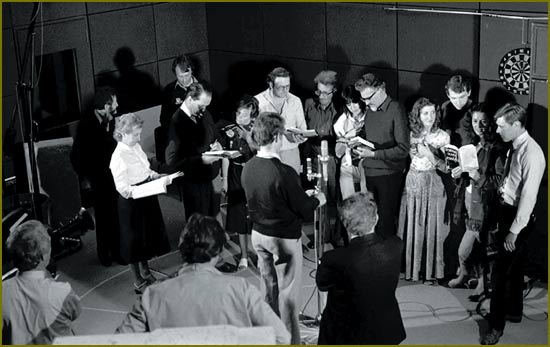
First thing’s first — I listened to, absorbed, choked up at, guffawed about, cackled around, and generally loved RTÉ’s 1982 dramatized, soundtracked, sound-effected, lovingly detailed recording of Ulysses, a work crammed with voices to match (if perhaps not equal) Joyce’s big fat work. This recording is not as widely available as LibriVox’s (free) full cast production or Jim Norton’s Naxos reading, but, after sampling both, I’d argue that it’s better. The Irish players bring sensitivity and humor to their roles, but beyond that pathos, the energy of RTÉ’s troupe is what really makes the book sing. Leopold Bloom gets his own voice, as does Stephen Dedalus and Molly (and all the characters). This innovation propels the narrative forward with dramatic power, and clarifies the oh-so indirectness of Joyce’s free indirect style, making the plot’s pitfalls and pratfalls more distinct and defined. There are songs (and dances) and music (and musing) and humming (and hemming and hawing and reverb). There is chanting and chawing and brouhaha. There is chaos and calamity and confusion. There is brilliance and peace and transcendence. It’s all very good, great, wonderful.

So: Who is a full cast unabridged audio recording of Ulysses for? Say, for instance, can someone who’s never read Ulysses listen to this instead?

I don’t know.

Here’s what I think though: Ulysses begs to be read aloud, is musical, soundical. Beyond obvious chapters like episode 11, “Sirens,” an overtly musical interlude that actually hurt my throat the first (second?) time I read it (even though I read it that time silently) — beyond the obvious musicality of “Sirens,” Ulysses hums and thrums and bristles and thumps with lively, vocal, melodious, rhythmic energy, pulses in sound and vision. The full cast reading, to cling to a hoary cliché, brings this sound and vision to life, animating Joyce’s words with a just vitality. But I’ve tripped into details, put carts before horses — the prime advantage for an audio recording of Ulysses to newbies is probably how clearly (and audibly, ahem) it delineates the book’s plot. But —

At the same time, I think anyone reading the book for the first time will want to read it along with the audio recording. Read along as in literally read along with, or, more likely read first or after — chapter by chapter that is. Yes, I think, yes, that’s what I’d recommend (lagersoaked now as my brain might be) — read a chapter first, then listen, then read another (or reread). Rinse. Lather. Repeat.

The Cast at Work

Now I retreat to that ugly bastard of literary criticism, reader response shtick, the stuff of fellows who can’t make real claims on the work itself but rather hide behind how the book made me feel and think and blah blah blah. Sorry. I break myself against Ulysses. And it’s not even the book, truth be told (to trot out another hoary cliché) — I’ve reviewed books here that sought to rival Ulysses, books that undoubtedly contend with it — it’s more the critical tradition that accompanies Ulysses that daunts me. But enough. Anyone who wishes to read pages of graduate school work on the subject, written by moi, may apply below. Suffice to say for now that I loved loved loved listening to this audio recording.

Perhaps because I was so familiar (or familiar enough) with Joyce’s themes at this reading/auditing, I was able to relax during this odyssey through Joyce’s epic. To put it another way, I felt no need to be “on” — to pick up allusions, to grasp at threads — and trip over them. Instead, I found a human dimension to Joyce’s work, one I’d felt there before, but perhaps not fully experienced (I am not claiming that I have fully experienced Ulysses). I laughed. I angered. I spit. I snarled. I cried (yes, I cried; at the mention of Rudy at the end of “Circes,” and then, again, at the end of the novel, just a bit, when I felt (felt) Molly’s love for her husband). There might have been a stirring at the loins.

I found a confirmation of my favorite episodes: “Circe,” foremost, an apocalyptic carnival brought to a bristling boil in the Irish cast’s capable choir. The aforementioned “Sirens” sings of course; far more pleasant, really, to hear than read. “Telemachus,” sure, who can nay-say an opener like that, although it’s really just the opener to the prelude to the real opener “Calypso” — great stuff. What earthy joy to meet Bloom. “Hades” — a sad treat. “Aeolus” — a funny treat, windily rebounding in vim and vigor and vigorous vim. The library episode — “Scylla and Charybdis” — I’ve always thought of it as Hamlet and Stephen, or grandfathers and ghosts — becomes clearer in the voices of RTÉ’s cast. Clearer not in the sense of: “Now I understand what Stephen’s getting at,” but clearer in the sense: “Now I see where Stephen sees what he is not quite sure he is getting at.” That chapter on pig-headed closemindedness, “The Cyclops” — a triumph, a magnitude, a bold chuckle. And “Penelope.” Well, yes, great stuff.

It’s more remarkable, I suppose, the ways in which RTÉ’s recording illuminated those chapters I’d struggled with, those that had made me yawn. The first, tedious, purposefully clichéd half of “Nausica” tried my patience (get back to Bloom!) — but the actress who reads it highlights the chapter’s tedium, its commonplaces — even as it/she rushes to that juicy climax. “Proteus”: far more manageable than I’d remembered. And “The Oxen of the Sun” (aka that chapter that I never really read properly) — well, with a full band of nasty drunken med students, a bold narrator (and a sympathetic nurse), this stumbling rock becomes a springboard to the madness I so love (and have loved) in “Circe.” In the once-trying catechism of “Ithaca,” the actors find a rhythmic bounce, a dry crunching that explodes in the wet gush of “Penelope.” And didn’t I say, yes, great stuff.

What this audio recording does best is humanize Joyce’s characters. While there is never a doubt that they are set against their mythotypical forebears, I found in Joyce’s characters this time a deep specificity, a concreteness of place, a realness. I found no need to situate a Bloom-as-Odysseus correspondence. Molly did not have to be an earth goddess. Stephen was freed from the burden of Hamlet. Sure, metempsychosis was in play, but it was a backdrop, not a foregrounding, determining analytical program. I think the audio recording helped transmit this humanity, a humanity that was always there, obscured by the clutter of critical tradition.

If I haven’t been clear: Very highly recommended.

Romantic Remixes: We Look at Jane Goes Batty and The Raven’s Bride

In the past few years we’ve seen a spate of books where public domain characters and historical figures feature in supernatural tales, usually written in an ironic, or at least parodic mode. It seems like a heavy percentage of these books are mixed up somehow with Jane Austen, whose legacy has become grist for a literary cottage industry, with a new “re-imagining” of Pride and Prejudice or Sense and Sensibility coming out every season. Last year, Michael Thomas Ford offered the public the mix of Jane Austen and vampires we had been so desperately clamoring for, Jane Bites Back. By way of a little more context (and pure laziness), I’ll quote Biblioklept’s review of Ford’s novel–
Jane Bites Back reveres its subject, Jane Austen, even as it blatantly cashes in on the very trend that it satirizes. The book’s program shouldn’t be confused with the absurdity behind Sense and Sensibility and Seamonsters (which we liked) or the wackiness of Pride and Prejudice and Zombies (which we didn’t like), but it does adhere to the same sense of fun. Ford seems to delight in corny, over the top passages, and we’ll take it for granted that his literary tongue is in his cheek . . .

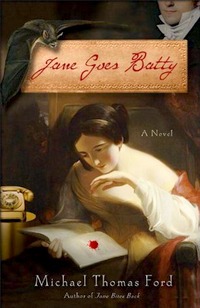
Ford’s inevitable sequel Jane Goes Batty arrives this month, and showcases a willingness to take vamp-camp into new directions. Plot: big time Hollywood folks are out to “sex up” Jane’s latest manuscript; Jane’s editor decides to become an agent and leaves her with Jessica Abernathy (evil nemesis in Batty); Jane has to run constant interference on her wacky/charming friend Lord Byron (also a vampire, of course); etc., etc., etc. The most ridiculous/campiest plot device of all though is that Jane is converting to Judaism to please her boyfriend Walter’s judgmental mom. Yes. That’s right. We also learn that Jane played Magenta in a traveling production of The Rocky Horror Picture Show in the seventies, a minor detail to be sure, but one that seems to reinforce Ford’s whimsical kitsch. Batty aims for a kind of sassy brevity in its scene constructions, and while its certainly not a book for me, I think that those who want to see Jane Austen as a 21st century vampire will probably enjoy it quite a bit. Jane Goes Batty is new in trade paperback from Ballantine.
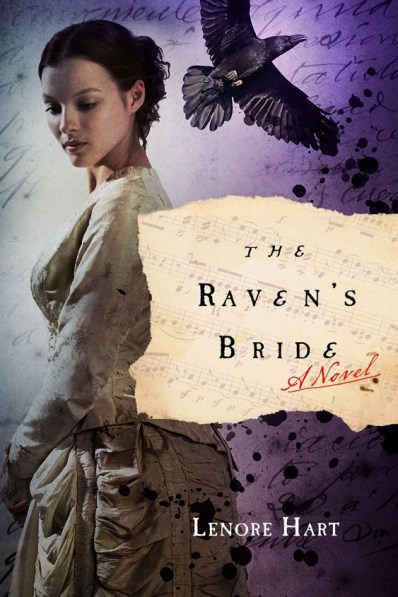
Lenore Hart’s novel The Raven’s Bride tells the story of the marriage of Edgar Allan Poe from the viewpoint of his child-bride/cousin Virginia “Sissy” Clemm. The decidedly tragic arc of their union is set against a supernatural backdrop — and an often morose tone. While The Raven’s Bride takes liberties with history, it seems well-researched and faithful enough to its subject. Compared to Ford’s campy take on the supernatural, Hart’s novel seems a bit too self-serious, but again, I’m hardly the audience for this book. Still, I suppose the tale of an alcoholic horror writer’s incestuous/underage marriage might have been easy fodder to exploit, yet Hart focuses a keen sensitivity on her characters, particularly her narrator Sissy, Poe’s muse demystified. While Poe buffs will know how the story turns out, those interested in reviewing Poe’s marriage through a new perspective may want to check out The Raven’s Bride, new in trade paperback from St. Martin’s Griffin.

Bloodlands — Timothy Snyder

Timothy Snyder’s monumental new history Bloodlands is a staggering work of scholarship.  Using primary sources written in at least ten languages, Snyder documents the nightmarish history of that portion of eastern Europe that stretches from Poland north to St. Petersburg and sweeps southwest to the point where Ukraine runs into the Black Sea.  In these places, the titular bloodlands, the policies of Adolf Hitler and Josef Stalin converged to kill approximately 14 million people in less than a quarter of a century.  Snyder postulates that the eradication of such large numbers of human beings was possible because National Socialism was the perfect foil to Soviet Communism, and vice versa,  and because each system allowed totalitarian one-party states to deflect blame for their respective failings onto the other, or onto large groups of relatively powerless national, ethnic, or religious minorities.  Rectifying problems required starving, shooting, gassing, or otherwise disappearing hundreds of thousands of the people who inhabited these regions and who had no intention or ability to subvert whichever ruling regime claimed them as subjects at any particular moment.  The particular atrocities committed in these areas were largely overlooked in the West at the close of World War II as these victims and their memories disappeared behind the Iron Curtain.

The book begins not in 1941 when Hitler invaded the Soviet Union but a decade earlier.  After Lenin’s death, Josef Stalin found himself at the head of the Soviet Union’s security forces as well its sole ruling party.  When he recognized that revolutions were not about to sweep over the rest of capitalist Europe, Stalin prioritized ensuring that the U.S.S.R. remained a strong Communist nation and a beacon of hope to committed Marxists across the world.  Despite the  Communist ethos that capitalist excess would be negated by exploited industrial workers in urban environments, the Bolshevik Revolution had taken place in one of Europe’s most diverse and rural populations.  When Stalin took it upon himself to collectivize Soviet agriculture, disaster struck in the Ukraine and Bloodlands’ long and nuanced chronicle of paranoia and death properly begins.

The famine in the Soviet Union’s most fertile land, the Ukraine, caused at least 3 million people to starve in the early part of the 1930s.  After the seed needed to plant next year’s crop was requisitioned for the collective, nothing remained to eat and there was no future to look forward to, either.  People died where they fell, women prostituted themselves for bread, parents gave their children away to strangers, and villages ceased to exist.  Fires in chimneys marked the presence of cannibals.  Snyder writes–

In the cities carts would make rounds early in the mornings to remove the peasant dead of the night before.  In the countryside the healthier peasants formed brigades to collect the corpses and bury them.  They rarely had the inclination or the strength to dig graves very deeply, so that hands and feet could be seen above the earth.

In order to ensure their own corporeal and political survival, the Soviet leadership responsible for collecting the harvest had to steal whatever they could from the hungry.

And so it continued.  Hitler rose to power partially on the basis of his powerful condemnation of the popular German Communist parties, and used the famine in the U.S.S.R. to bolster arguments that doomed the opposition to his left and center.  Although Stalin argued that all the excesses of capitalism could be seen in the racist and nationalistic rhetoric spewing from the Nazis, these two nations signed a non-aggression pact and started the war in 1939 when they jointly invaded Poland.  The Soviet reign of terror commenced and the secret police killed and deported hundreds of thousands of class enemies and nationalists in Poland, Ukraine and the Baltic states.  The Germans and the Soviets began to move Poles out of their homes.  The Germans designed policies meant to kill educated Poles in order to create a population amenable to slavery.  The Soviets killed Polish military officers who were capable of leading uprisings against their new rulers.  Both nations instituted their first policies of mass shootings contemporaneously.

When Hitler disregarded the treaty and invaded the Soviet Union (which now included the portions of Poland both nations had agreed to share), already vulnerable populations were decimated.  Nazism required that a superior race must take what it needed without regard to rule of law or human empathy.  Advancing German forces who came upon obvious signs of recent brutality by the retreating secret police forces of the U.S.S.R. and the Red Army saw “a confirmation of what that had been trained to see: Soviet criminality, supposedly steered by and for the benefit of Jews.”  Hundreds of thousands of Soviet prisoners of war were condemned to die of starvation and exposure in makeshift camps.  Heinrich Himmler and Hermann Göring implemented a Hunger Plan, which, although unsuccessful, aimed to “transform eastern Europe into an exterminatory agrarian colony” by purposefully starving its inhabitants or deporting them to Siberia.  The German plan to achieve victory in Leningrad involved cutting off food supplies to the city’s 3.5 million inhabitants and covering all possible escape routes with landmines which would eliminate potential evacuees.  Even before the German security forces began purposefully destroying Jewish populations, a culture of cruelty and privation had been foisted upon innocent civilian populations.

The Jewish populations of cities and regions that had housed their families and their cultures for centuries were then systematically and brutally annihilated.  Snyder argues that Western minds have processed the Holocaust in a certain manner because in our history, the accounts of the soldiers who liberated camps in conquered lands to the south and west of the Reich predominate.  We have been privileged to hear the stories of survivors from the camps at Auschwitz like Primo Levy and Elie Wiesel, but Snyder points out that the labor and death camps at Auschwitz did not come on-line until near the end of the war and most of those sentenced to labor or die there were brought from German holdings in western Europe. Bloodlands is important because it documents that most of the horrors of the Holocaust were committed in the east.  69,750 of Latvia’s 80,000 Jewish citizens were killed by the end of 1941 by bullets.  With the help of Lithuanian conscripts and rifles, the Germans killed at least 114,000 of that nation’s 200,000 Jewish citizens.  Estonian volunteers for the S.S. killed all 963 Estonian Jews that could be found.  Himmler’s security forces were supposed to “pacify” annexed territories.  In Kiev, 33,761 human beings were killed in little more than a day by the concerted efforts of S.S. commandos and conscripted local forces as part of a sustained effort to eradicate Ukrainian Jews. Snyder continues–

Having surrendered their valuables and documents, people were forced to strip naked.  Then they were driven by threats or by shots fired overhead, in groups of about ten, to the edge of a ravine known as Babi Yar.  Many of them were beaten . . . They had to lie down on their stomachs on the corpses already beneath them, and wait for the shots to come from above and behind.  Then would come the next group.  Jews came and died for thirty-six hours.

The ghettos were in the east as were the death camps of Treblinka, Sobibor, and Belzec.  By invading Poland and the Soviet Union, Hitler conquered the nations with the largest Jewish populations on the planet, and when it became evident that the German army, like Napoleon’s previously, were unable to conquer Moscow and the icy Russian plains, the death camps were opened with the express purpose to kill massive numbers of people in the shortest period of time.  Treblinka, Sobibor, and Belzec were well-engineered for their horrible purpose of killing those who remained behind.

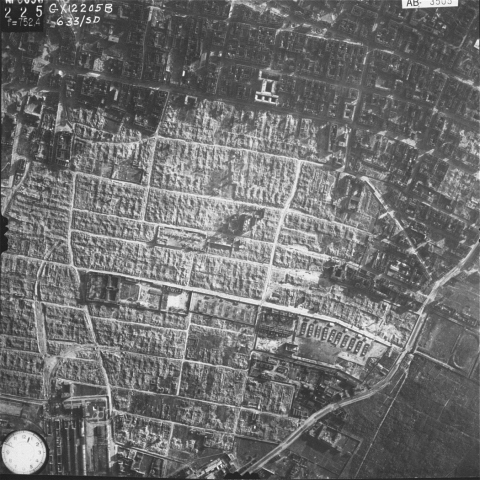
The Jewish Ghetto in Warsaw was burned to the ground.

Snyder asks the readers to remember that the lives he documents died because of policies that existed in the Soviet Union and Nazi German that promoted and committed deliberate mass murder.  The act of recording and remembering must be initiated where evidence is so easy to destroy or manipulate.  People complicit in the murder of their neighbors will attempt to mitigate their shame.  Even those with no connection to such events would probably rather think of something more pleasant.  Where the Nazis razed the Warsaw ghetto and dismantled the death camp at Treblinka in a matter of hours, Stalin purposefully changed the course of the historical discussion in the U.S.S.R. in order to promote nationalism.  The suffering of Jews and other innocents was sublimated to the overall suffering of the Soviet (mostly Russian) population.

14 million people.  Farmers, prisoners, gypsies, peasants, freedom fighters, and the unlucky.  Wives, fathers, and children.  Everyone died to placate ideologies that a great number of people of good conscience did not discount at the time.  Although the historical record is expanding, it seems inconceivable that our knowledge of such events could ever be perfected.  Appreciate your loved ones and relish the warmth in your homes and in your bodies.  Essential knowledge for every conscious, conscientious person.  Absolutely recommended.

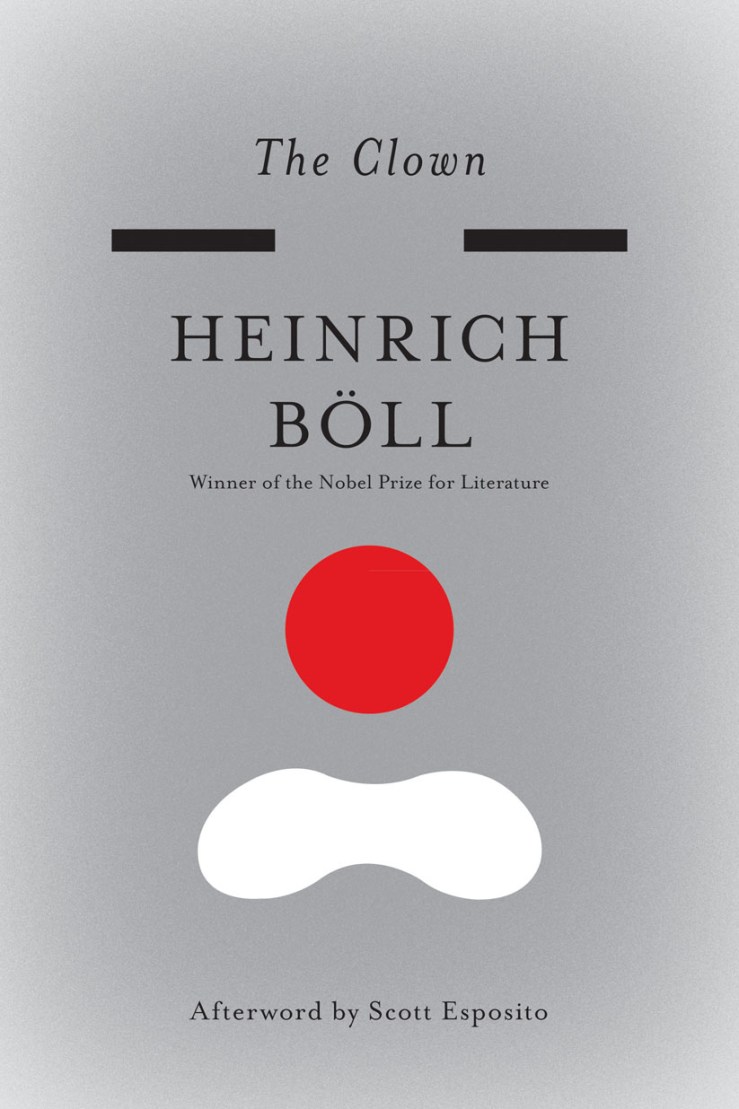
The Clown — Heinrich Böll

The titular figure in Heinrich Böll’s 1963 novel The Clown is Hans Schnier, a man whose personal and professional life is burning down around him as he howls in (often hilarious) despair. During a performance at a third-rate venue, Hans purposefully injures his knee and retreats to Bonn, where he holes up in his small apartment and makes angry desperate phone calls (and tries not to drink too much brandy) as he reflects on his past.
His common-law wife Marie has returned to the conservative Catholicism she was raised on, and subsequently left Hans; even worse, shes’ taken up with a bourgeois hack named Zupfner. Marie and Hans initially came together as teens, sexing it up in their provincial German town. After scandalizing all the decent ex-Nazis in town, they retreat to the comparatively cosmopolitan city of Bonn and begin a life (in sin) together, traveling from venue to venue and performance to performance as Hans’s career grows.

It becomes clear through the course of The Clown — which is essentially Hans’s long, angry rant against complacent conformity — that Marie is merely an object for Hans, a romantic idealization. He repeatedly tells us that she doesn’t get his art–

I don’t believe there is anyone in the world who understands a clown, even one clown doesn’t understand another, envy and jealousy always enter into it. Marie came close to understanding me, but she never quite understood me. She always felt that as a “creative person” I must be “deeply interested in absorbing as much culture as possible.” She was wrong.

Hans is always the outsider, even to the woman he loves. Still, Marie represents both comfort and some sense of continuity for this traveling artist whose life is basically a series of hotels, train rides, and performances. Without her, Hans is lost, adrift without an anchor, pure vitriol aimed at a society he rebukes at every turn. Consider his parents, for instance, rich Protestants with a penchant for providing patronage to middling writers — Hans’s hate for them is almost metaphorical, a hate that extends to their religion and their complicity in the evils of WWII. While The Clown is a highly personal story, the tale of an artistic soul tortured in the absence of his love, it’s also an indictment of postwar Germany, a milieu all-too ready to whitewash its sins in the easy absolution of cheap religion.

At times the nuances of The Clown’s argument against the conformist postwar German culture were lost on me. Hans’s many references to the particular rhythms and contrasts of Teutonic Protestants and Catholics were beyond my ken. Still, this rarely detracted from my enjoyment or involvement in the novel. Its caustic bite and extreme depression is tempered by ironic humor and expansive knowledge. Here’s an early passage in the book that I think shows off these attributes and obsessions while highlighting a bizarre metaphysical conceit that I don’t know how to properly work into this review–

I felt sick. I forgot to say that not only do I suffer from depression and headaches but a I also have another, almost mystical peculiarity: I can detect smells over the telephone.  . . . I had to get up and clean my teeth. Then I gargled with some of the cognac that was left, laboriously removed my makeup, got into bed again, and thought of Marie, of Christians, of Catholics, and contemplated the future. I thought of the gutters I would lie in one day. For a clown approaching fifty there are only two alternatives: gutter or palace. I had no faith in the palace, and before reaching fifty I had somehow to get through another twenty-two years.

So we learn that our hero is only in his late twenties, yet already romanticizes a dramatic life of failure; he sees himself as the failed artist down in the gutter, perhaps dreaming of the stars. And he can smell through the phone!

At its core, The Clown is a searing attack on hypocrisy, one grounded in a sense of time and place. And it’s this grounding that gives the book the weight — the concreteness of truth — to transcend its postwar setting and remain relevant today in a world where language, religion, and custom all provide societies and their institutions a kind of metaphysical escape hatch to avoid squarely assessing the gaps between mantra and action. Hans shows us that it takes a jester to truthfully comment on the absurdity of modernity; it’s the trickster whose pantomimes tap into the most mundane gestures to expose the intricate ways these gestures might disguise ugly, banal, or even evil intentions. Great stuff.

The Clown is new in print again from Melville House.

The Sunset Limited — Cormac McCarthy

thesunsetlimited

Cormac McCarthy’s The Sunset Limited is a lean, spare dialectic between two characters named simply “Black” and “White.” Black, a recovering addict who found Jesus in prison, saves White, an aging professor, who attempts to kill himself by jumping in front of a commuter train, the Sunset Limited. Black keeps White in his apartment, probing the older man’s justification for suicide. White makes it very clear that he intends to finish the job the moment he can leave Black’s apartment, leading Black to stall the professor through argument and storytelling. As such, Black sustains most of the book’s driving questions about morality, redemption, and love for one’s fellows, until near the end, when White unleashes a tirade of nihilism. As the story charges to its climactic conclusion, it becomes clear that it is not just White’s soul at stake, but also Black’s own spirituality.

The cover of The Sunset Limited attests that the book is “A Novel in Dramatic Form,” a conceit that may divide many of McCarthy’s admirers. The language here is precise and visceral, loaded with meaningful ideas yet also utterly concrete. McCarthy’s grasp of colloquial diction shines through these two voices, carrying the story forward in a hurtling momentum with minimal stage directions. Still, some readers may feel cheated out of McCarthy’s rich prose in this bare story (they need only to pick up Blood Meridian or The Road or All the Pretty Horses, of course). I found the story engaging, poignant, dark, and often surprisingly funny, and I read it in one taut sitting. The Sunset Limited is not the starting place for those interested in McCarthy, but fans who’ve yet to read it will probably enjoy it quite a bit. I’m already anticipating a second reading. Highly recommended.

(Editorial note: Biblioklept originally posted this review on February 14th, 2009. We run it again today to coincide with HBO’s debut of a feature film adaptation of McCarthy’s play).

The Vintage Book of American Women Writers

In her introduction to The Vintage Book of American Women Writers, editor Elaine Showalter suggests that “the main reason women do not figure in American literary history is because they have not been the ones to write it.” Showalter sought to amend the fact that women writers, even those who were praised in their own era, “tended to disappear from literary history and national memory” in her earlier volume A Jury of Her Peers, a comprehensive history of American women writers from 1650 to 2000. History though is not enough — Showalter continues in her introduction: “Finally, we need a canon of outstanding women writers over the past four centuries both to organize their history and to begin the arguments that keep literary discussion alive.” The Vintage Book of American Women Writers aims to be that canon, or at least to be a volume of that canon, collecting writing by American women from the past 360 years. And while Showalter admits that “it cannot claim to be comprehensive,” the trade paperback is impressively hefty at over 800 pages, showcasing the work of 79 authors.
Many of these authors will be familiar (hopefully) to anyone who didn’t sleep through his or her American lit class in high school. The volume begins with several selections from the Puritan poet Anne Bradstreet; there’s also Mary Rowlandson, Phillis Wheatley, and Margaret Fuller. A tidy chunk of the early part of the book comes from writers we might associate with the transcendentalist movement — Harriet Beecher Stowe, Julia Ward Howe, Louisa May Alcott, and Emily Dickinson, just to name a few of the more famous writers. There’s an abundance of riches near the turn of the twentieth century, with tales from Willa Cather, Kate Chopin, Charlotte Perkins Gilman, and Edith Wharton, writers who set the stage for the modernism of Gertrude Stein, Katherine Anne Porter, and H.D. And then: Marianne Moore, Sylvia Plath, Elizabeth Bishop, Dorothy Parker, Edna St. Vincent Millay, Zora Neale Hurston (the collection won my heart simply by including her incomparable short story “Sweat”), Gwendolyn Brooks, Cynthia Ozick, Joyce Carol Oates, Annie Proulx, Ursula K. LeGuin, Flannery O’Connor (but not, for some reason, Carson McCullers), Amy Tan, and Jhumpa Lahiri.

I realize I’m just listing names now, but hopefully you know these names, are familiar with them, have read their works (if not, The Vintage Book of American Women Writers is clearly a great starting place). As an experiment — and perhaps an implicit challenge to Showalter’s contention that these writers continue to be neglected — I counted the authors I’d read at least once before this collection: 33, or 42%. Granted, I teach English for a living, and many of these authors are represented in every literature anthology I’ve ever used. But that might be my point, I suppose, that the canon has opened up, been re-examined and reformed. I can’t think of a literature course I’ve ever taught that hasn’t included Hurston or O’Connor or Katherine Anne Porter.

For me then, the greater joy in The Vintage Book of American Women Writers is in reading the writers that I haven’t seen anthologized before. I’m almost ashamed to admit I hadn’t yet read (okay, never even heard of) the abolitionist poet Frances E. W. Harper; Lydia Huntley Sigourney’s poem “Indian Names,” written in 1849, seems more poignant (and troubling) than ever; Rose Terry Cooke’s “Blue-beard’s Closet” (1861) resonates strongly, in that it connects to the latest piece in the collection, Annie Proulx’s “55 Miles to the Nearest Gas Pump.” The story of Bluebeard of course metaphorizes the history that Showalter wishes to reverse, what with its discarded bodies, locked in a secret room, awaiting discorvery. Okay, maybe that’s a stretch (or at least a hyperbole). In any case, these stories, poems, essays, fables, and tales are hardly lifeless. Great stuff.

The Vintage Book of American Women Writers is new in trade paperback from Vintage.

Biblioklept Recommends Five Novels, Some of Them New, Not All of Them German

I shouldn’t be reading five novels at once. It’s a terrible idea, a symptom of a bad habit that I thought I’d broken, but after abandoning Levin’s tedious tome The Instructions and wasting my time on Shteyngart’s insipid dystopian novel Super Sad True Love Story, I found myself absorbed by a lovely little cache that had been neatly, patiently stacked for a few weeks now.
I’m only 60 or so pages into Lars Iyer’s Spurious — about a third of the way through — and at the rate I’m reading, I won’t finish it until the end of this month. It’s not that it’s slow or tedious or hard work: quite the opposite, in fact — it’s funny and lively, even when it’s erudite and depressive. I’ve enjoyed taking it in as a series of vignettes or skits or riffs. Spurious is about, or seems to be about (the term must be placed under suspicion) two would-be intellectuals, W. and his friend the narrator. They bitch and moan and despair: it’s the end of the world, it’s the apocalypse; they find themselves incapable of original thought, of producing any good writing. The shadow of Kafka paralyzes them. They travel about Europe, seeking out knowledge and inspiration — or at least a glimpse of some beautiful first editions. W. is cruel to the narrator, calling him fat and deriding his intellect for sport. But it’s all in good fun. Or maybe not. I’m really enjoying Spurious and have no hesitation recommending it; however, like a strong shot of bourbon, it’s best enjoyed frequently but in small doses. Spurious is brand spanking new from Melville House.

Iyer’s book dovetails nicely with W.G. Sebald’s first novel, Vertigo, which I picked up expressly to get the bad taste of Shteyngart out of my brain. Both books are haunted by Kafka, both  blur the lines between fiction and biography, both are works of and about flânerie, and both are melancholy. The book comprises four sections; the first section tells the story of the romantic novelist Stendhal (or, more to the point, a version of Stendhal); the second section details two trips Sebald made to Italy, one in 1980, and one in 1987; the third section, which I just read last night, describes a trip Kakfa took to Italy near the end of his life. I’m almost certain that I’ve read this section, “Dr. K Takes the Waters at Riva,” before — but I can’t remember where or when. It was strange reading it, almost as if I were experiencing some of the vertigo that permeates the volume. Full review forthcoming.
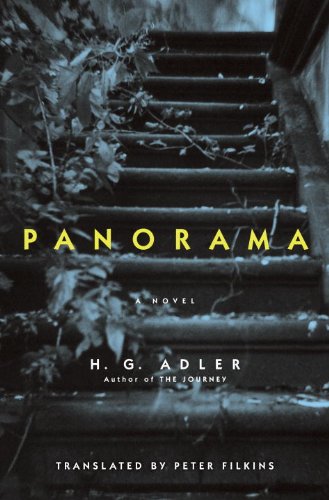
Kafka was a German-speaking Jewish writer from Prague. So was H.G. Adler, author of Panorama, new in English for the first time (hardback; Random House). Another way to transition from the Sebald paragraph above to this write-up of Panorama might be to point out that Sebald references Adler in Austerlitz, a book that tries to measure continental memory of the Holocaust. Adler survived the Holocaust, forced first into Theresienstadt and then Auschwitz, where his wife and mother were murdered in the gas chambers. Panorama is an autobiographical bildungsroman, with its hero young Josef Kramer standing in for Adler, and while it will clearly work its way into grim territory, the beginning — which is to say, the part that I’ve read so far — is bucolic and sweet and strange, as we see young Josef at home with his family. There’s a cinematic scope to Adler’s prose — Panorama is a Modernist work, one where the narrative freely dips into its protagonist’s mind. More to come.

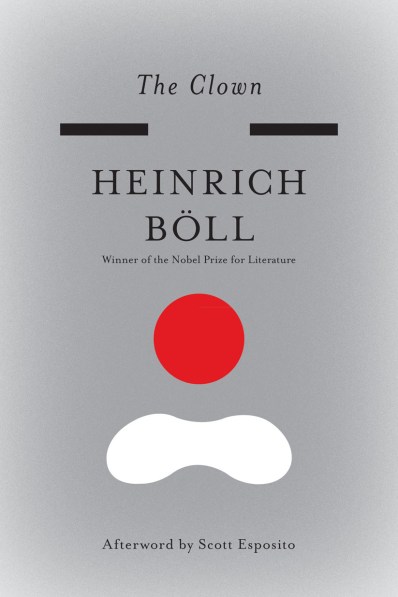
Continuing in this Teutonic vein is Heinrich Böll’s novel The Clown (also Melville House). It’s postwar Germany, and Hans Schnier is a clown who’s crashing and burning. He hurts himself–purposefully–during a performance (at one of the increasingly more provincial venues he finds himself playing for these days) and retreats to Bonn, where he holes up in his small apartment and makes angry desperate phone calls (and tries not to drink too much brandy) and reflects on his past. What’s eating him up? His gal Marie, basically his common-law wife, has reverted back to her Catholic ways and up and left him for some chump named Zupfner. Schnier rants against a complacent and complicit German bourgeoisie, spitting vitriol against Protestants and Catholics alike; some of the best parts of the novel though are his ravings about art and the role of the “artiste” in society. Also: he can smell over the phone. Full review soon.
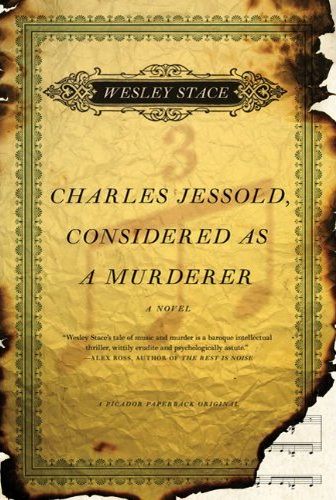
Wesley Stace’s new novel Charles Jessold, Considered as a Murderer (new from Picador) is a musical murder mystery set in the early part of 20th century Britain. Our (seemingly less than reliable) narrator Leslie Shepherd is a music critic with an aristocratic background who likes to spend his weekends collecting folk songs with other rich boys in the towns surrounding their country manors. He’s smitten (platonically, of course) with Charles Jessold, a middle class composer with a spark of avant-garde genius, and wins the younger man’s friendship quickly when he tells the story of Carlo Gesualdo, a fifteenth century composer/lord who kills his wife and her lover. (Notice the etymological connection between their names?) This tale of murder and cuckoldry is doubled in the ballad “Little Musgrave“; when Jessold and Shepherd find a new variation of the ballad, they set out to write the next (only?) great English opera, an adaptation of “Musgrave.” Oh, and that plot? The book opens with a news clipping reporting that Jessold killed his wife and her lover, and then himself, after the première of his opera Little Musgrave. Life imitates art imitates life. Stace has a keen ear for the period he writes about as well as a seemingly encyclopedic knowledge about music, but he also has the good sense to restrain himself and remember that he’s delivering a murder mystery. I’ve been enjoying Jessold quite a bit, and will return to it when I finish writing these lines. (And, for what it’s worth, part of Jessold is set in Germany).
The Skating Rink — Roberto Bolaño

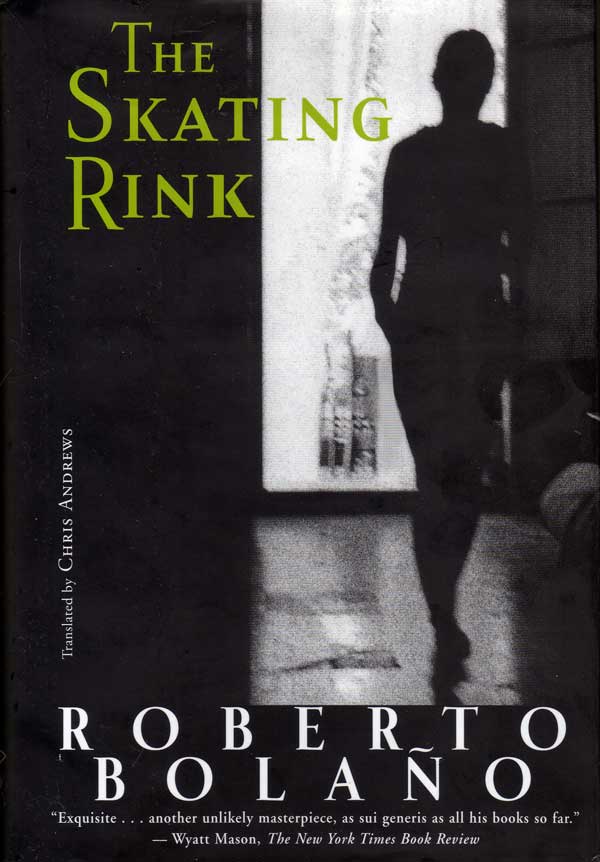
The Skating Rink was the first novel Roberto Bolaño published, a murder mystery in Spanish, all the way back in 1993.  It’s a short novel, but full of devices and ideas that readers will recognize from the late Chilean master’s later and better-known works. Characters who populate the novel recount events as if speaking extemporaneously to a reporter or a detective and discuss ideas and themes that the author would return to again and again:  obsession, alienation, lack of national identity, underappreciated poets, homelessness, and homicide.  The Skating Rink is a brief novel at 179 sharp and engaging pages. It wouldn’t be incorrect to call it a minor novel, but it would be a mistake to consider it merely a warm-up for the more intricate routines that the writer would perfect in the future.

The novel is about the construction and existence of a clandestine ice rink built in a deserted mansion on the cliffs of a seaside resort town in Catalonia, Spain. Erected to please Nuria Marti, a beautiful figure skater cut from the Spanish Olympic team, the rink and its inspiration are reserved and glacial while the locals who populate the seasonally bustling city are, with varying degrees of success, just trying to hold everything together. When the body of an itinerant singer is discovered in the middle of the ice deep within the labyrinthine halls of the decaying house, everything the characters have strained to preserve begins to fall apart.

The book is narrated by three men who represent different strata of Spanish society. Enric Rosquelle is an outwardly arrogant bureaucrat in charge of the city’s various social service agencies whose desperate need for love leads him to embezzle the funds  in order to build the skating facility for the athlete he knows will never return his feelings. Gaspar Heredia is an illegal Chilean immigrant who works in a campground for tourists and falls for a homeless woman who never relinquishes the kitchen knife she keeps tucked in her jeans.  Remo Moran, a legal arrival from Chile, has enjoyed success as a businessman and as a poet and is anxious about his own precarious sexual relationship with Nuria. Each man is more or less aware of his shortcomings and they utilize similar Bolañesque (Bolañan?) digressions to explain their motivations and feelings. They come to know and discuss each other in their retelling of events and so become interesting, sympathetic, and full characters.  Enric is jealous of Remo and suspicious that South Americans in general trade in filth and drugs.  Gaspar relies on his old friend Remo for his job and secretly watches Enric coaching Nuria.

The sense of loneliness and the failure to take advantage of fleeting opportunities are palpable. In a number of places, the narrative and the novel’s setting evoke a Wong Kar-wai movie. In slow motion, men follow women through cobblestone streets, not quite able to grasp that thing they desire. Hang-gliders dance in the sky and while everyone else is watching the fliers against the cool blue sky, we’re being told about how she’s just disappeared through a door down a side street. Solitary women stroll up cliff-side highways while our narrators limp behind. I almost expect Gaspar to sit down next to Tony Leung while cellos or Chinese versions of well-known pop tunes play from a nearby jukebox.  Unlike Wong Kar-wai though, Bolaño sees the single-minded pursuit of unrequited love as pathological and often a precursor to violence. The men in The Skating Rink, like any number of other men who populate Bolaño’s novels, are unable to resist the wills of the women they love or submit to personally or professionally. Two men here are willing to sublimate their own wishes for those of Nuria, whose choice of profession illustrates her own desire to overcome the normal limitations of geography, climate, and national history. As they seek her favor, they find themselves acting in unfamiliar ways, on uncertain paths and  unconcerned with appearance or ethics.

Like most of Bolaño’s work, endings (and beginnings and middles) are ambiguous. Readers are left unsure as to what has actually happened and the murder remains (I think) unsolved.  The Skating Rink could serve as an easy introduction to the writer’s more complex creations because it deals with time and plot in a relatively conventional manner. The characters get to say proper good-byes and reflect on the things that have happened to them. Like a standard mystery, most of the knots have been untangled.  But because real understanding sits just outside of consciousness, this reader is still waiting for the feeling that my task is complete. There are occasional missteps, like when Bolaño compares an elderly woman’s voice to a locker room, but passages lodge in your head like slow songs on repeat in dark comfortable places. Like those jams, The Skating Rink might be a masterpiece or something to be forgotten when something better comes along.  It’s short, so listen to it a couple times and decide for yourself.

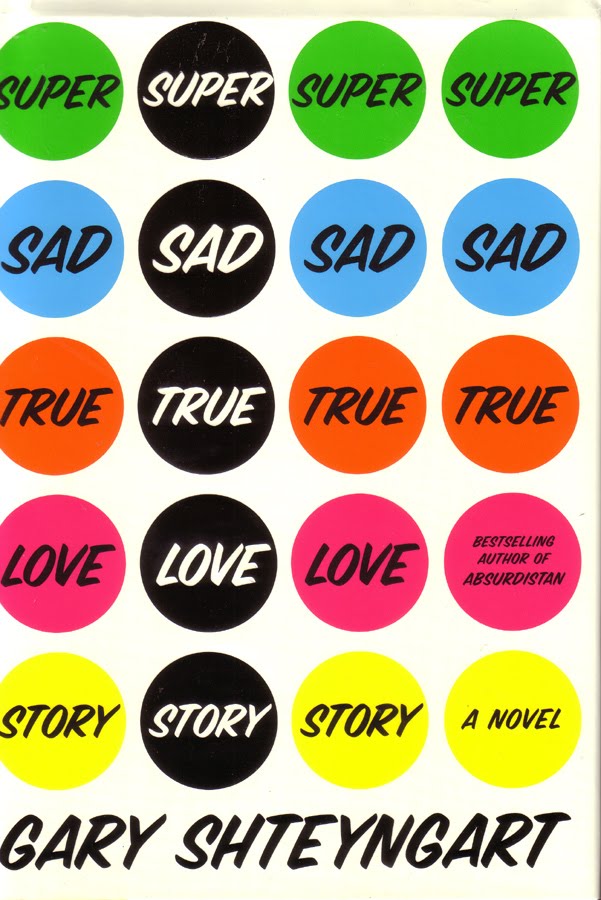
I Super Hated Gary Shteyngart’s Super Sad True Love Story

At a certain point, I was inclined to write a thoughtful review of Gary Shteyngart’s much-lauded, truly awful novel Super Sad True Love Story, the kind of review that might try to weigh Shteyngart’s choked May-December romance against its dystopian background. That was a few chapters in, a point at which I’d gotten past the realization that Shteyngart was going to do nothing new with the dystopian genre I so love, yet still early enough for me to think that he might have something to say about American culture and politics in the early 21st century. There’s nothing there, though — Super Sad True Love Story subscribes to the normal dystopian program of synthesizing 1984 and Brave New World through a contemporary lens, yet what we’re left with is Shteyngart’s observation that people might not like to read as much as they used to.
Obligatory plot summary: it’s America a few decades down the line–not enough to account for the change that Shteyngart proposes–an America under Bipartisan rule, a country without an elected President, at war with Venezuela, heavily indebted to China, and essentially ruled by a corporatocracy. People no longer read, they only scan data from their ever-present “äppäräti,” screen media devices they are addicted to through which they shamelessly broadcast every last piece of personal data. Sound familiar? Sure. (Those damn kids with their Facebooks!)

Shteyngart’s hero is Lenny Abramov, son of immigrant Russian Jews. Lenny works for Post-Human Services, a company that aims to extend human life indefinitely– as long as you’re very, very rich. This is Lenny’s obsession. For some reason, never fully explained (although painfully and boringly explored) Lenny wants to live forever. I suppose Shteyngart is trying to parody America’s obsession with youthfulness, only the parody is not funny and never insightful. Lenny meets a Korean-American girl named Eunice Park while spending some Bohemian time in Italy. Eunice is twenty years his junior, yet Lenny falls madly for her right away, for no good reason, at least not for any reason that we, the readers, are given to understand. It’s real old-white-boy-meets-young-Asian-girl-territory, which Shteyngart seems to understand yet seems too embarrassed (rightfully) to properly remark upon.

The backdrop of this romance is an American dystopia that Shteyngart wishes was as affecting as Alfonso Cuaron’s Children of Men. Hey, you know what? Watch Children of Men again instead of reading Shteyngart’s super boring book. And I think I won’t waste anymore time detailing Shteyngart’s super boring plot, a plot that seems to have no idea where its going, yet is, at all turns, overwhelmingly self-satisfied (and derivative). Shteyngart wants to write an end-of-America epic, yet nothing he says is worth re-remarking upon — yes, it seems like people are increasingly facile; yes, young people seem increasingly willing to forsake traditional ideas of privacy; yes, we owe the Chinese government some money. Sam Lipsyte does it all way better in The Ask, a book that doesn’t have to borrow its plot from every dystopian that came before it.

That Shteyngart has written a poor dystopian novel offends me at a literary-type level, but I’m also offended by his myopic regionalism, which, as I just mentioned, he tries to pass off as Americanism. For Shteyngart, New York City is America, and the (relatively) newly immigrated populations he places in his fictionalized NYC are far-more American than anyone else, particularly the dumb-ass-hick-redneck-Southerners he throws into the city as transplanted bad guys. Shteyngart’s Southern grotesques are mere props, barely thought out stereotypes that offend me as both a reader and a Southerner — and yet, they are just as facile as his leads.

Speaking of offensive and facile, there’s a moment at the end of the book when a critic takes the time to reflect on the publication of Lenny’s diaries and Eunice’s emails (not called “emails,” but Jesus Christ I’m not going to waste more time explaining the book’s silly recoding of contemporary culture) — it’s surreal in its tackiness, an overt act of literary criticism upon the rest of the book, one which attempts to focus a specific viewpoint upon the narrative proper. Like the rest of the book it fails miserably, and yet is indicative of Shteyngart’s needy, whiny program.

But why end negatively? There are plenty of great dystopian novels out there — Margaret Atwood’s Oryx and Crake and The Year of the Flood, almost anything by William Burroughs, Disch’s Camp Concentration, Aldous Huxley’s sorely under-read Ape and Essence, Cormac McCarthy’s Blood Meridian, which understands that it’s always the end of the world, more or less all of Philip K. Dick, Riddley Walker, Cloud Atlas, shit, even Roberto Bolaño. Just don’t waste your time with Shteyngart’s super sorry book.

The Instructions — Adam Levin

Adam Levin’s début novel The Instructions is long. It’s very long. It’s too long.

Or, more to the point, it’s too long to be so mediocre.

This is not a fair criticism, especially considering that I have only read about 35.5% of the book. 8 chapters. 366 pages. I have no conclusive evidence that the next 664 pages won’t be the kind of mind-blowing read that can justify taking up over a thousand pages. Significantly though, there’s nothing in the first 366 pages that especially compels me to continue reading. I give up. I abandon it. Although reading is hardly a quantitative experience — reading and digesting a page of Melville requires more sustained concentration and energy than a page of, say, Bukowski — it stands to reason that I can read two or three novels in the time it would take finish The Instructions. And if I spend my (limited, I am a human and am going to die at some point) reading time reading three novels instead of finishing Levin’s book, it’s likely that at least one of them might be good, even great, while I’m pretty sure that The Instructions is going to continue its middling trajectory.

So what’s it about? It must have had an interesting premise for me to read 366 pages, right?

Gurion ben-Judah Maccabee is a 10 year-old seventh grader (he’s been promoted, sort of) who is forced to attend a special program called “The Cage” after being expelled from his first three schools for various violent acts. Gurion is a hyper-intelligent, budding rabbinical scholar with serious Torah-interpreting skills. He’s also pretty much the toughest kid at Aptakisic Junior High, where, despite being only ten, he kicks ass left and right (his mom is a former Israeli commando). The novel takes place over four days in 2006, as Gurion declares his love for June Watermark, meets a new friend, and begins to rally the behavioral disorder kids against The Cage’s totalitarianism.

The opening scene of the novel is an engaging piece — Gurion and two friends take turns simulating water boarding on each other during a gym class held in a pool. Then, in the locker room, a fight. Gurion loves to fight, despite his inkling — or, at least the inkling of others — that he may be the potential messiah. This obsession with Jewish (“Israelite,” Gurion would correct me) identity seems to be the main thrust of the novel. Gurion, who is the “author” of the novel (which he refers to as “scripture”) speaks authoritatively and eruditely about Torah and religious philosophy. In fact, he speaks like a fully matured scholar who has taught and studied religious philosophy for decades. One can allow this conceit of the novel: sure, Gurion is special, he can fight, he’s a genius, sure, that’s what drives the plot–but Levin wants to extend this genius, or at least rhetorical flair, to almost every other character.

The effect is by turns grating and numbing, as we are subjected to page after page of dialog that is meant to sound witty or empathetic or just plain flavorful but is more often silly or inauthentic or, at worst, too fucking precious for words. The cartoonish dialog, rife with fake slang that no middle school kids ever used, wouldn’t be so bad on its own; in fact, it seems to go hand in hand with Levin’s goal, which appears to be slapstick of some kind. Only he (or Gurion) repeatedly calls attention to the slapstick, commenting on it, even pointing out how the reader should appreciate it.

This meta-textual attention is at work at all times. In particular, it’s there in the long (oh my god are they long) descriptions of each and every action that takes place in the prose. Gurion feels the need to analyze every last little detail, to load it with preternatural significance; these lengthy passages scream for an editor. The arrangement of the text is of course meta-textual as well: it purports to be a work of Gurion’s authorship, and includes a variety of texts from his “personal file” including emails, detention records, essay assignments, and, in one glaring case of squandered potential, a psychological report. And yet in all these documents, there does not seem to be any perspective outside of Gurion’s; when Gurion’s therapist comments on his behavior we learn nothing new, nothing different — we only see a confirmation of Gurion’s highly perceptive intelligence. It is grand solipsism on the largest of scales.

Which brings me to the David Foster Wallace comparisons, which are probably what got me interested in The Instructions in the first place. Granted, The Instructions may have facile similarities to Infinite Jest, but the books differ tremendously in how the reader must engage them. IJ is pluralistic and heteroglossic; The Instructions is essentially a monologue. IJ invites the reader to play, to pursue mystery; The Instructions, despite its volume, seems to contain just one mind. And maybe that’s the problem. Reviewers have compared Gurion to Hal Incandenza — and it’s true, both are bright, troubled young men — but The Instructions seems to be lacking a Don Gately.

Looking over my comments, they seem harsher than I perhaps intended. I believe that Levin has great talent and is surely a keen intellect with stories worth sharing. More to the point, I think that there might be a good novel somewhere inside of The Instructions — only I’m pretty sure it’s much, much shorter.

The Instructions is new in hardback from McSweeney’s.

Two Tales of the Tudors: The Tudor Secret by C.W. Gortner and Death and the Virgin Queen by Chris Skidmore

It’s been nearly half a millennium since a Tudor held the British throne, yet narratives of Tudor exploits seem to proliferate at an exponential rate. The primary reason may be that these monarchs — Henry VIII and Elizabeth I in particular — were such strong characters, people whose fascinating qualities extended beyond their world-changing edicts. And it’s not just the monarchs, of course, who draw our attention, but the characters around them — the Boelyns and the Cromwells, Thomas More and William Shakespeare (the latter was tangential and late, to be sure, but hardly an insignificant figure of the Elizabethan era). We identify in the Tudors a certain sexiness (one milked shamelessly by Showtime’s silly series), as well as its corollary intrigue: personal scandal for these royals was politicized; what happened in the bedroom affected the public sphere. There is something strikingly modern about this fact, which perhaps also makes us turn our attention to the Tudors again and again.
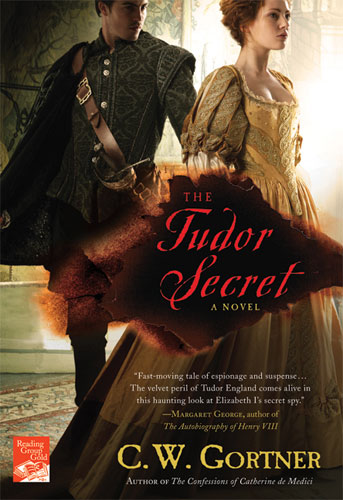
C.W. Gortner delves into the conflict between the political and the private in his historical novel The Tudor Secret. He plants his fictional hero Brendan Prescott into Dudley Castle, where the young man grows up bullied by Lord Robert Dudley –who will later become an “intimate familiar” of Queen Elizabeth. In the summer of 1553, however, Elizabeth is still Princess; her brother Edward VI is king. Around the same time Brendan is brought to court to squire for Robert Dudley, Edward falls gravely ill and then disappears. Princess Elizabeth soon enlists Brendan’s aid as a spy, a situation that quickly becomes more complicated when he finds himself having to serve as a double agent for William Cecil, Elizabeth’s adviser, an employee of the Duke of Northumberland who meanwhile plots to raise Jane Grey to the throne (a move that would cut Elizabeth out of succession). The Tudor Secret is a tightly-plotted, quick-paced read, stuffed with animated historical characters buzzing around in a world of espionage and intrigue. Setting the stage for the ascendancy of a crafty Elizabeth I, the book is the first in a planned series called the Elizabethan Spymaster Chronicles.

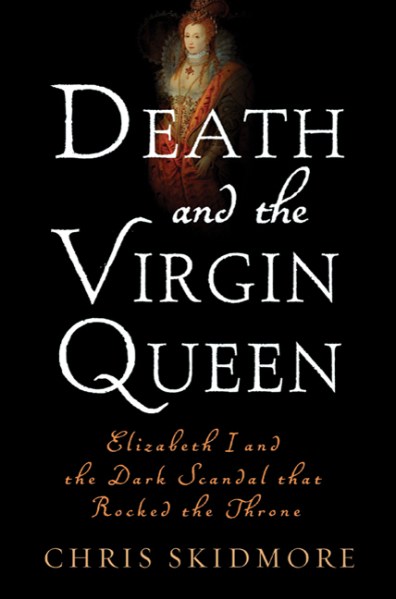
Chris Skidmore’s Death and the Virgin Queen will also be of great interest to those fascinated by the darker side of the Tudors. Skidmore’s book is essentially a forensic analysis of the events of September 8, 1560, when the body of Amy Robsart was found dead in Cumnor Place, her neck broken after an apparent fall down the stairs. The problem: Rosbart was the wife of one Lord Robert Dudley (hey, remember him from before?); with Rosbart out of the way, Elizabeth might be free to marry the man she was scandalously close to. Even after the death was ruled an accident, a cloud of suspicion and rumor about the issue hung over Elizabeth’s reign. Skidmore digs into the issue, outlining the motives of possible parties and detailing likely suspects. Skidmore also explores why, even with Rosbart out of the picture, Elizabeth’s advisers would never allow a marriage to Dudley — and how Dudley worked to prevent the queen from marrying another. Death and the Virgin Queen is a nice parallel to The Tudor Secret; both are written in a popular style for a general audience, both are clearly well-researched, and both should satisfy those thirsting for more details about the still-bewildering world of the Tudors.

Death and the Virgin Queen is new this month in hardback from St. Martin’s Press. The Tudor Secret is new in trade paperback February 1st from St. Martins’ Griffin.

New in Paperback: Ali Shaw Does Creepy Fables, Cathleen Schine Channels Jane Austen, and Joan Schenkar Plumbs Patricia Highsmith

The Girl with Glass Feet is the début novel from British author Ali Shaw. Set in the remote archipelago of St. Hauda’s Land and steeped in the traditions of English folklore, Shaw’s novel works in the idiom of magical realism. His titular girl Ida Maclaird suffers from a strange affliction: she’s slowly turning into glass. She returns to St. Hauda’s land in the winter (after a previous summer holiday there) in the hopes of finding a cure. There she meets Midas Crook (whose symbolically overdetermined name seems part and parcel of Shaw’s program), a photographer fascinated by his father’s ghost stories about the isolated archipelago who is trying to capture something of its haunted spirit in his pictures. Together (and with the help of some strange locals) the pair tries to find answers against a melancholy and magical backdrop of tiny winged cows, albino crows, and other grotesques. A sample ghost story, one of many in Glass Feet

His father had once told him a legend: lone travelers on overgrown paths would glimpse a humanoid glow that ghosted between trees or swam in a still lake. And something, some impulse from the guts, would make the traveler lurch off the path in pursuit, into the mazy trees or deep water. When they pinned it down it would take shape. Sometimes it would form a flower of phosphorescent petals. Sometimes it drew a bird of sparks whose tail feathers fizzled embers. Sometimes it became like a person and they’d think they saw, under a nimbus like a veil, the features of a loved one long lost. Always the light grew steadily brighter until–in a flash–they’d be blinded. Midas’s father hadn’t needed to elaborate on what happened to them after that. Lost and alone in the cold of the woods.

In The Three Weissmanns of Westport, Cathleen Schine transposes the Dashwoods of Jane Austen’s Sense and Sensibility to a dilapidated beach cottage in Westport, Connecticut. When 78 year old Joseph divorces his 75 year old wife Betty, and his mistress essentially forces her from their high-end NYC apartment, Betty rallies by moving to the beach cottage with her daughters, impulsive Miranda, a literary agent, and practical Annie, a library director. The premise may sound like the domain of that most maligned of genres, “chick lit,” a fact that many reviewers tackled when it debuted in hardback last year. Here’s Dominique Browning in The New York Times
Schine sets her novel squarely in the most appealing part of chick-lit territory — its light-hearted readability — and then thumbs her nose as she starts kicking up the dust. The strange thing about the Jane brigade is that most of its practitioners have raided only her plots, apparently not quite up to the task of honoring the essence of Austen. But Schine’s homage has it all: stinging social satire, mordant wit, delicate charm, lilting language and cosseting materialistic detail.

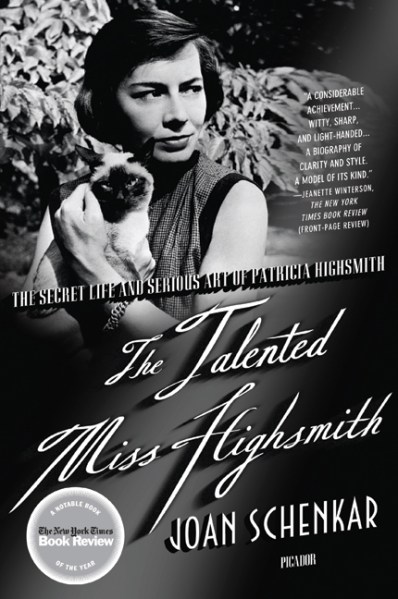
Before looking over Joan Schenkar’s exhaustive biography of Patricia Highsmith, The Talented Miss Highsmith: The Secret Life and Serious Art of Patricia Highsmith, I have to admit that I thought of the writer primarily as a practitioner of pulp fiction, the kind of lurid crime tales at home in airport bookshops. In recent years, I’ve come to reevaluate my stance on crime noir in particular (which I wrote about here), a genre whose conventions I find increasingly more apparent in the “literary fiction” that I enjoy. Anyway, Schenkar’s book places much stress on the Serious Art section of Highsmith’s biography. I knew Highsmith mainly from her Ripley novels, which I’ve never read, but gather to be smart and psychologically complex. I didn’t know that Highsmith wrote Strangers on a Train, adapted by Hitchcock into a noir classic. I didn’t know that she wrote comic books for years — the weird crime ones that stirred up so much commotion in the fifties. I didn’t know that she worked homoerotic themes into her novels, and wrote one very openly lesbian novel that was published during her lifetime (albeit under a pseudonym), The Price of Salt. Schenkar makes a case for a Highsmith as an underappreciated novelist, a contemporary of Mailer and Capote who never got her due (even if her novels were bestsellers), a writer in the tradition of Kafka and Freud. Rounding out the biography is a complex investigation of Highsmith’s strange relationship with her mother, a look at her long list of lovers, and plenty of charts, diagrams, and photos (Schenkar even sneaks a topless pic in, if that piques your interest).
All three titles are new in trade paperback from Picador.

The Novelist’s Lexicon

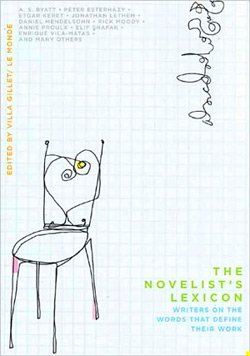
The Novelist’s Lexicon, new in hardback from Columbia University Press, is an auspicious and at times bewildering project originating from an international literary conference hosted by Le Monde a few years ago. Over seventy authors from more than a dozen countries were asked to write about a “key word that opens the door to his work.” A list of just a few of the authors here is probably more than enough to pique interest: Rick Moody, Helene Cixous, Colum McCann, Jonathan Lethem, Adam Thirlwell, A.S. Byatt, David Peace, Dennis Cooper, and Annie Proulx all contribute pieces, mostly short, somewhere between 100 and 500 words. By nature, The Novelist’s Lexicon is a fragmentary affair, discontinuous, open to multiplicity, and unified only by its authors’ sense of craft, as well as an abiding intelligence.
Some authors take the project in earnest, like Lethem, whose piece “Furniture,” (which we excerpted late last year) pinpoints a fundamental yet largely unremarked upon element of novel-writing. French author Nicholas Fargues taps into etymology, offering a bit of advice in his piece “Novice”–

Don’t ‘make’ literature. Don’t write because that’s what people expect of you now that you’re a ‘writer.’ Don’t write for the beauty of the gesture or the love of art. Beware of fine phrases and well-turned maxims; that’s not your thing. Watch out for words that strike a pose. But do let your memory and your instincts flow; let the aptest words, the words that resemble you most closely, come of their own accord.

Anne Weber’s piece “Waiting/Attention” suggests that a key word — or any key, really — is an impossible dream–

It would be a word that encapsulated my aspirations and expectations, my sadness and my joy, my amazement at the quince’s hairy skin, the wash of the sky, and the delicate pattern of the cyclamen’s leaves. And since everything would be contained in this single, essential word, since it would express everything, I wouldn’t need to write anymore. And good riddance, too!

Swedish author Jonas Hassen Khemiri, who goes with “Un-” also points to language’s simultaneous limitations and possibilities–

Un- as in never being satisfied with the language we have. Un- as in the realization of how difficult it is to communicate with people in a language you have invented yourself. Un- as in doubting whether you will ever succeed. Un- as in continuing to try even so. Un- as in suddenly launching yourself over a coffee table and transforming a dictionary into confetti.

Khemiri’s frustration with language (and paradoxical love) is thematic throughout Lexicon; we see it, for instance in David Peace’s “Plague.” Peace comes off like the crotchety old man in the group–

To be honest or stupid or both, but not churlish or contrary (I hope), I am uncertain I understand the premise of this lexicon. However, I am against the presumption of all premises and, equally, I am against all definitions and dictionaries, lexicons and lists, which, in their commodification and exclusivity, are the preserve and the territory of fascists and shoppers.

After this radical caveat, including the claim that he is under “duress” (did the folks at Le Monde put guns to these authors’ heads?), Peace goes on to discuss the word “plague,” tracing it through Western lit and showing how it evinces in his novel Occupied City (which we reviewed here, by the way).

Perhaps Peace should’ve just ignored the assignment, like Dennis Cooper, whose piece is “Signed D.C.” is simply a work of microfiction, imagining what would happen if Olive Oyl and Popeye who “peel like decals from the TV and live in the world.” The story is a clever, short five paragraphs, and ends with at least a trace of insight into Cooper’s writing process: “I am heavier than my constructions understand.” Maybe he didn’t ignore the assignment.

Cooper is not the only writer to let fiction reign — there are poems and meditations and strange riffs here, largely divorced of discussion from technique or craft. In any case, those interested in getting into the heads of some of the 21st century’s most prominent (and skillful) writers will wish to take notice of The Novelist’s Lexicon, a fun and repeatedly rewarding book. Recommended.

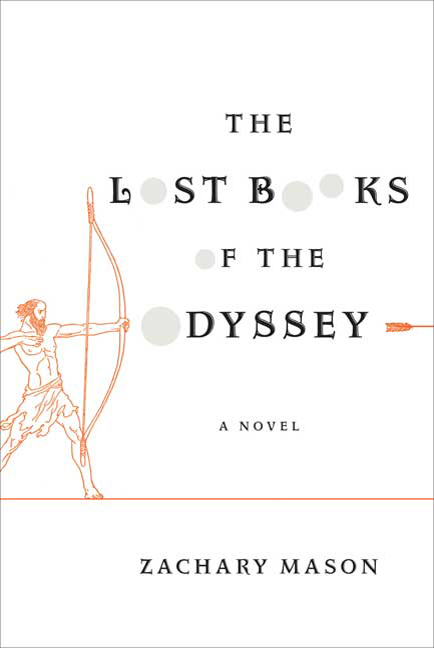
The Lost Books of the Odyssey — Zachary Mason

In his preface to The Lost Books of the Odyssey, author Zachary Mason tells us that before the story we now know as the Odyssey was organized by the poet Homer, the “material was formless, fluid, its elements shuffled into new narratives like cards in a deck.” Mason’s goal in The Lost Books is to echo these older versions of the story of Odysseus, omitting “stock epic formulae in favor of honing a single trope or image down to extreme clarity.” He succeeds admirably — Lost Books is an engaging and perplexing work that challenges our assumptions about one of the most foundational stories of Western literature. Mason’s “novel” (it is not really a novel, of course) strikes a wonderfully resonant and deeply upsetting chord, disrupting our sense of narrative satisfaction, breaking us away from the outcomes we thought we knew. I’ll share an example. Here’s chapter 14, “Fragment,” in its entirety–

A single fragment is all that survives of the forty-fifth book of the Odyssey:

Odysseus, finding that his reputation for trickery preceded, started inventing histories for himself and disseminating them wherever he went. This had the intended effect of clouding perception and distorting expectation, making it easier for him to work as he was wont, and the unexpected effect that one of his lies became, with minor variations, the Odyssey of Homer.

Lies with minor variations is a pretty good definition for storytelling. As the fragment above may skew a bit too academic for some readers, a bit too meta-textual, I’ll hasten to point out that Mason’s primary concern is storytelling. We get all the old characters: Penelope and Telemachus, Agamemnon and Achilles, Circe and Cassandra, and so on. Mason’s take is programmatic from the example above though — he works by “clouding perception and distorting expectation.” The opening chapter, “Sad Revelation,” begins with Odysseus returning home to find that Penelope is an old woman, and remarried at that. This revelation turns false, a “vengeful illusion, the deception of some malevolent god. The real Ithaca is elsewhere, somewhere on the sea-roads, hidden. Giddy, Odysseus turns and flees the tormenting shadows.” Hence, the real joy here is in movement and adventure. The journey is the telos, not Ithaca itself. Homecoming is always a deferral.

The opening chapter’s theme of an illusory home and wife repeats throughout the text, as Mason suggests again and again that notions of a stable, fixed identity will always prove untrue. Odysseus, through a clerical error, is ordered to carry out his own assassination. Later, he seems to swap souls with a Trojan enemy, living out another person’s life entirely. In another episode, we see that Odysseus never really escapes Hades, that he is simply always travelling through it, catching glimpses of another, older life.

While many of Mason’s pieces are short — one to three pages — there is a richness here that taps into the history of Western literature. What’s striking is how alienating it can all be: how dark, how cold, how scary. We are reminded that Odysseus can trace his lineage to lycanthropes, an odd call to Scandinavian myth, one reinforced later on a beach with three witches, a tale that echoes (or prefigures) the horror of Macbeth. Mason shows us (or, perhaps more accurately reminds us) that the Odyssey uncannily permeates more of our literature than we might readily recall.

The Lost Books of the Odyssey is post-modern through and through, fragmentary and elliptical, meta-textual and highly ironized. There’s of course a rich tradition of reinterpreting the Odyssey, from Tennyson’s poem to Joyce’s classic, from the Coen brothers’ film O Brother, Where Art Thou? to Margaret Atwood’s The Penelopiad, and Mason’s book will not disappoint those who are interested int the subject (although admittedly, some readers may find too much academic commentary in his work — not me though). In his brevity and frank humor, but most of all in the seemingly unclassifiableness of his work, Mason’s writing reminds me of Lydia Davis or Amy Hempel, but also Borges and Calvino. These are stories that might not be stories in a novel that might not be a novel. Highly recommended.

The Lost Books of the Odyssey is new in trade paperback from Picador.

Oh Pure and Radiant Heart — Lydia Millet

The nice people at Iambik Audiobooks were kind enough to give me a few books from their catalog recently, one of which is Lydia Millet’s Oh Pure and Radiant Heart, which I will review momentarily, but first I’m compelled to comment on Iambik itself. The company is a true indie, run by people who care very much about literature; they release audiobooks on mp3 from independent publishers in the U.S. and Canada. Their prices are more than reasonable — around five bucks a book, cheaper than iTunes or Audible. And, unlike many audiobook vendors, there’s no weird third-party software you have to download, no DRM, no password protected files. Just nice, high quality mp3s, tagged and ready to go. I was able to download the books in a few minutes, put them on my iPod, and begin listening. Good stuff.

The premise of Oh Pure and Radiant Heart is this: three of the lead scientists of the Manhattan Project, Robert Oppenheimer, Leo Szilard, and Enrico Fermi — those nice men who brought us the atom bomb — are somehow transported from 1945 (during the Trinity test) to the early 2000s, during the first term of George W. Bush. Their arrival coincides with a strange dream (or mystical vision) on the part of the book’s protagonist, a quiet, thoughtful librarian named Ann, who lives with her husband Ben, a gardener, in Santa Fe, New Mexico. After a violent tragedy at Ann’s library, circumstance brings her together with the three scientists, whom she recognizes. Ann quickly comes to believe in the scientists in an almost spiritual sense. They give her life the meaning it has thus far lacked. Ben is far more skeptical, and one of the novel’s strengths, particularly in its first half, is watching the strain on the young couple’s marriage as Ann increasingly finds her identity wrapped up in the scientists’ mission. Even more problematic is her platonic relationship with Oppenheimer, who becomes both a father-figure to her as well as the object of her motherly protection. Ann, Ben, and Oppenheimer form the novel’s intellectual and philosophical core; Millet grants us repeated access into their first-person thoughts and feelings, which comprise many of the book’s most interesting obsessions — Ann mulls over the tension between the concrete world and the hopes of a metaphysical reality; Ben ponders how one might come to possess (or perhaps earn) a soul; Oppenheimer, through a somewhat guilty lens, observes a materialistic and intellectually degraded 21st century.

It’s this degradation that the scientists seek to redress, perhaps in part to atone for their own complicity in creating the future (or rather, this future). First, however, there’s a trip to Japan to see what their bombs did firsthand. In Tokyo the scientists are doubly alienated, not only by Japanese culture, but also by the intensity and futurity of hyperkinetic Tokyo. It’s here that they meet Larry, a 40-something surfer-bum/stoner/rich kid/lazy plot device, whose father has “more money than God.” It’s this money that funds the scientists throughout the rest of the novel. Larry comes to believe in them almost immediately, and becomes their chief financier (and manager of sorts) as they move on to the next episode, an overlong final-third back in America.

Despite Ben’s protests, the scientists, led by pushy, media-savvy Szilard, set out on a rambling tour of America, leading a campaign for world peace via nuclear disarmament. The conflict heightens between Szilard and Ben, natural foils, as Oppenheimer becomes increasingly abstracted from the physical world, and Fermi enters a mystical depression. As the scientists tour about on luxury RVs, meeting with media organizations and staging rallies, they begin to attract a strange cavalcade of hippies and dropouts, runaways and weirdos –and, significantly, a burgeoning group of End Times obsessed evangelical Christians. Szilard initially thinks he can control the swelling circus, but leadership soon falls into disarray. Complicating the matter are the private security forces the different contingents utilize. The irony that the peace movement is littered with men bearing guns is not lost on Oppenheimer. In the meantime, Ann feels increasingly marginalized and Ben continues to see their marriage dissolve (Ann seems abstractedly unaware). Ben does, however, make a meaningful and somewhat paternal relationship with sensitive Fermi, taking the man on hiking trips and otherwise shielding him from the craziness that Szilard openly embraces.

This final section of the novel is easily its weakest–Millet’s strength in the early parts of the book comes in her handling of the interior spaces of Oppenheimer, Ben, and Ann, as well as the mystical absurdity of the scientists’ transportation to the future. These concerns get muddied by too many characters and too many plots as the book reaches its climax; what should be a build to a thrilling end is instead something of a slog. Nevertheless, Millet (thankfully) pulls off that end in a dazzling, disturbing rally in Washington D.C. complete with riots and spiritual revelations of a sort.

While Millet’s conclusion is not my metaphysical cup of tea, it is an appropriate and organic resolution for the novel. Far more interesting, to me anyway, is Millet’s keen research about the development of the atom bomb and the (continued) proliferation of nuclear weapons. The novel is larded with frank, concise facts about America’s military-industrial complex that, when set against the narrative proper, create a highly ironic and coldly searing satire. The closest point of comparison I can think of here is J.G. Ballard, whose 1994 novel Rushing to Paradise Oh Pure and Radiant Heart often echoes. And while Millet’s satire is often funny, it’s the kind of funny that is cold and black when honestly reflected on — which her thoughtful characters often do. Ultimately, Oh Pure and Radiant Heart is a deeply sad comedy, especially if we identify strongly with Ben and Ann, who in a wistful coda, continue to search for meaningful lives against the existential backdrop of a word that is, to use the novel’s language, “post-history.”