“At the Entering of the New Year” — Thomas Hardy

“At the Entering of the New Year” by Thomas Hardy–

I
(OLD STYLE)

Our songs went up and out the chimney,
And roused the home-gone husbandmen;
Our allemands, our heys, poussettings,
Our hands-across and back again,
Sent rhythmic throbbings through the casements
On to the white highway,
Where nighted farers paused and muttered,
“Keep it up well, do they!”

The contrabasso’s measured booming
Sped at each bar to the parish bounds,
To shepherds at their midnight lambings,
To stealthy poachers on their rounds;
And everybody caught full duly
The notes of our delight,
As Time unrobed the Youth of Promise
Hailed by our sanguine sight.

II
(NEW STYLE)

We stand in the dusk of a pine-tree limb,
As if to give ear to the muffled peal,
Brought or withheld at the breeze’s whim;
But our truest heed is to words that steal
From the mantled ghost that looms in the gray,
And seems, so far as our sense can see,
To feature bereaved Humanity,
As it sighs to the imminent year its say:—

“O stay without, O stay without,
Calm comely Youth, untasked, untired;
Though stars irradiate thee about
Thy entrance here is undesired.
Open the gate not, mystic one;
Must we avow what we would close confine?
With thee, good friend, we would have converse none,
Albeit the fault may not be thine.”

December 31. During the War


“A Song for New Year’s Eve” — William Cullen Bryant

“A Song for New Year’s Eve” by William Cullen Bryant–

Stay yet, my friends, a moment stay—
Stay till the good old year,
So long companion of our way,
Shakes hands, and leaves us here.
Oh stay, oh stay,
One little hour, and then away.

The year, whose hopes were high and strong,
Has now no hopes to wake;
Yet one hour more of jest and song
For his familiar sake.
Oh stay, oh stay,
One mirthful hour, and then away.

The kindly year, his liberal hands
Have lavished all his store.
And shall we turn from where he stands,
Because he gives no more?
Oh stay, oh stay,
One grateful hour, and then away.

Days brightly came and calmly went,
While yet he was our guest;
How cheerfully the week was spent!
How sweet the seventh day’s rest!
Oh stay, oh stay,
One golden hour, and then away.

Dear friends were with us, some who sleep
Beneath the coffin-lid:
What pleasant memories we keep
Of all they said and did!
Oh stay, oh stay,
One tender hour, and then away.

Even while we sing, he smiles his last,
And leaves our sphere behind.
The good old year is with the past;
Oh be the new as kind!
Oh stay, oh stay,
One parting strain, and then away

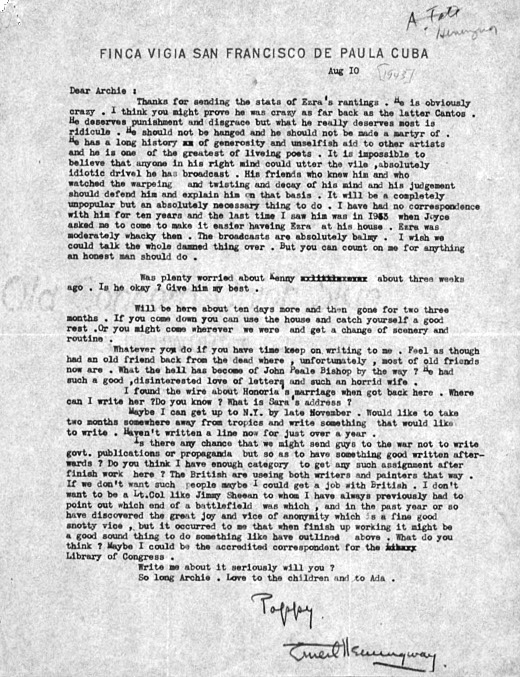
Ernest Hemingway Writes Archibald MacLeish About Ezra Pound’s Craziness

Ernest Hemingway writes Archibald MacLeish about Ezra Pound. Here’s the letter, via the excellent folks at Letters of Note, also responsible for the bit of transcription we’ve excised below–

Thanks for sending the stats of Ezra’s rantings. He is obviously crazy. I think you might prove he was crazy as far back as the latter Cantos. He deserves punishment and disgrace but what he really deserves most is ridicule. He should not be hanged and he should not be made a martyr of. He has a long history of generosity and unselfish aid to other artists and he is one of the greatest living poets. It is impossible to believe that anyone in his right mind could utter the vile, absolutely idiotic drivel he has broadcast. His friends who knew him and who watched the warpeing and twisting and decay of his mind and his judgement should defend him and explain him on that basis. It will be a completely unpopular but an absolutely necessary thing to do. I have had no correspondence with him for ten years and the last time I saw him was in 1933 when Joyce asked me to come to make it easier haveing Ezra at his house. Ezra was moderately whacky then. The broadcasts are absolutely balmy. I wish we could talk the whole damned thing over. But you can count on me for anything an honest man should do.

Gordon Lish on Beckett’s Boils and Other Matters of Literary Import

Hey. Do yourself a favor and listen to Iambik’s first podcast, a raucous, rambling conversation with legendary editor/short story author Gordon Lish. I finally got around to listening to the discussion between Lish and his publisher John Oakes. (Why the delay? I’ve been listening to and very much enjoying another Iambik recording, an audiobook of Lydia Millet’s Oh Pure and Radiant Heart, and I needed to get to a decent stopping place before the Lish (review of the Millet forthcoming)) . I had already listened to Lish reading a selection of his own stories which was nine kinds of awesome (thanks again to the good folks at Iambik, whose hooking me up with the sweet mp3age has in no way affected my fondness for their operation (review of the Lish selections forthcoming)).

Hearing Lish in this conversational, easy manner is revelatory. Wise and funny, erudite and crafty, you’ll learn something and be entertained:

Iambikcast #1a (mp3)
Iambikcast #1b (mp3)

What does he talk about? I’ll crib from Iambikist Miette’s write-up, which hardly sums it up but does a nice job of surveying the discussion–

In the first part of the conversation, Lish covers Beckett’s boils and other afflictions of our literary heroes, remembrances of Neal Cassady, and the writer as witch doctor.

The second part focuses on Lish’s (as always, uncensored) assertions on the state of contemporary American letters, in which we’re imparted with opinions on Allen Ginsberg and Philip Roth, achieving religious experience through DeLillo, the finer points of book blurbing, and encouraging the further crimes of Tao Lin.

Jon Lovitz’s Writing Tips

Jon Lovitz does AV Club’s Random Rules today. Here, he gives some pretty good writing advice. Context: he’s describing coming back as the host of the show in 1997, and going to the writer’s meeting on Monday. The “They” is the SNL writers–

They’d say, “We have an idea for a sketch. You’re a teacher, and the student brings you an apple.” I go, “Right.” “And then another comes in and another brings you an apple, and then another brings you an apple.” I go, “Then what happens?” They go, “No, that’s the sketch. They’re just all bringing you apples.” I said, “That’s not a sketch. That’s just a premise.” They didn’t know what I was talking about. I said, “A sketch is supposed to have a beginning, middle, and end. It’s like a movie. It’s supposed to have a story. You have a who, what, where—the beginning, and the conflict, and it builds and builds. That’s how you do improv. You’re filling in all those spots to make the scene work. It builds to a climax. Then there’s a resolution, which is the ending. It takes hours to write the ending. It’s hard to come up with them.” They just looked at me blankly.

I think the writers thought I was a jerk, because I was like, “Then what happens?” to all of it. They’d go, “That’s it.” Maybe they didn’t like that. They wrote a first draft, and, “Who are you to touch our brilliant first draft?” Writing is rewriting.


“Declaration on the Notion of ‘The Future'” — The International Necronautical Society

At The Believer, you can read the entirety of “Declaration on the Notion of ‘The Future’by The International Necronautical Society (aka Simon Critchley and Tom McCarthy (although we’re pretty sure that the essay’s authorization code TMcC010910 indicates that McCarthy is its author)). Playful and provocative stuff. A sample–

5. The INS rejects the Enlightenment’s version of time: of time as progress, a line growing stronger and clearer as it runs from past to future. This version is tied into a narrative of transcendence: in the Hegelian system, of Aufhebung, in which thought and matter ascend to the realm of spirit as the projects of philosophy and art perfect themselves. Against this totalizing (we would say, totalitarian) idealist vision, we pit counter-Hegelians like Georges Bataille, who inverts this upward movement, miring spirit in the trough of base materialism. Or Joyce’s Stephen Dedalus, who, hearing the moronic poet Russel claim that “art has to reveal to us ideas, formless spiritual essences,” pictures Platonists crawling through Blake’s buttocks to eternity, and silently retorts: “Hold to the now, the here, through which all future plunges to the past.”

6. To phrase it in more directly political terms: the INS rejects the idea of the future, which is always the ultimate trump card of dominant socioeconomic narratives of progress. As our Chief Philosopher Simon Critchley has recently argued, the neoliberal versions of capitalism and democracy present themselves as an inevitability, a destiny to whom the future belongs. We resist this ideology of the future, in the name of the sheer radical potentiality of the past, and of the way the past can shape the creative impulses and imaginative landscape of the present. The future of thinking is its past, a thinking which turns its back on the future.


“The Old Year” — John Clare

John Clare’s poem “The Old Year”—

The Old Year’s gone away
To nothingness and night:
We cannot find him all the day
Nor hear him in the night:
He left no footstep, mark or place
In either shade or sun:
The last year he’d a neighbour’s face,
In this he’s known by none.

All nothing everywhere:
Mists we on mornings see
Have more of substance when they’re here
And more of form than he.
He was a friend by every fire,
In every cot and hall–
A guest to every heart’s desire,
And now he’s nought at all.

Old papers thrown away,
Old garments cast aside,
The talk of yesterday,
Are things identified;
But time once torn away
No voices can recall:
The eve of New Year’s Day
Left the Old Year lost to all.

“There Must Be Some Level of Indignation” — William Gaddis

A Scene from Infinite Jest in the Xtranormal Style

Mario can’t sleep. Hal tells a joke. Not sure how I feel about this.


Kate Beaton Spoofs Charlotte Perkins Gilman’s “The Yellow Wallpaper”

At Hark, A Vagrant!, Kate Beaton spoofs Charlotte Perkins Gilman’s seminal feminist/horror short story “The Yellow Wallpaper”–


“Getting Closer” — Steven Millhauser

The New Yorker publishes Steven Millhauser’s “Getting Closer.” First paragraph–

He’s nine going on ten, skinny-tall, shoulder blades pushing out like things inside a paper bag, new blue bathing suit too tight here, too loose there, but what’s all that got to do with anything? What’s important is that he’s here, standing by the picnic table, the sun shining on the river, the smell of pine needles and river water sharp in the air, somewhere a shout, laughter, music from a radio. His father’s cleaning ashes out of the grill, his mother and sister are laying down blankets on the sunny grass not far from the table, Grandma’s carrying one of the aluminum folding chairs toward the high pine near the edge of the drop to the river, and he’s doing what he likes to do best, what he’s really good at: standing around doing nothing. Everyone’s forgotten about him for a few seconds, the way it happens sometimes. You try not to remind anybody you’re there. He loves this place. On the table’s the fat thermos jug with the white spout near the bottom. After his swim he’ll push the button on the spout and fill up a paper cup with pink lemonade. It’s a good sound: fsshhpsshh. In the picnic basket he can see two packages of hot dogs, jars of relish and mustard, some bun ends showing, a box of Oreo cookies, a bag of marshmallows which are marshmellows so why the “a,” paper plates sticking up sideways, a brown folded-over paper bag of maybe cherries. All week long he’s looked forward to this day. Nothing’s better than setting off on an all-day outing, in summer, to the park by the river—the familiar houses and vacant lots no longer sitting there with nothing to do but drifting toward you through the car window, the heat of the sun-warmed seat burning you through your jeans, the bottoms of your feet already feeling the pebbly ground pushing up on them as you walk from the parking lot to the picnic grounds above the riverbank. But now he’s here, right here, his jeans tossed in the back seat of the car and his T-shirt stuffed into his mother’s straw bag, the sun on one edge of the table and the piney shade covering the rest of it, Grandma already setting up the chair. And so the day’s about to get going at last, the day he’s been looking forward to in the hot nights while watching bars of light slide across his wall from passing cars, he’s here, he’s arrived, he’s ready to begin.

A Kidnapping in Milan: The CIA on Trial — Steve Hendricks

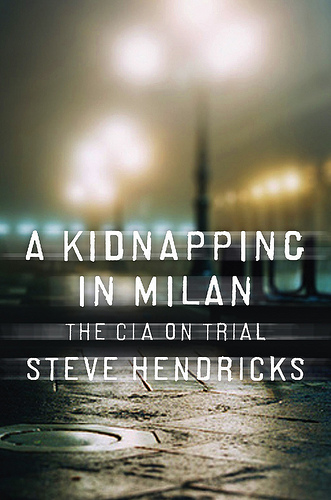
Steven Hendricks’s A Kidnapping in Milan: The CIA on Trial details the story of radical imam Abu Omar. Omar, an Egyptian radical who sought political asylum in Italy, was the focus of an investigation by the Milan police force, who, via wiretaps and other forms of surveillance, were building a case against Omar for recruiting a network of Islamist terrorists. In early 2003, the Milanese case fell apart when Omar was disappeared in what turned out to be one of the most conclusively documented cases of the CIA’s “extraordinary renditions.” Omar was kidnapped, relocated to Germany, and then returned to Egypt, where he was tortured and held by Egypt’s SSI–under the watchful eyes of the CIA. Italian prosecutor Armando Spataro, erstwhile protagonist of Kidnapping, reconstructed the evidence of the CIA’s extraordinary (and extra-legal) rendition, leading to the prosecution of twenty-six CIA operatives for kidnapping; twenty-three were convicted.

Hendricks combines journalistic clarity with the structure of a detective novel in Kidnapping, giving his book the urgency of a modern thriller, all the more striking for its cold reality. The book is well-researched; Hendricks interviewed, among others, Spataro, Omar, and even some of the indicted CIA agents–but Kidnapping never reads as a dry recitation of facts or a ponderous series of analyses. Additionally, Hendricks fleshes out his story with a consideration of the CIA’s history in Italian politics, with an emphasis on why Milan is such a hotbed for clandestine activities. Guiding the narrative is a refined sense of moral outrage against the idea that dark deeds done in the dark make our world somehow safer. While there are some that will remain unmoved by his descriptions of Omar’s torture — the cleric is a “bad guy,” in the Bush admin’s parlance, after all — Hendricks builds a clear case that the “outsourcing of torture” is a vile practice, and one antithetical to the spirit of our Constitution. And, even if the Obama administration is unwilling to shed further light on such crimes, it is good to know that there are writers who will.

A Kidnapping in Milan is new in hardback from W.W. Norton.

Alexander Pushkin’s Death Mask

“The Junky’s Christmas” — William Burroughs

“A Christmas Card” by Etgar Keret

“A Christmas Card” by Etgar Keret, via the good people at Electric Literature

Hemorrhoid

This is the story of a man who suffered from a hemorrhoid. Not a lot of hemorrhoids. A single, solitary one. This hemorrhoid started out small and annoying, but very soon it became medium-sized and irritating, and in less than two months it became big and really painful. The man continued to live his life as usual: he worked long hours every day, took time off on weekends and fucked on the side whenever he had the chance. But this hemorrhoid, which was clinging to a vein, kept reminding him at every long meeting or painful BM that to live is to suffer, to live is to sweat, to live is an ache you can’t fucking forget . And so, before every important decision the man would listen to his hemorrhoid the way others listen to their conscience. And the hemorrhoid, like any hemorrhoid, would give the man some asshole advice. Advice on whom to fire, advice on aiming higher, advice to pick a fight and with whom he should conspire. And it worked. With every passing day, the man became more and more successful. The earnings of the company he headed kept growing, and so did the hemorrhoid. It reached a point where the hemorrhoid outgrew the man. And even then, it didn’t stop. Until eventually it was the hemorrhoid that was Chairman of the Board. And sometimes, when the hemorrhoid took its seat on the chair in the board room, it found the man underneath a little irritating.

This is the story of a hemorrhoid that suffered from a man. The hemorrhoid continued to live its life as usual: it worked long hours every day, took time off on weekends and fucked on the side whenever it had the chance. But this man, who was clinging to a vein, kept reminding him at every long meeting or painful BM that to live is to yearn, to live is to burn, to live is to fucking screw up and wait for fate to turn. And the hemorrhoid would listen to the man the way people listen to their stomach when it rumbles and asks for food – passively but acceptingly. And thanks to this man, the hemorrhoid tried to believe it could live and let live, it could learn to forgive. It could conquer its urge to look down on others. And even when it swore, it didn’t mention people’s mothers. And so, thanks to the irritating little man under him, everyone came to value the hemorrhoid: hemorrhoids, people, and of course, the company’s satisfied shareholders all around the world.

The Adventures of Tintin, Vol. 3 — Hergé

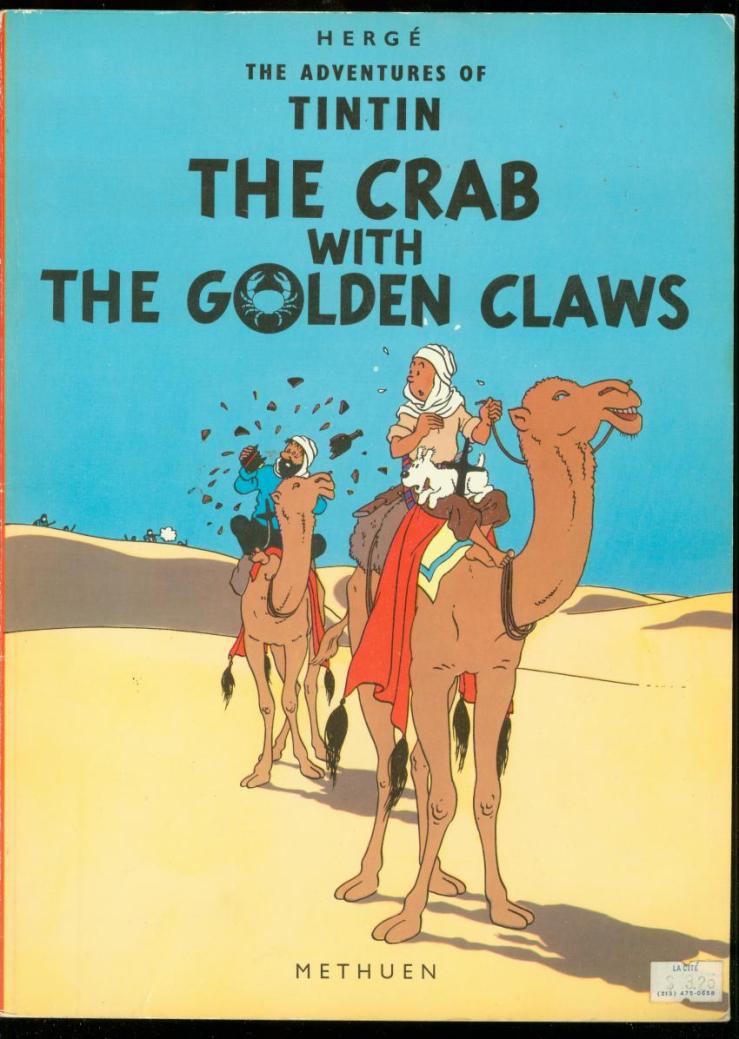
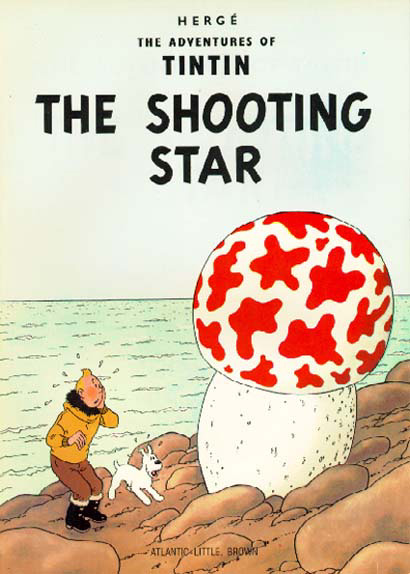
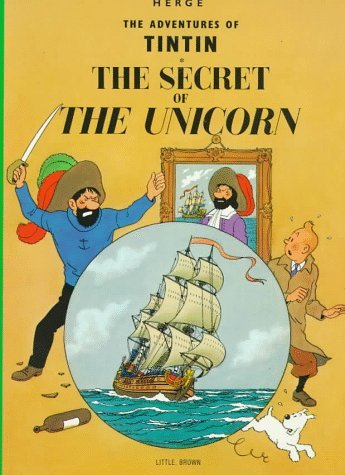
I’ve long been interested in Hergé’s Belgian comic series Tintin, which chronicles the adventures of Tintin, boy reporter, and his faithful dog Snowy. When a batch of hardback three-in-one editions showed up at my favorite used book store I picked up Vol. 3, which collects The Crab with the Golden Claws, The Shooting Star, and The Secret of the Unicorn. I read The Crab with the Golden Claws in one pleasant sitting that night and finished the other two adventures in similar fashion. Then I went back to the bookshop and picked up the other four three-in-one editions they had in stock.

It’s hard to divide the tales, which are all fun adventures in the high style of boy-adventuring, but I think Crab was my favorite of the three. It involves a drug smuggling ring and a trip to the Sahara desert. It also introduces Captain Haddock, an alcoholic lummox who tips into a verbose stream of insults whenever he’s in a rage (he merely stutters when in his cups). Haddock is Tintin’s unlikely (but totally likely) sidekick in the other tales in the volume, and he shows up in the other books I bought as well. The Shooting Star is a bit more sporadic in its plot–it begins with the end of the world (by asteroid!) and when that doesn’t pan out, moves into an ocean race to recover a meteorite. Unicorn also boasts a nautical theme; Tintin finds part of a treasure map in a model ship and fights against antique-collecting brothers to recover the booty (Keno Bros. beware). These adventure stories share more in common with Indiana Jones and Edgar Rice Burroughs than Marvel or DC comics; there’s a prevalent sense of danger, fun, and mystery that underscores the series.
Hergé’s clean, efficient style evokes beautiful and strange worlds. His economy of storytelling is simply brilliant; he knows how to connote his characters’ movements–including some sweaty action sequences–and he also knows how to move the plot forward without resorting to talking heads (although you will find the occasional expository-friendly radio broadcast pop up in a Tintin comic). It’s when Hergé drops a luscious market scene or a crowded basement-dungeon larded with antiquities that the art in Tintin shines. Hergé’s great talent is to evoke a startling sense of place for each setting in his comics, a fully-realized set that creates a sort of visual (and emotional) baseline for the reader. This allows for the cleaner, crisper panels to relay action without clutter. Hergé’s knack for storytelling cannot be underestimated either. He blends high adventure with slapstick and verbal comedy, much of it courtesy Tintin’s foils: the Thompsons, bungling detectives, precisely, who provide Tintin with many of his cases; Haddock; and Snowy, of course.
If you know a bit about Hergé’s Tintin series, you may know that its depiction of non-white and non-European characters has come under attack in recent years; Tintin in the Congo has been singled out in particular. I haven’t read Congo, but Crab’s representation of  Arabs (and Asians) is riddled with all kinds of wrong–at least when viewed from a PC postmodern post-colonialist post-whatever perspective. Hergé’s comics reveal at times a particularly suspect Western European ideology, one that privileges white male authority in the form of white male adventure. We can see the same colonialism and Orientalism at work decades later in the Indiana Jones movies (particularly Temple of Doom). This comparison is not meant to indict Indy (or Spielberg, rather) or excuse Tintin (and Hergé); instead, I’m merely pointing out that adventure tales that feature white heroes exploring–and dominating–the Other are hardly new; nor have they disappeared. The big mistake would be not to read Hergé’s work for fear of tripping over politically-correct mores. Banning a book is never a smart practice.

Far better is Charles Burns’s recent Tintin revisionism in X’ed Out: he moves his inverted hero Nitnit to a bizarro world version of the Saharan market, a place teeming with strangeness that is also largely indebted to William Burroughs’s Interzone. The inversion reverses Tintin’s a priori white male domination into an equally fantastic (but far more horrific) vision of confrontation with radical Otherness. Shit gets weird (as alien encounters should). Nitnit is not in control, not the master of this domain, which is plainly not his. Burns’s Tintin revision saliently calls attention to the ways that the best in art might be transformed and reinterpreted. It points toward the subconscious inheritance intrinsic to art.

But back to the book I am ostensibly reviewing. The Adventures of Tintin, Vol 3 seems to me as good a place as any to start with Tintin, and those interested should dig in. These three-in-one editions are smaller than the traditional oversized format, but you can compensate by holding the book closer to your face (ah, intimacy). Lovely stuff.

David Foster Wallace Describes Poststructuralism

Thumbed through my copy of A Supposedly Fun Thing I’ll Never Do Again yesterday and ended up re-reading David Foster Wallace’s essay “Greatly Exaggerated,” ostensibly a review of H.L. Hix’s book Morte d’Author: An Autopsy, considers the literary fall-out after Roland Barthes declared the “death of the author.” Anyway, I thought Wallace’s description of poststructuralism was worth sharing–

The deconstructionists (“deconstructionist” and “poststructuralist” mean the same thing, by the way: “poststructuralist” is what you call a deconstructionist who doesn’t want to be called a deconstructionist) . . . see the debate over the ownership of meaning as a skirmish in a larger war in Western philosophy over the idea that presence and unity are ontologically prior to expression. There’s been this longstanding deluded presumption, they think, that if there is an utterance then there must exist a unified, efficacious presence that causes and owns that utterance. The poststructuralists attack what they see as a post-Platonic prejudice in favor of presence over absence and speech over writing. We tend to trust speech over writing because of the immediacy of the speaker: he’s right there, and we can grab him by the lapels and look into his face and figure out just exactly what one single thing he means. But the reason why poststructuralists are in the literary theory business at all is that they see writing, not speech, as more faithful to the metaphysics of true expression. For Barthes, Derrida, and Foucault, writing is a better animal than speech because it is iterable; it is iterable because it is abstract; and it is abstract because it is a function not of presence but of absence: the reader’s absent when the writer’s writing, and the writer’s absent when the reader’s reading.

For a deconstructionist, then, a writer’s circumstances and intentions are indeed a part of the “context” of a text, but context imposes no real cinctures on the text’s meaning, because meaning in language requires a cultivation of absence rather than presence, involves not the imposition but the erasure of consciousness. This is so because these guys–Derrida following Heidegger and Barthes Mallarme and Foucault God knows who–see literary language as a not a tool but an environment. A writer does not wield language; he is subsumed in it. Language speaks us; writing writes; etc.